Threads from Henry's Web

Category: Christianity

  • Conviction with Teachability

    This is just a short note—I hope!—as I have an extremely heavy day and really shouldn’t be stopping to write.

    I’ve been thinking of different ways to state my goal both in my own writing and teaching and in publishing, and I played with “conviction and …”. What about “conviction without arrogance”? Perhaps “conviction with gentleness”? I think both of those say something of my goals.

    But I think “conviction with teachability” may come closest. In my post two days ago, My Own Custom Bible, I said that we need to try to overcome the various elements that make us customize our Bible, but we should also be aware that we won’t be fully successful. I resemble that remark! I’d like to say that “conviction with teachability” is a good description for me, but I know that I can get stubborn on things I should change. Like most of us at one time or another I’ve been “saming when I should have been a-changing” (apologies Nancy Sinatra).

    But the realization of our own weaknesses can also lead to a lack of conviction and to inaction, because we cannot make a firm decision as to what we should do. This is not a weakness of just one particular branch of Christianity (or society, for that matter). I think it’s hard to truly combine these two aspects fully.

    “Teachability” is often seen as lack of conviction. Firm convictions result in one being seen as unteachable. And that even beyond the failings we will doubtless have.

    If I might illustrate from a question on which many of my friends disagree—evolution—I’d point out that I’ve been involved in studying the topic since I was around 10 or 11 years old. I started as a young earth creationist and am now a theistic evolutionist (though I don’t like the term). I recall someone asking me to read a web page of moderate length which he felt would immediately convert me back to the young earth creationist position. When I instead pointed out that there was nothing in the article that was any different from the material I read before I was a teenager, he accused me of being arrogant and unteachable. You see, those arguments were so forceful to him, that he couldn’t see how I could be unconvinced.

    On the same topic, there are hundreds of articles that come out every year, and normally at least a dozen or so books on this subject, just considering the ones I wish I had time to read. So one has to present a good reason to take the time on a particular book or article. Quite frequently, simply the fact that we’re having a conversation and a participant would like me to try, will lead me to read a particular book.

    My point here is that being teachable means willingness to examine evidence, but at the same time, when one has spent many years studying a particular topic and coming to their current convictions on it, failure to turn on a dime doesn’t mean they are unteachable. (For you grammar cops out there, that’s an example of the singular ‘they,’ an acceptable form of English usage. Acceptable by whom? By me!)

    At the same time, I have to watch carefully to make sure that the fact that I have certain convictions doesn’t mean that I’ll never read something from other perspectives.

    I think you can see that combining conviction (at least strong enough to lead to action) and teachability is not always going to be easy. But it’s something I strive for.

  • My Own Custom Bible

    I have in my inbox an e-mail sent on behalf of the American Bible Society. The subject line reads: “Create your own Custom Bible from American Bible Society.”

    I suspect some folks are thinking I’m going to draw the obvious lesson that we shouldn’t have our own custom Bible. After all, the correct Sunday School answer, whenever it’s not Jesus, is “everything it says in the Bible.” Others are probably thinking that if I do so I’ll be horribly unfair, as indeed I would. What the American Bible Society (an organization I strongly support) is doing is offering the option for organizations to get Bible bindings for particular situations. This is simply an application of modern printing technology. In many churches you’ll find Bibles with dedication labels. Some evangelism efforts have Bibles with contact information added. Modern technology lets you build all of that into the printing. I don’t have a problem with such editions.

    But the line still intrigued me, not because I think it’s so wrong, but because I think that taken out of context, it describes what pretty much all of us do with the Bible. We have our own custom Bible. Not only am I not writing to criticize us for that; I’m actually going to suggest it’s impossible for us not to have our own custom Bible. Why? Because we are such very custom individuals. Often we don’t even realize what we are bring into the text.

    I remember once discussing the issue of oaths with a someone who believed that Matthew 5:33-37 meant that one could not swear to tell the “truth, the whole truth, and nothing but the truth” in court, whether or not one added “so help me God.” Now my issue is not with his view of that text. He could be right. Rather, the issue is with the basis of that interpretation. He stated to me that his view was that we should take a scripture passage to mean what an average American high school graduate would understand from it. Thus, “don’t swear” would, he told me, mean “don’t swear” to this average American high school graduate. I then pointed to Matthew 5:29-30, which says we should pluck out our eye or cut of our hand if it offends. He immediately told me that this meant that one should be prepared to give up everything, even our lives, through martyrdom. I, being the mean, obtuse, and twisted person I am, asked him immediately if that was how the average American high school graduate would read it.

    He had a tradition that suggested how he should read these various texts. His tradition customized his Bible. In fact, tradition commonly customizes our reading of the Bible, and we rarely can escape that completely. We can be so certain that a text means a certain thing, that we don’t even consider alternative readings. I’m often annoyed by the extent to which modern commentaries cite every which possible reading and understanding of a passage before coming to any conclusion. It results in commentaries of 500+ pages on five page books. But there’s a good reason why scholars are taught to look at other commentaries: It forces them to think about approaches to the text that are different from their own.

    Tradition isn’t the only way we filter the text. When I first saw the e-mail subject line I though immediately of our favorite verse, chapter, book, and so forth. I remember one class I was teaching. After a couple of weeks they would laugh whenever I used the words “one of my favorite,” simply because I had designated so many passages as “favorite.” But that doesn’t exempt me from having a custom Bible. I still have passages I read more than others. I tend to avoid some of the favorites. I know more about Hebrews than Galatians or Romans, for example. I know more about Leviticus than Isaiah or Jeremiah. This is because of my personality, which tends to avoid well-trodden paths.

    Should we try to make our Bibles less custom? I think it’s a good idea to do so, but only so long as we remember that we won’t get there completely. When we forget the things that influence our own interpretation we tend to get arrogant.

    Commercial note:

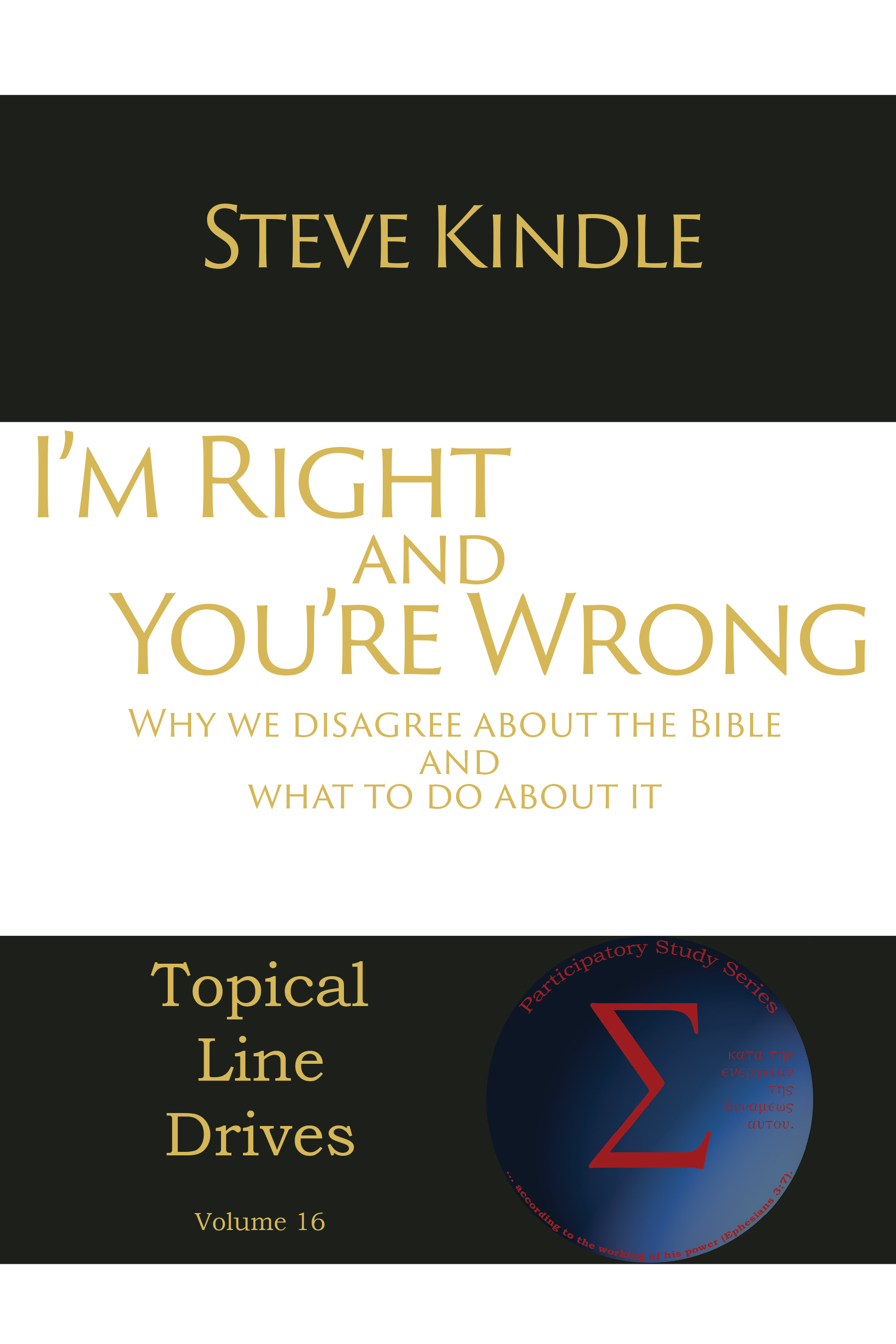
    My company, Energion Publications, will be releasing a book early next year. I’ve already had a chance to read the manuscript, and will be announcing it as forthcoming within the next couple of days. In the meantime, look at this cover and especially the subtitle:

    9781631990991I believe I shall enjoy marketing this book!

  • A Note on My View of Egalitarianism

    Speaking of equality, I want to write a brief note on egalitarianism as I see it. As with all labels, the boundaries are often a problem. Back in early science classes, I learned to distinguish vegetable, animal, and mineral. At certain levels, those distinctions become pretty muddy. It’s not just in social science.

    What I mean by egalitarianism is that all activities and offices should be available to men and women based on their gifts, not on their gender. If a woman has pastoral gifts, she should pastor. I’m actually less concerned with the office of pastor than with the exercise of the gifts of a pastor, but since I believe that offices should follow gifts, the two would generally go together. I do not mean that there must be an equal number of men and women in pastoral roles. I do not comment on how many women or men might be gifted for those roles. I don’t know. I suspect that there may be more women gifted for those roles in the church at the moment. I also believe that authority follows gifts in the same way as an office does; the greatest behaves as a servant.

    I’m not going to try to define complementarianism here, though I previously objected to a definition of complementarian which was alleged to include my own position. This is because I don’t believe that men and women are the same. They are not. I simply believe that either a man or a woman may have any set of gifts, and if they do, they should make use of those gifts as God’s servants. I’m stating this in church terms, but I hold the same view in society in general. The issue for me is not how many of what hold what position or job; rather, the issue is whether a person who has certain gifts can fully exercise those gifts.

    Now specifically in the church I think there should be less difference between the practice of the complementarian and egalitarian positions than there is, assuming we both take the same view of authority that Jesus did. “The greatest among you will be your servant” (Matthew 23:11 NRSV). In the church, this issue should not be one of seeking power. I think God, through Jesus Christ, has set the goal, which is leading with grace. That means that Christian leadership, no matter who exercises it, should be based in service. Those who follow leaders in the church should be doing so because they respond to that grace, demonstrated in being the servant of all. To whatever extent the battle over gender equality in the church is a struggle for supremacy, rather than for servanthood, it’s on the wrong track.

    I don’t mean by this that those who are suppressed or oppressed in churches by leaders who seek power should just roll over. What they should do is either follow servant leaders or become servant leaders themselves. Move on to where you can do that! Let those who seek power exercise it over empty buildings if they must. Let’s live as servants in the world and be a servant church.

  • Is Marriage a Partnership of Equals

    Those who know me, will know my answer. I’m egalitarian. My wife and I do two “yesses” and one “no” and either of us can provide the “no.”

    Bob Cornwall is working on a study guide on marriage and blogging as he goes. Today he begins to address this topic. I think one of the most interesting questions will be the way in which we read and apply scripture.

    Please take discussion to his blog.

  • Dance Floor Worship

    I have been working on cleaning up some of my old web site articles and reposting them were appropriate. I found one I forgot I’d written, titled Dance Floor Worship. I said regarding a moment looking out over the Gulf of Mexico:

    I can call this a secular moment, and wonder when I will be in church so that I can experience the presence of God. But God is not nearly so bound as I am. God doesn’t need me to wait.

    I’d like to remember this idea of seeing the sacredness in every moment, rather than waiting for the special, sacred ones. I need to do it more often!

  • When Theology Overrides Story

    Jody and I were reading the Lectionary passages for next Sunday this afternoon, and I was reminded about how our theology can keep us from reading Bible stories. I think it’s also easy to let our theology trump the theology of a Bible writer, but stories don’t have a one-to-one relationship to theology in the first place.

    The story in this case comes from Exodus 32:1-14, in which Moses is on the mountain talking to God and the Israelites decide he won’t becoming back. (The story is repeated in the reading from Psalm 106.) So they make and worship the golden calf. God becomes angry with Israel, but Moses steps in and persuades him not to destroy the Israelites, even though the alternative is that God will make a great nation of his descendants instead.

    There are two points here that bother different people. Is this picture of God true and/or helpful? Do we serve a God who becomes angry at people and determines to wipe them out? There are, of course, many other stories that raise the same questions as well. On the other hand we are presented with a God who can be persuaded to change his mind. Moses calms God down, so to speak.

    If you’re of some sort of Calvinist persuasion, you’ll likely be OK with the angry God who wants to destroy the Israelites. God’s anger against sin is a key part of that theology. But what about God changing his mind? It’s very likely that this will be dismissed as somewhat of a ploy, perhaps a test of Moses. Will he stand for the people he leads? And of course God knows the results of that test. But actually calming God down or making God actually change his mind is inadmissible.

    On the other hand, if you’re like me, and tend to favor something along the line of openness theology, the latter point is easy to accept. God repents regularly in scripture. So this experience tends to mesh with my own theology that has God interacting with human beings in deciding their destiny.

    Yet many people who share that theology are very uncomfortable with God becoming angry with his people. So in this case one accepts the changeability of God, but not the anger. The anger is dismissed as coming from an excessively primitive view of God.

    I would suggest that in both cases theology prevents an authentic reading of the story. We need to let the story speak first. There is a sense of tension here. God has brought his people out of Egypt, only to have them credit that to an entity they themselves have created. God is, in the terms of the story, rightfully angry. There is the real risk, from the storyteller’s point of view, of the people being destroyed. In fact, it might well be quite reasonable for God to do that.

    There is also a real test of the character of Moses. If our theology didn’t interfere, we’d feel the tension better as Moses has a choice to make. Will he be the leader who identifies with, and serves the best interests of those he leads? If he does so, will God change his mind?

    How we work the story into our theology is another matter, but must come later. Let the story speak first.


  • In Which I Am Completely Unhelpful about UMC General Conference

    Allan Bevere has carried on a discussion about the 2016 UMC General Conference, in which he is partially responding to another Energion author, Joel Watts.

    I have to agree with Allan that closing the floor is unlikely to help. I’m not sure anything will. I see individual United Methodist churches accomplishing things for the gospel. I don’t see the denomination doing so.

    One of the favored activities of Christian bloggers is to advocate one form of church organization over another, but that’s not the real question. Methodist can talk about how churches without an episcopal structure have less accountability. Churches that choose their pastors locally can talk about the constraints of a heavy bureaucracy. But the real question is whether whatever structure we’ve created will have Jesus at the top. I’m completely unconvinced that any structure whatsoever will make that certain. Reorganizing won’t help.

    I think listening to the Holy Spirit is what will really help, but even I don’t hear the same things from the Holy Spirit that all my friends do, so some holy conferencing needs to take place until we get to Acts 15:28, where the same thing “seems to the Holy Spirit and to us” before we have any solutions. And I don’t mean uniformity. I mean fellowship in a diversity that is still part of God’s kingdom.

    But before that happens we’ll all have to be much more broken and humble, definitely myself included, than we are right now.

  • Divorce and (Re)marriage Discussion

    Just in case I haven’t stirred things up enough lately, I’ve invited a discussion on divorce and marriage over on the Energion Discussion Network. Go participate and enjoy!

  • The Book I Can’t Give Away

    The Book I Can’t Give Away

    If you don’t know I own a publishing company (Energion Publications) by now, I’d be pretty surprised. It’s not as though I don’t talk about it regularly.

    One of the things I find interesting about blogging is to discover which blog posts actually catch people’s attention. There are times when I have put my heart and soul into a post, writing about something I consider extremely important, and there’s no response. At other times I write something quickly just because I feel I haven’t blogged enough, and I get comments, links, or e-mails that indicate it has really touched someone’s life. This unpredictability is great fun!

    As a publisher, however, the idea is for me to figure out what people will actually read, because I will be investing money in producing the book, and I need someone to buy it in order to stay in business. Now I say I run my business as a ministry, i.e., the primary mission is more to educate and to build the Kingdom (to use the Christianese expression) than it is to make money. If I simply put my entire time into using my IT skills, I’d make more money. Yet at the same time, it is a business and so it does have to make money. As such, part of my job is to determine whether people will buy a book before it is released.

    It’s interesting how often these goals collide. There are manuscripts I know people would buy, but I don’t consider them of any great value. No, I don’t place my judgment over the popular judgment. There will always be somebody to publish popular things. I’m not depriving you of them! But what about the things that say that becoming a Christian is not a matter of guaranteeing that you will be healthy, wealthy, and wise? What if they say that you may die of cancer rather than be healed? What about books that talk about martyrdom, persecution, and sacrifice? Who publishes those books?

    Such books do get published, and I do not claim to be the only one to do so. But I do think it is part of my duty to make such books available to people. And I’m not just talking about books about the negatives of becoming a Christian. (And quite frankly, in the United States, being a Christian can be quite good for business. Where I live, a common question in business networking is: “Where do you go to church?” It’s a good idea to have a “safe” answer that makes people feel you’re a part of the community.) I’m talking about books that challenge our prejudices, that ask us to think about things we might rather avoid, and that ask us to take action rather than just deal in theory.

    Let’s face it. A lot more of us talk about various reforms than are willing to take actions.

    Do you believe in house churches? Are you ready to get out there and start one, or join a group that is doing so?

    9781893729186Every member in ministry (a good UMC slogan)? Are you involved? If you’re a pastor or other church leader, are you willing to give up some of your power and control so more people can get involved? Are you willing to go look for people and challenge them to get involved rather than waiting for them to volunteer?

    Are you mission oriented? If so, are you ready to back that up with, again to borrow a United Methodist phrase, are you ready to support that goal with your prayers, your presence, your gifts, and your service? (Now if you answered “yes” there, please check to see how much of your church’s budget is going to support outreach ministries.)

    Which brings me to the book I can’t give away. The cover is pictured over to the left. Will You Join the Cause of Global Missions?

    It doesn’t sell very well. In fact, there’s a very specialized book by the same author, The Authorship of Hebrews. It quotes Greek words and phrases, and deals with a very technical issue of interest to a relatively small number of people. It’s not precisely a bestseller, but I sell more copies of it than I do of Will You Join the Cause of Global Missions?

    I know that many Christians are not too happy with the word “missions.” As I said in the description for another book I’m soon to release, also on the subject of missions:

    Many Christians have grown up with a very limited concept of “missions” and “missionaries.” In this view a missionary is a person who goes and preaches to lots of people, often in primitive lands, and explains the theology of the gospel. The natives are convinced and become Christians. Thus the gospel commission is fulfilled.

    Actual missions have not been carried out in this way very much….

    This sort of mechanical view has damaged the concepts of both evangelism and missions and made them bad words with many people. But a church without a mission is very dead. A church with a mission that is all internal is likely dying. I haven’t been going out and speaking at many churches lately. I spend most of my time in front of this computer. But I used to tell pastors I could gauge the health of their churches by asking a few members what the mission of the church was. In a healthy church, people will be able to answer quickly and clearly.

    “But evangelism,” someone says, “that refers to holding boring meetings in a tent trying to convince people to give their hearts to Jesus.” No, not so. Evangelism is spreading the good news.

    Let me give an example. My parents were missionaries, and they carried out evangelism. Neither of them ever conducted a tent meeting. My dad was an MD, and my mother (who is still active at 96 years old) was a nurse. They operated clinics. They cared for people. They prayed with people personally. When you visited their church, you would be invited home to lunch. I hear people taught to make visitors welcome by speaking to them and getting to know them. Good! Let’s do it. (Though I have a problem in that I’m a member of a 3500 member church and I often can’t tell who’s a visitor and who’s not. That may be another problem!) But for my parents making someone welcome meant making sure they had time to get truly acquainted, making sure that person was fed, and if they had needs, that those needs were met. I wonder how many people in our churches would be willing to take that on today?

    I suspect that many people simply don’t want church to change the fundamental way in which they live quite that much. That’s getting way too much into other people’s business. We don’t want to do that.

    The thing is, that sounds to me much more like the way the gospel was spread in New Testament times. I’m fully aware that times have changed. The church needs to adapt.

    So let’s ask this: Is the way we’ve adapted working?

    And so we return to the book I can’t give away. I’ve tried to give Will You Join the Cause of Global Missions? away in various places, from academic gatherings down to personal meetings with people. It’s not quite true to say that I can’t give it away at all, though at one academic gathering it was the only book from my book table of which I had the same number on my return as when I’d left. I’ve never run out of them. I’ve tried. I’ve offered free copies for people to use in study groups or to give away in church.

    Maybe it’s because the author is Southern Baptist, and I approached people of other denominations. Maybe it’s because he’s conservative, and I talk to people all across the spectrum. But this book doesn’t tell you what your theology has to be. It tells you what to do with it. It tells you the level of commitment that God calls for. I know plenty of people moderate or progressive theology who would not disagree with those points. Besides, how do people know when they haven’t read the book yet?

    My real challenge here is not to buy this particular book, though I’d be delighted if you did. What I hope you’ll do, however, is look at what you believe and then check out your actions. Do you believe you should be out doing social action, yet you’re sitting in the pew instead? Then get up and go! I’m not trying to define your mission. That’s up to you, hopefully as you discern God’s leading. Whatever it is, do it!

    I didn’t intend to when I started this post, but I just noted that I have 16 copies of this little book on my office shelf. This book talks about mission, it talks about martyrdom, and then it asks you to commit yourself to it. Let me know in the comments. Tell me how many you need and up to what I have on my office shelf I’ll send them to you free of charge. No shipping or handling either. Just ask. If you need ten copies for a church group, tell me that. First come, first serve, until they’re gone.

    Don’t worry about whether your mission, as you understand it, is the same as Dave Black’s. You aren’t called to Dave Black’s mission. You aren’t called to mine. You’re called to yours.

    If you need more than 16, or you want some after I’ve given those away, I’ll work out a price that will cut this as close to my cost as I can manage. I can’t afford to lose money, but I can live with making pennies on the book. Just email me (henry@energion.com) and ask.