Threads from Henry's Web

Category: Discipleship

  • When Is a Gift Spiritual?

    When Is a Gift Spiritual?

    Dave Black writes about spiritual gifts and natural abilities. (Link on jesusparadigm.com, to make a permanent link available.) I like what he said. I want to add a note. You can find more of my comments on 1 Corinthians 12-14 under the 1 Corinthians tag on this site.

    The problem that I see commonly with our reading of 1 Corinthians 12 especially is that we assume that Paul is setting out to explain spiritual gifts. I don’t think that’s what he’s up to. Rather, he is using the variety of spiritual gifts as a means to talk about Christian unity, and as a way to teach discernment of all of our activities.

    Everything is a gift of God. There are gifts that God places in the body of believers for the purpose of carrying out ministry. Whether these gifts are “spiritual” or not is not a function of whether they are received from God or not. All gifts come from God. The issue is under whose authority we place these gifts. If you take a look especially at 1 Corinthians 12:7-11, and then focus on 11, “All these are the work of one and the same Spirit,” you will start to get the picture, I think. This isn’t a list of “approved” spiritual gifts, and it isn’t a question of what gifts come from God and what gifts occur naturally. Nature itself belongs to God. The natural is divine by gift of its creator.

    Acting under one Spirit, however, is an excellent test. The gift, whether designated spiritual or not, that is used to tear down rather than to build up is distinctly unspiritual in this sense.

    Another error we often make is to extract 1 Corinthians 13 from the passage of 12-14. (Of course, the structure of the entire book is important as well.) I recently read an article, and I now can’t recall the source, that mentioned this wasn’t a wedding passage, and indeed it isn’t. Nontheless I will say it’s fine at weddings, because scripture uses the marital relationship as a metaphor to tell us about the divine relationship and also about the body of Christ. But here it is Paul’s principles for the use of God’s gifts in a spiritual way. He in turn makes those principles explicit in detailed action in 1 Corinthians 14.

    We shouldn’t be complacent in reading 1 Corinthians 14. We sometimes read it as a corrective to raucous or disorganized worship services, but the worst problem we have is that we don’t have the problems that the Corinthian church had in worship. We don’t have everyone showing up with each having “a hymn, or a word of instruction, a revelation, a tongue or an interpretation” (14:26, NIV). We each show up only with a backside to plant in a pew.

    We need first to put our gifts into God’s hands for service, and then we can start talking about how to best use them in an edifying, i.e. building, worship service.

    These three chapters are powerful, and I think incredibly relevant to the church today. We should have problems like the Corinthian church!


  • Thoughts on James 2

    Thoughts on James 2

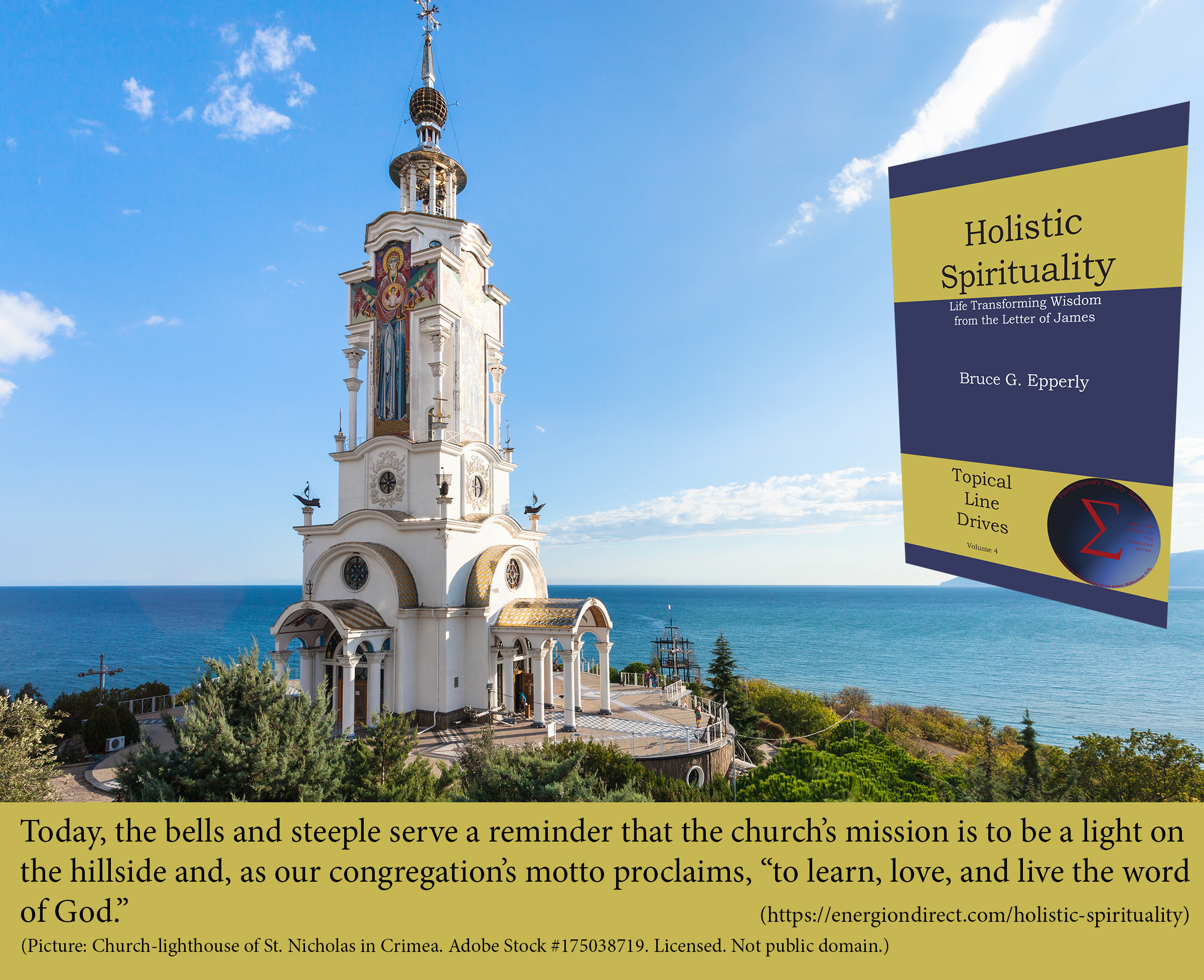
    Our Sunday School lesson, which I’m not teaching this week, is from James, focusing on chapter 2. I’m not teaching, but in studying, I looked at a book I publish, Holistic Spirituality: Life Transforming Wisdom from the Letter of James.

    Bruce Epperly makes a number of important comments. I’m going to do a bit of quoting from his chapter 3, pp. 15-21.

    One of my great joys is my first glimpse of the steeple of South Congregational Church, when I round the bend toward home. In earlier times, the church’s steeple guided mariners safely to shore. Today, the bells andsteeple serve a reminder that the church’s mission is to be a light on the hillside and, as our congregation’s motto proclaims, “to learn, love, and live the word of God.” (p. 15)

    I like that motto, “learn, love, and live.” I think it may go the other way as well, we learn from what we live, especially when we’re trying to live the word of God.

    Faith means nothing unless it lights the way of pilgrims and seekers, providing guidance, comfort, and nurture. (p. 16)

    Here Bruce combines faith in action and faith in witness (and our action is, I think, our best witness) in a way of which I think James would approve. We are not Christians, or Jesus people, for our own benefit alone. We receive grace to share grace. That’s why grace cannot be a passive thing. It erupts in action.

    … The Apostle asserts that because God loves us, our vocation is to love one another, even if this means crossing the barriers of race and ethnicity. Grace makes us all first-class Christians, worthy of respect regardless of ethnicity or economics. This is the essence of James’ message as well.

    James believes that a holistic faith brings together belief and action. In the spirit of the Quakers, what is important to James is to “Let your life speak.” … (p. 17)

    I think that the tendency of many interpreters to see James and Paul as opponents is misguided. They do have a different emphasis, but it is not because Paul hated or devalued action or that James thought beliefs were unimportant. Each had an emphasis, but these emphases are compatible or complementary.

    Loving Jesus means loving your neighbor. And if James is right, it means standing aloof and becoming counter-cultural in
    relation to socially-acceptable, but life-destroying, values – “being unstained by the world” – that put profits ahead of people, neglect the needy, and blame the poor for their poverty. We are all created in the image of God and we all deserve to be loved, to have a place to call home, and an opportunity to live out our gifts and talents as God’s beloved daughters and sons. (p. 19)

    That’s were it will start to get with us. Sanctified wallets are the hardest of possessions to acquire. Or, looked at the other way, the wallet is the hardest thing to give up. How much stuff must we have? What is first in our life? Putting God first will result in also putting our neighbor first.

    But what can you do? Maybe all you have to spare is coins in your pocket.

    In the realm of God, no deed is too small, for with one action at a time we can become God’s companions in healing the world. Let your life speak. (p. 20)

    This is a great little book, just 40 pages of text from Energion’s Topical Line Drives series, for accompanying a study of James. It might just be, as the subtitle suggests, life transforming!

    Read Now


  • Following the Path of Jesus

    Following the Path of Jesus

    On January 1 God called two texts to my attention as themes for the year. They are Philippians 1:27-30 and Ephesians 5:1-2. I haven’t said a great deal about this, though the theme of those texts has shown up in a number of posts. Then yesterday I saw Dave Black’s latest translation of Philippians 1:27-30, which I like a great deal, and I wanted to mention it. Reading a text in a modern, clear, might I say dynamic, rendering brings it home. Here’s the translation:

    Now the only thing that really matters is that you make it your habit to live as good citizens of heaven in a manner required by the Good News about Christ, so that, whether or not I’m able to go and see you in person or remain absent, I will be hearing that all of you, like soldiers on a battlefield, are standing shoulder to shoulder and working as one team to help people put their trust in the Good News. Don’t allow your enemies to terrify you in any way. Your boldness in the midst of opposition will be a clear sign to them that they will be destroyed and that you will be saved, because it’s God who gives you salvation. For God has granted you the privilege on behalf of Christ of not only believing in Him but also suffering for Him. Now it’s your turn to take part with me in the life-or-death battle I’m fighting — the same battle you saw me fighting in Philippi and, as you hear, the one I’m fighting now. (emphasis mine)

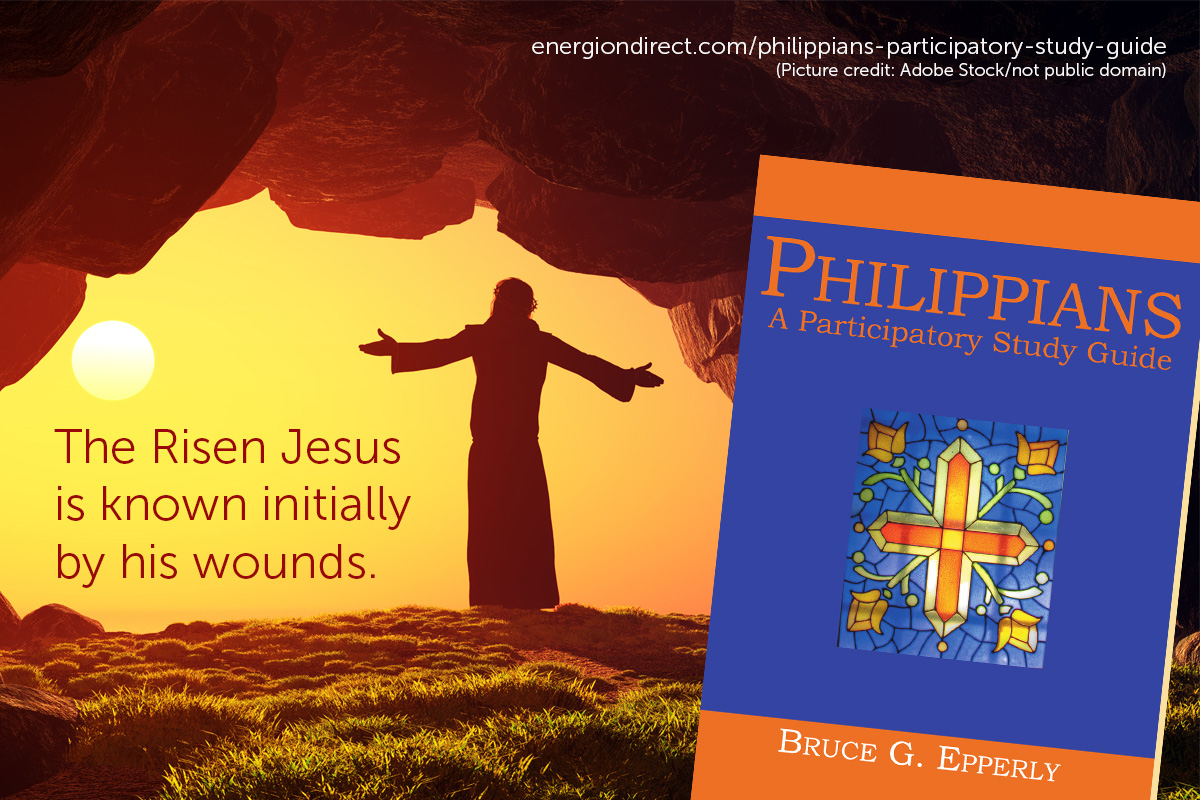
    This emphasized line led me to a quote from Bruce Epperly’s book Philippians: A Participatory Study Guide:

    Even now in our time, we can take confidence in Paul’s assertion that God is with us and that, in life and death, and celebration and persecution, Christ sustains us. We are resurrection people. But, our lives are also cruciform or cross-shaped. The Risen Jesus is known initially by his wounds, and we too may experience suffering and loss as a result of our relationship with Christ. Still, at the end of the day, integrity, fidelity, and the promise of resurrection life far outweigh any trials of this lifetime. – p. 19

    Bruce also quotes the song “I have decided to follow Jesus.” It’s a good song, but it’s one that should be very hard to sing. No, not musically, but due to meaning.

    (I must note here in passing that I love to use materials that come from very different theological streams. It is especially important, I think, when people from opposite sides of the spectrum agree fully on the meaning of a text, even more so when that text says something people would often rather not hear.)

    On the night when Jesus was betrayed, there were twelve people (at least) who had decided to follow Jesus. One betrayed him. One denied him publicly. The rest “advanced in the opposite direction.” We can take hope from the fact that so many found their way back!

    Ephesians 5:2 similarly gives us a hard call “walk in love.” Now we like that, because we often call very unloving things “love.” But the verse goes on “just as Christ loved us and gave himself for us. We have a very clear pattern for what love actually means. I’m a love proclaimer. I believe in the power of love. The reason love so often seems wishy-washy, that it so often fails, is that what we call love is often partial. It is not commitment, but rather a sort of generic liking. That’s why the key to following Jesus is not the experience of miraculous physical acts, or wealth, or healing for everyone in sight, or healing of all our emotional ills. The key to following Jesus is the willingness to take up the “privilege” of suffering for him.

    This, I must confess, is not the true story of my life. Nonetheless, just as I can travel northward by using the pole star as a guide even though I’ll never reach it, so I will keep facing this way, and trust in the grace of the One who gave himself first.

    (Allow me to call attention to two previous posts: God Perfected through Suffering and Thankful for the Gift of Suffering for Jesus?)

  • Marketing Jesus

    Marketing Jesus

    Shortly after I separated from the Air Force I was chatting with a gentleman while waiting in line for something or other. On realizing that I was a veteran, and in fact had been somewhere that would qualify me as a veteran of a foreign war, he started a pitch to get me to join that fine organization (VFW).

    His initial pitch was simply that I could. I asked him why I should. At this point he was somewhat at a loss and simply told me that they had a wonderful local VFW post where I could drink and swap war stories with other veterans. On short acquaintance he couldn’t possibly have know what a poor pitch that was for me.

    Now please don’t imagine that I’m writing against the VFW, any more than I will be writing against Jesus when I talk about marketing approaches. The VFW does some fine work, which is my point. You can give a poor sales pitch for a good cause and drive people away.

    Fast forward about 12 years to a time when I was looking at church congregations. I had not been a member of any church for those years and more, but as regular readers may know, I did have my MA in Religion (with that wonderful concentration in Biblical and Cognate Languages). This made life a bit difficult for pastors who discussed their churches with me.

    In the end, I was considering two United Methodist congregations. I had attended church and some excellent studies at both, and I liked both organizations in many ways. At one of the churches pastor said: “We don’t care what you believe. If you want to enjoy our fellowship, you’re welcome.” The other discussed my beliefs and how they fit with the congregation.

    Now I’m very interested in openness and acceptance, and I advocate the maximum freedom of belief, but I do think an organization requires some sort of center to make it functional and useful. And a mission. That too.

    Thus I joined the other congregation.

    Over the course of my life I have experienced a variety of sales pitches to get me to accept Jesus Christ as my savior, most of them after I already had. Many of these came from people who felt I hadn’t quite gotten it right. Others came from people who presented their pitch so quickly they hadn’t had time to realize I was already a Christian. One came from someone who saw me reading my Greek New Testament while waiting for tires to be installed on my car, and was convinced that my Christianity must just be a thing of the intellect. He was truly concerned that I might mistakenly think that reading Greek was a means of salvation.

    I’ll call it a means of grace. I didn’t think of saying that to him. It would doubtlessly have sent him ballistic. (Then I would have needed to repent, so perhaps it’s best I didn’t think of it.)

    I would categorize approaches to selling Christianity in a few broad camps:

    1. The desperate. These are the people who are afraid that if you don’t accept Christ while in conversation with them, you will doubtless go to hell. One short prayer, and you’ll at least avoid that. Flames are usually involved in the conversation (pun absolutely intended). Conservative and charismatic Christians are susceptible to the use of this approach. Liberals and other mainliners might be susceptible, but often they don’t believe in hell.
    2. The cultural. Christianity is a good society, sort of like Kiwanis or the Lions Clubs. Good people are Christians and attend church every so often. Come join our church and be socially acceptable to the good people. Mainline congregations are most susceptible to this, but conservatives may fall for it in the right cultural context.
    3. The upwardly mobile. This is the home of the prosperity gospel. The pitch goes that you’re in a lower economic and social class than you’d like to be, and Jesus wants you to have abundant life, so just follow Jesus to health, wealth, and satisfaction. (No, not the satisfaction theory of the atonement. Self-satisfaction.)
    4. The apologetic approach. By this I don’t mean a person who defends elements of the Christian faith, but rather the person who desires to batter down your defenses with his or her command of data.

    In fact, in all of these approaches there’s some truth. Being a part of a caring community can improve your standard of living, your sense of joy, your peace, and many other things. Not quite in the way the prosperity preachers tell it, but it can help. Being part of the church can be a good cultural and social move. Considering your eternal state is likely worthwhile, and studying the data behind your religious faith is constructive.

    There’s an effective temptation to attack every good intention or work. The desperate evangelist is driven by a desire to help. Believing that eternal hell fire is in your future if you don’t accept Jesus as your savior, he feels compelled to make you. This sense led to some theological support for the burning of heretics. What was a few moments of torment in this life compared to what God would do to them in the next? If the torturer could bring this eternal punishment to their minds forcefully enough, perhaps they’d repent and be saved. The temptation here is to take away from God the power of salvation and judgment. Most humans are susceptible to it in some way.

    Then there is the Jesus way. I was hit by it this morning as I was reading texts for next Sunday’s lesson.

    Jesus was saying to everyone: “If anyone wants to come after me, let them deny themselves, take up their cross, and follow me.” (Luke 9:23)

    Now there’s an “ouch”! No promise of prosperity. No threat of hell. No social acceptability. In fact, if you read on through the end of the chapter, it gets even worse. The facts of the situation were present in the Person.

    I wonder how a church growth program would work that called for people to lose their respectability, give up their comfort, become socially unacceptable, experience pain, and ignore ridicule. I’ve never seen one of those.

    Other than in the gospels.

    Let me look at some other texts from this week’s reading list.

    9He said to me, “My grace is enough for you, because strength is made complete in weakness.” I now gladly boast in my weaknesses because Christ’s strength is all over me. 10So I am pleased in weaknesses, when insulted, when in need, when persecuted, when in hardship, for Christ. For when I am weak, he is strong. (2 Corinthians 12:9-10)

    I guess Paul wasn’t up on the latest pitches and methods of evangelism either. And just to add to our feeling of injury and annoyance:

    If we suffer together with him, we will be glorified with him. (Romans 8:17b)

    I was somewhat surprised after reading the scriptures to find that the lesson author managed to write the whole lesson without mentioning suffering. He had some good thoughts, but somehow avoided that one.

    So just what is it we’re proclaiming (or selling)? Are we doing it right?


    (Note: All translations are my own, and are sometimes intentionally loose. Featured image downloade from Pixabay.com, which doesn’t require attribution, but I’ll give it anyhow.)
  • Seeking a Bible Topic

    Seeking a Bible Topic

    Franklin Graham is quoted by the Huffington Post as saying that the President Trump’s refugee ban is not a Bible topic. He actually said a bit more, but “not a Bible topic” is going to be the quote that follows him all the (remaining) days of his life. And well it should, though I think most are missing what’s being said.

    My purpose is not to defend Franklin Graham on this; in fact, I am diametrically opposed to his position on these refugees. I believe that we should welcome Muslims in the same way as we would welcome anyone else in need. It’s relevant, in one way, to point out that many refugees from Syria and Iraq are Christians. But for a Christian that shouldn’t be the issue. If all were Muslims we should remain equally concerned for their welfare, and equally willing to put our own welfare at risk on their behalf.

    But I think the issue here is a bit different. Let me quote just a bit more from the article. (If you’re diligent, you’ll go and read my source, and perhaps some of its sources in turn.)

    “It’s not a biblical command for the country to let everyone in who wants to come, that’s not a Bible issue,” Graham told HuffPost. “We want to love people, we want to be kind to people, we want to be considerate, but we have a country and a country should have order and there are laws that relate to immigration and I think we should follow those laws. Because of the dangers we see today in this world, we need to be very careful.”

    The issue here is not directly that refugees are not a topic in the Bible. The specific question is whether the Bible provides a command that can be directed at the United States, that directs us to admit all refugees. This question is one of hermeneutics. How do you make such a determination?

    One passage that might be cited is this:

     The alien who resides with you shall be to you as the citizen among you; you shall love the alien as yourself, for you were aliens in the land of Egypt: I am the Lord your God. (Leviticus 19:34)

    That line “love the alien as yourself” might come up in a discussion of how a Christian should look at this. I would not want to be left in a refugee camp for years, and if I had gone through a series of checks in that camp, I would not be delighted to suddenly learn that I would be left there for another six months (or perhaps more). A person who loves an alien as himself probably wouldn’t do that.

    But does this law apply to us right now? I personally believe it applies to me (for reasons I won’t detail here), but does it apply to my country?

    At this point we might consider another passage from Leviticus:

    22 You shall not lie with a male as with a woman; it is an abomination. (18:22)

    Now if Leviticus 19:34 is a command, is not this also a command? If the first applies to America does the second not apply also, and vice versa?

    But what we find is that those people who want Leviticus 18:22 to apply find a way to make it apply. I’m not discussing here whether their way works or not, but merely consistency. A certain number of those don’t want 19:34 to apply and they find a way to explain that it doesn’t. Again, the reverse is also true. No, not everyone is thus inconsistent. Some will apply both and others will not apply both, but there is a considerable amount of inconsistency.

    Is there a valid, consistent hermeneutic that can make one apply and not the other? Possibly. But we rarely hear about that.

    I was teaching the New Life Sunday School class at First United Methodist Church of Pensacola as a guest this Sunday and we discussed this topic a bit. One of the members quickly brought the conclusion: Most of us have our viewpoint first and then find scripture to support it. I pointed out that this was also the case when we reject or accept someone else’s viewpoint and biblical claim.

    From one point of view, I can’t help but agree with Franklin Graham. No, not about refugees. I agree with him that in the sense he describes (using the full quote) that there is no scriptural command that could be said to apply to the United States and that would require that we accept anyone who wants to come here.

    I also disagree, with some vigor. That is not the way to determine what is a biblical issue. I’ll be interviewing one of my undergraduate professors tomorrow evening for our Energion Tuesday Night Hangout. (Note: It appears this hangout never took place. – HN 02/06/2021) I’ll embed the YouTube viewer at the end of this post. He used to tell us to narrow the letter and broaden the spirit. That is, you find out who it applies to originally in the narrowest way possible, but then you find the principle or spirit that inspires that command, and you apply that much more broadly.

    One might say that this approach offers a great deal of leeway. Indeed it does. And so does every approach to interpreting the Bible. That’s because the Bible wasn’t created by a committee of lawyers and mathematicians. Rather, it is the result of the experience of (some of) God’s people with their God.

    As such, the Bible can enlighten, guide, inform, and help, but does remarkably little (if any) direction in the sense that Franklin Graham was apparently applying. If that approach is applied consistently, the Bible fades into insignificance.

    Except as a fig-leaf used to cover our pre-existing passions.

    This is one reason I advocate the process of letting the Bible change you and then that you, through your actions, influence others. Even better, let God use the pages and text of scripture as God wills to change your own life.

    In my case, this would mean adjusting my way of thinking about other people. It would mean making me feel empathy for those who suffer. As such, I would want to live in a nation with policies that reflect such a view. I don’t have to ask anyone to live according to one divine decree or another, always in dispute. Rather, I simply use what influence I have in favor of that position.

    If the Bible is used in the sense of the quote from Franklin Graham, then very little is a Bible issue, at least in terms of politics or society. But if we look at the Bible as one of the ways in which God changes our character, then everything is a Bible issue, because through it I let God change me and then I go forth to influence the world.

    I believe that Jesus would want me to welcome Muslims into my country, my neighborhood, and even my home. But I know people from many faiths, and indeed some atheists who would agree with my goal. So I can advocate this as a good policy from a secular or a religious viewpoint.


    A collection of books I publish and recommend on inspiration.

  • Wanting to Be Right Theologically

    Wanting to Be Right Theologically

    I work on a heavy schedule, and as someone who is self-employed, with two distinct lines of business, I very rarely see a blank to-do list. In fact, now that I think about it, it has been several years since I finished a day and could say I was done.

    I identify a couple of goals here. First, I’d like to be done at some point. “Now I can go on vacation,” I would say, “because everything is done.” Second, I want to get as much done as possible, not to mention a few impossible things. In reality, I’m not going to be satisfied on either of those points.

    Quoth Paul, “Oh wretched man that I am! Who will deliver me?”

    You may think I’m being irreverent to use that quote, in which Paul is referring to his own inability to do what he knows is right and wants to do, but I think it’s closer to the mark than most suspect. So let me first illustrate what I’m talking about with my work, and then get back to the spiritual lesson.

    No, that’s not quite right. Getting done with my work is physical, mental, and spiritual process. One of our problems is that we spiritualize spirituality until it has nothing to do with daily life. Ideally (another interesting word), we’ll see the physical and the spiritual working together. Everything from doing the dishes to writing a book to running a marathon (as my friend Dave Black is about to do) is both physical and spiritual; above all, real.

    Thus I start with the illustration of how I can attack my day. There are two extremes I can take. The first is my natural inclination. That is, I get up in the morning, come to this computer (most of my work resides in its chips), and start attacking my list. I’m not really a list person, but reality has forced lists on me. If I find myself failing to accomplish the list, I add hours at the end of the work day, all the while wishing I could add hours to the physical day.  This process is direct, measurable in effort and results, and easy to understand. More work = more accomplishment.

    Before I go to the next option, let me tell you about the problem I have with leaving the first. Mary Heaton Vorse (I believe she originated the saying) said that writing was the art of applying the seat of the pants to the seat of the chair. She was absolutely right. The arts of editing, designing, and marketing are much the same. So if chair meets backside for more hours, more will get written. Authors (and editors, designers, marketers, and perhaps all humans) have many excuses for not having seat meet seat, one of the most common being that you can’t force creativity. Editors, who like to disembowel the excuses of authors, like to point out that you’re not being all that creative outside of the chair either. Writing great novels in your imagination is perhaps not all that likely to bring either fame or fortune!

    So having written one or two books myself, and having published around 170 by other authors, I have a strong tendency to stick with Mary Heaton Vorse.

    Not so fast!

    I also know that creativity will demand its pound of my flesh. One of my techniques for planning out a cover or the chapter headers for the interior of a book is to put them on a computer screen I’m not using and walk by them every so often. This is a way of forcing me to become so disillusioned with the current state of the object that I will come up with a new look just to preserve my sanity. Put less bluntly, I look at it, think about it, and suddenly come up with an idea. Then I apply back side to chair and implement, generally followed by more looking.

    Now we turn to the second approach to my day. In this approach I ask what makes me productive. I could list a number of things, such as getting enough sleep. Staying up late to finish a project can get it out the door on schedule, while actually making me further behind overall. I am less efficient on insufficient sleep. Failing to spend time in daily devotions makes me less efficient. It’s easy—almost irresistibly easy—to decide that I’m too busy for that devotional time and simply jump into work. In fact, as I write, I must confess that this morning other than prayer time before I got out of bed, I am writing without devotional time. But this blog post struck me as I prayed (no, I’m not telling you this is God’s word; it’s just my musings), and here I am, drawn to the keyboard and the chair.

    Walking is also important for my efficiency. If I don’t get active, I’ll find myself accomplishing little. Walking can be done at any time of the day, and therein lies another problem. Can I stop working and take a walk? Can I stop working inside and go out and clean up branches in the yard? The second is easier than the first. Why? Because it feels like I’m working toward a goal. What is walking but time when the seat of my pants does not connect with the seat of my chair and thus is wasted? At least cleaning the yard produces stacks of broken branches and piles of leaves!

    But, and this is a serious “but,” thus gaining the initial point in this paragraph. But, I say, this impression is an illusion. Yes, I need to work. I need to accomplish things, but I also need to do things that keep me functional. There is a balance here that is not helped by my tendency to think in extremes. If I could just work 16 hours straight, the book would be done, I think. But that doesn’t work. There is a balance, a place where things work best.

    But, another serious “but,” I want to be able to say how hard I work. If I rest, in order to be more efficient, I can’t say I worked 16 hours, thus impressing other people with my diligence and dedication. Saying that I ordered my day to preserve mental, physical, and spiritual health, and thus actually accomplished more work than I would have if I had gone with Plan A just doesn’t have the same ring. Deep inside me is this little voice telling me that approach sounds lazy. Somewhere in there is another voice that tells me it is lazy. The voice that tells me it’s lazy lies like a rug. The one that tells me others will think it’s lazy is just irrelevant.

    I’m so programmed for work that I tend to listen to those voices anyhow. “Oh wretched man that I am! Who will deliver me?”

    Can you perhaps see some of our problems with spiritual things? In our minds there is a God out there demanding this ultimate perfection, incredibly wonderful holiness, and the attainment of unreasonable standards. We’ve even made a theology of it. We’re so desperately wicked and God is so holy that we are without hope. Jesus comes in and makes up the difference. That’s fine, except that we don’t really buy it. So we come up with new ways to try to attain “rightness” with God.

    Way, way back in the ancient days, it was by offering enough of the right sacrifices. Then we weren’t sure, so we offered more, all the while letting actual righteousness get lost in the scramble to offer the right sacrifices. Then we got hold of Jesus, so to speak, but since we couldn’t really believe that things were taken care of, we had lists of works. We’d try to make sure we got the lists done, and we were afraid that if we didn’t quite manage that, we’d be lost. (This isn’t a critique of Catholic theology, but of human existence. I don’t think the change of theology does nearly as much as people hope.)

    Come the reformation, we renewed the idea that God had taken care of it. We ended all the sacrifices with Jesus and now the reformation wanted to end all that checklist work being righteous enough to get to heaven. But we really didn’t want to believe that either, so we came up with righteousness by correct theology.

    I personally think the demands of theological correctness are much greater and much more sinister than the demands of correct living. The farmer in the field or the construction worker laying bricks could hope to live with integrity and carry out acts of charity. But now we have details of theology that must be learned but that many people don’t really get. There are those who demand, however, that they be understood. I was told once that if I didn’t realize that Christ had died for my sins and that I was thus “once saved, always saved” irrespective of any future event, I was not in fact saved at all. In this man’s view, my understanding of the theology was critical to my salvation. I might be incapable of doing one righteous thing (he made sure to quote scripture on that), but I must be capable of righteously (and rightly) understanding his view of the atonement, else Christ died in vain.

    We replaced the vanity of gaining righteousness by performing the right ritual with the vanity of performing the right set of deeds. Then we replaced the vanity of the deeds with the vanity of our understanding. All the while our lives continued to do very little to reflect righteousness by any standard.

    “Oh wretched people that we are! Who will deliver us?”

    Jesus, I think, if we’ll listen. Matthew 5:48 says to be perfect, but Matthew 7:1 says not to judge. Interesting that we try to apply that to others (while missing “by their fruit” a few verses forward), but not necessarily to ourselves. Earning the favor of God by doing things that are, really, the best things for ourselves and doing them perfectly is, of course, impossible. We can’t attain this. We might as well hope to reach the pole star by walking north!

    But here comes grace, ready to take that burden from you. To quote Paul again, “Thanks be to God through Jesus Christ our Lord!” It’s the realization that you don’t have to reach the pole star, but you can walk north. You can go ahead and have times of rest in your spiritual life. Why? Because you live in grace. You can work on your own sanctification. Why? Because God has given you the space.

    If you spent your time trying to attain the pole star, you would have serious problems getting over the next hill. In an article titled North Star Closer to Earth than Thought, I found the estimate that it’s only 323 light years to Polaris, the current pole star. I also found an estimate that it would take 225 million years to walk one light year at 20 miles per hour. (I think the writer has a problem with the concept “walk.”) But even at that clip, Google tells me that 225 million times 323 light years is seventy-two billion six hundred seventy-five million. Of course that is shortened from ninety-seven billion six hundred fifty million by the new measurements (323 light years to Polaris rather than 434)!

    That shortening is sort of like saying, “No, you don’t have to accomplish all these deeds, just make sure you get the right set of beliefs. Then it will take only a bit under 73 billion years longer than you’ll live instead of 97 billion. Rejoice! Sing Hallelujah!”

    We need to let grace free us from the need for judgment, and then we can seek God without the constant worry that our experience and understanding are inadequate. Of course they’re inadequate! But God …

    You were dead through the trespasses and sins in which you once lived, following the course of this world, following the ruler of the power of the air, the spirit that is now at work among those who are disobedient. All of us once lived among them in the passions of our flesh, following the desires of flesh and senses, and we were by nature children of wrath, like everyone else. But God, who is rich in mercy, out of the great love with which he loved us even when we were dead through our trespasses, made us alive together with Christ[a]—by grace you have been saved— and raised us up with him and seated us with him in the heavenly places in Christ Jesus, so that in the ages to come he might show the immeasurable riches of his grace in kindness toward us in Christ Jesus. For by grace you have been saved through faith, and this is not your own doing; it is the gift of God— not the result of works, so that no one may boast. 10 For we are what he has made us, created in Christ Jesus for good works, which God prepared beforehand to be our way of life. (Ephesians 2:1-10, emphasis mine)

    Perhaps we should give up the works and the judgment, especially self-judgment, and live.

  • Thankful for the Gift of Suffering for Jesus?

    Thankful for the Gift of Suffering for Jesus?

    Because you have been graciously given this on behalf of Christ:
    not only in Him to believe,
    but also for Him to suffer. (Philippians 1:29, excessively literally)

    I’ve been meditating on two texts as the new year begins, Philippians 1:27-30, and Ephesians 5:1-2. I’ve been kind of ignoring this suffering thing so far. But last night listening to music in worship at Freedom Church Pensacola, it suddenly struck me to think: Do we have any songs in which we actually praise or thank God for suffering? There may well be, but I don’t recall one off-hand.

    This is certainly not a criticism of the church I was in at the time I thought it. I don’t recall this sort of thing anywhere. We don’t talk about it in the way Paul does here. In fact, we don’t really want to acknowledge the reality of suffering. Often our singing, praying, preaching, and indeed our living presents the pretense that nothing ever can or will go wrong. Have you ever heard anyone say in church, when a testimony is called for, that they have had a horrible week and just don’t know how they can go on? No! That’s a sign that they’re crazy. The intelligent and sane ones pretend.

    I don’t think Paul is saying here that suffering is wonderful and good in itself. I think the privilege is that the suffering that will come—and despite our desires, it will—is not vain and of no worth, but rather it is suffering on  behalf of the kingdom. It’s not cheering that there is pain, but rather cheering from the pain that whatever happens is not in vain.

    This reminds me of the Battle Hymn of the Republic and the frequent change of the line “as He died to make men holy, let us die to make men free” to “as He died to make men holy, let us live to make men free.” (You can find more on this here.) Those who have served in the military know that dying may be necessary. It’s not what you live for, but many people have faced death for their nation. Many Christians have faced or are now facing death for their faith. It’s a reality, but just as we change the line in the song, we’d rather not talk about it. Certainly, we don’t want to sing about it.

    Conducting ourselves in a way that is worthy of the gospel (Philippians 1:27) may involve annoyance, discomfort, suffering, and even death. God’s gift is that we do it in, with, and through Jesus Christ.


  • God Perfected through Suffering

    God Perfected through Suffering

    For it was appropriate for
        him,
            for whom everything exists
                and
            through whom everything exists,
        in bringing many children to glory,
            the pioneer of their salvation
        to perfect
            through suffering

    (Hebrews 2:10, very literal)

    I wouldn’t suggest that any Greek students translate the way I just did, or your Greek teacher may suggest you learn English. I’m trying to bring the focus onto certain things and it’s sometimes hard to gauge what this is going to do for readers of the English text that results.

    I think this text is one of those that we tend to discount, because what it’s actually saying is a bit startling. In his commentary, Luke Timothy Johnson points out that this text forms a sort of envelope with 2:18, and that the verses between are a carefully structured argument. I quite agree, but I want to just bring your attention to the stark initial statement. Johnson emphasizes how outrageous this concept would be in the Greek world. I would suggest it would sound outrageous just about anywhere. When a Bible writer says something that sounds outrageous we have our defensive mechanisms: Discounting (take 20% or 30% off the rough edges), find a balancing text so we can believe that one instead, or just move on to something more edifying.

    In this case I think we tend to focus on the suffering, since we have heard the story of the cross so many times. That was something shocking to those who first heard it, but it has become routine now, not that when we’re called to suffer as Christ did, we take that very seriously. We  tend to think we’re suffering for Jesus every time we have a bad day. No, we’re just living in the world. Some days just aren’t as nice as others!

    But the idea that the Son, described in such majestic terms in Hebrews 1:1-4 is to be made perfect, or perhaps complete, through suffering is a little bit more difficult. Luke 2:52 notwithstanding, we tend to think of Jesus in majesty all the way through. Just look at all the halos around the baby Jesus in art. I suspect not so much halo spotting by Mary. In Hebrews, we’ll hear this theme many times, one of the key ones is 5:9, where “having been made complete he became the means of eternal salvation.

    I’d suggest two points here that we avoid, and we need to affirm and absorb instead:

    1. God is much more involve in and impacted by our lives and situation. The incarnation may have been an event in history, but it’s also an eternal reality. God is much more involved. We sometimes wobble between transcendence and immanence. God has no problem with both.
    2. The suffering and death of Jesus was a necessary part of atonement, in different ways. I do not affirm penal substitutionary atonement as the singular theory expressing the truth of the atonement. It is, in my view, just one metaphor that helps us think about our salvation. But if we think incarnation, to be complete it must be real, and, well, complete. Becoming human and then not facing death would be to become something other than human; rather, it would be a contradiction. So Jesus became complete as the means of our salvation by living and dying as we do.

    As difficult as it is sometimes to keep this in focus, salvation requires both the glory and the suffering. And when we are called to suffer, or even given the gift both of believing in Christ, but of suffering for him (Philippians 1:29).

    I don’t know about you, but I suspect that could involve more than some mild annoyances.

  • Quick Thought: Stewardship

    Preachers and teachers, myself included, frequently talk about how all that you own belongs to God, but most commonly it is in the context of getting more money for a particular church or ministry. Having led a non-profit ministry, I understand the pressures here.

    So: What if we talked about stewardship not less often, but more often, but did so in other contexts, such as:

    • Using and investing your money wisely so that you can carry out God’s mission to your family
    • The needs of other ministries
    • Concern that the way we produce wealth is consistent with being followers of Jesus
    • The realization that this planet and this universe belong to God just as we do
    • Care for those outside our church or ministry
    • Concern for the needs of someone else’s ministry, one that isn’t involved in paying my salary or increasing my prestige.

    Just some thoughts. I believe everything belongs to God and we should use what we have and who we are as God guides. But that is a 365/24/7 topic, not in the nature of a fund drive.

  • Faith Made Active through Love

    Faith Made Active through Love

    despicableWhat groups of people do you think it’s alright to look down on?

    Because in Christ neither circumcision or uncircumcision matters any more, but instead faith made active through love. – Galatians 5:6

    Which, in turn, reminds me of:

    Thus faith, if it has no works, is dead by itself. – James 2:17

    It is possible that the conflict between James and Paul has been overstated.

    But my key reason for pulling this text out of my morning reading, as I prepare for my online study tonight which I’ll post about later, is that it represents a broader principle. Sometimes we’re afraid to read between the lines, or better, to discover principles which apply in other circumstances.

    These days, circumcision or not is a medical discussion for most people. Yes, it is still a mark of Judaism, but many are circumcised who are not Jews. So what is Paul talking about here? I believe he’s referring to the distinction in God’s favor between Jews and Gentiles. That was the church conflict of his time. Did one have to become a Jew first in order to be a follower of Jesus? Was entry to the family through circumcision?

    In the prior four chapters of Galatians Paul has argued that this is not the case. Grace is open to all and is the way one becomes part of the family. Christians have read these four chapters and then either failed to continue reading, or treated chapter five as though it was some sort of advice tacked on to an otherwise theological letter.

    That is not the case. The final chapters are a clear continuation of the intent of the earlier ones. My seminary class in Galatians only made it to chapter 4. We were supposed to read the rest, but we never discussed the latter part of the book in class. I don’t know if it was just time or if the professor intended it that way. But Paul wrote it as one document. For him, there was more than becoming part of the family, though that was important, demonstrated by four very heated chapters dedicated to talking about it.

    Paul’s concern continued with living as part of God’s family. How do we live now that we’re “in”? That’s where we get to this verse.

    Historical understanding is important. Historically this verse was about the distinction between Gentiles and Jews before God, i.e., as part of the family. (Don’t come to conclusions about other aspects of the relationship without reading Romans 1-3 & 9-11.) But it also expresses a principle.

    We humans are good at creating distinctions and barriers. In fact, such distinctions are necessary to life. I hate “labeling” yet I must do it in order to talk. This post is filled with labels. If I label someone as “poor” so that I can despise that person and distinguish him from his betters, I’m creating a barrier. I might use the same label, however, to set that person aside as the one who should receive my help. The distinction between Jew and Gentile does still exist, as Paul would acknowledge. It just doesn’t mean that God loves Jews (circumcised) and hates or ignores Gentiles (uncircumcised). The distinction was necessary (and is necessary) for certain purposes (“God’s messages were entrusted to them” [Romans 3:2]), but is not to be used to distinguish those God loves and those God does not love.

    Now what distinctions might you and I be using to divide people into acceptable and unacceptable groups? People loved by God and those who can be despised?

    Here’s how Eugene Petersen renders Galatians 5:6 in The Message:

    For in Christ, neither our most conscientious religion nor disregard of religion amounts to anything. What matters is something far more interior: faith expressed in love.*

    Can I hear “ouch” instead of “amen”?


    *Peterson, E. H. (2005). The Message: the Bible in contemporary language (Ga 5:6). Colorado Springs, CO: NavPress.

    Elements of the illustration I used were taken from OpenClipart.org.