Threads from Henry's Web

Category: Discipleship

  • The Danger in Appealing to the Miraculous

    The Danger in Appealing to the Miraculous

    A friend’s post on Facebook got me thinking about this verse:

    I said to them, “If anyone has items made of gold, bring them. And they gave them to me, and I threw them in the fire, and out came this calf.”

    (Exodus 32:24, my translation from the LXX)

    I can’t help but think that Aaron is hoping that a claim of miraculous activity will somehow justify his action. Moses wasn’t buying it, as his actions show.

    We laugh, but how often to we make Aaron’s appeal?

    Appeal to Blessings and Curses

    In fact, I think we do this from both directions. If someone is blessed, we often say they must be following God’s will because look at all the blessings! On the other hand, if someone is suffering hardship, we say, “They must be doing God’s work, otherwise the devil wouldn’t be after them that way!”

    Depending on how we feel about the people, we might just reverse those things. “Look at how their worldly behavior is resulting in increased worldly good! Must not be very spiritual with all that money!” Or, “If you were truly doing God’s will, you wouldn’t be having all those hardships.”

    The Bible story presents many examples that stand in opposition, no matter which of these options you take. In preparing for my Sunday School lesson tomorrow, I read Isaiah 53, which is one of background passages:

    He was despised, rejected by humanity,
    Beaten, experiencing disease.
    We turned and looked away from him,
    We despised him and accounted him nothing.

    Isaiah 53:3 (my translation)

    Whether you apply this to Israel as God’s servant, or to the remnant of exiled Israel whom God would restore, or to Jesus as the suffering servant, it still refers to someone who is suffering, even though they are in the process of carrying out God’s plan.

    In Philippians (chapter 2 was the reading, but I refer back to chapter 1 as well), we find Paul in prison. He is suffering. There are those who proclaim the gospel in a way intended to give him pain. It’s possible these were people who thought their view and presentation of the gospel was superior to Paul’s, and were using his suffering as a basis for asserting that superiority. Surely God would free Paul if his teaching was so good!

    Yet in the key reading for today’s lesson, we have the note that Jesus did not consider equality with God something to be grasped or hung onto (Philippians 2:6), yet clearly it is not Paul’s intent to suggest Jesus, in giving up everything, was not following God’s plan.

    The Case of Prophecy

    In discussing prophecy, many make frequent reference to Deuteronomy 18:21-22. If a prophet makes a prediction and that word does not come true, God has not spoken. This test of a prophet is both simple and deadly.

    Consider Jonah. He made a prediction, and that prediction did not come true. He was really annoyed, because he wanted Nineveh destroyed. I’m sure he was also annoyed, because now he was a false prophet.

    Turn that around and think of the Ninevites. Suppose they have their version of Deuteronomy 18:21-22. They say, “Well, if he’s a true prophet, the city will be destroyed in 40 days and we can be certain.”

    I call this the “dead test” for a prophet, because by the time you’ve completed your test and made a determination, you’re likely dead. Not an optimum strategy, I would say. Of course, if you’re not dead, find that prophet and a pile of rocks.

    Too bad for Jonah.

    Another Example: 1 Kings 22

    In 1 Kings 22 we have a lovely story in which Jehoshaphat of Judah, by all accounts a good king, is visiting the king of Israel. While there, they get the idea to go to war. Jehoshaphat, good king that he was, wanted to consult the LORD. The king of Israel gets 400 prophets who tell the two kings to do what they want to do.

    Jehoshaphat is not satisfied and looks for one more prophet. Micaiah is brought in, and he prophesies something quite different. The day isn’t going to go well. (You can get out your Bible and read the details.)

    So if you’re one of the two kings, how do you make a decision? If Micaiah is prophesying falsely, you can ignore him, but by the time you know that, you will also have lost the battle. Not so helpful!

    The Other Test

    Deuteronomy has another test, however, and it’s an important one.

    If prophets or those who divine by dreams appear among you and promise you omens or portents, and the omens or the portents declared by them take place, and they say, “Let us follow other gods” (whom you have not known) “and let us serve them,” you must not heed the words of those prophets or those who divine by dreams; for the LORD your God is testing you, to know whether you indeed love the LORD your God with all your heart and soul. The LORD your God you shall follow, him alone you shall fear, his commandments you shall keep, his voice you shall obey, him you shall serve, and to him you shall hold fast. But those prophets or those who divine by dreams shall be put to death for having spoken treason against the LORD your God—who brought you out of the land of Egypt and redeemed you from the house of slavery—to turn you from the way in which the LORD your God commanded you to walk. So you shall purge the evil from your midst.

    Deuteronomy 13:1-5 (NRSV)

    In this case your test is one that can be done immediately. Is this person telling us to worship other gods? I wonder if that was not the reason Jehoshaphat doubted the word of the 400 prophets. Unfortunately, even though he was wise enough to ask for one more prophet, he was apparently unwilling to go with the advice of the prophet he requested.

    The Case of Gifts

    I’ve seen this used in connection with spiritual gifts. People look for a manifestation of miraculous gifts, sometimes a specific gift, or one off of a list Paul provides. But Paul is never intending to provide exhaustive lists of the spiritual gifts. That’s why his lists don’t match. He’s just giving us examples. In each case, he’s providing a different test, not one that appeals to miraculous (or at least obviously miraculous) activity.

    In 1 Corinthians 12, we are given a view of the real test in verses 4-7, as the example list is introduced. There are varieties of gifts, but one Spirit, one Lord, one God. It is by looking at the One in whose service the gifts are used that we can discern their nature.

    No Simple Answer

    Scripture doesn’t provide us with a single, simple answer. It leaves us with the task of discernment. Are your troubles due to the devil trying to stop your carrying out of God’s work, or are they God closing doors? Is your wealth God’s blessing in response to your following God’s will, or is it the devil rewarding a servant?

    You find this out through prayer, thinking, discernment, study, and good counsel. The result may be miraculous!

    (Theme image credit: Openclipart.org.)

  • Knowing About God or Knowing God

    Knowing About God or Knowing God

    In the dim reaches of time (no, no dinosaurs, not that long ago) I was attending college, and right during registration for my second year, I heard the call of God to study biblical languages. The call is another story, but whether it was God or not, the idea of studying the languages fit with my personality and preconceptions.

    The most important thing was to get “it” right, and “it” was whatever God had revealed. For me, this meant the Bible, and so what I needed was to go back to the original texts, a task I thought possible in those days. I also hoped to be independent, not looking to any human being to tell me what God had said, but rather to have discovered this for myself. I also thought this was an attainable goal.

    More fool me.

    Avoiding Theology

    In pursuit of this goal, I wanted to avoid the study of theology, because theology was separated from the Bible. Why study theologians when I could study the actual source? Why discuss theological ideas unless they were very directly rooted in the biblical text?

    This attitude was based on my belief that God had provided a complete and final set of facts in the Bible, and that if I got these right, I would also be right with God. I had a certain amount of perfectionism in my make-up. I’d gone to a Christian school where papers were to be completed perfectly before a student went on. I’d memorized scripture there and then had to write it perfectly, including punctuation. That exercise complete, I had to record it, again perfectly.

    I do not remember these things as chores. To me they seemed quite the proper way of going about one’s learning. Wrong wasn’t really an option. I was doubtless wrong many times, but I never believed I was wrong, so no problem!

    Theologians, because they were arguing from theological premise to new conclusion, were certainly on the wrong track, because they would certainly never attain certainty. You needed to be absolutely right about God.

    Certainty Evaporates in the Face of an Uncertain Text

    I got pretty good with biblical languages, but I also had the bad taste to study textual criticism, and in that I discovered several things. First, I would never to absolutely certain of the biblical text. My textual criticism teacher made sure I understood that by having me create my own critical text based on the manuscript images available to me. Using a limited set of resources (this was before the internet and folks like CSNTM), I was unable to produce an absolutely certain text of half a dozen verses. Not even my determination was able to convince me that my goal of independently getting to the very root of scripture was attainable.

    As I studied further into biblical criticism, I also found that even the idea of the original text was fraught with difficulties. Jeremiah comes in two versions. Daniel and Esther have additions. What would constitute the original text?

    A Question of Goals

    There are those who assume I left the church for a period of nearly 12 years because of these issues regarding the Bible. Many assume I went to a liberal seminary and was led astray. Neither of those things is true. I had plenty of teachers who tried to get me to get to know God, and most of my professors were quite conservative by any standard.

    What happened to me was a failure to connect the data points I had about God with a knowledge of and experience of God. I knew a great deal about God. I knew God not at all. My worship life withered away in graduate school.

    People told me what was going on. Lucille Knapp, who taught me Greek, would comment regularly about the literary beauty of passages. For graduation, she gave me a book of religious verse with a pointed suggestion that not everything was to be found in digging through the Greek. Alden Thompson, my advisor, regularly pointed to issues of devotion, of connecting to God and not just to stuff about God. In graduate school, my advisor Leona Running similarly pointed me to other things, while at the same time helping to satisfy my thirst for research about the data.

    With the data in hand, I left the church. All churches.

    In a post some months ago, Wanting to Be Right Theologically, I noted this pursuit of righteousness by correct theology. If we just get our beliefs right, we’ll be OK. But as important as our theology can be, this is just as much, or more of a burden than aiming work our way into favor with God. It doesn’t work.

    Theology is important, but it’s importance is in the way it can help us relate to God, most importantly in realizing that letting God into our lives isn’t the end, but a new beginning.

    Ramblings for the Coming Year

    This is going to be my topic for a number of posts in the coming year.

    I got started on making it a topic through working on the book by S. J. Hill, What’s God Really Like?: Unique Insights into His Fascinating Personality. As Stephen R. Crosby says in his endorsement of the book, “A robust theology of beauty is, and has been, conspicuously absent in much of western theology.”

    Even when we get things technically right, when we realize that God’s grace is sufficient, we can end up with a dry faith, a boring faith, a rather sad faith. We can find ourselves saved by, and living by, the data. We can have a relationship with our theological beliefs, and not with the one we believe in.

    I’m going to follow S. J. Hill’s book through, but I’m going to use many other books, primarily ones that I publish (I am a publisher, and this is what I do!), but also others. I can think off-hand of a range of books from my list, including most of our devotional category, that have helped to drive me in the direction of really enjoying God and seeing God as having a personality, and not just an entry in a theological dictionary. I’ll mention many of these books, but I’ll also be writing about my own experience and thinking and looking at the scriptures.

    Join me in thinking about these things, and hopefully in experiencing a God of beauty.

    I will be keeping books on a resource page here.

  • What Do I Do About Grace?

    What Do I Do About Grace?

    This question has come up a number of times in my Romans study group, and it’s a good one. I’m not one to call all questions good. In fact, I think if you ask the wrong question, you often end up with an answer that leads you astray.

    In this case, however, we’ve gone from Romans 1 through 11, and we’ve been learning about God’s faithfulness and God’s grace. One class member commented that the answer to any question I ever asked should be “God’s grace is sufficient.” That’s not a bad answer. Sometimes, however, we need to go a bit further.

    Paul’s going to do just that starting with Romans 12. Now some people write, teach, and preach as though Paul talks about theology and then makes a break with his theology in order to talk about action or ethics. I disagree. Paul makes clear in Romans 12 that he is building on what he has said before, and what he says is very well founded. We should read his “therefore” in 12:1 as tying this together.

    Because God is faithful, because God has given us his grace, here is the result.

    Using the Word “Law”

    One of the critical elements in understanding Romans, which leads up to this point, is Paul’s usage of the word “law.” When I was in my late teens a person I respected greatly told me that the big mistake in reading Romans and Galatians was misunderstanding “law.” This person told me to understand it as “Torah,” i.e., the practice of Judaism. The issue of the law here was one of whether gentiles needed first to be Jews.

    This is doubtless one of Paul’s points, but it is far from Paul’s whole point. That definition works better in much of Galatians, where requiring gentiles to practice Judaism, with the entry point of circumcision, is much more central. In Romans, Paul uses “law” in some different senses.

    Our tendency here is to try to find out which one sense Paul is using and then apply it throughout, but this may not be the best approach. “Law” can have quite a sizable semantic range, including God’s divine law and purpose for all time, specific bodies of law, such as the Torah as a whole, or the instructions to Noah, or even specific commands. English usage of Law doesn’t quite extend to a body of broad instruction, but that is part of the range of Paul’s usage.

    A Diagram

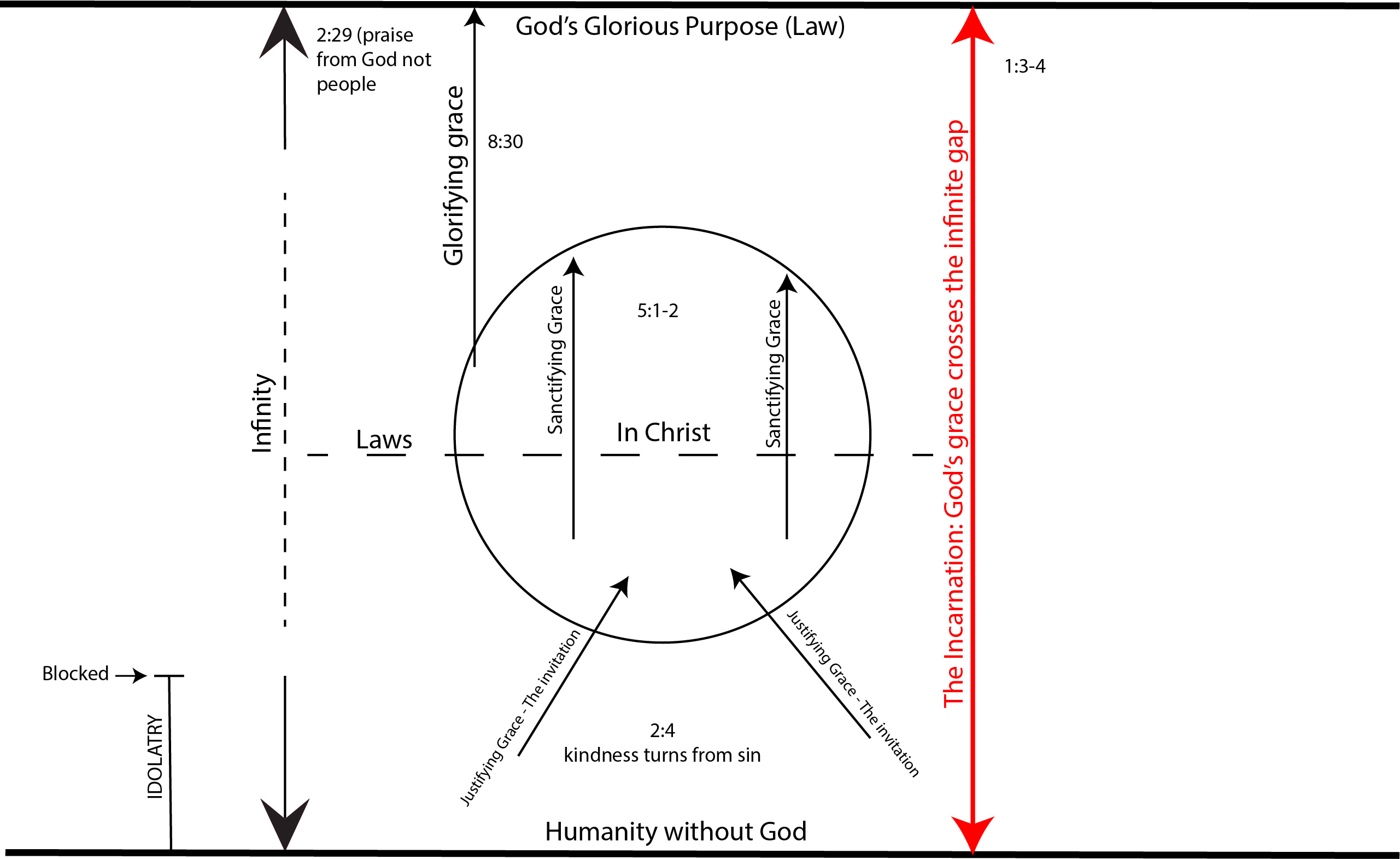
    Here’s a diagram I provided to my class. I’m going to write a few notes about it. Obviously, this is abbreviated. We have spent months getting to this point with my Romans class.

    I started to put all the notes and the text on the diagram, but that proved a bit too complex and confusing. So herewith a few notes.

    God has made no plan ever that was not intended to produce a holy people. God has a glorious purpose for us, and reaching that purpose perfectly is the ultimate goal. We have, however, all fallen well short of that, and we continue to fall short. But God’s grace is sufficient.

    There should be no balance between faith and works or grace and works, because these are different things and cannot be balanced. There is no amount of works that I can do that will force God’s hand or earn God’s favor. I like to use navigation by the pole star. Think of yourself orienting your journey by sighting Polaris. You do not believe you’re going to get to Polaris by walking in that direction, but you do believe that you’ll get to another destination. The fact that you cannot reach it doesn’t make it less of a guide for what you can reach. (You can find my calculations on the north star here, along with much other verbage!)

    The key here is the invitation of grace, the invitation to be “in Christ,” in which we allow God to work on us and change us, but we cease judging ourselves or others according to the ultimate perfection of a goal we cannot possibly attain.

    Idolatry

    The short line at the bottom left deals with idolatry. The true problem with idolatry is that it places something less than God in the place of God. That can be our own desire to attain, to be in control. We like to be in control. We feel safer if we can say that God will take us to heaven because we have completed a list of chores. But that’s placing something less than God in God’s place.

    Similarly, we can place something less than God’s perfect law in the place of God’s law. (My friend Pat Badstibner has written about this in The Law Is Not Soggy Corn Flakes.) I use Paul Tillich’s terminology to some extent, that idolatry is making something not ultimate your ultimate concern. So we have those who decide that this perfection thing being unattainable, we need to find something attainable and do that.

    Doing the attainable with God (see Philippians 2:12-13 and John 15:1-8) is just fine. God knows where he can take you, and through sanctifying grace will guide you there. (Here’s where I depart from Wesley’s plan. I don’t believe in Christian perfection. I believe that is only accomplished with glorification. It should be made clear, however, that the perfection Wesley spoke about was not the attainment of all of God’s glorious purpose for us either.)

    We start to step into idolatry when we start to trim God’s standards so that they look better to us. By this, again, I don’t mean looking at attainable goals. In fact, that is precisely what God has done with us. I show this in my diagram by the lines representing God’s commands and laws for times and circumstances.

    God’s goal is always the same, but God works this out in many different ways in various times and places.

    God’s Grace Is the Context

    On the right I put the long red line that represents God’s grace. That is the one and only thing that connects us to an infinite God. Only God can cross that gap.

    Let me apply this now to the particular question that came up in class multiple times. What do we do about sin in our midst? Do we forgive, excuse, confront, ignore?

    And here is where we need to watch out. Matthew 7:1 is, I think, one of the most misunderstood and simultaneously disobeyed passages of scripture. It’s an important command. We also have Matthew 7:15ff regarding watching out for false prophets and knowing them by their fruit. Is this latter not an act of judgment?

    I would say that we have to regularly inspect fruit and make decisions based on that. We might have to choose between one person and another to lead the children’s ministry. We might have to decide whether a pastor or teacher is acting as a false prophet. Those would be acts of judgment in one sense.

    Guidance

    The guidance I see in my chart is simply this: We also judge and inspect fruit in the light of the law and the laws.

    First, we understand ourselves to be the objects of infinite grace. We are, ourselves, sinners, in need of God’s grace and action. I realize many find this hard to accept, but I see it in the context of broader reality. I am so pitiful that without God’s creative power I would not exist at all. Thus saying I need God in order to do good is a minor derivative. From that flows the idea that all depends on God.

    Second, as recipients of God’s grace, we know that God is working in us and through us and that we are witnesses to the working of God’s grace. I often tell Christian audiences that there’s no question whether you will witness. The question is whether you will be a good witness or a bad one.

    Thus we conduct all our fruit inspection in the context of the knowledge that we are recipients of God’s infinite grace, and not as superior people looking down upon lesser mortals. That position is left to God.

    So how does that help one decide whether to confront or remain quiet?

    Simply this: It sets the context. What is right becomes the question of what is the right thing to do as a recipient of God’s grace. Proverbs 26:4-5 provides a similar issue. Read it and then ask yourself the question. If I find a fool speaking, which should I do? Listen to the Holy Spirit and decide in the context of grace.

    All to God’s Glory

    As Paul says in 1 Corinthians 10:31, “Whether you eat or drink or whatever you do, do all things to God’s glory.” So ask, “Am I doing this for God’s glory, or am I doing it to justify myself or even glorify myself?” and “Is this done as an act of grace, or an act of condemnation?”

  • A Challenge to See

    A Challenge to See

    This past Sunday I was invited to preach in my home church, Chumuckla Community Church. It’s a real privilege to speak on the last Sunday of the year, hopefully rounding up where we have been and presenting a challenge for the future.

    I was offered the epiphany scriptures, and used Matthew 2:1-12. I’m not going to summarize the sermon. My message was simple: We need to learn to see Jesus in people and respond accordingly. I contrasted the “god made manifest” of an Antiochus Ephiphanes, as opposed to the baby in Bethlehem. Where is it that you see Jesus?

    Even further, how to you pursue the mission of Jesus? Is it according to the power-seeking ways of human politics, or is it in the giving ways of the Bethlehem story? Do you see God working when the powerful make power plays, or when servants serve?

    I referred to Matthew 25:31-46. There are many debates about this passage. Years ago I read it as a performance based righteousness, and as identifying the specific type of righteous performance required. (I still think it identifies righteousness for a follower of Jesus.) I later realized that nobody who thought they were going to heaven actually were doing so, and those who were, didn’t realize it. (I understand the varying views of just what is involved in this judgment. I’m not concerned with that difference at the moment. The good guys don’t realize they’re good; the bad guys think they’re good.)

    In the last couple of weeks, however, I became aware of a tragedy in the story. I’m not in any way presenting this as an interpretation of the parable. The blessing of a story, however, is that it can convey many things. The tragedy I see is that nobody at all was aware of the fact that they were seeing Jesus as they looked into the faces of people they either helped or didn’t. Not one recognized what they were seeing. This isn’t a question of salvation, but rather of the joy of living this life.

    We can argue that we should help the homeless, as an example, on the basis that we ought to do good things. We ought to help those less fortunate. Unfortunately, this can result in condescension. We look at the person as a way to punch our “good person” ticket. Or, perhaps, we perform whatever act we do out of a sense of duty. “It sure is annoying, but I suppose Jesus wants me to help this person.” This leads, for example (and I’m guilty!) to looking the other way when we don’t have cash, or don’t intend to give to a particular person.

    I’m not arguing that we need to give money to each and every person who asks. There is stewardship. There is the need to actually help. But what we do need to do is treat every person first as a human being, as one Jesus came to save, as bearing God’s image, and as a way in which we can see the face of Jesus. Hopefully, the other person will have the opportunity to see Jesus in us at the same time.

    This is not a New Year’s resolution. I expect to fail at it many times. But my challenge to myself, and to you, is to see Jesus much more frequently, and not turn away from the faces in which he is trying to show himself to me.

    And yes, you may see Jesus in the face of someone in need, someone that society might consider less than you. But you also might see Jesus in the face of one of the world’s elites. They also have a need to be treated as people.

    As I asked the congregation of Chumuckla Community Church: Did you see Him? Will you?

  • Slippery Slopes

    Slippery Slopes

    There are a few terms that are quite true and yet misleading in many actual uses. I like to cite “Christians aren’t perfect; just forgiven.” Precisely true, but in common use very likely an excuse for ordinary bad behavior. Whatever the intent, it ends up sounding like, “I’m a Christian, so I can do whatever I want to. If you question my actions, nobody’s perfect.” They’re not perfect; you’re not perfect. In this case, however, the true statement is being used as a bad excuse.

    Or there’s the great “I’m an adult, so I’m not offended by your political views.” Just so! An adult will not be offended by the political views of others. Disagree, yes. Be offended, not so much. Though I’ll confess that some political (and religious, for that matter) views are quite offensive. But in practice this line is most frequently used by people who want to behave in an offensive manner. When someone objects, they have the passive-aggressive response. “Adults wouldn’t get offended.” So of course you’re not an adult because you get offended when they behave like toddlers. It’s true you shouldn’t get offended. What good does it do? But they’re really using it as an excuse, and as a way to manipulate you.

    And then there are slipperly slopes. Slippery slopes are real. That’s because one idea leads to another. In fact, unless you start learning, you live your life on slippery slopes.

    My particular brand of moderate, or passionate moderate as I like to call myself, celebrates being all across the slopes of various ideas. I like to identify the extremes on any particular idea or topic and then find all the ground between. Where is the best place to be? If the correct place to be is poised on the slippery slope, that’s where I want to be.

    But “slippery slope” is more commonly used as a scare tactic against certain ideas. It is quite true, for example, some some people have gone from conservative Christianity, through moderate or mainline Christianity, then progressive Christianity, and then to atheism. It’s a slippery slope. Once you start thinking, it’s hard to be certain where you’ll go. It’s also true that many people have reacted badly to their conservative or fundamentalist upbringing and have then jumped straight to atheism.

    Others have turned to Christian faith and then gotten narrower and narrower and harsher and harsher and ended up as dangerous cultists.

    Yet others have turned to Jesus and slid right down the slippery slope to living a life of sacrifice and commitment to Jesus. Some of these have ended up doing mission work on the street.

    I have named none of these, but there numbers are quite substantial.

    You live in a world filled with slippery slopes. It’s not only likely you’ll make mistakes and find yourself sliding somewhere you don’t want to go. It’s likely someone else has taken a step similar to one you’ve just taken and then continued on to somewhere you don’t want to go.

    My suggestion would be to always remember where you have been, and to always consider the foundations of what you believe. That will help you measure your movement and decide whether you really want the changes taking place or not.

    Or, alternatively, you can anchor yourself where you are, and live in fear of the slippery slopes all around. It’s not all that likely you’ll be right or safe.

    You might even avoid slipping into some beautiful new truths!

    Beware of the fear of slippery slopes.

  • Connecting the Unhooked to the Word

    Dave has some interesting points here. Love for one another doesn’t disconnect us from the “other.” A genuine church might attract genuine people.

  • Reading, Studying, Discussing, Teaching, and Proclaiming but not Practicing

    Reading, Studying, Discussing, Teaching, and Proclaiming but not Practicing

    I was struck by Dave Black’s note on Hebrews 4:14-16 from Wednesday on his blog. I extracted it to jesusparadigm.com, as Dave’s blog is a journal that doesn’t offer links to individual posts. (I have his permission.)

    I highly recommend his post. It struck me because Hebrews is such a central part of my reading and study. There are those who claim I can’t get through an hour of study, no matter what the subject, without referring to the book of Hebrews. Within Hebrews, 4:14-16 has to be one of my most quoted passages in the book.

    Dave talks about not going to our great High Priest first. That really struck me, because I think I don’t either. The other day I woke up in a cold sweat because I had dreamed about something critical going wrong. Now I’m working through quite a number of things that can justify worry, in a normal sense. I was telling Jody about my “awakening” and she just said, “Next time you wake up in a cold sweat, just remind yourself that Jesus has it all under control.” Jesus says, “Can anxious thought add a single day to your life?” (Matthew 6:27 REB).

    I don’t intend to do less. But I’d also like to worry less. None of the problems I’m facing have been alleviated by my worry. Not one.

  • Can We Have a Commitment to Biblical Truth?

    Can We Have a Commitment to Biblical Truth?

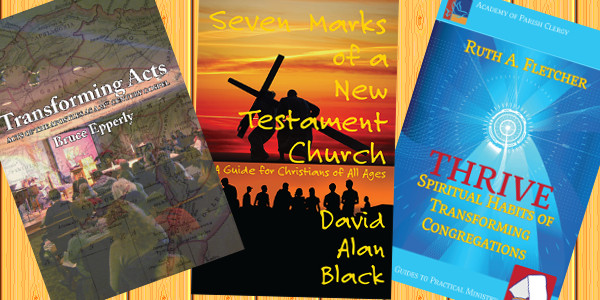
    We now come to the third mark of a New Testament church, and that is its commitment to biblical truth. One of the weakest aspects of Western Christianity is our failure to give proper teaching to new converts. As a result, biblical illiteracy plagues the church in America. This is a weakness in some mainline churches, and often in evangelical churches too. (Seven Marks of a New Testament Church, p. 17)

    I discussed this to some extent when I worked through this book, but now I want to place the question before my readers for some discussion. With the wide variety of beliefs that we claim are biblical, one wonders just what biblical truth is and how we discern it. Are all those who disagree not listening to the Holy Spirit? Are they ignorant?

    Read my previous post, which also quotes from Transforming Acts: Acts of the Apostles as a 21st Century Gospel and Thrive: Spiritual Habits of Transforming Congregations.


  • Video Interview for Quit Christianity

    Their title may not tell you precisely what they’re up to, but I’ll let you figure that out by visiting.

    I was asked to answer a few questions for a video, with a key text of Romans 4:3. Here’s the video. It’s nice when someone truly skilled puts the final result together!

    https://youtu.be/jEsyvEGeCu4

    There’s lots of interesting stuff on their channel, which you can find by clicking through on the video link.

  • Grace and the Book of Hebrews

    Grace and the Book of Hebrews

    In my experience, Hebrews has provided a wealth of texts for sermons that call for works and human effort. Pride of place, perhaps, should be held by the Wesleyan doctrine of Christian perfection, for which one of the central texts is Hebrews 6:1. No matter how many times Wesley affirmed Christian perfection as a gift of grace, he was unable to prevent this becoming a basis for performance based salvation, judgment, and self-righteousness. (While I believe in sanctification, and will mention it below, I don’t accept the idea of perfection in this life.)

    Hebrews 6:4-6 follows, which is often treated as teaching that if we commit some particular sin or other, we will lose our salvation for doing so. I’ve written about this recently, and I disagree, but I’ve heard it preached.

    Then there’s Hebrews 10:26-31, starting with the warning against continuing in sin and ending with what a terrifying thing it is to fall into the hands of the living God.

    Or Hebrews 11, so often preached as a litany of great accomplishments and presented against the lack of accomplishments in the congregation. We must, of course, become faithful like these heroes of ancient times and hold up our end of the deal. After all, God needs us and demands our service.

    Hebrews 12 starts with the clouds of witnesses, which I’ve heard preached as the “encouragement” of having all these wonderful people watching you from heaven, so you had better not mess up. Don’t want all these holy people watching you mess up, do you?

    Of course, you aim to accomplish all of this in fear of the God who is a devouring fire (12:29).

    James may be seen as an epistle of works (not an accurate portrayal, in my view, but Hebrews may well have been the source of more sermons on performance righteousness.

    But is this approach justified by the text of the letter itself? I don’t think so.

    Let me make a couple of assertions that I’m not really going to justify. Knowing that I believe these may help you understand the rest of what I’m saying. The first is that there was never a plan for salvation presented in scripture that did not have as its goal the creation of a holy people. From the invitation to the first couple to walk in the garden with God, to the call in Leviticus to be holy as God is holy, to Jesus asking disciples to follow him, to Paul inviting everyone to put their faith in Jesus, the anointed one, all the plans are part of one plan aiming at that point. The second is that grace is one of the, of not the, most difficult things to accept, because if grace is true, we are not in control. We humans like to be in control.

    Hebrews is a book about God making a holy people, and it’s a book about how none of us are in control.

    Hebrews starts with the description of God’s gracious gift, himself, in the person of Jesus. Hebrews 1:1-4 lays out this presentation. The one who is sent is sufficient to the task. As we move through the book, we see Jesus presented as one of us, tested as we are, and sharing in our experience. I have been asked whether I see Hebrews as teaching substitutionary atonement. If this is a question of whether Jesus died for us and for our sins, then the answer is surely “yes.” But if we mean “penal substitutionary atonement,” as in Jesus taking our punishment in a judical context, I think the answer is “no.”

    In Hebrews, Jesus is presented as becoming one of us. The necessary elements of the sacrifice is that it must be perfect, i.e., fully connected to God, and also fully ours. Then the form of “dying for” is incorporation. We are in Christ who is our king, our parent, and our priest, and we are incorporated in his death. He dies and we die “in him.” It is not a judicial substitution, but rather that the one dies for the nation (John 11:50) as one of the nation, indeed, as the king. The key here is that we become incorporated into that kingdom, that community, and are thus buried in his death and raised into his life (Romans 6). I think Hebrews is closely aligned with this Pauline theological presentation. Everything we are called to accomplish in the book is accomplished in Christ. That’s why Christ is presented first in the book and his superiority is established. (Refer again back to my post on Hebrews 6:4-6 for some backup for this idea.)

    So when we are called to perfection, we are called to be carried on to perfection. This is not the perfection of a person who lives a perfect life, and certainly not something we accomplish on our own. That’s clear through the arguments on why Jesus is the perfect high priest. In order to make that argument, one must establish that we are not capable of this on our own. The perfection to which we are called and to which we are carried is not ours, but the perfection of Jesus (Hebrews 5:9). He, Christ, is the source of salvation.

    Of course it is a terrible thing to fall into the hands of the living God, but we can instead be in the hands of the living God through the high priest who is sympathetic to our weaknesses. Of course, there is no more sacrifice for sin. If Jesus has opened a “new and living way” (Hebrews 10:19-20), then the only options are to go through it or not. If we are offered complete access to God and incorporation into his redemption and sanctification, what other option is needed? What other option could possible work?

    Then there’s Hebrews 11, which I think provides the key to the view of the message of Hebrews I’m presenting here. Contrary to those who preach Hebrews 11 as a triumph of the saints, it is, in fact, a triumph of grace in action. We err if we read this without adequate consideration of the stories from the Hebrew scriptures of these great heroes. Moses doesn’t fear the wrath of the king in Hebrews 11, but he flees in terror in Exodus. Sarah is rewarded for faith, but in Genesis she laughs. These people were not those who tried to obtain perfection, but those who were carried on to perfection. In 11:40 we are told that God’s plan was that they should attain perfection “with us.”

    That perfection, I believe is found in Jesus, and only in Jesus.

    These are the witnesses of Hebrews 12. We are being watched as we are carried on by those who have been carried before us. The question is truly simply whether we will truly be carried on. We can miss this both by thinking that we are going to do it ourselves, or by missing that it needs to be done at all. I’ve used the metaphor of a train for the theme of Hebrews. Get on the right train and stay on it until it reaches its destination. You can equally fail by sitting at the train station by never getting on the train, or if you set out to run alongside the train on your own power. Neither one will work. But if you get on the train you’ll move forward. (As with all metaphors, this one has its weaknesses!)

    In this view of grace, it is not put against faith. It is not faith vs. works, as though there were two approaches and one was better. It’s not a balance between faith and works. No amount of running, even combined with train-riding attempts, is adequate. But sitting in the station is also not a real option.

    What I think Hebrews makes clear is that the grace is available. Jesus opens the way to God. This is grace in action. But rather than being the enemy of true works, works of faith, grace is what opens the door and makes any works, any holiness, and any approach to God possible. Sanctification occurs only on the train, i.e., only when we are being carried on toward perfection in Jesus, our brother, our sacrifice, our high priest, and our king.

    That’s why I see grace as the critical key to the entire book of Hebrews, but I also see the book as providing a critical view of grace, a grace that is active, even more, that is God’s action taken in our lives.

    In this post I have not provided nearly enough scripture and logic to back this up fully. This is just an introduction. My recommendation is that you consider these ideas while reading the entire book to see what you find.

    (Feature image credit: Openclipart.org.)