Threads from Henry's Web

Category: Bible Study

  • Quick Follow-up on Hebrews 2:6-8

    I commented earlier on the difficult choices involved in translating an Old Testament reference that does not match the Old Testament passage in your own translation.

    Here’s an example from the NIV1984. First, Psalm 8:4-6 –

    what is man that you are mindful of him,
    the son of man that you care for him?

    You made him a little lower than the heavenly beings
    and crowned him with glory and honor.

    You made him ruler over the works of your hands,
    you put everything under his feet.

    Now look at this as translated in Hebrews 2:6-8 –

    “What is man that you are mindful of him,
    the son of man that you care for him?

    You made him a little lower than the angels;
    you crowned him with glory and honor
    and put everything under his feet.”

    The key phrase here is “a little lower than the angels.” The usage of this line in Hebrews will reflect an alternate translation of the Greek (LXX), “for a little while lower.” The translation is, I believe, accommodated to the phraseology in the Old Testament. The NASB is pretty open about simply translated the text in front of the committee, and leaving it to commentators to deal with the difference in the text and translation.

    I find this interesting, though not a major issue. It is valuable, however, to understand the approach taken by your translation. I am much more concerned with the attempt by the NIV to “fix” problems through questionable translations, such as the sudden introduction of an unjustified pluperfect at Genesis 2:19, a rendering that survived from the 1984 to the 2011 NIV.

  • Keeping Up Greek for Exegesis

    Keeping Up Greek for Exegesis

    9781893729179mDave Black posted today about keeping up Greek and its importance for exegesis. I’ve extracted that post to the JesusParadigm.com site so as to have a specific link. Everything he said could apply to Hebrew as well. I turned to his passage, though I was confident I would be able to read it. I’ve read the entire gospel of Mark multiple times in Greek as part of keeping up my language skills. I was not disappointed. I learned Greek and Hebrew so that I would be able to read the texts in the source languages, not so that I could occasionally look up a Greek or Hebrew word, or pronounce words tolerably well when I found them in commentaries. I’ve kept up the skills necessary for that.

    So how fresh is your Greek? Does it help you?

    I’ve questioned our approach to teaching biblical languages in seminaries for a very long time. Quite often I believe that students learn just enough Greek to be dangerous and in a way that is often dangerous. Witness how common it is to hear a preacher say “what the Greek here really means here” or “what this Greek word actually means.” Either of those statements, almost without exception, means that someone doesn’t really know how language works. The result is a new translation. Assuming the preacher involved is using a modern English translation produced by a committee, he’s asking you to accept the “real meaning” as determined by someone with a couple of semesters of the language over the “real meaning” as determined by a committee of qualified scholars.

    So do I bow to the “committee of qualified scholars”? I do not! I have my own opinions. I study passages for myself. But when I translate from Greek or Hebrew and use it publicly, or when I comment on the meaning of a passage based on my own study, I identify it as such. It is my opinion after I have studied, not the “real meaning.” It might be the real meaning. I hope it’s the real meaning in that context. But in reality it’s my best approximation of it. Since I’m the one teaching the passage, that’s what I work with.

    My thought is that if we are not going to require actual proficiency in the biblical languages, we would do better to teach students just a few basics and then a great deal about linguistics to help them understand what they read from various commentaries or articles. The number of pastors I know who truly apply their Greek and Hebrew in a beneficial way is vanishingly small. I would urge those pastors who have a little Greek to work on getting more. If you are not truly skilled, make sure to use your Greek carefully.

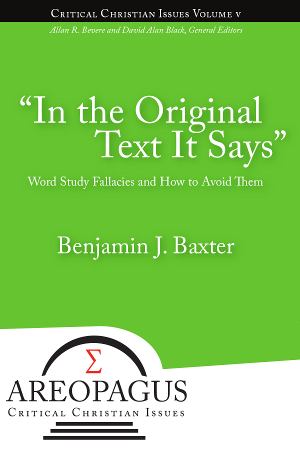
    Come to think of it, I publish something useful: “In the Original Text It Says …”, and Dave has written something too, on which I wrote a few notes: Book Notes: Linguistics for Students of New Testament Greek.

  • Barriers to Hearing the Word

    It turns out that I was off the track a bit in saying what we would discuss in Sunday School this morning. I think it’s one of the problems of teaching from a book I wrote. Everything is familiar and I can’t remember precisely what we’ve discussed and haven’t. I should perhaps take better notes, but this is a fairly free-form class. In addition, I guest taught another class one Sunday in the a couple of weeks ago on a closely related topic.

    In any case, today we were discussing more about how we (and preachers) shape our expressions to the audience and how we should recognize that and still test everything, especially the things we are inclined to hear. As an editor, I’m well acquainted with the tendency we often have to be more tolerant of data presented by someone who is agreeing with us. We need to test everything and not just accept it because someone said it.

    We will also not get to the material I mentioned on the history of receiving the word this coming week. That will wait for three weeks from today (we won’t have class on Consecration Sunday). This coming week the topic will be barriers to hearing the word. The section in my book is derived from a pamphlet I prepared several years ago. I do intend to re-edit and reformat that pamphlet, but I haven’t managed to find the time. The current edition can be read at Seven Barriers to Hearing the Word. I suspect we can take some serious time discussing those seven barriers and maybe a few more.

  • 1 Thessalonians 1:1-10 – Translations

    My wife reminded me after her own study of 1 Thessalonians 1 today that those who don’t read Greek don’t necessarily see the same divisions or indicators of divisions. Translation does often involved changing the sentence structure and might require changing the division of paragraphs.

    I noticed that the commentary Dave referenced (see this post) using 1 Thessalonians 1:1-3 as the first division of the book also uses the NIV as it’s English text. The NIV also makes that division in the text. I thought it would be interesting to list some of the major translations and what how they divide the paragraphs in this chapter.

    With some help from BibleGateway, my Logos software, and my bookshelves, here goes.

    A) 1:1, 1:2-3, 1:4-10 – NIV (1984 & 2011),

    B) 1:1, 1:2-3, 1:4-7, 1:8-10 – NLT

    C) 1:1, 1:2-10 – NRSV, ESV, CEB, HCSB, REB, NASB

    D) 1:1, 1:2-5, 1:6-10 – NET, Die Gute Nachricht

    E) 1:1, 1:2-3, 1:4-6, 1:7-10 – CEV

    F) 1:1, 1:2-5, 1:6-8, 1:9-10 – ISV

    G) 1:1, 1:2-3, 1:4-10 – NJB

    I could check quite a number more, especially if I checked all the foreign language Bibles I have available. The author of a commentary on an English translation is generally constrained at least to start from the choices made by the translators, though he or she can certainly debate those.

    I’d make a few points:

    1) The wide variety of divisions indicates the difficulty of translating this long Greek passage into readable English sentences. We simply don’t make one sentence (or two) quite this long.

    2) Reading the passage in English obscures the underlying difficulty. One could wonder why there were so many distinctions.

    3) Reading multiple translations while paying attention to the divisions in the text will help the English reader get an overview of the complexity and of the options available.

    I try to teach people to understand that the divisions are not original to the writers, and that they should consider understandings of a passage that cross the divisions made in the text. Don’t get hung up on the added material.


  • 1 Thessalonians 1:1-10 Structure

    Dave Black commented on the structure of this passage, and I’ve been trying to work with it a bit. I do a loose form of phrasing when I study, in which I break pieces of the passage in some detail at times and leave others less chopped, so to speak.

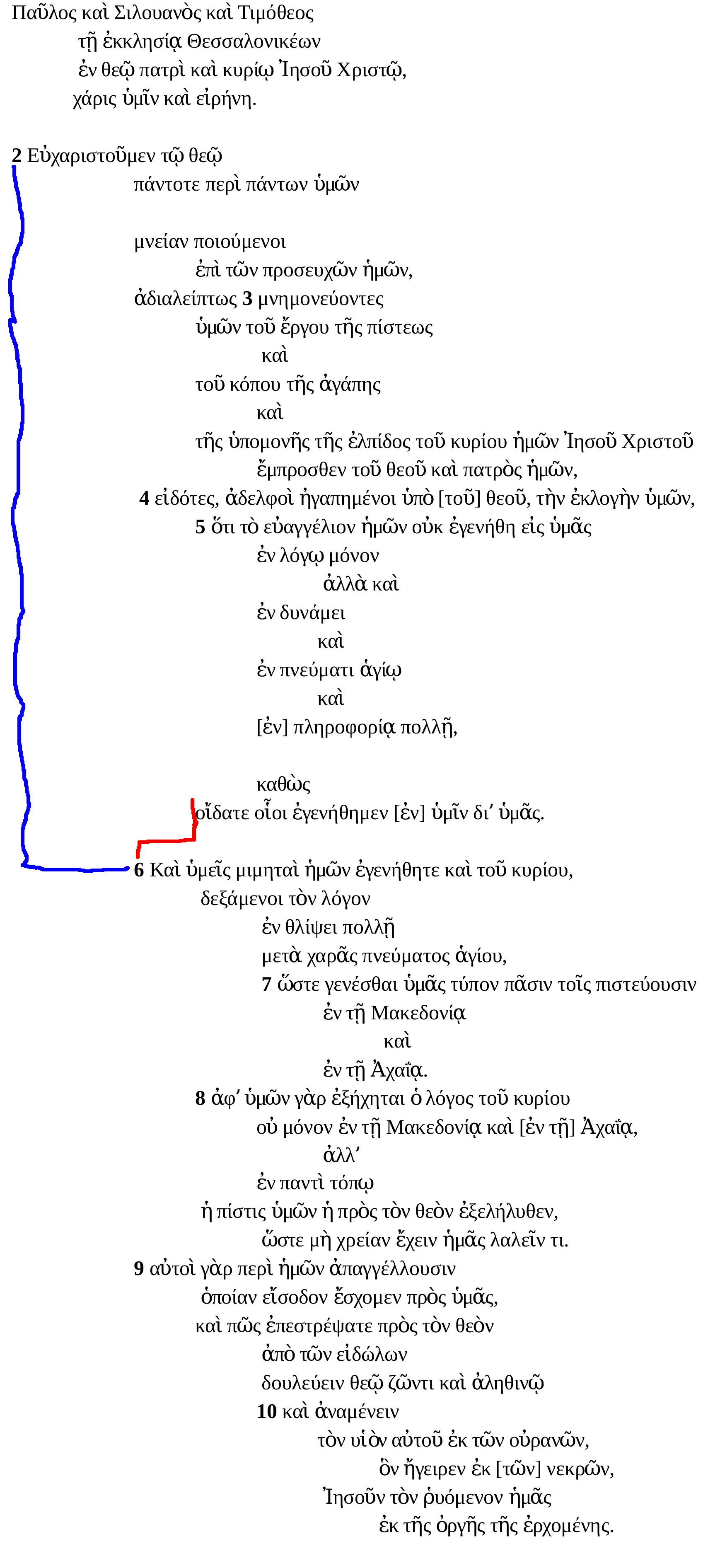
    This morning, my Sunday School class, always small, was canceled due to absences, so I spent some time chopping! Here’s an image of what I did. This is a large image. If you want to actually read it, you can click on it, but if you have your Greek NT nearby, you should be able to see just the shape.

    1 Thessalonians 1-1-10 Greek


    Now I don’t know if this was of any value to you, because it’s just my way of thinking about the structure. You may find it hard to follow. I know there are some phrasing systems that are different.

    Nonetheless, it helped me, though I don’t think it finally answered the questions I had. You might want to read Dave’s post (which I copied to JesusParadigm.com so we’d have a good link!) before this discussion.

    There seemed to be two major questions, first whether 1:2-10 should be divided into two paragraphs (2-5, 6-10) or seen as one, and second whether one could imagine a division of the text that used 1:1-3 as a division.

    As to the second question, I could not see when I first read this how it could be divided in that way. First, there is a clear division, in my view, between 1:1 and 1:2, and second, there is no division that I can see between 1:3 and 1:4. I think eidotes is likely parallel with poioumenoi in modifying eucharistoumen. (Pardon some loose transliteration.)

    As to the first, this results from the e-mail that was sent to Dave, challenging the division between 5 & 6. The most logical reading seems to me to relate verse 6 right back to the thanksgiving of verse one. My blue line on my image above would should the structure if 6-10 is a different paragraph. My red line subordinates it to eidotes in verse 4. I was having a hard time seeing that logic until I had broken this down and bit and read it several times. It could be, but I would lean to making 2-10 a single paragraph and tying verse 6 back to verse 2. Lean, not fall head over heels into.

    I rarely post this sort of stuff. I’m not really an expert, and the epistles are not my normal stomping ground, but one must venture off of comfortable territory at some time or another!

    I do want to call attention to Dave’s article and his post because I think it is unfortunate that so many of the epistles are chopped into pieces in the way they are used in the church. We have our proof texts and our favorite passages, but we don’t read them as a whole. They’re short. You can afford to sit down and read the whole thing. I can afford to sit down and read all of 1 Thessalonians in Greek. It’s fun, and it’s profitable.

    On something this short, I recommend starting a study by reading it 12 times, preferably in different sources. It’s a good time to polish up your Latin or French, or if you’re not into languages, just use a number of English translations. People tell me they’ll get bored reading the same thing 12 times. I haven’t found it to be so. I recall being challenged to try this on the Sermon on the Mount. I promised to stop when I found nothing new. I read it over 30x, and stopped just because I needed to study other scriptures. How can it be boring?

    But even more, we neglect so much of the Pauline material in the Bible. Galatians and Romans are the big things, but I think you won’t understand Paul unless you read other epistles. I think 2 Corinthians is another one that is neglected, and by neglecting it, we miss some of who the apostle Paul was and how he led churches.

    Those are my thoughts instead of teaching Sunday School!

    What do you think?


  • My Own Custom Bible

    I have in my inbox an e-mail sent on behalf of the American Bible Society. The subject line reads: “Create your own Custom Bible from American Bible Society.”

    I suspect some folks are thinking I’m going to draw the obvious lesson that we shouldn’t have our own custom Bible. After all, the correct Sunday School answer, whenever it’s not Jesus, is “everything it says in the Bible.” Others are probably thinking that if I do so I’ll be horribly unfair, as indeed I would. What the American Bible Society (an organization I strongly support) is doing is offering the option for organizations to get Bible bindings for particular situations. This is simply an application of modern printing technology. In many churches you’ll find Bibles with dedication labels. Some evangelism efforts have Bibles with contact information added. Modern technology lets you build all of that into the printing. I don’t have a problem with such editions.

    But the line still intrigued me, not because I think it’s so wrong, but because I think that taken out of context, it describes what pretty much all of us do with the Bible. We have our own custom Bible. Not only am I not writing to criticize us for that; I’m actually going to suggest it’s impossible for us not to have our own custom Bible. Why? Because we are such very custom individuals. Often we don’t even realize what we are bring into the text.

    I remember once discussing the issue of oaths with a someone who believed that Matthew 5:33-37 meant that one could not swear to tell the “truth, the whole truth, and nothing but the truth” in court, whether or not one added “so help me God.” Now my issue is not with his view of that text. He could be right. Rather, the issue is with the basis of that interpretation. He stated to me that his view was that we should take a scripture passage to mean what an average American high school graduate would understand from it. Thus, “don’t swear” would, he told me, mean “don’t swear” to this average American high school graduate. I then pointed to Matthew 5:29-30, which says we should pluck out our eye or cut of our hand if it offends. He immediately told me that this meant that one should be prepared to give up everything, even our lives, through martyrdom. I, being the mean, obtuse, and twisted person I am, asked him immediately if that was how the average American high school graduate would read it.

    He had a tradition that suggested how he should read these various texts. His tradition customized his Bible. In fact, tradition commonly customizes our reading of the Bible, and we rarely can escape that completely. We can be so certain that a text means a certain thing, that we don’t even consider alternative readings. I’m often annoyed by the extent to which modern commentaries cite every which possible reading and understanding of a passage before coming to any conclusion. It results in commentaries of 500+ pages on five page books. But there’s a good reason why scholars are taught to look at other commentaries: It forces them to think about approaches to the text that are different from their own.

    Tradition isn’t the only way we filter the text. When I first saw the e-mail subject line I though immediately of our favorite verse, chapter, book, and so forth. I remember one class I was teaching. After a couple of weeks they would laugh whenever I used the words “one of my favorite,” simply because I had designated so many passages as “favorite.” But that doesn’t exempt me from having a custom Bible. I still have passages I read more than others. I tend to avoid some of the favorites. I know more about Hebrews than Galatians or Romans, for example. I know more about Leviticus than Isaiah or Jeremiah. This is because of my personality, which tends to avoid well-trodden paths.

    Should we try to make our Bibles less custom? I think it’s a good idea to do so, but only so long as we remember that we won’t get there completely. When we forget the things that influence our own interpretation we tend to get arrogant.

    Commercial note:

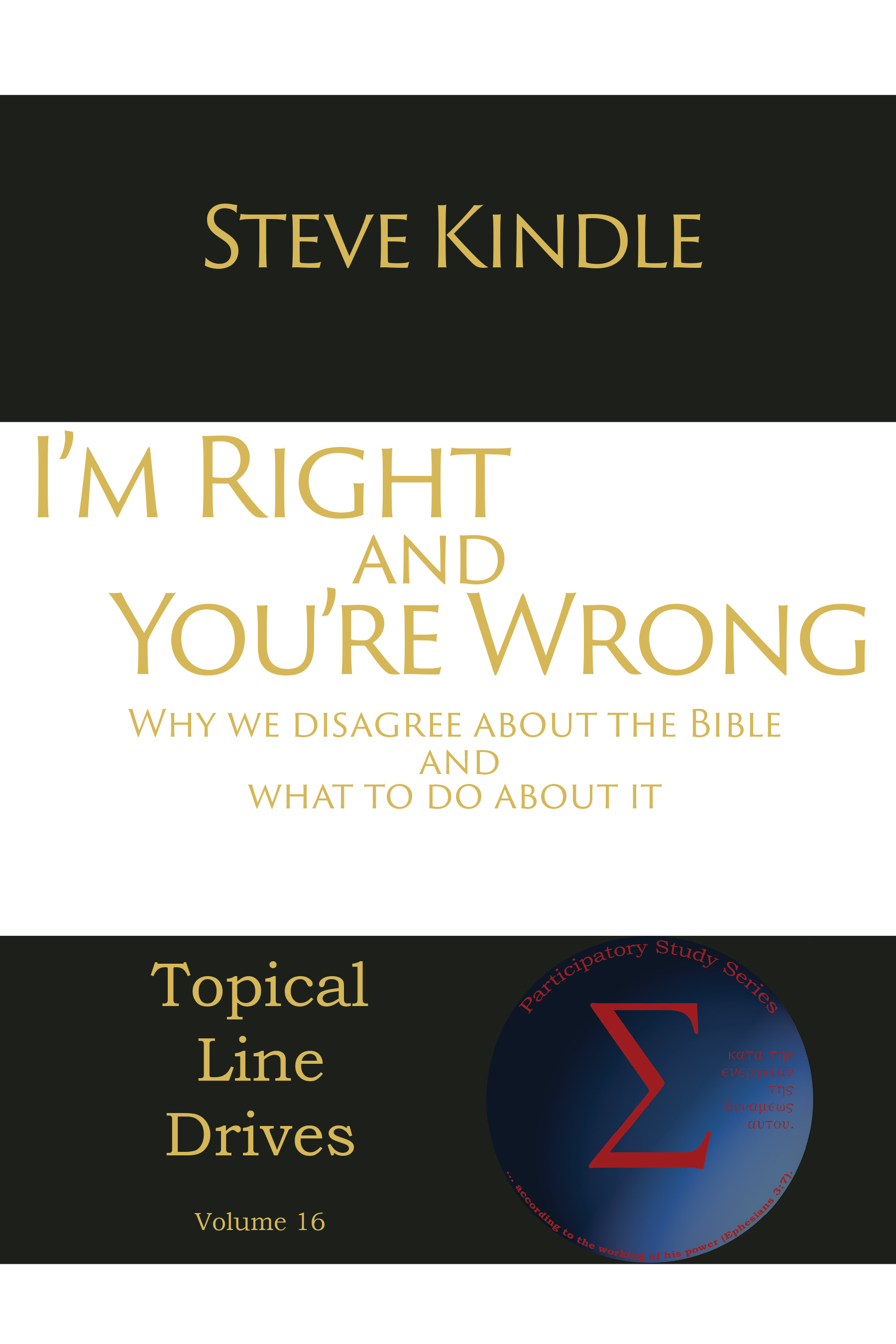
    My company, Energion Publications, will be releasing a book early next year. I’ve already had a chance to read the manuscript, and will be announcing it as forthcoming within the next couple of days. In the meantime, look at this cover and especially the subtitle:

    9781631990991I believe I shall enjoy marketing this book!

  • Old Testament Violence Discussion

    Allan R. Bevere is hosting a response from L. Daniel Hawk to Adam Hamilton’s three part series on the violence of God in the Old Testament. It’s a topic I find fascinating. I’m going to wait for detailed comment until I’ve read all of Dr. Hawk’s response. But I can tell you what I’m looking for in two quotes.

    In Adam Hamilton’s second part he states:

    … If we understand the Bible as having been essentially dictated by God, then yes, we have no choice but to accept what is written as accurately describing God’s actions and God’s will. But if we recognize the Bible’s humanity—that it was written by human beings whose understanding and experience of God was shaped by their culture, their theological assumptions, and the time in which they lived—then we might be able to say, “In this case, the biblical authors were representing what they believed about God rather than what God actually inspired them to say.” …

    Note that this is extracted from the middle of a paragraph which may contain pointers to how Hamilton would answer the question. I have not read his book. But the issue that this statement raises with me is this: Do we have an adequate hermeneutic that will allow us to discern God’s will and purpose from the human-divine mix? In my experience, very frequently those who say this do not. Note that I’m very definitely one who says that the Bible is a divine-human combination, using an incarnational model. But that combination (not mix), is all present by divine will. Why are those violent passages present? How do I learn from this?

    Dr. Hawk, on the other hand says this:

    Here’s the main flaw in this line of reasoning. Who decides which texts are humanly-contrived and which are inspired? And on what basis? This is a slippery business to say the least, and especially so when historically-oriented interpreters attempt to ground their decisions by discerning the intent of ancient authors and redactors. While we have learned a great deal about the historical and cultural environments of the ancient world, we cannot even today confidently locate the composition of most texts in a particular historical and social context. Furthermore, our ideas of what was in an ancient author’s head will inevitably be infused with the projections of our own ideas and perspectives.

    This time I at least quoted a full paragraph. And what’s my problem with this? Well, in my experience both sides pick and choose and then accuse the other of doing so. There is not only choosing what we accept as relevant, but we need to choose just how some particular passage is relevant. I’m going to wait for the rest, but I doubt Dr. Hawk is suggesting otherwise. Nonetheless statements like ” … our ideas of what was in an ancient author’s head will inevitably be infused with the projections of our own ideas and perspectives” tend to get me on edge, because I am so frequently then told that either we must then accept the orthodox interpretation (also selected by the speaker), or that we must essentially give up on discerning the meaning. I have some confidence that Dr. Hawk isn’t headed that direction, yet paragraphs such as this raise an attention flag for me. I ask here again just how we will discern the message God intended, and discussing the obscurity of it can drive people away just as much as the attempt to discard the humanity.

    I’ll say more when I’ve read the final post. I may have to read a couple of books as well, considering that what both of these men are saying comes from much more extended works on the topic.

  • Reflecting on Today’s Sunday School Discussion

    9781631990021Today my Sunday School class, The Way at First UMC Pensacola, will spend a second week discussing Process Theology after reading Bruce Epperly’s little introduction (Process Theology: Embracing Adventure with God).

    Last week we spent most of our time on definitions. Asked to relate Calvinism, Arminianism, Openness Theology, and Process Theology, here’s what I came up with. Perhaps my more theologically inclined readers will tell me how I did.

    • Calvinism – God created the universe and foreordained all that would happen. He knows the future both because he does it, and because he is above space and time, transcendent.
    • Arminianism – God created the universe, and the people in it have real free choice, an impact on what happens, and God elected those who he foreknew would choose salvation. As with the Calvinists, God is seen as separate from the universe, not bound by time and space.
    • Openness – God created the universe as described by the Arminians, but has chosen to work within the universe and not to know. It is as though all time and space is available for God to see, but he chooses not to see all time, and thus works with us as though he lacks this form of foreknowledge. (Note: I have also heard openness express as “God knows everything there is to know, but the future is not there to know. I got the definition I used through an interview with Dr. Richard Rice of Loma Linda University and am using it from memory, so I wish to credit him without blaming him for the way I shortened it!)
    • Process Theology – God is entangled with space and time, expressed by panentheism, i.e. the universe is entirely in God. Process theologians talk about God’s action much as openness theologians do but without the same transcendence. (Note that this is not the same as pantheism, in with the universe and God are the same.)

    One of the questions I will ask today is this: How much difference does your belief on these various systems make in the way you relate to God and to others? Is this important or trivial?

    My own comment is that while I personally don’t find Calvinism scripturally acceptable (though I certainly understand where it comes from scripturally), I have never had difficulty working with Calvinists in ministry and mission. (A few of them have difficulty working with me, I suppose, but really not that many.) So while I’m Arminian with a certain sympathy for the openness position, I don’t consider this some sort of test of fellowship or faith. The reason is simple: I don’t think I know the answer. I see in scripture God interacting with people as though the outcome was in doubt. I see statements that sound much more static. I see humanity’s free will and responsibility asserted. I see God’s absolute sovereignty asserted. I don’t think we really know how they relate in actuality.

    So on something that is so contentious, and I think so subject to error, a bit of humility is in order.

    Next week we’ll begin studying my own book When People Speak for God. Other than my study guides to Revelation and Hebrews, I’ve rarely used one of my own books as the basis for a class discussion. Fun!

  • Bible Study for Monday, July 28

    Well, we didn’t do so well this past Monday, but a new week is coming! On Monday, July 28, we will meet again via Google Hangouts, with the announcement via e-mail (if you’ve requested one), or on my Google+ page.

    Jody has already posted the question for this coming Monday and the scriptures:

    The Scriptures for this week are:
    Isaiah 55:1-5
    Psalm 145:8-21
    Romans 9:1-5
    Matthew 14:13-21

    Opening question is: What legacy will you leave your family and friends? Or What legacy did your parents leave you?

    I’d simply focus in on the word “legacy.” Start with Romans 9:1-5 and work outward. I suggest reading all of Psalm 145 and Isaiah 55. If you haven’t read all of Romans 9-11 recently, try that as well. It puts the question of Romans 9:1-5 into some context. I’ve found that those on the Arminian side of the divide people tend not to like Romans 9-11 very much. When I took Exegesis of Romans as an undergraduate, we didn’t make it out of chapter 8. The semester ended and there we were!

    I recall one discussion group I was leading as we studied the book of Hebrews and its connections with other scriptures. Suddenly in the middle of one session one of the members stopped us all by exclaiming, “Wow! You’d almost think there was a plan!”

    Yeah, you just might at that. Look for the plan. Look for the legacy.

  • Work Glitch and Bible Study

    Something happened on the way to Bible study, and we were unavailable. We apologize profoundly to anyone who showed up. We will resume next Monday night. We’ll announce the topic tomorrow.