Threads from Henry's Web

Category: Bible Study

  • On Ecclesiastes and Disagreeing with Authors

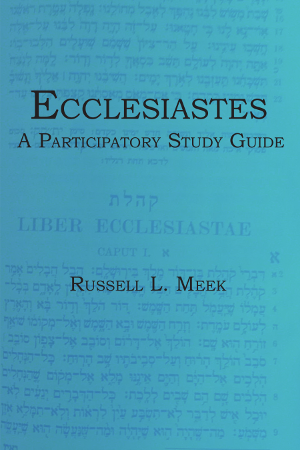
    Ecclesiastes: A Participatory Study GuideNo, not the authors of the biblical text, though that’s an interesting topic. I’m talking about disagreeing with a study guide author, in this case a study guide author I chose both to publish and then to use in my Sunday School class.

    One class member was surprised—not shocked, annoyed, or disturbed, but just surprised—that I would make those choices.

    More on that in a moment. What is it that I disagree on? Well, it is fairly simple and quite broad: authors, date, and the translation of the Hebrew word hebel. Those are the subjects we’ve covered in the first two chapters. I consider Solomonic authorship unlikely. It sounds to me more like someone later writing in a way that will suggest to his readers hearing this later literature in the light of the life and times of King Solomon. Incidentally, while I haven’t studied it that much, this could be a textual relationship, and the methods taught in chapter 2 could be used to discover whether there is, in fact, such a relationship, or if it’s just a relationship of ideas, or none at all. On hebel, I tend to read it more negatively than does the author of the study guide.

    This recalls to my mind some of the best times I had in college and graduate school. I would get together with a group of fellow students, sometimes with one of our professors, and we’d hash out issues. The goal wasn’t to find people you agreed with. That was pointless. The goal was to find brilliant people who thought differently than you did. Then you’d argue out the details and you’d all learn new things. The only time disagreement was a problem was when someone couldn’t be reasonably gracious about it. Vigorous disagreement and a spirited defense of one’s ideas was good. We tried not to get personal, and generally succeeded.

    What I told my class was that agreeing with me wasn’t even a consideration in choosing what book to publish. If it slipped in, it could just as well be a negative as a positive.

    These first two chapters of the Ecclesiastes study guide are brilliant, in my view, because they present views that will be controversial in many quarters, and they do so thoroughly, but in a way that a serious non-specialist can read and understand. You don’t just learn what the author’s opinion is and the names of some people who oppose it. You learn why he made those choices. The introduction to intertextuality is also excellent and gets Bible students to think of things that we often neglect. Just how do two texts/passages relate? Which might have influence the other? That involves sequence and availability. Which was written first? Is it likely that the earlier work was available to the later writer? What characteristics would show that two texts were related?

    People from all parts of the theological and spiritual spectrum have an unfortunate tendency to read things they find agreeable. I’m hoping that through both teaching and publishing, I can get them to look at things that are very different. This is not simply to get an idea of the spectrum of ideas. It’s also so that people learn why. In the 21st century it is unrealistic for pastors to assume people won’t get exposed to these other viewpoints. Yet there are still pastors who think they can somehow protect their congregations from discovering this fact.

    Bible students all too frequently simply accept what their study Bibles, their pastors, or some Bible teacher says as to authorship, dating, relationships between texts, and interpretation. They don’t understand why those things happen. This guide is attempting to teach people how to examine the nuts and bolts of the process, how to make such determinations for themselves.

    I was reminded of the conversation in class during the sermon. My pastor was preaching from Matthew 5, including the portions that discuss divorce, lust, and adultery. I happened to agree with what he drew from the text, but I noticed that it would be nearly impossible for people in the congregation to rebuild his logic. It’s likely a bit much to expect a pastor to get any of that “other stuff” across in a 20-25 minute homily, but I think it is unfortunate that for many congregants, that one discussion will be all that they learn about that passage. They will go home with an interpretation (assuming they remember it), but will be unable to defend it, and would be unable to reproduce it or apply the same principles to another text.

    I truly don’t look for authors who agree with me. I look for authors who will educate, because education in turn empowers people to take action.

  • Trajectories, Hermeneutics, Sexual Ethics, and Ecclesiology

    Reading Chris Seitz on the Biblical Crisis in the Homosexuality Debates (by Alastair Roberts) reminded me of three things I already believed:

    1. It is very dangerous to try to develop hermeneutics while wrapped up in a debate on a particular topic.
    2. The best test of one’s hermeneutics is to change the subject. Does it still work?
    3. Debate often tends to obscure the middle ground.

    Despite the pretentious title, I mean this to be a short post. I also would like to note that I have not read Chris Seitz; I have only read Alastair Roberts’ comments. But his comments are not particularly wild or annoying, compared to other things I have read.

    You need to read Alastair’s entire post, but here’s a key line:

    The flirting of many evangelicals with forms of trajectory hermeneutics is just one example of the way in which the creedal understanding of the relationship between the testaments has become compromised.

    I’ve written before about trajectories, and clearly I believe that there are trajectories in scripture and that we need to pay attention to them. This is part of my belief that we often develop doctrines of inspiration (and a resulting hermeneutic) that ignore the human portion of the communication. I don’t refer here to the prophet, but rather to those who receive God’s communication. The accuracy of communication cannot be stated without noting how accurately a message is received. But that is another topic which I discuss further in my book on the subject.

    What I’m interested in here is the suggestion that the debates about sexual ethics in general, and about homosexuality in particular, have done violence to hermeneutics that had not already been done.

    So I change the subject. What hermeneutic produces the liturgy and organizational structure of the Episcopal Church USA or the Anglican communion as a whole? How do we get from the New Testament to the cathedral, from the home meeting where everyone participated to church architecture with a raised platform and a privileged few leaders? Might I even go so far as to ask what trajectory permitted these changes?

    I note that one departure from scripture, in sexual ethics, is regarded as sufficient to prevent certain levels of fellowship between the United Methodist Church, of which I am a member, and the Episcopal Church or the United Church of Christ. The other, in ecclesiology seems less important to those in positions of authority.

    But of course that question is grossly unfair, because I could ask the same thing about the organizational structures and liturgy of the United Methodist Church. Well, as long as everyone is sinning in the same way …

    This reminds me of a conversation I had with a theology professor about a colleague who was teaching religion somewhere in the Bible belt. This colleague noted that there was a great deal of tension about his moderately liberal academic views regarding scripture as he taught. He was teaching a general course in basic Christianity, however, and eventually they came to sexual ethics. Suddenly the students reversed positions. The professor took the idea of sexual purity seriously, with sexual relations only permissible within marriage. Suddenly the conservative students thought their “liberal” professor was way too conservative.

    Which reminds me of another thing I’ve observed about the human side of doctrine. There are clean sins and dirty sins. Clean sins are the ones I commit. Dirty sins are the ones you commit.

    I wouldn’t want to speak for God, but I’m suspecting God’s view might be different.

  • Ecclesiastes Lesson 1

    I thought I’d write just a few reflections on our class today.

    1. In general the class was less interested in authorship than either I or the author of the study guide were. We had folks using the Wesley study Bible and the CEB Study Bible, both of which brush past the authorship issue. While I find Solomonic authorship unlikely, Russell Meek makes a very clear set of arguments in favor of his view that Solomon is the author.
    2. How important is authorship in general for interpretation? I think that as we continue, I will be thinking and observing just how much our views of authorship impact the way we read the book.
    3. In general, the class wonders why Ecclesiastes is included in the canon. This is a standard question I’ve heard many times. I even admit to haven’t questioned this myself.
    4. This is going to be fun! 🙂


  • Starting Ecclesiastes in Sunday School

    Starting Ecclesiastes in Sunday School

    9781938434662mWhile I was off teaching Revelation elsewhere, my Sunday School class at First United Methodist Church of Pensacola studied from Harvey Brown’s new book Forgiveness: Finding Freedom from Your Past. Harvey’s book is just 40 pages (it’s in our Topical Line Drives series, and that’s the limit), and we discovered just how many questions can be raised in 40 pages!

    Today we’re starting a study of Ecclesiastes, using the participatory study guide just published in November. This guide is written by Russell Meek of Midwestern Baptist Theological Seminary, and though I may be biased as editor and publisher, I think it’s one of the best studies you could do on the book of Ecclesiastes. Still, I’m going to have to tell the class that I disagree with a number of the conclusions in the book.

    But that, you see, is the great thing. Russ presents those conclusions so well, that I’ll have a run for my money making a case against things that he says, even with him absent. And in that discussion, I hope, the members of our small Sunday School class we’ll learn how these things are done.

    We’ll be talking about date and authorship today. This is an area of biblical studies that I think lay people in the church need to understand better. They take dates given in their study Bibles and assume they are either absolute, or at least they are a scholarly consensus. But how is it that serious biblical scholars make determinations about these things. Russ’s lengthy and very readable discussion of authorship is an excellent place to start.

    As I’ve been reading Ecclesiastes in preparation for this class, I’ve been struck by the interesting question of what the inclusion of such a book in scripture means about inspiration. No, I don’t mean about inerrancy, but rather about the way in which God chooses to communicate with us. I think we are often misguided in our discussions of inspiration because we are asking the wrong questions. Then we adjust our views of inspiration according to how effective scripture is at answering our questions. But what if God never intended to answer those questions through scripture in the first place? We might be doing something like querying our physics text to learn how to deal with our emotions.

    So I will also ask the class to think about just what questions might be answered by the inclusion of Ecclesiastes in the canon as well as by the text of the book.

  • Link: What Makes Someone a Bible Scholar

    Rev. Jeremiah Gibbs provides an interesting answer. I tend to be more restrictive in my use of the term “scholar.” I use it to describe those who do research and writing that is read and used by other scholars. On that basis, I regard myself not as a scholar, though I would attempt to do all the things Rev. Gibbs indicates, but rather as a consumer of scholarship.

    In addition, it strikes me that those points are a rather good list of how one should interact with information generally. The comparison to what has gone before helps prevent one from making errors already discovered, though I should note that an excessive concentration on what has gone before can prevent one from correcting errors that have become engrained in the past. Being available for criticism in many ways describes a good, open life and testimony. And the search for evidence? That seems pretty useful as well.

    So do these points distinguish the Bible scholar? They should certainly characterize a scholar. But distinguish him or her?

  • A Rant about Study Bibles

    A Rant about Study Bibles

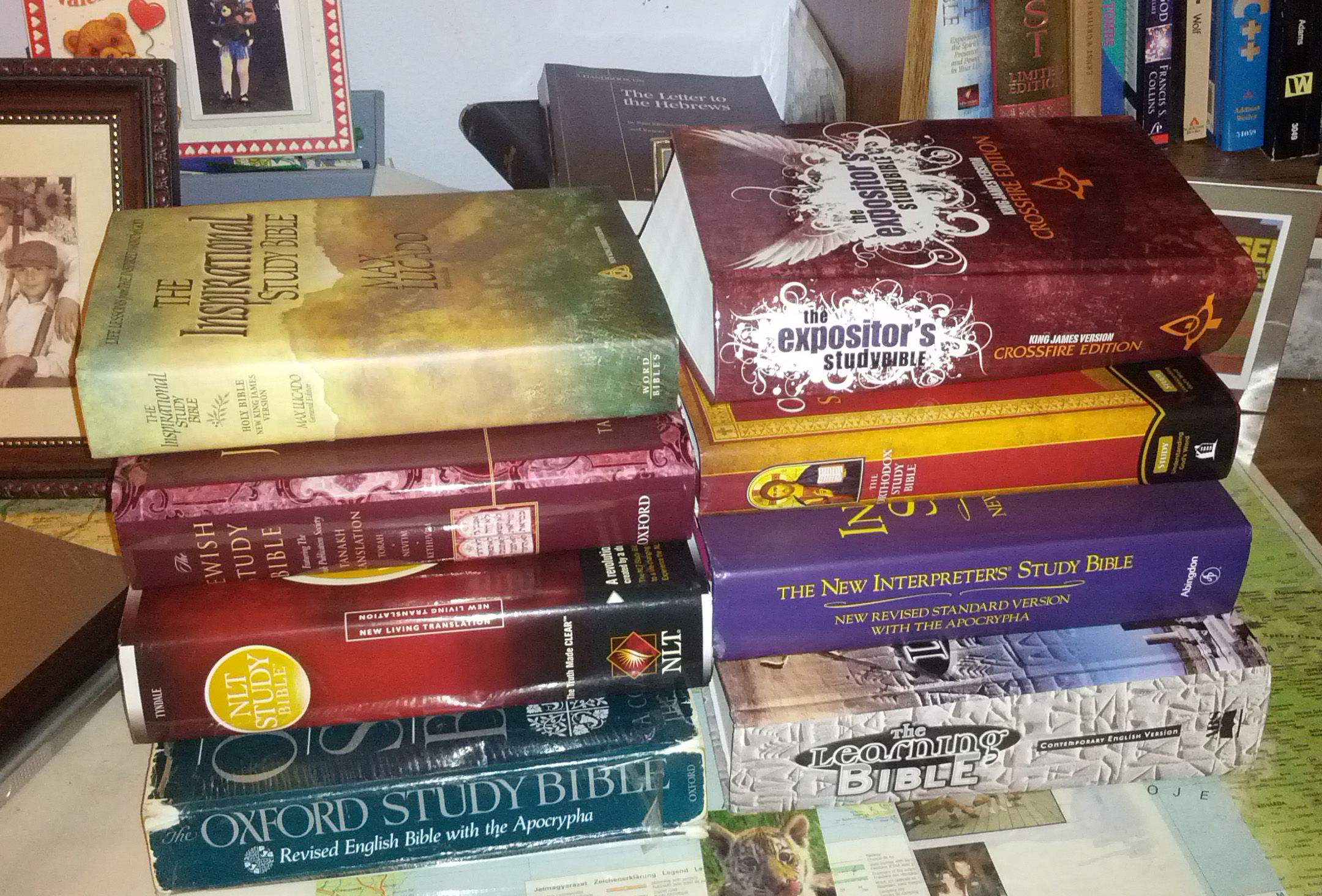
    Study Bibles Galore!
    Despite my dislike, all these Bibles were within arm’s reach of my desk

    I dislike study Bibles. I almost said I hate them, but since I do tolerate some of them, that would be overstating the case.

    My problem with them is that they tend to blur the distinction between the text that we’re studying and the commentary made about it.

    I have managed to keep my annoyance under control by dividing these Bibles into two classes. The first class is those that present historical and technical data as an aid to the reader. This information is much like what would be found in a Bible handbook, but it is conveniently presented within the same covers as the Bible text. I still would prefer a separate Bible handbook, but I understand the value.

    There are still differences in the material presented. What editors choose as the most relevant material to be included in limited space is going to be determined to some extent by their philosophy and view of scripture. Someone who studies the Bible from a secular viewpoint, as history, will be largely interested in the historical context; someone who reads the Bible as the church’s literature will be more interested in theological connections. Both of these items may be valuable to the reader.

    Because of the limitations of space, it’s usually not possible to cover a text from all angles, or to provide a wide variety of information that relates to interpretation. So if a Bible student becomes tied too closely to a particular study Bible, which can happen quite easily if it’s the Bible that person carries to church, their perspectives will be limited.

    So I’m uncomfortable with these Bibles, but I understand their purpose, and believe that if used appropriately they can be valuable.

    But there’s a second class of study Bible. I encountered a number of them over the last couple of days as I looked for a Bible to giveaway at 2014 Reimagine Santa Rosa County. (We ended up using the NLT Study Bible, which I think is one of the better study Bibles, though its notes reflect somewhat more conservative views than mine.) But on the way to buying that Bible, I had to wade through dozens of editions of Bibles with notes by one person. The So-and-So Study Bible. It just doesn’t work for me.

    I believe that teachers and scholars are important. I don’t have a problem with commentaries. I don’t mind study guides (I even publish a few.) I would like to see people have the goal of getting to the point where they study the Bible text directly. Use commentaries for backup. Compare notes with others. But get to the text.

    In my experience there’s a very real tendency to confuse the interpretations in the notes of such Bibles with the text itself. I recall one man who showed up for a series I was teaching on Revelation with a Jack Van Impe Prophecy Bible. I didn’t mind being challenged by Jack Van Impe’s views. Actually, I don’t find them very challenging. But for this man, what that Bible said a text meant was precisely what the text meant. You couldn’t get him to discuss the text itself. He would only quote the notes.

    Unfortunately, this was not an isolated incident. One lady called me aside in the church hallway with a question. She had read a text and then read the notes, and she couldn’t see how the writer of the note got that interpretation from the text. She assumed she must be wrong, since the note writers were so much more educated about the Bible than she was, but could I please explain. Actually, I thought the note was wrong. I explained to her how the writers might have gotten their interpretation and then explained why I disagreed, and suggested she spend more time with the text and less with the notes.

    While I’m uncomfortable with study Bibles generally, I really can’t see the purpose in the study Bible written by an individual. I think it points away from the text and toward a single expert’s opinion. I think that’s bad.

    Well, maybe I nuanced my rant a bit …


  • Quote: Theology Moving from the Classroom

    This is another quote from my editing work:

    James is a theologian, but his theology moves from the classroom and the study to the street corner and the soup kitchen.  James is a “practical theologian,” whose beliefs motivate his actions and whose actions transform his beliefs.  Theological reflection and worship find their fulfillment in faithful action. — Bruce Epperly, Holistic Spirituality: Life Transforming Wisdom from the Letter of James (forthcoming)

    I’ll probably be posting more of these than I have in the past, as I really enjoy the work of editing and often find nuggets to share!

  • Two Old Testament Books (or Preach More from the Old Testament)

    My company is offering special prices on all our books related to the Old Testament. I decided to blog a bit about the books we’re offering. So if you don’t want to hear about books that are for sale, this one isn’t for you. On the other hand, I promise to be wordy, tell stories, and fail to get to the point for paragraphs at a time. As usual! And by the way, this got started because we’ve put Ecclesiastes: A Participatory Study Guide, the first in the series on an Old Testament book, on pre-order. Look for it in mid-November. I’ll talk about it later in the week.

    This morning I was thinking about two books, because they relate so closely to my own Christian experience and to a weakness I see in the church and the way we teach the Bible. The first is by one of my college professors, Dr. Alden Thompson. He guided me through my second and third year of Hebrew as well as any number of questions that arose. I never did take an introduction to the Old Testament, though I took several Old Testament courses other than Hebrew, but I did dig into the theology enough to keep the discussion lively.

    Alden is primarily concerned with getting Christians to study the Old Testament more, and with letting people know that you can find God’s story of grace there as well as in the New Testament. His book, Who’s Afraid of the Old Testament God?, was released after I graduated, but I read it with great interest, and when I was invited to teach later in a Methodist church, I found it was no longer in print. I got some remaindered copies from him, and then later got permission to issue two different comb bound editions. These got me through a number of classes, but we referred to one of them as the “unfortunate edition.” This was also before Energion Publications had come into existence.

    We issued a fourth edition, properly printed and bound, though the printer did not produce the best quality work. I purchased several thousand of those books from another organization I’d been working with and used that as the starting point for Energion Publications. So Who’s Afraid of the Old Testament God? (now in its fifth edition) is a key part of the history of the company.

    Alden’s focus can be found in two stories, I think. When I first contacted him about his book, some 20 years after we had last talked, his first question, before he wanted to talk about books, was this: “How are things with your soul?” Authors tend to care about their books, especially if there’s an opportunity to get them reprinted. But that was his first thought. Later, when he came to teach at Pine Forest United Methodist Church here in Pensacola, he told the group that the measure of his success as a teacher would be whether he left them loving God and one another more than when he came. I like that.

    The book itself can be mildly (or more than mildly) controversial, as one would expect of a book that has chapters covering Judges 19-21 (read it if you don’t understand why), and another on the Messianic prophecies. It’s easy to generate an argument on those topics. But I’ve seen a lot of people spending more time with their Old Testaments after hearing Alden speak about it. If nothing else, his enthusiasm for the topic draws people in.

    The second book is related, though it comes more from my present than my past. It’s written by Methodist pastor and seminary professor Allan R. Bevere. It’s based on sermons he preached from the Old Testament. Now there are those who are turned off by collections of sermons. I like them, provided they are good sermons that serve a purpose, and that they apply to a broad audience. The book is The Character of Our Discontent, I think this book has not gotten the attention it deserves. The vast majority of times that I hear sermons from the lectionary, the text is from the gospel lesson. Now I don’t have any problem preaching from the gospels. But I don’t think people will understand the whole story if they don’t get the background to the gospels by learning from the Bible Jesus used.

    So I’d see two purposes to this book. First, it can be read for devotional reading. I’d take an essay at a time. You’ll find your spiritual life growing when your devotionals don’t just come from the Sermon on the Mount, but also take in characters like Samson and texts from books such as Leviticus or Ezekiel. But second, if you’re a pastor, consider looking at this pattern of presenting material from the Old Testament.

    And unlike Alden Thompson, Allan Bevere is a New Testament scholar. Just because you specialize in the New Testament doesn’t mean you can’t include preaching from the Old. You may even have some special perspective.


  • Science and Genesis: Allister McGrath, John Polkinghorne, N. T. Wright, John Walton, et. al.

    Some very interesting points. It’s only fair that Herold Weiss, whose book Creation in Scripture I publish, would disagree with some of John Walton’s views, while affirming the broader ideas about how to read an ancient text.

    (HT: Allan R. Bevere)

  • What Could Be More Dangerous than Liberalism?

    If you let your eyes wander up to the header you’ll see that my tag line includes the word “liberal” and not in a negative light. I’ve even written about being a liberal charismatic believer. So if you’re wondering how I can use both labels at once, follow the link. But in certain circles, “liberals” make good enemies, you know, the kind of enemies that you know will help make other people your friends—the enemy of my enemy is my friend, right?

    And so Adrian Warnock points to a post by Micah Fries, titled simply Fighting with Scripture. In this post he speaks of the joys of being Southern Baptism following the conservative resurgence, and how nice it is to know that those around him embrace infallibility and inerrancy. In this portion of the universe, the old enemy, liberalism” has been laid to rest and it is easy to ridicule, at least in these sanitized domains. Now my point here is not to beat up on Southern Baptists. I do not consider those who believe in biblical inerrancy to be either worse Christians or scholars than those who do not. In fact, I hope that more moderate and liberal theologians will read and engage with conservative scholarship. I do like to make the point that those of us who see biblical inspiration differently are not the enemies, and may have something to contribute as well.

    Just a couple of lines from the post:

    Liberalism, of course, reduces God’s word, and in doing so attempts to make a mockery of those who would dare take that word at face value. It assumes a position of great authority, in fact it could be argued that it assumes a position of greater authority than scripture itself as it attempts to “rectify” the “errors” found in the bible.

    When I see “of course” in a sentence like that I must confess that it gets under my skin a bit. You see, I don’t think I “reduce God’s word.” Rather, I attempt to understand God’s word as clearly as possible. I don’t “make a mockery of those who would dare take that word at face value,” in fact, I try to avoid mockery. (There are those who assume that disagreement, especially vigorous disagreement is mockery. I’ll just have to live with that.) But still, the issue here is not whether to take “God’s word” at face value. The question is just what that face value is.

    Let’s illustrate this for a moment from Genesis, the great controversy these days. I’ve just edited, and my company has published, a book titled Creation in Scripture by Herold Weiss. It takes a look at the various ways in which creation is discussed in scripture. What it taught me as I edited it was how much more there was to the “face” of what the Bible has to say about creation than most people realize. There are major texts in scripture that are rarely part of this discussion. Many people who try to discuss creation see a “face” of God’s word that is like viewing a large mountain through the trees. You see a little bit of the mountain where light gets between all the trees. But the mountain is more than what you see in that way.

    And how do I get the face value of scripture? Do I read Genesis 1 & 2 as a 21st century citizen of a scientific era? Do I try to get into the perspective of someone from the ancient world? The face looks considerably different depending on which of those perspectives I take.

    My intent here is not to demonstrate what particular view is better, but rather to show that the simple statement that “liberalism reduces God’s word” is somewhere between inadequate and false. It’s inadequate in the sense that it doesn’t do justice to what moderate and liberal students of scripture do when studying. It’s false because very often the liberal interpreter is actually seeing more of the “face” from which the “value” is derived.

    This reminds me of my discussions with KJV-Only advocates. They refer to any word or phrase that is present in the KJV but not in a modern version as something that has been removed from scripture. In vain does one point out that the best Greek manuscripts do not have the word or phrase in question, and that one might just as well say that the KJV added it to scripture. What are you taking as your standard? More importantly, how are you using and applying that standard?

    In order to have valuable discussions of these points we need to state the questions a different way. Conservatives, moderates, and liberals understand scripture differently. We need to discuss passages on that basis, and examine our hermeneutic first. It’s often valuable to take a passage that is slightly less controversial and ask how we look at that passage. We may well continue to disagree (doubtless in many cases we will), but perhaps we would have a better understanding of why and how.

    I share the concern of the authors I linked with reference to legalism, though I don’t think the accusation that it is “adding to scripture” is the best way to address it. I suspect legalism is more a matter of where we place things in our thinking and acting. Having just taught from Ephesians 2 and done preparation to teach from Ephesians 3, I see a fairly clear relationship between grace and action. It’s not that legalists do too much, though some do, it is that they place rules and their actions in the wrong place in their relationship to God. Grace, God’s grace, comes first.

    In pursuing correct theology, I think we often fall into the same danger. We make theology our works and become legalistic in terms of what people should believe. But placing barriers of knowledge and belief ahead of grace is just as damaging as placing barriers of action. We can get into the position of earning God’s favor through getting things right just as easily as through doing things right, and often with even greater damage.

    Legalism will not be defeated by making sure people’s theology of grace is thoroughly correct and orthodox. Legalism is defeated by grace in action. God’s grace, and yes, God’s grace displayed through God’s people.