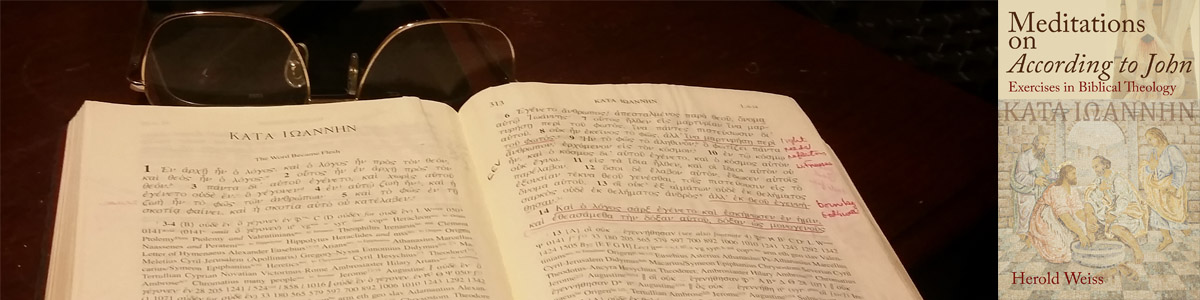
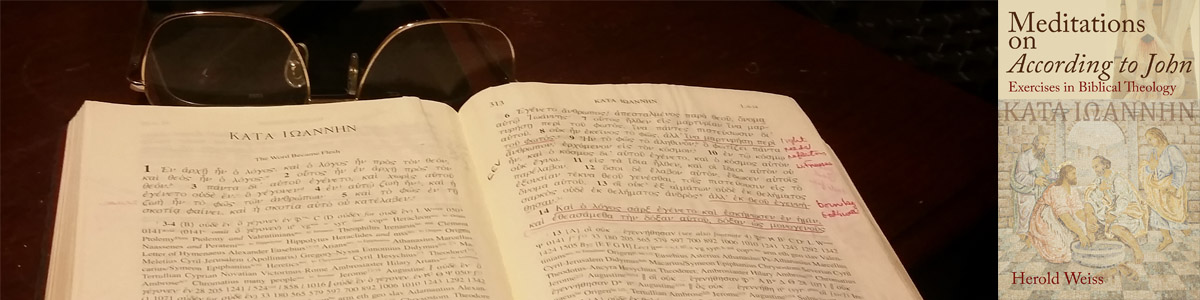
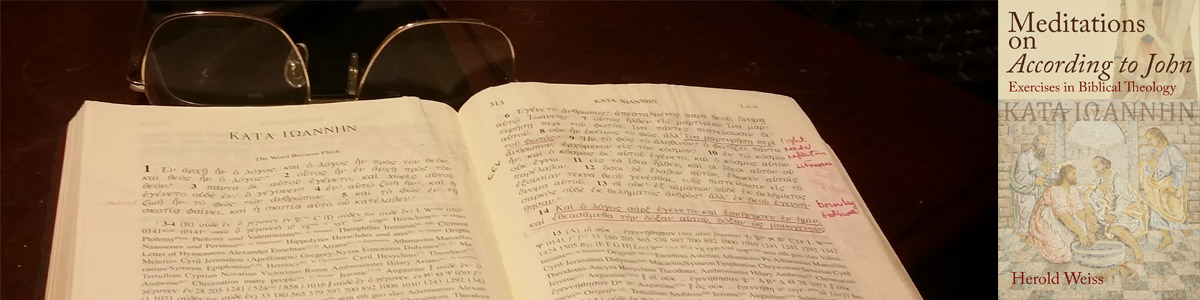
Well, I hope it’s not my final interview ever, and since we’re going to announce his next book, already under contract (and I have a preliminary manuscript in hand!), it likely won’t be. But it’s a wind-up interview for my study of According to John using Dr. Weiss’s book Meditations on According to John. You can find out more about the interview on the Google+ Event Page, or simply come back to this post and use the viewer embedded here.
Be sure to post any questions in the comments here and I’ll ask Dr. Weiss during his interview.
It has been that kind of a day. I apologize for not posting this earlier. You can find out more about this discussion on the Google+ Event Page or view it using the YouTube embedded below.
I’ve been planning to create some short notes on John, discussions of topics about which I’ve gotten a number of questions. I recorded the first of these today, and here’s the embedded YouTube video:
Tonight I’ve decided that I will focus much more on the trial of Jesus and the relationship between ritual, symbol, and spiritual reality. You can find more information on the Google+ Event Page, or you can view using the embedded viewer below.
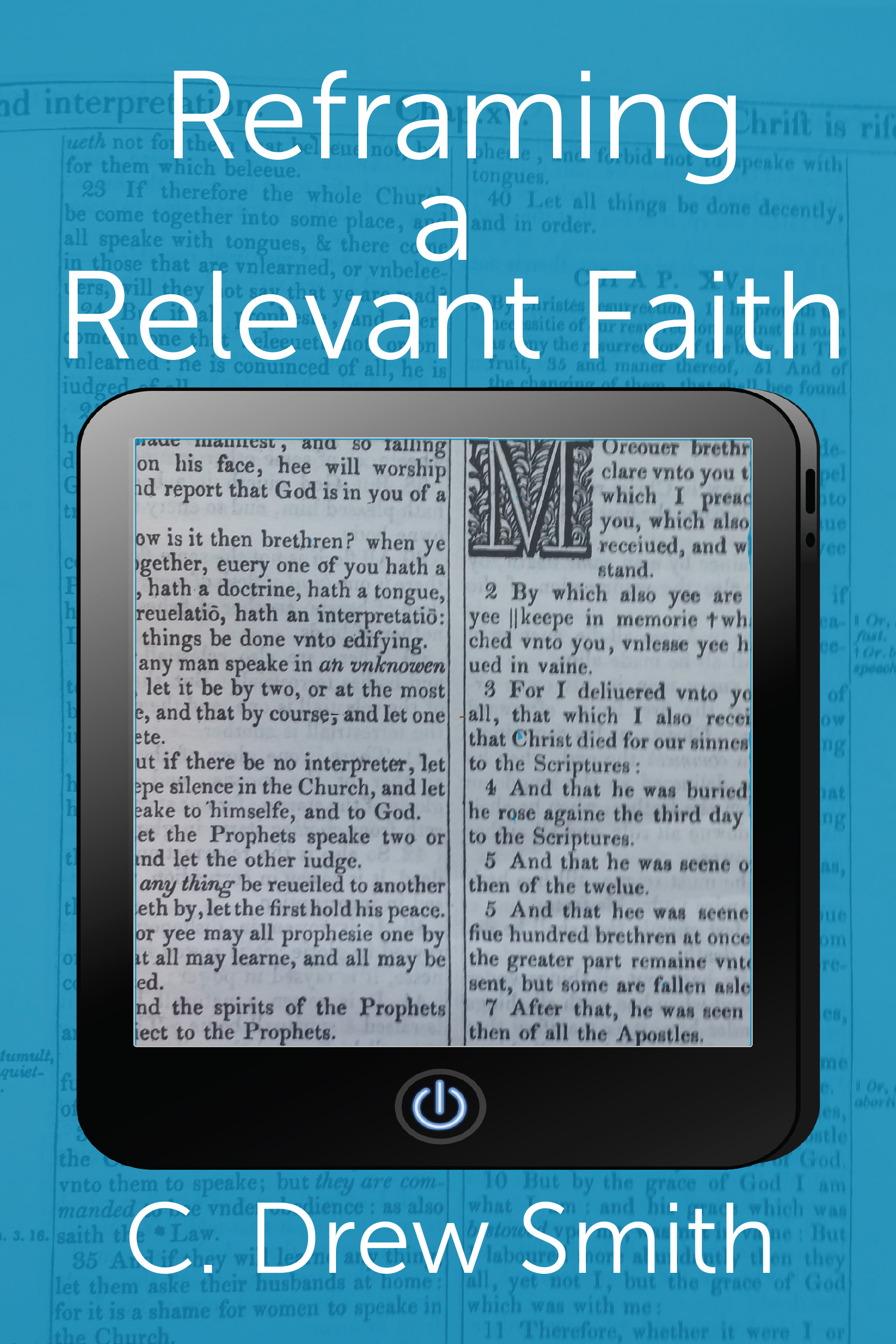
I had a great time yesterday interviewing Drew Smith for my study on the gospel of John. I wanted to talk to him about how one “does” biblical thelogy and do some comparisons between John and Mark. Drew is very knowledgeable, having written his dissertation on a narrative critical reading of the gospel of Mark for his PhD in New Testament from the University of Edinburgh.
Here’s the interview:
We were left with one question: Is there a case in Mark where one can unequivocally say that the title “son of God” is not the equivalent of Messiah. “Unequivocally” is a tall order, but Drew said he’d look at it. I look forward to posting the results in the comments here.
We had lots of audio problems last time we tried, so we’re trying again! Tonight (7/16/15), Drew Smith will be my guest on my study of the gospel according to John. Drew got his PhD in New Testament from the University of Edinburgh, and wrote his dissertation on the gospel according to Mark. Tonight we’ll compare the theologies of the two books and ask Drew about adoptionism. Does the absence of a birth narrative in Mark mean support adoptionism?
You can find more information on the Google+ Event Page, or view using the YouTube embedded below.
I’ll be discussing this tonight at 7:00 pm via Google Hangouts on Air. You can find out more on the Google+ Event Page. You can also view using the YouTube viewer below:
This is a late announcement, but I will be doing my According to John study tonight. The Google+ Event page has details. The YouTube viewer is embedded below. I’ll be working from Chapter 20 of Herold Weiss’s book Meditations on According to John.
Well, last night my discussion of According to John covered a lot of other ground. In particular, I was looking at the eschatological use of “hour” and “now,” and I suggested that John has a fairly simple eschatology to go with his fairly simple soteriology. I’m not going to rehash all of this. The foundation is found in Chapter 19 of Herold Weiss’s book Mediations on According to John: Exercises in Biblical Theology. For those who might wish to review the video, here it is.
In the middle of this discussion I got into talking about the ‘L’ word. No, not liberal. Literal. I tell people that we should avoid simply saying that we’re not taking something literal, and get specific about just how we are taking whatever it is. “We don’t take that literally,” has become commonplace in discussions of the Bible in mainline and progressive circles, but often we don’t tell people just what we do with the thing we aren’t taking literally.
Last night I was talking about something that is fairly simple to pinpoint, symbolic language in a vision report. (Note that you don’t necessarily have to believe that a person has received a divine vision in order to accept a literary category of “vision report.” I do believe people have visions, but the form remains no matter the source.) If we take a vision such as Daniel 7, for example, we have beasts (which represent something), coming up out of the sea (which represents something), onto the land (which represents something), and so forth. “Not taking Daniel 7 literally” means that I don’t believe that Daniel’s vision was about actual creatures coming from an actual sea onto the land. Rather, these beasts represent something else. Rather than taking them literally, one should take them as symbols of something else.
One of the problems with the way visions are often interpreted is that people drop from the symbolic to the literal. The beasts, the sea, and the land are symbols, sure enough, but when the Son of Man appears in the clouds, that’s literal. But there isn’t any justification in the text for taking one part of the vision literally. One interpreter of Revelation has maintained (actually more than one, but I won’t list) that we should take everything literally that we can in the book, and only treat it as symbolic where that is essential. It’s a vision! It is filled with symbols! The default has to be that anything in the vision is symbolic unless you have good reason to believe that the writer is seeing actual events. And quite bluntly, in Revelation (or the latter chapters of Daniel), you don’t.
I think a couple of extensions of how symbols might function would be in order, and Revelation provides examples. First, something literal can be used as a symbol. There is no doubt that the seven churches were real places. Under the rule of taking what can be taken literally, we would see the messages as tailored messages to those particular seven churches. But I would argue here that the actual churches are being used symbolically, with the number seven indicating that the messages to the seven churches constitute as a whole a message to the whole church. Various schemes, such as applying the churches to periods of history and their messages as specifically applicable to such times, while interesting, have the potential to lose us part of the message to the whole church. Second, I would use Revelation 12 as an example of where a visionary symbol points not to something physical, but to something spiritual. We might call it a symbol of a symbol.
It’s a bit more complex to specify how this works in other passages. For example, I would call Genesis 1 liturgy. That is, by most people’s understanding, non-literal. In addition, there are symbols within the liturgical text. This is why I think it’s important to talk about how we understand a passage and why we understand it that way and avoid simply saying that we don’t take it literally. There are many non-literal ways of taking things.
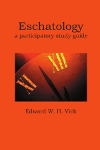
I will go into these issues in greater detail when I begin my YouTube study on eschatology starting August 17. On August 10 I plan an interview with Dr. Herold Weiss, winding up my study of According to John. I will begin the eschatology study by looking at the landscape of eschatology using Eschatology: A Participatory Study Guide by Edward W. H. Vick, and then proceed to eschatological and apocalyptic passages. I talked about this in more detail yesterday.
Tonight (Thursday, June 25, 2015) via Google Hangout on Air I’ll be talking about chapter 19 of Dr. Herold Weiss’s book Meditations on According to John, title “We Must Work while It Is Day.” There’s a great deal of interesting material in this chapter, and I keep adding to it as I read and re-read the passages. I’ll be talking about what the Sabbath means to Christians and also about some basic concepts in eschatology, not to mention eschatology itself.
I also want to give everyone a tentative schedule for the next few weeks and let you know what I’m planning after this series is done.
Here’s the schedule (edited June 30 to add the interview with Drew Smith):
July 23 – Chapter 22 – Rivers of Living Water (since I’m preparing for a Sunday School series in August on the time of the exile, I will doubtless reference Ezekiel’s temple!)
July 30 – Chapter 23 – Where Are You From?
August 3 – Chapter 24 – Abide in My Love
August 10 – Closing interview with Dr. Herold Weiss
I am also planning to schedule a re-do of my interview with Dr. C. Drew Smith, which may move some of these sessions, or it may simply fill the open slot on August 3. This interview is now on the schedule for July 16, with the later chapters moved down to fill in.
I think I’ve mentioned a few times how far out of the box this whole series has taken me. I diligently pursued nuts and bolts of biblical studies, avoiding theology and liturgy as I would abominations (whatever those may be!). So to spend this much time thinking about theology from a biblical book was somewhat of a challenge. I’m going to move somewhat closer to my roots as we move forward, both in the sense of my approach, which will involved more nuts and bolts, and in terms of the topic, which will be eschatology, something rooted in my upbringing and education in the Seventh-day Adventist Church.
I’m going to start by using the book Eschatology: A Participatory Study Guide by Edward W. H. Vick as a guide to learning the general terminology and getting a view of the map of ideas on this topic. That will be quite theological, of course. Then I plan to look at a number of apocalyptic and/or otherwise eschatological passages in scripture, looking for the author’s intentions in the text and then also at how those words have become part of the various views about eschatology in the Christian community today. The idea will be to understand how people come to their conclusions, why there is so much variety, and how one can find one’s own way through the material. This series will likely continue for some time, as I have the complete books of Daniel and Revelation, not to mention a large number of shorter passages elsewhere. And yes, I would treat the first six chapters of Daniel as material that is just as eschatological (or not) as chapters 7-12.
If nothing else, I’ll have plenty of opportunity to learn new things myself! I have been gratified, however, to see that a few of these sessions have YouTube views in the teens, though most stay single digit. I really expected three or four to follow along the way. Over time, who knows! I am grateful to those who have listened and who have commented, either via the Q&A app or by e-mail. It has been a great experience already, and we still have several weeks to go.
Paul’s words gave the Galatians hope for transformation and they are hopeful to us, too. Jesus Christ frees us from bondage. The external world may not immediately change, but the cross and resurrection of Jesus Christ frees us from guilt, fear, anxiety, and hopelessness. God acts in Christ to set us free to live joyfully and creatively. The cross and resurrection are a matter of life and death – they must be proclaimed – spiritually, ethically, and communally. Anything that challenges God’s liberating message must be confronted boldly.
Besides the excellent message, there’s a good “editorial” moment in there. Do you see “the cross and resurrection of Jesus Christ frees us.” Grammatically, I should correct that to free us, except that I know from the context that these are being seen as a single event. I’m sure some folks will say this is an error. Perhaps it is, but it is intentionally so.

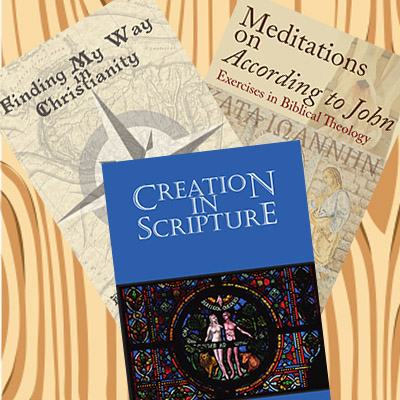 Well, I hope it’s not my final interview ever, and since we’re going to announce his next book, already under contract (and I have a preliminary manuscript in hand!), it likely won’t be. But it’s a wind-up interview for my study of According to John using Dr. Weiss’s book Meditations on According to John. You can find out more about the interview on the Google+ Event Page, or simply come back to this post and use the viewer embedded here.