Threads from Henry's Web

Category: Bible Study

  • Psalm 119:5 – Let’s Get Real

    Psalm 119:5 – Let’s Get Real

    Oh that my ways were steady,
    Keeping your statutes.

    Any time we’re looking at a set of standards, it’s well to be realistic, especially with ourselves. As we go through this Psalm, we’ll be celebrating God’s law in many ways and places, but there are a number of instances where the author admits his limitations and calls for help from the lawgiver.

    It would all be very good if …

    I sure wish I could, says the Psalmist. He knows it’s good. He’s glad to know it. But can he?

    I feel this. There are things in my daily life I wish I could do better. Some days are better than others.

    There’s a balance here, and we can see that balance in the rhythms of the Psalm.

    The praise is a prayer. I’m going for it! Please help me!

  • Psalm 119:4 – Tough!!

    Psalm 119:4 – Tough!!

    About your precepts you commanded,
    “Keep them diligently!”

    Sometimes things are tough. You wonder what’s coming next.

    I’m meditating on these passages one at a time. I read the passage in the morning, and then I write these in the evening. During the day, I keep coming back to that verse. In deciding to do 176 daily meditations (that’s how many verses there are in this Psalm), I knew that some would be more encouraging than others.

    This one is just tough. God says to do this diligently. Don’t just pretend. Don’t follow these precepts sometimes. Seventh percent is not a passing grade.

    I’m reminded of choosing a Sudoku puzzle. How spiritual is that? Well, I like to pick the hardest level in the app I use. Sometimes I’m tempted to do an easier one. If I give in to that temptation, I’m drawn to watch the time and try to complete it as rapidly as possible. Most of the time, however, I choose the hard one.

    Is the call of the toughest “right” living just as strong for me? Do I want to take the hard, but right path whenever possible?

    The bad news, which I notice even in a sparse verse such as this, is that I don’t get there. Not ever. I have a desire, but it’s often a fairly week desire. The good news is that God is working on me, and the fact that he has such high hopes is very encouraging.

    I think the Psalmist shares some of my feelings. But that’s the next verse!

    (The featured image was generated by Jetpack AI.)

  • Psalm 119:2 – The Blessing of Seeking

    Psalm 119:2 – The Blessing of Seeking

    Continuing with Psalm 119, which I began with Psalm 119:1 yesterday. There are some notes on this series there.

    Blessed are those who preserve [keep] his testimonies,
    who wholeheartedly seek him.

    In the translation I use “testimonies” as in the KJV, though there are a number of other possible translations. I’ll comment on these various words for “law” in Psalm 119, though I don’t think the author’s intention is to discuss different types of law and say different things about them. Rather, he is pointing us to the whole of God’s law in its various manifestations through the use of these various types of law.

    It’s interesting to compare two other passages that use the same word used here for “blessed.” One is Isaiah 30:18, which says those who wait on the Lord are happy/blessed. Deuteronomy 33:29 says Israel is blessed because the Lord is their shield.

    There is a blessing simply in being able to seek. The history of Israel at the time of the Exodus shows us a time when we are told the people don’t even know who to call on. Moses has to ask for the name he is to give when the people wonder who sent him.

    When the ten commandments are given at Mt. Sinai, they begin with the declaration, “I am YHWH your God, who brought you up out of the land of Egypt.”

    This verse points us to the blessing there is in simply being able to seek God. This seeking is a result of the call of God. Those testimonies (covenant provisions) are the result of God’s choosing and opening to you the opportunity to seek.

    What does seeking God with your whole heart mean for you today?

  • It’s Not a Success Story

    It’s Not a Success Story

    Prologue

    I’ve been listening to Robert Alter’s translation of the Hebrew Bible as an audiobook. I’ll doubtless write something about this translation later. But right now I’m listening to Judges, and it’s caused me to think a bit about the broader story of the history of Israel and then of the church.

    Charismatic Leadership

    One of Alter’s comments is that the judges tended to be selected as charismatic leaders with their origins in moves of the spirit, such as angelic visions. So Israel was ruled by a succession of leaders chosen by God’s call given in various ways, and the book of Judges is not very positive on all of this. It doesn’t speak negatively about God’s selection of leaders, but it does comment regularly on the repeatedly dismal results. After a period of safety, the Israelites fall back into apostasy and are conquered by their enemies.

    The author/compiler of Judges tends to think Israel needs a king, presumably with a secured succession, so as to avoid these times of apostasy and failure.

    It doesn’t work out that way. We see the end of the period of the Judges and the beginning of the kingdom in the books of Samuel, and it’s a turbulent time. The first king is at best equivocal, and at worst actively working against God and the interests of Israel. David does maintain the loyalty of Israel, but his son Solomon plants the seeds of failure.

    The Monarchy Isn’t Better

    The northern kingdom pursues an almost continually dismal process of decay, while the southern kingdom has good kings followed by bad kings in a cycle. One could say, “New system of government, same old problems.”

    Following the Babylonian exile, the Jewish people no longer govern themselves and pursue a more consistent course religiously, but one has only to look at some of the leaders described in the books of Maccabees to realize that all was not consistently going well. The Maccabees end up fighting both foreign domination and internal apostasy.

    Christians Have No Basis to Look Down on Others

    As Christians, we sometimes look down on Israel and the Jews after reading all this history, but such a reading is self-righteous and dismally lacking in self awareness. We’ve gone through many ways of “governing” the church, and have only had very short times when one could be totally proud of the church as an organization.

    I believe God as always had a Church consisting of true followers of Jesus. But I also believe God had a people in Israel throughout its history who were truly God’s people even when their brethren. For every Jason, there was a family such as the Maccabees who were faithful.

    But there never was a system of government that worked.

    This led me to think of conversations I’ve had about church governance. Over and over problems noted in a church are blamed on the particular approach to church governance. The church has bishops who supervise pastors? Not responsive enough to the local church. Pastors are responsible only to the local church? No true accountability! The church is led by a team of elders? Unclear leadership! The church is led by a powerful senior pastor? Hierarchical with too much power in one person.

    One can certainly debate ways of managing a church, but no form of governance is likely to be 100% effective.

    My Suggestion

    I don’t have a structural suggestion here myself. My one suggestion is not structural. It is simply this: Look to Jesus. Keep looking to Jesus. Turn your eyes back to Jesus if they drift to other things. It’s the one effective answer to any church problems.

  • Psalm 119:1 – Living According to God’s Law

    Psalm 119:1 – Living According to God’s Law

    Introductory Note

    I’ve been meditating on Psalm 119 recently after a conversation with an author regarding a forthcoming book reminded me of it. I’m going to write a few short devotionals. I’m not sure how many I’ll write, but reading this Psalm does make me think.

    For any devotional on Psalm 119, please remember that I’m commenting on no more than a few verses at a time, and thus won’t cover all, or even a substantial number of related ideas. Also, please remember that this is poetry, not a theological essay, so even within the text of the Psalm, ideas are not completed in a systematic way.

    Psalm 119:1

    Blessed are those blameless in their living
    Who act according to God’s instructions.

    Now there’s a challenging verse. We all have ways of avoiding it. But I think it pursues us through all our escape routes.

    Our escape routes often start from something very good. That’s what makes them so tempting.

    1. As Christians, we look immediately to the grace of God, given through Jesus. This is a good thing. We realize that being blameless and having all our actions fall within the range of God’s instructions (Torah), is not something we’re going to accomplish, and we are driven to a gracious God who forgives. But we can use this to avoid the issue. “Because God is gracious, I can safely ignore this,” we think. We think the only reason God talks about good actions is to let us know we can’t make it. But the Psalmist, at least, is talking about doing, hoping to do, an mourning the failure to do.
    2. We can decide that a totally blameless life is, in fact what we’re going to do, on our own and in this life. This leads us astray in two ways. It can be horribly discouraging and end up in cynicism, inevitable failure, and self loathing. On the other hand, it can lead us to imagine ourselves successful even when we aren’t and an incredible spiritual pride that falsely assumes one is blameless.
    3. We can engage in trimming the text, so as to make “blameless” less daunting. We can’t reach the goal, so we move the goal closer, or we pretend the goal is closer. This can result in complacency and also to a trust in ourselves for our salvation. The problem with aiming low is that we generally manage to reach no higher than our aim.

    That’s my long way of getting to this: God has instructions that are worth our attention. Even in our limited ways of attempting to follow these instructions there is blessing, not just bringing us to Christ, as important as that is, but also simply as good ways to live.

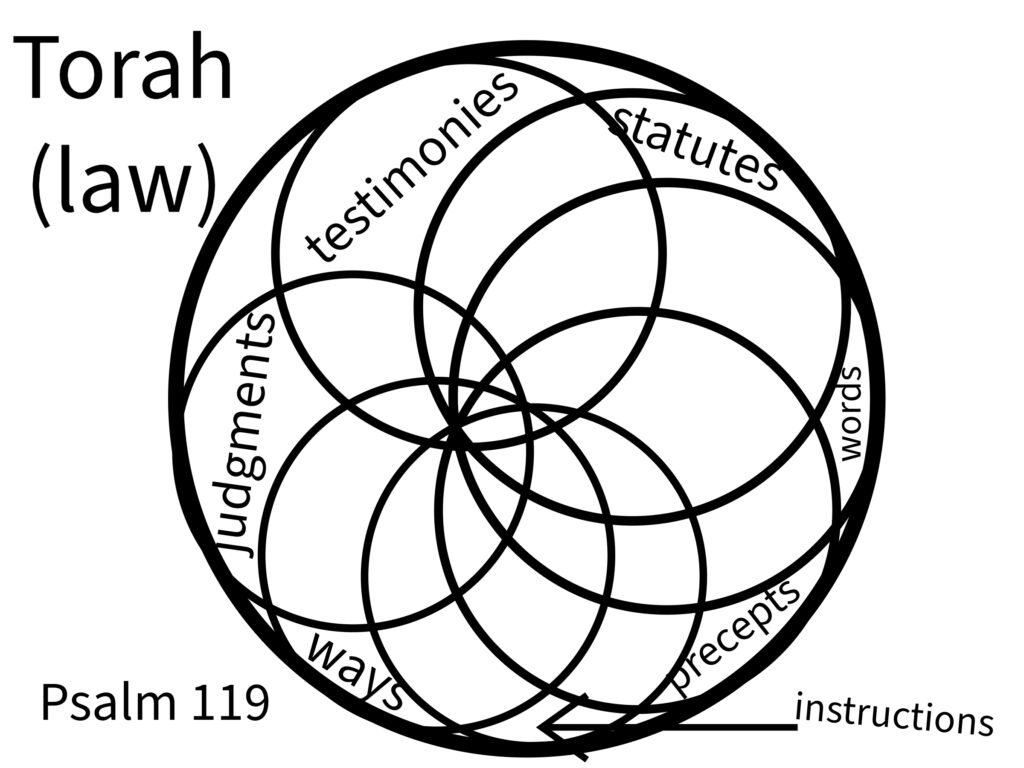
    Torah, the word used here for “instruction” (your translation may read “law”), goes beyond giving us a list of rules. I’ll discuss the various rule/law/instruction words in Psalm 119 along with other verses. It also includes stories of heroes of the faith. They were blessed in following Gods law, but they were not generally “blameless.”

    One need go no further than the last version in this section. (Psalm 119 is divided into 22 sections of 8 verses each, in which each verse begins with the same letter of the Hebrew alphabet.) “I remember your edicts. Don’t abandon me completely!”

    The Torah referenced here is the story of how God never abandons, even those who do forget.


    Some Definitions of Law in Scripture

  • Beastly Attributes

    Beastly Attributes

    I’m following up on my post from yesterday, Making an Image to the Beast. I think these chapters contain quite a lot of useful information that is not primarily prediction, but is definitely prophetic, in the sense of bringing God’s Word to our situations.

    I want to talk a bit more about what kind of image we create through our actions as the Church, but first, I wanted to look at the nature of the dragon and beasts, of whom we finally get an image late in the story.

    Here are some of those attributes and the references:

    1. Tears down others – 12:4, drawing 1/3 of the stars. Beasts and dragons rarely fall alone.
    2. Consumes and destroys – 12:4
    3. Is not the greatest power – 12:8. Note that verses 8 & 9 compile a great deal of what is now Christian belief about the Devil. The imagery hear draws on a number of passages in Hebrew scripture.
    4. Persecuter – 12:13
    5. Sweeps people/things away – 12:15. It’s humorous to note here that there is a single Greek word for “carried away by a river.” There’s got to be some history for that word!
    6. Angry with those not on his side – 12:17.
    7. Speaks blasphemy – 13:1,5.
    8. Though not the geatest power (see #3), operates with great authority – 13:2.
    9. Puts anger into action in war with the “other side” – 13:7.
    10. Wants all the attention and worship – 13:13.
    11. Deceives – 13:14.
    12. Applies force to get worship – 13:16-17

    Now if you’ve read Revelation, you’re probably acquainted with these items, but I thought it useful to compile a list. I didn’t intend it to have 12 items. That’s coincidental.

    If you’re following along, an interesting mental exercise is to ask just what wisdom is involved in counting the number of the beast.

    Almost forgot! The featured image was generated from text on Adobe Express this time. Just trying things out!

  • YouVersion Verse of the Year

    YouVersion Verse of the Year

    I received an email from YouVersion (I use their app occasionally) with their 2023 “verse of the year.” This is the verse that has been shared, bookmarked, and highlighted most often through their community.

    It is Isaiah 41:10 (note that my links go to BibleGateway):

    [D]o not fear, for I am with you;
        do not be afraid, for I am your God;
    I will strengthen you; I will help you;
        I will uphold you with my victorious right hand.

    Isaiah 41:10 (NRSV)

    I find this interesting as this is a verse that might be considered by some to be taken out of context. I don’t know if you’ve seen any examples, but there’s even a coffee cup that reads “I can do all things through a verse taken out of context.” This lampoons the frequent use of Philippians 4:13 as a promise that God will help you do anything, from winning in sports to success in your business, to successful family life, and beyond. More on this verse a few paragraphs down.

    In the case of Isaiah 41:10, the specific reference is to the return of the Jewish exiles from Babylon, who are promised strength for the return and rebuilding. Isaiah 40 and onward, especially through 55, deals with these circumstances and is tremendously encouraging. So if you’re using it as encouragement in trying to get through your work week, you might well be taking it out of context.

    If you take the Bible as a series of data points, this is fairly accurate. This is not, in its context, a promise for all times and places. You will still get tired. Bad things may happen to you, as they happened to Job and as they have happened to many of God’s servants through time.

    So maybe it shouldn’t be used in the way that it is, likely the very usage that got it “verse of the year” from YouVersion.

    I’d say, not so fast.

    First, let me note, that many of those same servants of God who have grown weary and suffered through history have been sustained by verses like this. We might ask ourselves why that is. I haven’t run into that many Christians who really believe a Christian will never get tired. I don’t. Yet I appreciate this verse. I appreciate it even more when I’m bone weary and wondering whether I can take the next step.

    Crazy man, eh? (Well, yes, I am crazy, but that’s not relevant!)

    I recall C. S. Lewis’s image in The Magician’s Nephew, which I will always see as book 6 in the series however much publishers change it!) of a “deep magic from before the dawn of time” that overrides the rules that are known generally. Similarly, there’s context, and then there’s context.

    If my intent is to answer the question, “What is Isaiah saying about God?” Then I’m going to answer in terms of the return from exile, and also note that the audience is Israel. On this basis, I could find ways to remove the majority of scripture from relevance to me today. God isn’t talking to me here. That promise doesn’t apply to me.

    Scholars, and those who aim to appear scholarly, tend to wander about the landscape of scripture, informing the poor mortals who have been getting comfort from various passages that they are wrong, and that the scripture doesn’t mean what they think it means.

    Very often, that is quite correct. Sometimes people can be dangerously wrong in what they’re getting from scripture.

    But the problem is this: As scholars pull up the markers people have used to guide their lives, what do they hand out instead? With what do they replace these markers that have guided Bible readers’ relationship with God for decades, centuries, even millennia?

    Oh, did I say the problem? There’s a second one. Are those who criticize sure they’re right when they say a passage does not apply?

    I think very often they’re wrong, and I think many non-scholarly Christians living day-by-day relatively ordinary Christian lives instinctively get it more right. This is based on both a deeper and a broader context.

    In the case of Isaiah 40, the exiles are promised strength. Now remember that these exiles were in no danger of thinking God was promising that no matter what happened, they would never get tired. They weren’t in danger of thinking that everything was going to be easy. No, they were headed out on a hard task, and they and their immediate ancestors had lived through the exile.

    What was important was that God was with them and was now rescuing them and would be with them through all that came. In the broadest (and I think deepest) context of scripture, this is the story of the God who saves, built on the original story of the Exodus from Egypt. What do you suppose those Israelites thought about the idea that those who worship God would never suffer harm? They had even experienced some of the plagues right along with the Egyptians! They wandered through the wilderness. That experience was reinforced by the exile and restoration and became a foundation for the ultimate core story of Christianity, the incarnation, death, and resurrection of Jesus.

    As such, Christians should be very willing to take up the promises of these events just as they are taken up in the story of redemption. We serve a God who redeems. We serve a God who is with us through all our suffering, who is there when we are weary. We know these things happen to us. But we also know they happened to people in the past because we’ve read their stories (testimonies) and we know that God’s promises to them, always tempered by understanding the broad and deep context, and even the immediate literary context, do, in fact, apply to us.

    I recall when a relative ripped one such verse from my mother, surely with good scholarly intent to maintain the accuracy of biblical interpretation. She had a favorite verse, Isaiah 49:25:

    But thus says the Lord:
    Even the captives of the mighty will be taken,
        and the prey of the tyrant will be rescued,
    for I will contend with those who contend with you,
        and I will save your children.

    Isaiah 49:25 (NRSV)

    This relative pointed out to her the context, very much like the one in Isaiah 41, and part of the same sequence of materials (Isaiah 40-55 form a coherent block) did not involve making sure everyone’s children were saved, but simply that the children of those who had gone into exile would be saved and brought back to their land. She used this as encouragement about her children, which, he told her, was to use the passage out of context.

    In the immediate context, that’s absolutely true. But in the broader and deeper context, this becomes part of the underlying story of redemption and of God’s intention for God’s people in all times and places. Readers should be encouraged by this, not because it was somehow specifically directed at them, but because it formed a formidable piece of the foundation of the story of a saving God, one who was and is with us in trouble, one who knows the pain, and yet one who takes us through to triumph.

    I had an opportunity to discuss this with my mother many years ago, and when I had given my explanation, she simply said, “Then I’m taking my verse back!” And she did!

    Philippians 4:13 can be used in many questionable ways, but it is not questionable to think that God will help you get through whatever situation you’re in. Many point out how this is about being able to carry out one’s mission despite hardships. And it is precisely that. But as a Christian, your life should be mission. I don’t think God is promising you that you’ll win all your games. Bluntly, most people, even those I’ve heard mocked about taking this out of context, don’t think it means that either.

    But if you’re reading it that God is with you as you carry out whatever call God has put on your life, if you believe from this that God will be with you and strengthen you for God’s own purposes, then I think you’re reading the verse in the deeper context.

    I want to end with one warning. Seeing this deeper context can help us connect with God through the story of scripture. We learn about relationship to God through reading about those who have been in such relationships over the centuries and millennia. When we read such a passage as giving us permission and power to carry out our own will wherever and whenever we want, we’re missing both the immediate context of scripture and also the broader and deeper context.

    Suggestion: When you want to apply one of these promises, read the immediate context. Then ask yourself how those who first heard it might have experienced it. Try to join the story as you see it in their lives and find your courage there.


  • Agendas, Conversation, and Bible Reading

    Agendas, Conversation, and Bible Reading

    It’s not really a new thing, but in a number of conversations recently, both in person and online, I’ve been noticing agendas. Someone will make a comment or say something in a conversation that really doesn’t seem to make sense in context, but then if you consider a different context, you’ll suddenly see that the comment makes its own kind of sense.

    I know I can do this. If there’s something on my mind that I feel is important, I will tend to tie it into a conversation whether it really fits or not. Other people in the conversation may wonder what’s going on. In real conversations, often the subject just wanders.

    This is a natural process. If you’re trying to discuss something in particular, it can be disconcerting. I find it hard to lead in a meeting because my tendency is to try to figure out what the side comment is about and follow it right off the map! I have often asked my wife to lead meetings because she is good at bringing things back to the planned subject, thus letting us complete our agenda.

    I often comment that God comes to us in Scripture for conversation while we tend to be looking for information. Now there’s nothing wrong with looking for information. There certainly is information in the Bible. But one can come out of the study of Scripture with a great deal of information and no transformation.

    In particular, we tend to come to a book looking for information we believe we need. We come with an agenda. How shall I conduct my life? How should I do business? Is it permissible to do certain things?

    Or there’s the more negative agenda of finding things I can use to condemn my neighbor. Where is the text that tells me that so-and-so is wrong?

    When we come to Scripture in this way, we are likely to be led astray. Just like we edge conversations with other people right off the edge of the map due to our primary agenda, we can get a message from Scripture that is much more formed by our agenda than by the actual message and story presented in the Scripture passage(s) we consult.

    An interesting example of this is the many centuries long search for a precise roadmap to the end of time or the end times. Date setters have repeatedly “found” dates in Scripture. How do they do that? They come to the Word with their own determination of what the Word must tell them. As a result, we have repeated examples of failed predictions, and still we have people looking for more.

    For a Christian, the study of Scripture should be an encounter with God. That means coming ready to listen and coming ready to have your agenda adjusted. That will result in conversation and potentially transformation through the Spirit and God’s creative and powerful Word.

  • Signs That You Won’t Know!

    Signs That You Won’t Know!

    It is critical to note that the signs Jesus’ gives his disciples are general and vague and always contemporary. War and suffering, famine and earthquakes, persecutions and false Messiahs have not only been prevalent throughout history; they are the also to be witnessed and experienced in the present, and they will be encountered in the future. Thus, the posture that Jesus is encouraging his disciples to take is not one where such signs signal the imminent end of history, but rather that such events remind them of the necessity to be ready for the end because they cannot know from these signs when it will take place.

    Allan R. Bevere, Keeping Up WIth Jesus, p. 52 (forthcoming)

    This was too good not tomention. I’m doing a final editorial read on this book which will be available shortly. Allan calls it a “narrative devotional commentary” which is a good description of what it accomplishes. I’ll post more here when the book is available.

  • After Teaching on the Sermon on the Mount

    After Teaching on the Sermon on the Mount

    My Sunday School class just finished a several-week study on the Sermon on the Mount. We did not use any study guides as a class, though I consulted three books I publish, One World: The Lord’s Prayer from a Process Perspective, The Jesus Manifesto: A Participatory Study Guide to the Sermon on the Mount, and Ultimate Allegiance: The Subversive Nature of the Lord’s Prayer. Some class members did make use of those references, and I also provided links to and some printed copies of John Wesley’s sermons on this topic. Class members also used a variety of Bible translations and other reference works.

    At the end of the class, one of the members commented that he was very glad to have studied the entire sermon, because he could see how it fit together and how the various parts built on others. He commented that we often read the Beatitudes and the Lord’s Prayer, while not continuing to cover the rest of the three chapters.

    Over the years I have read and studied this sermon many times, and I never fail to find something new with each adventure in it. There are three (well, maybe four) general approaches to it.

    First, let me dismiss my “maybe four.” I had one young man come to my house to try to get me saved. That I already professed Christianity was not important to him. I needed to understand it the way he did. One of the things he wanted me to understand was salvation by faith, which in his view eliminated anything having to do with works. He specifically told me that the Sermon on the Mount does not apply to Christians. I found it interesting that the longest collection of the teachings of Jesus we have was regarded as not applicable.

    Dismissing dismissal, I have found three general approaches, with the first two covering most and the third as a sort of supplement based on sermons I’ve heard.

    1. The sermon is a description of righteousness, designed to let us know we can’t attain it, and drive us to the cross.
    2. The sermon contains the central ethical teachings of Jesus which we are expected to follow.
    3. The sermon is descriptive of ways in which our behavior impacts others and our own social environment, and provides a guide to more effective functioning of society.

    I’ve intentionally made these as distinctive as possible. One of the things that struck me as I studied this time was that the sermon truly can function in all three ways. You might expect a Reformed theologian to embrace something like #1. Wesleyans might tend more toward #2. I’ve only heard a few people who go purely one way or another, though they often sound like they do! The third option is more often exhibited in preaching broadly based on the sermon when the speaker is trying to make applications in the social gospel.

    It struck me this time through that all three elements are present. There are repeated indications that the expectations expressed are well beyond our ordinary capabilities. Loving your enemies is well beyond most of us, though I’ve heard people cut the command down to size to make it possible. Consider, however, that Jesus’ own demonstration of this command involved requesting that the Father forgive those who were in the process of crucifying him.

    In the class we all commented on how potentially frightening it was to sincerely pray, “Forgive us our trespasses as we forgive those who trespass against us.” Do you really want to be forgiven as you forgive? Perhaps you are a paragon on virtue in the matter of forgiveness, but I suspect not many of us are.

    Then there is the simple matter of most of chapter five, which sees all these things as expressions of what’s in the heart. I shocked some in the class by explaining that I had been a murderer during the prior week. I had been on the phone with a customer “service” rep who whose ignorance was exceeded only by his arrogance. (Can you perceive me despising him even now?) I told them that if I’d been physically with him, I’d likely have strangled him. Jesus isn’t giving me points for not being able to carry this out.

    Thus I think that the Sermon on the Mount very much calls us to realize that we are quite imperfect, and also directs us to an unattainable standard. That’s where grace comes in, and grace is reflected in some of those very passages on forgiveness. God is more forgiving than we are.

    At the same time, there is a great deal of value in the second way of looking at this. However unattainable the standard is, it is a good one. That is, it tells us about things that are good to do. The problem with perfection is that you fail to attain it, and end up apathetic. I can’t do what I’m supposed to, so why do anything? Perfectionism has created a large number of failures.

    The problem is that each time you lower the standard, you end up aiming lower. If you’re headed north following the north star you know you’re unlikely to get to that north star, or even the north pole. But if you decide that unattainability makes it unimportant, you’re likely to get nowhere. That’s where keeping a high standard and incredible grace together does well.

    I can’t resist quoting one of my favorite scriptures: “Work out your own salvation with fear and trembling, for it is God who works in you both to will and to do his good pleasure” (Philippians 2:12-13). We often hear that preached by halves. I can’t count the number of times I’ve heard “work out your own salvation with fear and trembling” from someone who was only vaguely aware of the next verse, if at all. Similarly, we can say, “It’s God, so don’t bother to do anything.” Neither of these is effective.

    And that leads to the third point. I wouldn’t use the third option alone, but in many cases this sermon shows us how society works. “Forgive and you will be forgiven,” speaks of God’s forgiveness, but also points to a way of life. The one who is unforgiving builds an atmosphere of unforgiveness. “Judge not, lest you be judged,” is also a very good principle in society. The verse, Matthew 7:1, is one of the more abused passages in scripture with some destroying it by overapplication and others essentially dismissing it by referencing exceptions.

    Jesus himself provides some clarification in Matthew 7:15-20. Thus we wind up with those who avoid 7:1 by calling every judgment “fruit inspection” and those who eliminate fruit inspection by calling it all judgment. Both passages are right there and both apply. There’s some wisdom needed, and doubtless we will not attain perfection!

    I enjoyed reading these passages and looking for the variety of applications. I’m grateful for grace in all circumstances. I’m grateful for a standard, which tells me that God’s glorious purpose is greater than I can imagine. Finally, I’m grateful for wisdom in looking at how we can better live with one another.

    It’s an error to treat everything as an answer to the question of whether one is going to heaven. Some things are about a better life here as well.