Threads from Henry's Web

Category: Bible Study Method

  • The 5-Minute-a-Day Bible Reading Plan vs. My Dad’s Bible

    Some time ago I was invited to answer questions from a group of wonderful young people. They were invited to ask me any question they wanted. On about the third question, as they were discussing the background between them, I had my finger in a place in my Bible where I was going to start with my answer. One young man said, pointing at my Bible,”You know, it’s almost frightening the way you have somewhere to turn to in that thing.”

    I say that not to boast, but rather to say this. You know what’s really frightening? That this surprised him.

    When I try to answer Bible questions, I’m frequently asked just how one can get to know the Bible like I do. What it generally comes down to, however, is that they’d like me to provide them with something along the lines of a 5-minute-a-day plan. Now don’t get me wrong. There are plenty of Christians who could benefit from five minutes of Bible reading per day. It’s just that five minutes each day won’t get you to the point where you really know your Bible.

    Very few of us would spend that little time keeping up with our professional fields, and I note that Bible study is a part of my work. But while claiming that the things in the Bible are of eternal importance, we are often mysteriously uninterested in actually knowing what they are.

    Let me start with how I got to know my Bible as well as I do, and let me add that there are plenty of weaknesses in my knowledge of scripture. You see, it’s not my fault. I can’t claim superior spiritual reasons. I grew up with it. It all started with my Dad’s Bible.

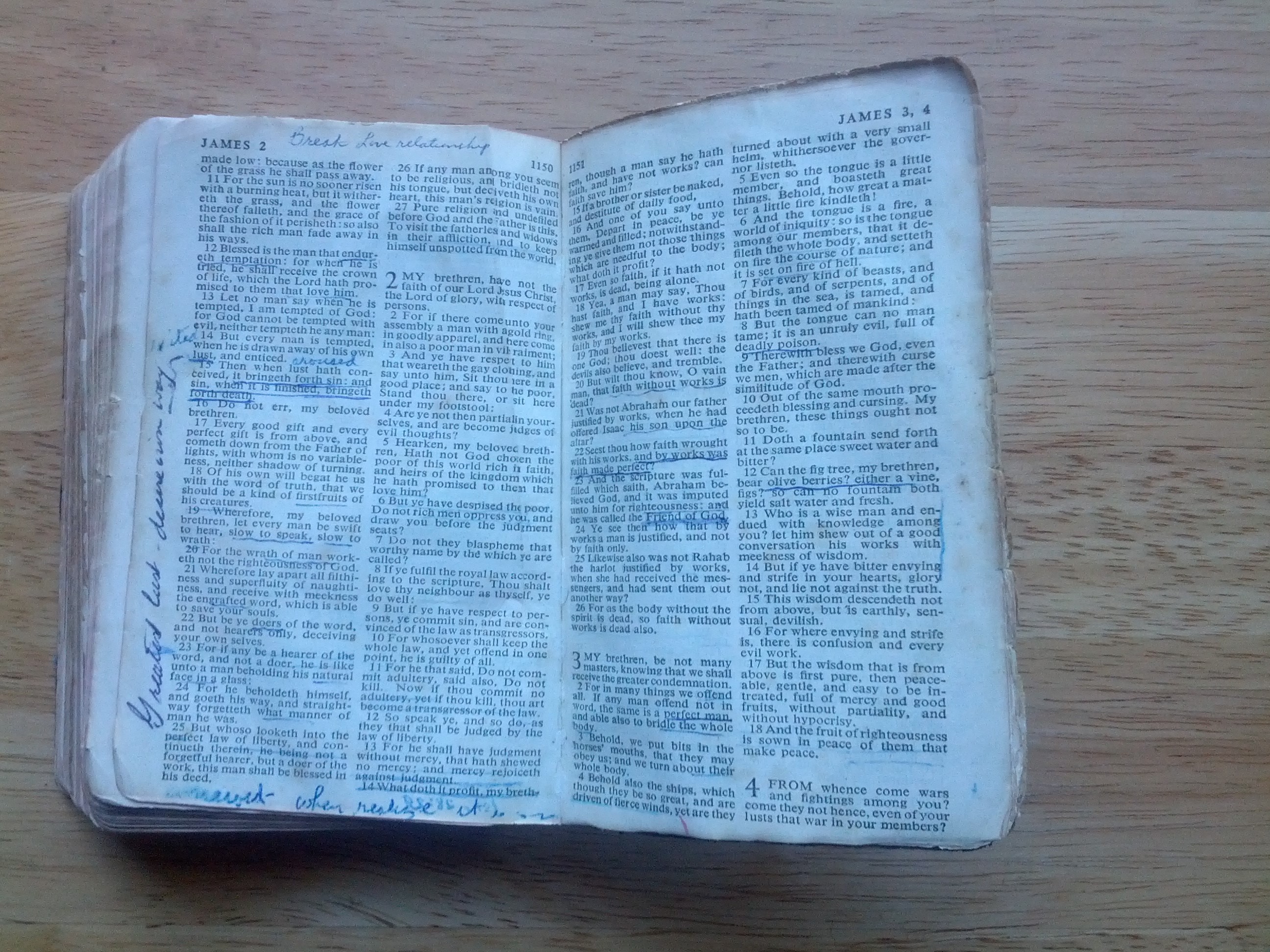
    My Dad's Bible, one of many that he used over a lifetime. I'd often see him reading and marking them. He used this one toward the end of his life.
    My Dad’s Bible, one of many that he used over a lifetime. I’d often see him reading and marking them. He used this one toward the end of his life.

    Here are the key points:

    1. I saw my parents study their Bibles regularly, frequently, and for much more than five minutes at a time. It looked natural to me. Parents, if you want your children to read their Bibles, read yours. It will do you (and them) much more good than all the urging you can provide.
    2. I studied and memorized the Bible through church programs and in school. I memorized whole chapters. I read so much of the King James Version that I still tend to use a KJV concordance or do my #BibleGateway lookups in the KJV.
    3. I studied the Bible in college. I went out of my way to do extra reading either of or about the Bible. I took German reading and then did an independent readings course covering Old Testament textual criticism. I studied French and when it was time to write, I wrote about French translations of Hebrew poetry. I did a two quarter hour independent study of just the first chapter of Ezekiel.
    4. I asked myself what was important. If I claimed that God and my relationship with him was even moderately important in my life, I needed to spend time in touch with God through his Word.
    5. I continued reading. I even read for language maintenance while I was out of the church following seminary. When I returned, I was able to restart reading at the rate of a chapter a day in Greek.

    Boasting? God forbid that I should boast save in the grace of God that led my parents to instill these habit patterns in me and let me take an honest look at myself as I would be without him!

    My point is that if you want to know the Bible, there is no quick plan, no shortcuts, no easy osmosis method. You need to spend time with it. Prayerfully examine your priorities. If you are a parent, consider what you want to teach your children. Do you want them to think that Bible study is important? Study it. Let them see your priorities in action. Do you want them to grow up as praying people? Pray! Don’t be afraid to be spiritual and to talk about spiritual things.

  • On Ecclesiastes and Disagreeing with Authors

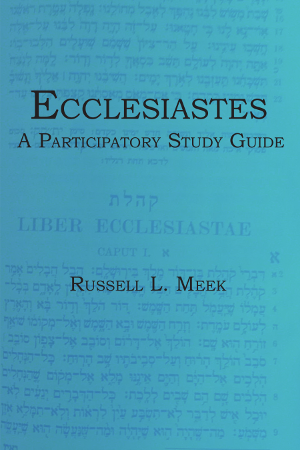
    Ecclesiastes: A Participatory Study GuideNo, not the authors of the biblical text, though that’s an interesting topic. I’m talking about disagreeing with a study guide author, in this case a study guide author I chose both to publish and then to use in my Sunday School class.

    One class member was surprised—not shocked, annoyed, or disturbed, but just surprised—that I would make those choices.

    More on that in a moment. What is it that I disagree on? Well, it is fairly simple and quite broad: authors, date, and the translation of the Hebrew word hebel. Those are the subjects we’ve covered in the first two chapters. I consider Solomonic authorship unlikely. It sounds to me more like someone later writing in a way that will suggest to his readers hearing this later literature in the light of the life and times of King Solomon. Incidentally, while I haven’t studied it that much, this could be a textual relationship, and the methods taught in chapter 2 could be used to discover whether there is, in fact, such a relationship, or if it’s just a relationship of ideas, or none at all. On hebel, I tend to read it more negatively than does the author of the study guide.

    This recalls to my mind some of the best times I had in college and graduate school. I would get together with a group of fellow students, sometimes with one of our professors, and we’d hash out issues. The goal wasn’t to find people you agreed with. That was pointless. The goal was to find brilliant people who thought differently than you did. Then you’d argue out the details and you’d all learn new things. The only time disagreement was a problem was when someone couldn’t be reasonably gracious about it. Vigorous disagreement and a spirited defense of one’s ideas was good. We tried not to get personal, and generally succeeded.

    What I told my class was that agreeing with me wasn’t even a consideration in choosing what book to publish. If it slipped in, it could just as well be a negative as a positive.

    These first two chapters of the Ecclesiastes study guide are brilliant, in my view, because they present views that will be controversial in many quarters, and they do so thoroughly, but in a way that a serious non-specialist can read and understand. You don’t just learn what the author’s opinion is and the names of some people who oppose it. You learn why he made those choices. The introduction to intertextuality is also excellent and gets Bible students to think of things that we often neglect. Just how do two texts/passages relate? Which might have influence the other? That involves sequence and availability. Which was written first? Is it likely that the earlier work was available to the later writer? What characteristics would show that two texts were related?

    People from all parts of the theological and spiritual spectrum have an unfortunate tendency to read things they find agreeable. I’m hoping that through both teaching and publishing, I can get them to look at things that are very different. This is not simply to get an idea of the spectrum of ideas. It’s also so that people learn why. In the 21st century it is unrealistic for pastors to assume people won’t get exposed to these other viewpoints. Yet there are still pastors who think they can somehow protect their congregations from discovering this fact.

    Bible students all too frequently simply accept what their study Bibles, their pastors, or some Bible teacher says as to authorship, dating, relationships between texts, and interpretation. They don’t understand why those things happen. This guide is attempting to teach people how to examine the nuts and bolts of the process, how to make such determinations for themselves.

    I was reminded of the conversation in class during the sermon. My pastor was preaching from Matthew 5, including the portions that discuss divorce, lust, and adultery. I happened to agree with what he drew from the text, but I noticed that it would be nearly impossible for people in the congregation to rebuild his logic. It’s likely a bit much to expect a pastor to get any of that “other stuff” across in a 20-25 minute homily, but I think it is unfortunate that for many congregants, that one discussion will be all that they learn about that passage. They will go home with an interpretation (assuming they remember it), but will be unable to defend it, and would be unable to reproduce it or apply the same principles to another text.

    I truly don’t look for authors who agree with me. I look for authors who will educate, because education in turn empowers people to take action.

  • The Authority of the Longer Ending of Mark

    Here’s an interesting post on the longer ending of Mark and snake handling. (HT: Dave Black Online, Why Four Gospels?)

    There’s obviously a serious question about hermeneutics lurking in the discussion, but what I would like to see discussed is just what text of Mark is authoritative. We tend to assume that what we want is the most original text. What did Mark write?

    But we count as scripture what was recognized by the church councils as scripture. (I ignore here whatever reasons they may have had for their choice.) The Gospel of Mary or the Gospel of Peter are not authoritative, but Mark is. What text of Mark were the church fathers looking at when they made it canonical? Does that matter?

    I think it would relate (in a distant way) to the question of whether a gospel retains its authority if one thinks it was authored by someone other than the traditional one. If the church fathers canonized a gospel they believe to have been written by Mark, and then it turns out he didn’t write it, should their decision be reviewed?

    I ask these questions because we often try to dodge doctrinal difficulties through textual criticism. I think that is not always (or often) the right approach. It has its value, but creates its own difficulties.

    Worth thinking on, I think.

  • Reflections on Teaching Revelation

    Reflections on Teaching Revelation

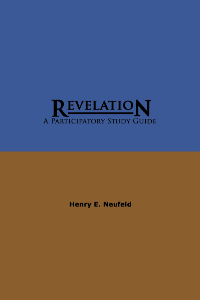
    Revelation: A Participatory Study GuideThis past Sunday I completed teaching a four week series on Revelation for one of the Sunday School classes at Chumuckla Community Church. It’s always interesting to try to teach a short series on the book of Revelation. There is so much there, and so much background information is needed. It’s difficult to be effective.

    This series turned out well. My goal was to suggest some ways to read Revelation more profitably. We discussed the nature of the book and looked at some specific passages as examples. I hope that the material I was able to share will help folks dig deeper into other books of the Bible as well.

    Here are some points that impressed themselves on me during this series.

    1. I’m more convinced than ever that we need to read Revelation more for theology and spiritual growth and less for trying to lay out timelines for the end of the world. I find good theology and good principles in many of these passages even if we continue to disagree on the specific referents.
    2. I have a great deal of sympathy for the preterist position, even though that is not precisely what I believe. Symbols generally do find credible referents in the immediate time and place. The problem with the preterist position, in my view, is that it is easy to leave all the book’s other lessons in the past as well. Revelation spoke to its own time, but it also speaks to the future.
    3. Revelation is possibly the most violent book in the New Testament. But it’s not about the violence. It’s about God’s faithfulness.
    4. Revelation is an unfolding of the gospel. It begins with Jesus with his church/people, and it ends with Jesus with his people. The rest assures God’s people that God is paying attention and is with them even when he doesn’t appear to be.
    5. In teaching Revelation we need to emphasize the persecuted church more. When you get to the fifth seal, for example, and the souls under the altar are asking “How long oh Lord?” it helps if we understand what persecution was and is like. I have always discussed persecution as an historical phenomenon. This time I spent more time discussing the present and what some of these passage might mean viewed from the perspective of people suffering persecution right now. Like Hebrews, Revelation speaks to people suffering or soon-to-suffer great hardship. We American Christians, in our ease, are likely to have a hard time hearing the message.
    6. The most important thing a Bible teacher can so, I believe, is teach people how to study for themselves. It’s not about getting across all of my beliefs or particular interpretations. What people need is to find a way to experience God for themselves—to hear God’s voice—through the pages of scripture.

    In addition, I was impressed by how badly I need to revise and improve my study guide. I’m still very happy with the basic approach, but there is so much more that could be said. I’m going to redo the layout, expand my notes and move them to the beginning of each lesson, and spend more time in the study guide talking about the lessons one can learn in this important book about reading scripture and allowing it to change our lives.

  • A Rant about Study Bibles

    A Rant about Study Bibles

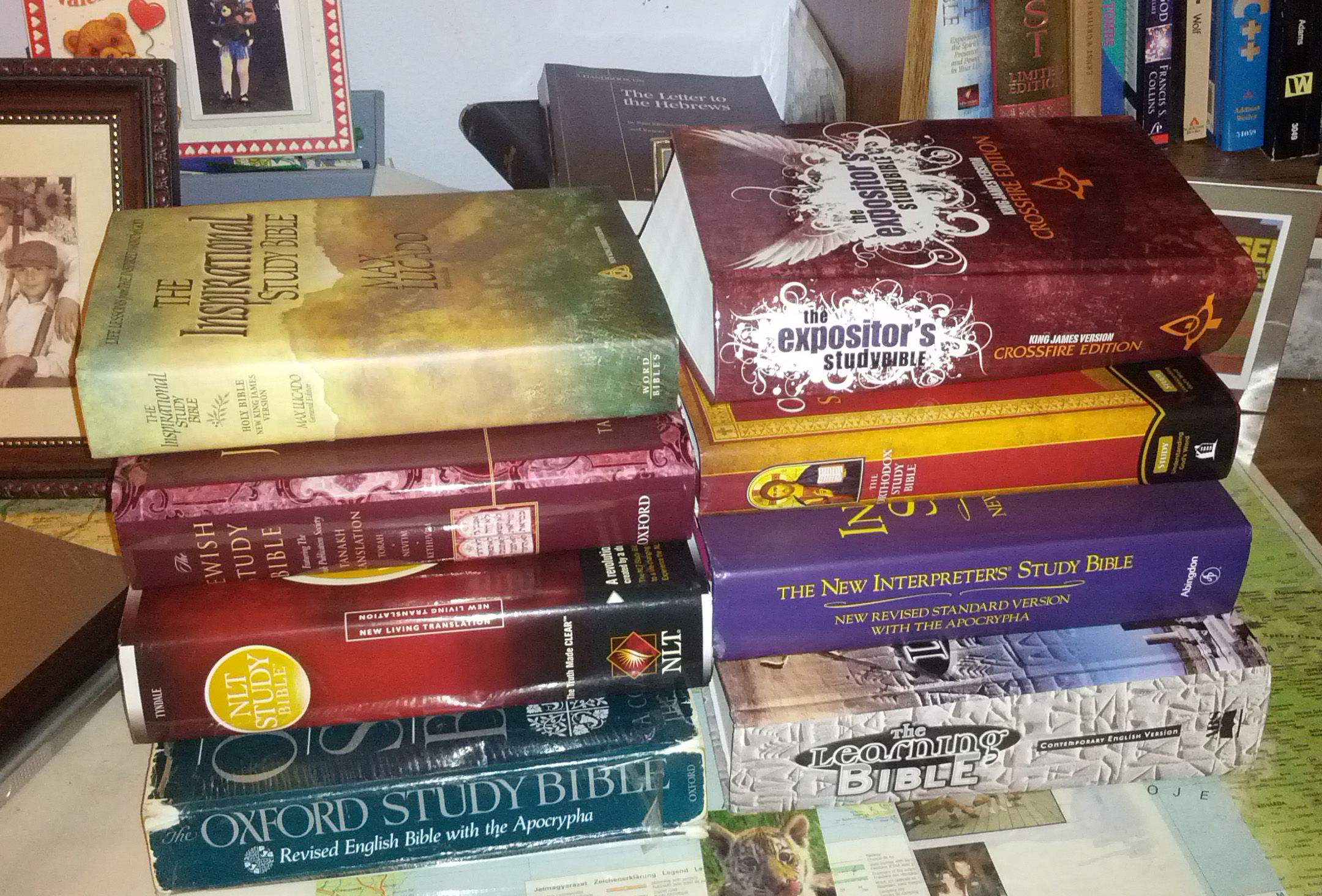
    Study Bibles Galore!
    Despite my dislike, all these Bibles were within arm’s reach of my desk

    I dislike study Bibles. I almost said I hate them, but since I do tolerate some of them, that would be overstating the case.

    My problem with them is that they tend to blur the distinction between the text that we’re studying and the commentary made about it.

    I have managed to keep my annoyance under control by dividing these Bibles into two classes. The first class is those that present historical and technical data as an aid to the reader. This information is much like what would be found in a Bible handbook, but it is conveniently presented within the same covers as the Bible text. I still would prefer a separate Bible handbook, but I understand the value.

    There are still differences in the material presented. What editors choose as the most relevant material to be included in limited space is going to be determined to some extent by their philosophy and view of scripture. Someone who studies the Bible from a secular viewpoint, as history, will be largely interested in the historical context; someone who reads the Bible as the church’s literature will be more interested in theological connections. Both of these items may be valuable to the reader.

    Because of the limitations of space, it’s usually not possible to cover a text from all angles, or to provide a wide variety of information that relates to interpretation. So if a Bible student becomes tied too closely to a particular study Bible, which can happen quite easily if it’s the Bible that person carries to church, their perspectives will be limited.

    So I’m uncomfortable with these Bibles, but I understand their purpose, and believe that if used appropriately they can be valuable.

    But there’s a second class of study Bible. I encountered a number of them over the last couple of days as I looked for a Bible to giveaway at 2014 Reimagine Santa Rosa County. (We ended up using the NLT Study Bible, which I think is one of the better study Bibles, though its notes reflect somewhat more conservative views than mine.) But on the way to buying that Bible, I had to wade through dozens of editions of Bibles with notes by one person. The So-and-So Study Bible. It just doesn’t work for me.

    I believe that teachers and scholars are important. I don’t have a problem with commentaries. I don’t mind study guides (I even publish a few.) I would like to see people have the goal of getting to the point where they study the Bible text directly. Use commentaries for backup. Compare notes with others. But get to the text.

    In my experience there’s a very real tendency to confuse the interpretations in the notes of such Bibles with the text itself. I recall one man who showed up for a series I was teaching on Revelation with a Jack Van Impe Prophecy Bible. I didn’t mind being challenged by Jack Van Impe’s views. Actually, I don’t find them very challenging. But for this man, what that Bible said a text meant was precisely what the text meant. You couldn’t get him to discuss the text itself. He would only quote the notes.

    Unfortunately, this was not an isolated incident. One lady called me aside in the church hallway with a question. She had read a text and then read the notes, and she couldn’t see how the writer of the note got that interpretation from the text. She assumed she must be wrong, since the note writers were so much more educated about the Bible than she was, but could I please explain. Actually, I thought the note was wrong. I explained to her how the writers might have gotten their interpretation and then explained why I disagreed, and suggested she spend more time with the text and less with the notes.

    While I’m uncomfortable with study Bibles generally, I really can’t see the purpose in the study Bible written by an individual. I think it points away from the text and toward a single expert’s opinion. I think that’s bad.

    Well, maybe I nuanced my rant a bit …


  • The Potential Arrogance of Critiquing Bible Translations

    When I wrote yesterday about the HCSB introduction and its use of the label “optimal equivalence” I fully intended to write another post complaining about that introduction. And I will mention the other issue briefly in this post. But something else was drawn to my attention in the meantime.

    Let me lay a foundation. Some years ago I was chatting about a particular Bible passage with a young person who was also a new Christian. We were discussing the best rendering of a particular verse in the Old Testament and when I defended the version we were looking at he said, “Wouldn’t ____ (naming a well-known figure) know best, since he reads Hebrew?” Now I didn’t point out that I read Hebrew as well, which was, perhaps, relevant! But I did point out that the translation we were examining had been made by a committee of several people, each of whom read Hebrew, and then it was reviewed by editorial committees, many of whom read Hebrew. They should get some credit!

    This is one thing that concerns me when I hear pastors or teachers say, “This is how this text should be translated …” or “What the Greek text really means is ….” I’ve commented before that you’re generally about to be misinformed when someone says that. But even when an expert makes a comment about just what a translation should be, I have concerns. (Note that I’ve never heard someone say “what the Greek text really means” who was well-qualified in the language. They just don’t talk that way.)

    My concern even when the linguistic information to follow is accurate is that this suggests to people that our Bible translations are carelessly put together by people with less language skills than the average pastor. Anyone with a few minutes and a reasonable pastor’s library can correct the work of the Bible translation committee! That’s simply not accurate. It also feeds a concern amongst many Christians that they cannot truly get to the meaning of scripture because so much is lost in translation, and they don’t have the time or talent to acquire facility with the source languages.

    People like these come up to me in church hallways all the time. They’ve heard me introduced as knowing Greek and Hebrew, usually in exaggerated terms. “Reads Greek as well as you read English,” is one line that’s been used. I don’t know where they get that. No, most English readers exceed my speed at reading Greek. My main claim to fame is that I have kept my Greek and Hebrew up. I read my devotions in the original languages, so my comprehension is better than average, but I have not kept abreast of all the best linguistic scholarship. Nonetheless, people ask me what’s the best Bible translation. Can they trust the translation they’re using? What wonderful insights can I give them quickly that are missing from their Bible version?

    These kinds of questions result, I think, from a profound ignorance about how Bible translations are made, who makes them, and the general quality of the work. I don’t want to diminish the value of knowing biblical languages. I wouldn’t trade that training for anything. But the best use to make of such knowledge is to deepen your own understanding of the scriptures, and then express that deeper understanding in words that people in the pews can understand. You don’t have to tell them with every insight how wonderfully smart you are because you know the languages.

    The fact is that we have a very good set of translation options. Most—nearly all, I think—significant errors in interpretation can be avoided simply by carefully studying your text in context from your translation, and then comparing a few other translations to check your work. Properly using the linguistic comments of a few commentaries will help you even more. (May I recommend a book that I publish, “In the Original Text It Says …”?)

    My point here is that Bible translators, in general, are a skilled and dedicated group of people who have provided a number of excellent translations for the English-speaking world.

    Barring a couple of really troubling efforts, such as Jack Blanco’s Clear Word, any critique I offer relates to details and general approach. I don’t intend to call a translation bad unless I say it outright, for example, The Clear Word is a bad translation, if it can even properly be called a translation. So when I publish a couple of posts criticizing something in the HCSB introduction, I’m not trying to tell you it’s a bad translation. It’s not. It’s quite good. As with most translations, I disagree with some renderings.

    Here’s some key points I try to remember in order to avoid the potential pitfalls. How successful am I?

    • Most “errors” reported in a Bible translation are not errors. Yes, I mean that. I have found very few translations for which I cannot find the justification. I may not agree with that justification, but it exists. For example, the following are not errors: Choosing a different textual variant than I prefer, translating a Greek genitive as a different type than I think appropriate, finding the English translation in a different part of the semantic range of a word, choosing a different option for what a clause modifies, using English words that I think are less than well-known by people in the pews. Each of those things can be annoying. I’ll criticize it in the translation. But that simply means that I would make another choice than the translation committee did. In general, there were more of them with higher level degrees. Read my arguments and make your choice. Reserve the word “error” for an error of fact, such as citing that reading incorrectly, proposing a meaning for a word that has no foundation at all, or using an English word that doesn’t fall in the semantic range of the word in the source language. You’ll find that translation committees make very few errors under this latter definition.
    • Say “I disagree” or I would prefer” rather than “this is wrong” or “the right way to translate this is.” It’s not a matter of uncertainty, or not caring about the truth. It’s a matter of giving credit to qualified people who disagree.
    • Don’t preach about translation differences. Preach about the text and the message of the text. You can almost always do this well in English without trotting out your Greek and Hebrew knowledge.
    • Say some good things about Bible translators. I have some concerns about the priority placed on providing more and more English translations as opposed to providing for those who have no translation, or even don’t have the quality we have in English. But these people are doing good work for the Lord and your congregation should know about them and be thankful for them.
    • When the foundation of your difference is theological, make sure people know it. Sometimes our theology influences our translation. It could hardly be otherwise. That overlaps closely with thoroughly studying the context. If I understand Paul’s theology in one way, I am going to be influenced away from a linguistically sustainable translation that has him teaching something else. The theology matters.

    But this last point leads me to my other complaint from the HCSB introduction. It’s under the heading “The gender language policy in Bible translation.”

    Some people today ignore the Bible’s teachings on distinctive roles of men and women in family and church and have an agenda to eliminate those distinctions in everhy arena of life. These people have begun a program to engineer the removal of a perceived male bias in the English language. The targets of this program have been such traditional linguistic practices as the generic use of “man” or “men,” as well as “he,” “him,” and “his.”

    I resemble that remark. Well, not very much. You see, I prefer “people” to “men,” “humankind” to “mankind,” and “brothers and sisters” rather than “brothers” or “brethren.” I’ve found, in surveying folks I teach, that there is a bit of a generation gap on these terms. Younger people tend to hear “men” as referring just to male persons. Older folks understand it generically. So my approach in translation is to translate as I think my audience understands the term.

    I was quite amused by a former pastor of mine who complained bitterly about the use of “brothers and sisters” to translate the Greek adelphoi. In the NRSV this is done when the translators thought the referrent was a group including both genders. He preferred the older RSV because of this issue. Yet when he read from the RSV in church and came to “brothers” he’d look up and say, “That means you sisters as well!” He complained about the translation, but he knew about the problem with understanding, and his pastor’s gift kicked in to make sure nobody felt left out.

    But having said that, I don’t think I’m ignoring the Bible’s teaching on “distinctive roles of men and women.” I disagree on where lines should be drawn. You may think I’m wrong, but I assure you my motivation is not to avoid the teaching of scripture. I simply read it differently.

    Could we not simply say something like, “We believe that gender distinctions should be maintained in the language and have translated according to the Colorado Springs guidelines? (The introduction references these in the next paragraph.)

    The issue of gender roles and gender languages is a legitimate topic of debate. What I’m suggesting here is that we don’t make this kind of issue, on either side, a matter of questioning one’s commitment to scripture or the quality of one’s work on Bible translation.

    In my little charting program (MyBibleVersion.com) I rate translations on such issues. The point is that you can use this information to pick a translation that you are comfortable with. Find the NRSV annoying because of gender language? The ESV handles the issue differently while otherwise following a similar translation philosophy. And so on …

  • On Interpreting Hebrews 6:1-8

    David Allen has an excellent series of posts on this passage (HT: David Alan Black), which I think is the key to the entire book. I am, of course, especially impressed with the fact that much of what he says is compatible with the way I believe the passage should be interpreted!

    Agree or disagree, I think one must admit this is exceptionally well written and reasoned.

    I will doubtless acquire a copy of his commentary on Hebrews in the New American Commentary Series [Hebrews: 35 (New American Commentary)].


  • Step-by-Step Exegesis

    Thomas Hudgins provides 10 steps for biblical exegesis. I’m particularly pleased to see structural and rhetorical analysis on the list.

  • Pious but Stupid Statements about the Bible

    I was out driving today and saw a church sign with the statement, “The Bible – Your First Notebook.” What exactly does that mean? I see almost nothing about the Bible that makes it like a notebook.

    It’s still better than the common statement—at least I heard it frequently when I was younger—that the Bible is like the Boy Scout Handbook. In fact, again, the Bible is almost totally unlike the Boy Scout Handbook. They do both have covers, pages, and letters on the page, but there the similarity seems to end. There are portions of the Bible that are more like the handbook than others, but even those, such a Proverbs, or certain sections of the Pentateuch, but even there the differences are overwhelming.

    The Bible is a bit more like a collection of all the camp fires tales and verbal wisdom passed from one leader to another, though nobody is likely to use that as an analogy. Nonetheless, such an analogy would provide more help in learning to interpret the Bible well.

    I think we see these expressions as somehow pious. People respect the Boy Scout Handbook in a certain way. People follow the directions that are in it. So it seems pious and virtuous to make the comparison.

    But such comparisons are really unhelpful. The Bible presents the word of God, but it often provides us with more questions than answers, starting places for thinking rather than conclusions. I’m not saying that it does not provide any conclusions. It’s just that it’s not as simple as an instruction manual. It tells a story of human interaction with God. That makes the Bible work.

    The Bible also makes much larger claims than any instruction manual. Besides the claim to bring God’s word, it claims that study of that word will bring wisdom. (Consider Psalm 19 or all of Psalm 119, for example.)

    So while it may seem pious to compare the Bible to things in our ordinary lives that we respect. But we do not help people by making these claims or comparisons. The most respectful thing to do about the Bible is to represent it accurately, and treat it as it is.

    I doubt such an accurate representation will fit on a church sign.

  • A Brief Venture into the Practical

    9781938434716sOh, we don’t have to keep it brief. My friend Greg May (also an Energion author, Crewed Awakening and It’s in the Toolbox) wrote a great post this morning about application. There’s nothing wrong, in my view, and much good about learning the nuts and bolts of the Bible.

    I’ve encountered an attitude similar to that of the guy in Greg’s post many times. I am urged to stick with just the facts. But the Bible isn’t about “just the facts.” In fact, the parables of Jesus are best not “solved” but left to stimulate our kingdom thinking.

    So let me link to another friend, who went on a thinking spree about the prodigal son. You may well disagree with where his thinking led him, and that should generate some good discussion, but the process is wonderful.

    And that is a brief post for me!