Today in Sunday School class the teacher referred back to challenge I had presented to the calls some time ago. I had suggested reading the prophecies of Isaiah, particularly 2nd Isaiah (40-55) without our “Jesus colored glasses.” I don’t suggest this not because I think Christian readings are inappropriate, but rather because it helps give you a sense of history. Place yourself as best as you can into the place and time from which the prophecies were spoken.
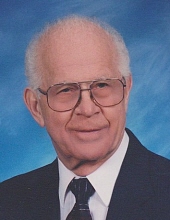
J. Paul Grove
Our Sunday School teacher today, Melinda Henry, brought this challenge back to the class, after she had taken it herself. In her experience an teaching it led to placing ourselves into these prophecies, particularly the servant passages, and seeing there the call to be a servant in just that way.
When she did this I was reminded of when I was first challenged to read this passages in a different way. My undergraduate major in Biblical Languages was offered by the School of Theology at Walla Walla College (now a university). Thus most of my classes were taken with students who were preparing for pastoral ministry.
I took a class in Hebrew prophets from J. Paul Grove, and I confess that I didn’t really like it that much. He was the one to first challenge me to read Isaiah in that fashion. In addition, he had the requirement that we produce three sermon outlines per week derived from the texts we were studying. I hated that requirement and even tried to get out of it by pointing out that I wasn’t going to be a preacher. But the professor insisted.
It was a great experience and has stuck with me ever since. Paul Grove has gone on to his rest (as they would say in his SDA tradition), but I wanted to express my gratitude for pointing me toward some ideas I have used repeatedly in the years since, even though I thought it was wasted effort at the time.
I will be dealing frequently with issues of date and authorship while discussing Paul. The reason for this is that there is a considerable variation in what books scholars believe that Paul wrote, so while giving perspectives, I need to deal with the differences in the books attributed to Paul and what picture emerges of the apostle.
As some background, let me embed two videos I’ve done on dating and authorship. One major problem with this discussion is that for most laypeople the discussion is quite opaque. They don’t really understand how scholars determine date and authorship, so they’re stuck with either a consensus, or with what is presented in their study materials.
The first video is on dating the book of Daniel. In this, I’m not trying to give you the answer, but rather to give you a look at the various considerations:
The video above is from my own YouTube channel. The next one is from the Energion Publications YouTube channel. It’s a dialogue with Elgin Hushbeck, Jr. on this topic. Elgin takes a somewhat more conservative approach than I do, but his approach is also conversation friendly, i.e., you are asked to look at and evaluate evidence.
A little over a week ago I reviewed the NIV Cultural Backgrounds Study Bible using the Olive Tree electronic edition. On Tuesday I received my hardcover copy from the publisher. (Note: I received this copy free of charge in exchange for an honest review. No other strings were attached!) This is not an extraordinarily new experience in Bible editions, but it is a good one.
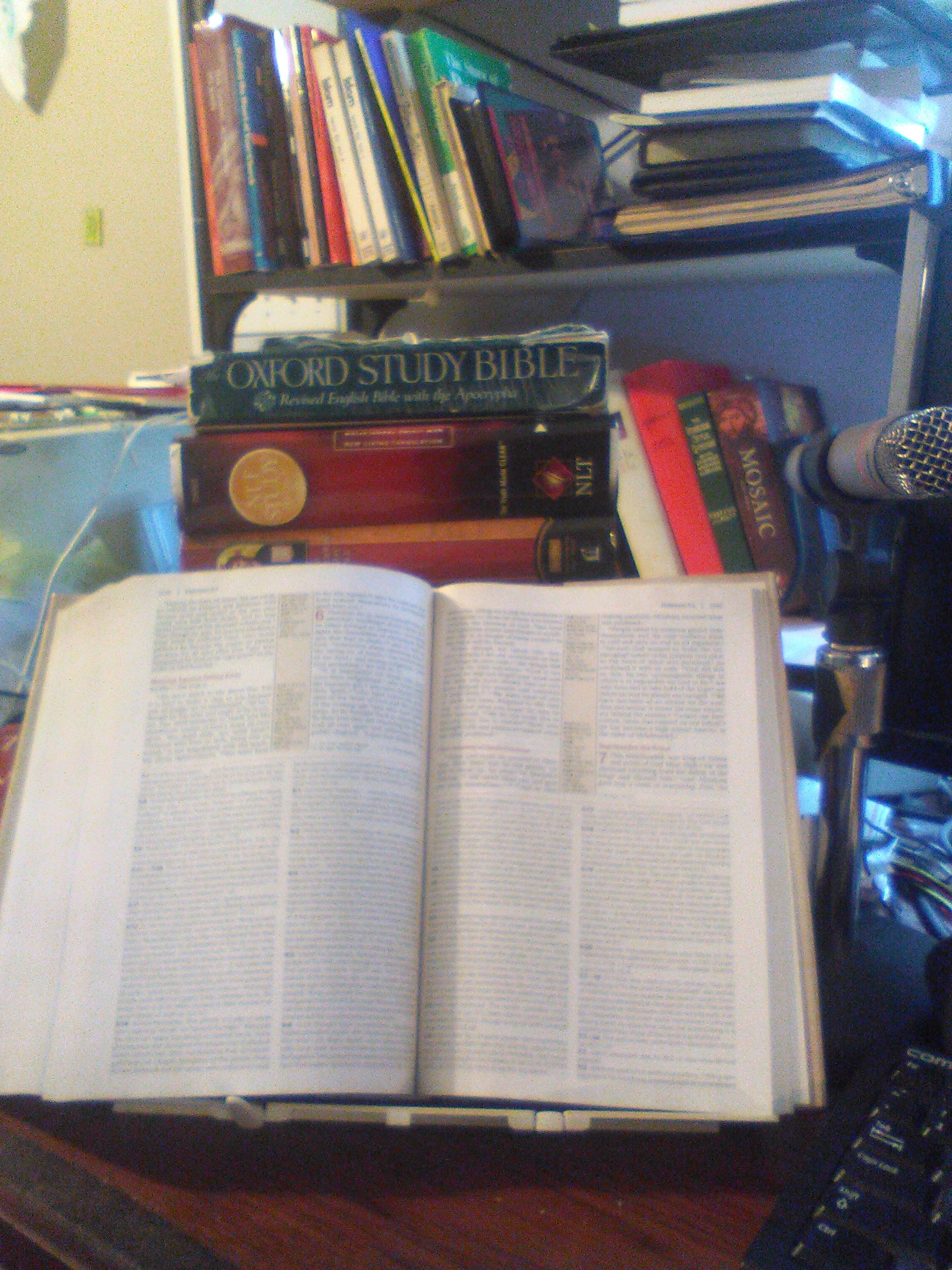
The Bible is 6″ x 9″, so fits nicely on all my disorderly stacks of books. It’s about 2 1/4″ thick, which makes it substantial, but not the largest Bible I use. The picture at the top shows it in my (not necessarily its) natural environment. That’s my actual desk, and so you can see it in comparison to the other study Bibles I have around it. You can click on the image to see it in high resolution. These days I rarely carry a physical Bible to church, other than my Greek & Hebrew testaments (I have years of marking and marginal notes in them), so I don’t worry that much about the physical size of a study Bible.
These days I rarely carry a physical Bible to church, other than my Greek & Hebrew testaments (I have years of marking and marginal notes in them), so I don’t worry that much about the physical size of a study Bible. That said, I can say that I prefer working with the electronic edition of this Bible, even though I am not well-acquainted with Olive Tree software. There is a great deal of information to present, and the size of an edition is always a compromise.
In this case, the text is small (as is common with study Bibles). The image just below shows it by comparison with my own Revelation: A Participatory Study Guide, which is printed in a 12 point font. The notes appear slightly smaller, though I’m not good enough to say for certain, and the impression may be created by a different (sans-serif) font for the notes. This note on text size is not intended as criticism, but it is one of the major reasons I prefer to use an electronic edition in which I can set font size. This is a problem for just about every study Bible out there. There is so much information to be included that something has to give. Having done page layout on a large number of books myself, I understand this completely.
The biblical text is printed in two columns with reference notes in the center. This is a classical style of presentation, but not one of my favorites. Again, I should emphasize that nobody can avoid all criticisms for the layout of a text. Doubtless others would complain about a single column with notes on the outer margins, for example. The double-column format is so standard that I have only a couple of Bibles that don’t follow it. An excellent example is The Jewish Study Bible (JPS Tanakh Translation), which uses a single column for the text with notes consistently in a narrower column to the right. I find their edition quite friendly.
There are a variety of excurses and notes included directly in the text section, besides the standard notes which are in two columns at the bottom of the page. The notes supplement and follow-up on the introduction, generally providing information that is applicable on a wider basis, i.e. not to just the text in question. For example, just before the text of Isaiah we have an introduction to “The Oracles of the Prophets,” followed by a short introduction to the book of Isaiah itself. But about three pages in we have a nearly three-page section titled “The Historical Background of Isaiah,” which provides a great deal of helpful information that will also relate to others of the prophets.
But just after these sections, on p. 1122, is an inset titled “Dating Methods.” No, this is not for those of you interested in origins and how rocks and fossils might be dated. Rather, it presents the basics of how one tries to place a particular oracle at a particular date. This is a tightly packed, extremely useful essay. Everyone should read it, no matter what portion of the Bible you’re studying. That’s why I chose Isaiah for this brief tour!
I mentioned that I will comment on some more specifics regarding the book of Hebrews. I will do so, but this past week has been intense, and I didn’t yet get to it. Nonetheless, the picture to the left at this point is the introduction to the book of Hebrews. I will go through that introduction in more detail in a post I hope to publish by Saturday.
Having the physical copy of this Bible in my hands makes me completely comfortable in recommending it. It’s easier to scan the portions I’m not emphasizing. For example, in using an electronic version I rarely “leaf through” the book, and thus might have missed the excellent introductory material for Isaiah. My main concern with study Bibles is that people tend to take the word of the note writer as to the meaning of the text. It’s certainly appropriate and valuable to get the opinions of others, but when one doesn’t find out why the writer believes a certain thing, one is left with either accepting it on authority—surely the author of such a fine volume would have his facts straight!—or having to dig elsewhere for that background information. That’s the value of this type of explanation.
Outlining is a valuable practice in Bible study. It can
Help you understand the relationship between sections of a passage
Direct you to the key point
Clarify ambiguities
Give you a feel for the structure of an author’s argument
Clearly some of these overlap.
One of the common practices in teaching the Bible, however, is to provide an outline. Providing such an outline can be very helpful, but we need to remember that the outline is also an interpreter’s opinion about the passage and needs to be considered critically.
An illustration of the problem here can be found in the way laws are often named. “An act to prevent crime in the county” may be optimistic or even outright misleading. Frequently it will at least be controversial. Let’s suppose that “An act to prevent gun crime” provides restrictions on gun sales and ownership. Someone’s view of how likely such a law is to be successful will impact whether they believe the title is accurate or not.
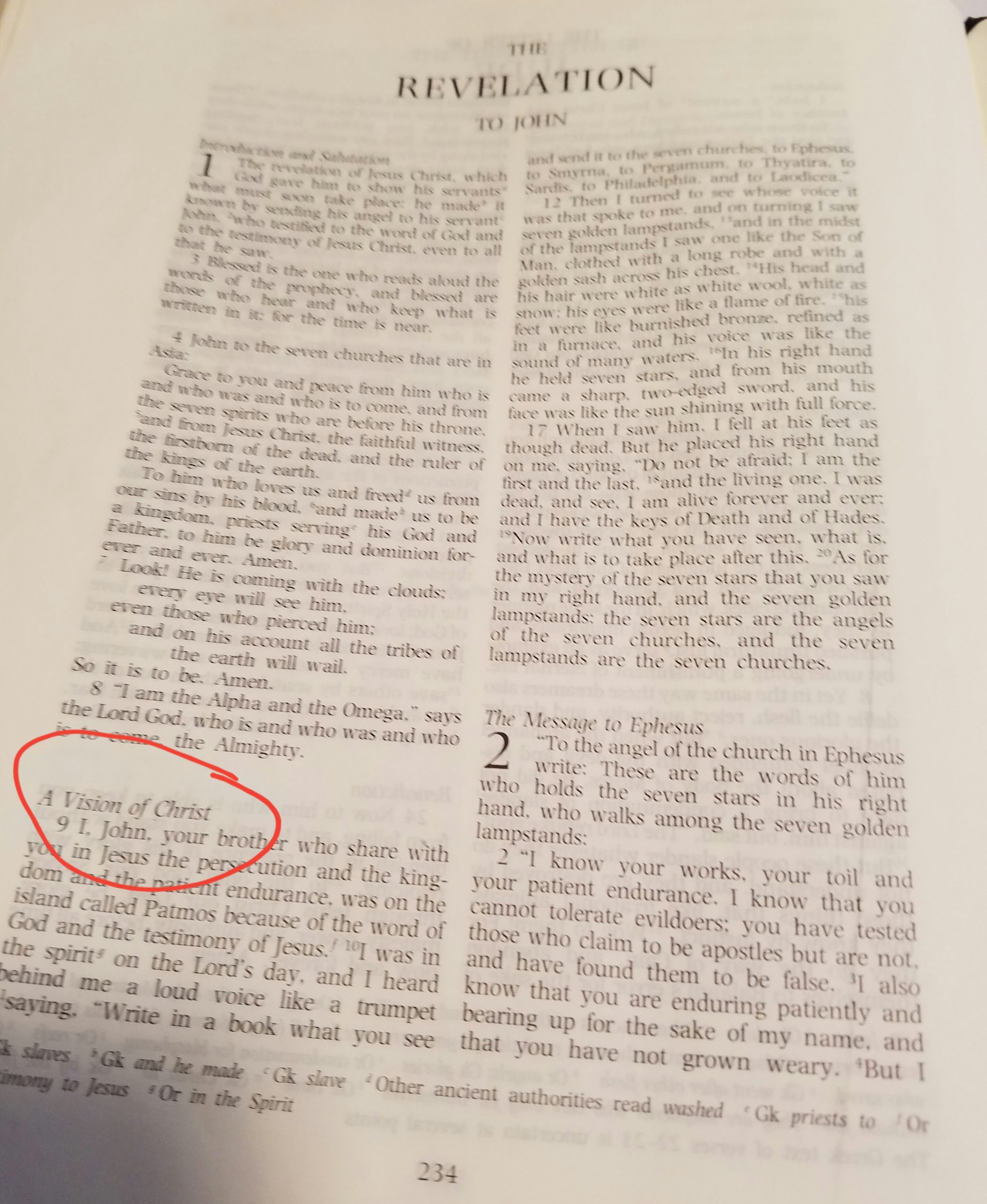
Section headings in Bibles fall into the same category. We often absorb them without thinking, and quite commonly there’s nothing wrong with them. But precisely because we don’t pay attention to them, they can subtly alter our understanding of a passage.
I recently reminded a Sunday School class of this when we concluded in our study that a passage was talking about something other than the section heading. That heading is part of the editorial activity in producing that Bible edition and not part of the original text, as are verse numbers and paragraphing.
Outlining is good, but before you settle on a particular structure, look at the material for yourself.
Since I have been reading the Cornerstone Biblical Commentary on Leviticus, Numbers, and Deuteronomy along with the text, I wanted to place a short note about the response to this passage in that commentary. (The author of the Leviticus portion is Dale A Brueggemann.)
He notes the command to slaughter all the males, including the children, and all the women who were not virgins, then on page 403 he says:
This slaughter was not the result of “collateral damage” in the heat of battle, or even an outrage committed in the heat of war’s bloodlust. It was purposeful judicial slaughter after the battle was already over. In fact, this action fits the modern definition of ethnic cleansing or possibly even genocide. The conquest was a holy war aimed at driving out an entire human population from Canaan (33:50-53), annihilating everyone there to purge idolatry and remove its temptations (Deut 20:16-18). …
He continues (p. 404) to note that Israel was promised similar judgment if they did not follow God and stay clear of idolatry. It’s interesting to note that at this point the chapter turns to the issue of ritual purity, specifying purification rituals for the spoils as well as for the warriors who, at God’s command, have come in contact with dead bodies. Dale Brueggemann notes (404):
… Even glorious battles fought and won with God’s blessing cause death, which doesn’t belong in the presence of the God of the living.
[ncs_ad pid=’9780842334280′ float=’right’ adtype=’aer.io’]Alright then …
It is here that I must note that this passage presents an interesting problem for those who want to quote the Qur’an and use texts, apart from their interpretation by representatives of any branch of Islam, to demonstrate that Islam is not a religion of peace. The Bible has similar passages which can be interpreted, and indeed have been interpreted by some, as justifying violence. Our commentator in this case calls this action a “holy war” and then a “glorious battle.” Apart from your particular means of reading this passage, could you blame someone not involved in your particular hermeneutic for concluding that Judaism or Christianity are not religions of peace either?
There are a number of ways of looking at this passage, some of which I enumerated in my article in Sharing the Practice, Preaching an Unpreachable Passage. Very few Christians would use this passage today as a justification for this sort of act of war. Reasons range from “that’s the Old Testament,” though it should be noted that few Jews would use it to justify slaughter either, to such violence is only at God’s specific and rare command, to noting that it was a violent time, and God worked with people as they were.
[ncs_ad pid=’1893729907′ float=’right’ adtype=’aer.io’]I must confess that I find the explanation give in the CBC on Numbers to be extremely unsatisfactory. The Canaanites were so wicked that the Israelites were justified in slaughtering everyone including the baby boys? Note as well that the women were not spared due to mercy. They were spared as spoils of war. I discuss my own responses in the article linked above, but I think that there is a requirement that we see a process of learning going on in scripture, that this was a way in which people behaved in the past in a world in which that behavior was standard, but that we have been told better (by the Prince of Peace, among others), and we have (I hope) learned better by now.
Most importantly, in our relations with other faiths, I would suggest that we need to “do unto others as we would have them do unto us.” We would object to the statement that Christianity supports genocide based upon this passage. We would reject interpretations by others that say this is so. We’d present our hermeneutic in support of our position. Just as we would like others to allow us to use our scriptures in our way, we should allow them the same privilege.
I enjoyed reading the responses for a number of reasons other than the actual answer given to the question. Quite frequently we respond to an article based on whether we agree with the answer or not. The well-argued, well-presented article is one that supports our own point of view. The scattered, poorly presented one is the one we oppose. In my experience only a few people can say, “This was a well-written article even though I disagree vigorously with its conclusion.”
I’m going to do precisely that in this case. Both of these responses to the question are well-written, and they are even well reasoned. It may seem odd to say that when they come to opposite conclusions. It’s important, however, when you read something this short regarding a topic this complex, that you ask yourself just where the author is coming from. Having edited books by both men, I have a leg-up in doing that, but if you read carefully you can clearly see the approach each takes to revelation (particularly scripture), theology, and finally doctrine. These approaches can be experienced at length in Dr. Weiss’s book Meditations on According to John: Exercises in Biblical Theology, and Dr. Parunak’s book Except for Fornication: The Teaching of the Lord Jesus on Divorce and Remarriage.
You can get some idea of the difference simply by counting the number of scriptural quotations in each post. My quick count gives me eight quotations by Dr. Parunak and one by Dr. Weiss. There are some who will think that gives the answer. Dr. Parunak is being more scriptural than Dr. Weiss. I would suggest that this is something like determining how scholarly a book is by counting the footnotes. I have a book on my shelves which has an overwhelmingly large number of footnotes. But if one eliminates footnotes to the author’s own works, footnotes to unreliable sources, and simply incorrect footnotes, the count drops dramatically. The notes give the impression of scholarship, but unless they are also carefully and correctly done, they are not themselves good scholarship.
So the question here is how scripture is used in each case. If you think of it this way, Dr. Weiss is actually inviting you to read more scripture, as he refers to broad theological concepts. You’d need to read at least the books of John, Romans, and Galatians, to actually pick up on some of the ideas he’s presenting.
So now, in turn, am I intending to put down Dr. Parunak’s work based on changing the way I count from a quotation count to a necessary reading count. Absolutely not! This is, in fact, one of the best exercises I’ve seen in years of the way in which the approach an author takes to scripture impacts his or her results.
For Dr. Weiss, scripture is a varied landscape, reflecting a variety of viewpoints, backgrounds, cultures, and even theologies. This landscape invites us to study and to form theology. He would never (and in my experience has never) simply quote a text and say that the text settles the issue. He would always apply that text to a study of the theology of the book of the Bible it came from and as part of the work of its author, particularly its human author. He demonstrates this in a range of books, but particularly in his book Creation in Scripture in which he looks at the variety of views on creation that are contained in the Bible. Some people wonder how he can do this. Surely the creation story is not told repeatedly, even if one accepts that there are two stories in Genesis, which many do not. But Weiss is talking about views of creation, how God is understood to be the creator: Theology, not science or history.
In the YouTube video below you can watch me interview him about the gospel of John, though Colossians comes up at well!
Dr. Parunak, on the other hand, sees scripture as more directly from the hand of God, in the sense that all scripture presents a unified picture of doctrine that can be deciphered by the interpreter, and can and should be tested and result in a high degree of certainty. So he will draw a more direct connection between a particular scripture passage. He does not have room for a variety in scripture such that we could say that one theology differs from another.
You can see me interview Dr. Parunak below, and you’ll hear him express this for himself:
Though I find the question of pluralism interesting, I find the way in which we answer it even more interesting.
My point here is not to critique either approach. I am not forced to publish anything. I wouldn’t have published books by these two authors unless I found their contribution valuable. But you and I as readers have to answer for ourselves the question of what we believe, and to do that we need to get behind the question of what an author believes to why he or she believes that. “Because the Bible says it,” is not really an answer unless you also know how that author or speaker reads and interprets the Bible.
So what about my answer to the question posed? Can the great world religions be vehicles of salvation for their adherents? I must note first that I regard my discussion of methology as much more important than any answer I might give here. Let me use Dr. Weiss’s terminology, which he discusses in his book Finding My Way in Christianity, pages 192 & 193. Exclusivism, he says, is the belief that all are saved through the sacrifice of Jesus and must confess in order to do so. Inclusivism says that there may be those in other faiths who are saved, but they are saved by the sacrifice of Jesus. Pluralism says that any religion may provide salvation and that Christianity does not have an exclusive hold on the true salvation story (I am using my own wording though working from Weiss’s material).
As I look at the question, I find it very difficult to answer without implying something I don’t mean. I am saved by the grace of God, not by a faith tradition, or a particular set of doctrinal beliefs. So just because someone says “Lord, Lord” doesn’t mean they are on the right road. My church membership is not what saves me. So in the sense that I believe God’s grace comes to me without consideration for my merit, in which I include meritorious beliefs as well as meritorious acts, I cannot exclude anyone. How wrong would I have to be in order to be excluded from God’s grace?
On the other hand, since I do believe that God was in Christ reconciling the world to himself, i.e., I believe that the incarnation is conceptually an exclusive event, and I also believe that there is just one God, however differently we may understand God, then I also see no salvation outside of Jesus, not because one has to understand this in a particular way, but because that was God’s ultimate act, one I see not merely as historical, but also as timeless and unbound by geography. God said that God was not too far away, that God was able to understand and to feel, and that God was able to deal with our guilt, our brokenness, and yes, our healing.
I find that both a message worth proclaiming, and at the same time a call for humility. How wrong can I be and yet be the subject of God’s grace? And in that case how wrong should I allow someone else to be and still consider them to be under God’s grace?
Actually I have an easy answer to that one. Nowhere has God made me the one to decide. I am simply convinced that if infinite God was willing to become finite and limited and live life as I must live it, that God isn’t going to miss any useful option in seeing God’s grace become effective on God’s children. I must sincerely doubt that God’s grace is less effective than mine.
Jody and I are teaching Sunday School tomorrow, and the starting point is the Adult Bible Studies Uniform Series, Winter 2015-2016. Thus we start the Advent season by studying the 4th commandment (the Sabbath command; some count these differently) and related texts. If you know me, you’ll probably know that I’m not a fan of the Adult Bible Studies series. In fact, I’m not really that much of a fan of Sunday School curriculum. The problem I have with it is not bad content, but rather homogenized content, as the series is edited to be used in many contexts. It’s a hazard of producing material that can be used generally.
If I could have my own way, I’d strongly suggest that such material only be used at the starting level, and that more challenging material follow, eventually leading to Sunday School classes going straight to sources and bringing in a variety of views. But they should bring this variety in through studying serious examples of material from various streams, not by watering down the material.
That said, I also want to emphasize that I’m not trying to critique the author of these lessons. In fact, I’ve added his book The Bible’s Foundation: An Introduction to the Pentateuch to my planned reading list. I’m not trying to critique the editors either. It’s simply that when something is written for this broad of an audience, the edges get knocked off before it’s finished, and I think the people in our pews can benefit from experiencing those edges. It was the misfortune of this lesson to sand down (in my view) one of the edges that I think very important.
Note to those who like short posts: This won’t be short. I’m planning to refer my Sunday School class to it if they want more. For the same reason I won’t be quoting much from the lesson, because I expect the primary readers to be people who are holding this lesson in their hands.
First, I’m going to look at the topic and where I see difficulties. Then I’m going to follow up with some of my own take on that material. I will also talk about the issue of space. Priorities are always hard to work out when you have limited space in which to express your view. I’m also writing against that constraint.
Two passages take pride of place in the discussion, both from Exodus. The first is Exodus 20:8-11, the Sabbath command itself, and how that might work out in modern times. In this discussion we go from the Sabbath command itself, which specifies that no work is to be performed on the seventh day of the week, and roots this in the creation account (“in six days YHWH God made heaven and earth”). This passage brings discomfort in a couple of different ways, as generally mainline Christians worship on Sunday (if they show up at all), and do not believe in a literal six day creation week.
In addressing the second point, the lesson gives us one of the best parts of the lesson, noting that the story in Genesis 1, and rooting the Sabbath in creation in the commandment as well, is the faith assertion of the writing that the Sabbath was “embedded within the very structure of the universe” (p. 7). Then he also shows us how a single event can take more than one meaning by referring to the reiteration of this command in Deuteronomy. So this command can have multiple meanings, one more universal (creation) and one more specific to Israel (the Exodus), though considering the way the Exodus motif is drawn into Christianity in the gospels, the second is somewhat universal as well.
The one thing I would add is that if one looks at the two stories of creation in Genesis, 1:1-2:4a and 2:4bff, one can see that at least the final redactor was not all that concerned with the physical structure or chronological history of creation, but rather had theological issues in mind. Genesis 1:1-2:4a is a liturgical passage. Worship in ancient near eastern temples reflected in some ways the people’s view of cosmology, and so liturgy was (and in my view, is) to reflect reality. Genesis 1 then places the Sabbath command into the heart of the liturgy as a weekly reminder of who is in charge. It’s difficult to be certain precisely how much of that liturgy was thought by author, redactor, or early reader to reflect reality. I suspect that if our concern is science, we should be more interested in the difference in cosmology (waters below, earth, firmament, waters above) than in the chronology, as the latter is liturgical. We do not maintain that Jesus was raised precisely on the date of Easter because we celebrate at that time, and we do not hold that Jesus is somehow raised once a year every year. Similarly, we don’t maintain that the ministry of Jesus was a week-long affair because we commemorate the resurrection through gathering for worship each Sunday. These are liturgical remembrances. The Israelites were capable of designing good liturgy, and embedding God as creator in a central way laid that foundation.
Thus I don’t think that creationism, whether old or young age, really needs to come into this. I accept the theory of evolution and would have no problem with commemorating creation on a weekly basis on the seventh day of the week. I can even imagine that this liturgical role might have been in the mind of the writer of Genesis 1 at the time, though it’s entirely possible that he thought this literally happened in a literal seven day week. That bothers me no more than his cosmology does, which is not at all. God must speak to people as they are. Imagine Genesis 1 starting with an explanation of the physics of a singularity.
But having moved past that we ask how do Christians keep the Sabbath today. There are two lines drawn between a text and modern practice in this lesson. I’m pretty sure the way the lines function is pretty much by accident. But I do think this is what classes are likely to get out of the material. On page 8 we are told that for us the Sabbath has become Sunday because we celebrate the resurrection, and we carry out Sabbath-keeping by attending Sunday School and church and participating in the life of the church. This paragraph looks like a kind of direct connection. We do obey this law and we do it in this particular way.
My problem here is that while I can draw a connection between commemorating the resurrection and commemorating creation, and I think a rather good one, that connection is not made explicit. On the other hand I cannot draw a very good connection between the command to rest and give rest to your entire household and those (even animals) that depend on you and going to Sunday School and church. I can find plenty of Old Testament warrant for participating in community education and worship life, but it’s not what the Sabbath command talks about. So here we travel fairly directly down the road from Old Testament law to modern application, yet I see a chasm in the road that isn’t bridged.
Before I did deeper into how I might handle the Sabbath command, however, I want to look at the other passage, Exodus 31:12-16. which calls for the death penalty for breaking the Sabbath. The lesson draws a very different line here. Citing 1 John 4:18, we are told that “… we cannot reconcile a loving God who demands death for working on the sabbath. We cannot affirm the death penalty for sabbath violation” (p. 7). And yet, we have Leviticus 19:18 “love your neighbor” on the one hand, and the deaths of Ananias and Sapphira (Acts 5) as death penalty counter-examples. We have a canon-within-the-canon disjunction, but only by assertion.
One of the tests of a hermeneutic is to ask whether it can be applied consistently. Now I will note that I know of consistent approaches that would deal with all these texts, but they are simply not expressed. That is my key issue here, and it has been my key issue with many United Methodist materials since I first joined a UM congregation. Way too much is presented by assertion. A scholar asserts, so we assume that is what we should believe. Then another scholar asserts something different, and the more thoughtful members wonder what’s wrong. A good illustration is the long-time church member who came to me wondering how she could ever learn to study her Bible. She kept reading the study notes and couldn’t see how the text said what she was seeing. She was shocked when I said, “How do you know the people who wrote the study notes are right?”
It’s hard to show people how we got to the conclusion as well as the conclusion itself, but if I were to make a choice, it would be for us to present less conclusions and show our work. Teach the members to study by our examples, and they can go form more conclusions for themselves.
So let’s go back to these two texts. How would I approach them? Here’s the first point:
Unless you are a Jew, the letter of these two laws does not apply to you.
How do I know this? Simple. They are addressed to the children of Israel. Read the beginning of Exodus 20. Ask yourself, “Who is the audience?” You’ll get it. I’m appalled at movements to put Ten Commandments monuments on courthouse lawns. The tables are very much an expression of the letter, especially when extracted from the story in which they are presented. We have no intention of keeping most of them. We can start with the one in question in this week’s lesson. We do not keep the Sabbath according to the letter of the Sabbath command and we don’t intend to. We don’t keep the one about graven images either, and we don’t intend to, not according to the letter of the law. We would at least claim that we ought to keep the one about coveting, but doubtless we won’t. So why put the text of those laws up on courthouse lawns? That isn’t (and shouldn’t be) the law that the court is enforcing. When we see people bow down in front of those tables of the law it gets even worse. No, the text isn’t a graven image (according to the letter), but bowing down in front of it and making it a central issue starts pushing the boundaries.
The boundaries of what, you ask? Well, the boundaries of the principles that are expressed in these commands. Those principles are expressed in a variety of ways, and they are modified in a variety of ways. They come from the story as well as from the command itself. One of the things to note about Bible stories is that many things are told in a very sparse way without commentary. People often cite the she-bears in 2 Kings 2:23-25 as an example of divine violence in the Old Testament, but there are two things one should note: 1) The story doesn’t comment one way or the other as to whether it was a good idea for Elisha to curse the boys and 2) it doesn’t even say that God sent the she-bears, just that they showed up. I think it’s likely that the writer thinks God sent the she-bears and at least didn’t disapprove of Elisha’s behavior. But the story doesn’t actually say that. (See a homily I wrote about Elisha and the She-Bears here.)
So we start from the point of view that we are not commanded to do any of these things. I can say this at least for my Sunday School class as we are all gentiles! But nonetheless this is scripture for us, and we see God in action. So using this approach let me tell you some of the principles I find in the Sabbath command.
I agree fully with our lesson that God is in charge of time.
God as the creator is made central to our lives, our ethics, and our worship.
Care for one another and care even for creation is embedded at this same place, as the Sabbath command is to apply to all within our gates. We aren’t even to make slaves work. All get to rest.
There is a need to specifically set aside time for rest. I’d suggest that if we don’t do it specifically, the rest time will never happen. I can certainly testify to that in my own life. This fourth point is the place where I violate the principles of the Sabbath command most regularly and directly!
Considering these principles, does going to church on Sunday fulfil the Sabbath command, not in letter (which would mean truly resting every Saturday all day)? In terms of the first element, I think it does. The shift to the resurrection is not nearly as radical as it seems, as the resurrection is itself a reaffirmation of God as creator. This shift also goes along with another Christian shift, expressed especially well in the book of Hebrews, and that is the shift from the Torah (in its narrower sense as the Pentateuch) as the center of our faith and understanding of God to the person of Jesus. That principle is carried out.
By keeping this celebration weekly, we also meet in some sense the second principle. Unfortunately, I think we fail to affirm adequately why we are in church each Sunday. It just sort of happens, as it did in our lesson. There we are for no better reason than that it’s what we do. It’s our habit. I don’t want to knock having church attendance a habit. That helps you through the difficult times. But it needs to be much more than that as often as possible.
But as for time for rest, and giving rest to others, I would suggest our Sunday worship pretty much fails. I’d note the number of work related e-mails I receive on Sunday afternoon from pastors. My point here, however, is not that these pastors shouldn’t send me e-mails on Sunday afternoon. Rather it is that there needs to be explicit times for the rest that we need, and that this rest needs to be extended to others as well. For pastors, Sunday is pretty much a day of work. They need to find themselves a day off. Their Sabbath is likely to come in two parts at least: Their worship with their congregation, which may actually be debilitating, and their time for their own rest that will need to come later in the week. Congregations should be aware that Sunday doesn’t work as a Sabbath for their pastor or generally for their church staff. They should positively participate in finding the appropriate rest time for those who serve them.
Finally, I go back to point #3, and note that often our worship on a Sunday morning is about us. That is also a failure to apply the principles of the Sabbath command. The rest we need is to be extended to others. It is an inclusive rest, and it applies to all of creation.
You’ll note here that while I say that the written command does not apply, from its principles I find a great deal that we should consider imperative in our lives. I could easily get all of this wrong. Realizing that the letter does not apply should lead us to a process of discernment and asking just what it is that God would have us to learn from a particular passage. I’m laying out what I see here. What do you see? If you disagree, can we discuss it? Perhaps we’ll all learn together. In applying principles we will get to practice the sort of community that results from us all being part of God’s creation, and in turn all being part of God’s redemption. The law grows! In us, it is alive!
And then we turn to Exodus 31:12-16, which seems to be the more difficult passage. As I have already said, this law does not apply to me and it does not apply to you. I am not commanded to carry out the death penalty on Sabbath breakers. But can I reconcile the death penalty for Sabbath breaking with a loving God? That’s a more difficult question. I think it needs to be met with a counter-question: Do I have to reconcile it?
Just as I believe God could not start his discussion with Israel about God’s role as creator by explaining a singularity and the big bang (and is that really the answer or will we look back and laugh at it in another few decades or centuries?), so God could not simply change everything about people in one act. In this case, I’ll only go so far as to say that applying the death penalty to the Sabbath command simply puts it into that most serious category of crimes. Should I support the death penalty for it now? I don’t think this passage answers that question or even points to an answer. I would agree that I could not now affirm the death penalty for this command as the act of a loving God, but I think it’s much harder to discern its role for the Israelites in their very earliest history.
So the question that I ask instead is what would make Sabbath breaking an offense of the most dire nature. Here I think we must go back first to the fact that these commands are addressed to Israel at Mt. Sinai following the Exodus. There is no death penalty, for example, in Genesis 2:1-4a. There’s just a blessing. Why is there one here? And I see as a good answer that the Sabbath was a marker of identity. It identified Israelites to others as Israelites. It identified them as YHWH’s people. Violation was seen in these passages as tantamount to treason, to a rejection of that identity. That the death penalty applied I would suggest is an example of a thing not changed, rather than an indication of God’s eternal will.
We often imagine how God might have changed everyone in a moment, but I suspect those of us who have tried to change the ethos of a group of people are much less certain that this result can be obtained quickly. People don’t change all that easily. When God interacts with people we will see not only God but the people he interacts with. If you’re thinking that I’m wrong, just consider how quick we are to want others killed today, whether it is as part of our judicial system or in war. We resort to “kill them” awfully quickly. Perhaps we haven’t moved as much from the world of Exodus 31:12-16 as we’d like to think.
Fortunately, we have other passages that tend to work on us in those areas as well. We as Christians struggle with identity. We are in the world but we are supposed to be different. Where is our identity to be found now? John 13:35 might suggest something: “If you love one another.” We don’t have the death penalty for this one, but perhaps we ought to consider that this definition of identity should have the highest respect that we can give anything in our church and community.
Now, having laid out how I see these texts, I want to ask how you do. I’ll be listening to my Sunday School class, and I’ll be happy to listen to (or read!) comments here. My main hope here is that by laying out our thinking we can learn to help one another grow, always looking back to scripture and to those around us to see what principles we should be applying in our lives.
Well, my prospective, perhaps presumptive garden, that is.
One of the important elements to understanding stories in the Bible, parables included, is our perspective. In Christian circles, when we hear “the sower went forth to sow,” (Matthew 13:3), or perhaps “a farmer went out to sow his seed,” we generally see ourselves in the role of the one doing the planting. We are evangelising, and people have different kinds of hearts. Have you ever heard someone describe another person as being rocky ground? Or perhaps someone has said, “He’s trying to dig some hard ground there!” Usually these expressions are used regarding targets of evangelism.
I’ll mention evangelism later, but first, let me place myself in the role of one receiving the seed. Is that not what I do when I pray and hope to hear from the Lord? Is that also not what I do when I open my Bible and hope to be changed by God’s message? So I am the ground, not the sower.
But let me tell you the story of my garden thus far. Fortunately for me, I have few plans that involve saving money on food, supplementing my diet, or saving on the food budget. I had one purpose in starting a garden: I need to spend more time in physical activity. Now I’m a bit of a workaholic. I have a hard time not doing anything. The easiest way to get myself to do what I need to do was to make it into work. Then I can feel good while I do it.
So I picked a plot on our little place out here and started to work on it. It has gone through being broken up with an excavator (at which time I killed power to my office and broke our water line, but that’s another story), lots of hoeing and raking, and digging up of roots and rocks. This morning I finally got to the point of being ready to actually till the plot. My previous work had been aimed, not at getting the soil ready for actual planting, but at removing obstacles. I have a large pile of brush, roots, and rocks at either end of the plot, things I have removed as I worked.
Then I had a period of time when I was just too busy with work. Between my work with computers and computer networks and my publishing work, I was simply overwhelmed. The phone would ring by 8 am and I wouldn’t get that much done outside. What do you suppose happened? Well, the plot got some new growth, but not the stuff I want to grow, of course, since I hadn’t yet planted. So out came the weedwacker, the hoe, and finally the rake.
Today I finally got to the tiller. That’s the tiller, in the picture to the left. I borrowed it from my friend Tom Hunt. If you need a floorplan done for a new house, he’s the one to go to.
There were some interesting things about using the tiller as well. Weeds leave behind small roots that tend to wrap themselves around anything available. No matter how may rocks you’ve removed there may be a few more. Run the tiller in a couple of directions. The pile of dirt from one pass may hide some hard soil. Power tools are great, but I ended my morning session more tired than when I worked with the hoe. The tool helps, but the human still better put heart and back into the effort.
Let me apply these to Bible study just a bit. You might want to reference my post from yesterday. Here are some thoughts I had while listening to that wonderful purr (or roar) of the tiller motor.
Different tools accomplish different things. No matter how much you may have gotten with one approach, try taking another look from another angle or with some different help.
Weeds don’t stay dead. You’re never really done. It’s easy to get complacent and think you already have it covered. Now it’s all about telling other people. Don’t get in that place. If you neglect your heart garden for a while, you may find the ground hardening and the weeds getting tall.
Don’t imagine that a period of neglect is the end. That’s what weedwackers, hoes, shovels, rakes, and tillers are for. Those of you who have forgotten your biblical languages after seminary, consider this as well. How about working on reviving them? Yes, I believe you can study the Bible effectively without the biblical languages, but after investing all that time and effort wouldn’t you like the benefit of that tool?
Don’t be blind to the rocks that are still there. You may have removed bunches of rocks, yet there are still some to find and remove. I often joke with Jody that it would be nice if I could measure the quality of my cleaning by the quantity of dirt I removed and not by what was left. Read 1 Corinthians 8:1-3 if you’re thinking you’re good!
Tools help but they don’t do the job. I love Logos Bible software. I love sites that let me compare versions (BibleGateway.com, for example). But these things don’t do your studying for you. They will make you more efficient. Many Bible students amass information and yet don’t get to what the text is saying to them. I was reminded of that forcefully as I moved the tiller through my prospective garden. It did more work than I could have accomplished with the hoe, but it still required me to make the application!
Sometimes you get so tangled with the weeds that you can’t really go on clearing and tilling. I experienced this as left-over weeds and roots tangled up the tiller. I had to stop and clear the blades so the tiller could work efficiently. I’ve experienced this in preparation for teaching my Eschatology series on Google Hangouts on Air (link to next session, Thurs. night at 7 pm central time). Eschatological views are based on many, many texts, and there are many, many views on each of these texts, plus mountains of theology done to tie them together or explain them away. It’s very easy to get so tangled in the details that you can’t see the actual text in front of you. I bounced this off my wife Jody, who has a practical mind set. I asked her to read Mark 13 the other day and then question me about it. She had a set of questions that helped clarify the chapter.
I’m sure there are many more lessons, but those are the ones that occurred to me as I worked this morning. But does any of this apply to evangelism?
Quit trying to judge the people you witness to. You can’t see what’s under the ground.
The best way to witness is to till your own heart. I can’t emphasize this enough. Most people can tell very quickly if you’re trying to use them for something else. So if you are making relationships with other people in order to convert them or make them into church members, they’re going to get that feeling. But if you are genuine and genuinely care about them, they will also know that.
The Christian life and Christian witness isn’t a strategy. See #2. Enough said!
God is the one who changes people. You witness. God acts. Be humble enough to give God the credit. Be humble enough to let God take the responsibility.
Do you see what happened? Quite frankly, all the lessons but one applied to me. As for reaching others, I have one duty: plant the seed. Now planting the seed can be complex, but I suggest that it starts with some of the points I made above. Let God’s word impact your life. Continue to let God’s word impact your life. Continue some more letting God’s word impact your life. Continue yet much more letting God’s word impact your life.
While I titled the event Eschatology: Mark 13, Matthew 24, and Luke 21, I will be focusing on the first. I will be mentioning the parallels and likely working directly from gospel parallels. I’m embedding the YouTube viewer first, then I’ll make a few comments.
I had hoped to post more earlier, but the work load this week prevented it. I also hope to post something more this afternoon, giving some background for what I’ll be saying. It is obviously impossible to do a detailed exegesis of Mark 13 in an hour, so I’ll be looking at some key points.
First, yes, I won’t be able to resist. I’ll mention some elements in the parallels that could play into arguments over Markan vs. Matthean priority.
Second, I want to talk about my overall view of biblical eschatology, and how I read that in Mark 13. Note that this is, to a certain extent, eisegesis. My overall view is the result of my study of many eschatological and apocalyptic passages, and not a derivative from Mark 13. Yet I will use it. I had planned to wait to present this overview, but I think it’s better for me to give my “mini-eschatology” first and then develop how I connect it with much broader and deeper eschatological views as I move forward.
Third, I want to focus on just what the disciples would have expected when they heard or encountered this material. Thus I’ll discuss the debates on whether this is original to the gospel (as a whole), whether certain elements were added later, and also just when this was written.
All of that leads to the point where I—finally—talk about “this generation shall not pass,” which has provided fodder for biblical and theological debate for the last two millenia. How was it understood in the past and how shall we read it now?
In studying eschatology from a biblical perspective, it is important to realize that one needs to resolve a broad range of questions nearly every time one wants to resolve one question. For example, the way in which one understands Daniel 9:27 impacts how one will understand “the abomination of desolation” and how one understands the vision of Daniel 7 will impact how one understands the son of man coming in the clouds. Not to mention whether one is certain those particular references are in view. Deciding how to understand those chapters involves a range of decisions regarding the text of Daniel as well as its historical and cultural context. Those decisions involve a number of issues regarding how one dates literature.
I say this because I expect to circle back to many of these passages after we’ve studied others. I think it would be useful to read Mark 13 again after we have done further study of Daniel. Jesus did not live in a cultural or theological vacuum either. Certainly his disciples did not. How might they have drawn these passages into their understanding of the words in the gospels? It is possible that what you or I decide in studying Daniel might be the correct historical understanding, i.e., we might be right about when it was written and how it would have been understood by its original audiences, but that the understanding we get there might not be the one the disciples would naturally draw in as they studied the words of Mark.
I had hoped to do a bit more writing on how we interpret the Bible before tonight’s discussion. In diving into teaching a bit on eschatology, I have come to feel a bit like someone who has encountered one of the versions of the certification test for senior generalists, or the ultimate final exam. (You’ll find a few different versions and titles.) The extra credit question, “Define the universe. Give three examples,” is a bit of the right feeling.
There does not seem to be any aspect of biblical studies that is not important or even critical in understanding eschatology. Some of the best examples of how not to interpret an be found in the way people handle this subject. There is always the problem of background information. How much must the student know before tackling a topic? But in eschatology, those background items become even more critical.
Tonight I’m going to work from Dr. Vick’s second chapter, “They Remembered Him,” and discuss what is the core of explicitly Christian eschatology. It’s quite easy for people to predict the end of the world. It may take some time, but eventually somebody is likely to be right! But does a particular outline of the end times make this doctrine Christian?
We frequently neglect eschatology in teaching and preaching. But how well does the gospel work when do this? Is it possible just to ignore this issue? Even when we talk eschatology in an individual sense, not when will the world come to an end (if it will), but when will you personally come to an end and meet God? And the latter question may not be quite as simple as it seems either. Are these events simultaneous? Do I go to heaven when I die or not?
So join me tonight as I discuss these issues and also the foundation for what Jesus said in his little apocalypse. You can find in on its Google+ Event Page or using the YouTube embedded below.





 Outlining is a valuable practice in Bible study. It can