Threads from Henry's Web

Category: Bible Study Method

  • John Walton on Different Hermeneutical Presuppositions

    In an interview published on The Jesus Creed, though released by IVP, John Walton comments on different hermeneutical presuppositions. He is referring to the endless debates about how and when creation took place, but the ideas might be useful regarding other topics.

    Walton: We too easily believe that the world of biblical interpretation is a black and white world—that whatever view we have adopted is right and everyone else is wrong. Such a view is too facile. In many cases we do our best to be faithful interpreters, but the Bible just doesn’t offer enough information to give irreproachable confidence. Even as evangelicals with a common core of theological affirmations, we work with varieties of hermeneutical presuppositions and we weigh the evidence differently. Consequently we develop different preferences based on which view has the preponderance of the evidence supporting it. Though ultimately one position undoubtedly is right and others wrong, we are not always positioned to see that well.

    That being the case, it is uncharitable to simply label those who disagree with you as wrong, and even as less than Christian, when they have done their best to engage in faithful interpretation based on orthodox theological presuppositions and a defensible hermeneutic. Theoretically, people will know we are Christians by our love, and I am not sure that we always do a good job of that if we are constantly engaged in denouncing others who are simply trying to be faithful to the text.

    There are several things that interest me here. Overall, I wish more people would take this sort of thing to heart. Of course, when we get to “orthdox theological presuppositions and a defensible hermeneutic” we reopen all the questions again. Often the debate is just what presuppositions are truly orthodox and what hermeneutical principles are, in fact, defensible.

    This reminds me of another post I read recently, titled Types of Scholarship, and posted by Ken Schenck. There are a number of quite useful comments in the post, but he says that “a good deal of scholarship probably is bunk.” That’s very useful to know, right up until the moment that you have to determine just what is bunk and what isn’t. The problem is that not everyone agrees. I have published things that one person will say is quite horrible while another thinks it’s forward looking and well researched. I’ve encountered these contrasting attitudes much more frequently with other scholarly works I read.

    My point here is that much of what is written in any field is going to be discarded eventually, and the process of scholarship–publishing, getting responses, thinking some more, perhaps getting discarded–is probably necessary. If any person or small group of people was permitted to exclude the bunk, then we’d be very likely to filter out the gems, stuff that looks like bunk at first but turns out to be exciting.

    It reminds me of the comment one of my professors in graduate school made about Mitchell Dahood. I was making use of his commentary on the Psalms (Anchor Bible) and commented that I felt that in many cases I just couldn’t buy what Dahood had to say, yet in some cases he would come up with what seemed to me positively brilliant. I wondered if that was the result of my inexperience at the time. The professor said no. He said that Dahood was only right about 20% of the time (no idea where he got that figure!), but when he was right, he was so right that he made up for all the other times.

    So if that professor was right, would I consider Dahood’s work on the Psalms extremely valuable (20%) or bunk (80%)? Personally, I’m willing to filter the material to get the creative input.

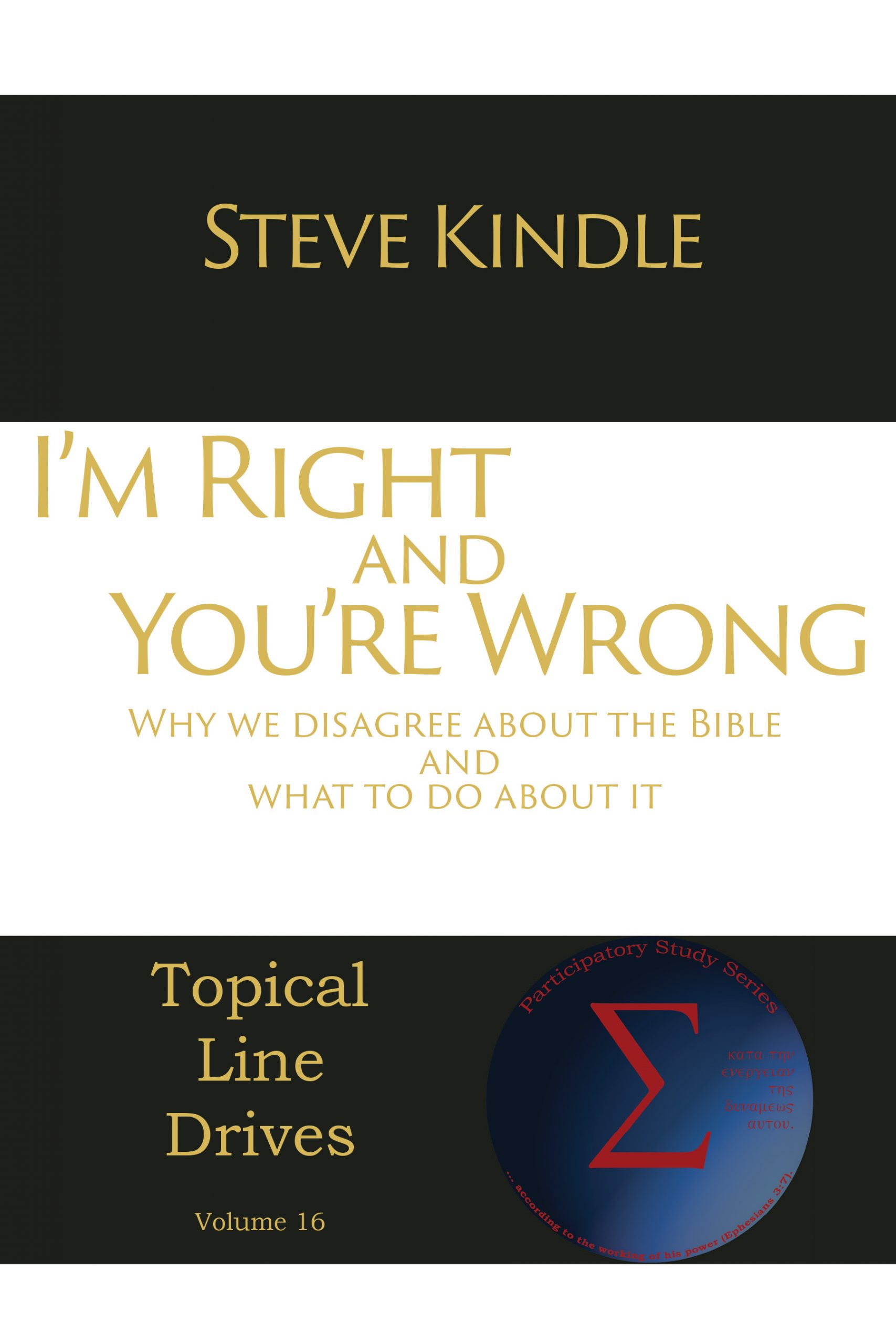
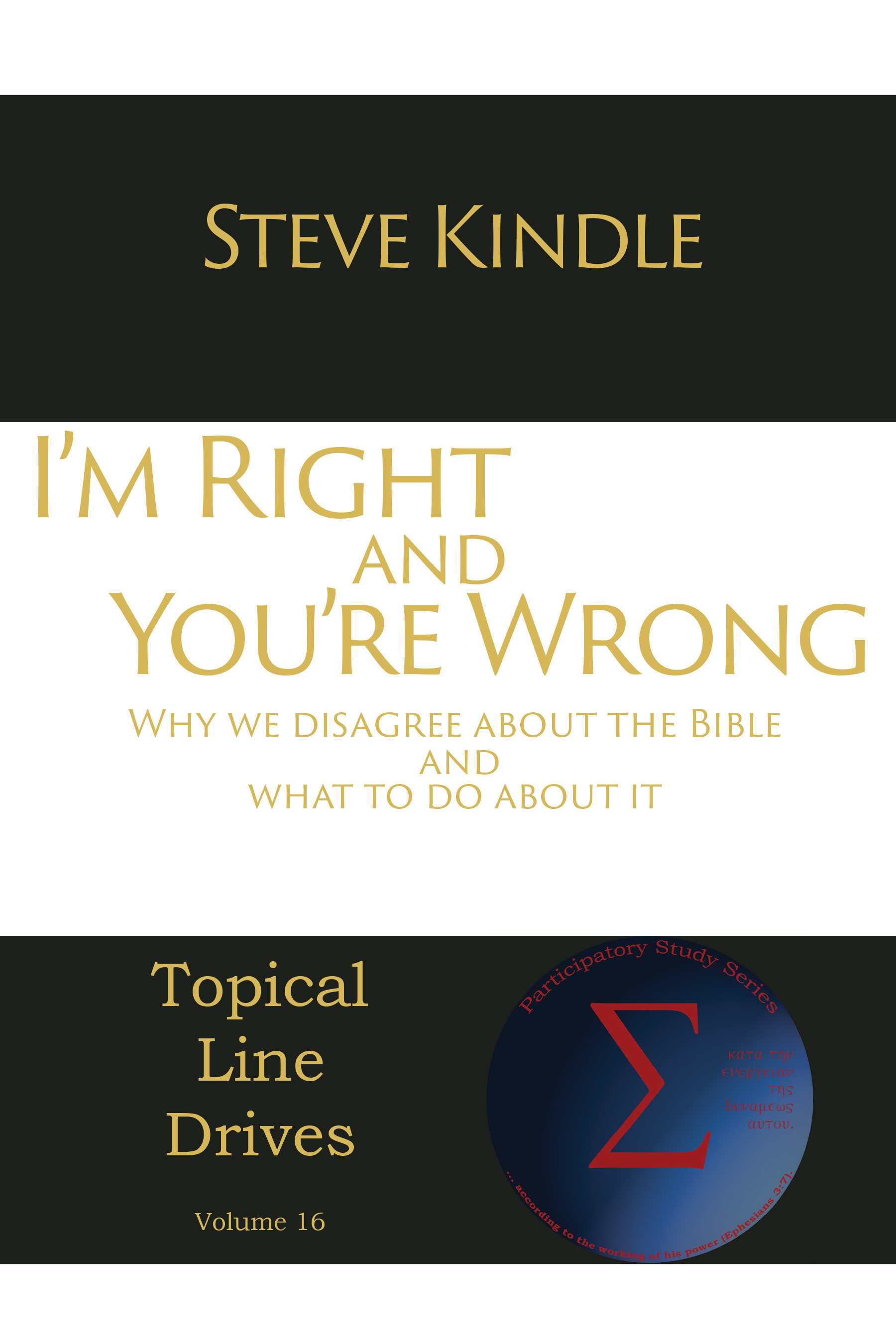
    And since I usually try to mention a book or so that I publish, this post relates closely to the book I’m Right and You’re Wrong: Why we disagree about the Bible and what to do about it by Steve Kindle.
  • Book: I’m Right and You’re Wrong

    Book: I’m Right and You’re Wrong

    When I started Energion Publications just over 10 years ago, my primary interest was in Bible study materials. My goal was to get the people in our churches to study the Bible more, and to do so for themselves. My complaint about much of the material available was that it was often shallow and repetitive, and that people had often been seeing the same things over and over again. (I don’t mean that there were or are no good materials; merely that there are not enough materials that address people in the pews.)

    It wasn’t just that some material was shallow. It was that often when the material was a bit deeper it tended to present conclusions without really teaching students just how those conclusions were reached. Quite frequently, church members were simply accepting the conclusions they were taught on authority, not because they had really examined them and come to accept them for good reasons. Their pastor, or some well-respected person from their denomination or tradition stream claimed that a verse meant a certain thing, so that’s what it meant.

    When people from two different tradition streams would meet, debate could get heated as people fired spiritual canon loaded with pre-interpreted texts. They thought they were firing them at one another, but generally they were firing them past one another, because their targets had memorized a completely different interpretation for that particular passage.

    I launched several projects in response to this. First was the Participatory Study Series, the first series I know of to intentionally select authors from different tradition streams to cover different books of the Bible. My idea was to give people a chance not just to study about the various methodologies, but to study a whole book of the Bible with the guidance of a qualified scholar from different traditions. Thus you can study Philippians with the guidance of process theologian Bruce Epperly and Ecclesiastes with conservative evangelical Russel Meek. As time goes on, this variety will increase rather than decrease.

    There was still more to be done. Our conclusions about scripture depend heavily on our approach to interpretation, our interpretation depends to some extent on our view of authority, and both interpretation and authority depend, to some extent on our understanding of inspiration.

    Thus I published Learning and Living Scripture: A Introduction to the Participatory Study Method, but that little book didn’t really deal with the conclusion. It embraced it and invited more! So I wrote my own book about inspiration and listening to God, When People Speak for God, and then acquired a truly masterful work, From Inspiration to Understanding: Reading the Bible Seriously and Faithfully by Edward W. H. Vick. Shoring up a more conservative viewpoint was Elgin Hushbeck’s Evidence for the Bible.

    9781631990991With all those books, the question still remained. How does one learn to understand and even benefit from the variety of approaches to Bible study?

    Well, now we have a short, easy-to-read book that will help you understand why we disagree about what the Bible says, and why so many of those disagreements are so intractable. It’s I’m Right and You’re Wrong: Why we disagree about the Bible and what to do about it. It’s a challenging title, and in just 40 pages, you’re going to begin to get a picture of the variety of scriptural interpretation.

    Author Steve Kindle writes with a gentle passion. This is not a book proving that his approach to interpretation is the one and only right approach. He doesn’t deny that there is objective truth out there; he just doubts that we are going to be able to get there with are finite and not-so-objective minds. What he does instead is try to give us an idea how various approaches work.

    There are at least two things you can do, starting with this book. The first is simply improve your ability to converse with people whose approach to the Bible might be different than your own. With the basic information Rev. Kindle provides, you can build your understanding by listening to others. Second, you can use the excellent footnotes to find more detailed expositions of these various approaches and learn more about them than could possibly be contained in a 40 page book.

    As a publisher, of course, I would be delighted if you’d also embark on a journey with the Participatory Study Series and actually study some books using guides written from a perspective other than your own.

    At a minimum, however, learn how to break through the hostility that often characterizes debates about the Bible to come to understand how someone else has become convinced that he’s right and you’re wrong!

    Note: This book is already printing, but we’re leaving the pre-order pricing up for one more day. That means you can order from Energion Direct for just $3.49. If you take this opportunity to get 3 or more copies, shipping will be free. The shipping charge is just $2.00 on orders of less than $9.99.

  • Tonight’s Energion Hangout

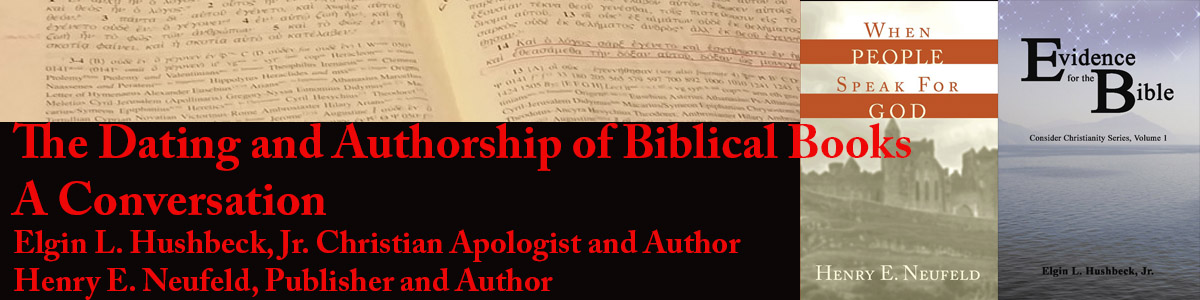
    dating and authorship bannerUsing Google Hangouts on Air, we will again broadcast a hangout with some of our authors. For further information, check the Google Plus event. I will embed the YouTube viewer below. Note that once the hangout is complete, the recording will be available through the same viewer.

    Due to unforeseen circumstances, the event tonight has been changed. Elgin Hushbeck and I had been planning to discuss the dating and authorship of Bible books in April, but we’re going to be doing that tonight. This is a conversation, though Elgin is the moderator/interviewer. This reverses the usual procedure, in which I interview one or more of my authors. Fun!

  • Embrace Interpretation

    multimeterWhen I tell someone that they need to consider how they interpret a particular verse, I often get that glazed-over or eye-roll expression that says, “There you go again. Why can’t it just be simple?”

    The fact, however, is that we have to interpret everything. As I look out my window at the branches of a tree in front of my office, there is a great deal of interpretation going on automatically that lets me see this in a coherent way and identify it as a tree. Everything requires some interpretation.

    The picture at the top shows a multimeter that I use in my work. It’s a fairly simple piece of equipment as such gear goes. The other day I was trying to measure a simple voltage and was getting weird results. I must have been tired because I didn’t realize immediately that I had it set on the wrong range for the voltage I was trying to measure. I single click of a switch and all was well. The result was in the interpretation.

    When we study the Bible we are interpreting a tradition that is thousands of year’s old. It involves the experience of people over a great deal of time. Consider how difficult it can be to understand the culture of people in our own country even centuries ago.

    I don’t mean that the Bible is incomprehensible. I just mean that we should be surprised that it requires some effort for us to adjust ourselves to hear what it says. It’s not like reading today’s newspaper, though interpretation is required there as well.

    It’s worth the effort.

  • A Gender Neutral Example – Hebrews 2:6-8

    A couple of days ago I discussed gender-neutral language in a post dealing with both inerrancy and Bible translation issues. Today, as I was doing some reading about Hebrews, I encountered a vigorous comment against such language in a passage in Hebrews. The passage in question is Hebrews 2:6-8, and it quotes from Psalm 8:4-6. The NIV translates the first anthrwpos as “mankind” and then huios anthrwpou as “a son of man.” They then continue with a series of plural pronouns in the explanation.

    In his The New American Commentary: Hebrews, David L. Allen responds to this translation with some vigor. (Note that he is responding to the TNIV, and relying on the text of the 1984 NIV, but the text of the 2011 NIV has in it every difficulty he references in his discussion. I really can’t get the flavor of his arguments without quoting more than I’m going to quote in a blog, but he starts with two major issues. The first is that by obscuring the anthrwpos/’adam reference with a plural (TNIV uses “mortals” while NIV2011 uses “mankind”) one loses the sense of the unity of the human race through descent from Adam. Secondly, by using plural references in succeeding texts, one makes it more difficult, if not impossible, to connect this to “son of man” as a Messianic title for Jesus. Whether this was the intent of Psalm 8 in its original context, it appears to be an intent of the author of Hebrews.
    Of these he says:

    Third, to change the word or phrase to a more “gender neutral” expression, especially in light of the other two problems above, is simply an exercise in linguistic political correctness. (p. 240, Nook edition)

    The issues here are somewhat more complex than any case I was referencing in my earlier post. When you have someone address a congregation that includes both men and women using adelphoi, the issue is more one of referent. In this case, we need to ask a couple of questions:

    1) In what way was the author reading the passage? In other words, how would he have understood it in then making his argument? It seems courteous, in a sense, to render a quotation in the same way as the person quoting it intended. This is by no means uncontroversial. If an author quotes the LXX, as is done here, but the Bible translation in question translates its Old Testament from the Hebrew, what should be done? There are cases in which a translation will accommodate their own rendering of the OT verse to the translation as they have it in their OT, whether or not that fits the author. On the other hand, to have the author of Hebrews quote Psalm 8:4-6, and then have the rendering there differ from what a reader will find when he or she turns to the Old Testament in that very same Bible edition can (and will) raise questions. So it is a case of decisions, decisions, and no matter what you do, there will be disagreement.

    2) What will your readers miss when they read your rendering? In this case we have two choices. We might leave out some understanding of the unity of humanity and the connection between a singular son of man and Jesus. On the other hand, for some readers, we might be leaving out the sense that this is humanity and not just some particular man. I know of nothing that would cover all options except for an explanatory note, and most of us are likely aware of how many people read explanatory notes.

    I don’t consider this a clear case of a change of language requiring a change of translation. The word anthrwpos, as used here, is covering a different semantic range, and the translator needs to take that into account. The danger into which the NIV2011 and the TNIV have both slipped here is that they undercut the author’s presentation by using a different translation of the passage he’s building on. He chose the LXX of his time. Perhaps we should honor the idea of his choosing a translation by translating that translation in a way that matches his use.

    What do you think?

  • Barriers to Hearing the Word

    It turns out that I was off the track a bit in saying what we would discuss in Sunday School this morning. I think it’s one of the problems of teaching from a book I wrote. Everything is familiar and I can’t remember precisely what we’ve discussed and haven’t. I should perhaps take better notes, but this is a fairly free-form class. In addition, I guest taught another class one Sunday in the a couple of weeks ago on a closely related topic.

    In any case, today we were discussing more about how we (and preachers) shape our expressions to the audience and how we should recognize that and still test everything, especially the things we are inclined to hear. As an editor, I’m well acquainted with the tendency we often have to be more tolerant of data presented by someone who is agreeing with us. We need to test everything and not just accept it because someone said it.

    We will also not get to the material I mentioned on the history of receiving the word this coming week. That will wait for three weeks from today (we won’t have class on Consecration Sunday). This coming week the topic will be barriers to hearing the word. The section in my book is derived from a pamphlet I prepared several years ago. I do intend to re-edit and reformat that pamphlet, but I haven’t managed to find the time. The current edition can be read at Seven Barriers to Hearing the Word. I suspect we can take some serious time discussing those seven barriers and maybe a few more.

  • 1 Thessalonians 1:1-10 – What Paul is Thankful For

    I couldn’t end this run of posts on 1 Thessalonians 1 without commenting on the content of the passage: Paul’s prayer of thanks. (See posts on structure and translation survey.)

    I think it’s important to notice what Paul is thankful for. He is thankful first for the fact that they received the Word and that action resulted. The action, in turn, resulted in witness and further proclamation of the Word. Within that passage we have an excellent pattern for spreading the gospel.

    It is often difficult for us to balance faith and works. That is a good thing, because I don’t think it’s balance we’re looking for. It’s not a proper proportion of faith and works that becomes a recipe for results. Rather, God acts in us by grace, received by faith. God’s grace makes the response of action possible, and the action of God’s grace makes the following witness possible, because the witness must be to what God has been able to do.

    Paul is thankful that the Thessalonian believers have become a witness as God has acted through them. God chose them (1:4) because the gospel came to them not just as words but as active power (1:5), which resulted in them imitating those already impacted by the power of the gospel (1:6), which results in them being an example (can we say witness?) to others (1:7), and that, in turn, means that the word of the gospel goes forth from them.

    Do you see the generational effect here?

    Think: This was successful ministry. In our ministries, when things aren’t working, where is this broken?


  • My Own Custom Bible

    I have in my inbox an e-mail sent on behalf of the American Bible Society. The subject line reads: “Create your own Custom Bible from American Bible Society.”

    I suspect some folks are thinking I’m going to draw the obvious lesson that we shouldn’t have our own custom Bible. After all, the correct Sunday School answer, whenever it’s not Jesus, is “everything it says in the Bible.” Others are probably thinking that if I do so I’ll be horribly unfair, as indeed I would. What the American Bible Society (an organization I strongly support) is doing is offering the option for organizations to get Bible bindings for particular situations. This is simply an application of modern printing technology. In many churches you’ll find Bibles with dedication labels. Some evangelism efforts have Bibles with contact information added. Modern technology lets you build all of that into the printing. I don’t have a problem with such editions.

    But the line still intrigued me, not because I think it’s so wrong, but because I think that taken out of context, it describes what pretty much all of us do with the Bible. We have our own custom Bible. Not only am I not writing to criticize us for that; I’m actually going to suggest it’s impossible for us not to have our own custom Bible. Why? Because we are such very custom individuals. Often we don’t even realize what we are bring into the text.

    I remember once discussing the issue of oaths with a someone who believed that Matthew 5:33-37 meant that one could not swear to tell the “truth, the whole truth, and nothing but the truth” in court, whether or not one added “so help me God.” Now my issue is not with his view of that text. He could be right. Rather, the issue is with the basis of that interpretation. He stated to me that his view was that we should take a scripture passage to mean what an average American high school graduate would understand from it. Thus, “don’t swear” would, he told me, mean “don’t swear” to this average American high school graduate. I then pointed to Matthew 5:29-30, which says we should pluck out our eye or cut of our hand if it offends. He immediately told me that this meant that one should be prepared to give up everything, even our lives, through martyrdom. I, being the mean, obtuse, and twisted person I am, asked him immediately if that was how the average American high school graduate would read it.

    He had a tradition that suggested how he should read these various texts. His tradition customized his Bible. In fact, tradition commonly customizes our reading of the Bible, and we rarely can escape that completely. We can be so certain that a text means a certain thing, that we don’t even consider alternative readings. I’m often annoyed by the extent to which modern commentaries cite every which possible reading and understanding of a passage before coming to any conclusion. It results in commentaries of 500+ pages on five page books. But there’s a good reason why scholars are taught to look at other commentaries: It forces them to think about approaches to the text that are different from their own.

    Tradition isn’t the only way we filter the text. When I first saw the e-mail subject line I though immediately of our favorite verse, chapter, book, and so forth. I remember one class I was teaching. After a couple of weeks they would laugh whenever I used the words “one of my favorite,” simply because I had designated so many passages as “favorite.” But that doesn’t exempt me from having a custom Bible. I still have passages I read more than others. I tend to avoid some of the favorites. I know more about Hebrews than Galatians or Romans, for example. I know more about Leviticus than Isaiah or Jeremiah. This is because of my personality, which tends to avoid well-trodden paths.

    Should we try to make our Bibles less custom? I think it’s a good idea to do so, but only so long as we remember that we won’t get there completely. When we forget the things that influence our own interpretation we tend to get arrogant.

    Commercial note:

    My company, Energion Publications, will be releasing a book early next year. I’ve already had a chance to read the manuscript, and will be announcing it as forthcoming within the next couple of days. In the meantime, look at this cover and especially the subtitle:

    9781631990991I believe I shall enjoy marketing this book!

  • When Theology Overrides Story

    Jody and I were reading the Lectionary passages for next Sunday this afternoon, and I was reminded about how our theology can keep us from reading Bible stories. I think it’s also easy to let our theology trump the theology of a Bible writer, but stories don’t have a one-to-one relationship to theology in the first place.

    The story in this case comes from Exodus 32:1-14, in which Moses is on the mountain talking to God and the Israelites decide he won’t becoming back. (The story is repeated in the reading from Psalm 106.) So they make and worship the golden calf. God becomes angry with Israel, but Moses steps in and persuades him not to destroy the Israelites, even though the alternative is that God will make a great nation of his descendants instead.

    There are two points here that bother different people. Is this picture of God true and/or helpful? Do we serve a God who becomes angry at people and determines to wipe them out? There are, of course, many other stories that raise the same questions as well. On the other hand we are presented with a God who can be persuaded to change his mind. Moses calms God down, so to speak.

    If you’re of some sort of Calvinist persuasion, you’ll likely be OK with the angry God who wants to destroy the Israelites. God’s anger against sin is a key part of that theology. But what about God changing his mind? It’s very likely that this will be dismissed as somewhat of a ploy, perhaps a test of Moses. Will he stand for the people he leads? And of course God knows the results of that test. But actually calming God down or making God actually change his mind is inadmissible.

    On the other hand, if you’re like me, and tend to favor something along the line of openness theology, the latter point is easy to accept. God repents regularly in scripture. So this experience tends to mesh with my own theology that has God interacting with human beings in deciding their destiny.

    Yet many people who share that theology are very uncomfortable with God becoming angry with his people. So in this case one accepts the changeability of God, but not the anger. The anger is dismissed as coming from an excessively primitive view of God.

    I would suggest that in both cases theology prevents an authentic reading of the story. We need to let the story speak first. There is a sense of tension here. God has brought his people out of Egypt, only to have them credit that to an entity they themselves have created. God is, in the terms of the story, rightfully angry. There is the real risk, from the storyteller’s point of view, of the people being destroyed. In fact, it might well be quite reasonable for God to do that.

    There is also a real test of the character of Moses. If our theology didn’t interfere, we’d feel the tension better as Moses has a choice to make. Will he be the leader who identifies with, and serves the best interests of those he leads? If he does so, will God change his mind?

    How we work the story into our theology is another matter, but must come later. Let the story speak first.


  • Meditations on According to John

    Meditations on According to JohnAnyone who has made a serious effort to teach from the Gospel of John has likely experienced the difficulty of giving people a clear picture of the connections between various parts of the book, not to mention the frequent allusions to passages in the Hebrew scriptures. One can easily run out of fingers to “hold that passage” while one flips to another in order to compare. The difficulty is that one needs to get an overview of the entire book before one can truly comprehend the individual parts, and people rarely study Bible books in that way. Too frequently they jump into a passage on a particular topic from the middle of the book, and the Lectionary encourages this, and never really get a full picture.

    So I was delighted to get a manuscript from Herold Weiss, at one time a professor at my alma mater, Andrews University, and later at St Mary’s College, Notre Dame titled Meditations on According to John. Editors generally look with some disfavor on collections of essays, meditations or sermons. I’ve had to reject not a few such collections. They often don’t sell. One of the reasons they don’t is that people rarely read sermons by anyone who is not famous. They tend to prefer books that cover a particular topic in some detail than a collection of different thoughts.

    But this book is not that sort of collection. It does not consist of unrelated thoughts that have no particular sequence. Rather, the 24 meditations on this book take particular passages in the gospel of John, According to John as Dr. Weiss likes to call it following the Greek title, and then fits them into the scheme of the entire book. I like to invite people to read a Bible book multiple times in order to get an overview. With this book, you get that sort of an overview multiple times, each with a different theme.

    The gospel of John is extremely simple on the one hand, but very challenging on the other. The language is easy to understand at the basic level. But as you meditate further it tends to grow on you and make you think again … and again and again.

    I think I have an excellent group of authors represented in the Energion Publications catalog. I have a long list of books I want to write about, but haven’t had time. Sometimes these books challenge me. Sometimes I am simply saying, “Yes, that was a good presentation of the _____ topic, and people should read it.” But some books stand out in that they inspire me to study as I read the manuscripts as an editor. This one had be referencing my Greek New Testament frequently, and eventually had me re-reading the entire gospel in Greek just to follow some of the thoughts presented.

    You may agree or disagree with some of the conclusions. For example, Dr. Weiss does not accept this gospel as the source of sacramental theology:

    The sacraments were established toward the end of the first century when Christianity was becoming institutionalized and starting to create official channels through which the Holy Spirit could flow under ecclesiastical control. (p. 152)

    and

    It is a bit disconcerting, therefore, to find that most commentators consider this gospel as the New Testament document that provides the basic source for sacramental theology. This judgment is based on interpretations which see the conversation between Jesus and Nicodemus as supporting the sacrament of baptism, and the discourse following the feeding of the five thousand as supporting the sacrament of the Lord’s Supper. The texts, however, do not support these interpretations. (p. 152)

    Now that will annoy a number of my friends! A bit later Dr. Weiss says:

    In According to John Jesus is not baptized, does not celebrate a Lord’s Supper, and does not institute bread and wine as sacraments that need to be administered by authorized clergy. Jesus only institutes the washing of the feet which must be administered by everyone to everyone, in this way democratizing the kingdom of heaven. (pp. 156-157)

    That, I think, is worth discussing. Why is it that only authorized clergy can administer sacraments? I know the theology, but is it well rooted?

    In any case, both reading this book and reading John after reading this book have been beneficial experiences for me. I strongly commend this one to my friends who are interested in either biblical studies or theology. It’s a great text.