Threads from Henry's Web

Category: Bible Passages

  • Following the Path of Jesus

    Following the Path of Jesus

    On January 1 God called two texts to my attention as themes for the year. They are Philippians 1:27-30 and Ephesians 5:1-2. I haven’t said a great deal about this, though the theme of those texts has shown up in a number of posts. Then yesterday I saw Dave Black’s latest translation of Philippians 1:27-30, which I like a great deal, and I wanted to mention it. Reading a text in a modern, clear, might I say dynamic, rendering brings it home. Here’s the translation:

    Now the only thing that really matters is that you make it your habit to live as good citizens of heaven in a manner required by the Good News about Christ, so that, whether or not I’m able to go and see you in person or remain absent, I will be hearing that all of you, like soldiers on a battlefield, are standing shoulder to shoulder and working as one team to help people put their trust in the Good News. Don’t allow your enemies to terrify you in any way. Your boldness in the midst of opposition will be a clear sign to them that they will be destroyed and that you will be saved, because it’s God who gives you salvation. For God has granted you the privilege on behalf of Christ of not only believing in Him but also suffering for Him. Now it’s your turn to take part with me in the life-or-death battle I’m fighting — the same battle you saw me fighting in Philippi and, as you hear, the one I’m fighting now. (emphasis mine)

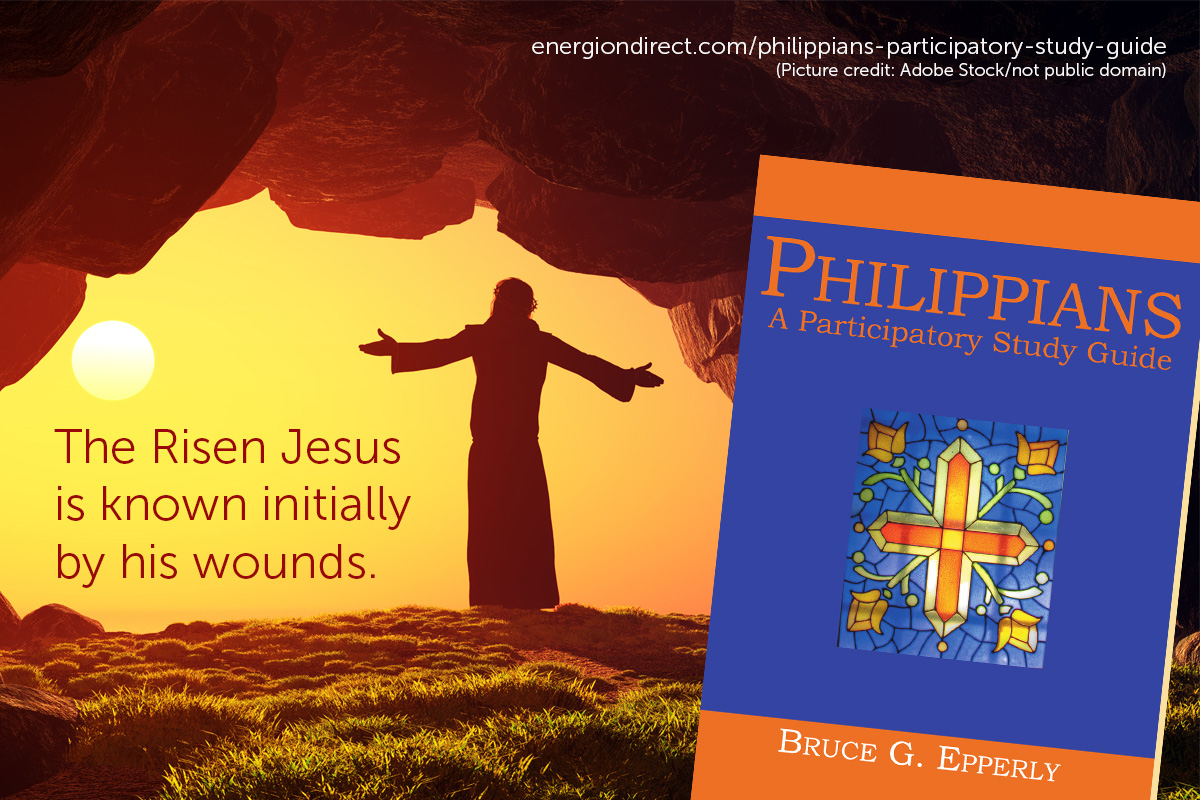
    This emphasized line led me to a quote from Bruce Epperly’s book Philippians: A Participatory Study Guide:

    Even now in our time, we can take confidence in Paul’s assertion that God is with us and that, in life and death, and celebration and persecution, Christ sustains us. We are resurrection people. But, our lives are also cruciform or cross-shaped. The Risen Jesus is known initially by his wounds, and we too may experience suffering and loss as a result of our relationship with Christ. Still, at the end of the day, integrity, fidelity, and the promise of resurrection life far outweigh any trials of this lifetime. – p. 19

    Bruce also quotes the song “I have decided to follow Jesus.” It’s a good song, but it’s one that should be very hard to sing. No, not musically, but due to meaning.

    (I must note here in passing that I love to use materials that come from very different theological streams. It is especially important, I think, when people from opposite sides of the spectrum agree fully on the meaning of a text, even more so when that text says something people would often rather not hear.)

    On the night when Jesus was betrayed, there were twelve people (at least) who had decided to follow Jesus. One betrayed him. One denied him publicly. The rest “advanced in the opposite direction.” We can take hope from the fact that so many found their way back!

    Ephesians 5:2 similarly gives us a hard call “walk in love.” Now we like that, because we often call very unloving things “love.” But the verse goes on “just as Christ loved us and gave himself for us. We have a very clear pattern for what love actually means. I’m a love proclaimer. I believe in the power of love. The reason love so often seems wishy-washy, that it so often fails, is that what we call love is often partial. It is not commitment, but rather a sort of generic liking. That’s why the key to following Jesus is not the experience of miraculous physical acts, or wealth, or healing for everyone in sight, or healing of all our emotional ills. The key to following Jesus is the willingness to take up the “privilege” of suffering for him.

    This, I must confess, is not the true story of my life. Nonetheless, just as I can travel northward by using the pole star as a guide even though I’ll never reach it, so I will keep facing this way, and trust in the grace of the One who gave himself first.

    (Allow me to call attention to two previous posts: God Perfected through Suffering and Thankful for the Gift of Suffering for Jesus?)

  • Acts 12: Reacting to Miracles (and Their Absence)

    Acts 12: Reacting to Miracles (and Their Absence)

    Acts 12 is an interesting chapter, both because of what happens and what doesn’t.

    James, the brother of John, is seized by Herod and killed. No comment, backstory, or reaction provided. One short verse and gone. I’ve just said more!

    Then Peter is seized, and they expect him to be killed as well. The whole church prays for Peter. We’ll suppose that the church prayed for James as well, though it’s possible he was seized and killed so quickly the word didn’t get around until he was dead.

    I think the stark presentation of James’s death, followed by the prayer of the church and then the rescue of Peter starkly emphasizes that prayer doesn’t always make things work the way we want it to, provided we haven’t figured that out by reading about Stephen’s death in Chapter 7. Yet the church prays.

    As we watch calls for prayer regarding the aftermath of Hurricane Harvey, and recognize the prayer that went before, we should perhaps note that prayer isn’t a means of steering hurricanes according to our desires, nor of doing the cleanup afterwards. As I once heard preached, prayer isn’t a substitute for anything else, and nothing else is a substitute for prayer. Prayer has its own functions.

    In any case, this time while the church is praying, an angel is off to rescue Peter. It may be just my imagination, but it feels like Peter is kind of an automaton through the first part. In verse 9, we’re told he thinks it’s a vision. He is certainly not thinking, “Oh, yes, here’s the angel I expected come to rescue me.” Once he’s in the street and the angel poofs, he realizes it’s really happening.

    He heads off to where the church people are praying, and here we get a cameo by young Rhoda, who appears in scripture this once to be so happy at hearing Peter’s voice that she doesn’t open the door for him, but rather heads off to tell the other people he’s alive.

    There are a few people like her around today. They want to see a miracle happen, or even something they can imagine to be a miracle, and their purpose is to talk about it. They too can forget to open the door to whatever is happening next.

    The people in the house are also quite normal people. They don’t believe Rhoda. After all, if you knew the security arrangements around Peter, you likely wouldn’t believe he was there either. I’d probably think someone got the guards drunk, stole the key, and then led Peter out of prison. If it was today, I’d think some kind of sleeping substance added to their food. At least they let Peter in off the street.

    Sometimes Bible stories are really sparse. I keep wondering about Peter’s thoughts. He keeps knocking, but I imagine he was a bit put out when they didn’t open the door. Peter’s angel, indeed! (12:15).

    Finally, we have Herod’s reaction. Imagine being one of those guards. I know I go off track, but I kind of feel sorry for the guards. They’re just ordinary guys off serving their country/ruler, and Herod isn’t for a moment going to believe that they were miraculously put to sleep while their prisoner was taken. Honestly, Herod’s reaction is quite rational. The best explanation for the facts he has before him is that the guards either shirked their duty or perhaps even took bribes to let Peter go.

    Peter, who seems a relatively sensible guy in this story goes somewhere else.

    I think if we read this story and let some of the turns sink in, we might away from a mechanical view of prayer and providence. It’s worth a try in any case.

    (Some books I publish that relate: Pathways to Prayer (David Moffett-Moore), Angels, Mysteries, and Miracles (Bruce Epperly), and Directed Paths (my mother Myrtle Blabey Neufeld. Featured image credit, Openclipart.org.)


     

  • Measuring Success

    Measuring Success

    It seems to me that one of the most serious difficulties we have in the church today is the way we measure success. We are driven by numbers and money. It’s easy, of course, to justify this. After all, if you don’t have money, you generally can’t help people. I am reminded of Chapter 3 of Acts, in which Peter (with John) says, “Silver and gold I have none,” yet look what they did.

    Still, the temptation is great to judge the success of a meeting by the attendance, and the success of a church by its budget. I’d add that I don’t suggest we think the other way either. Just because a church is prosperous does not mean its ministry and mission is in trouble. It’s just that I don’t see the numbers and the money as God’s measure.

    With that in mind I was struck by two verses in Chapter 8. Stephen has just been killed, and Luke tells us that Saul continues to persecute the church. Everyone except the apostles is scattered across the countryside of Judea and Samaria (v. 1).

    By our standards, this is a bad thing. All this talent is leaving the big church, the one with the resources to carry out the mission! Stephen is dead, and Philip is about to head out. “Everyone” doubtless includes many more. The church is being drained.

    If this was an American church, the next question would be how we would pay the bills for the facility. I recall one church that had a serious scattering of membership, and that became a serious problem. You have to sell some buildings or some land, and that can be difficult. Members don’t like the feel of selling off the property and there’s always a question of whether you’ll get enough for it. Besides, selling stuff and downsizing is a sign of defeat!

    We’d doubtless feel the same way about persecution. Now don’t get me wrong. I’m not a fan of persecution. I really don’t want to be persecuted. But if I can put it bluntly, I doubt God really cares what I want.

    In this case, something great happens. “As they were scattered, they went about proclaiming the Word …” (8:4). In the movement of the story of the early church as told in Acts we’re in that transition as we move from Judea to Samaria and from there to the whole world. The failure of the church as the members scatter is the success of God’s plan.

    I’m thinking we need to spend our time finding God’s plan and measuring our success by how much we’re on that. As I read scripture, I’m suspecting that plan may be different from ours. Let God speak and move in our generation.


  • Acts: God Moves in Unexpected Ways

    Acts: God Moves in Unexpected Ways

    I’m currently reading the book of Acts for my morning devotions and today I read chapter 6. That’s a nice, short chapter!

    The disciples find that there are complaints about distribution of charitable works and they decide they shouldn’t be distracted from the Word in order to wait at tables (and other such things). The result is the choice of seven deacons. Again, they pray, and then lay hands on them and commission them to this work. Other than the continuing spread of the message, we’re not told how this organizational structure worked.

    As Acts proceeds (since I’ve read it before, I know how the story ends!), we’ll hear quite a bit about Stephen and Philip. It’s interesting to note, however, that we don’t hear about them serving at tables, which, ostensibly, they were chosen to do. In fact, we hear them proclaiming the Word themselves. In chapter 6, it starts with Stephen, and it promptly leads to his arrest.

    Let me note a couple of things here:

    1. They don’t record any time of prayer before going out to choose these seven men. It appears they jump straight to the strategy.
    2. They don’t record any time of prayer or deliberation before choosing the seven.
    3. They do pray before commissioning the men by laying hands on them.
    4. We see no record of results of this activity that match the intent. Yes, results. Stephen and Philip are significant players in the story and they are introduced to us here, but there is no record that the issue with distribution of service (apparently particularly food) was resolved.

    Now it may be that I’m reading too much into the white spaces here, but this is the second time I’ve noticed this during this pass through Acts. I’d noticed before that Matthias (chapter 1) is appointed as a new apostle and then disappears from history. Considering how much of this portion of early Christian history is recorded just in Acts, one wonders if this is accidental. (My sister Betty Rae pointed this out to me some years ago.) In my reading this time I noticed how the choice to replace the missing apostle is made based on Peter’s interpretation of scripture. There’s no effort made to seek God’s will for this particular instance. Then two people are chose according to criteria they select.

    Let’s parallel the numbers:

    1. There is no prayer time as they choose the basic strategy. Unlike Acts 6, this strategy is apparently based on Peter’s reading of scripture.
    2. They choose two people again without any time of prayer.
    3. They now pray and ask God to choose between the two. The situation differs from Acts 6 in that the seven were chosen and then the prayer is offered as they commission them. “Please bless the ones we have chosen,” is the petition. Here it’s “choose one of the two options we’ve given you, Lord.”
    4. No results are recorded.

    Now comes the fifth step, which is what’s hitting me on this pass through Acts. God immediately takes action to advance the kingdom, and it doesn’t fit with the human plans, even the plans by the apostles. In Acts 6, Stephen heads right out to proclaim the gospel and defend it. In the case of Acts 1 we have to wait until chapter 9 before we see God choosing someone as an apostle, one who doesn’t fit the list of criteria, but who certainly carries out the mission.

    I wonder if Luke is telling us something here? I’m really not that acquainted with scholarship on Acts, so this may have been thoroughly ground to dust somewhere in the commentaries. Still, it’s something to think about.

  • When God Ordains a Change

    When God Ordains a Change

    We’ve had some discussion of Romans 13 over on the Energion Discussion Network, with contributions from David Alan Black, Elgin Hushbeck, Jr., and Steve Kindle (via comments). The question is just what it means to be subject to the “higher powers,” and when or whether a Christian can ever be involved in a revolutionary movement. I commented on some of my own view on this in a post some time ago, but today I want to look at another passage. I think it’s an excellent illustration of why we should refrain from the phrase “the Bible clearly teaches” as much as possible.

    So what about when God ordains a change? A fun example of this occurs in 2 Kings 9. Actually, this starts with 1 Kings 19:26 when Elijah is told to anoint Jehu, son of Nimshi as king of Israel. This doesn’t happen until 2 Kings 9:

    Elisha the prophet called one of the sons of the prophet and told him, “Get yourself ready and take this vial of oil in your hand and go to Ramoth Gilead. You’ll go there and you’ll see Jehu, son of Jehoshaphat, son of Nimshi, and you’ll take him from among his brethren and take him to another room. You’ll take the vial of oil and pour it out on his head, and you’ll say, “This is what YHWH says, ‘I have anointed you king over Israel.’ Then you’ll open the door, flee, and you won’t hesitate.”

    You can read the rest of the story that follows in 2 Kings 9. It makes for some very interesting reading. It was probably a rather good idea for the prophet to flee!

    There are a number of very obvious differences between the situation faced by Elijah, Elisha, and the sons of the prophets and that faced by Paul when writing the letter to the Romans. Israel was being treated as at least a sort of theocracy. In this case, God’s people were a nation, not people living within a nation. Further, in this case we have a direct order recorded from God via a prophet to be the catalyst for this change of government. The situation is complicated by the fact that God’s people are divided into two nations, Israel and Judah (the result of another case of God ordaining a change, 1 Kings 11:26-40), and that all of the kings of the northern kingdom of Israel are rated as evil.

    It points to the complexity that arises when one views all government as ordained by God. Almost definition, all government is permitted by God. The difference between “permitted” and “ordained” when one speaks in consideration of divine power are fairly close in meaning.

    Many modern readers would assume that the key difference is that God was able to order this via the prophets. That is not an explanation that I find useful. God directs in many ways. In fact, I believe God can direct through simple moral choice, i.e., if the government forces one to do something that is immoral, one ought to obey God rather than human authority. In the case of Elisha, God was willing, according to the story, to order revolution against a government that had become intolerable. Interestingly enough, Jehu’s dynasty was not that much better, though it does get a slightly better report than the dynasty of Omri.

    It strikes me that it’s dangerous to make too much theology out of one passage.

  • James and a Living Gospel

    James and a Living Gospel

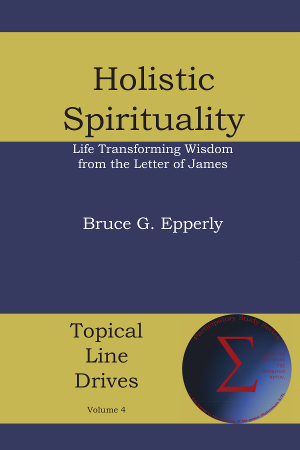
    Our pastor at Chumuckla Community Church started a sermon series on the book of James. This provoked me to look again at Bruce Epperly’s little book Holistic Spirituality: Life Transforming Wisdom from the Letter of James. Here’s a sample:

    Despite Martin Luther’s misguided dismissal of James as “an epistle of straw,” due to James’ emphasis on agency and lifestyle rather than receptive grace as central to Christian experience, James is good news for congregants and seekers. It is the gospel lived out in everyday life, not by words alone or doctrinal requirements, but by actions that transform the world. This is the good news of Jesus Christ who shows us the pathway to abundant life, and not a dead letter or a soul-deadening creed or abstract doctrines about the divinity of Jesus unrelated to daily life. James invites us to be companions on the pathway of the living Christ. (p. 4)

    Dave Black quoted today from Gordon Fee’s commentary on the epistles to the Thessalonians, discussing the connection between believing and living. I’m going to link to Dave’s post again tomorrow, when I briefly discuss Bible commentaries, but Dave’s post is worth reading in this connection as well.

    Bruce Epperly comments again on the supposed contrast between James and Paul:

    While Paul’s theology is often contrasted with the Letter of James, both Christian leaders believed that faith without works is dead (James 5:17).8 Paul affirms “the only thing that counts is faith working through love” (5:6). (Galatians: A Participatory Study Guide, p. xxvii)

    I think we frequently see contrasts when we should see differences in emphasis and even in circumstances.


    Read Now


  • Paul and the Law Tangle

    Paul and the Law Tangle

    I’m working through key elements of Galatians 3 & 4 tonight and drawing in some material from Romans and elsewhere. My main topic will be to look at Paul’s use of the word “law” in these passages. My main references other than the Bible text will be Galatians: A Participatory Study Guide pp. 43-47 and Meditations on the Letters of Paul, Chapter VIII, pp. 89-97

    Here’s a sample:

    No Jew would deny the wisdom of Torah, or disavow its validity. Neither did Paul. When arguing for the universality of God’s promise to Abraham, and that all those who like Abraham have faith in God are justified before God, Paul asks rhetorically, “Do we then overthrow the law by this faith? By no means! On the contrary, we uphold the law” (Rom. 3:31). For that to be the case, Paul must have in mind more than one way of seeing the authority of the law, or the way it functions. (p. 92)

    The chapter in Herold Weiss’s book (Meditations) is one of the most helpful presentations I’ve found on this subject.

  • How Was Jesus Portrayed as Crucified to the Galatians?

    How Was Jesus Portrayed as Crucified to the Galatians?

     You foolish Galatians! Who put you under a spell? Was not Jesus the Messiah clearly portrayed before your very eyes as having been crucified? I want to learn only one thing from you: Did you receive the Spirit by doing the actions of the Law or by believing what you heard? (Galatians 3:1-2, ISV, from BibleGateway)

    I only managed to discuss about the first five verses of Galatians during my Thursday night Bible study. Next week I’ll look some at the Spirit and the Law in Romans as well as in the rest of this chapter.

    There are two key points I see in the two verses I quoted.

    1. Paul tells the Galatians that Jesus was “clearly portrayed” to them as crucified. How is that? They obviously didn’t all witness the actual crucifixion. The answer, I think, is that Paul, both in words and in life, portrayed a crucified savior. It’s worthwhile to think about how this might work and how we might each portray Christ crucified to others.
    2. The Galatians should know, according to Paul, by the fact that they received the Spirit. Now how do they know that they have received the Spirit? There are many ways in which people claim to be able to know. Pentecostals might pick speaking in tongues. Holiness Christians might look to the presence of holiness in the life. But I would suggest that this is primarily an internal experience. Yes, a genuine internal experience will bear fruit, but the question here is not whether someone else can tell, but what you know yourself. Paul had likely heard the testimonies of those impacted by his portrayal of Christ crucified, and having heard those, he was shocked that one could abandon such an experience for someone else.

    I suspect, in fact, that for many of the readers/hearers of this letter, the reminder of that experience did, in fact, have a serious impact on their thinking. Why indeed am I looking for another way to receive something I already have? What do I think will be better about my life in the Spirit following circumcision.

    Teachers and preachers might take a lesson here about trusting the experience of their hearers. Refresh their memory; remind them of their experience. Trust the Spirit.

    Here’s my video.

  • Perspectives on Paul: Some Comparisons between Galatians and Romans

    Perspectives on Paul: Some Comparisons between Galatians and Romans

    This will continue the discussion, dealing more with definitions. In the area of soteriology (the study of salvation) we frequently make the same statements in terms of words and structure, yet mean something quite different by it. “Jesus died on the cross to save us from our sins” means quite different things, depending on who is saying it.

  • Perfection and Maturity in Hebrews 6:1

    Perfection and Maturity in Hebrews 6:1

    Perfectionism is an interesting trait, and can be quite destructive. United Methodist pastors are still asked whether they are going on toward perfection, though I have found few who expressed great comfort with the required “yes” answer, and not a few who had their fingers crossed.

    The line comes from Hebrews 6:1, and the more I study Hebrews, the less I see this in terms of attaining a moral standard. John Wesley himself made it clear that “Christian perfection” would be a gift of God, given by grace, and not an attainment (repeatedly stated in his compilation A Plain Account of Christian Perfection).

    But what is the perfection to which a Christian should go on toward?

    Before I look at that, let’s ask about the verb that is being rendered by “going on” here. This is almost universally translated actively, taking it as a middle voice. (Let me skip all the arguments about the middle voice here and just say that in this context, a middle does justify an active translation.) But it can also be taken as passive, and I think it should.

    Let me quote David Allen:

    …The verb may be construed in the middle voice in the sense of “to bring oneself forward,” but most likely it should be taken as passive, suggesting God as the one who moves the readers along to the desired goal. Christians are dependent upon God and his grace to enable them to press forward to maturity. (Hebrews, The New American Commentary, p. 400 [Nook Edition])

    (I was helped to a decision on this in a discussion with Dr. David Alan Black, who should not be blamed for the rest of this post!)

    This fits well with what I see as the message of Hebrews in general, which I summarize as “get on the right train and stay on it until it reaches its destination.” Human action is called for in the book of Hebrews, yet it is always action that is empowered by God, and not by us.

    But the other side of this is what sort of perfection is involved. In learning we’re often told to go find the definition of a word in the dictionary and then we think we understand a passage we’re reading. For building language skill, that’s not a bad plan. But for coming to understand a relatively complex piece of theology, it leaves something to be desired.

    Biblical languages students start by learning glosses for (a word or phrase seen as an equivalent), then learning that there are numerous possible glosses and that the lexicon provides such lists. After they have become skilled at this process, one hopes they will learn to work with definitions and semantic ranges for the words. But even at that stage, the tendency is to discover what a word means in scripture and then to force that meaning into the text.

    I think that’s what is happening here. We see this verse as demanding that we continue the quest to attain a state of moral perfection. But in the book of Hebrews our task is to continue in Jesus, our High Priest. If we stay the course with Him, we will attain the promises. (I’m not going to reference everything here. Many of these are themes stated repeatedly and in different ways through the book.)

    We might also consider the perfection of Jesus, who is “perfected” through suffering (Hebrews 2:10). Clearly, Jesus is not brought to a state of moral or ethical perfection. Rather, he is being perfected as a High Priest, acquainted with all our weaknesses (Hebrew 4:14-16) but also above us all in all ways (Hebrews 7:26-27), the perfect person to be the communicator or mediator between God and humanity. In this case we’re looking at a definition on the order of “totally suited to accomplish a particular mission.”

    I might use this sense in recommending someone for a job. The “perfect” candidate is not one who is never going to make any mistakes, nor is he necessarily a person who is known never to engage in sexual misconduct off the job. Rather, that candidate is the person who is fully qualified to carry out the assigned tasks. It doesn’t mean he’s not wonderful in all those other ways; it’s just not the element in view.

    Thus Jesus can be perfect and need perfecting all at the same time, and we see this developed from Hebrews 2-4. Hebrews 5:9, which immediately precedes our passage (I consider 5:11-14 as the first step in an argument that continues in 6:1. The chapter break separates this in a less than helpful manner.

    So now we look at the state of the audience. They are stuck at basics and not ready to understand the discussion of Melchizedek which he wants to start. So having noted both the weakness and what strength would look like, he suggests that we lay aside the basics (the milk) and go on to the meat, whereupon he does precisely that.

    “Let us be moved along toward perfection …” calls us away from basics and on to the meaning of this high priesthood. There is, I believe, a call to action and yes, to holiness, in moving on doctrinally, but the call here is to get past basic thinking and move on toward more mature thinking. Let your minds be perfected.

    As I’ve commented before, students of Hebrews often divide the book into doctrinal presentations and exhortations. It’s not entirely wrong to differentiate, but I don’t believe these two elements are all that separated for him. The understanding of the Melchizedek priesthood of Christ is, in itself, a call to new action.

    “Being carried on” or “being moved on” toward perfection is passive in form, but being carried by Christ is a rather active passivity, as we might deduce from Hebrews 11. Note how the preparation for solid food is through exercising one’s faculties.

    Active passivity. Gracious working. It might just describe life “in Christ”!


    (This post’s featured image is licensed from Adobe Stock, #115932220. It is not in the public domain.)