Threads from Henry's Web

Category: Bible Passages

  • Paul’s Gospel vs. Another Gospel III

    Paul’s Gospel vs. Another Gospel III

    Apocalyptic background - flash and lightning in dramatic dark sky

    This is the unintentional third part of my discussion of this topic. Last week I talked a bit more about the initial statement of the gospel in Galatians and then began looking at how Paul talked about the gospel elsewhere, first in 2 Corinthians 5 and the ministry of reconciliation. I’ll be moving from there to Romans 1 (and a few other references in that book). I’m including those books whose authorship is controversial, though I’ll note each one as I make use of it.

    Here’s the embedded viewer for tonight:

    Remember my resource page on Paul. I will continue to expand on those references with some comments.

  • Paul’s Gospel or Another Gospel, Part 2

    Paul’s Gospel or Another Gospel, Part 2

    Apocalyptic background - flash and lightning in dramatic dark sky

    This is the unintended second part of last week’s discussion, since I didn’t even come close to completing the material. We’ll be launching from Galatians 5:6-9, but I had already discussed the content of those verses. Now we’ll be looking through Paul’s letters, including those attributed to him, but disputed by scholars, looking for the nature of the gospel according to Paul, and what might “another gospel” be.

    Reminder: Resource Page.

    Here’s the viewer:

  • Faith Made Active through Love

    Faith Made Active through Love

    despicableWhat groups of people do you think it’s alright to look down on?

    Because in Christ neither circumcision or uncircumcision matters any more, but instead faith made active through love. – Galatians 5:6

    Which, in turn, reminds me of:

    Thus faith, if it has no works, is dead by itself. – James 2:17

    It is possible that the conflict between James and Paul has been overstated.

    But my key reason for pulling this text out of my morning reading, as I prepare for my online study tonight which I’ll post about later, is that it represents a broader principle. Sometimes we’re afraid to read between the lines, or better, to discover principles which apply in other circumstances.

    These days, circumcision or not is a medical discussion for most people. Yes, it is still a mark of Judaism, but many are circumcised who are not Jews. So what is Paul talking about here? I believe he’s referring to the distinction in God’s favor between Jews and Gentiles. That was the church conflict of his time. Did one have to become a Jew first in order to be a follower of Jesus? Was entry to the family through circumcision?

    In the prior four chapters of Galatians Paul has argued that this is not the case. Grace is open to all and is the way one becomes part of the family. Christians have read these four chapters and then either failed to continue reading, or treated chapter five as though it was some sort of advice tacked on to an otherwise theological letter.

    That is not the case. The final chapters are a clear continuation of the intent of the earlier ones. My seminary class in Galatians only made it to chapter 4. We were supposed to read the rest, but we never discussed the latter part of the book in class. I don’t know if it was just time or if the professor intended it that way. But Paul wrote it as one document. For him, there was more than becoming part of the family, though that was important, demonstrated by four very heated chapters dedicated to talking about it.

    Paul’s concern continued with living as part of God’s family. How do we live now that we’re “in”? That’s where we get to this verse.

    Historical understanding is important. Historically this verse was about the distinction between Gentiles and Jews before God, i.e., as part of the family. (Don’t come to conclusions about other aspects of the relationship without reading Romans 1-3 & 9-11.) But it also expresses a principle.

    We humans are good at creating distinctions and barriers. In fact, such distinctions are necessary to life. I hate “labeling” yet I must do it in order to talk. This post is filled with labels. If I label someone as “poor” so that I can despise that person and distinguish him from his betters, I’m creating a barrier. I might use the same label, however, to set that person aside as the one who should receive my help. The distinction between Jew and Gentile does still exist, as Paul would acknowledge. It just doesn’t mean that God loves Jews (circumcised) and hates or ignores Gentiles (uncircumcised). The distinction was necessary (and is necessary) for certain purposes (“God’s messages were entrusted to them” [Romans 3:2]), but is not to be used to distinguish those God loves and those God does not love.

    Now what distinctions might you and I be using to divide people into acceptable and unacceptable groups? People loved by God and those who can be despised?

    Here’s how Eugene Petersen renders Galatians 5:6 in The Message:

    For in Christ, neither our most conscientious religion nor disregard of religion amounts to anything. What matters is something far more interior: faith expressed in love.*

    Can I hear “ouch” instead of “amen”?


    *Peterson, E. H. (2005). The Message: the Bible in contemporary language (Ga 5:6). Colorado Springs, CO: NavPress.

    Elements of the illustration I used were taken from OpenClipart.org.

  • Reading Stories: Jonah, Ruth, and Esther

    Reading Stories: Jonah, Ruth, and Esther

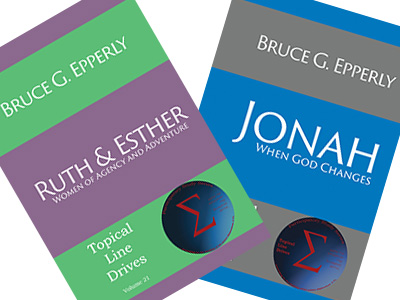
    ruth-esther-jonahI just posted my interview with Bruce Epperly about his new book Jonah: When God Changes on the Energion Discussion Network. I’m going to embed it here as well. I want to call attention to it along with Bruce’s next most recent (!) book Ruth & Esther: Women of Agency and Adventure.

    Sometimes we get different pictures of God from the narratives of scripture than we do from the affirmations. I don’t think the narrative should be neglected. We often geld the narrative in order to keep it from challenging our existing perceptions of God. But those perceptions frequently are desperately in need of a challenge.

    What happens when the good guy finds himself on the wrong side of everything (Jonah)? What if two Jewish characters survive in a foreign court in completely different ways (Daniel and Esther)? What if there’s a woman in David’s genealogy (and in Jesus’s) that really shouldn’t be there? Can a perfect, sovereign God regret things? If not, what actually happens at the beginning of Genesis 6?

    Here’s my interview with Bruce Epperly:

    And here’s Louis Armstrong’s Jonah and the Whale, just for fun:

  • Perspectives on Paul: Paul’s Gospel or Another Gospel

    I don’t expect to finish this topic, but I’ll make a stab at getting started.

    I have added my interview with Dr. Herold Weiss to the resource page.

    Here’s the viewer embed for tonight:


    And here’s my interview with Dr. Herold Weiss:

  • Perspectives on Paul: Another Gospel

    Perspectives on Paul: Another Gospel

    Apocalyptic background - flash and lightning in dramatic dark sky
    Apocalyptic background – flash and lightning in dramatic dark sky

    Well, I’ll be starting from the word “church” and going forward to “gospel.” With only a half hour, I’m not sure how far we’ll get. Scripture is still Galatians 1:1-10, and you can add the first chapter of Herold Weiss’s book Meditations on the Letters of Paul, “My Gospel.”

    I’ll start at 7:00 pm central time and the session lasts 1/2 hour. Live chat will be enabled for those who would like to comment or ask questions.


  • Thoughts on Releasing a New Book about Jonah

    Thoughts on Releasing a New Book about Jonah

    esther and jonahI believe that it’s easy to let our theology keep us from reading the Bible, especially the narrative parts. The Bible is filled with stories. One example is the story of the flood. When Genesis 6 says (using the KJV), “It repenteth me that I have made man,” the first reaction is to try to explain how God didn’t really repent, thus preserving doctrines of omniscience expressed particularly in foreknowledge. A vigorous desire to preserve one’s theology can prevent one from hearing the story as it is actually told.

    Jonah is just such a story. It’s very easy to make this a story about obeying God. The story was explained to me when I was a child as an illustration of the bad things that could happen to you if you went against God’s will. Another lesson, often taught at the same time, is that God can and does work miracles. Many people have seen belief in the whale (really more like “great fish”) as a test of one’s belief in the truth of scripture.

    But to spend our time on the reality of the great fish, whether to disparage the idea or uphold it, is to stray from the story.

    I’ve been delighted to publish a couple of books by Bruce Epperly that deal with Bible stories from a less theologically defensive position. Bruce tends to let the stories speak and as such he gets lessons from them that we might otherwise miss. A few months ago we released Ruth and Esther: Women of Agency and Adventure. I commend that study to you.

    This week we released another book about stories, Jonah: When God Changes. Just the subtitle is likely to unsettle a few people. I think it’s good to be unsettled. I think that Jonah was unsettling when it was first written and it was intended to be.

    We often have to work hard to love and care for people who are actually very similar to us. We tend to discount the command of Jesus to love our enemies. But in Jonah we have a call to love people we now hate—and with good reason!—and to take God’s message to them. While Jonah’s message sounds like a “fire and brimstone” sermon, it becomes a call to salvation, just as Jonah feared it would (read the last chapter)!

    Bruce really works this little book and calls to our attention things we might normally miss in pursuit of theological comfort. I suggest that you give up that comfort and read the book!


    We’ll have it for $4.19 pre-order pricing (even though it’s already printing) on Energion Direct. We’ll keep that up through Labor Day. Find a couple of other books to go with it so your order is at least $9.99 and you’ll get free shipping.

  • Review: NIV Cultural Backgrounds Study Bible – Hebrews

    Introduction

    #contextchangeseverything – yes, it does. But how?

    With the vast array of Bible study materials that are available in the English language comes a problem. How does one choose what materials are worth my time, shelf space (or HD space!), or money? If you search my blog for posts about study Bibles, you’ll find that I have a love-hate relationship with them, and it tends to be mostly hate. Nonetheless, I own—and use—a variety of study Bibles, and you’ll even see some positive reviews.

    The reason for the hate side of the equation is that far too many people purchase a study Bible that’s recommended by someone they trust, or even written by someone they trust, not to mention randomly selected from a bookstore shelf and then accept what the notes say because they are written by biblical scholars after all. I recall being accosted by a church member some years ago who asked me about the notes on a particular text. I can’t even recall which text it was. Her problem was that she couldn’t figure out how the meaning presented in the note could be extracted from the text itself. I strongly recommend asking just such a question! I asked her if she’d considered the possibility that the note could be wrong. That was a revelation for her.

    What I recommend is that a reader make sure to get study Bibles that are written from different perspectives and use them as an aid, not as a source of the answers. To some extent one should study the Bible text first, and then the notes, but sometimes one can read background material first. A study Bible that provides notes that tell you directly what the passage means can be quite convenient, but also quite misleading.

    But one of the key problems for Bible students in the 21st century western world is the extent to which our culture is different from that of the world of the Bible. Very frequently what seems quite plain to us is not at all what the Bible writer is trying to say because we simply don’t share enough of those norms. I have come to believe that I have benefitted more by coming to understand human culture and language over the last 30 or so years than I have by learning the biblical languages. I do not mean to underestimate the value of learning Greek and Hebrew, but if my language learning had not been enhanced by the study of linguistics, history, sociology, and anthropology, it would have been of little value.

    Pastors frequently proclaim that “the Greek word ____ means” or “the Hebrew word ____ means” and then build their exegesis on what is essentially simply another gloss. This makes people believe they have been enlightened by the ancient languages, when they have actually simply transferred their 21st century attitudes and presuppositions to a set of sounds they are told is Greek or Hebrew. Understanding a language means to some extent understanding a culture. Similarly understanding a text means understanding something about the person or persons who wrote it and the audience for which it was intended.

    This is the key element that I believe a study Bible can provide. Certainly cross-references and historical connections are important, but letting the reader know how people in that time and place lived and thought is much more important.

    NIV Cultural Backgrounds Study Bible

    Olive Tree with NIV Cultural Bible
    NIV Cultural Backgrounds Study Bible on my Android Tablet

    (Note: I am basing my notes on the Olive Tree Bible software edition provided to me free of charge as I did not receive my print edition. I will not make comments on the layout or usability of the print edition.)

    Thus I come to the NIV Cultural Backgrounds Study Bible. They use the provocative (and obviously true) URL contextchangeseverything.com. I should note here that there are many types of context. There is a literary context, historical context, linguistic context, and (among others) cultural context. We usually think of context in a fairly narrow linguistic sense. A word study might be done by finding a variety of sentences that use a particular word. We know that when Jesus says, “Go and do likewise” we need to look at the context of what has been commanded. We can’t grab some other activity and make that the command of Jesus instead.

    Study Bibles generally examine a range of these ideas as well as proposing interpretations for difficult passages, often without providing enough information so that the reader can follow the logic. The final reader is left with the simple logic that the skilled scholar who wrote the study notes concluded X, so X must be correct, an assumption that will be severely shaken in many cases if one compares other Bibles written by skilled scholars.

    The Cultural Backgrounds Study Bible aims to help you understand the Bible writers, their audience, and their times. In the notes you will find direct connections between ancient culture(s) and the text itself. Rather than just being told that a certain phrase means a certain thing, you will be given the reason why one might come to that conclusion. This is no guarantee that every interpretation is correct; that would be expecting the impossible. (Which perfect one of us would make the determination in any case?) What it does mean is that for most explanations in the notes in this Bible you can follow the logic path. If you want to, you can do deeper research, and the notes are specific enough that you’ll be able to do your search, Bible dictionary reference, or deeper study in a commentary or at a good library.

    Since I’m not reviewing the Bible overall, but rather looking in particular at one book, I won’t spend more time on an overview. Let me simply say that I’m delighted with the intent, and quite impressed with the implementation. There are obviously limitations. This is a study Bible, not a multi-volume commentary or an encyclopedia. It would be easy to complain about what’s not there. In my review of the book of Hebrews, I believe that the editorial choices made were quite good. I would doubtless have chosen differently in some cases, as would just about anyone, but that’s only to be expected.

    On to Hebrews

    To study Hebrews most effectively using this Bible, start first with the introduction to the Old Testament. Why? Because Hebrews displays an interesting interplay between the text of Hebrew Scripture, seen generally through the LXX translation, and then interpreted in a particularly New Testament light. The details of how these elements interact require some discussion, and that’s why you study and compare, but you need to understand the sources. The introduction discusses 12 issues in which we will see the world differently, and I think all of these issues will impact your reading of Hebrews.

    While reading the text of Hebrews you can use the links (if you’re using Bible software) or follow the references to Old Testament passages. You cannot impose your own exegesis of passages of Hebrew Scripture on Hebrews, but it is important to know not just the text that is quoted, but also its literary context that might be brought to the audience’s mind by the reference, and also by ways in which that text might have been understood. It is not sufficient to treat the Old Testament quotations in Hebrews as words used in the context of Hebrews. Of course, the context of their use in Hebrews is the most definitive when we determine how the author of Hebrews intended them, but we need to do everything possible to get into his (or her) world in order to understand that context.

    This is the value of a volume like this. I’m currently reading a commentary on Hebrews that is more than 600 pages. I have another on the shelf in front of me that is of similar length. It’s hard to back off and get an overview of the forest using those commentaries, though both are extremely valuable. What I enjoyed with the Cultural Backgrounds Study Bible, even as someone who has read the book of Hebrews many times, and studied the works of many commentators on it, was this broader view. Having dealt busily with the trees, putting each leaf under a microscope, it was nice to get so much material easily available. (This is a general advantage with study Bibles over detailed commentaries, at least the better ones, but the Cultural Backgrounds Study Bible excels).

    Content Comparison

    study bible stackI’m going to compare the content of several study Bibles I have on my shelf. Where I give word counts, they are loose estimates based on line counts and my eyeball count of average words per line. The Bibles I’m using to compare are: The New Oxford Annotated Bible (NRSV), The Orthodox Study Bible, The New Interpreter’s Study Bible, The NLT Study Bible, and of course the NIV Cultural Backgrounds Study Bible.

    First, let’s compare sheer quantity of text. First, the introduction. (I’ll add a note on approach.)

    NOAB: About 450 words, no outline, though an outline can be extracted easily from the notes. The approach of the notes is often technical. Users complain that they don’t get enough theological help.

    OSB: About 220 words, short outline provided, stronger suggestion of possible Pauline authorship than others. Theology is consistent with that of the Eastern Orthodox tradition.

    NISB: A bit more than 1000 words and a mid-length outline. The NISB is kind of the pastor’s answer to the NOAB for mainline teachers/preachers. It provides more theological reflection, a fact I receive with definitely mixed emotions, though the material is generally helpful in its place. Theology is mainline with a bit of a liberal lean.

    NLT Study Bible: About 1500 words and a brief outline. Theology is strongly evangelical

    NIV Cultural Backgrounds Study Bible: About 800 words, no outline, features “Quick Glance” section. Theology is evangelical.

    Now let’s consider a specific passage, in this case Hebrews 4:12-13, and look at the quantity of notes, along with a count of insets or excurses in the whole text of Hebrews:

    NOAB: 21 words. No excurses.

    OSB: 54 words. One excursus.

    NISB:  75 words. No excurses.

    NLT Study Bible: 74 words. 9 excurses.

    NIV Cultural Background Study Bible: 136 words. Two excurses.

    The critical value of these notes is that they are aimed at the background and at helping you draw a line from the background to the meaning. I would say that the NOAB is great at pointing to technical details, but not so much at theology, while the NISB spends less time on technical details while using much of its space to reflect on theology. The NIV Cultural Backgrounds Study Bible uses its space in drawing a picture and pointing that to possible theological conclusions without trying to be a theology text.

    Conclusion

    Over the next few days I will post something on a couple of my favorite passages and the specific comments provided by this study Bible. I would consider this an excellent Bible to have at hand for a study of any biblical book. In my To the Hebrews: A Participatory Study Guide (currently under revision), I recommend that a study group have more than one study Bible available. I think it would be good for a group studying Hebrews to have this one at hand. One of the reasons my own guide is being revised is that it is largely a collection of thought questions. I’m going to provide more of a basis for those questions in the second edition. But the book will still be intended for use by a study group that has available multiple resources to compare. This will be one of the few that I recommend.


    Note: All of these introductions to the book of Hebrews tend to dismiss Pauline authorship, with the Orthodox Study Bible being the most favorable. My own position is that it is not possible to determine the author. I used to exclude Paul as a possibility, but have been persuaded by the writing of David Alan Black that Paul should be kept as a possibility. I publish his little book The Authorship of Hebrews: The Case for Paul.

  • Thoughts on Moving from Numbers to Deuteronomy

    Thoughts on Moving from Numbers to Deuteronomy

    Leviticus, Numbers, Deuteronomy (CBC)I’ve completed the second chapter of Deuteronomy in the CBC commentary on Leviticus, Numbers, and Deuteronomy, and it may surprise some that I’ve felt a bit of a letdown as I moved from the variety of liturgy and laws, though interspersed with narrative, that is Numbers. It might surprise you less if you realize that my personal theology (and I think we all have one), is built on Ezekiel, Hebrews, and Leviticus, though not necessarily in that order. That’s the order in which I started studying the books seriously, however.

    For most Christian readers of Hebrew scripture, I think that getting into Deuteronomy is a bit of a relief. Reading Genesis through the first half of Exodus goes pretty smoothly, but then one bogs down on all those details of building the sanctuary, and you get them twice: instructions and implementation. Then when you’ve worked your way through that you get to Leviticus, which contains so much liturgy, along with obscure laws on issues we generally don’t face. Numbers is a little less dismal, and then Deuteronomy starts to give us propositional theology that we can get our teeth into.

    I was there before I spent serious time in Leviticus. I don’t claim expertise; that takes incredible amounts of study. But I’ve spent a great deal of time on the text. There’s a great deal that one can learn from that liturgy, including the simple fact that liturgy matters. Those of us who are not “high church” tend to think that the way in which worship is conducted isn’t very important. It’s mostly a time to accomplish our goals, often divided between “worship” (when that’s defined as musical), and “sharing the Word,” and of course those who believe one or the other is critical can have some great debates.

    But we can learn a great deal from the ancient liturgy, and I think we can either increase or diminish our impact on the world around us through constructive liturgy. This is not an argument for high church liturgy. I am also not arguing that worship only takes place in worship services, much less that worship can be equated to music. All our activities should be done in worship to our creator.

    But there is a time for us to act out for ourselves and for others the nature of the church as a community, and coming together at a common place and at a common time to share in activities as a community is, I think a critical part of this. Unfortunately, we have a variety of ways to avoid this. We may reject gathering together entirely. It may be a time when an ordained pastor occupies most of the time explaining to us what he believes we should believe. It may be a time to experience an emotional high as part of musical or artistic endeavors. It may be a scripted program that is ancient and could be meaningful, but is carried out by rote.

    But it doesn’t have to be any of those things. It can be, instead, a time when we gather together and join in activities that encourage one another and prepare us to face the world around us as effective witnesses for Jesus. I don’t think there’s a particular set of activities that make this happen. I do think it’s possible because I have seen and experienced it.

    God doesn’t just communicate in one way. Hebrews 1:1-4 makes it clear, and presents Jesus as the ultimate communication from our creator (amongst other things that reinforce that idea). The Torah (or Pentateuch) presents these different ways. We have liturgy helping to teach the people and to shape them into God’s people. We have story, showing us people experiencing God’s activity in the world, and we have theological propositions. I kind of prefer the liturgy, but that’s just me. Here we have all three demonstrated.

    I think that neglecting one or the other leaves us with potentially skewed views of God. We need both the God who is the same yesterday, today, and tomorrow (Hebrews 13:8), and the God who is sorry that He created humanity (Genesis 6:6). The same God also forgives a poor Israelite who can’t even afford a bird as a sin offering (Leviticus 5:11).

    So I guess I won’t be let down and instead enjoy the change!

    (For studying the Bible as story, try Ruth and Esther: Women of Agency and Adventure by Dr. Bruce Epperly.)

  • Exhortation Does Not Interrupt Exposition

    [ncs_ad pid=’0664239013′ float=’left’ adtype=’aer.io’]On page 238 of his NTL commentary on Hebrews Luke Timothy Johnson uses the word “interrupt” to describe the transition between exposition and exhortation starting in Hebrews 5:11. In a way I’m nitpicking here, and because I am, I must also note that overall I find Johnson’s commentary nearly the most useful I’ve read, and if I were just talking about theological reflection, I would call it the best.

    I have a couple of objections to use of the word “interrupt,” however. First, it seems to me that calling the transition an interruption divides the text without consideration for the author’s purpose in writing. There is no exposition here which stands alone, and which can then optionally be applied to the hearers via an exhortation. Rather, the intention is exhortation and the exposition underlies the exhortation and is illustrated and illuminated by the nature of that exhortation.

    Second, the exhortations also help raise questions for the further exposition that follows. In the case in question (Hebrews 5:11-6:12), the question of the faithfulness and reliability of God is raised, which will be answered in Hebrews 6:13ff. This is also the critical question of the entire book. God has provided the final High Priest (logically and temporally), who will offer the final sacrifice, and will provide the way back to the presence of God. Since this is all final, human beings are presented with this final choice, in the view of our author. If you reject this, what means can God provide for you?

    Without exhortation, the exposition would be dry, pointless, and incomplete. The exhortation is an integral part of developing the topic.

    I emphasize this because of some of my experience in studying Pauline epistles in college and graduate school. We would make it through the theological exposition in the beginning of the book, but when we got to the practical admonitions, those were treated as something of an afterthought by Paul. “Here’s your theology of salvation, and oh, by the way, there are a few things it would be a good idea to do …”

    But for Paul those admonitions grow out of the theology he has presented. The practical elements are not appendices to letters that are otherwise theological treatises. It would be better to call the theological exposition introductory matter to the practical sections. Perhaps this explains why Galatians and Romans seem to get so much more treatment from a theological viewpoint than 1 & 2 Corinthians.

    Sometimes I think the worst thing about biblical scholarship is that it is carried out by biblical scholars. Their interest is in extracting theological propositions and historical data. The writers, especially Paul, are writing pastorally. The two don’t always work well together.

    At least that is the view from someone who took Romans (through chapter 8!) and Galatians (through chapter 4!) in school. As far as I could tell, the professors were happy with that.