Threads from Henry's Web

Category: Bible Passages

  • Beware CNN Bearing Bible Verses

    Beware CNN Bearing Bible Verses

    Mom’s Grave Marker

    When my mother passed away in April, my brother and sisters and I chose a text for her grave marker: “I will content with him that contendeth with thee, and I will save thy children” (Isaiah 49:25, KJV). It was one of mother’s favorite texts, and her concept of “children” was broad. She was a nurse and a teacher and was involved in the lives of many.

    There was, however, a period in her life when she was deprived of her favorite text. Someone with scholarly credentials told her that the text didn’t mean what she thought it meant, and that she could not claim this as a promise for herself that God would save her children.

    She confided this to me in the car one day. She was deeply saddened not to have this text, but she didn’t want to use it if she was misusing it.

    Now if one looks at the context of the passage, both literary and historical, it is not talking about spiritual salvation of the descendants of a modern American mother, or of keeping them safe from all danger. It’s talking about the exiles of Judah who are to be brought back to their homeland. In that sense, anyone outside of the time frame of 2nd Isaiah cannot claim the passage for themselves, as it isn’t talking about them. It’s addressed narrowly and specifically.

    So are quite a large number of Bible verses.

    So here’s how I responded. I told her that yes, indeed, the historical context was different, but that I saw in that passage something about the character of God, portrayed in this passage. God is a God of redemption and works to redeem. God is interested in the generations to come. (It might not surprise you in this context to learn that Psalm 78:1-8 is my theme text for my teaching ministry. God cares about the generations to follow.) I could certainly find many other texts to indicate this as well, but Isaiah 49:25 encapsulates it very well, while placing it in the context of God’s negative judgment as well. This suggests in turn that God’s judgment is intended to result eventually in redemption.

    So while the text was not addressed to Myrtle Neufeld in the 20th century (which was when the conversation occurred), and did not specifically speak of her children and what would happen to them, it did express God’s nature and desire for those children. My mother was never naive enough to believe that, despite any choices made, God would make everything right. What she did believe was that God was working to save her children at all times and in all circumstances.

    Mom decided that she could use the text after all. Mission accomplished.

    So today I read this article from CNN. What struck me in this was not the debate about Romans 13. I have definite opinions on that, but at the moment I will only note that people I respect deeply, who are both sincere and well qualified, disagree with my definite opinions on Romans 13. Well, I should acknowledge that many agree as well! I’ll get to the matter of disagreeing on the meaning of texts in a moment.

    The passage that struck me was Philippians 4:13. “I can do all things through Christ who strengthens me.” Or let me quote a bit more in context:

    10 It is a great joy to me in the Lord that after so long your care for me has now revived. I know you always cared; it was opportunity you lacked. 11 Not that I am speaking of want, for I have learned to be self-sufficient whatever my circumstances. 12 I know what it is to have nothing, and I know what it is to have plenty. I have been thoroughly initiated into fullness and hunger, plenty and poverty. 13 I am able to face anything through him who gives me strength. 14 All the same, it was kind of you to share the burden of my troubles.

    The Revised English Bible. (1996). (Php 4:10–14). Cambridge; New York; Melbourne; Madrid; Cape Town; Singapore; São Paulo; Delhi; Dubai; Tokyo: Cambridge University Press.

    You know something? Here’s the comment from the article:

    When the Apostle Paul wrote that line, he was referring to a Christian’s ability to withstand suffering. It wasn’t about winning; it was about enduring loss. Paul wasn’t taking a victory lap; he was in prison contemplating his execution, says Van Voorst, a professor at Western Theological Seminary in Michigan.

    Um, true. Paul didn’t play basketball. But he wasn’t just talking about a Christian’s ability to withstand suffering. He was talking about being able to handle whatever life throws at you. If you’re a basketball player, what life throws at you might be a career-ending injury or it might be an opportunity to make a couple of free throws to end the game victoriously. Yes, it is quite possible to apply this verse in ways that are not appropriate. It doesn’t mean you’re always going to win, for example.

    Neither does Romans 8:28ff. The passage goes on to say that nothing can separate us from the love of Christ. It’s a powerful passage about spiritual things, about our ultimate salvation. But it’s also a powerful passage about God being with us at all times. It doesn’t mean things will happen the way I want them to. It does mean that, in the end, what God works out will be good. And yes, that good may come in the next life.

    I have two major problems with what goes on in this article, though first I must note that many things noted there about abused texts are quite correct. It’s certainly possible to misuse a text. It’s also possible to disagree quite rationally about the meaning of a text or to rob that text of all applicability.

    1. My first problem is this: Biblical scholars can suck the lifeblood from Scripture. With enough historical study, one can assure that nothing in Scripture applies to anything in anyone’s life. Scripture is understood in community, and how it applies to the present grows out of the community and its understanding. It is important to use historical scholarship as an anchor. It’s important to acknowledge and celebrate the history. But for those who believe that God is still God, it’s quite possible to think that God might act again in ways God has acted before. If you don’t believe God is still God, your argument is on that point, not in the understanding of Scripture.I would hope that scholars would encourage, inform, and edify the members of the community, not nit-pick them into abandoning a personal reading and application of Scripture.
    2. My second problem is simply this: If we understand that there are multiple possibilities for ways to understand and apply Scripture, we should also expect that a news article from CNN that quotes a couple of scholars cannot settle the issue of meaning for multiple Scriptures. This is why I prefer “I disagree with that view” to “That view is wrong.” There are some really bad interpretations out there, but some of those are held by highly qualified people, and a response should include careful argumentation. “There’s another way to view this” will accomplish more, I think, than “Your view of this is stupid.”

    Most obviously, I might suggest that a short article is hardly going to set the record straight on multiple Scripture passages. I found places I agreed and places I didn’t. I know of serious commentators who would agree and some who wouldn’t.

    As a life-giving, spiritually invigorating support, a text can be wonderful. As a club to beat up your neighbor? Not so much.

  • Tonight in Romans

    Tonight in Romans

    This evening, at 6 pm at Chumuckla Community Church, we continue the study of Romans, just starting chapter 2. Here’s a quote from some of my reading today:

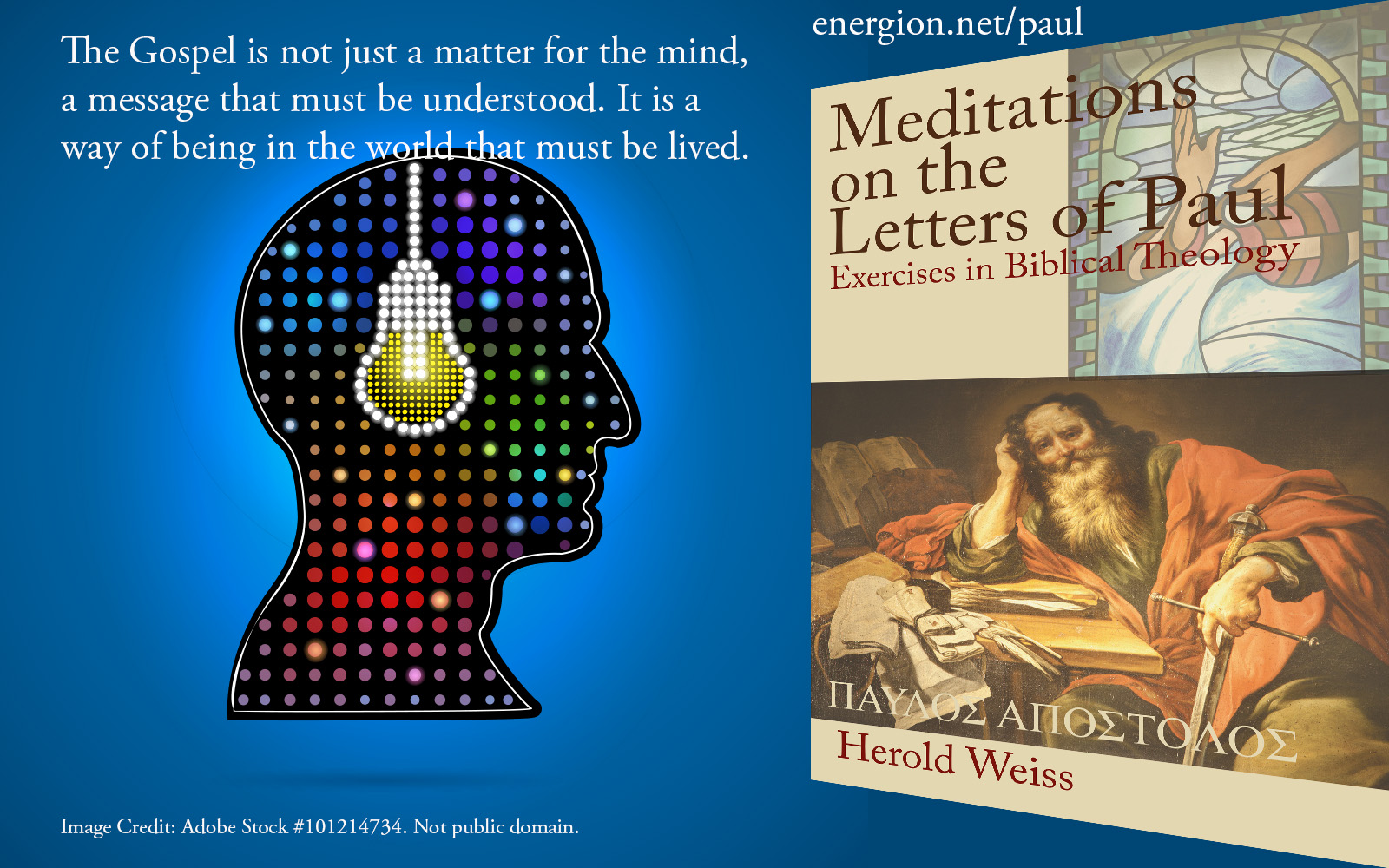
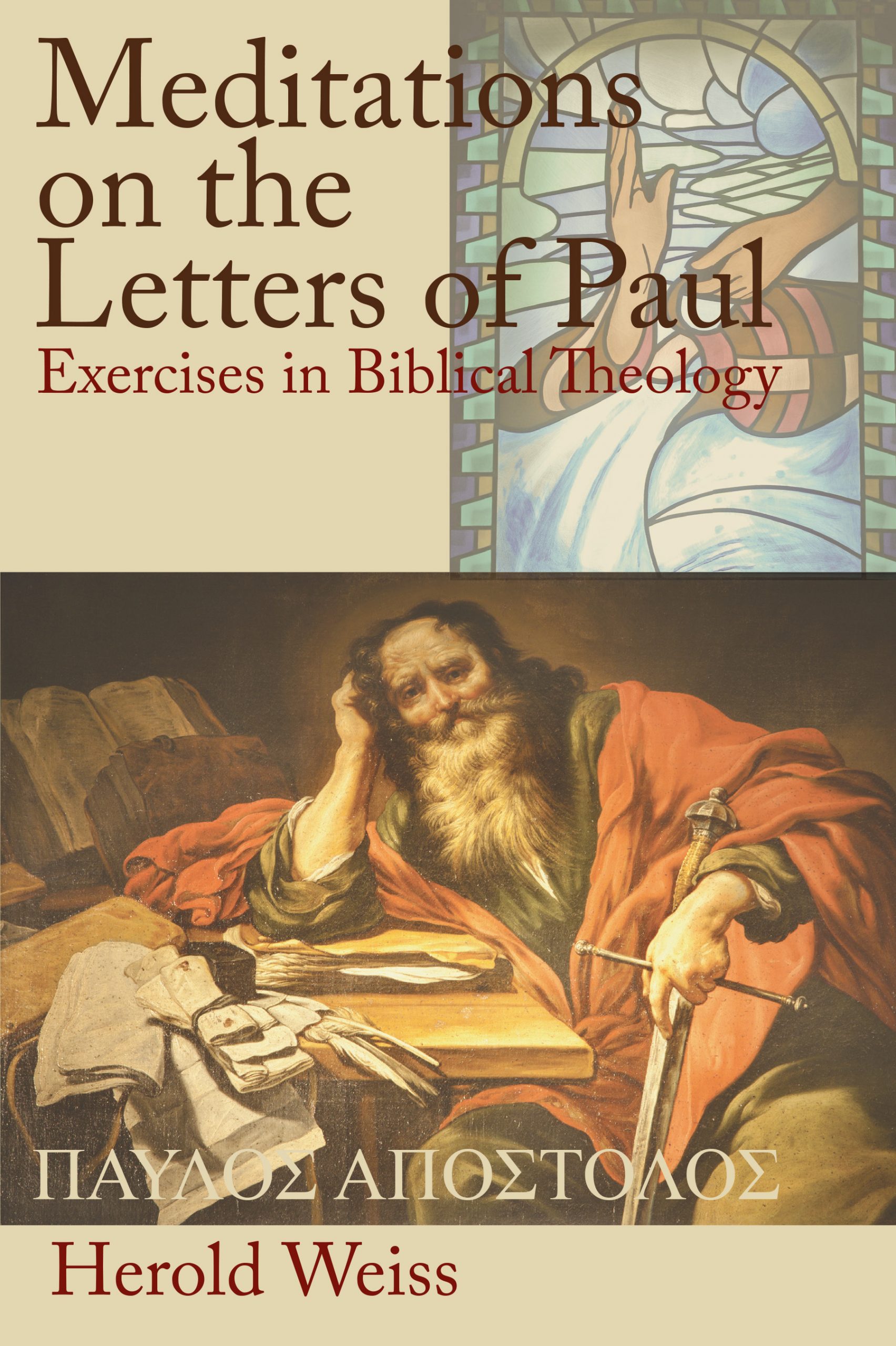
    The Gospel is not just a matter for the mind, a message that must be understood. It is a way of being in the world that must be lived. The Gospel may reach the individual through the mind, and the mind has a task to do with it, considering its premises, judging its arguments, evaluating its goals. But the Gospel must find its home in the heart, the seat of being. It cannot get to the heart without passing through the mind, but it is not effective unless it settles in the heart, changing it in the process. As Paul puts it, the heart must be circumcised (Rom. 2:29). The power of sin in it must be expurgated. The Christian has a mind renewed from above and a circumcised heart. Paul’s promise to his converts is that “the peace of God, which passes all understanding, will keep your hearts and your minds in Christ Jesus” (Phil. 4:7). To keep the mind and the heart together is to live by faith and reason. The love of God that the Spirit pours into the heart does not dislodge the unity of the mind and the heart. It strengthens it. In the Christian, faith and reason abide as one. (Herold Weiss, Meditations on the Letters of Paul, pp. 59-60)

    There are those who think we’re moving slowly. I think we’re moving at lightning speed! If you live in the area, come and join us for an exciting discussion.

  • Repentance in Hebrews 6:4-6

    Repentance in Hebrews 6:4-6

    When I talked about structure, I mentioned that I’d write a follow-up after my Wednesday night class. Here’s the rundown, though I plan to keep it brief. I’m indebted to David Alan Black for the basic note about the participles in this passage, and in a scholarly article I would need to cite a number of additional sources. The structure of the passage followed my own take on it in the context of Hebrews and made the argument easier. I include this discussion in my book To the Hebrews: A Participatory Study Guide, which is currently under revision for a second edition. (The main problem with the current edition is that I created it with readings, exercises, and questions, along with several appendices with discussion. I’m putting some discussion in the lessons!)

    There are a number of passages I referenced in class, but there are three passages before 6:4-6 that I see as key, and then one after. The reason is that the author of Hebrews signals new topics well ahead of the main discussion and then ties them in to later discussion.

    So if you look at Hebrews 2:1, “drifting off course.” This is an early signal of what I think is the key theme of the book, one that is further developed in 6:4-6 especially. At this point, the author has presented Jesus as the true representation of God and is now ready to open up the door to the result. God has spoken in these last days through a Son, which sounds good, even exciting, but what does it mean?

    Frequently Hebrews is read as a book with a message of works and perfectionism. In fact, as someone with a Wesleyan background, I’m used to starting there in my thinking. But the more I study the book, the less I think that is the correct reading. The warnings in Hebrews are not about human performance of good actions, but rather of total confidence in the one who has been presented here in chapter 1. Verses 1-4 present the Who, while the rest emphasizes that Jesus is greater than the angels. There will be more emphasis on precisely who Jesus is, but we have this pause in the first few verses of chapter 2 so we can get a preview of the theme.

    Through the rest of chapter two and into chapter five, but especially in 4:12-16, we’ll develop the things that make Jesus ideal as our priest, even though we aren’t quite sure what such a priest will accomplish.

    In 5:8-9 we get the second key connection, as we are told that Jesus learned obedience through suffering (and a rich passage that is, even though I’m just going to touch on it only briefly. Verse 9 tells us that he was perfected. It is this “perfection” that I think is the key object of Hebrews, the perfection of Jesus, not the perfection of any human being.

    I see 5:11-14 as a bit of reverse psychology, challenging the readers/hearers with their dependence on milk just before he goes ahead and introduces some meat anyhow.

    The third key passage is Hebrews 6:1, and “going on toward perfection.” It’s my understanding that United Methodist pastors are still asked this question on ordination, and I believe not a few have their fingers crossed when they answer. Figuratively speaking, of course! But though few translations do it, this can be taken as a passive, and thus be translated “carried on toward perfection” rather than “going on toward perfection.” I would go further and argue that the perfection that we are to go on toward is Jesus, and is only to be attained “in Christ” and not by us or as something possessed by us.

    Having jumped from signpost to signpost, this leads to 6:4-6. I have noted previously that I don’t take this as a “once out always out” passage, but rather as a warning against rejecting the voice or urging of the Holy Spirit. Paying closer attention to structure and the participle tenses helped back that view up and expand it.

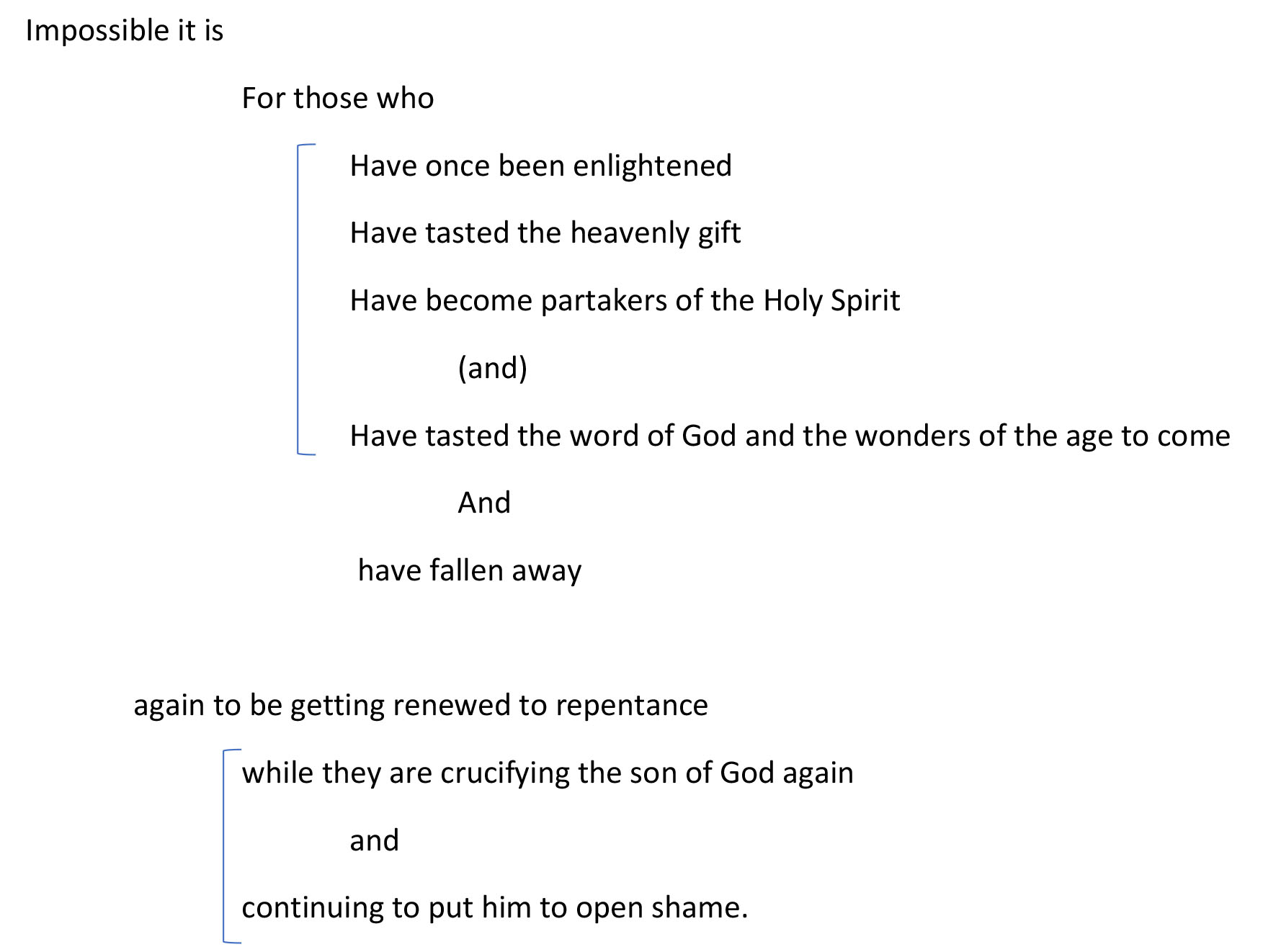
    Here’s my translation with structure:

    I have summarized the theme of Hebrews as “get on the right train and stay on it until you reach the destination.” The key is that if you have the best, the greatest, or even the only hope of rescue and you don’t take it, rescue escapes you. That’s why I have the temporal sense here. If you are rejecting the final sacrifice of Christ, according to the concepts developed in the preceding five chapters, what option is there? Jesus, the Christ is sacrificed once-for-all, and cannot be sacrificed again. If we continue to fail to accept the finality, we are crucifying him afresh.

    But it’s even more simple than that. You can’t accept while you reject.

    Does that make it too simple? Actually, I think it makes it a clear statement of precisely the point of Hebrews. You have two choices: This train or no train.

    And that leads to the final passage I want to use, Hebrews 10:26-27. Here we have no sacrifice for sin after Jesus. It’s often used in sermons to threaten people with how seriously they should take New Testament commands. But that’s not the point at all. There is no more sacrifice because the sacrifice has been offered. If you don’t accept the sacrifice, there isn’t another one. You can’t redo it or substitute it.

    The whole message centers on confidence in the grace that has opened this “new and living way” (10:20), in the perfection of our High Priest, and in the necessity of placing our full confidence in Him.

    Let me add that I believe that the “cloud of witnesses” in Hebrews 12:1ff should be seen as those who are cheering us on because they have experienced the weaknesses and the failings that we have and know the grace of God and the final reward. It should not be used as a club as I have heard it preached, in the sense of: “Look at all these holy people who are watching you. Don’t screw up!”

    (Featured Image Credit: Openclipart.org.)


  • Thoughts on James 2

    Thoughts on James 2

    Our Sunday School lesson, which I’m not teaching this week, is from James, focusing on chapter 2. I’m not teaching, but in studying, I looked at a book I publish, Holistic Spirituality: Life Transforming Wisdom from the Letter of James.

    Bruce Epperly makes a number of important comments. I’m going to do a bit of quoting from his chapter 3, pp. 15-21.

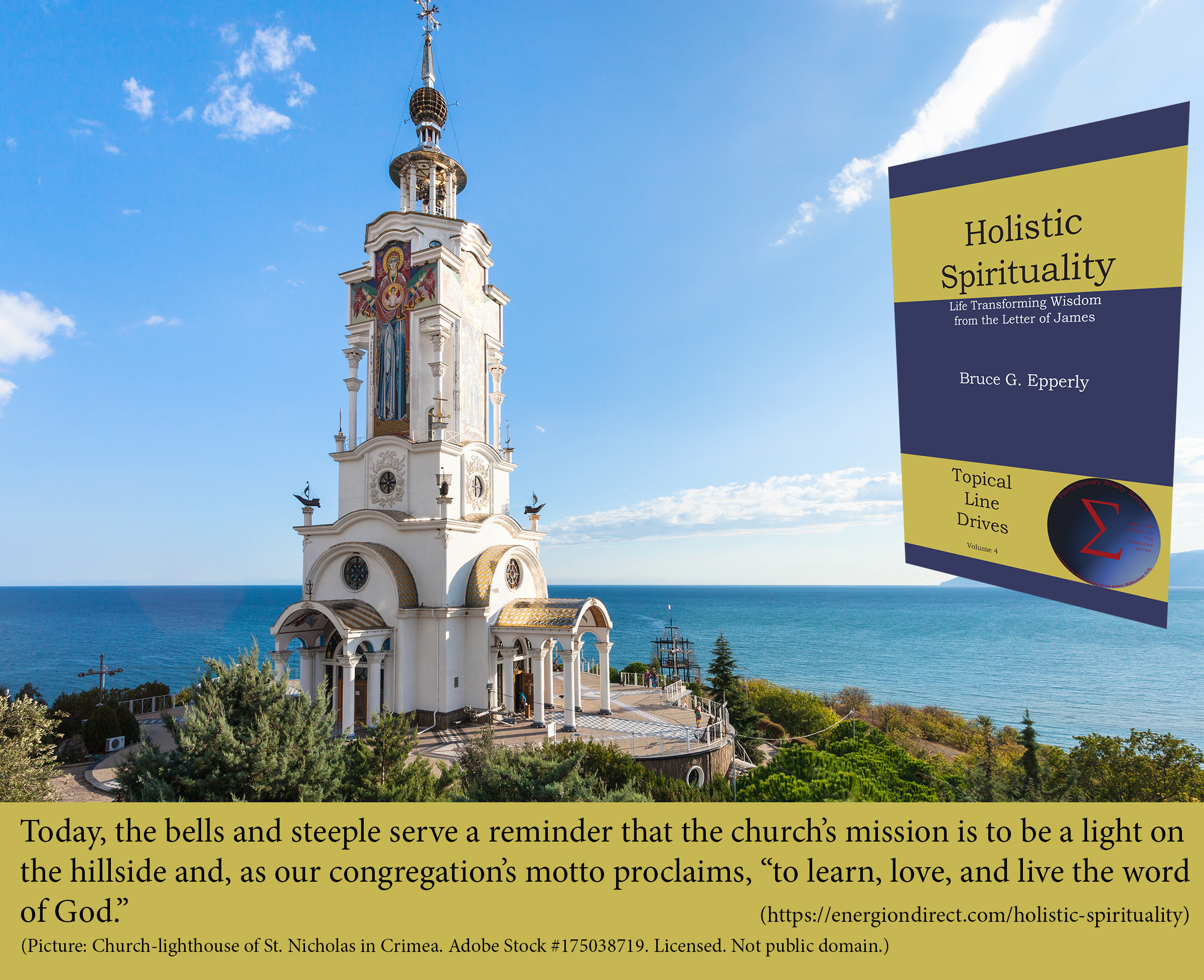
    One of my great joys is my first glimpse of the steeple of South Congregational Church, when I round the bend toward home. In earlier times, the church’s steeple guided mariners safely to shore. Today, the bells andsteeple serve a reminder that the church’s mission is to be a light on the hillside and, as our congregation’s motto proclaims, “to learn, love, and live the word of God.” (p. 15)

    I like that motto, “learn, love, and live.” I think it may go the other way as well, we learn from what we live, especially when we’re trying to live the word of God.

    Faith means nothing unless it lights the way of pilgrims and seekers, providing guidance, comfort, and nurture. (p. 16)

    Here Bruce combines faith in action and faith in witness (and our action is, I think, our best witness) in a way of which I think James would approve. We are not Christians, or Jesus people, for our own benefit alone. We receive grace to share grace. That’s why grace cannot be a passive thing. It erupts in action.

    … The Apostle asserts that because God loves us, our vocation is to love one another, even if this means crossing the barriers of race and ethnicity. Grace makes us all first-class Christians, worthy of respect regardless of ethnicity or economics. This is the essence of James’ message as well.

    James believes that a holistic faith brings together belief and action. In the spirit of the Quakers, what is important to James is to “Let your life speak.” … (p. 17)

    I think that the tendency of many interpreters to see James and Paul as opponents is misguided. They do have a different emphasis, but it is not because Paul hated or devalued action or that James thought beliefs were unimportant. Each had an emphasis, but these emphases are compatible or complementary.

    Loving Jesus means loving your neighbor. And if James is right, it means standing aloof and becoming counter-cultural in
    relation to socially-acceptable, but life-destroying, values – “being unstained by the world” – that put profits ahead of people, neglect the needy, and blame the poor for their poverty. We are all created in the image of God and we all deserve to be loved, to have a place to call home, and an opportunity to live out our gifts and talents as God’s beloved daughters and sons. (p. 19)

    That’s were it will start to get with us. Sanctified wallets are the hardest of possessions to acquire. Or, looked at the other way, the wallet is the hardest thing to give up. How much stuff must we have? What is first in our life? Putting God first will result in also putting our neighbor first.

    But what can you do? Maybe all you have to spare is coins in your pocket.

    In the realm of God, no deed is too small, for with one action at a time we can become God’s companions in healing the world. Let your life speak. (p. 20)

    This is a great little book, just 40 pages of text from Energion’s Topical Line Drives series, for accompanying a study of James. It might just be, as the subtitle suggests, life transforming!

    Read Now


  • The Little Horn of Daniel (Again)

    Since I grew up as a Seventh-day Adventist, I almost have to be interested in Daniel 8, particularly 8:14, which is critical to the development of the Adventist movement. For those not acquainted with that history, this is the verse from which the prediction of the second coming of Jesus on October 22, 1844 was derived. In turn, that doctrine developed into the doctrine of the investigative judgment, which I list as one of my reasons for not being an SDA today.

    While at first my objections were exegetical and based on Daniel 8:14, I have come to be more concerned with the soteriology involved. I still hold to those original objections.

    Thus I link to an article from Adventist Today, Why the Little Horn of Daniel 8 Must Be Antiochus Epiphanes. I would note that the author, Winston McHarg, resigned from the SDA ministry in 1978, while I was a student at Walla Walla College, and still a few years before I left the SDA church. For a short article, this one is well-done exegetically.

  • Advent, Christmas, Epiphany

    Advent, Christmas, Epiphany

    From time to time I hear Christians, particularly pastors, lament the neglect of the Advent season. As a religious celebration Christmas comes best after the season of Advent in which we study and meditate on expectation. Then comes Christmas. Because of the commercialization of Christmas as a secular holiday (I believe one can commemorate the spiritual Christmas in the midst of a secular celebration if you want), the time of Advent is not spent in waiting and expectation, so much as in a rush. Ebenezer Scrooge had a point about Christmas being a time to buy things we can’t afford!

    But many of those who spend time on Advent don’t pay similar attention to Epiphany, which caps the twelve days of Christmas. It generally doesn’t come on a Sunday, and how can you possibly get people into church on a weekday?

    But all three of these days or seasons (Christmas is also a season), reflect important moments in spiritual life. Besides a historical reflection on the events that stand behind the Christian faith, we can have a reflection on the present of our lives, in which we wait with expectation for God to act, see God intervening, and/or come to the realization that God has acted, though God may have chosen to do so in a way that was not recognized at the time.

    I taught the Sunday School lesson this morning, and the key scripture was Matthew 2:1-12, which would be better placed on Epiphany than on Christmas Eve. Yet it helps make an important point placed here. Very few people recognized what was going on. I suggested that my class check the rest of the gospels. Nowhere does Jesus encounter someone who remembered something about his birth. “Wow, those shepherds told me about you, and here you are!” is a line that simply doesn’t come up.

    Different people recognized Jesus in different ways and under different circumstances. It’s important to remember that. Why? Because we need to understand where different people are in their experiences.

    I’ve watched a few Christmas movies this season. I enjoy the light entertainment with a definite good finish, even if I can predict it practically from the opening credits. Small towns generally win over cities. People who do “country” things generally win over those who are urban. The driven and ambitious are generally cast as villains. But there’s a sweetness to all of it.

    One interesting thing is that while the movies tell us about people who have been hurt during the holiday season, they generally tell the story of the moment in which someone overcomes or transcends that hurt and finds the joy of the wonderful holiday season.

    It would be nice if that was how the world works. It doesn’t. There will be people who will transcend emotional hurt and find healing this Christmas season. There are others who will experience new wounds. Yet others will suffer through the season, often silently, simply hoping it will be over. They won’t want to admit that they’d love to say, “Bah! Humbug!” because then they’d get labeled with the ultimate badge of dishonor: Scrooge. Before the ghosts.

    As a community, we need to be prepared to bring comfort to those who aren’t “in season.” It’s easy to imagine that someone will get into the proper spirit of expectation of advent, receive their gifts, and THE GIFT, on Christmas day, and rejoice with the Wise Men (astrologers, no doubt), on Epiphany. But many will not.

    We need to find the the time and the season of those in need of help and support. We need to recognize that Advent is not necessarily a time of confident and certain expectancy, but may be a time of wondering and struggle.

    One of the things the Israelite religion, and particularly the prophetic school, brought to Judaism and through it to Christianity is the idea that living is not an endless cycle. We’re going somewhere. There’s a point to the arrangement church fathers made of scripture, with Genesis 1 at the beginning and Revelation 21-22 at the end. We don’t live in an endless cycle. We’re going somewhere, and that somewhere is good.

    But in the meantime we celebrate cycles, with New Year’s Day coming up as we celebrate the arrival of a new year, and in many cases make resolutions that say that this next 365 (or 366) days will be better than the last. We celebrate advent every year, realizing that not everything is realized yet. We commemorate Easter, not because the event must be repeated, but because we need the reminder of new life.

    We’re always tempted to get mired one way or the other. On the one hand we can fall into hopelessness and maintain that the cycles of life are all that there are. On the other, we can get the idea that, having reached our Epiphany, we’ve made it permanently, and everyone else should join us. In the future, if we pay attention to these days it’s just a commemoration of how wonderful our lives have gotten. So we lie and we judge. We lie as we pretend that life really is that good. We judge because others haven’t attained what we pretend to have attained.

    Romans 7 is an interesting illustration. Paul seems to wallow in difficulty, finally saying, “Oh wretched man that I am! Who will rescue me?” We have the answer (or so we think) in Romans 8 as we learn that “there is now no condemnation to those who are in Christ Jesus,” and we proclaim, “Thanks be to God! Through Jesus Christ our Lord!”

    Which leads to a debate in biblical interpretation. Does Romans 7 speak of the life of one who has not accepted the grace of Christ or does it describe the life of the Christian? Do we really get to that better life here in this world, or is the Romans 8 proclamation the result of our glorification? (And, you may ask, what does this have to do with Christmas?)

    I bring up Romans 7 because it is so incredibly real. Wesleyans use the terms “prevenient grace,” meaning that grace which God offers to everyone and which is there before you even ask, and “sanctifying grace,” mean the grace that keeps moving one along toward holiness (or on toward perfection, as John Wesley might say). Romans 7, I think, speaks to us of the cycles of our lives. We do not always move forward. We also fall backward. We do what we think is not good, and sometimes (all too many times) we do what we think we ought not to do. I think the idea that we suddenly cease to experience Romans 7 is a lie we tell. It’s a lie we expect our leaders to tell. We all experience these cycles.

    That’s some bad news. The struggle continues. You’ll still be praying for God to act. You’ll still be living through times of expectation. God may still intervene, only to go unrecognized for some time afterward, when we suddenly receiver our epiphany.

    It’s also some good news. What it says is that grace is ever active. God’s sanctifying grace is persistent and active, and when we fall back into that cycle, God’s grace reaches out, grabs us, and pushes us forward so that we can still be moving onward, despite the difficulty. The bad news is that there will be more “Oh wretched man that I am” moments; the good news is that Grace will respond to each with those moments of “no condemnation” which will result in our proclamation of thanks to God through Jesus Christ our Lord.

    If we shed the lies and are real, we’ll be prepared to help others whatever their season. We do this not as people who have no problems, but as overcomers of problems who know, because we’ve experience it, that times of advent waiting are followed by God’s intervention, and that often God has already intervened, and like the folks in Herod’s court and in Jerusalem, we simply haven’t recognized the event yet. We’re waiting for epiphany.

    If you’re joyous this Christmas, I rejoice with you. What I pray is that you use your joy to help strengthen the weak, to encourage those who are less joyful, and to be real in all your times of trouble.

    The gift that Jesus brought was himself, yes, but himself as the messenger and vehicle of God’s grace. Be gracious to yourself and others in this season of joy … and grace.

  • A Note on General Revelation

    A Note on General Revelation

    No, that the horribly misused book, but the theological concept of general revelation.

    It is quite common to express concern about the quality of knowledge of God that one can get from general revelation. It lacks specificity, it’s easy to misunderstand, or it has become corrupted.

    I’m not writing this note to challenge the idea that extrapolating from the creation to the God of creation can be difficult. On the other hand, I was just reading Psalm 33 in preparation for next week’s Sunday School lesson, and I note that in vs. 6-9, we have a rather direct line drawn from creation to creator. By his word the heavens were created. He established, and that’s how it was. He commanded and it stood.

    My thought is this: I have found in written scripture that often we reject the meaning of a passage because we don’t like it. I’ve told classes that you can get a clue to how little people like what a passage says by how much ink has been used explaining it. That doesn’t mean that there aren’t obscure passages or those where the obvious is actually wrong. It can be a clue, however.

    I suspect that it may be where nature does not tell us warm and comfortable things about God that we tend to think it’s unclear. Perhaps we need to find a way to distinguish “unclear” from “very clear, but annoying.”

  • Ezekiel 36: Telling the Story

    Ezekiel 36: Telling the Story

    This was one of my texts from yesterday, though we worked from Titus 3:3-11, where I think vs. 3-8 parallels chapter 36 quite nicely.

    But my interest today is not in a specific verse, but rather in the way in which Israel’s story is told. Christians often have ambivalent, if not downright negative, feelings about the Old Testament or Hebrew scriptures. You’ll hear people say, “I’m more of a New Testament person.” In a certain sense, we should all be New Testament (Covenant) people. We are God’s people under terms of the new covenant. That’s why we call that portion of Scripture the “New Testament.”

    Nonetheless, Israel’s story is critical. One reason it is so useful is the way in which Israel told their story. Other nations record their triumphs and their successes, crediting the appropriate historical characters. Sure, one will have comments on how the gods favored this person or that, but the overall story is one of human triumph.

    Israel, on the other hand, records key failures. We focus on things like slavery in Egypt, and the human leader who brings out Israel is a reluctant leader, taking actions as God initiates. One of the key high points, the establishment of the Davidic monarchy, is told with amazing details about the failings of the human players. Then we have the exile, from which Israel emerges due to the intervention of a foreign monarch. Ezekiel 36 underlines this by not claiming that Israel had, themselves, reformed, but rather that YHWH would cleanse them, give them a new heart, restore them, and be their God. He wouldn’t even do this for their sake, but for the sake of their reputations, ending (Ezekiel 37:28) with the nations knowing that he is God because he makes Israel holy.

    Christianity joins this tradition as it is born out of the depths of despair and not the heights of triumph. We need to remember this as we strive for position and power. We serve one who did not. We honor (I hope!) a tradition that does not give its greatest honor to the powerful. We are sinners in the hands of a God who is making us holy. That is the story of salvation.


  • OT v. NT: God Does It

    OT v. NT: God Does It

    One of the differences some claim between the Old and the New Testaments is that in the Old Testament it’s about works, while in the New it’s about God’s grace. I’ve found vanishingly few Old Testament scholars who hold this difference, but in the pews it’s fairly common. One response, of course, is to read a good collection of the commands to action in the New Testament. On the other hand, one can read the Old, as I was doing this morning in preparation for teaching Sunday School.

    I’m studying Ezekiel 36 & 37, looking particularly at the actions of the Spirit there. There is a theme in chapter 36, and it’s important. While God talks about Israel’s failings, and the reason they were scattered, when it comes time for redemption, there is no discussion of the punishment having taught them their lesson so that from now on they will be good on their own power. Rather, the emphasis is that God is causing them to be gathered for God’s reasons and purposes.

    “I YHWH have spoken, and I will do it” (v. 36). “My Spirit I will put within you, I will make it happen that you will walk in my statutes, keep my judgments, and do them” (v. 27). Both those translations are a mite over literal, but I could get even more literal to connect the Hebrew vocabulary in v. 27 “I will do that … you will do.” The reform is presented here as a decision and an act of God, not of human beings.

    Human action is certainly called for, both here and elsewhere, including all through the New Testament. But the decision and cause is put back to God’s Spirit.

  • Greater Good than Before

    I will multiply on you people and animals, and they will increase and bear fruit. People will live on you as in the former times and I will do greater good to you than I did before. Then you will know that I am YHWH. (Ezekiel 36:11)

    Ezekiel here address the message to the mountains of Israel, which paints a nice word picture. This is part of my preparation to teach the Sunday School lesson this coming Sunday.

    I want to call attention to the phrase I have translated “do greater good to you than I did before.” I think that Israel is here learning the lesson that often to get greater good what we have now has to go away. We fear something new because we lose the old. But an earthquake, a fire, or even a hurricane can get us started on something new because we have to.

    I don’t mean that the destruction itself is good. What I’m suggesting is that sometimes we, like nature itself, become renewed after the things we cling to have been destroyed.