Threads from Henry's Web

Category: Bible Passages

  • Psalm 33:3-9 for the Daily Bible Study

    Psalm 33:3-9 for the Daily Bible Study

    I’m continuing with comments on the scripture passages for this week from the Daily Bible Study, which my Sunday School class uses as curriculum.

    This passage, like most of the passages this week, links God’s Word (whether in words or not) with creation and justice. We are to praise God because his word holds true, his work endures (v. 4). He loves righteousness and justice and his unfailing love fills the earth (v. 5).

    It’s interesting to note that this passage, very much like yesterday’s passage from Proverbs, states the attributes first and then makes the power explicit. “By YHWH’s word the heavens were made, by the breath of his mouth all their host” (v. 6). “He spoke, and it was, he commanded, and it stood firmly” (v. 9).

    I quote it fairly frequently, but I wonder how often we think about who this must be when we talk about being in God’s presence, or hearing God’s voice, or looking at something that we say must surely be the act of God.

    It’s possible for us to affirm the right things about God and never even imagine a tiny fraction of what all this would be like. Perhaps a slightly less casual attitude might be in order.

    The reference “Ephesians 3:14-21” is inscribed inside my wedding band. This is a powerful passage, and I just want to call attention to a few lines: “… that you may be able to grasp with all the saints the breadth, length, height, and depth, (19) to know the love of Christ that surpasses knowledge, so that you can be filled with all of God’s fullness.”

    We often—I often—don’t really get this. It is in the nature of a teacher to explain things, but in this case we have to say we can’t make this clear. It surpasses knowledge. It surpasses our ability to imagine it.

    And then verse 20: “Now to the one who is able to immeasurably more than we ask or conceive according to the power that is working among us …” And that points us back to Psalm 33 and the one who speaks and it is done.

    Do you ever pause and try to imagine this? Or is “we are the body of Christ” just a description of an ordinary gathering of humans?

    Here is a link to a story and a poem I wrote some time ago, but that I believe connect to our lesson this week: It Got Very Quiet up in the Mountains and What Was It Like?

    Featured image credit: Image by Arek Socha from Pixabay

  • Proverbs 3:13-20 from the Daily Bible Study

    Proverbs 3:13-20 from the Daily Bible Study

    Continuing my notes on the daily passages from this week’s lesson, I’m looking at Proverbs 3:13-20. I assume it’s clear to all that the subject is creation.

    13      Happy are those who find wisdom, 
            and those who get understanding, 
    14      for her income is better than silver, 
            and her revenue better than gold. 
    15      She is more precious than jewels, 
            and nothing you desire can compare with her. 
    16      Long life is in her right hand; 
            in her left hand are riches and honor. 
    17      Her ways are ways of pleasantness, 
            and all her paths are peace. 
    18      She is a tree of life to those who lay hold of her; 
            those who hold her fast are called happy.
    19      The LORD by wisdom founded the earth; 
            by understanding he established the heavens; 
    20      by his knowledge the deeps broke open, 
            and the clouds drop down the dew.  (Prov. 3:13-20 NRSV)

    We again find ourselves looking at God’s revelation through God’s work. I like to emphasize the importance of not just reading words from the Word of God, as we do in scripture, but also receiving the Word of God as revealed in God’s acts in history (as well as our own lives) and in Jesus.

    This passage is logically extracted from the chapter, which is not always the case, as I noted yesterday. You can see a simple inclusio which ties the passage together. In verse 13, the ones who are fortunate are those who find wisdom and get understanding. This is reflected again in verse 19 when these same to things (the words in Hebrew are the same just as they are in the NRSV). The tie between these two verses emphasizes the message. It is divine wisdom and understanding that the happy, or fortunate, ones have found.

    But I think one can further deduce that real wisdom (and not all claimed wisdom really is) and real understanding derive, just as does all creation, from God. It’s interesting how often we try to discover those things that God does. That is, as opposed to things that just happen. But the scriptural view of creation would say rather than all things depend upon God and function because it is God’s will that they do.

    As a believer in free will, I also note that my ability to choose along with the ranges of choices available all derive from God’s action and God’s will. There is no real independence. Everything derives in some way from God. I believe in free will, but each act of my will happens because God has permitted it and also set the bounds on it.

    Today’s scripture is very positive. It emphasizes the good things: Long life, pleasantness, peace, happiness. Yesterday’s passage was taken from a cry of deep despair. Job was facing just how unlikely it was that God would respond to him. The wise person is not always fortunate in everything. Job, called righteous, suffers. The season of his life reflected in the book that bears his name was anything but pleasant and peaceful.

    Is this a contradiction in scripture? Is it inappropriate to say of wisdom that “her income is better than silver, and her revenue better than gold”? (v. 14). Actually, I think that the contradiction, or better the tension, is in the nature of reality itself.

    We tell young people not to text and drive. A young driver collided with my car while probably texting. So we say, “Don’t text and drive. It’s safer.” There’s that hedging. But no matter how safely one drives, bad things can happen. When the other car collided with mine, I was driving within the speed limit and obeying all traffic laws. Indeed, I was paying quite close attention. Yet from a side street came something I was not prepared for.

    In life as well, unpleasant things can come upon us from a side street and smash our lives to pieces. It’s just the nature of reality. No matter how careful you are, there are things that happen that are beyond your control. As I write, people in Puerto Rico are awaiting Tropical Storm, likely to become Hurricane Dorian. Wisdom is useful. Good preparation is helpful. But there are some things that storm will do that nobody could have prepared for well enough.

    We don’t abandon preparation just because storms come when they come no matter what. We don’t abandon safe driving because someone else may be driving while impaired or sending an essential text at just the wrong moment. These things help, but nothing is certain.

    As a Christian, however, I believe that God has set a boundary. God permitted Job to be stricken by disaster, but God also set limits. I could definitely wish those limits were more, well, ummm, limiting! But odds are that when I want to see some flexibility in the boundaries, I will be less happy with the limits.

    Perhaps God thinks of that as well, noting how unhelpfully we beat against the limits set on creation.

    Featured Image Credit: Image by PublicDomainPictures from Pixabay

  • Job 9:4-10 – A Sunday School Text Used Out of Context

    Job 9:4-10 – A Sunday School Text Used Out of Context

    I like reading the texts before I’ve read the lesson material so that I can see what I can learn from them without the direction of the lesson topic. So why do I call this text “out of context” when I haven’t even seen how it will be used by the lesson material.

    The reason is simply that the text trims out the material that would let us know the speaker or the point in the argument at which this text appears. If we look back to Job 9:1, we find that this is one of Job’s responses to his friends, the friends who have come to make sure his depression is as deep as possible.

    When you consider that when God appears in this story, God doesn’t think much of what has been said before God’s appearance, it is perhaps not helpful to take theology out of any of the speeches from chapter 3 through chapter 37. While God commends Job, it is not for Job’s speech.

    In my experience, most Christians who quote from Job at all quote from the speeches of Job’s friends, and don’t trouble to take note of who is speaking. That’s because Job’s friends maintain what most of us feel, which is that many, if not most of the bad things that happen to people are the result of their bad decision. God, according to this view, is in the business of rewarding good behavior and punishing bad.

    Job doesn’t really counter this so much as simply assert his innocence. In this passage he’s declaring God powerful, but also distant. That’s Job’s problem with all this. He’d like God to show up and answer his questions. God hasn’t done that.

    What is trimmed out of our reading is the fact that this is Job speaking (v. 1), and that he has just declared that God will not answer. His comments on God’s power are not so much praise as they are a declaration of God’s distance. At the end of verse 3 he declares that God won’t respond one time in a thousand.

    With all that trimmed, this can sound like a declaration of praise for the Creator. What it actually is, is a complaint about the distance of a God who allows Job to suffer and yet refuses to explain himself.

    Job is often referred to as a theodicy, a justification of God’s behavior. Theodicies usually try to explain how God can be good, all-powerful, and yet allow suffering or evil to exist. The book of Job doesn’t actually attempt any theodicy. Job is answered, insofar as he is at all, when God appears and challenges him. In the story, Job never finds out what was going on in the background. We, the readers are privy to the council, and to what God is proving through Job’s suffering.

    Equally interesting to me is the fact that Job is quite satisfied with the answer, even though on a logical basis it’s not much of an answer. What Job longs for is what he sees lacking: God needs to take note of him. Once this has happened Job is quite happy.

    One of the reasons for that, I suspect, is that Job simply sees that God truly is that great, and is in turn grateful that God has paid attention to his complaints at all, even though God doesn’t answer the questions Job has raised.

    So let’s go full circle back to the point about context. Sometimes texts can be used out of context. The problem is that we generally try to make scripture authoritative. If one uses a text out of context and pretends that this reading is authoritative because it is scripture, that presents quite a problem.

    When I was in elementary school we had a program of scripture memorization that included memorizing lists of four texts. We’d have four texts on the Sabbath (I was Seventh-day Adventist at the time), four texts on the state of the dead, and so forth. Today I would view a number of these texts as taken out of context. And for their purpose, some of them were.

    On the other hand there are allusions and literary borrowing. Revelation, for example, is filled with verbal allusions to various passages in Hebrew scripture. These are not used as proof texts, but rather form part of the literary fabric from which the report of John’s vision is woven. As long as we understand what is going on, there is no problem. The problem is that we often see only one use in scripture: proving doctrinal points.

    I’m reminded of the saying, “Good fences make good neighbors.” This is quoted in a pious way, indicating that by erecting effective barriers, we can live more peacefully. I actually think this is quite correct. Boundaries, well-defined and reasonable, are very helpful to relationships.

    That was not the meaning of this line when it was first written. You might take the time to read the Robert Front poem.

    Sometimes in our Bible reading we need to realize that we are reading a story, seeing a picture, getting a sense, and not learning a doctrine.

  • Psalm 19 for Sunday School

    Psalm 19 for Sunday School

    I’m teaching Sunday School this coming week, and the class uses the Daily Bible Study from Cokesbury. The first scripture for the week is Pslam 19:1-6.

    The lesson focuses on creation, so it’s not surprising that only the first six verses are used. Some scholars believe that Psalm 19 is two separate compositions. These first six verses talk about the glories of God’s creation, yet the purpose of the Psalm is not simply to assert God’s glory as seen through what God has made.

    In fact, I would suggest that the key to the purpose of the Psalm is found in verse 13, ending with being innocent of the “great transgression” or “grave offence” (REB). Dahood (and others, see Anchor Bible on this passage) maintain that this is the sin of idolatry. At the same time, Dahood suggests the first part of the Psalm is adapted from a hymn to the sun. If so, it was adapted rather vigorously and with malice toward its intended purpose.

    The heavens declare the glory of YHWH, and it is made clear that YHWH sets the course of the sun. The sun, often seen as a god of justice in the ancient near east, is placed subordinate to the Creator. Similarly, the law is shown as subordinate to the lawgiver, who can give this law because He is the one who created all and put the sun on its course.

    There is some tendency amongst Christians to see the Hebrew Scriptures as presenting a legalistic approach to righteousness, which is negated and replaced with grace in the New Testament. So here, in verse seven, we have the law “converting the soul” (KJV) or “reviving the soul” (REB). One might contrast this with Paul’s view of the law in Romans 6 & 7, but I don’t think this is accurate.

    In fact, worship of the law would also be idolatry as would worship of the sun. That is the parallel between the first six verses and the remainder of the Psalm. Verses 12 & 13 remind us who is the one who can keep us from wrong.

    I’m reminded of Paul Tillich’s definition of idolatry as treating something that is not ultimate as our ultimate concern. The law is important and so is the sun, but neither replace the one who gave the law or created the sun. As an instrument of God’s work in us, the law has a place (thus Matthew 5:17). Yet when we replace God and God’s power with anything less, we head into failure.

    Psalm 19 is a reminder that God gives (grace) before he legislates (law), i.e., grace comes before law. Law can, in fact, be good news, in that it not only shows God’s requirements (which we cannot accomplish), but shows the glory of the purpose God has for us. God intends to make each of us something that we cannot even imagine. When we try to accomplish this through a reading of the law or through our own efforts to fulfill its requirements, we choose to take something less and make it ultimate.

    It is because it takes our concern away from the ultimate that idolatry is so dangerous. Good things can be idols. If I do mission work in order to earn God’s favor or in order to be seen by others as a good person, then I’m settling for less than the ultimate. It has to be God working in me or it’s leading me down the wrong path. The wrong path leaves me short of the glorious purpose God has for me.

    Psalm 19 also talks about God’s revelation, which is part of God’s grace given to us. God’s grace is shown by the gift of the sun to give light. Yet if we say that this is sufficient, and grab hold of that alone, we will fall short of God’s purpose for us. Similarly if we take our conception and understanding of the law, it will always be less than what God demands, but in the same way that God’s law is demanding, so it is a sign of the glory planned for us.

    We can see this in God’s creation, in studying God’s actions. This is sometimes called general revelation, God’s Word without words. But we also have God’s instruction, which is God’s Word in words.

    To many, the general revelation is less important. I would suggest that it is rather important in different ways. Through science we can study God in action. We have the danger of thinking we have somehow eliminated the need for God because we understand God’s creation so well. That is considered the weakness. We can misunderstand it, and use it to replace God.

    But the same problem exists for God’s Word in words; for God’s law or instruction. We can try to let us replace God, not with God’s real law, but with our limited and limiting understanding of it. It is God alone who can keep our sins from ruling over us, and it is God alone who can sanctify us, and even glorify us, but God is the one with the glory; the real glory.

  • Link: Interview with Brent A Strawn

    This interview is excellent, though in some ways frightening, and in all ways challenging.

  • Starting Leviticus

    Starting Leviticus

    I mentioned in my post about completing the study of Romans that our next book was Leviticus. This was by choice of the group, but it is surely driven somewhat by the number of references I have made to Leviticus.

    While I experienced Leviticus as a child, going to a Christian school where we read—really read—the entire Bible, and memorized a great deal, it never really caught my attention.

    Two factors combined to catch my attention:

    1. I changed my view of biblical inspiration
    2. I studied through Leviticus using the three volume commentary on it in the Anchor Bible series by Jacob Milgrom.

    Studying with Milgrom

    Here’s a key Milgrom quote, and this from a man who does not tend to speak in one-liners!

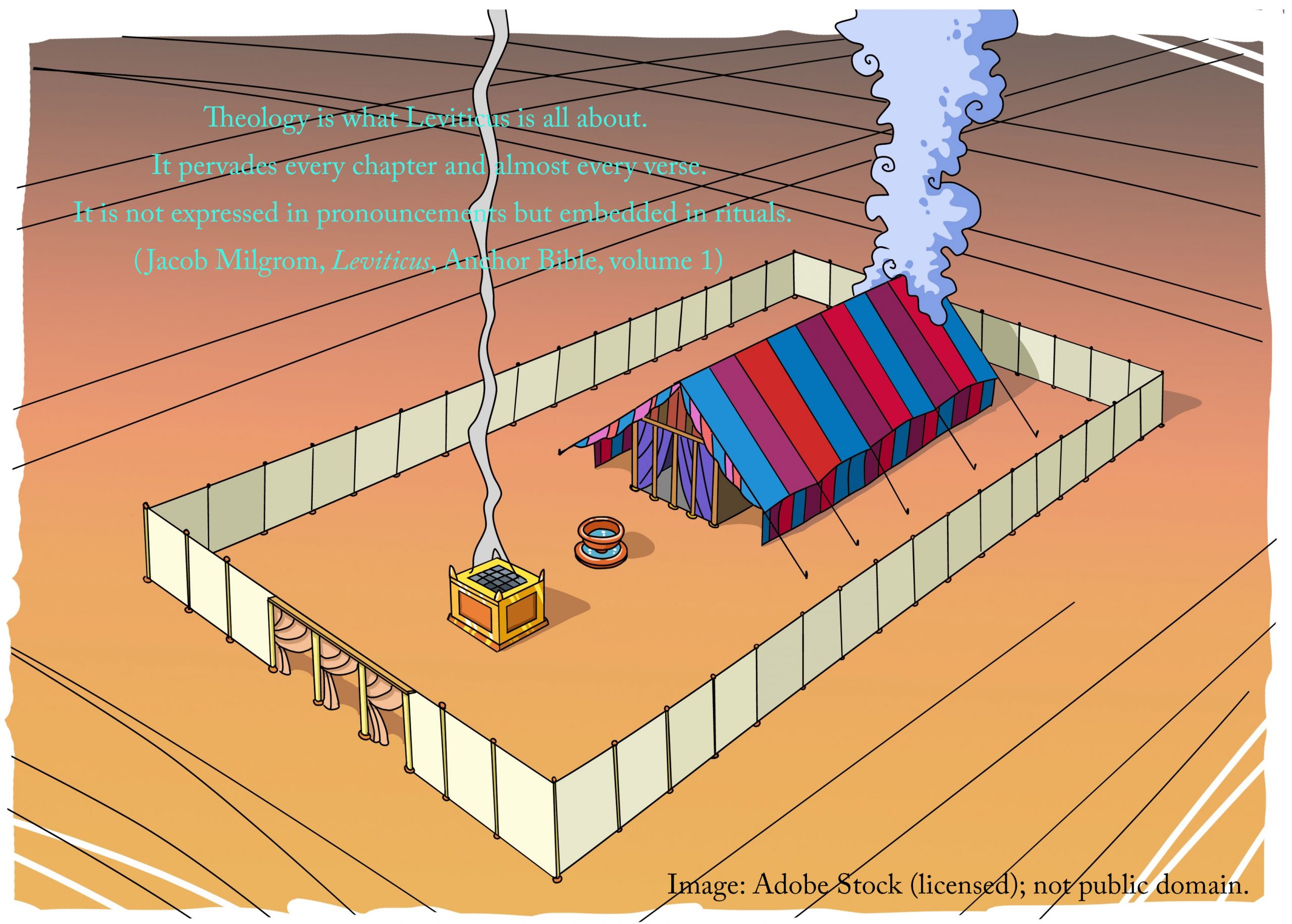
    Theology is what Leviticus is all about. It pervades every chapter and almost every verse. It is not expressed in pronouncements but embedded in rituals.

    Jacob Milgrom, Leviticus, Vol. 1, Anchor Bible. (New York: Doubleday, 1991), 42. (Link is to my review.)

    One of the key lessons I learned in that book is that ritual matters. The way we worship both reflects and creates theology. When we go to church and listen to one person from the front do all the talking, that has an impact on how we see the Christian life, learning, discipleship.

    I recall that I was once asked to speak at a church where, unknown to me, people felt they could delegate that task of prayer to the prayer warriors. The pastor who invited me knew I’d say something different.

    I would like to say something similar about study to the church as a whole: You can’t leave your study to pastors or scholars. You need to get involved.

    Bottom line here is that our ritual matters in many ways.

    I asked a question in a previous post:

    If God showed up on Sunday morning, would God enjoy what was going on?

    Henry’s Threads, “A Morbid and Boring Christianity

    I think it’s a good question. In terms of Leviticus, would it be a “pleasing odor?”

    What’s God Really Like?

    Inspiration in the Production of Scripture

    The other element is my change was my view of inspiration. There is a single element that is critical. I came to regard the process of inspiration and transmission of scripture as a critical element in our understanding. I see scripture as a compendium of the experience of people with God. It is important to recognize both the divine and human element.

    Out of that divine-human story, I see God working with people through scripture. In Leviticus, we see God as educator. Yes, we see the human report of what happened. I’m not trying here to debate details on how human and how divine scripture is; in fact, I think that’s the wrong question. What we’re looking for is the process behind what we have. We want to see God in action.

    Is that perhaps arrogant? I don’t believe so. I believe God has left God’s imprint all over creation, and very much in the way in which God’s chosen people were developed and prepared. Looking at this process is even more critical than connecting dots between specific scriptures.

    Things I Won’t Be Doing

    In focusing on the way ritual expresses theology and develops worshipers, there are two things I will not be emphasizing.

    First, I will not be looking for the minor ties between specific scripture prophecies and New Testament events. While I accept predictive prophecy in principle, in practice I find that the detailed interpretation of a prediction/fulfillment is rarely necessary to learn the lessons expressed.

    Second, I will not be doing a detailed symbolic connection between elements of the ritual. Those sorts of things (and the resulting debates) are available elsewhere.

    I will be focusing on the expression of theology through ritual and the relationship of that ritual to forming God’s people. I hope to learn something about discipleship and instruction/nurture through this book.

    (Featured image credit: Adobe Stock #158382143. Licensed, not public domain.)

  • What Does It Mean to Call Jesus Lord

    What Does It Mean to Call Jesus Lord

    A commentator noted that I was not all that helpful in my post yesterday, since I hadn’t made any effort to say just what it would mean to have Jesus as the center of a doctrine, nor what it means to call Jesus Lord. In response, I obviously had to create a new, more ambitious title!

    As a first note, in moving forward, I think it would be helpful to read an earlier post that I wrote about community: Philippians 2:1-11, Romans 12, and the Nature of Christian Community. The question this raises goes beyond what was asked to look at just why we care.

    In other words, let’s say I find a doctrine “not Christian.” What does that mean for my actions? For the most part, it makes a difference largely to whether I keep it in my personal theology. In dealing with others, the question is one of what we should debate.

    As an example, I am quite willing to discuss creation and evolution as a matter of Christian doctrine. What do we believe about God as creator that is an essential part of our Christian theology? Here I would distinguish something that might make that doctrine not Christian at all, as in a believe in a creator other than God. This might take some mind twisting work with definitions to accomplish, since the word “God” tends to follow the concept “creator” around in dialog, but something that drastic would result in me saying, “That’s not a Christian doctrine.”

    Let me note carefully that I would not be saying the person holding it was not a good person. That’s a whole other discussion tied up with quite different theological questions.

    What is more likely is that I will identify differences as not relevant to whether the doctrine is Christian or not. In the case of creation, while the issue of whether there was a real Adam is significant (though often solved in various ways), the issue of the length of a Genesis day, or whether the length is even relevant, is not. I can still believe in Jesus while not believing in 24 hour days.

    This doesn’t mean that there cannot be debates about which view of the details is correct. It simply puts those issues on a lower level.

    To get past this point and use “Jesus is Lord” as a testing point for an application of doctrine requires a great deal more thinking. I’m not going to provide any of my own answers to this today, but I will simply warn you of this: You are unlikely to be satisfied, at least if you like simple and clear answers that let you classify worship experiences and activities as “of the Holy Spirit” or “not of the Holy Spirit.” Part of my view of what “Jesus is Lord” means tends to deny such simple answers. I’ll discuss that in a future post.

    The reason I referenced my article on community is this: I believe the church is to be a community, and so one way of phrasing the test would be: Does this tend to build community, and is it the right kind of community?

    This past Tuesday night we ended up discussing this same issue, referring back to Isaiah 42:6:

    I, YHWH, have called you in righteousness.
    I have taken you by the hand and kept you.
    I have placed you as a covenant to people,
    a light to the nations.

    Now this was written to the Jews when they were in exile in Babylon, and was part of promising their return. I believe, however, that it says something about how God works in general. God blesses, not so that the person(s) blessed can be special, but rather so that they can be a blessing. The blessing is not meant to stop here, wherever “here” may be.

    Christians often think this is a New Testament concept, but it is very old. You can find it in Genesis 12:2, said to Abraham. The New Testament is remarkable in its lack of newness. This is an established way in which God works.

    So this points to the type of community the church is to be. We form and strengthen community so that we can bless those who are outside. We are not the community of those who are more right, or more in favor with God, or better behaved. We are a community of God’s grace, and we’re not even special as recipients of God’s grace, we are rather sharers of God’s grace. If you want to be special, superior to others, God’s kingdom is likely not your best place.

    I will expand on this later in a future post. Right now, let me simply say that announcing that “Jesus is Lord,” so that you can immediately afterward gloat about your superiority to someone else, you likely have not truly proclaimed Jesus as truly Lord.

  • Evaluating Doctrines regarding the Holy Spirit (Pneumatology)

    Evaluating Doctrines regarding the Holy Spirit (Pneumatology)

    I have encountered a few questions lately regarding the work of the Holy Spirit, particularly the manifestation(s) and gifts of the Holy Spirit as they may be observed in a church setting. There is always a problem with evaluating theology based on the visible actions of God, because this gets confused with identifying God’s actions. This latter is difficult to accomplish.

    My aim in this post is to point to the way in which I look at any Christian doctrine, using as examples the manifestation (note singular) and gifts of the Holy Spirit. By my use of those expressions I point you to 1 Corinthians 12-14, where those are used in verses 4 & 7 of chapter 12.

    (I have a prior series on 1 Corinthians 12-14, which includes 1 Corinthians 12-14, 1 Corinthians 12-14 Greek Terms, 1 Corinthians 12, 1 Corinthians 13, and 1 Corinthians 14.)

    What I frequently hear done is that one identifies what the gifts of the Spirit are by looking at the list in 1 Corinthians 12, sometimes combining this with lists in Romans 12 and Ephesians 4, and thus identifying whether a gift is “of God,” that is, has its source in God’s action, by whether it occurs in the list. Should one use a gift that is not in the list, that gift is seen as suspect.

    I find that process suspect, because I do not believe that Paul is attempting to teach the Corinthians about the gifts of the Spirit here. Rather, Paul is teaching them about true spirituality, and is using the gifts as an illustration. I imagine that the Corinthians would have agreed with the list of spiritual gifts he gives, and thus he can use it to illustrate the real way to test.

    He gives that real way in 12:3, which can be boiled down to the assertion that Jesus is Lord. That is the key assertion. How that works is detailed in verses 4-11, with 11 being the wrap-up. It is one Spirit, that acts in the church under the church’s one Lord.

    We depart from this test at our peril in the church, and it is the test that Paul puts up front. He doesn’t say, “Check out whether the person is speaking in tongues,” or “Check out whether they can prophesy,” or even “Look at whether they have some gifts of administration.” Rather, he emphasizes that all of those come from one Lord.

    I am not a theologian by profession, though many will point out that a Christian is always a theologian in a certain sense. Having the opportunity of reading and studying under some quite gifted theologians, however, I don’t want anyone to think I’m claiming to be one them.

    I found this view repeatedly stated by one of the authors I publish, Edward W. H. Vick. To summarize his various statements, just one of which I will quote below, the way you determine if a doctrine is Christian is by asking whether it is centered in Jesus Christ. He makes this note in his book Eschatology: A Participatory Study Guide, in From Inspiration to Understanding: Reading the Bible Seriously and Faithfully, and Creation: The Christian Doctrine.

    I quote the latter here:

    The essential Christian conviction is that God moved toward man and made his decisive revelation in Jesus Christ, that what is known of God is known in Jesus Christ, that in Jesus Christ we have the clue to the meaning of reality, not this or that part of reality only (although this as well), but to reality as such. This means that the Christian must attempt to see every aspect of reality in the light of God’s revelation in Jesus Christ. We emphasize: the starting‑point, the sine qua non of Christian theology is belief in Jesus Christ. Belief in Jesus Christ is evoked by God’s revelation in Jesus Christ. That is given. Once present it is never questioned. The faith in Jesus Christ that is a result of God’s revealing activity in Him provides the theologian with the starting point. All Christian doctrine, works from this starting-point, A Christian doctrine of creation must start here. No scientific research or discovery can touch this basic religious conviction or its theological expression. It is a method of interpreting the world and an explanation of the very existence of the world. It is an explanation of the world that says basically that the world is dependent on a reality that may not be known by an examination of the world alone.

    Edward W. H. Vick, Creation: The Christian Doctrine, (Gonzalez, FL: Energion Publications, 2013), 104-105.

    You can have numbers everywhere and plenty of scriptures and calculations to back them up, but if the center of your eschatology is not Jesus, the Christ, it is not Christian. It may be partially, even mostly, based on scripture, but it will remain outside Christian doctrine. Similarly, you can know ever so much about creation, whatever your view on the details is, but if you do not find Christ in creation, your doctrine of creation is not a Christian doctrine.

    Finally, and perhaps most importantly, you can know ever so much about scripture, but if Christ is not at the center of your interpretation, it is not Christian. Note here that I do not mean that non-Christians cannot interpret scripture, nor that Christians should not do historical interpretation using sound, scientific methodologies. I’m speaking of the scriptural interpretation that nurtures and builds (edifies, to use the term from 1 Corinthians 14) our faith and our community.

    I use this principle in two ways. First, as you have seen, I define (having learned from Dr. Vick), a doctrine as Christian based on whether it is centered in Jesus Christ. Multiple tie-downs to various scriptures, appeals to experience, or a variety of other options do not make a Christian doctrine.

    Second, however, I use this to help me define the essentials. When looking at doctrinal disagreements, I ask how those disagreements impact the view that Jesus has come in the flesh (1 John 4:2-3) and that Jesus is Lord. This is not a clean checklist, because not everything has an equal impact. I’m usually willing to trust the expressed intent of the person who holds the doctrine.

    I believe it is important to know the difference between essentials and non-essentials in order to prevent ourselves from becoming narrow and judgmental. Romans 12-14 covers much of this ground, and it is often quoted out of context on both sides of the divide: the importance of right doctrine, and the importance of some flexibility and of letting the Lord lead.

    This leads me to the way in which I evaluate either gifts attributed to the Spirit or manifestations attributed to the Spirit.

    First, the manifestation of the Spirit comes in many ways, one of which is the availability of the gifts of the spirit. The spirit is also made manifest through the fruit of the Spirit (Galatians 5:22-24). Most importantly, the gifts are made manifest directly in calling forth the confession that Jesus is Lord (1 Corinthians 12:3).

    Second, does the expression of any doctrine of the Spirit center on Jesus Christ, in other words, is the doctrine itself a specific expression of the broader statement that Jesus is Lord?

    Third, as Paul expresses himself in the rest of 12 and then reinforces and expands in chapters 13 and 14, is the expression of the doctrine or the manifestation of the Spirit something that builds the body of Christ? (The term we’re used to in chapter 14 is “edify,” which is fine, provided you really hear it!)

    The love chapter, 13, is often treated separately from 12 & 14, but Paul is here giving us a key to the way in which we identify gifts. For example, are people claiming superiority over others because of the gifts of the Spirit? That is not manifesting the love of Christ, nor is it building the body of Christ. It is therefore hardly an expression of the statement that Jesus is Lord.

    Tomorrow (hopefully I will make time!), I will discuss the idea of manifestations a bit more, but this is going to be the foundation of everything. I think one of our human problems is equating “things that make us comfortable” with “things that build the body.” Those may not be the same thing.

    So we’ll discuss!

  • Of Isaiah 40 and Grasshoppers

    Of Isaiah 40 and Grasshoppers

    Last night in our Tuesday night group we discussed this rather interesting chapter, one that I believe expresses the basics of the gospel message well.

    Now I don’t mean by this that it mentions the name of Jesus or even directly predicts anything about his ministry. There is some material here that is used of John the Baptist and Jesus, but that is another subject. What I mean is the basic principles. I will express these as: We can’t, God can, God does.

    There are those who find the whole depravity thing in Christian theology somewhat morbid. But there’s a really simple point, and one I think is obvious once you see it. We really can’t!

    Once we accept the fundamental idea of God as creator at all, we accept total dependence and our inherent smallness. As Isaiah calls us, grasshoppers. God looks down from the circle of the earth and the inhabitants (that’s us) are as grasshoppers.

    If we think about it for a moment, not only can we not do good without God, we can’t do anything at all. We can’t exist. We are, before our creator, nothing at all.

    And yet!

    And yet, God is coming to God’s people. God cares, in great detail.

    Here is the Lord GOD; he is coming in might,
    coming to rule with powerful arm.
    His reward is with him,
    his recompense before him.
    Like a shepherd he will tend his flock
    and with his arm keep them together;
    he will carry the lambs in his bosom
    and lead the ewes to water.

    (Isaish 40:10-11, REB)

    God’s greatness is not something that should make us miserable. Face it, we have looked at the universe and it is incomprehensibly large. We are small. Yet we are significant. If God is the creator, as we believe, then God is incomprehensibly large, and we don’t really have anything to offer.

    And yet!

    When I consider your heavens
    the work of your fingers
    the moon and the stars
    which you have put in place,

    What is a human being
    that you take notice?
    A mortal that you seek him out?

    Yet you have made him a little lower than God,
    with glory and honor you have crowned him.
    You have made him rule over what your hands have made.
    You have put everything under his authority.

    Psalm 8:4-7 (my translation)

    Isaiah 40 tells us that while we can’t, God can, and God will.

  • A Different View on Hezekiah

    A Different View on Hezekiah

    I will now do on my blog what I did last night for my Tuesday night group. Contradict my previous post. Here’s the idea in a Monty Python sketch:

    Watch to the end. I dare you!

    What I did was quote a scholar whom I respect, and in fact who has been my companion through much of my study of the book of Isaiah, Brevard Childs.

    For my part, I am unconvinced that these explanations help in understanding the judgment [the exile-HN]. The very fact that the narrator of the chapter is unwilling to proceed in these directions should check the need for supplying reason. The writer’s emphasis rather falls on establishing a link from one event to another. The judgment that was shortly to occur was not by accident of even directly evoked by the king’s misdeed, but unfolded according to to a divine plan. This theme clearly emerges in the response of Hezekiah to the prophet. Ackroyd (“An Interpretation of the Babylonian Exile,” Studies, 157ff.) has mounted a persuasive case against interpreting it as a smug response that the judgment will not personally affect him. Rather, it is an acceptance of the divine will in which Isaiah’s form of the response (39:8) emphasizes the certainty of divine blessing at least in his lifetime.

    Brevard Childs, Isaiah, Old Testament Library, (Louisville, KY: Westminster-John Knox Press, 2001), p. 287.

    For my part, I am unconvinced that the normal sparseness of Hebrew narrative is an indication of a lack of moral commentary. I admit that I may read this too much in the context of 2 Kings, but I think the Isaiah context supports this adequately. But Brevard Childs is a really excellent commentator.