Nearly 20 years ago a waitress at a well-known breakfast chain messed up my order for hash browns by adding diced ham.
If you don’t find anything odd about that sentence, you are, perhaps, a candidate for counseling. But I digress.
I had wanted jalapeños, onions, mushrooms, and cheese. I got all of those. Plus ham.
As a vegetarian, I don’t eat ham. The waitress was very nice and got me a new order with what I wanted, but for years (yes, years) thereafter, I was known to remind the staff at that particular chain that I did not want any meat in my hash browns. None at all.
I was reminded of this last night when I asked Jody if she had done a certain thing, something that we had both forgotten a couple of months ago, but that I didn’t want forgotten again. She said she supposed she’d have to wear forgetting this one monthly task once for some time, considering how long it took me to forget about the ham in my hash browns. Well, I obviously haven’t actually forgotten it. I have quit mentioning it. One step at a time, you know!
I was reminded of it again this morning as I read Numbers 32. The story takes place after the Israelites have defeated a variety of enemies on the east bank of the Jordan River, and are preparing to cross into the promised land. The leaders of the tribes of Reuben and Gad really like the territory that has been conquered as it is good for their flocks, so they come to Moses and Eleazar and ask for this land rather than a share of the land across the Jordan. Moses is angry with them and reminds them of something that had happened nearly 40 years before. He calls them a brood of sinners. It’s really not a very pleasant conversation.
[ncs_ad pid=’9780842334280′ float=’right’ adtype=’aer.io’]They reply that they will certainly help their fellow-Israelites conquer the land, but that they like this land just fine. Eventually with that agreement, Moses agrees to grant them the land (somehow the half tribe of Manasseh gets in the mix toward the end), and we get an explanation of what cities they built and what territory each took.
In reading about this, I note that commentators try to decide whether the final decision was a positive one or not. Was it a good idea to let these two and a half tribes settle east of the Jordan? I don’t know of any way to determine the answer. I suspect that there would have been problems either way. But when interpreting stories one thing to remember is that some things in a story, even in a fictional one, happen because they happen. I think it is a mistake to always try to find a moral in a story, even a Bible story. Some things just happened that way, and there is not great moral in it.
Despite the fact that I’m unable to decide one way or another on the value of having some of the Israelites settle to the east of the river, I do see some potential questions, and perhaps resulting lessons in the story. One might be that there is no reference in this chapter to seeking the will of the Lord. It’s entirely a human decision. Given the frequency with which Moses consults with the Lord before taking action, is it possible that the writer here is trying to make a point?
But one of the values in stories is that they can connect to different aspects of our lives, and today Moses’s response connected for me. Here come these poor tribal elders, much younger than Moses, one of the few survivors from those who left Egypt as adults, and they are coming to one who is now a revered leader. I suspect there was a bit of fear and trembling going on. They ask what seems to be a simple question: Could we have this territory?
Now consider. The territory has been conquered. It’s going to go to someone. All the tribes are going to get some land. It might be a good idea to occupy the territory, in fact. On the surface, there is nothing wrong with their request. It’s perfectly reasonable. They don’t even say they won’t help with the conquest of the promised land. They just haven’t mentioned it.
The CBC commentary I’m reading right now calls the solution involving them joining the other tribes in the conquest while leaving their wives and children in fortified settlements a compromise. But I see no delay and discussion. It looks to me as though they already had that ready, but hadn’t managed to roll it out.
Moses reacts. Forty years ago other Israelites did this, and it’s right at the top of his mind. He remembers those people and those lessons, and he’s not about to let anyone forget the lesson.
About 40 years before some other people had sinned. In fact, their actions were only similar in a superficial way, but Moses had learned the lesson well. Perhaps too well. Someone could put ham in his hash browns once, but never again! He calls them a brood of sinners while reminding them of past failings.
It may seem that I’m being a bit disrespectful in my treatment of Moses, a man who spoke to God face-to-face. But if there’s anything we learn from the broader story of scripture it’s that every human being has weaknesses. Scripture is not afraid to take note of those weaknesses. Now Moses becomes a special case. I was working through Hebrews 3:1-6 this morning as well, and the argument that Jesus is greater than Moses. That argument must be made because of the great respect we grant Moses as Christians.
The thing is that having learned his lesson, he applied it where it didn’t really apply. The continuing discussion makes it clear that these elders are not opposed to conquering Canaan, nor do they want to shirk their responsibilities. They’re simply proposing a plan for making good use of this land.
Moses, to his credit, calms down, considers the situation, and they all agree to a plan. It’s a reasonable ending to a story.
But for me, it’s a reminder that sometimes we do need to forget the faults and failings of others. Our own as well! And we don’t need to fit everyone into the narrative of past failures. The failure Moses remembers was real and it was important. It was a failure that did not need to be repeated. But Moses misapplied it to these elders.
Brood of sinners? No, just looking for a good place to care for their flocks.
[ncs_ad pid=’0664239013′ float=’right’ adtype=’aer.io’]As I’m reading through another commentary on Hebrews (Luke Timothy Johnson, Hebrews, New Testament Library), I can’t help but write a few notes. One might get the idea from a couple of my recent posts that I find a great deal to argue with in this commentary. Actually, it’s one of the best I’ve found. Johnson is both clear in his exegetical notes and challenging in his theological reflections. Of recent commentaries I find David Allen (Hebrews: An Exegetical and Theological Exposition, New American Commentary) more helpful on exegetical details, with his great summaries of the various positions and evidence for them, but I am finding Johnson more helpful thematically.
The prologue to Hebrews is critical. Unlike many of the Pauline epistles (though I don’t exclude Pauline authorship), this isn’t the introduction to a letter. Rather, it’s a launching pad for the theological discussion. In the train analogy I used yesterday, it’s a large signpost telling you what train you’re supposed to get on and why. I would add a quick note that the structure clearly makes Hebrews 1:1-4 a unit, not Hebrews 1:1-3. The argument is picked up with the first supporting scripture in verse 5.
[ncs_ad pid=’0805401350′ float=’right’ adtype=’aer.io’]It’s important in any book of the Bible, but especially in Hebrews, to look at how a thought is carried forward and concluded before determining for certain the meaning of a specific proposition. One claim regarding Hebrews is that it teaches supersessionism, a claim I find more often in superficial studies of the book than in serious commentaries.
There’s a good reason for this. In reading the prologue quickly, you might get the idea that the argument is that Jesus is good, and the partial, earlier revelation is bad. As you read through the book you can find passages such as Hebrews 8:13 you have explicit statements that have led some to such a conclusion. But in 8:13, the author is referencing a specific passage of Hebrew scripture and founding his argument in the thing that is made “old.”
The image that comes to my mind is of a house being built. In working on some software for a home designer, I toured a building site. There we saw the frame of a house. It was not finished. I could see where the nails, braces, tie-down straps, and so forth were. Later, siding would be added and many other elements that would finish the house. The old, the framework, would be put out of site, but not eliminated. It wasn’t that the framework was bad. In fact, our whole purpose was to make sure the framework was good, and ready for hurricane force winds. But to live in the house, to consider the house complete, more was needed.
(Nestle, E., Nestle, E., Aland, B., Aland, K., Karavidopoulos, J., Martini, C. M., & Metzger, B. M. (1993). The Greek New Testament (27th ed., Heb 8:13). Stuttgart: Deutsche Bibelgesellschaft. Accessed from Logos Bible Software.)
In saying “new” he makes the first old. That which is being declared old and is aging is close to disappearing.
Yes, the old is being declared (or made, but I prefer “declared”) to be what it is. It’s going to disappear. But the author’s argument here is built on precisely that “old” revelation. We’re about to finish out that house, put on the frame and the trimmings and call it complete. The revelation of God in Jesus Christ truly brings God and man together, a theme that we’ll revisit in discussion the priesthood and why Jesus is considered the great high priest.
So while in the prologue the author argues that Jesus is much superior to that which occurred at many times and in various ways, as he proceeds he builds his argument on the scattered revelation which is being “superseded.” Those older revelations still have their value, but for the Christian, all is seen through the ultimate revelation in the person of Jesus Christ. God has spoken to us through “a son,” which, absent the definite article in Greek emphasizes the nature. Through the prophets, but through a son. I tell my Sunday School classes that this involves putting on our “Jesus-colored glasses.”
While individual statements may seem to support an idea of supersession, the fact that the author builds his argument, an argument made after the resurrection, on those same supposedly superseded passages means that we need to look closer. He is telling us to change our focus, to look at the greatest revelation and to see other revelation through it.
Despite my somewhat snippy comments in my last post, I found reading Luke Timothy Johnson’s introduction to Hebrews in his volume in the New Testament Library (pictured at left) quite helpful. In particular, he looks at reasons why modern people may have a hard time reading and understanding this book. Along the way, it becomes clear that some of the same points may have made it difficult for people in past centuries as well! One of his points is one I frequently emphasize: our lack of understanding of sacrifice in the ancient world and particularly in Israel.
But to take his points in order:
It challenges the value of the historical-critical method. I would note both that this is true also of many other books, especially in the Hebrews scriptures. Historical methodologies need to be practiced with a certain humility and willingness to admit ignorance. On the other hand, if we are going to view a piece of literature as having an historical setting, we must look for the setting to whatever extent we can determine it. Which, in fact, Johnson proceeds to do. I prefer “historical-critical methodologies” (emphasizing the plural), because while I think that the critical approaches have opened up some avenues, they do not stand alone, the do not stand or fall as a body, and one can derive value from them even while doubting the basis on which some were created.
We have no understanding of sacrifice (as noted above). I have two notes, even though I agree. First, this is not just a problem for understanding Hebrews, but also for understanding the entire New Testament. A failure to understand the sacrificial system will result in a superficial understanding of New Testament allusions to it, at best. Hebrews is just a concentrated example of the problem. Second, however, I think many who would claim to understand sacrifice narrow it by looking back from the New Testament to the Old. They see sacrifice as being purely about atonement and thus fail to see the broad spectrum of theology that underlies the various sacrifices. Just last night I was reading Numbers 28 & 29 and was struck again by the variety of sacrifices. The original readers of Hebrews, I suspect, had a view of sacrifice that couldn’t be covered in a paragraph or so.
It “… challenges our construction of the world, our image of Jesus, and our understanding of discipleship …” I’m afraid I had to do some chopping to get a short quote, but I also believe I’m faithful to Dr. Johnson’s intent in that paragraph. This is also a good point. Hebrews is very theological, but at the same time as it challenges our view of Jesus and salvation, it also calls to action and does so in a very severe way. My own impression is that we have misread this a bit, but nothing I see diminishes the level of the call. Along with the call is also a message of grace, that the means of answering the call is now available.
My own theological has been formed as I started with Ezekiel, moved back from there into Leviticus and the Torah in general, and forward to Ezekiel. I frequently see the author of Hebrews bringing in big ideas by alluding to passages with which his audience would be familiar. Unfortunately, we are not.
So I would add a fourth point: Our serious lack of knowledge of the Hebrew scriptures, and particularly Torah, means that we have a hard time understanding Hebrews. We don’t have the right questions, so we don’t recognize when the answers appear before us!
I’m reading through Luke Timothy Johnson’s commentary in the New Testament Library and have just completed the introduction. I have a couple of thoughts today, not least of which is to note the problem with writing introductions.
For a reader to truly follow an introduction, it would best come after the commentary and some serious time reading the book, but (catch-22), the commentary is best understood in light of the introduction. For me this has often involved reading the introduction, then the commentary, and then reading the introduction again as a sort of conclusion.
But often the introductory material is still quite illusive, if not illusory, and the author is left to construct the sort of fantasy realm in which the study will take place. This isn’t a particular criticism of Johnson, who is an excellent writer and makes some quite profound points about Hebrews and Bible study in general in the course of his introduction. His arguments on the dating of the book (45-68 CE) are interesting but not conclusive and he admits as much.
On authorship he expresses the strong conviction that it is right that modern scholarship has abandoned the idea of Pauline authorship of the book. He gives us notice that this is coming a couple of times earlier in the introduction. And he provides a quite good set of reasons for why he believes this to be the case, though I cannot read references to Origen and “God only knows” with the same confidence after seeing Dave Black’s discussion of it in The Authorship of Hebrews (full disclosure: I’m the publisher).
Then he begins to make his case for his own candidate as author, Apollos. Here he provides affirmation of my rule of biblical introduction: Authors are much better at critiquing the proposals of others than they are at establishing their own. I can’t quite say that there is no evidence whatsoever to support Apollos as author, but someone proposing Apollos should restrain himself from critiquing too vigorously the proposal of Priscilla as author (Johnson lays into it, admittedly with quite good arguments).
The line I like regarding Priscilla is: “… the fact that everything supporting her candidacy would apply equally to her male partner, Aquila.” Just so. And further, pretty much every argument advanced in favor of Apollos would apply to any Greek speaking Jew who met Paul at some point. Some may object that Apollos was considered a good orator, and there is the elevated language of Hebrews, but if such an argument were advanced about a modern book (the book is well written, and so-and-so is a good writer), it would be laughable.
I can, of course, leave the laughing to others more qualified than I, and there are plenty who will take up the cause. The fact is, that if you abandon Paul, you pretty much need to abandon naming the author. There is so little known about the candidates. Other than Luke, we lack any written material from them which can be used to compare to the text of Hebrews, and their biographies are so short that one can make up whatever story one wants.
But such is the hardship of writing an introduction. How many paragraphs does it take to say “I don’t know”?
Tonight I’ll be bridging the gap between these two very commonly associated books and doing a look-ahead to my several week study of Revelation. This study will conclude my series on Eschatology.
Amongst the small but diligent group that watches these, are there suggestions for continuation? I will doubtless keep talking, even if the audience is small!
In Hebrews 2:1-4 I believe the author of Hebrews provides a basic apologetic outline, and I think it’s a very useful one to follow. After the first two verses, which start from a platform that was already accepted by the audience, the author emphasizes the importance of the decision. If he is right in what he says, the decision is critical in an eternal sense. The elements are these: 1) It was delivered by the Lord, 2) Affirmed by the testimony of those who witnessed, 3) Given divine witness through (a) signs and wonders and (b) the gift of the Holy Spirit.
Looking first from the viewpoint of process, this argument, and indeed the general argument of Hebrews, is based on ground that will be accepted by his audience. They believed that the Torah was firmly established, and many, at least, believed that it was delivered by angels. Throughout the book, we have this focus on sourcing material from the Hebrew scriptures. Those who argue a simple supersession should pay attention to the form of the argument. At the same time as the author argues that Jesus is greater than, he also argues that the revelation in existing scripture is great and should be honored. Too often we fail to found what we have to say on what we already hold in common, when that can be supported.
The first element of his argument has two parts, the words spoken by Jesus, and the affirmation of those words by witnesses. For someone who tends fideistic like myself, this is a bit of a rebuke. It’s not that I don’t believe that Jesus spoke, or that there were those who heard. I’m even optimistic that we can get a picture of Jesus from the gospel record. But I tend to ignore that part of the argument and go straight to the experiential second part. This argument says that the faith is founded on historical realities, and that this is worthy of our attention.
The second element of his argument again consists of two parts, the signs and wonders that follow the gospel, and the gift of the Holy Spirit, delivered as God wills. I’m of course more comfortable here, as my experience (in particular) has much to do with experience (in general).
I was reading this from The Learning Bible (CEV) this morning, and saw that their note refers these signs and wonders (semeiois kai terasin) refer to past events (from the viewpoint of the readers), such as the exodus from Egypt. I would disagree. That is an element either of the first part, or more properly of the commonly accepted foundation of the Hebrew scriptures. Rather, this is the miraculous events/signs that followed the apostles as we read in the book of Acts, for example. It was by acting on behalf of his apostles that God affirmed their witness of Jesus, both in terms of the truth of the stories they told, and in terms of its continued relevance to those who heard.
The second part is the gift of the Holy Spirit, which is, I believe, the life of the church. We can see how critical this is in 1 Corinthians 12-14, for example, and I see this as a loose, but nonetheless real point of connection with Pauline theology.
It’s this last point that I think is the most important in the church today. I believe all these elements should be part of our apologetic, yet having a faith that truly takes hold of hope and makes it possible for one to live differently is, I think, the most important element, and is also the key point of Hebrews. If the church does not show evidence of the gift of the Holy Spirit I think that all the other elements will tend to fail. It is sort of like one builds a machine to accomplish a particular task, explains the science behind it, then the technology that goes into producing the device, and then finally applies the power. But the machine doesn’t accomplish the task.
By “evidence of the Holy Spirit” I don’t mean speaking in tongues, as many in the pentecostal movement believe, but rather in terms of bringing people together and empowering new life in the one God has anointed forever. As Paul points out in 1 Corinthians 14, we can do without speaking in tongues; it doesn’t build the church. But we can’t do without building.
For those who hold to the historicity of the story of Daniel and generally to an early dating, Daniel 1:1 is a critical text that presents some problems. As I proceed with my eschatology series, and starting going through the book of Daniel verse by verse, I’m trying to keep all the options in mind and explore interpretation based on the different views.
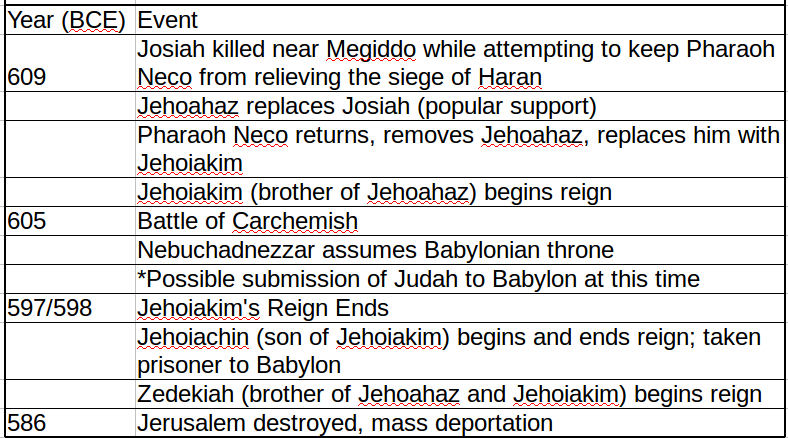
As I talked about this last night (February 4, 2016; video embedded at end of post), I thought I was being confusing, and at one point said “Nebuchadnezaar” when I should have said “Pharaoh Neco.” I want to clarify the people and dates and how they apply to the text in question.
First, here is a chart of the most critical dates. Note that you will find reference sources that differ on these dates by a year. It is beyond this post to discuss the different calendars and accession year vs non-accession year dating. The sequences involved are adequately handled by the dates I’m using.
Click to view full size
Biblical sources for this time period may be found in 2 Kings 23:29 – 25:30 and 2 Chronicles 35:20 – 36:23.
Now for Daniel 1:1, my translation:
In the third year of the reign of Jehoiakim, King of Juday, Nebuchadnezzar King of Babylon came to Jerusalem and put it under siege.
Here is a list of the problems:
Unless it is described in 2 Kings 24:1, which seems more likely to describe the events of 598/597 BCE, there is no siege and exile set for 605. It is nonetheless possible that there was one, as the Babylonians became dominant over the territory after winning the battle of Carchemish in 605. There might have been a small exile at that time. Even if 2 Kings 24:1 describes later events, Jehoiakim would have to first submit to Babylon before he could rebel. He was put in power by Pharaoh Neco.
Nebuchadnezzar, as “King of Babylon” could not attack Jerusalem in 605, as he was not yet king of Babylon, but rather became king in that year.
Even if there was a small set of exiles, or perhaps hostages, taken in 605, it doesn’t fulfill the description of the siege.
The question here is how you evaluate the evidence. One critical element would be one’s determination on other grounds that the Book of Daniel is or is not historical. As an historian one would look for the most probable reconstruction of the evidence. Most scholars tend to support the later dating, even evangelicals, but you can find other arguments regarding dating via my Dating of Daniel Resources page.
I’ll discuss dating and historicity further in my series, but for now I think this will clarify the issues discussed in the video.
I ran across this while looking for something else. Dr. Alden Thompson was the author of the first book sold by Energion Publications, though it was published before I bought and renamed the company. We’ve now published a 5th edition, and this is overall our best selling book.
In this presentation Alden using a number of Adventist specific references, but I think the message comes through. There are a variety of responses to the violence in the Old Testament. One of the keys to Alden’s approach is his insistence that it is all inspired, even the parts we don’t like very much, and he makes that claim in the video. Alden’s teaching at Walla Walla University was quite formative of my theology and I still enjoy working with him. We’ll be releasing a second edition of his book Inspiration: Hard Questions, Honest Answers later this year, as the publisher of the first edition allowed it to go out of print.
Jody and I are teaching Sunday School tomorrow, and the starting point is the Adult Bible Studies Uniform Series, Winter 2015-2016. Thus we start the Advent season by studying the 4th commandment (the Sabbath command; some count these differently) and related texts. If you know me, you’ll probably know that I’m not a fan of the Adult Bible Studies series. In fact, I’m not really that much of a fan of Sunday School curriculum. The problem I have with it is not bad content, but rather homogenized content, as the series is edited to be used in many contexts. It’s a hazard of producing material that can be used generally.
If I could have my own way, I’d strongly suggest that such material only be used at the starting level, and that more challenging material follow, eventually leading to Sunday School classes going straight to sources and bringing in a variety of views. But they should bring this variety in through studying serious examples of material from various streams, not by watering down the material.
That said, I also want to emphasize that I’m not trying to critique the author of these lessons. In fact, I’ve added his book The Bible’s Foundation: An Introduction to the Pentateuch to my planned reading list. I’m not trying to critique the editors either. It’s simply that when something is written for this broad of an audience, the edges get knocked off before it’s finished, and I think the people in our pews can benefit from experiencing those edges. It was the misfortune of this lesson to sand down (in my view) one of the edges that I think very important.
Note to those who like short posts: This won’t be short. I’m planning to refer my Sunday School class to it if they want more. For the same reason I won’t be quoting much from the lesson, because I expect the primary readers to be people who are holding this lesson in their hands.
First, I’m going to look at the topic and where I see difficulties. Then I’m going to follow up with some of my own take on that material. I will also talk about the issue of space. Priorities are always hard to work out when you have limited space in which to express your view. I’m also writing against that constraint.
Two passages take pride of place in the discussion, both from Exodus. The first is Exodus 20:8-11, the Sabbath command itself, and how that might work out in modern times. In this discussion we go from the Sabbath command itself, which specifies that no work is to be performed on the seventh day of the week, and roots this in the creation account (“in six days YHWH God made heaven and earth”). This passage brings discomfort in a couple of different ways, as generally mainline Christians worship on Sunday (if they show up at all), and do not believe in a literal six day creation week.
In addressing the second point, the lesson gives us one of the best parts of the lesson, noting that the story in Genesis 1, and rooting the Sabbath in creation in the commandment as well, is the faith assertion of the writing that the Sabbath was “embedded within the very structure of the universe” (p. 7). Then he also shows us how a single event can take more than one meaning by referring to the reiteration of this command in Deuteronomy. So this command can have multiple meanings, one more universal (creation) and one more specific to Israel (the Exodus), though considering the way the Exodus motif is drawn into Christianity in the gospels, the second is somewhat universal as well.
The one thing I would add is that if one looks at the two stories of creation in Genesis, 1:1-2:4a and 2:4bff, one can see that at least the final redactor was not all that concerned with the physical structure or chronological history of creation, but rather had theological issues in mind. Genesis 1:1-2:4a is a liturgical passage. Worship in ancient near eastern temples reflected in some ways the people’s view of cosmology, and so liturgy was (and in my view, is) to reflect reality. Genesis 1 then places the Sabbath command into the heart of the liturgy as a weekly reminder of who is in charge. It’s difficult to be certain precisely how much of that liturgy was thought by author, redactor, or early reader to reflect reality. I suspect that if our concern is science, we should be more interested in the difference in cosmology (waters below, earth, firmament, waters above) than in the chronology, as the latter is liturgical. We do not maintain that Jesus was raised precisely on the date of Easter because we celebrate at that time, and we do not hold that Jesus is somehow raised once a year every year. Similarly, we don’t maintain that the ministry of Jesus was a week-long affair because we commemorate the resurrection through gathering for worship each Sunday. These are liturgical remembrances. The Israelites were capable of designing good liturgy, and embedding God as creator in a central way laid that foundation.
Thus I don’t think that creationism, whether old or young age, really needs to come into this. I accept the theory of evolution and would have no problem with commemorating creation on a weekly basis on the seventh day of the week. I can even imagine that this liturgical role might have been in the mind of the writer of Genesis 1 at the time, though it’s entirely possible that he thought this literally happened in a literal seven day week. That bothers me no more than his cosmology does, which is not at all. God must speak to people as they are. Imagine Genesis 1 starting with an explanation of the physics of a singularity.
But having moved past that we ask how do Christians keep the Sabbath today. There are two lines drawn between a text and modern practice in this lesson. I’m pretty sure the way the lines function is pretty much by accident. But I do think this is what classes are likely to get out of the material. On page 8 we are told that for us the Sabbath has become Sunday because we celebrate the resurrection, and we carry out Sabbath-keeping by attending Sunday School and church and participating in the life of the church. This paragraph looks like a kind of direct connection. We do obey this law and we do it in this particular way.
My problem here is that while I can draw a connection between commemorating the resurrection and commemorating creation, and I think a rather good one, that connection is not made explicit. On the other hand I cannot draw a very good connection between the command to rest and give rest to your entire household and those (even animals) that depend on you and going to Sunday School and church. I can find plenty of Old Testament warrant for participating in community education and worship life, but it’s not what the Sabbath command talks about. So here we travel fairly directly down the road from Old Testament law to modern application, yet I see a chasm in the road that isn’t bridged.
Before I did deeper into how I might handle the Sabbath command, however, I want to look at the other passage, Exodus 31:12-16. which calls for the death penalty for breaking the Sabbath. The lesson draws a very different line here. Citing 1 John 4:18, we are told that “… we cannot reconcile a loving God who demands death for working on the sabbath. We cannot affirm the death penalty for sabbath violation” (p. 7). And yet, we have Leviticus 19:18 “love your neighbor” on the one hand, and the deaths of Ananias and Sapphira (Acts 5) as death penalty counter-examples. We have a canon-within-the-canon disjunction, but only by assertion.
One of the tests of a hermeneutic is to ask whether it can be applied consistently. Now I will note that I know of consistent approaches that would deal with all these texts, but they are simply not expressed. That is my key issue here, and it has been my key issue with many United Methodist materials since I first joined a UM congregation. Way too much is presented by assertion. A scholar asserts, so we assume that is what we should believe. Then another scholar asserts something different, and the more thoughtful members wonder what’s wrong. A good illustration is the long-time church member who came to me wondering how she could ever learn to study her Bible. She kept reading the study notes and couldn’t see how the text said what she was seeing. She was shocked when I said, “How do you know the people who wrote the study notes are right?”
It’s hard to show people how we got to the conclusion as well as the conclusion itself, but if I were to make a choice, it would be for us to present less conclusions and show our work. Teach the members to study by our examples, and they can go form more conclusions for themselves.
So let’s go back to these two texts. How would I approach them? Here’s the first point:
Unless you are a Jew, the letter of these two laws does not apply to you.
How do I know this? Simple. They are addressed to the children of Israel. Read the beginning of Exodus 20. Ask yourself, “Who is the audience?” You’ll get it. I’m appalled at movements to put Ten Commandments monuments on courthouse lawns. The tables are very much an expression of the letter, especially when extracted from the story in which they are presented. We have no intention of keeping most of them. We can start with the one in question in this week’s lesson. We do not keep the Sabbath according to the letter of the Sabbath command and we don’t intend to. We don’t keep the one about graven images either, and we don’t intend to, not according to the letter of the law. We would at least claim that we ought to keep the one about coveting, but doubtless we won’t. So why put the text of those laws up on courthouse lawns? That isn’t (and shouldn’t be) the law that the court is enforcing. When we see people bow down in front of those tables of the law it gets even worse. No, the text isn’t a graven image (according to the letter), but bowing down in front of it and making it a central issue starts pushing the boundaries.
The boundaries of what, you ask? Well, the boundaries of the principles that are expressed in these commands. Those principles are expressed in a variety of ways, and they are modified in a variety of ways. They come from the story as well as from the command itself. One of the things to note about Bible stories is that many things are told in a very sparse way without commentary. People often cite the she-bears in 2 Kings 2:23-25 as an example of divine violence in the Old Testament, but there are two things one should note: 1) The story doesn’t comment one way or the other as to whether it was a good idea for Elisha to curse the boys and 2) it doesn’t even say that God sent the she-bears, just that they showed up. I think it’s likely that the writer thinks God sent the she-bears and at least didn’t disapprove of Elisha’s behavior. But the story doesn’t actually say that. (See a homily I wrote about Elisha and the She-Bears here.)
So we start from the point of view that we are not commanded to do any of these things. I can say this at least for my Sunday School class as we are all gentiles! But nonetheless this is scripture for us, and we see God in action. So using this approach let me tell you some of the principles I find in the Sabbath command.
I agree fully with our lesson that God is in charge of time.
God as the creator is made central to our lives, our ethics, and our worship.
Care for one another and care even for creation is embedded at this same place, as the Sabbath command is to apply to all within our gates. We aren’t even to make slaves work. All get to rest.
There is a need to specifically set aside time for rest. I’d suggest that if we don’t do it specifically, the rest time will never happen. I can certainly testify to that in my own life. This fourth point is the place where I violate the principles of the Sabbath command most regularly and directly!
Considering these principles, does going to church on Sunday fulfil the Sabbath command, not in letter (which would mean truly resting every Saturday all day)? In terms of the first element, I think it does. The shift to the resurrection is not nearly as radical as it seems, as the resurrection is itself a reaffirmation of God as creator. This shift also goes along with another Christian shift, expressed especially well in the book of Hebrews, and that is the shift from the Torah (in its narrower sense as the Pentateuch) as the center of our faith and understanding of God to the person of Jesus. That principle is carried out.
By keeping this celebration weekly, we also meet in some sense the second principle. Unfortunately, I think we fail to affirm adequately why we are in church each Sunday. It just sort of happens, as it did in our lesson. There we are for no better reason than that it’s what we do. It’s our habit. I don’t want to knock having church attendance a habit. That helps you through the difficult times. But it needs to be much more than that as often as possible.
But as for time for rest, and giving rest to others, I would suggest our Sunday worship pretty much fails. I’d note the number of work related e-mails I receive on Sunday afternoon from pastors. My point here, however, is not that these pastors shouldn’t send me e-mails on Sunday afternoon. Rather it is that there needs to be explicit times for the rest that we need, and that this rest needs to be extended to others as well. For pastors, Sunday is pretty much a day of work. They need to find themselves a day off. Their Sabbath is likely to come in two parts at least: Their worship with their congregation, which may actually be debilitating, and their time for their own rest that will need to come later in the week. Congregations should be aware that Sunday doesn’t work as a Sabbath for their pastor or generally for their church staff. They should positively participate in finding the appropriate rest time for those who serve them.
Finally, I go back to point #3, and note that often our worship on a Sunday morning is about us. That is also a failure to apply the principles of the Sabbath command. The rest we need is to be extended to others. It is an inclusive rest, and it applies to all of creation.
You’ll note here that while I say that the written command does not apply, from its principles I find a great deal that we should consider imperative in our lives. I could easily get all of this wrong. Realizing that the letter does not apply should lead us to a process of discernment and asking just what it is that God would have us to learn from a particular passage. I’m laying out what I see here. What do you see? If you disagree, can we discuss it? Perhaps we’ll all learn together. In applying principles we will get to practice the sort of community that results from us all being part of God’s creation, and in turn all being part of God’s redemption. The law grows! In us, it is alive!
And then we turn to Exodus 31:12-16, which seems to be the more difficult passage. As I have already said, this law does not apply to me and it does not apply to you. I am not commanded to carry out the death penalty on Sabbath breakers. But can I reconcile the death penalty for Sabbath breaking with a loving God? That’s a more difficult question. I think it needs to be met with a counter-question: Do I have to reconcile it?
Just as I believe God could not start his discussion with Israel about God’s role as creator by explaining a singularity and the big bang (and is that really the answer or will we look back and laugh at it in another few decades or centuries?), so God could not simply change everything about people in one act. In this case, I’ll only go so far as to say that applying the death penalty to the Sabbath command simply puts it into that most serious category of crimes. Should I support the death penalty for it now? I don’t think this passage answers that question or even points to an answer. I would agree that I could not now affirm the death penalty for this command as the act of a loving God, but I think it’s much harder to discern its role for the Israelites in their very earliest history.
So the question that I ask instead is what would make Sabbath breaking an offense of the most dire nature. Here I think we must go back first to the fact that these commands are addressed to Israel at Mt. Sinai following the Exodus. There is no death penalty, for example, in Genesis 2:1-4a. There’s just a blessing. Why is there one here? And I see as a good answer that the Sabbath was a marker of identity. It identified Israelites to others as Israelites. It identified them as YHWH’s people. Violation was seen in these passages as tantamount to treason, to a rejection of that identity. That the death penalty applied I would suggest is an example of a thing not changed, rather than an indication of God’s eternal will.
We often imagine how God might have changed everyone in a moment, but I suspect those of us who have tried to change the ethos of a group of people are much less certain that this result can be obtained quickly. People don’t change all that easily. When God interacts with people we will see not only God but the people he interacts with. If you’re thinking that I’m wrong, just consider how quick we are to want others killed today, whether it is as part of our judicial system or in war. We resort to “kill them” awfully quickly. Perhaps we haven’t moved as much from the world of Exodus 31:12-16 as we’d like to think.
Fortunately, we have other passages that tend to work on us in those areas as well. We as Christians struggle with identity. We are in the world but we are supposed to be different. Where is our identity to be found now? John 13:35 might suggest something: “If you love one another.” We don’t have the death penalty for this one, but perhaps we ought to consider that this definition of identity should have the highest respect that we can give anything in our church and community.
Now, having laid out how I see these texts, I want to ask how you do. I’ll be listening to my Sunday School class, and I’ll be happy to listen to (or read!) comments here. My main hope here is that by laying out our thinking we can learn to help one another grow, always looking back to scripture and to those around us to see what principles we should be applying in our lives.
My post is very late, so I expect I won’t have a live audience tonight at all (they’re always very small), but still I need to provide the link for those who watch later. There will be some interesting connections tonight with my discussion with Steve Kindle (and his book I’m Right and You’re Wrong) on the video below:



 I ran across this while looking for something else. Dr. Alden Thompson was the author of the first book sold by Energion Publications, though it was published before I bought and renamed the company. We’ve now published a 5th edition, and this is overall our best selling book.