
I’ll be tackling this rather intense topic tonight and likely failing to hold it down and get it under control! Following the event I will post more resources.
Informational Link: What Does It Mean to Survive Death?
I’ll be tackling this rather intense topic tonight and likely failing to hold it down and get it under control! Following the event I will post more resources.
Informational Link: What Does It Mean to Survive Death?
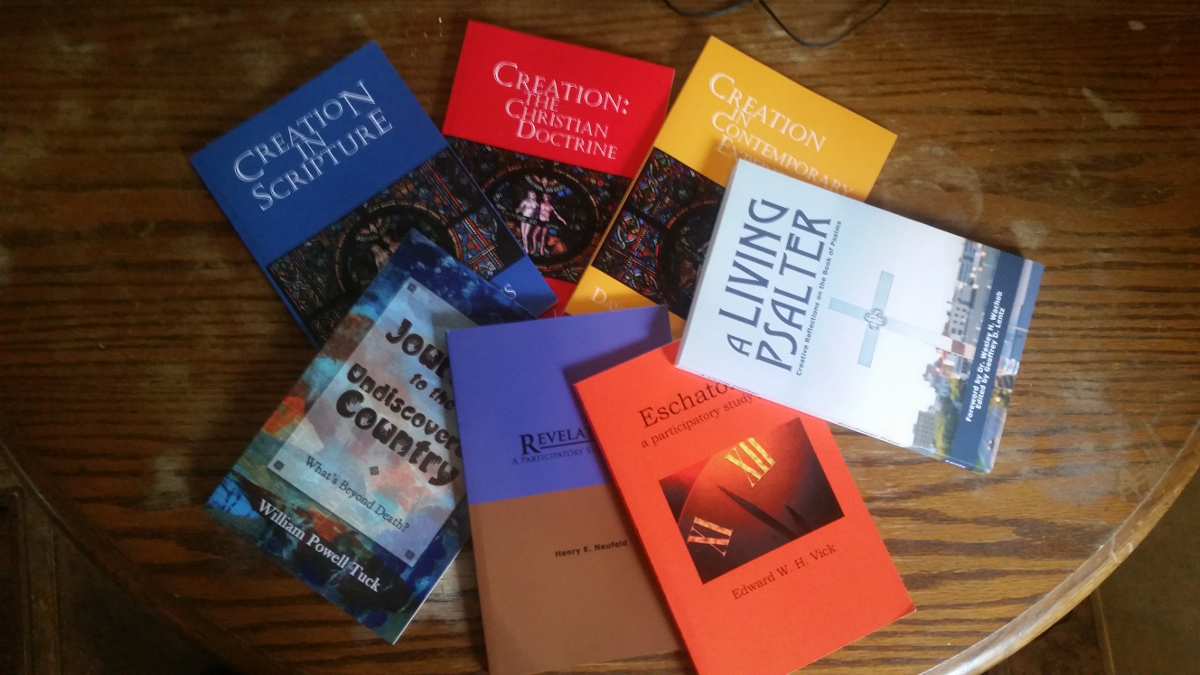
On Thursday night I’m going to do two things: 1) Present some material related to chapter 6 of Eschatology: A Participatory Study Guide (titled “Eschatology Future and Present”), and 2) Discuss October 22 as the anniversary of the Great Disappointment of October 22, 1844, as it is recalled in Adventism. On Thursday I will also kick off publication of some articles by Energion authors on that event and its implications for how we study the Bible generally and eschatology in particular. I’ll provide links to that material here.
Here are the links for the event. Below the YouTube viewer, I will post a couple of questions to consider relating to Thursday night’s study.
In the study questions (page 67 of the book), Dr. Vick asks:
(3) We cannot construct a theology without making assumptions. With what assumptions would you organise your beliefs? Which of the assumptions suggested in the chapter would you be in agreement, and which would you reject? [emphasis mine]
 The latter part of this question will be hard to answer without the book, but consider the first line. Do you agree or disagree? Feel free to comment here or to bring your comments to the study on Thursday night. If you enter the comments via the Q&A app, they can become part of the study.
For some perhaps even more provocative suggestions, the following questions come from page 65, and might help in feeling out your way on assumptions.
What can I believe and what can I not believe? What are the implications of the answers I give to the question? This question then ramifies into more precise formulations.
What can I not believe about how things happen in the system of an ordered cosmos?
What can I not believe about how historical reports come to be written?
What can I not believe about the reliability of human testimony as an avenue to knowledge, whether given verbally or in writing?
What can I not believe about the capacity of a being with human limitations to foretell the future?
What can I not believe about the supernatural?
What can I not believe about claims that the supernatural causes events to take place within the cosmos? (p. 65)
I’m sure that as you consider these questions, you’ll quickly see their implications for how you might read scripture. One can be open on some of these, certainly. But thinking about how you would approach the question can nonetheless be critical.
Taken from chapter 5 of Eschatology: A Participatory Study Guide by Edward W. H. Vick. You can find out more about this study on the Google+ Event page.
Description:
This study is from chapter 5 of the book Eschatology: A Participatory Study Guide by Edward W. H. Vick. This will be some very basic background, discussing the quest for the historical Jesus and how it has impacted our understanding of Christian eschatology.We will also discuss (again!) the critical issue of the way in which we read and interpret scripture and how that will impact our understanding of eschatology, which draws on such a wide variety of sources.
Or watch here:
Tonight I’m giving myself permission to ramble in my presentation. “How will that be different?” you ask. I would imagine largely in that I won’t feel guilty while I ramble!
There are few areas that demonstrate differences in views of biblical inspiration and interpretation than eschatology, whether we mean end-time events or our own end-of-life considerations. ”
Where does everyone go at the end? and What happens to me when I die? tend to lead us to similar issues even though the chronology involved is different. In addition, the difference between a scattered proof-text approach and one that is carefully grounded in historical and literary context will come out substantially different. I don’t mean that if we could just choose one method of interpretation, we would all agree. We’re all human; we will disagree. But it would be nice to debate about the actual issues.
I recall debating online with a Seventh-day Adventist. Since I am a former SDA, he expected me to “understand” certain things about prophecy, by which he meant that I would “see them as true.” Of course, “understand” and “see as true” are not synonymous. I recall that the debate came down to whether there was a connection between Daniel 8 & 9. Is there some relationship between the opening of the “2300 evenings-mornings” of Daniel 8:14 and the prophecies of Daniel 9? He simply refused to discuss the possibility of a connection. There was no connection and could not be. Why? Because his interpretation of the two prophecies required that they be separated. Now this observation doesn’t determine whether, much less how those two passages are connected. What I’m noting here is simply that for him, there was no possibility of a connection.
In terms of inspiration, we have the additional issue of just what we expect to be able to know as a result of studying eschatology from scripture. Is there a single view of the end times that one can piece together from pieces coming from 3rd Isaiah (Isaiah 56-66), Ezekiel, Daniel, the gospels (Mark 13/Matthew24/Luke 21), Paul, and Revelation, along with quite a number of other scriptures? Should we expect such a thing? If not, in what way can we view these scriptures as inspired? If so, why is the process of piecing this material together made so difficult?
My intent this evening will be to draw a very general map of the material and how it contributes to this topic. In order to understand eschatology, one must have somewhat of a handle on the whole of scripture. This is a daunting task. There are far too many people claiming to have simple solutions to everything when they show know awareness of the extent of “everything” with regard to this topic.
You can read a bit more about tonight’s discussion on the Google+ Event Page.
I’m embedded the YouTube here as well. Below this, I will post a schedule of upcoming topics, where applicable noting the chapters for Eschatology: A Participatory Study Guide by Edward W. H. Vick.
Here are the topics to follow:
Eschatology: They Remembered Him (Chapter 2 of Eschatology: A Participatory Study Guide)
Eschatology: Mark 13, Matthew 24, and Luke 21
Eschatology: New Testament Eschatology (Chapter 3 of Eschatology: A Participatory Study Guide)
(All links are to the Google+ events.)
As you can see, I interspersing material from the study guide with time spent discussing some of the source texts. In some cases, we will come back to those texts after we’ve studied further from the guide and also from other scriptures. For example, does your understanding of Mark 13 change when you think about realized eschatology in connection with it? Does your understanding of the materials in the gospels as a whole change after you study Daniel?
As you can see, I can have fun with this topic for an indefinite period of time. I may follow up a more general study with chapter by chapter studies of Daniel and Revelation, though I’d be more tempted to do this with Ezekiel. So we shall see!
It has been that kind of a day. I apologize for not posting this earlier. You can find out more about this discussion on the Google+ Event Page or view it using the YouTube embedded below.
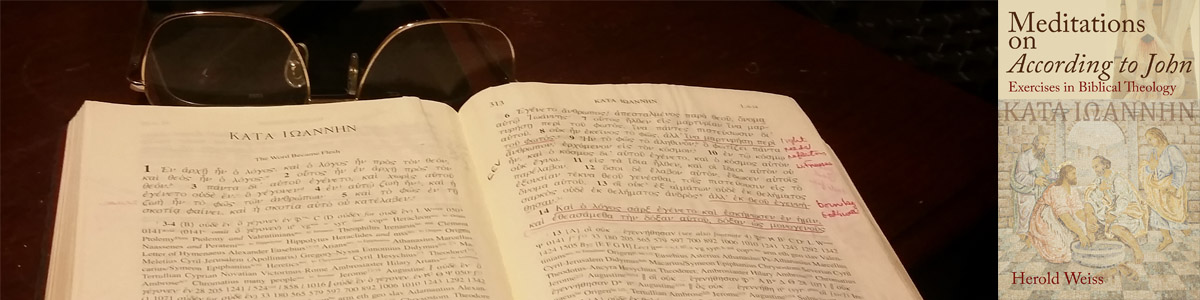 We had lots of audio problems last time we tried, so we’re trying again! Tonight (7/16/15), Drew Smith will be my guest on my study of the gospel according to John. Drew got his PhD in New Testament from the University of Edinburgh, and wrote his dissertation on the gospel according to Mark. Tonight we’ll compare the theologies of the two books and ask Drew about adoptionism. Does the absence of a birth narrative in Mark mean support adoptionism?
You can find more information on the Google+ Event Page, or view using the YouTube embedded below.
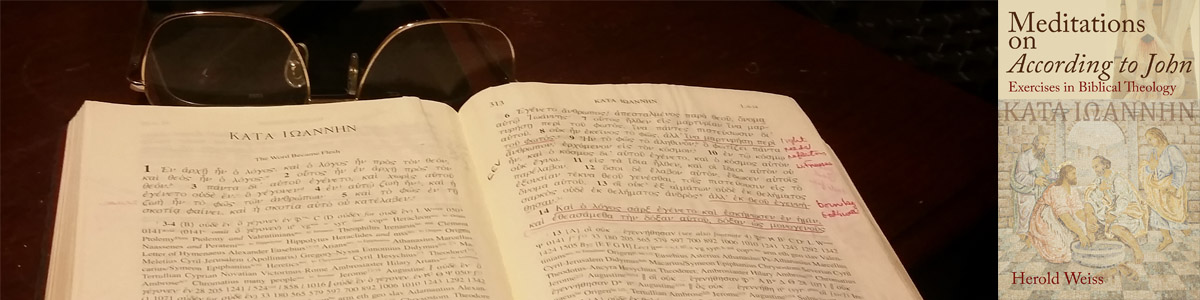
 I’ll be discussing this tonight at 7:00 pm via Google Hangouts on Air. You can find out more on the Google+ Event Page. You can also view using the YouTube viewer below:
Well, that and some additional news …
Tonight (Thursday, June 25, 2015) via Google Hangout on Air I’ll be talking about chapter 19 of Dr. Herold Weiss’s book Meditations on According to John, title “We Must Work while It Is Day.” There’s a great deal of interesting material in this chapter, and I keep adding to it as I read and re-read the passages. I’ll be talking about what the Sabbath means to Christians and also about some basic concepts in eschatology, not to mention eschatology itself.
I also want to give everyone a tentative schedule for the next few weeks and let you know what I’m planning after this series is done.
Here’s the schedule (edited June 30 to add the interview with Drew Smith):
July 2 – Chapter 20 – United by Love
July 9 – Chapter 21 – Jesus Wept
July 16 – Interview with Dr. Drew Smith, author of Reframing a Relevant Faith.
July 23 – Chapter 22 – Rivers of Living Water (since I’m preparing for a Sunday School series in August on the time of the exile, I will doubtless reference Ezekiel’s temple!)
July 30 – Chapter 23 – Where Are You From?
August 3 – Chapter 24 – Abide in My Love
August 10 – Closing interview with Dr. Herold Weiss
I am also planning to schedule a re-do of my interview with Dr. C. Drew Smith, which may move some of these sessions, or it may simply fill the open slot on August 3. This interview is now on the schedule for July 16, with the later chapters moved down to fill in.
 I think I’ve mentioned a few times how far out of the box this whole series has taken me. I diligently pursued nuts and bolts of biblical studies, avoiding theology and liturgy as I would abominations (whatever those may be!). So to spend this much time thinking about theology from a biblical book was somewhat of a challenge. I’m going to move somewhat closer to my roots as we move forward, both in the sense of my approach, which will involved more nuts and bolts, and in terms of the topic, which will be eschatology, something rooted in my upbringing and education in the Seventh-day Adventist Church.
I’m going to start by using the book Eschatology: A Participatory Study Guide by Edward W. H. Vick as a guide to learning the general terminology and getting a view of the map of ideas on this topic. That will be quite theological, of course. Then I plan to look at a number of apocalyptic and/or otherwise eschatological passages in scripture, looking for the author’s intentions in the text and then also at how those words have become part of the various views about eschatology in the Christian community today. The idea will be to understand how people come to their conclusions, why there is so much variety, and how one can find one’s own way through the material. This series will likely continue for some time, as I have the complete books of Daniel and Revelation, not to mention a large number of shorter passages elsewhere. And yes, I would treat the first six chapters of Daniel as material that is just as eschatological (or not) as chapters 7-12.
If nothing else, I’ll have plenty of opportunity to learn new things myself! I have been gratified, however, to see that a few of these sessions have YouTube views in the teens, though most stay single digit. I really expected three or four to follow along the way. Over time, who knows! I am grateful to those who have listened and who have commented, either via the Q&A app or by e-mail. It has been a great experience already, and we still have several weeks to go.
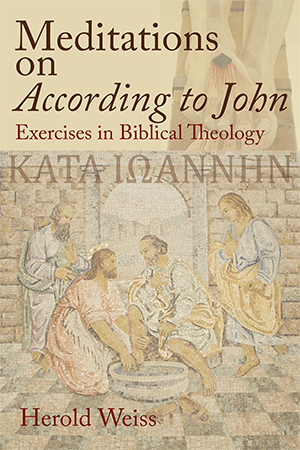 I’ve generated a bit of surprise by my agreement with Dr. Herold Weiss (Meditations on According to John, chapter 18) in last Thursday’s video study from the gospel according to John (not to mention my Sunday School class), that the gospel is not attempting to institute or to teach sacraments.
As a foundation to this brief note, you might want to either read Weiss’s chapter (pp. 151-158), watch my video (about 1 hr, embedded below), or both. I’m just going to follow up on a couple of items here. I suspect not that many people will watch an hour of me talking, so I will try to make these notes self-contained.
First, the video:
My view of the sacraments is simple: I think that there are public actions and rituals that we take that reflect what is happening spiritually. I do not believe that the presence of Jesus in these activities is dependent on having ordained clergy to preside. I don’t believe that the rituals in themselves are valuable.
The value of sacramental acts is that they help us recognize and participate in the spiritual reality that is behind, in, and through them. Thus if I partake of communion, a shared meal, and then spend the following week withholding food from those in need, or cutting off fellowship from people I don’t like for various reasons, my act of communion has become a dead ritual.
Weiss discusses the difference between footwashing and communion in his chapter. One has become a sacrament and one a sacramental act, the latter rarely performed. I could perform the ritual act of footwashing, which rarely has the same impact or feeling that it would have had in Jesus’ time, and then go out and refuse to place myself in the service of others. In that case, the act of footwashing would be a dead and empty ritual as well.
In the video I relate the experience of my own baptism, at which time we celebrated, as Seventh-day Adventists do frequently, by washing one another’s feet. I was partnered with a Chamula gentleman (this occurred in the mountains of Chiapas, Mexico when I was nine years old) who had walked for days to be at this event. We were both newly baptized. He laughed when it came time to wash my feet because I had shoes, while he had but sandals, and I had walked a half mile or so as opposed to days. Washing his feet was meaningful to me and has stuck with me.
Despite my views, however, I don’t go out offering formal services of the Eucharist as an unordained person. Despite the fact that I don’t think the presence of an ordained pastor should be required, this is an act that is, by nature, done in community. As a member of a United Methodist congregation, part of my duty is to act in community.
At the same time, I believe that I can and should make every meal a sacramental act. The greater joy I get from the celebration of communion in the church congregation is not that I believe God is more present there, but rather that it is an act I perform in community and covenant. Sometimes in order to be in community, we have to do things the way the community does them, whether we think these things are special or not.
At the same time I have become fully convinced of the concept of open communion, and by this I mean fully open. I have long accepted the notion that when Paul, in 1 Corinthians 11, talks about taking this “unworthily” he is talking about the way in which the celebration is done, not about the character of the person receiving it.
By nature of its source, in the shared meal, and its institution, which included offering it to Judas as he prepared to betray Jesus, I think this sacramental meal is intended to invite and not to exclude. It is reaching out, not commemorating our special status as members of some inner circle. Thus communion should be offered to all both in church and when we share our meals with others. I question the idea of a Christian sacrament that celebrates membership in the club.
But, you might say, what about baptism? Surely baptism can’t be for everyone!
Yes, baptism is different, yet it is different by its very nature. It is the testimony, the ritual representation of our dying with Christ and being raised with him to new life. It is a singular (generally) event. It does not celebrate how we have become special, but rather how we have chosen to give ourselves up and become part of a community, a community that, in turn, reaches out to draw others in.
And even here we invite anyone who wishes to testify to that, anyone who wishes to become a servant.
I think this becomes a problem when we see these events as a sort of initiation, bringing us into the club of the special, in which there are other special rituals in which only other special people can take part. The “in group” view of the people of God that many of us have, consciously or not, leads us to misread scripture. The Jews weren’t chosen by God to sit around and be special. They were chosen to be a blessing. Sometimes being chosen isn’t much fun. There’s the great line in “Fiddler on the Roof” when Tevye wonders if God couldn’t choose someone else for a while.
Christians, who are often anxious to appropriate the promises made to the Jewish people, are not nearly as often anxious to appropriate the calling, the tasks, and the negative responses of others. Being chosen, being “in” with God isn’t necessarily a picnic.
In conclusion, I suppose I could say that I have a high view of sacramental acts, and that I consider sacraments to be no more and no less. My high view says God is present and active in sacramental acts. The Holy Spirit works in and through them. But just as the rituals of tabernacle and temple didn’t magically accomplish forgiveness and reconciliation, but rather accompanied God’s actions, so these sacramental acts are filled with God’s presence when done “worthily.” (Note: I’m indebted to Jacob Milgrom, author of the Anchor Bible volumes on Leviticus among many other works, for my view of the relationship between ritual and divine action. Milgrom sees this presented, in contrast to some of the surrounding religions, in the way rituals are presented in Torah.)
Tonight (4/2/15) at 7:00 pm central time I’ll be continuing my study of John using the book Meditations on According to John by Herold Weiss. We’ll be working from chapter 10, “I Finished the Work.”
This is an exceptionally good chapter to be studying on Maundy Thursday, though I’m going to assume nobody will miss a Maundy Thursday service in order to listen! We’re going to talk about footwashing, signs, miracles, works, and witness and the difference between a sign and miracle. We’re also going to discuss what Jesus meant by “greater works” (John 14:12). What are these “greater works”?
Here’s the key quote from the chapter that will guide what I’ll be talking about tonight:
Jesus lived performing signs that pointed to the time when he would finish his work. Therefore the life of the Christian must provide signs that advertise the source of strength and vision for those who live by faith. Signs and faith must remain closely bound in the lives of the disciples of the one who is THE SIGN that must be seen and believed. (91-92)