For it was appropriate for
him,
for whom everything exists
and
through whom everything exists,
in bringing many children to glory,
the pioneer of their salvation
to perfect
through suffering
(Hebrews 2:10, very literal)
I wouldn’t suggest that any Greek students translate the way I just did, or your Greek teacher may suggest you learn English. I’m trying to bring the focus onto certain things and it’s sometimes hard to gauge what this is going to do for readers of the English text that results.
I think this text is one of those that we tend to discount, because what it’s actually saying is a bit startling. In his commentary, Luke Timothy Johnson points out that this text forms a sort of envelope with 2:18, and that the verses between are a carefully structured argument. I quite agree, but I want to just bring your attention to the stark initial statement. Johnson emphasizes how outrageous this concept would be in the Greek world. I would suggest it would sound outrageous just about anywhere. When a Bible writer says something that sounds outrageous we have our defensive mechanisms: Discounting (take 20% or 30% off the rough edges), find a balancing text so we can believe that one instead, or just move on to something more edifying.
In this case I think we tend to focus on the suffering, since we have heard the story of the cross so many times. That was something shocking to those who first heard it, but it has become routine now, not that when we’re called to suffer as Christ did, we take that very seriously. We tend to think we’re suffering for Jesus every time we have a bad day. No, we’re just living in the world. Some days just aren’t as nice as others!
But the idea that the Son, described in such majestic terms in Hebrews 1:1-4 is to be made perfect, or perhaps complete, through suffering is a little bit more difficult. Luke 2:52 notwithstanding, we tend to think of Jesus in majesty all the way through. Just look at all the halos around the baby Jesus in art. I suspect not so much halo spotting by Mary. In Hebrews, we’ll hear this theme many times, one of the key ones is 5:9, where “having been made complete he became the means of eternal salvation.
I’d suggest two points here that we avoid, and we need to affirm and absorb instead:
God is much more involve in and impacted by our lives and situation. The incarnation may have been an event in history, but it’s also an eternal reality. God is much more involved. We sometimes wobble between transcendence and immanence. God has no problem with both.
The suffering and death of Jesus was a necessary part of atonement, in different ways. I do not affirm penal substitutionary atonement as the singular theory expressing the truth of the atonement. It is, in my view, just one metaphor that helps us think about our salvation. But if we think incarnation, to be complete it must be real, and, well, complete. Becoming human and then not facing death would be to become something other than human; rather, it would be a contradiction. So Jesus became complete as the means of our salvation by living and dying as we do.
As difficult as it is sometimes to keep this in focus, salvation requires both the glory and the suffering. And when we are called to suffer, or even given the gift both of believing in Christ, but of suffering for him (Philippians 1:29).
I don’t know about you, but I suspect that could involve more than some mild annoyances.
Paul was impacted by his mystical experiences and the intervention of God by a vision of light. (Source: Adobe Stock [licensed]).Tonight I begin my new series of Thursday night studies on the apostle Paul. My approach will be a bit different than usual. I’m more interested in developing the background, particularly in Israelite religion and Judaism and looking at the way Paul draws from his theological sources.
I’ll also introduce my approach to the subject. I’ll be working first with material from Energion Publications authors. I publish these materials and I’m acquainted with them. More importantly, I wouldn’t have published them if I didn’t consider them valuable.
I’m going to use Galatians as my basic guide. That wasn’t my first choice. I’ve often felt that Pauline scholars spend excessive time in Romans and Galatians and neglect books like 1 Corinthians or Philippians in developing their view of Paul’s theology. But I have come to believe instead that what I saw as deficiencies in building a picture of Paul from these letters is more a result of misreading Paul than of choosing the wrong letters. Of course, I will still maintain that in order to understand Paul and his theology, one needs to consult everything he wrote, but I doubt anyone actually disagrees with me on that point. It’s rather a matter of emphasis.
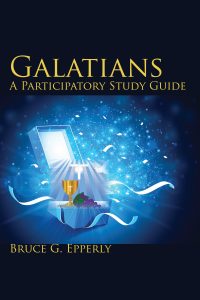
In studying Galatians, I’m going to start from a foundation of reading the book with Bruce Epperly’s study guide in the Participatory Study Series, titled creatively Galatians: A Participatory Study Guide. (The title is not Bruce’s fault. It’s standard for the series, and therefore my fault.) Besides the fact that I publish the book, my reason for choosing this is that it is written by a progressive theologian, also a process theologian, who is nonetheless very favorable to Paul’s writings. I would like to create a conversation here between evangelical and progressive approaches to interpretation and also to take a look at the way our existing theology impacts our reading.
As part of the resources for this study, I’m going to be interviewing scholars from our Energion Publications author list with a variety of perspectives. Because I’m using Bruce Epperly’s study guide, I’m starting by interviewing him. I completed it this morning, and I’m excited by the results and what he had to say. Bruce is always entertaining. He’s the first of several. I hope you will listen to (or watch) all of them. Here’s the video:
It’s not necessarily a bad thing for our theology to impact our reading. In fact, I think it would be quite shocking if it didn’t. I am only reading the Bible because I grew up in a Christian home and have a theology that suggests that this book is useful. My existing theology is also going to have an impact on the way I place the content of the book. In turn, Paul is himself impacted by his own background and theology. This doesn’t suggest that interaction with the book doesn’t have the potential to change or even totally revolutionize our existing thinking. Paul encountered God in a new and different way on the road to Damascus and his theology was revolutionized. Yet one can still see his background in his destination.
It’s easy to separate Paul from his own background. In fact, it’s easier to do so than not. So I’m going to emphasize the background. Now I’m not in search of some undiscovered country where I hear Paul 100% as he was. My theology will be in tension with his as I learn, and I hope yours will be there as well.
It’s my hope to provide additional video notes and some blog posts each week. Just as we have with the Energion Publications Tuesday Night Hangouts I’ve changed these to a half hour each. I also hope that you will pick up a copy of Bruce Epperly’s book and do a study of Galatians at the same time as I do.
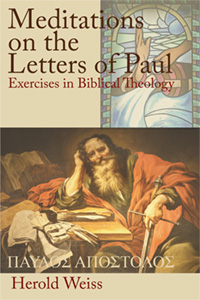
I will be consulting the other books listed, and also providing a resource page with a list of available books. But another book will be with me for the entire study is Herold Weiss’s book Meditations on the Letters of Paul. Herold brings some impressive scholarship to his reading of Paul, and I will be making full use of his material. As a suggestion, pick up copies of both of these books and follow along. And yes, I will be interviewing Herold as part of my series asking “Who was Paul?”
Here’s the viewer for tonight’s presentation:
Note that if you want to participate in live chat you will need to go to my YouTube channel and watch there. I will be watching the live chat for questions and comments. Note that I have put the books involved on sale on Energion Direct. You will be able to see them on the home page.
#contextchangeseverything – yes, it does. But how?
With the vast array of Bible study materials that are available in the English language comes a problem. How does one choose what materials are worth my time, shelf space (or HD space!), or money? If you search my blog for posts about study Bibles, you’ll find that I have a love-hate relationship with them, and it tends to be mostly hate. Nonetheless, I own—and use—a variety of study Bibles, and you’ll even see some positive reviews.
The reason for the hate side of the equation is that far too many people purchase a study Bible that’s recommended by someone they trust, or even written by someone they trust, not to mention randomly selected from a bookstore shelf and then accept what the notes say because they are written by biblical scholars after all. I recall being accosted by a church member some years ago who asked me about the notes on a particular text. I can’t even recall which text it was. Her problem was that she couldn’t figure out how the meaning presented in the note could be extracted from the text itself. I strongly recommend asking just such a question! I asked her if she’d considered the possibility that the note could be wrong. That was a revelation for her.
What I recommend is that a reader make sure to get study Bibles that are written from different perspectives and use them as an aid, not as a source of the answers. To some extent one should study the Bible text first, and then the notes, but sometimes one can read background material first. A study Bible that provides notes that tell you directly what the passage means can be quite convenient, but also quite misleading.
But one of the key problems for Bible students in the 21st century western world is the extent to which our culture is different from that of the world of the Bible. Very frequently what seems quite plain to us is not at all what the Bible writer is trying to say because we simply don’t share enough of those norms. I have come to believe that I have benefitted more by coming to understand human culture and language over the last 30 or so years than I have by learning the biblical languages. I do not mean to underestimate the value of learning Greek and Hebrew, but if my language learning had not been enhanced by the study of linguistics, history, sociology, and anthropology, it would have been of little value.
Pastors frequently proclaim that “the Greek word ____ means” or “the Hebrew word ____ means” and then build their exegesis on what is essentially simply another gloss. This makes people believe they have been enlightened by the ancient languages, when they have actually simply transferred their 21st century attitudes and presuppositions to a set of sounds they are told is Greek or Hebrew. Understanding a language means to some extent understanding a culture. Similarly understanding a text means understanding something about the person or persons who wrote it and the audience for which it was intended.
This is the key element that I believe a study Bible can provide. Certainly cross-references and historical connections are important, but letting the reader know how people in that time and place lived and thought is much more important.
NIV Cultural Backgrounds Study Bible
NIV Cultural Backgrounds Study Bible on my Android Tablet
(Note: I am basing my notes on the Olive Tree Bible software edition provided to me free of charge as I did not receive my print edition. I will not make comments on the layout or usability of the print edition.)
Thus I come to the NIV Cultural Backgrounds Study Bible. They use the provocative (and obviously true) URL contextchangeseverything.com. I should note here that there are many types of context. There is a literary context, historical context, linguistic context, and (among others) cultural context. We usually think of context in a fairly narrow linguistic sense. A word study might be done by finding a variety of sentences that use a particular word. We know that when Jesus says, “Go and do likewise” we need to look at the context of what has been commanded. We can’t grab some other activity and make that the command of Jesus instead.
Study Bibles generally examine a range of these ideas as well as proposing interpretations for difficult passages, often without providing enough information so that the reader can follow the logic. The final reader is left with the simple logic that the skilled scholar who wrote the study notes concluded X, so X must be correct, an assumption that will be severely shaken in many cases if one compares other Bibles written by skilled scholars.
The Cultural Backgrounds Study Bible aims to help you understand the Bible writers, their audience, and their times. In the notes you will find direct connections between ancient culture(s) and the text itself. Rather than just being told that a certain phrase means a certain thing, you will be given the reason why one might come to that conclusion. This is no guarantee that every interpretation is correct; that would be expecting the impossible. (Which perfect one of us would make the determination in any case?) What it does mean is that for most explanations in the notes in this Bible you can follow the logic path. If you want to, you can do deeper research, and the notes are specific enough that you’ll be able to do your search, Bible dictionary reference, or deeper study in a commentary or at a good library.
Since I’m not reviewing the Bible overall, but rather looking in particular at one book, I won’t spend more time on an overview. Let me simply say that I’m delighted with the intent, and quite impressed with the implementation. There are obviously limitations. This is a study Bible, not a multi-volume commentary or an encyclopedia. It would be easy to complain about what’s not there. In my review of the book of Hebrews, I believe that the editorial choices made were quite good. I would doubtless have chosen differently in some cases, as would just about anyone, but that’s only to be expected.
On to Hebrews
To study Hebrews most effectively using this Bible, start first with the introduction to the Old Testament. Why? Because Hebrews displays an interesting interplay between the text of Hebrew Scripture, seen generally through the LXX translation, and then interpreted in a particularly New Testament light. The details of how these elements interact require some discussion, and that’s why you study and compare, but you need to understand the sources. The introduction discusses 12 issues in which we will see the world differently, and I think all of these issues will impact your reading of Hebrews.
While reading the text of Hebrews you can use the links (if you’re using Bible software) or follow the references to Old Testament passages. You cannot impose your own exegesis of passages of Hebrew Scripture on Hebrews, but it is important to know not just the text that is quoted, but also its literary context that might be brought to the audience’s mind by the reference, and also by ways in which that text might have been understood. It is not sufficient to treat the Old Testament quotations in Hebrews as words used in the context of Hebrews. Of course, the context of their use in Hebrews is the most definitive when we determine how the author of Hebrews intended them, but we need to do everything possible to get into his (or her) world in order to understand that context.
This is the value of a volume like this. I’m currently reading a commentary on Hebrews that is more than 600 pages. I have another on the shelf in front of me that is of similar length. It’s hard to back off and get an overview of the forest using those commentaries, though both are extremely valuable. What I enjoyed with the Cultural Backgrounds Study Bible, even as someone who has read the book of Hebrews many times, and studied the works of many commentators on it, was this broader view. Having dealt busily with the trees, putting each leaf under a microscope, it was nice to get so much material easily available. (This is a general advantage with study Bibles over detailed commentaries, at least the better ones, but the Cultural Backgrounds Study Bible excels).
Content Comparison
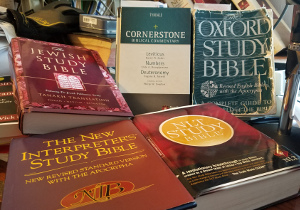
I’m going to compare the content of several study Bibles I have on my shelf. Where I give word counts, they are loose estimates based on line counts and my eyeball count of average words per line. The Bibles I’m using to compare are: The New Oxford Annotated Bible (NRSV), The Orthodox Study Bible, The New Interpreter’s Study Bible, The NLT Study Bible, and of course the NIV Cultural Backgrounds Study Bible.

First, let’s compare sheer quantity of text. First, the introduction. (I’ll add a note on approach.)
NOAB: About 450 words, no outline, though an outline can be extracted easily from the notes. The approach of the notes is often technical. Users complain that they don’t get enough theological help.
OSB: About 220 words, short outline provided, stronger suggestion of possible Pauline authorship than others. Theology is consistent with that of the Eastern Orthodox tradition.
NISB: A bit more than 1000 words and a mid-length outline. The NISB is kind of the pastor’s answer to the NOAB for mainline teachers/preachers. It provides more theological reflection, a fact I receive with definitely mixed emotions, though the material is generally helpful in its place. Theology is mainline with a bit of a liberal lean.
NLT Study Bible: About 1500 words and a brief outline. Theology is strongly evangelical
NIV Cultural Backgrounds Study Bible: About 800 words, no outline, features “Quick Glance” section. Theology is evangelical.
Now let’s consider a specific passage, in this case Hebrews 4:12-13, and look at the quantity of notes, along with a count of insets or excurses in the whole text of Hebrews:
NOAB: 21 words. No excurses.
OSB: 54 words. One excursus.
NISB: 75 words. No excurses.
NLT Study Bible: 74 words. 9 excurses.
NIV Cultural Background Study Bible: 136 words. Two excurses.
The critical value of these notes is that they are aimed at the background and at helping you draw a line from the background to the meaning. I would say that the NOAB is great at pointing to technical details, but not so much at theology, while the NISB spends less time on technical details while using much of its space to reflect on theology. The NIV Cultural Backgrounds Study Bible uses its space in drawing a picture and pointing that to possible theological conclusions without trying to be a theology text.
Conclusion
Over the next few days I will post something on a couple of my favorite passages and the specific comments provided by this study Bible. I would consider this an excellent Bible to have at hand for a study of any biblical book. In my To the Hebrews: A Participatory Study Guide (currently under revision), I recommend that a study group have more than one study Bible available. I think it would be good for a group studying Hebrews to have this one at hand. One of the reasons my own guide is being revised is that it is largely a collection of thought questions. I’m going to provide more of a basis for those questions in the second edition. But the book will still be intended for use by a study group that has available multiple resources to compare. This will be one of the few that I recommend.
Note: All of these introductions to the book of Hebrews tend to dismiss Pauline authorship, with the Orthodox Study Bible being the most favorable. My own position is that it is not possible to determine the author. I used to exclude Paul as a possibility, but have been persuaded by the writing of David Alan Black that Paul should be kept as a possibility. I publish his little book The Authorship of Hebrews: The Case for Paul.
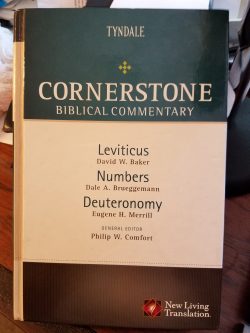
I’ve completed the second chapter of Deuteronomy in the CBC commentary on Leviticus, Numbers, and Deuteronomy, and it may surprise some that I’ve felt a bit of a letdown as I moved from the variety of liturgy and laws, though interspersed with narrative, that is Numbers. It might surprise you less if you realize that my personal theology (and I think we all have one), is built on Ezekiel, Hebrews, and Leviticus, though not necessarily in that order. That’s the order in which I started studying the books seriously, however.
For most Christian readers of Hebrew scripture, I think that getting into Deuteronomy is a bit of a relief. Reading Genesis through the first half of Exodus goes pretty smoothly, but then one bogs down on all those details of building the sanctuary, and you get them twice: instructions and implementation. Then when you’ve worked your way through that you get to Leviticus, which contains so much liturgy, along with obscure laws on issues we generally don’t face. Numbers is a little less dismal, and then Deuteronomy starts to give us propositional theology that we can get our teeth into.
I was there before I spent serious time in Leviticus. I don’t claim expertise; that takes incredible amounts of study. But I’ve spent a great deal of time on the text. There’s a great deal that one can learn from that liturgy, including the simple fact that liturgy matters. Those of us who are not “high church” tend to think that the way in which worship is conducted isn’t very important. It’s mostly a time to accomplish our goals, often divided between “worship” (when that’s defined as musical), and “sharing the Word,” and of course those who believe one or the other is critical can have some great debates.
But we can learn a great deal from the ancient liturgy, and I think we can either increase or diminish our impact on the world around us through constructive liturgy. This is not an argument for high church liturgy. I am also not arguing that worship only takes place in worship services, much less that worship can be equated to music. All our activities should be done in worship to our creator.
But there is a time for us to act out for ourselves and for others the nature of the church as a community, and coming together at a common place and at a common time to share in activities as a community is, I think a critical part of this. Unfortunately, we have a variety of ways to avoid this. We may reject gathering together entirely. It may be a time when an ordained pastor occupies most of the time explaining to us what he believes we should believe. It may be a time to experience an emotional high as part of musical or artistic endeavors. It may be a scripted program that is ancient and could be meaningful, but is carried out by rote.
But it doesn’t have to be any of those things. It can be, instead, a time when we gather together and join in activities that encourage one another and prepare us to face the world around us as effective witnesses for Jesus. I don’t think there’s a particular set of activities that make this happen. I do think it’s possible because I have seen and experienced it.
God doesn’t just communicate in one way. Hebrews 1:1-4 makes it clear, and presents Jesus as the ultimate communication from our creator (amongst other things that reinforce that idea). The Torah (or Pentateuch) presents these different ways. We have liturgy helping to teach the people and to shape them into God’s people. We have story, showing us people experiencing God’s activity in the world, and we have theological propositions. I kind of prefer the liturgy, but that’s just me. Here we have all three demonstrated.
I think that neglecting one or the other leaves us with potentially skewed views of God. We need both the God who is the same yesterday, today, and tomorrow (Hebrews 13:8), and the God who is sorry that He created humanity (Genesis 6:6). The same God also forgives a poor Israelite who can’t even afford a bird as a sin offering (Leviticus 5:11).
So I guess I won’t be let down and instead enjoy the change!
They differ on the referent of ὁ λόγος τοῦ θεοῦ. There are good arguments for using this as the “personified word,” and for not reading it as a reference to Jesus, but again, as I have time and again over the years, I end up disagreeing. I think this forms an excellent tie back to the prologue, which clearly outlines a high Christology. Now we have definitely been reading arguments taken from the written word, and references to spoken word (Hebrews 2:1-4). But the prologue points us to Jesus as God’s ultimate communication with humanity.
This, in turn, points us to Hebrew 4:14-16, which summarizes one side of the coin of the high priesthood of Jesus. Here we are told, based on the arguments of chapters 2 & 3, that we have a high priest who is able to sympathize with our weakness. He is our brother (2:11). This will be brought together with the other side of the coin in Hebrews 7:26-28, which tells us that his brotherhood with us does not diminish his status in all ways with God. But right here it’s the one who is our brother, who can sympathize with our weaknesses, who is the one to whom we must give account.
And there you can see how I think λόγος should be rendered at the end of verse 13. I think we do have a play on words, but we should also look beyond a gloss or even a simple dictionary definition, and note that Jesus is giving an account to us of God, while we give an account of ourselves to God. Except not so much. Because we have such a high priest who is able to take us all the way in to the throne of grace.
This doesn’t take the written word of God, nor the word of God spoken by the prophets or apostles out of the equation. Wherever God’s word is, it is “alive and active,” but its ultimate representation is in the person of Jesus. To the question, “Is this the written word of the prophets or is it Jesus?” I’m saying “yes.” But mostly Jesus, because that’s where our author is pointing us everywhere.
Jesus does not replace the written word. Rather he completes it. The New Testament doesn’t supersede the Old. It builds on it. If you’ve read Hebrews thus far, getting to the end of Chapter 4, you’ve experienced the work of someone whose respect for the Hebrew Scriptures is very great and shows clearly through. One should remember this when one gets to passages that talk about something old vanishing, such as Hebrews 8:13. The very foundation of his argument is not vanishing.
He’s going to make the case that Jesus is the perfect High Priest (and we see functions of that priest in 12-13, God->Us, Us->God), that Jesus is the perfect sacrifice, and subtly, by the texts used in making those cases, he will let us know that Jesus is the perfect King.
A second law and a second note on introductions to biblical books. Goes together, no?
I completed my reading of Numbers along with the Cornerstone Biblical Commentary yesterday and today read the introduction from the section on Deuteronomy. In it the author, Eugene H. Merrill (professor at Dallas Theological Seminary) argues forcefully for Mosaic authorship and for an early (1446 BC) date for the exodus. In school I learned 1445, but the majority position is that the exodus occurred in the mid to late 13th century, and critical scholars in general would reject at least direct Mosaic authorship in favor of a date of writing in the 7th century BC.
In the course of presenting these positions and his basis for them he makes the statement (p. 449) that “there is absolutely no objective evidence that compels a late provenance for the book.” I would first point out that it is useful to realize that evidence rarely compels, especially in historical situations such as this. Secondly, there is evidence that would point to the composite nature of the book and some that would suggest a later historical setting. Certain Merrill, along with many others, has provided explanations for this apparent evidence, but having provided an alternate explanation, however convincing it may be to the one providing it, does not make the evidence go away.
[ncs_ad pid=’9780842334280′ float=’right’ adtype=’aer.io’]I like to look at introductions in various study Bibles. I’m not sure why, as the usual result is simply to raise my blood pressure a bit. In this case I have at hand The Oxford Study Bible, The Jewish Study Bible, The New Interpreter’s Study Bible, and the NLT Study Bible. Out of these, only the NLT Study Bible would tend to agree with Merrill. That count is not important, however, because it doesn’t constitute a good survey of quality scholarship on the issue.
The problem with the lot of these is that they each assert their position with confidence and provide a couple of notes on things that favor that position, but give very few reasons why anyone might disagree. If you read the conservative introductions, you might well conclude that the critical scholars who disagree are just perverse, while if you read the more critical introductions, you might not be aware that there are modern conservative scholars who would hold to such views as a 1446 BC date for the exodus or Mosaic authorship of Deuteronomy around 1406 BCE.
You may think I’m being unfair, as each introduction must be short, especially in the study Bibles. Merrill’s can be somewhat longer as he is writing for a substantial commentary on just three books of the Bible. But my point is not to chastise the scholars for their positions or for espousing them in their introductions. I do find their language a bit intemperate, and I would also point out that it doesn’t take many words to indicate that other scholars disagree with at least some indication of why that might be.
My interest is in what you do about it. I’d suggest strongly that you don’t surround yourself with books that agree with you and that come from scholars that are in your own religious/denominational tradition. I am generally convinced, though I wouldn’t use “compelling” for any evidence, that the Pentateuch, including Deuteronomy, is a composite text containing some ancient traditions, but built up with case law and later additions and adaptations. Yet I will carefully read Merrill’s commentary as I also read through the Hebrew text. What’s more, I can predict right now that I will learn a great deal from Merrill’s work.
The reason I can do that is that I’ve read this introduction, and while I disagree with the dating and authorship section, it is followed by a discussion of structure and themes that is extremely helpful. I frequently encounter the idea that a certain writer is just a liberal, or too conservative for me, so why should I read his material. We could go for “iron sharpens iron” (Proverbs 27:17). But I think perhaps Provebers 27:21 is better:
The crucible is for silver, and the furnace is for gold, so a person is tested by being praised. (NRSV)
Or as I translated it for a Tweet (I like literal in this type of poetry):
As refining fire for silver, As a furnace for gold, So to a man is a voice praising him (Prov. 27:21).
I really need to read someone saying that there is “no compelling evidence” for the position I hold. If I only read The Oxford Study Bible, The Jewish Study Bible, and The New Interpreter’s Study Bible, I would never be pushed to look more closely at the evidence.
I think it is particularly important in using study Bibles, because people seem to get the idea that whatever is in the notes is what “scholars” believe regarding the passage. They often also decide that if “scholars” believe it, then they must too. But scholars as a group rarely agree on anything. It’s one of their best features, because they all want to refine things and find some new, good ideas. The results are sometimes crazy, but nothing like as bad as the results of not doing so.
Introductions are hard to write and often don’t prove that useful. But using a range of them can be quite enlightening!
I’m about to move from the section on Numbers in the Cornerstone Biblical Commentary and from there go on to reading Deuteronomy. I’m reading this in parallel with a reading of the Hebrew text.
I’ll first note that I find this commentary very helpful, and I believe it would be helpful to a person preparing lessons or sermons on these books (Leviticus, Numbers, and Deuteronomy), which are not that easy to work with. The authors of all three sections provide good theological reflections on the passages, which I find helpful despite the fact that they are somewhat more conservative than my own theology.
One of the keys for Christians reading the Pentateuch is being open to the questions and looking for the answers. It is much less important to have a set of “good” answers at hand when you finish. It’s OK to admit that the culture reflected is very different from modern culture, and is hard for us to apply. As I have noted before, and recently read in Luke Timothy Johnson’s NTL commentary on Hebrews, modern Christians don’t really understand the idea of sacrifice, amongst other things, and so see the entire tabernacle/sanctuary service/cult as a foreign land.
Numbers 35 illustrates some difficulties. Here we have the concept of the avenger who will kill the person who has killed (even accidentally) a relative. So the cities of refuge are provided. There the killer can find refuge provided the killing was inadvertent. (Just how “inadvertence” is defined is up for some discussion.) In this passage we find the rule requiring at least two witnesses for a capital charge.
So we have a mitigation of vengeance killing, yet even if the person is found innocent of capital murder, he will be restricted to the city of refuge. Having been found not guilty, he still suffers exile. But modern readers may miss what many commentators see as the reason he remains until the death of the high priest. The death of the high priest is seen as atoning. I find the argument for this latter point less compelling than some, but nonetheless a serious possibility, and one which might well impact our understanding of Jesus as both high priest and sacrifice in Hebrews.
Which leads backward, in a sense, to the idea that the land itself is polluted by murder and that atonement must be made in order to remove this pollution. The atonement for intentional, premeditated murder can only be made by the death of the murder, and no ransom can be accepted. There is no indication in the text of what happens in case of doubt, when two witnesses cannot be produced. There would be no atonement. Clearly, people are not expected to atone for a sin they cannot determine existed.
We have here a tension between what we would see as Christian principles and a society based on vengeance. There is mitigation, and yet there is considerable accommodation as well. I think it is a good example of how God works with people. It’s easy for us to say that God should make things absolutely right (as we see it) in an instant. But it is not that easy to change a culture and a society.
Yet if you look at Judaism today, you see an amazing edifice built on just this kind of material, and Christianity grew out of this same soil with some interesting outside influence!
Regarding Numbers 33 and the 42 stations on the route to the promised land, footnote #1 on page 420, (Cornerstone Biblical Commentary on Numbers), notes that “[p]atristic commentators compared these 42 stations to the 42 (3 x 14) generations in Jesus’ genealogy, but that doesn’t shed any light on ch 33 …”
It is quite true that this comparison sheds no light on chapter 33, but I doubt that there was any intention by the author of Matthew to shed light on Numbers. More likely, if he was making a connection, he was intending to have Numbers 33 shed light on his genealogy. Clearly he went out of his way to get 42 generations and divide them into three groups of 14. It’s very easy to make too much of numerology.
Despite that, I am more and more convinced that New Testament authors quite frequently intended to draw more of the Old Testament narrative into their writing than just what was quoted. One reason for this is that I have noted how the lack of knowledge of the Hebrew Scriptures/Old Testament in modern audiences makes discussing certain passages more difficult. The corollary to this is that a greater knowledge would make discussion easier. New Testament writers could count on greater knowledge among their readers than we can today.
What might Matthew be drawing into the text here? I have argued that Matthew 2:15, when it quotes from Hosea 11:1, “Out of Egypt I have called my son,” is drawing the broader story there into his narrative. At first glance, one might accuse Matthew of taking something that is clearly not Messianic and making a prophecy out of it. Hosea 11 continues with telling us that the more YHWH called his people, the more they went away. My initial reaction to this, and the reaction of many, is that Matthew is grabbing a single clause out of context, and making a prediction of something that isn’t actually a prediction. But I’d suggest instead that Matthew is presenting Jesus as Israel doing it right. When God called Israel at various times, they went away, as Hosea is saying. Jesus, on the other hand, when called out of Egypt or when called to the cross, continues to come.
My suspicion is that the use of 42, besides being the numerologically comfortable grouping of three pairs of sevens (and there are so many ways a set of numbers can be presented!), is intended to point us back to the travels of the Israelites in coming to the promised land. I am in no way suggesting that these 42 stops were in some way predictive, nor am I suggesting that Matthew 1:1-17 gives some sort of new or special meaning to Numbers 33. Rather, I’m suggesting that Matthew uses 42 generations as an allusion to Numbers 33 and to Israel coming out of Egypt and to the promised land.
Nearly 20 years ago a waitress at a well-known breakfast chain messed up my order for hash browns by adding diced ham.
If you don’t find anything odd about that sentence, you are, perhaps, a candidate for counseling. But I digress.
I had wanted jalapeños, onions, mushrooms, and cheese. I got all of those. Plus ham.
As a vegetarian, I don’t eat ham. The waitress was very nice and got me a new order with what I wanted, but for years (yes, years) thereafter, I was known to remind the staff at that particular chain that I did not want any meat in my hash browns. None at all.
I was reminded of this last night when I asked Jody if she had done a certain thing, something that we had both forgotten a couple of months ago, but that I didn’t want forgotten again. She said she supposed she’d have to wear forgetting this one monthly task once for some time, considering how long it took me to forget about the ham in my hash browns. Well, I obviously haven’t actually forgotten it. I have quit mentioning it. One step at a time, you know!
I was reminded of it again this morning as I read Numbers 32. The story takes place after the Israelites have defeated a variety of enemies on the east bank of the Jordan River, and are preparing to cross into the promised land. The leaders of the tribes of Reuben and Gad really like the territory that has been conquered as it is good for their flocks, so they come to Moses and Eleazar and ask for this land rather than a share of the land across the Jordan. Moses is angry with them and reminds them of something that had happened nearly 40 years before. He calls them a brood of sinners. It’s really not a very pleasant conversation.
[ncs_ad pid=’9780842334280′ float=’right’ adtype=’aer.io’]They reply that they will certainly help their fellow-Israelites conquer the land, but that they like this land just fine. Eventually with that agreement, Moses agrees to grant them the land (somehow the half tribe of Manasseh gets in the mix toward the end), and we get an explanation of what cities they built and what territory each took.
In reading about this, I note that commentators try to decide whether the final decision was a positive one or not. Was it a good idea to let these two and a half tribes settle east of the Jordan? I don’t know of any way to determine the answer. I suspect that there would have been problems either way. But when interpreting stories one thing to remember is that some things in a story, even in a fictional one, happen because they happen. I think it is a mistake to always try to find a moral in a story, even a Bible story. Some things just happened that way, and there is not great moral in it.
Despite the fact that I’m unable to decide one way or another on the value of having some of the Israelites settle to the east of the river, I do see some potential questions, and perhaps resulting lessons in the story. One might be that there is no reference in this chapter to seeking the will of the Lord. It’s entirely a human decision. Given the frequency with which Moses consults with the Lord before taking action, is it possible that the writer here is trying to make a point?
But one of the values in stories is that they can connect to different aspects of our lives, and today Moses’s response connected for me. Here come these poor tribal elders, much younger than Moses, one of the few survivors from those who left Egypt as adults, and they are coming to one who is now a revered leader. I suspect there was a bit of fear and trembling going on. They ask what seems to be a simple question: Could we have this territory?
Now consider. The territory has been conquered. It’s going to go to someone. All the tribes are going to get some land. It might be a good idea to occupy the territory, in fact. On the surface, there is nothing wrong with their request. It’s perfectly reasonable. They don’t even say they won’t help with the conquest of the promised land. They just haven’t mentioned it.
The CBC commentary I’m reading right now calls the solution involving them joining the other tribes in the conquest while leaving their wives and children in fortified settlements a compromise. But I see no delay and discussion. It looks to me as though they already had that ready, but hadn’t managed to roll it out.
Moses reacts. Forty years ago other Israelites did this, and it’s right at the top of his mind. He remembers those people and those lessons, and he’s not about to let anyone forget the lesson.
About 40 years before some other people had sinned. In fact, their actions were only similar in a superficial way, but Moses had learned the lesson well. Perhaps too well. Someone could put ham in his hash browns once, but never again! He calls them a brood of sinners while reminding them of past failings.
It may seem that I’m being a bit disrespectful in my treatment of Moses, a man who spoke to God face-to-face. But if there’s anything we learn from the broader story of scripture it’s that every human being has weaknesses. Scripture is not afraid to take note of those weaknesses. Now Moses becomes a special case. I was working through Hebrews 3:1-6 this morning as well, and the argument that Jesus is greater than Moses. That argument must be made because of the great respect we grant Moses as Christians.
The thing is that having learned his lesson, he applied it where it didn’t really apply. The continuing discussion makes it clear that these elders are not opposed to conquering Canaan, nor do they want to shirk their responsibilities. They’re simply proposing a plan for making good use of this land.
Moses, to his credit, calms down, considers the situation, and they all agree to a plan. It’s a reasonable ending to a story.
But for me, it’s a reminder that sometimes we do need to forget the faults and failings of others. Our own as well! And we don’t need to fit everyone into the narrative of past failures. The failure Moses remembers was real and it was important. It was a failure that did not need to be repeated. But Moses misapplied it to these elders.
Brood of sinners? No, just looking for a good place to care for their flocks.
[ncs_ad pid=’0664239013′ float=’right’ adtype=’aer.io’]As I’m reading through another commentary on Hebrews (Luke Timothy Johnson, Hebrews, New Testament Library), I can’t help but write a few notes. One might get the idea from a couple of my recent posts that I find a great deal to argue with in this commentary. Actually, it’s one of the best I’ve found. Johnson is both clear in his exegetical notes and challenging in his theological reflections. Of recent commentaries I find David Allen (Hebrews: An Exegetical and Theological Exposition, New American Commentary) more helpful on exegetical details, with his great summaries of the various positions and evidence for them, but I am finding Johnson more helpful thematically.
The prologue to Hebrews is critical. Unlike many of the Pauline epistles (though I don’t exclude Pauline authorship), this isn’t the introduction to a letter. Rather, it’s a launching pad for the theological discussion. In the train analogy I used yesterday, it’s a large signpost telling you what train you’re supposed to get on and why. I would add a quick note that the structure clearly makes Hebrews 1:1-4 a unit, not Hebrews 1:1-3. The argument is picked up with the first supporting scripture in verse 5.
[ncs_ad pid=’0805401350′ float=’right’ adtype=’aer.io’]It’s important in any book of the Bible, but especially in Hebrews, to look at how a thought is carried forward and concluded before determining for certain the meaning of a specific proposition. One claim regarding Hebrews is that it teaches supersessionism, a claim I find more often in superficial studies of the book than in serious commentaries.
There’s a good reason for this. In reading the prologue quickly, you might get the idea that the argument is that Jesus is good, and the partial, earlier revelation is bad. As you read through the book you can find passages such as Hebrews 8:13 you have explicit statements that have led some to such a conclusion. But in 8:13, the author is referencing a specific passage of Hebrew scripture and founding his argument in the thing that is made “old.”
The image that comes to my mind is of a house being built. In working on some software for a home designer, I toured a building site. There we saw the frame of a house. It was not finished. I could see where the nails, braces, tie-down straps, and so forth were. Later, siding would be added and many other elements that would finish the house. The old, the framework, would be put out of site, but not eliminated. It wasn’t that the framework was bad. In fact, our whole purpose was to make sure the framework was good, and ready for hurricane force winds. But to live in the house, to consider the house complete, more was needed.
(Nestle, E., Nestle, E., Aland, B., Aland, K., Karavidopoulos, J., Martini, C. M., & Metzger, B. M. (1993). The Greek New Testament (27th ed., Heb 8:13). Stuttgart: Deutsche Bibelgesellschaft. Accessed from Logos Bible Software.)
In saying “new” he makes the first old. That which is being declared old and is aging is close to disappearing.
Yes, the old is being declared (or made, but I prefer “declared”) to be what it is. It’s going to disappear. But the author’s argument here is built on precisely that “old” revelation. We’re about to finish out that house, put on the frame and the trimmings and call it complete. The revelation of God in Jesus Christ truly brings God and man together, a theme that we’ll revisit in discussion the priesthood and why Jesus is considered the great high priest.
So while in the prologue the author argues that Jesus is much superior to that which occurred at many times and in various ways, as he proceeds he builds his argument on the scattered revelation which is being “superseded.” Those older revelations still have their value, but for the Christian, all is seen through the ultimate revelation in the person of Jesus Christ. God has spoken to us through “a son,” which, absent the definite article in Greek emphasizes the nature. Through the prophets, but through a son. I tell my Sunday School classes that this involves putting on our “Jesus-colored glasses.”
While individual statements may seem to support an idea of supersession, the fact that the author builds his argument, an argument made after the resurrection, on those same supposedly superseded passages means that we need to look closer. He is telling us to change our focus, to look at the greatest revelation and to see other revelation through it.