It is critical to note that the signs Jesus’ gives his disciples are general and vague and always contemporary. War and suffering, famine and earthquakes, persecutions and false Messiahs have not only been prevalent throughout history; they are the also to be witnessed and experienced in the present, and they will be encountered in the future. Thus, the posture that Jesus is encouraging his disciples to take is not one where such signs signal the imminent end of history, but rather that such events remind them of the necessity to be ready for the end because they cannot know from these signs when it will take place.
Allan R. Bevere, Keeping Up WIth Jesus, p. 52 (forthcoming)
This was too good not tomention. I’m doing a final editorial read on this book which will be available shortly. Allan calls it a “narrative devotional commentary” which is a good description of what it accomplishes. I’ll post more here when the book is available.
I’ve been working my way through Ezekiel with my Sunday School class, at their request, since I have frequently said that Leviticus, Ezekiel, and Hebrews are the books most formative of my own theology. When this is done, I will have been through all three books with this group.
One major difficulty in teaching through Ezekiel is that it is a rather dismal book. There are long passages promising and explaining judgment. There are various passages about the hardships Ezekiel endures as a prophet. At the same time, there are brief looks ahead toward a time of redemption, that the judgment is not intended to destroy and put an end to God’s people, but rather to restore and rebuild after a cleanup.
One temptation in interpreting Ezekiel and many other books of Hebrew Scripture (which I refer to as the Old Testament when understood as part of Christian scripture) is to see the failures of Israel as theological and ritual. Theological in the sense that they are believing wrong stuff. Ritual in the sense that worship is going astray. This meets a frequent Christian assumption that the Israelite religion was largely about ritual.
This is a mischaracterization of Israelite religion. Ritual was intended to teach. What is condemned by the prophets is not ritual as such, but rather the performance of ritual while failing to learn from the moral, ethical, and indeed spiritual lessons of such ritual. In modern terms, this is much like the Christian who goes to church and carries out whatever rituals are expected, but then heads out to be something quite different from what those rituals represent.
As an example, we can participate in the ritual of the Eucharist, or communion as many protestants prefer to call it, and then fail completely to put the unity that this illustrates into practice. “The body of Christ broken for you and for many” is shared because we are all in Christ, and Christ is in all of us. To go out and be denominationally competitive after receiving the body of Christ is to miss the point of the “one body.” To go out and abuse those less fortunate than we are, no matter what our reason is for looking down on them, is to miss the lesson of that broken body. Just before his body was broken, Jesus said to “love one another as I have loved you.” Then he went and died for us. Skip all the arguments about the reason for this. He died. For us.
The problem that Ezekiel is busy proclaiming is often expressed as idolatry, but then is brought home in the failure to care for those in need. In fact, when accusing Judah of sharing in the sins of Sodom, the lead point is: “She and her daughters had the pride that goes with food in plenty, comfort, and ease, yet she never helped the poor in their need” (Ezekiel 16:49 REB).
The problem with idolatry is not that you walk the wrong way or go to the wrong place, or that the ritual is performed incorrectly. Rather, it is a matter of lowered standards. I like to use a definition of idolatry cribbed from Paul Tillich: “Making something ultimate that is not ultimate.” As soon as you start worshiping something less than God, you start looking lower. When the potential goal is lowered, less is done.
This is the problem with using grace to deny law. The standard still needs to be there. I am a publisher. I am quite certain I have never produced the perfect book. But as soon as I dismiss the idea of a perfect book from my mind, knowing that I will not attain it, I will start working toward a lesser standard, and will, in turn, fail to meet that. Having failed, I lower the standard again, and fail to meet that.
One of the key points in Ezekiel 24 is blood guilt. If we go back to Deuteronomy 21:1-9, we’ll see the extreme importance the Torah places on life, and on the unlawful and unjustified taking of life. There the people are given a ritual for dealing with someone who is killed, but without witnesses, there is no way to assign guilt. The nearest community takes on the task of atoning. Ezekiel is addressing this blood guilt. The people are not dealing simply with erroneous theology. They are killing one another. They have not just worshiped other gods. They have destroyed other people.
Let me add a side-note here. I really, really don’t like the line “good in theory but bad in practice.” It is not that all theories work, but rather that a theory that cannot be put into practice is not a good theory. Similarly, I dislike having theology and doctrine lined up in opposition to how we treat people. “If you’re putting your doctrine above people, forget doctrine.” Rather, if your doctrine is one that justifies you in mistreating other people, reexamine your doctrine, because it has problems. Jesus says that all the law and the prophets hangs on the two laws, loving God and loving your neighbor. If it won’t hang there, it’s not a good doctrine.
But it is not the idea of “doctrine” that is bad. The idea that loving one’s neighbor is central is itself doctrine, and I believe good doctrine. Replace your bad doctrine with a good doctrine, one that fits with what Jesus made central.
Again, back to Ezekiel 24. I tend to jump around a bit. We don’t always go straight from the passage we’re studying to the way in which we will live for the following week.
Here are some key points:
The reason the passage is dismal is that the situation is dismal. On the bright side, Judah returned from exile. Many cultures effectively disappeared after the sort of events that had happened to Judah. Failing to recognize what it is that one needs to be rescued from likely means failure to rescue at all.
Ezekiel loses his wife and is instructed not to mourn, illustrating in his own actions what was happening to people back in Jerusalem, which was under siege at the time. We like to think of prophetic voices speaking from on high and informing the dismally flawed lesser mortals below of the error of their ways. The true prophetic voice operates differently. It lives in a community. It shares with the community. It is God’s voice inside, not outside.
The prophet, when called by God doesn’t get to have an easy life. So many today think that if God has called them to some activity or another, they must have an easy, obstruction-free journey. We look for leaders whose lives are better than ours. As Christians, we should recognize that we serve a leader who was not recognized as such by the society in which he lived. Ezekiel exemplified this with the people. He suffered among them and with them. Silently.
Finally, we should be tremendously encouraged by these facts. Easy, positive, glowing platitudes don’t provide comfort to the person who is suffering deeply. Such things may actually instead suggest that the sufferer is despised by God and make things even more difficult. That was the message of Job’s friends, whose speeches God refers to as “darkening wisdom by words without knowledge” (Job 38:2). One who can suffer with, who knows what the bad side of life is like, is also one who can rescue. God made “the pioneer of their salvation perfect through sufferings” (Hebrews 2:10).
I’ll close with a short quote from Bruce Epperly’s book, Walking with Whitehead, in which he builds on a well-known quote from Whitehead:
God is the fellow sufferer who understands and the intimate companion who celebrates.
Via Dave Black, I found this post, which outlines the participles of this passage well. I have expressed my view on this passage previously, and it takes the participles into account and aligns with one of the positions suggested.
I agree, and add the fact that in most cases when I’ve heard Greek referenced from the pulpit it is referenced incorrectly. Use your Greek or Hebrew to enhance your own study, but bring it to the people in their language.
I confess that I usually do use a Greek word (one, unless it’s in a language context), because people expect it of someone whose degrees are in biblical languages and not in theology. But I introduce it with a caveat, and tell people why I’m doing it.
Then again, I’m usually teaching small groups and only rarely preaching.
… a God without wrath does not plan to do much liberating. Indeed, that God’s anger is kindled when harm is done to the least among us not only gives us hope that earthly injustices don’t have the last word but also insight into God’s compassionate nature.
This review is of a Bible I received as a #BibleGatewayPartner.
When I set out to review a Bible, I find it difficult to determine precisely what I should discuss. There is the translation it is based on, the nature and extent of the notes, the theological positions that drive those notes, and elements of the edition such as text size, arrangement, and paper quality.
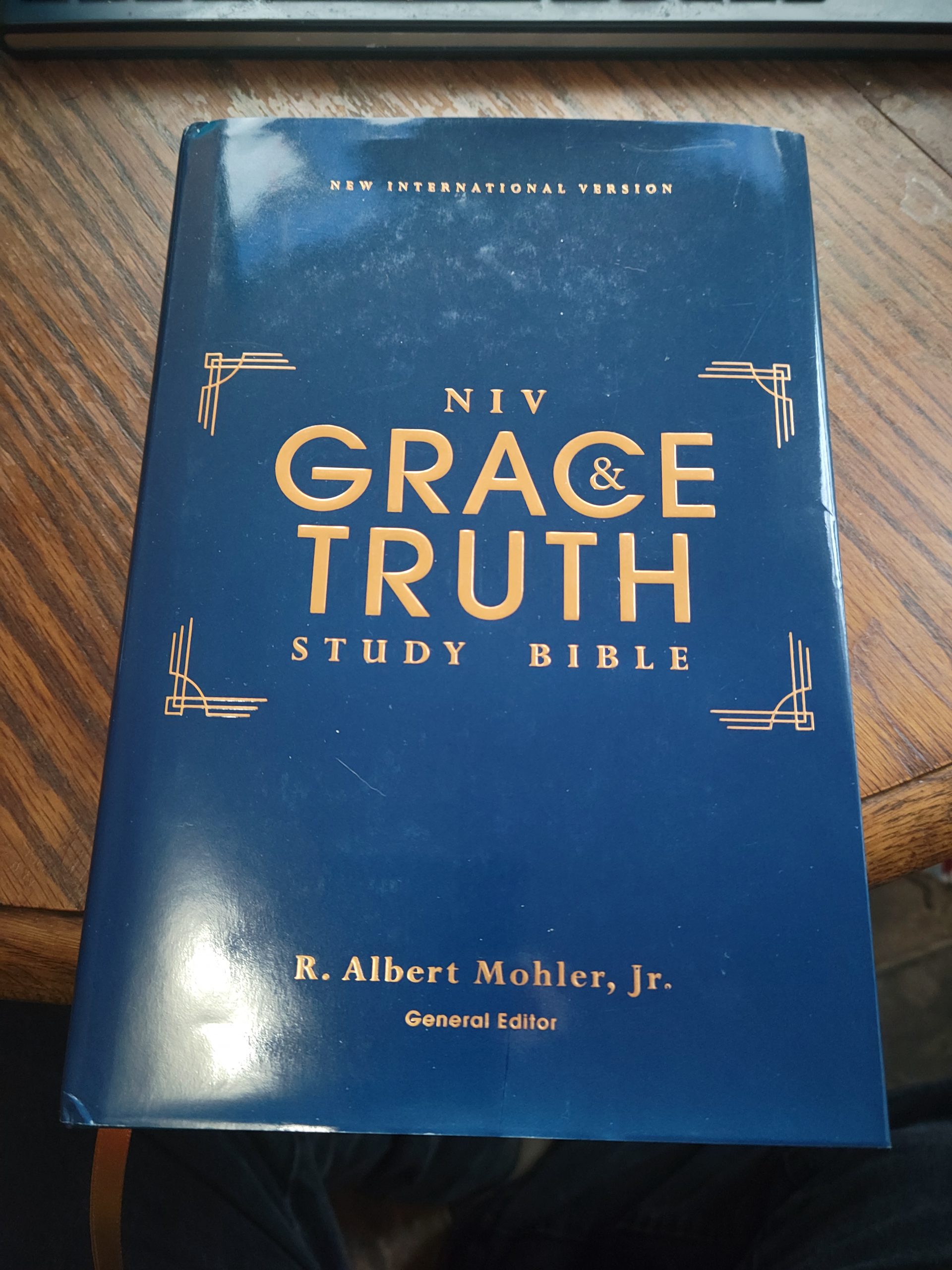
In approaching the Grace & Truth Study Bible, edited by R. Albert Mohler and published by Zondervan, the question became even more interesting when I added it to my Bible store, and found that my distributor has 17 editions/formats available, ranging in price from $39.99 (unjacketed hardcover) to $279.99 (Premium Goatskin, gilded edges). The edition I’m reviewing is priced at $49.99, and is a jacketed hardcover.
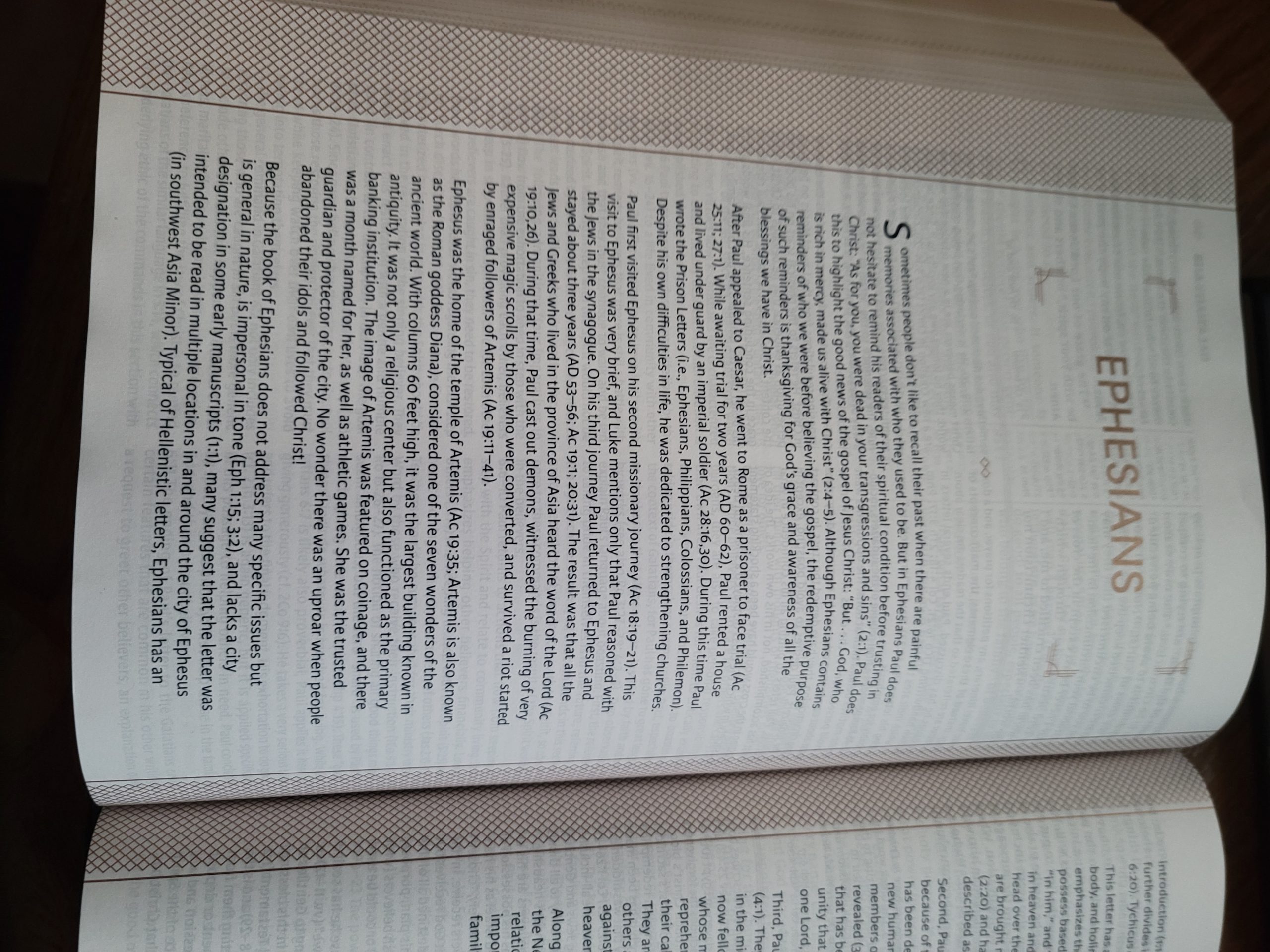
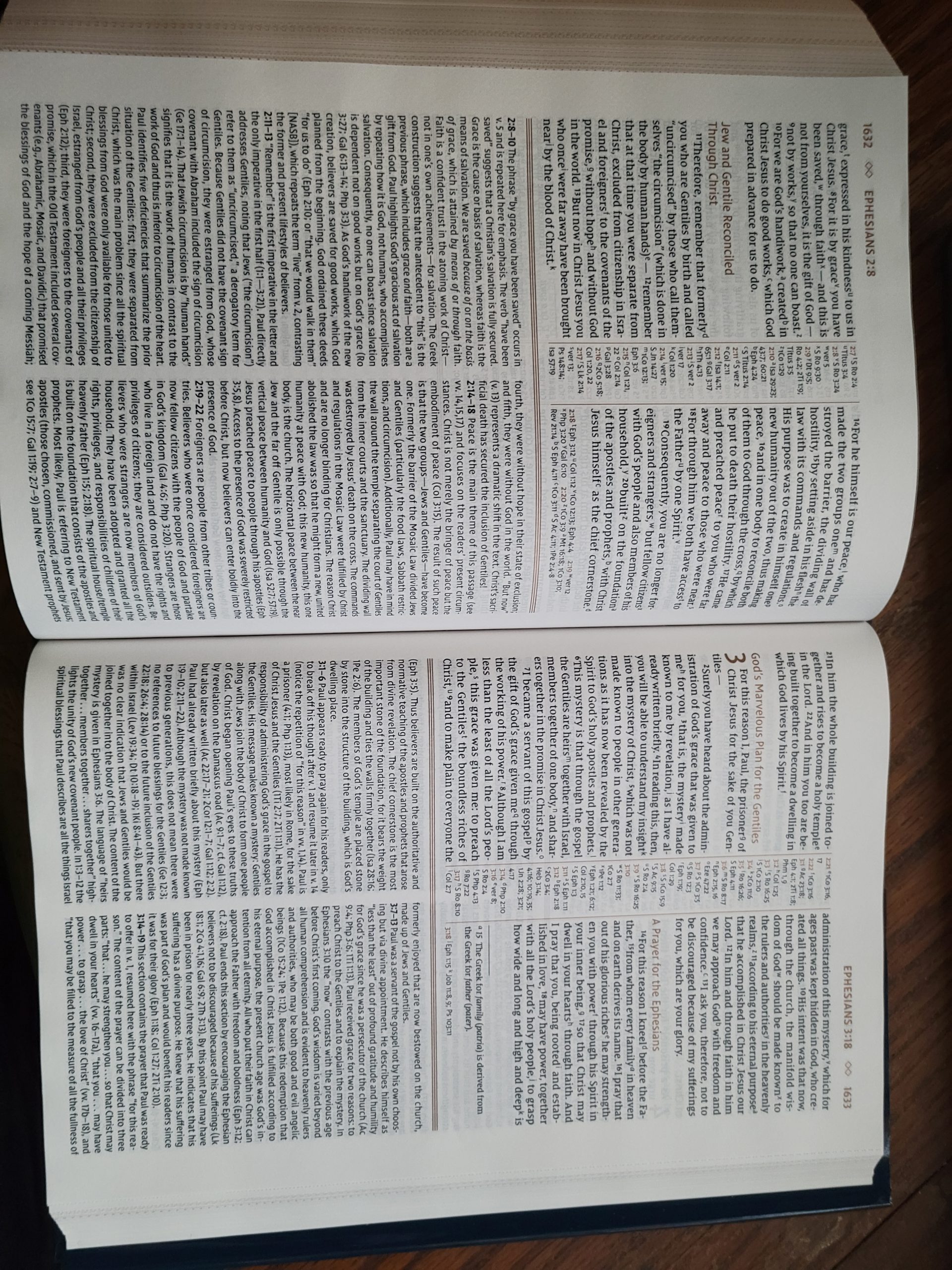
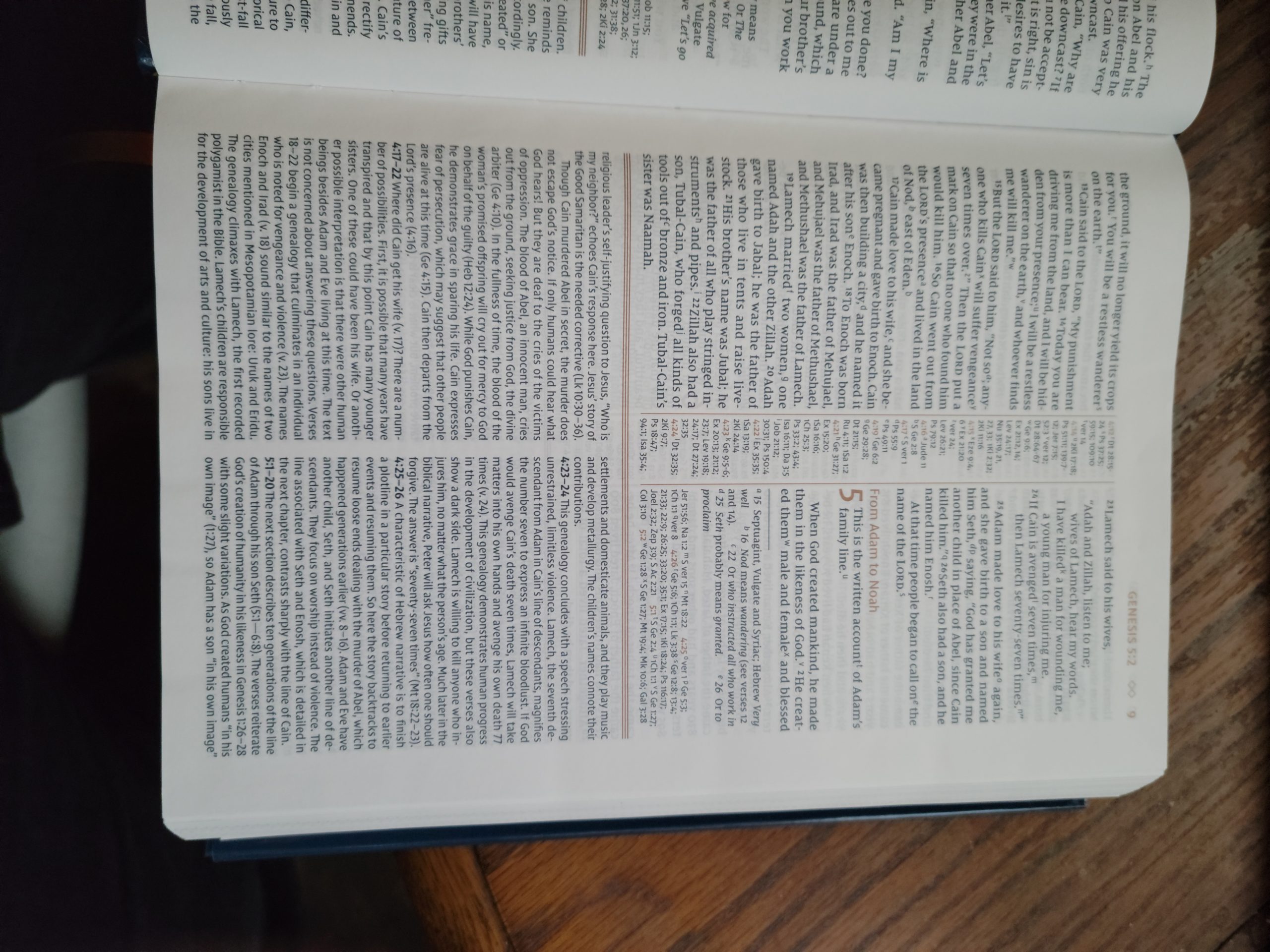
I’ll begin with a few pictures.
Front CoverIntroduction to EphesiansA Spread from EphesiansA Page from GenesisA few pictures of the Grace & Truth Study Bible
Edition / Format
The production is of good quality, as you would expect from a Zondervan product. The layout is quite traditional for a study Bible. You have an introduction to each book, notes at the bottom of each page (allowing me to continue to remind classes to read from the upper part!), and cross-references in the center of the Bible text. In the back you’ll find a concordance and some fairly standard Bible maps.
Other editions have some variations on this, such as different page sizes, binding, and paper.
Overall, there is nothing to criticize about the layout, and in fact, I kind of like the straightforward approach. We don’t have numerous “features” added that really tend to detract from study. There is a text, and there is a commentary, one study Bible! I think few modern readers make great use of cross-references, but it is nice to have them.
The big weakness of this particular edition is the 9 pt font. I found it hard to read extended portions of the text. I’m just five years short of three-score and ten, and thus my eyes may not be quite as good as those of some readers, but I read extensively and rapidly, and reading this Bible feels like work.
It’s important to note, however, that several of the editions do have larger print than the one I’m reading, so one can look at the page and font size and choose a better compromise along those lines.
Content
The translation used is the New International Version. My general comment on this edition is simply that it is a compromise between woodenly literal and freely interpretive dynamic translation work. This means it suffers from the problems of both formal and dynamic equivalence, but it also shares in the benefits. There is no such thing as a perfect translation, and the NIV covers a great deal of ground. It is definitely evangelical in flavor and thus it is not surprising for it to be the basis of this study Bible, considering the general editor. You can find brief comments on the NIV at My Bible Version or in my book What’s in a Version?
First, let me note that I do not intend to criticize this study Bible for differences in theology. Dr. Mohler is a Southern Baptist and I’m United Methodist. The header of this blog proclaims me a “passionate moderate, liberal charismatic,” and while each word of that description brings up issues when applied to my theology, it does not suggest that I’m a conservative evangelical. A book edited by a conservative evangelical is one I expect to be, well, conservative and evangelical. And this book is that.
I strongly recommend that Bible students have on hand study Bibles that disagree with them as well as ones that are from their own theological tradition. I have gotten valuable insights by comparing the comments in various study Bibles.
The commentary is not dedicated to railing against theological opponents. I would describe most comments as gently conservative, but often not putting controversial issues front and center. For example, in the introduction to Genesis there is a comment about treating this not as a scientific or historical account, but understanding it as theology and even as a work of art. I know of people all across the spectrum who would find the literary description of Genesis as quite acceptable. Conservative evangelical interpretations are espoused in the notes as one would expect.
Another example is Romans 1, which is a frequent citation in arguments about homosexuality. The notes do, in fact, express a conservative view, but it correctly (in my view) see the primary point of the passage in idolatry, and it places idolatry at the foundation of human sin.
Book introductions don’t spend a great deal of time on issues of dating and authorship and don’t enter into controversies on these issues, but do assume a relatively conservative chronology regarding the writing of the text. For example, you could read the introductions to each of the gospels and miss any issues of authorship and dependency between the various writers.
The strength of the notes is that they are a nice blend of theological and devotional. Some study Bibles emphasize giving you technical and background details that you might not know. While you will get some of that from this Bible, the devotional value appears to be primary. I would say that this is a sort of theology that is readable by the average Sunday School class. It is not seminary material. It doesn’t give you a list of options for various issues, but basically preaches its way through.
Overall
Overall, I found nothing surprising here. The Bible was very much as I imagined it would be when I first looked over the descriptions involved. I personally wouldn’t recommend it as your sole study Bible. There is a strong possibility of absorbing relatively controversial conclusions without being alerted to the possibility of disagreement. That can be nice for morning devotions, but not as your sole opportunity to study.
I do think it would be valuable as one study Bible out of a set that one uses to study. The other study Bible should be from different tradition streams, and also with a different emphasis. There are a number of evangelical study Bibles that do more analysis of the issues, for example. That may be less devotional, but if you want a balanced perspective, it’s good to know what other views exist.
Note: I received this copy of the Grace & Truth Study Bible as a #BibleGatewayPartner, with the only requirement being an honest review.
I wrote a short story as a lead-in to this study and posted it on The Jevlir Caravansary. It is titled About the Jump in Safety Violations. It illustrates what I’m trying to say about the law in this discussion.
I’m a bit behind posting these, but here are the files from the last Perspectives video. Note we will be continuing the discussion this coming week, as I only completed about half of what I had planned. The key theme text will be Jeremiah 31:31-34.
Remember that a good deal of the material I’m covering presently relies somewhat on Hebrews, which is not generally regarded as Pauline. I am one who does not believe Paul was the author. This may provide us with some material on which to base a discussion of the differences and similarities of the theology of Hebrews and of the uncontested Pauline letters.
(Note that I publish the book The Authorship of Hebrews: The Case for Paul by David Alan Black, which contends that Paul was the author. Though I think Dave makes the best possible case, in the end I am not convinced.)