Well, I didn’t do it alone, but I don’t think I can plead completely “not guilty.”
Tonight at 7 pm (about a half hour from when I’m posting this), I’ll be interviewing Lee Wyatt, author of the new book The Incredible Shrinking Gospel. Join me!
I have been asked whether I accept open theism or process theology. The fact is that I accept extreme uncertainty about the way God relates to space and time, but that I think the process theologians come closer to the way the Bible story seems to read while traditional theism seems to come closer to the assertions Bible writers make about God.
In a way it’s much like my view on the Calvinist-Arminian divide. I think there is scripture on both sides, with the Bible writers moving forward without much concern for resolving the tension between sovereign control and the true free will of creatures, both of which are affirmed in scripture, I believe. God thus remains both outside of time and yet interactive within it; both in control of all that takes place, yet impacted by events chosen by people.
It seems to me that one cannot read the story of God’s action in this world in scripture without seeing the evidence of interaction. If nothing else, Jeremiah 18, to which I refer frequently in my Eschatology series, which explicitly says that God will speak in one way, yet if the people involved change their minds, God will change his. God repents.
Now I’ve heard plenty of ways of explaining this, but none of them feel “settled” to me, so I won’t use the word “heretic” anywhere on the spectrum. Well, I rarely use that word other than with intended humor in any case. I’ve been dubbed Henry the Heretic, (usually) in a friendly way!
Let me summarize these views on God’s relationship to time broadly:
Calvinism – God is sovereign over all and predetermines all that takes place. There are, in fact, a spectrum of views on the details, but this is an intended (over)simplification.
Arminianism – God foresees all, and predestines as he foresees. There are a variety again of ways of seeing the details. This view, along with Calvinism, preserves omniscience in the sense of God knowing every details of what will take place from start to finish, from the end to the beginning.
Open Theism – God could know all of time, but has created space-time, and us in it, in such a way that he does not. In other words, he limits his own knowledge and therefore can interact with us. There are again quite a number of ways of expressing or explaining this relationship. I owe this one to a conversation with Dr. Richard Rice, author of The Openness of God (no longer in print, reprinted as God’s Foreknowledge and Man’s Freewill), but I am relaying the gist by memory, not quoting any of Dr. Rice’s work.
Process Theology – God is inextricably linked with creation and is not so much in control as we might like to think. Free will is, as I understand it, an integral part of everything and God does, in fact respond. For a bit more detail I’d refer you to Bruce Epperly, Process Theology: Embracing Adventure with God, which I publish.
My personal position remains in the open theism camp, with a very strong sprinkling of “I don’t really know” thrown in. It’s just that for me those things short of open theism do not adequately express the view of God that the overarching Bible story expresses, while process theology seems to be a bridge too far for me. But as you can see by the fact that I cite a book I edited and published, not to mention requested from the author as a source on process theology, I hardly regard it as the dangerous heresy that many do.
In fact, one of the things I have become more and more convinced of as I work as a publisher is that people’s actions are not very directly related to their doctrines. I once would have thought that Calvinists would not be that involved in missions, because God has predestined everyone. Yet they carry out missions with vigor. I might have expected Arminians to be less likely than others to “blame God” for every little thing that happens, yet they do precisely that. Both Arminians and Calvinists will talk about their prayers changing the course of hurricanes, surely something at least as predetermined as a human life.
“Orthodox” theologians, by which in this one quoted instance I mean both Arminians and Calvinists, as they both assert full sovereignty, omnipotence, omniscience, and free will, doubt that process theologians will pray, and certainly, if they pray, will not expect God to act. Yes they do, as do open theists.
In fact, if we observed behavior, we would likely find ourselves dividing Christians very differently from the way we do with regard to doctrine. I hope, in this case, to have done some distinguishing without further division!
I’ve had a hard time keeping up with blogging this week. It’s a busy month. On Wednesday nights I’m teaching from Revelation for a youth group at a local church, and of course I have my Thursday night events, one of which I’m announcing here, which are a sort of spiritual discipline for me.
I was going to try to both talk about Daniel and Revelation (in a very general way) and then go on to talk about eschatology and the quest for the historical Jesus, but I have decided not to do that and give myself a slightly more relaxed session talking about the structure and rhetoric of Daniel and Revelation. The two books are substantially different, yet they are the two acknowledged works of apocalyptic literature in the Bible, and almost any Christian discussion of eschatology touches on them at one point or another.
Growing up as a Seventh-day Adventist meant that I repeatedly studied these books. I even took a college class titled just “Daniel and Revelation.” There was an extract of the SDA Bible Commentary combining the comments on Daniel and Revelation in one book.
While I will be looking at these two books in particular, my study since has led me to look at a much broader range of material, from Ezekiel, to several chapters in Jeremiah, to much of the latter portion of Isaiah, and much more in the Bible, and also a considerable amount of non-biblical material. Yet these two books still tend to hold pride of place.
Is their purpose to give us an end-times outline? If so, in what detail, and if not, what is their purpose? I’ll be discussing this on video this evening.
I’ll be working from Chapter 4 of Dr. Edward Vick’s book Eschatology: A Participatory Study Guide and looking at the nature of prophecy and the literary nature of the texts. I’ll also be looking at ways in which we interpret prophetic literature. I apologize for posting this very late. I will try to comment in writing and add some links tomorrow and Saturday.
In the video, Dave calls this simply “The Word of God.” I’m embedding it at the end of this post.
One of my observations in talking to people about their churches and church programs is that they find the first moment when a book or program differs from their situation and take one of two approaches. First, they might discard the entire thing. This is fairly common. That won’t work for us. It doesn’t matter that what we’re doing isn’t working either. Second, they try to follow the program precisely, despite any differences, because if it worked for the expert who wrote the book, it has to work for them.
Neither of these is a strategy that is likely to succeed. Each person, community, church congregation, denomination (or jurisdiction within a denomination) is different. Each one will have different opportunities and perhaps a different call from God. I am passionately convinced that sharing the good news about Jesus with the world is our general calling. Whether that is going to involve a food pantry, classes, involvement in broader community outreach, collecting money for projects across the globe, or any one of a myriad of other possibilities, is wide open.
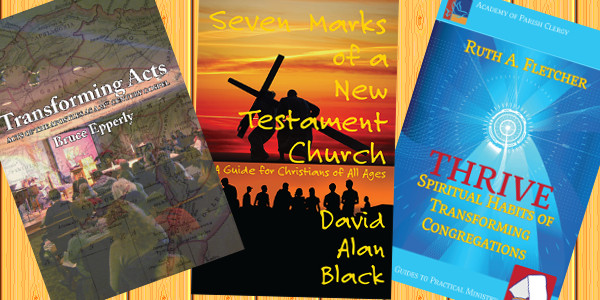
Especially in protestantism we tend to downplay tradition, but our church tradition has a role. The way you will carry out certain missions is going to depend on the history of the church congregation. We don’t all get her in the same way, and we’re not going to move forward in the same way. Dr. Ruth Fletcher, in her book Thrive: Spiritual Habits of Transforming Congregations devotes an entire chapter to choosing, to the necessity of discerning the right path and making and carrying out decisions.
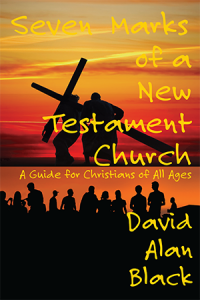
The reason I wanted to emphasize this right now is that quite frequently we think we cannot benefit from something like “apostolic teaching” or “the Word of God” unless we absolutely agree on what it is and how we’re going to deal with it. But just amongst the books that I publish, we have Dr. David Alan Black, a Southern Baptist Greek teacher (and full-time missionary, he’d insist!) and Dr. Bruce Epperly, a United Church of Christ pastor, seminary professor, and a process theologian who are both going back to the same place: Acts of the Apostles. Now I’ll tell you that if you read both of their books, something I urge you to do for reasons beyond the fact that I publish both, you’ll find quite a number of things they disagree on and quite a number of points of different emphasis. But in a church that is often drifting and dying while repeating the same behaviors that led it to its current malaise, that one similarity is enormous. Let’s look back at the early church. Let’s ask what made Christianity what it is. Perhaps there is something there that would help us.
Now one interpreter might be looking for a definitive, apostolic pattern to apply and follow. Another might be looking for a series of commands that one can carry out. Another might be reading the story and asking how are stories might relate. Yet certain things come out of such a study, and certain things result from going to the source.
I’m very protestant in ethos. I’m not at all interested in things like apostolic succession, in the sense of a series of people who had hands laid on them by a person who had hands laid on them leading back to the apostles. But I’m very interested in seeing what those early apostles did. I’m very interested in connecting my story to theirs. There is nothing about that process that is mechanical or that allows me to depend totally on someone else’s work.
Dave makes this point in the interview as he talks about us teaching one another. Why am I comparing what Dave has said with what two other authors have said? Is it so that I can sell more books? Of course I want to sell more books. I’m never going to lie to you and tell you I don’t care about selling books. But that’s not the key reason. I started publishing to do this. I wanted us to teach one another, to do on a broad scale what Dave is talking about in the local church (where I also want to see it done). I want is to help one another learn. I hope we find ourselves challenged.
There is nowhere that I want to see this more than in our use of the Bible. How is it that we can begin to see more of this individual Bible study in the church? And let me specify here by “individual” I mean “individual in community.” Let’s avoid two serious errors: 1) That Bible study is individual without any community control or involvement, and 2) That Bible study is a communal affair that can be handled by an expert passing out information. The reason I named a series I publish “participatory” in spite of the number of people who thought that word was too long, is that it is individuals participating in community who have the best possibility to find the message for themselves, their churches, and their communities.
Ruth Fletcher comments on this. Note how she doesn’t propose the same type of study for all types of churches.
Even though this is an age when people care more about what the church does than what it believes, transforming congregations know they must lessen the gap between people’s experience of God and the church’s teaching about God if the church is once again to become a reliable source of wisdom. Beliefs matter. Transforming congregations that are creedal churches help individuals discover a deeper truth in the words they recite; those that are non-creedal churches create safe space where individuals can work out their own guiding beliefs. They create space within their own tradition where people have the freedom to honestly express doubts, to say what they do not believe, to ask questions that don’t have predetermined answers, and to wonder about the mysteries of the universe. (Thrive, p. 91)
Bruce Epperly has a similar idea:
The first followers of Jesus “devoted themselves to the apostles’ teaching and fellowship, to the breaking of bread and the prayers.” They were a church whose spirituality was truly holistic. They prayed and they studied, and discovered study was a form of prayer. We need thinking Christians, who take theological reflection seriously, who ask serious questions, and challenge unhealthy and superficial images of God and human experience. (Transforming Acts, p. 48)
If you think the various visions are distant from one another consider this: What would happen to the church in America if we were to focus on studying the early church looking for insight into how to be a church following Jesus in the world today? I think that a number of wonderful things might happen despite how we decided to approach the question and the hermeneutical principles we took to the effort. Do I want us to debate such hermeneutical principles? Absolutely! The do make a difference. I think one of the greatest things we can do is to consider and discuss that issue seriously. But if we started at that point, we’d already be devoting ourselves, in our own limited ways, to the apostles’ teaching. Wouldn’t that be a good thing?
The section on this mark in the video begins about 15:30. I’m not setting the video to the starting point, as I suspect most who are willing to invest time in the video will watch it as a whole once.
… so it is not left to this sort of discussion. I did some study of and discussion of the so-called Bible codes some years back, and I’m not spending more time. The problem is that using the methodology in question (and its variants) one can come up with so many things and such vague things that it becomes self-defeating to try to respond.
In my view, by doing this sort of thing (trying to know things that are not present in the text), we go well beyond what the Bible was intended to do. The Bible is there to help you come into communication with God. That it conveys some information is not the main issue. We get stuck arguing about informational details while ignoring the broad sweep of the text.
When we turn to the Bible codes, we begin not just concentrating on informational details, we’re creating new content. It may be nice to feel that we know these things, but in fact we do not. Nobody knows. That’s the way God intended it.
One of the interesting questions that the New Testament raises is the relationship between personal eschatology and universal. When the Bible talks about the end being “soon,” which has resulted in numerous disappointments for Christians, is there an element of the personal in the statement. After all, the end has been “soon” for a few billion of us over the years. I think that idea tends to raise more questions than it answers, but it raises worthwhile questsions.
If you’re wondering what about that statement I reject, I could point to plenty of items, but the short answer would be Article XII, which Tim Bulkeley quotes, especially this: “We further deny that scientific hypotheses about earth history may properly be used to overturn the teaching of Scripture on creation and the flood.”
I’ve written on all this before. For now I just want to provide the link and open the discussion.
Since I’ve been talking about churches and leadership, I thought it would be useful to point to this article on UMC.org: Local church pastors on the rise. As usual, I think we’re behind. My personal belief is that the whole system of education we’re using, including degrees is well past its prime. If we made use of all the resources available, there would be no reason we couldn’t make better opportunities available for local church pastors to improve their skills.
But my experience with local church pastors suggests two things: 1) For every local church pastor who has a weakness, there’s very likely an elder who also has a problem, and 2) Local church pastors also have skills in ministry that many of your full elders do not.
I’m just not that enamored of the wonders of seminary education. But it’s not the education we need to get rid of. What we need to do is restructure the means and time when education is delivered, received and applied.
Recently I’ve encountered a seeming avalanche of comments, articles, and posts that claim that some new technological tool will make you stupid. Or possibly lazy. Or immoral. Or something.
Doubtless the first stone knife was similarly received — as the end of manly dependence upon unformed sticks and stones, and the birth of a generation too lazy to rip the skins off their prey with their bare hands.
Amongst the things I’ve been told will make people stupid are cell phones, tablets, laptop computers, PowerPoint presentations, television, and YouTube. These things will make you lazy, destroy your memory, rip out your analytical capabilities, and probably precipitate immoral behavior. Or something.
Thus contrary to the upright nature of previous generations, the current generation is going to hell in a handbasket. And doubtless using cliches and incomplete sentences too.
Besides the myth of the golden age, which seems to infect people around my age, this is simply nonsense. Tools are tools. We will use them according to our character. Any tool can be misused. Television can convey information and be educational. It can also convey abominable trash. A PowerPoint presentation can be boring beyond belief (I’ve made one or two), or it can contain helpful illustrations that aid understanding and memory.
I believe it is intellectual laziness that causes us to blame the tools for the result. The sort of moaning that some folks in my generation indulge in regarding modern technology is enabled by our own intellectual laziness, lack of critical thinking, and unwillingness to examine the facts.
So quit moaning about progress. Learn new things. Make effective use of new tools. Get involved in educating the next generation. Or go ahead and vegetate.
Oh, and about that seeming avalanche I mentioned in the first paragraph. That’s laziness too. There’s no recent avalanche. People have always complained about these things and always will. The only thing that happened today is that I got annoyed enough to write a blog post.