Well, the church isn’t new, except to us. We’re changing our church membership from First United Methodist Church of Pensacola to Chumuckla Community Church (a United Methodst congregation). I want to make sure you know that this is a move to, not a move from. First UMC is doing many things to be a witness to Jesus in their community and to serve others. I have enjoyed my many opportunities to teach while I was there.
Recently I was invited to teach a Sunday School series at Chumuckla Community Church. The first day I was there I started to feel that there was something there that I should try to be a part of. Over the course of the five weeks I taught (and I preached once), this feeling got stronger. I also found that Jody was feeling the same thing.
The problem for me was that there are some things happening in the education department at First UMC that I have hoped to see for a long time. Was this the time to be moving on? Then in succession I found that my very small regular Sunday School class (I’m absent guest teaching frequently, and they don’t meet when I’m gone) would very quickly find roles in the new programs. I also received a fall schedule which showed the abundance of resources at First UMC and how well they were being deployed by the new education chair (Joe Taylor) and the new Director of Christian Education, Lisa Bond.
I hadn’t imagined that I was essential to the new programs, but I had felt that I should support things that I had talked about and prayed for over the years I’ve been there.
So Jody and I are now attending a new church, and we’re hoping to be very active participants in ministry there. This church is about the same distance from us north as First UMC was south, so we still have a bit over a half hour drive.
I had thought that I was unlikely to transfer to another United Methodist congregation. This is not due to the various doctrinal controversies that are occupying everyone’s attention right now. Rather, it is due to polity. If I had my own way, I’d probably join or start a house church and meet with a smaller number of people. But unless I discern very poorly (always a possibility), God has other plans right now.
There are enormous opportunities to be the Body of Christ in the community of Chumuckla and the surrounding area. Pray for Jody and for me that we will find and answer God’s call for us in this church.
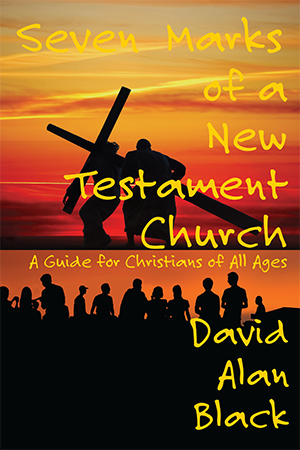
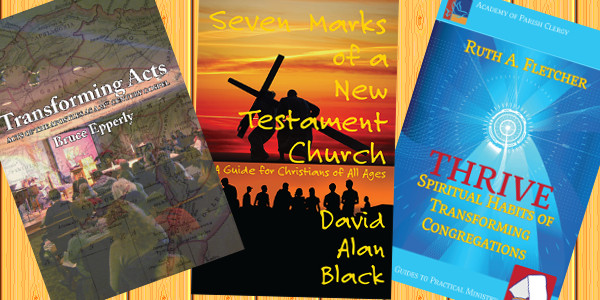
I’m starting a series of posts inspired by my recent interview with Dr. David Alan Black regarding his book Seven Marks of a New Testament Church. He bases this book and the seven marks on Acts 2:37-47. You can see a video of that interview below.
I had the privilege of interviewing Dave while he was visiting Pensacola the weekend of September 6. The interview was recorded by Kyle Hall in the library at First United Methodist Church here in Pensacola. I want to thank Dave for visiting and Kyle for recording the video.
But what does all this have to do with my belief that church pews are unbiblical?
The starting point for Dave’s book is that you can look at the book of Acts, and the activities of the early Christian church, and find things that are normative, or at least very valuable, to modern Christians. Dave isn’t alone in this conviction, but I want to start with the question of how we move from what we find in Acts to what we should do in modern churches. This topic is discussed in the first 4.5 minutes of the video.
We don’t find sound systems or their use in the New Testament. Neither do we find hymnals, organs, pianos, praise bands, orders of service, parking lots, or many other things that are automatically part of our modern life, and often of our church activities. Is it wrong to have something in church that isn’t actually mentioned in the New Testament? There are those who would think so.
On the other hand there are those who would say that church has changed so much that we need to come up with our own unique ways of doing things, that looking back to the early church isn’t going to be enough to deal with our complex world of the 21st century.
I think there is some truth in both points. There are, in fact, critical principles in the New Testament that need to be part of any church that wants to label itself Christian, or more important wants to consider itself a community of disciples of Jesus. (I’d prefer the latter personally.) On the other hand we have situations in the modern world that weren’t a part of the world of the New Testament.
The question is whether the way we choose to meet the challenges of the 21st century is worthy of the good news about Jesus. Do our solutions to modern problems, even when those problems are not directly reflected in some New Testament story or statement, fulfill the principles that Jesus taught? When we make a change does it help us love God and one another? Does it help us to make disciples wherever we go?
So I come to church pews. They aren’t mentioned in the New Testament. They wouldn’t have been needed, though doubtless the various Christian homes that hosted meetings had chairs of some sort. I have a problem with church pews.
Now my problem is that we can’t develop new tools and new practices to meet 21st century demands. The problem is that I don’t think church pews help us love God or one another more and I think they tend to prevent us from fulfilling the gospel commission.
Bicycles are also not mentioned in the New Testament. They’re really good and very helpful in many places. Neither are motorcycles mentioned, but what a blessing they are. I can’t count the number of times I’d head out as a teenager, living with my parents in Guyana, South America, riding on the back of a motorcycle behind an evangelist, holding my trumpet case in one hand. It was the 20th century, true, but it was a very non-1st-century scene. Well, in one way, not 1st century. But in another, the young person heading out to help the evangelist do his work is a very 1st century scene. The tools changed, but the mission didn’t.
But what about those pews? Yes, back to pews. What do pews do for the work of ministry. The very arrangement of our sanctuaries with pews lined up facing a platform where the more important people sit and from which they tell the less knowledgeable what to think tends toward hierarchy. If we’re going to fulfill the hope of Jeremiah 31:34, we need to get more people involved. Our problem is not that our churches don’t have enough order it’s that we don’t have the problems of 1 Corinthians 14. Too many people wanting to speak? On the contrary, just try to get them to do so.
The pews enable this bad behavior and congregational laziness. The people in the pews are there to listen, to receive, not to share and participate.
And then there’s the matter of stewardship. A church “sanctuary” (and what happened to worshiping in spirit and in truth?) is by nature going to be wasted space. There are so many things you can’t do there, because there are very few meetings, other than a totally platform-centered church “service” (who is getting served?), that can take place there.
The same space, made level and filled with movable chairs would be of value for many other purposes. Children could play games. Groups could meet and discuss, putting the chairs in a circle. One might even celebrate communion as a full meal. Yes, I know, we probably have a fellowship hall for that. But why do we do that? Probably because sitting down together and eating isn’t sacred enough to happen in the holy space filled with holy pews.
After we take the pews out, I wouldn’t mind having musical instruments, video, and plenty of parking for those who meet there, none of which are mentioned in the New Testament.
It’s not what’s mentioned and what’s not, but the type of people we are to be and the way we are to behave as disciples of Jesus.
Oh, we could also offer meals to those in need using that space. If it didn’t have pews, that is.
I’m married to a nurse, my mother is a retired nurse, my sister is a nurse (NICU, which puts me in awe of her), and my daughter is in nursing school. It was unlikely I’d miss the discussion of Joy Behar’s comments and the resulting, entirely deserved firestorm, not to mention the failure of efforts to apologize.
I’m going to say very little about nursing. It’s a job I would be totally incapable of doing. I wouldn’t want to. The work is too hard, the sacrifice is too great, the pay is too bad, and the treatment they receive often leaves something to be desired. We need them badly, but we don’t generally realize it.
But the way in which one contestant for Miss America was treated is not some kind of accident. It is not just that someone misspoke or had a stupid moment. We can all have stupid moments when something comes out of our mouth that we didn’t really want to say. Many times, however, what comes out of our mouth at such moments reflects who we are and what we value more accurately than our carefully planned and nuanced statements.
Let me get one thing out of the way. I don’t like our media. I don’t like our entertainment industry. There are remarkable few things produced by it that I will watch. So yes, I am very biased. If I didn’t say it now you’d guess from what I’m about to say. I think our media is shallow. I think our entertainment is designed for the raising of non-thinkers who don’t merely have bad values; rather, they have no real system of values at all, unless we count mental (and physical) laziness. Parents who leave your kids to be raised by your TV: That’s what you’re asking for and it’s what you’re likely to get.
It isn’t that I’m extremely prudish. At least I don’t think so. I don’t even mind the portrayal of nudity and of sex in the media—where it is artistically appropriate. What I object to is the feeling that none of this matters. That sex, violence, indolence, irresponsibility, drunkenness, ignorance, and stupidity are so unimportant as to be routine. It’s not that sex before marriage is portrayed or implied in the shows. It is that it is assumed. You go on a date. You have sex. It doesn’t matter.
But I don’t blame this mythical engine called “the media” for this problem. No! I blame us.
One of the things I learned in economics that I’ve observed in real life is that prices are determined by supply and demand. There’s a corollary that supply will increase to meet demand. Even where governments have attempted to suppress the freedom of the economy, there is a limit on how much one can buck this one rule.
Now get this: The media doesn’t want to. Why do we see what we do on television? Because that is what we watch. We may talk about higher values and a desire to see good, wholesome, edifying content (no, I don’t mean just religious), but what we actually watch is not what we claim to want. The folks in Hollywood and in the executive offices of TV and Cable networks know that. They’re going to provide what you actually watch, not what you like to pretend—in church and in blog posts that others will read—that you want to watch. Yes, I know, some of us don’t watch that sort of thing. Some of us do look for better fare. But that is not where our culture is right now, and that is the problem.
I recall my hopes when I first got cable. I made sure the History Channel would be in my package. I planned to get all that interesting documentary material. And there are occasionally, very occasionally, things to watch. But most of it is not that helpful. My wife and I turned off cable some time ago. I admit we miss baseball, which is hard to get live, especially in the post season, but that and “A Capitol Fourth” are the only things I recall us saying we wished we had.
But this isn’t really about TV or the media, though those tend to reflect our values as a society. There’s another reflection of our values, the amount we are willing to pay for things.
I encounter this in working on computers. I’ll get called out to someone’s home or office to help them with their computer and they’ll complain to me about the lack of service provided by the manufacturer or retailer for their PC. But it often turns out that they have purchased the lowest cost discount PC from the largest discount organization possible. I don’t have a problem with that as such. But if you buy discount hardware from a discount retailer and then have trouble, it’s going to cost you. Just as we claim to want one sort of material in media but actually watch something different, we claim to want a certain level of service, but we give our money to businesses that don’t provide it. Guess what? Their prices are set with the intention of not providing that sort of service.
It carries over to churches. It’s very interesting to compare a church’s claims regarding its mission and priorities and then look at the church budget. A mission oriented church will turn out to spend 1% or less of its budget on missions. Churches that claim their priority is to “reach the lost for Christ” spend more on their softball fields, cemeteries, or recreational facilities than on their claimed mission. And yes, I know that the softball field and recreational facilities can be a venue for missions. But are they? Really? Or was that just the excuse given to the church board to justify the money spent. I’ve known churches who were quite willing to spend money on the facilities and who claimed that those facilities were there so the church could better serve Jesus, but who then refused to spend the utility money to keep the building open for young people who weren’t church members.
We may not want to talk about money, but money, in my view, is the surest way to tell what one’s values actually are. That goes for individuals as well as churches.
And if you look at the numbers, we don’t really value nurses all that much. To some extent we value doctors, unless you bother to consider the student loans they’re busy paying off. (Some of those nurses have a stack of those too. Settle that against the amount they earn!)
I don’t begrudge good money to sports figures and entertainers. A great baseball player is a percentage of a percentage of a percentage of an already fairly elite group. He works hard to get there, and he’s fun to watch. But the proportions of what we pay for stars? It’s not explained by all that effort or even by the numbers. Not unless you include our value system as a society. We’ll complain about Joy Behar and The View today, but tomorrow she’ll still be making more money than dozens of nurses combined, even with the way advertising is being pulled form the show.
We’ll complain that the electrician, the construction worker, the checker at the nearest box store, or the receptionist in an office don’t do their jobs well enough, but do we treat them with respect? If they do their jobs well, do we say something? If we’re their employer, do we pay them as valued people? We need all those people along with the doctors, nurses, lab technicians, radiology techs, and so many others, but despite anything we say when we have an incident like this, many of us are going to say “Wow!” when we see the celebrity and “just another nurse” when we see the nurse. In our heads, I mean. Part of it’s the routine. We see more nurses than famous actors or actresses. We like to see people who have a gig that’s better than we expect. Sure. And that right there reflects our real values.
So I think we should complain when someone says something stupid and demeaning about an entire profession. That’s good. Let’s have plenty of letters, stories, essays, and tributes about/to nurses. They deserve every bit of it.
But let’s go a step further. Let’s reorder our values. Our children who are in football are not more important than those in music, or those in science programs, or those who are preparing to be excellent construction workers. We want those jobs done well. How about starting by reflecting in words and actions every day how much we value them?
This will be on my YouTube channel and Google+ at 7 pm central time tonight.
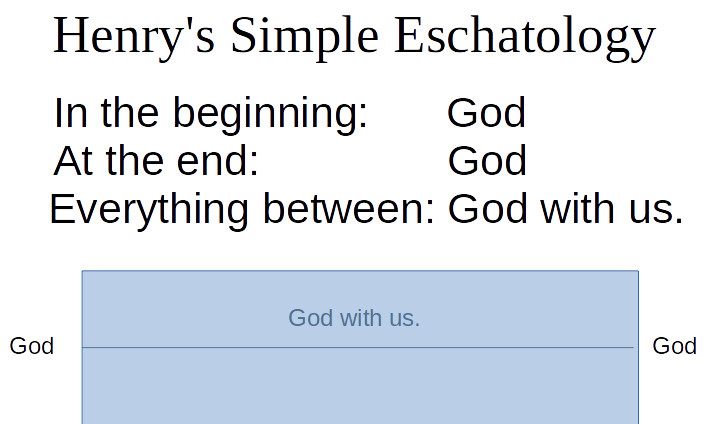
I’m actually going to start from what I left off last week and talk about “this generation shall not pass,” which will require me to talk a bit about biblical inspiration. Following that I plan to introduce my (not so original) simple view of eschatology and then look at Mark 13 and how it might fit in.
Next week I’ll be looking at the variety, and some history of prophecy in Old Testament times, and then next week we’ll tackle chapter 4 of Dr. Vick’s book, Prophecy and Apocalyptic.
As I work on these, I’m also working on a series of four talks on Revelation to be presented to some teenagers during the month of October. That may be more challenging than these presentations.
We’re starting a new series of posts on the Energion Discussion Network and the current author is my friend and Energion author Dr. Herold Weiss. He’s the author of the book Creation in Scripture, the first in a series discussing creation from the point of view of those who accept the theory of evolution. That note should tell you that Dr. Weiss’s work can be controversial, as are all discussions of this topic.
I don’t happen to like the terms generally used, but it is generally somewhere between frustrating and futile to try to change language. “Creationist” has become the label of those who believe in a recent (read 6 to 10 thousand years) creation in a literal week, while “theistic evolutionist” labels those who believe God is creator but that the process of evolution is how he has chosen to diversify life here on this planet.
Dr. Weiss does something in his first post in this series that tends to annoy creationists (using the definition above). He calls their view unscriptural. The typical view of a creationist is that their view is scriptural while the theistic evolutionist has chosen to ignore the Bible in favor of evolutionary theory. No matter how strong the evidence for evolution (and they will, with few exceptions, maintain that it is weak), they would not see how it could override the Word of God. So the argument, at least as they generally present it to me, should be couched in terms of their strong convictions about scripture and the weak convictions of the theistic evolutionists, which are to be defended.
But neither I nor Dr. Weiss thinks our position is biblically weak. In fact, I did not change my view from a young earth creationist, which I was until some time during my third year in college, because I had studied evolutionary science. My science requirement was fulfilled in a chemistry class, taught, by the way, by a young earth creationist. It was in doing research for a paper that I found that I could not reconcile the biblical texts on the basis required for young earth creationism. The starting point was chronology, and it wasn’t even comparisons with archeology. It was simply looking at what must have happened between two points in the biblical story, and determining that it was beyond extremely improbable; it was impossible. And further, there was no report of some sort of miracle to connect the dots.
From there the question changed for me. Why is God presenting the story in this manner? (I’m ignoring here all the things I have come to believe about biblical inspiration over the years and discussing my thinking at age 20.) From there I started to ask just what it means to me that God is the creator and how that doctrine reverberates through scripture.
And this is what I think creationists can learn from Dr. Weiss. No, I’m not suggesting they will all read his book and decide to become theistic evolutionists. He isn’t even trying to make that case in the book, and I know my own views would be unlikely to change in reading one book. What he does that is important is look at how creation, and its implications, is presented in various parts of the Bible. Creationists seem to me to be hung up in Genesis 1-3, important chapters to be sure, but not the only thing in scripture on the topic. And yes, I do think these chapters are important, even foundational, even though I read them differently. And no, I’m not claiming that creationists are ignorant of all other passages. What I’m suggesting is that they are not brought into the discussion enough.
Too much of the debate about creation and evolution is concentrated on when and how and too little is focused on so what now?.
I think it would be great if we spent more time on the third question. Yes, we’d still disagree on when and how, and we’d still argue that both of those questions impact the answer to the third, but we might have a chance to shed a bit more light. I think Dr. Weiss has facilitated that.
I asked Dave about going into prayer in such a way as to simply reinforce what I already think and want. He talks about how important listening is as part of prayer. It’s not a catalog of our desires sent to God. It’s a time of listening and learning.
I also asked him what to do if one wanted to improve the prayer life of a church congregation or community, and how one proceeds when someone asks for prayer for a specific purpose.
Dave is practical and down to earth. I really enjoyed the conversation and learned from it.
Well, my prospective, perhaps presumptive garden, that is.
One of the important elements to understanding stories in the Bible, parables included, is our perspective. In Christian circles, when we hear “the sower went forth to sow,” (Matthew 13:3), or perhaps “a farmer went out to sow his seed,” we generally see ourselves in the role of the one doing the planting. We are evangelising, and people have different kinds of hearts. Have you ever heard someone describe another person as being rocky ground? Or perhaps someone has said, “He’s trying to dig some hard ground there!” Usually these expressions are used regarding targets of evangelism.
I’ll mention evangelism later, but first, let me place myself in the role of one receiving the seed. Is that not what I do when I pray and hope to hear from the Lord? Is that also not what I do when I open my Bible and hope to be changed by God’s message? So I am the ground, not the sower.
But let me tell you the story of my garden thus far. Fortunately for me, I have few plans that involve saving money on food, supplementing my diet, or saving on the food budget. I had one purpose in starting a garden: I need to spend more time in physical activity. Now I’m a bit of a workaholic. I have a hard time not doing anything. The easiest way to get myself to do what I need to do was to make it into work. Then I can feel good while I do it.
So I picked a plot on our little place out here and started to work on it. It has gone through being broken up with an excavator (at which time I killed power to my office and broke our water line, but that’s another story), lots of hoeing and raking, and digging up of roots and rocks. This morning I finally got to the point of being ready to actually till the plot. My previous work had been aimed, not at getting the soil ready for actual planting, but at removing obstacles. I have a large pile of brush, roots, and rocks at either end of the plot, things I have removed as I worked.
Then I had a period of time when I was just too busy with work. Between my work with computers and computer networks and my publishing work, I was simply overwhelmed. The phone would ring by 8 am and I wouldn’t get that much done outside. What do you suppose happened? Well, the plot got some new growth, but not the stuff I want to grow, of course, since I hadn’t yet planted. So out came the weedwacker, the hoe, and finally the rake.
Today I finally got to the tiller. That’s the tiller, in the picture to the left. I borrowed it from my friend Tom Hunt. If you need a floorplan done for a new house, he’s the one to go to.
There were some interesting things about using the tiller as well. Weeds leave behind small roots that tend to wrap themselves around anything available. No matter how may rocks you’ve removed there may be a few more. Run the tiller in a couple of directions. The pile of dirt from one pass may hide some hard soil. Power tools are great, but I ended my morning session more tired than when I worked with the hoe. The tool helps, but the human still better put heart and back into the effort.
Let me apply these to Bible study just a bit. You might want to reference my post from yesterday. Here are some thoughts I had while listening to that wonderful purr (or roar) of the tiller motor.
Different tools accomplish different things. No matter how much you may have gotten with one approach, try taking another look from another angle or with some different help.
Weeds don’t stay dead. You’re never really done. It’s easy to get complacent and think you already have it covered. Now it’s all about telling other people. Don’t get in that place. If you neglect your heart garden for a while, you may find the ground hardening and the weeds getting tall.
Don’t imagine that a period of neglect is the end. That’s what weedwackers, hoes, shovels, rakes, and tillers are for. Those of you who have forgotten your biblical languages after seminary, consider this as well. How about working on reviving them? Yes, I believe you can study the Bible effectively without the biblical languages, but after investing all that time and effort wouldn’t you like the benefit of that tool?
Don’t be blind to the rocks that are still there. You may have removed bunches of rocks, yet there are still some to find and remove. I often joke with Jody that it would be nice if I could measure the quality of my cleaning by the quantity of dirt I removed and not by what was left. Read 1 Corinthians 8:1-3 if you’re thinking you’re good!
Tools help but they don’t do the job. I love Logos Bible software. I love sites that let me compare versions (BibleGateway.com, for example). But these things don’t do your studying for you. They will make you more efficient. Many Bible students amass information and yet don’t get to what the text is saying to them. I was reminded of that forcefully as I moved the tiller through my prospective garden. It did more work than I could have accomplished with the hoe, but it still required me to make the application!
Sometimes you get so tangled with the weeds that you can’t really go on clearing and tilling. I experienced this as left-over weeds and roots tangled up the tiller. I had to stop and clear the blades so the tiller could work efficiently. I’ve experienced this in preparation for teaching my Eschatology series on Google Hangouts on Air (link to next session, Thurs. night at 7 pm central time). Eschatological views are based on many, many texts, and there are many, many views on each of these texts, plus mountains of theology done to tie them together or explain them away. It’s very easy to get so tangled in the details that you can’t see the actual text in front of you. I bounced this off my wife Jody, who has a practical mind set. I asked her to read Mark 13 the other day and then question me about it. She had a set of questions that helped clarify the chapter.
I’m sure there are many more lessons, but those are the ones that occurred to me as I worked this morning. But does any of this apply to evangelism?
Quit trying to judge the people you witness to. You can’t see what’s under the ground.
The best way to witness is to till your own heart. I can’t emphasize this enough. Most people can tell very quickly if you’re trying to use them for something else. So if you are making relationships with other people in order to convert them or make them into church members, they’re going to get that feeling. But if you are genuine and genuinely care about them, they will also know that.
The Christian life and Christian witness isn’t a strategy. See #2. Enough said!
God is the one who changes people. You witness. God acts. Be humble enough to give God the credit. Be humble enough to let God take the responsibility.
Do you see what happened? Quite frankly, all the lessons but one applied to me. As for reaching others, I have one duty: plant the seed. Now planting the seed can be complex, but I suggest that it starts with some of the points I made above. Let God’s word impact your life. Continue to let God’s word impact your life. Continue some more letting God’s word impact your life. Continue yet much more letting God’s word impact your life.
Yesterday I wrote a bit about using prayer and Bible study as a starting point for change. The problem is that it’s very easy to pray and study the Bible in such a way that it makes you a worse person.
I’ve found a relatively simple way to determine whether I’m doing this myself:
If I’m studying the Bible to figure out what other people are doing wrong, how other people need to change, I’m making a worse person of myself.
If I’m studying the Bible so that by beholding I can be changed, so that I can find out how to be a better follower of Jesus, I’m allowing God to make a better person of me.
I frequently hear (and have sometimes myself offered) prayers that ask God to fix someone else. If you’re praying for your pastor and asking God to make him or her see things your way, you’re on a dangerous path. Let God make the decisions. It might just turn out that what needs to change in your relationship with your pastor might be you.
In Bible study I’d take another step and say that one’s general approach needs adjustment. When I started studying biblical languages I imagined that I would discover the original text and read it in the original languages, and thus resolve issues, at least to the extent that I would be certain of what was right and what was wrong. Getting that information was my entire intent.
As I studied, I found that every aspect of that approach was problematic. Even the idea of an original text wasn’t easy to define. Was I looking for the text that came from the pen of the writer, however inaccessible that might be? Was it to be found in whatever sources were used by a writer? Perhaps the text actually used in the early church was more important than some earlier text that was beyond my reach. Having discovered (or pretended to discover) whatever text I was after I then had the problem with where and how it applied. The hard and indisputable facts were generally in dispute, no matter how long I studied.
Over time I have come to believe that there is value in studying all levels of the text. Those who prefer canonical criticism look down on form, source, and redaction critics, and claim that the canonical form is the “special” form of the text. Source criticism, just as an example, assumes that one wants to get closer to the roots of the text.
I find both approaches helpful. One is certainly on less solid ground looking at the prehistory of the text. While I may have doubt about the details of the canonical form of the text, I am frequently in serious doubt about the text’s prehistory. Yet when I’m studying the text to see God in action, I am always able to listen for the voice of God. Sometimes that voice will even get through the static of my own thoughts.
Talking to God and listening to God are about changing me. Only when I first focus this on me will I be in a position to help someone else. If I respect them and love them as I believe God loves me and calls me to behave, I have to allow them to behold and become changed (2 Cor. 3:18) as well.
Over the last few years I’ve come to believe that we have two key elements that need to be changed, but more fundamentally, we keep talking about the church too much differently than we talk about individuals. As individuals, we need to be following Jesus, not just appropriating the label “Christian.” As a church, we need to be following Jesus. Those who are following Jesus will be witnesses. A church following Jesus is a witness.
What do I see as the two key elements?
Lack of Bible study and reflection. I see this broadly, as in study that leads us closer to God.
We do not lead lives of prayer. This differs from praying occasionally, or offering pre-written prayers in a church service.
I think that if we were to correct these two elements, others would correct themselves. I need to correct them as well. There are those who commend me on my biblical knowledge and who consider me a man of prayer. (Others, not so much!) But the fact is that I don’t live up to the standards I believe in. While we are, indeed, all imperfect, we can all keep heading in the right direction.
I also think these two elements are much more closely connected than is generally realized. Prayer should be communication, conversation, not a monologue directed at God. Bible study should include the discipline of listening and a constant process of opening one’s self up to what God has for one in scripture.
I met Dr. Agatha Thrash back in 1974 when I went to stay with my brother-in-law Ted Nick and my sister Betty Rae. I managed the Country Life Natural Food Store (it was not then a restaurant) for nearly a year. Well, I was manager and sole worker. I didn’t really get to know Dr. Agatha very well, but I’d have lunch with Dr. Calvin Thrash on a regular basis.
I note that I never really connected, and indeed my life has gone very far from the sort of life style upheld at Uchee Pines Institute (then Yuchi Pines). I’m no longer Seventh-day Adventist which puts me multiple steps for self-supporting SDA programs and institutions.
As a pathologist, Thrash had a goal to establish a large lab to process tests for doctors throughout the region. But when she became an Adventist, “Jesus got a hold of her and said ‘I have a different way I want you to go, not just making a lot of money. I want you to change lives.’ And she did.”
I would note that my father also worked in self-supporting Adventist institutions, as medical director of Wildwood Sanitarium and Hospital. By the time I was working at Uchee Pines, he was a missionary in Guyana, South America.
It was an interesting year I spent at Uchee Pines (still can’t get used to the new spelling/pronunciation!). I was very young, but also a member of staff, so I spent a year as neither fish nor fowl. Yet the Drs. Thrash still had a significant impact on my life. I know those who survive her will find peace in the certain hope of the resurrection.