In the past I have been accused of rejecting penal substitutionary atonement because of the fact that I don’t see it as central, or as the explanation of the atonement. In fact, I don’t see any theory of the atonement as a single explanation of the atonement. Our theories of the atonement are metaphors, used to carry across some of the meaning to us.
As does Allan Bevere, I do find pretty much all theories of the atonement relevant in one way or another. Where I tend to be concerned is where a metaphor begins, in some people’s minds, to become the reality, i.e. that rather than believing in the cross of Christ we believe in our particular metaphor, the one that may best speak to us. I recall a professor from whom I took a class in exegesis of Romans from the Greek text. What was remarkable about the class was that his favorite theory, or metaphor, for the atonement as the moral influence theory. Now I have a bit of a liking for that metaphor myself, but it is not the metaphor Paul uses in Romans. There is some overlap. But this professor, because that was his very most favorite metaphor, taught nothing but, twisting Paul considerably in the process.
I’d add one more caveat. Relevance is a word that points both ways. A metaphor, to be relevant must communicate to one who hears. If it doesn’t, it isn’t working as a metaphor. I think quite often we need to correct the presentation of some metaphors to make them function better. If they don’t carry something over, they aren’t relevant in that case, however great they might be otherwise.
The day after the Iowa caucuses I’m left to wonder how I could have gotten so uninterested in politics. I have been fascinated by government as long as I can remember, and when I turned 18 and could vote I not only registered immediately, I also started working as a precinct worker for a presidential campaign. Now I can read a couple of articles on an election and my appetite is more than satisfied.
What has really happened, I think, is that I have gotten more perspective on politics. I have lived through eight years of my friends to the left despising President George W. Bush, and then another eight years of my friends on the right despising President Barack Obama. In both cases it was very difficult to conduct a civil conversation on topics of policy. I have problems with both of these presidents, I might note, and almost all of the problems I have with them are the same for both, primarily an extension of executive power and an excessive willingness to resort to force.
I have not decided politics is not important. I will definitely vote every time I’m eligible. I will always research the candidates thoroughly once it is time to make my choice.
What I have decided is that politics is not as critical as I once thought. I have other priorities now.
Tonight I’ll be finishing my preparatory studies for eschatology as I look at a few more visions, especially from Zechariah, and then at a bit of chronology in preparation for studying the book of Daniel on a more verse by verse basis starting next week.
I’m working on a programming project for the IT side of my business today and I was reminded of the importance of little things.
When I’m programming and something goes wrong, my tendency is to look for big things. For example, there was a problem in this program with handling time zone data. Time codes were coming out different processed through different systems. My first thought, which I followed, was to look for bad settings in the overall system, and then for subtle differences in the way different functions handled this data.
But no, none of the above was correct. The actual error was a one character problem in the way I was formatting some text—the simplest element of the code involved. Because I was looking for the big things, none of which were causing the problem, I wasted considerable time. Once I saw the actual problem, a couple of keystrokes fixed it.
Might this not apply to our lives at times? We’re looking for the big changes when we just need to change something small, but which will have a big result?
I’m starting in about 15 minutes. Tonight I’m going to be looking at Revelation 21 & 22 and their use of 3rd Isaiah (chapters 56-66). I want to look at how imagery is used and reused and how this impacts the way we interpret.
This morning Dave Black posted some things about reading Hebrews from the Good News Bible (TEV) and also on authorship and canonicity. I’m not posting to enter into a debate on this point, but rather to note an attitude.
Dave says:
The undeniable reality is that questions of canon and authorship matter. Of course, both sides demonize the other. Proponents of Pauline authorship are dismissed as obscurantists, while proponents of Hebrews’ non-Paulinity are accused of succumbing to the spirit of the age. But why should we tolerate this kind of judgmental divisiveness? Maybe we need another conference on campus to discuss the issue!
Good points! I am deeply concerned when people who are treated with intolerance by one group, move to another, and then treat their former group with intolerance. Is there justification for some reaction? I know many people personally who have been treated badly and many of them have been deeply hurt. There’s some justification here for anger. I publish books by authors who have lost their jobs over theological positions.
But is the justification enough? I don’t think so. Our response to intolerance needs to be greater tolerance. That doesn’t mean we have to accept and approve behavior. What it means is that we need to look for a freer exchange of ideas and better treatment of people.
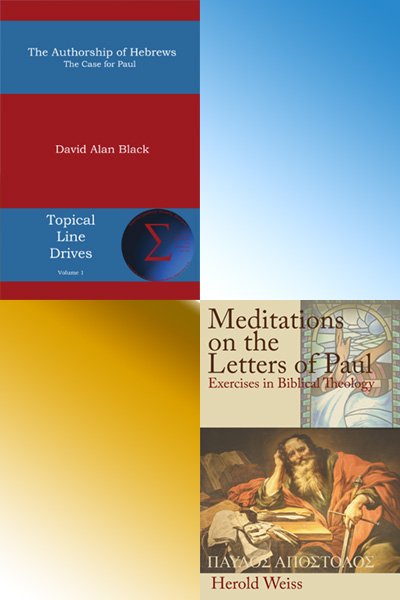
There are those who wonder why I publish a book like Dave’s The Authorship of Hebrews. Not only do I publish that book, but I requested it. Dave didn’t push it on me. I don’t accept Pauline authorship of Hebrews. I don’t believe we can know the author’s name with any confidence. Yet Dave’s work on this topic shifted my position from one that excluded Paul from the list of possible authors to accepting that his authorship is a possibility. More importantly, Dave demonstrates how to challenge an academic consensus—with detailed, careful scholarship.
Now let me provide a contrast and a comparison. In the lower right of my little graphic today we have the cover for the forthcoming book from Dr. Herold Weiss, Meditations on the Letters of Paul, which I’m currently editing. First, the contrast. Contrary to Dave Black’s acceptance of Pauline authorship of Hebrews, not to mention the pastorals, Dr. Weiss accepts a minimal Pauline corpus. He even rejects Colossians. So his meditations are on a substantially smaller set of writings that Dr. Black’s would be. Now for the similarity: Besides the fact that I enjoy and have learned much from both writers and both books, neither of these men has ever asked me to accept something because it’s in their tradition, or just because they said so. They are both willing to debate and discuss.
I can give you numerous reasons why I publish books from a variety of perspectives, and I’ve done so before. But there’s a personal reason. I like them and I benefit from them. I have published some books that I really wish had been better. I do not claim any sort of editorial infallibility. In fact, I would claim feet of clay. But I have learned from and benefitted by reading each and every book I have published.
Let me suggest a response to Dave’s little book. How about looking at some of the vocabulary comparisons excluding the pastorals, or even working from a minimal Pauline corpus? I’d like to play with that. I don’t know if it would be meaningful, but somebody could look at it.
I’ve posted the event for my study on eschatology tonight. I’ll be looking at Isaiah for at least two sessions, the first focused on the servant passages as an exercise in interpretation, and the second on the language of the latter chapters and how it is incorporated into apocalyptic and in turn into our eschatology.
I enjoyed reading the responses for a number of reasons other than the actual answer given to the question. Quite frequently we respond to an article based on whether we agree with the answer or not. The well-argued, well-presented article is one that supports our own point of view. The scattered, poorly presented one is the one we oppose. In my experience only a few people can say, “This was a well-written article even though I disagree vigorously with its conclusion.”
I’m going to do precisely that in this case. Both of these responses to the question are well-written, and they are even well reasoned. It may seem odd to say that when they come to opposite conclusions. It’s important, however, when you read something this short regarding a topic this complex, that you ask yourself just where the author is coming from. Having edited books by both men, I have a leg-up in doing that, but if you read carefully you can clearly see the approach each takes to revelation (particularly scripture), theology, and finally doctrine. These approaches can be experienced at length in Dr. Weiss’s book Meditations on According to John: Exercises in Biblical Theology, and Dr. Parunak’s book Except for Fornication: The Teaching of the Lord Jesus on Divorce and Remarriage.
You can get some idea of the difference simply by counting the number of scriptural quotations in each post. My quick count gives me eight quotations by Dr. Parunak and one by Dr. Weiss. There are some who will think that gives the answer. Dr. Parunak is being more scriptural than Dr. Weiss. I would suggest that this is something like determining how scholarly a book is by counting the footnotes. I have a book on my shelves which has an overwhelmingly large number of footnotes. But if one eliminates footnotes to the author’s own works, footnotes to unreliable sources, and simply incorrect footnotes, the count drops dramatically. The notes give the impression of scholarship, but unless they are also carefully and correctly done, they are not themselves good scholarship.
So the question here is how scripture is used in each case. If you think of it this way, Dr. Weiss is actually inviting you to read more scripture, as he refers to broad theological concepts. You’d need to read at least the books of John, Romans, and Galatians, to actually pick up on some of the ideas he’s presenting.
So now, in turn, am I intending to put down Dr. Parunak’s work based on changing the way I count from a quotation count to a necessary reading count. Absolutely not! This is, in fact, one of the best exercises I’ve seen in years of the way in which the approach an author takes to scripture impacts his or her results.
For Dr. Weiss, scripture is a varied landscape, reflecting a variety of viewpoints, backgrounds, cultures, and even theologies. This landscape invites us to study and to form theology. He would never (and in my experience has never) simply quote a text and say that the text settles the issue. He would always apply that text to a study of the theology of the book of the Bible it came from and as part of the work of its author, particularly its human author. He demonstrates this in a range of books, but particularly in his book Creation in Scripture in which he looks at the variety of views on creation that are contained in the Bible. Some people wonder how he can do this. Surely the creation story is not told repeatedly, even if one accepts that there are two stories in Genesis, which many do not. But Weiss is talking about views of creation, how God is understood to be the creator: Theology, not science or history.
In the YouTube video below you can watch me interview him about the gospel of John, though Colossians comes up at well!
Dr. Parunak, on the other hand, sees scripture as more directly from the hand of God, in the sense that all scripture presents a unified picture of doctrine that can be deciphered by the interpreter, and can and should be tested and result in a high degree of certainty. So he will draw a more direct connection between a particular scripture passage. He does not have room for a variety in scripture such that we could say that one theology differs from another.
You can see me interview Dr. Parunak below, and you’ll hear him express this for himself:
Though I find the question of pluralism interesting, I find the way in which we answer it even more interesting.
My point here is not to critique either approach. I am not forced to publish anything. I wouldn’t have published books by these two authors unless I found their contribution valuable. But you and I as readers have to answer for ourselves the question of what we believe, and to do that we need to get behind the question of what an author believes to why he or she believes that. “Because the Bible says it,” is not really an answer unless you also know how that author or speaker reads and interprets the Bible.
So what about my answer to the question posed? Can the great world religions be vehicles of salvation for their adherents? I must note first that I regard my discussion of methology as much more important than any answer I might give here. Let me use Dr. Weiss’s terminology, which he discusses in his book Finding My Way in Christianity, pages 192 & 193. Exclusivism, he says, is the belief that all are saved through the sacrifice of Jesus and must confess in order to do so. Inclusivism says that there may be those in other faiths who are saved, but they are saved by the sacrifice of Jesus. Pluralism says that any religion may provide salvation and that Christianity does not have an exclusive hold on the true salvation story (I am using my own wording though working from Weiss’s material).
As I look at the question, I find it very difficult to answer without implying something I don’t mean. I am saved by the grace of God, not by a faith tradition, or a particular set of doctrinal beliefs. So just because someone says “Lord, Lord” doesn’t mean they are on the right road. My church membership is not what saves me. So in the sense that I believe God’s grace comes to me without consideration for my merit, in which I include meritorious beliefs as well as meritorious acts, I cannot exclude anyone. How wrong would I have to be in order to be excluded from God’s grace?
On the other hand, since I do believe that God was in Christ reconciling the world to himself, i.e., I believe that the incarnation is conceptually an exclusive event, and I also believe that there is just one God, however differently we may understand God, then I also see no salvation outside of Jesus, not because one has to understand this in a particular way, but because that was God’s ultimate act, one I see not merely as historical, but also as timeless and unbound by geography. God said that God was not too far away, that God was able to understand and to feel, and that God was able to deal with our guilt, our brokenness, and yes, our healing.
I find that both a message worth proclaiming, and at the same time a call for humility. How wrong can I be and yet be the subject of God’s grace? And in that case how wrong should I allow someone else to be and still consider them to be under God’s grace?
Actually I have an easy answer to that one. Nowhere has God made me the one to decide. I am simply convinced that if infinite God was willing to become finite and limited and live life as I must live it, that God isn’t going to miss any useful option in seeing God’s grace become effective on God’s children. I must sincerely doubt that God’s grace is less effective than mine.
From the forthcoming book Meditations on the Letters of Paul by Herold Weiss:
The mind does not operate in a vacuum. As it operates it expresses itself in a concrete environment through the body. Faith and hope may be thought as purely intellectual activities – but Paul says “Not quite!” Christian faith and hope cannot be apart from love because in such case they would lack accountability. Indeed, faith and hope are possible on account of God’s love, and are effective when they manifest themselves as Christian love, which can only be a concrete expression of faith and hope. According to Paul, Christian faith, hope and love abide together. Thus, Christians don’t live in the past affirming their faith in what God did in Christ, neither do they live daydreaming about the future final triumph of God’s righteousness. They live in the present, loving the world by being engaged with it.
I don’t have the page number yet as I’m just working on the manuscript, but watch for this book soon!


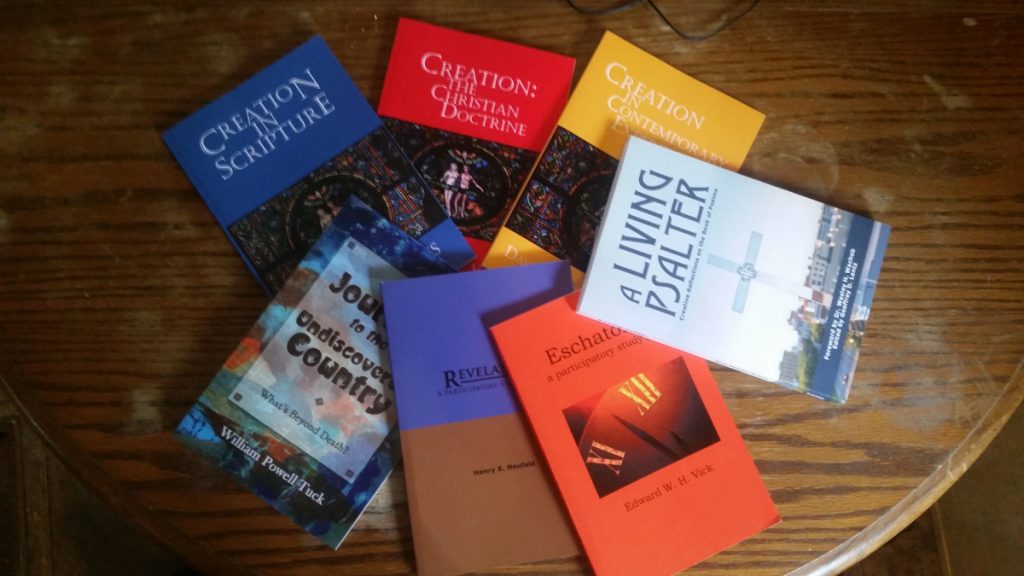 Tonight I’ll be finishing my preparatory studies for eschatology as I look at a few more visions, especially from Zechariah, and then at a bit of chronology in preparation for studying the book of Daniel on a more verse by verse basis starting next week.