Threads from Henry's Web

Author: henry

  • Why I Don’t Control My Wife

    Why I Don’t Control My Wife

    Shortly after Jody and I married, I was approached by a member of our church. He had a demand. “You need to control your wife,” he said. “She says [fill in theological thing here] which is wrong! You need to straighten her out.”

    I was astonished for a moment, but went with my gut. “I’d suggest you ask her about that idea,” I said. “She’s capable of answering for herself.”

    I noted that my response was from the gut, but then I started to second-guess myself. On the one hand I certainly was confident Jody could take care of herself and answer whatever questions might be asked. On the other, I didn’t want it to appear that I was unwilling to defend her. So we had a discussion and concluded that we would both use that same answer when someone asked us to explain or justify the other. “Henry/Jody is capable of answering for him/herself.” It’s worked fine for us. We’d rather have it appear that we are refusing to defend one another than that one of us considers the other incompetent.

    The first thing one might imagine was that this person was a male chauvinist who thought men should keep their wives in line. There was likely some of that involved. I doubt that he would have gone to Jody if he had agreed with her and asked her to keep me in line. But that wasn’t the only thing in play. There was, of course, the matter of theology, and also the matter of credentials. People disagree about theology all the time. I’m not concerned with the disagreement. I am concerned with the credentials.

    The particular chauvinism involved was the assumption that I would automatically know more about any particular theological issue that Jody would. Some of that, as I said, was likely simply because she’s a woman and I’m a man. This sort of thing can vary from very subtle to quite blatant, as in this case. In regard to that I’ll simply repeat what I’ve said before. I believe that everyone should act and serve according to their gifts. Who should do something or take some office is not determined by anything other than what gifts they have for that activity and how they’ve developed those gifts.

    For me this is a simple matter of recognizing each person as a person, and not as a category or a set of categories. I despise the term stupid, but I also despise the term smart as applied to a person. I think those words can be quite valid as applied to a specific idea. “Differently gifted” is often regarded as politically correct speech. I regard it as an accurate way of looking at people.

    If I regard someone as stupid, I am absolved of further concern with that person in other ways. I have now dismissed the person. They might have many things they can do, yet because I have applied this general label, I am done with that person. On the other hand, if I label someone as smart, I will then regard them as more valuable in many and various positions, and again I absolve myself of looking at specific gifts. It’s quite easy, however, to assign a smart person to a position for which they are not smart.

    I know that in reality it is rarely that extreme. People use a mix of seeing the specific gifts a person has and their overall label. Nonetheless I consider this type of thinking dangerous. It is counterproductive from a strictly business point of view. As a Christian I object to categorizing people in these ways, because I believe it violates the golden rule.

    I can illustrate how this works with me and my wife. Let’s start with a question: Who is more important to our business, Energion Publications. I’m the person with training in theology and biblical studies. I do cover design and book layout. I’m the one who figures out which of the various standards and punctuation rules we’ll follow. I’ve written more words than she has. I keep the accounts. Without me, Energion Publications would not exist.

    And then there’s the other side. Jody is the one who sets up the production schedule for a book. She’s the one who can organize our presence at a conference and create a display table. She’s the one who sees details in the appearance of a manuscript. She is best suited to recruit and work with certain authors, especially those who write devotionally. She’s the best salesman for a substantial selection of our products. She’s the one who gets me talking to the ones that I need to talk to.

    I could list many more items for each of us. Can I say the same thing about Jody—without her Energion Publications would not exist? Absolutely. Even the more academic books which she would not consider herself qualified to edit would not be completed without her efforts.

    It would be easy to consider my efforts as more important, just because I’m me, and I like to be important! I could obviously hire someone else to do all these other things. But if I’m honest, I know that there are people with the skills and gifts that I use as well. We are both essential!

    So here’s the stupid-smart scale: Which of us is smarter?

    That’s a question that just doesn’t work well. The fact is that we each have important, even critical gifts. There is no value in trying to make one better than the other. They are different. They are needed.

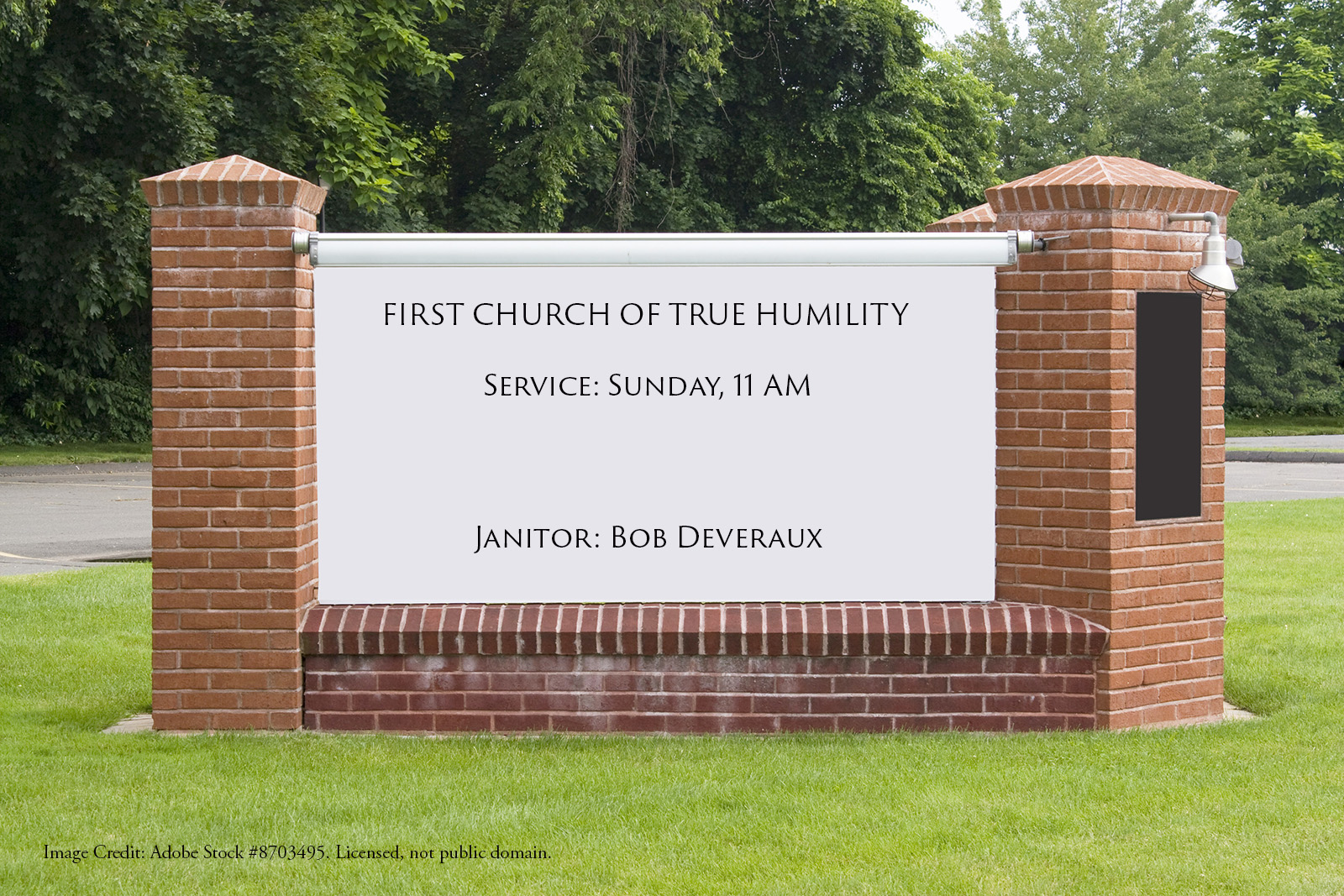
    Now let’s think about the church. Is a person with gifts of administration less critical than one with pastoral gifts? (Note that I regard almost every modern job description for a pastor as not only unscriptural, as in not even conceived of in scripture, but also unholy.) What about gifts of encouragement or helping others versus gifts of teaching? What are more important? Yet the person who helps, organizes, keeps the books, and so forth is considered less of a leader than the person who preaches or teaches. If you don’t believe me, let me ask you this: Can you find a single church sign that identifies the janitor or even the church administrator? No! It identifies the pastor.

    As an aside, I think there is a much better case for hiring a professional church administrator than there is for hiring someone to preach or teach in the local church, and certainly then there is to hire someone professionally to visit people in the hospital. Those duties can easily be divided among members of the congregation according to their gifts.

    And thus I come back to my wife and I and theological questions. Why would someone assume that I would straighten out my wife, though she wouldn’t straighten me out? Ignoring basic sexism, which I think does apply, we need to look at training, experience, and credentials.

    Many people (perhaps most) that we encounter would present theological questions to me and not to Jody. I have trained to be a teacher. I have a BA degree majoring in Biblical Languages and an MA in Religion, concentrating in Biblical and Cognate Languages. I have taught for years. I have written 13 books, which is considered an accomplishment, though none of them is particularly popular. I have been invited to preach many times and in many places. I am expected to be the theologian and to have an answer. Of course, there are many areas in which I have expertise and the ability to answer those questions.

    Jody, on the other hand, does not have a degree. What she does have is one of those old-fashioned three year nursing programs, years of experience in a variety of fields as a registered nurse, experience as a hospice nurse and then director of education for a hospice organization. Further, she has carried on a regular devotional live for decades. She has been invited to teach and to preach, and I can testify she is very good at it. She has written several books as well, at least one of which is more popular than any of mine!

    There are some questions you should ask me, but there are many other questions you should ask her. If you ask me, I’m likely going to give you an answer I got from her. If you want someone to visit you in the hospital, she’s the one. My degree, earned via seminary courses (though granted by the graduate school) didn’t teach me how to do that. I have never encountered someone who was sick or facing death who wanted my help translating a verse from Greek or Hebrew, or expounding on ancient manuscripts.

    Now how do you rate this sort of thing on a scale. Is Jody smarter than I am or am I smarter than she is? I have no idea, nor do I care. In fact, I don’t think there’s any good way to make that determination. We are each gifted in our own way. We each have a call from God to serve one another and those God places before us. We’re very different, but that makes our teamwork more valuable.

    In order to know what we can each do, you have to learn to know us as individuals. An intelligence test won’t do it. I have never been formally tested, but I know that I usually rate pretty well on the type of questions involved, yet I can forget where my local Walmart is located. Am I stupid or smart? Our degrees or lack of them will not do it. I have an MA degree, but I have trouble planning a route around town that doesn’t involve wasted miles. Am I stupid or smart? Jody can’t translate a Greek text for you, but she can help you through the inevitable questions you’ll have dealing with end of life issues. Is she stupid or smart?

    There’s the saying that there are no stupid questions. I disagree. I’ve just asked a stupid question several times. Is she/am I stupid or smart? It’s a completely useless question that produces nothing of value, and often helps people excuse themselves from actually looking at the person.

    This also goes back to the male/female thing. The assumption that because someone is a man or a woman one can safely make (derived) assumptions about their capabilities is based on a similar mental laziness. I can’t be bothered to determine what this woman or that man is capable of, so I’m just going to assign the general category to them. Whether you’re making the assumption based on a category of credentials, on race, on nationality, or on gender, It all goes back to an unwillingness to get to know someone as a person.

    Someone’s going to point out to me that men and women are different. It may shock you to know that I was already aware of that. But the difference doesn’t matter if you’re willing to learn to know the individual man or woman. If you know that person’s gifts, the abilities they share with their gender or other category will also be obvious.

    I don’t keep my wife in line. She doesn’t keep me in line. We allow each other to answer our own questions for the simple reason that we can, and that we respect one another and our gifts. Neither gender nor credentials matter.


  • Free Speech: When the Solution is Worse than the Problem

    Free Speech: When the Solution is Worse than the Problem

    Those who read my postings regularly, if there are any such, should know by now that I despise the algorithm Facebook uses to arrange my feed. Even the one that claims to be in date order isn’t. There is simply no Facebook reading option that I like.

    In addition, I agree with those who say that the algorithm tends to promote the more sensational and less truthful. This isn’t a problem of left or right. I see complete garbage from both sides in my feed. It’s annoying. It’s disturbing to think how many friends I must have who actually share the sort of things I see, assuming Facebook uses my friends’ likes and shares as part of their algorithm.

    But today I saw yet another headline about someone wanting to fix all of this by regulation. Bad idea! Very bad idea! This “solution” is much worse than any problem we have.

    I find it disturbing that so many of my friends seem to like inaccurate or, when accurate, unhelpful news. I’d really like them to try to be more thoughtful and engage in constructive dialog with their opponents.

    The very last thing I want is for the government to be somehow making the determination, or even shaping the way in which the determination is made regarding what I will see and what I will not see. What possible reason would I have for thinking the government would do a good job of that?

    I really love the first amendment to the U. S. Constitution, because I believe that free speech in a free market of ideas is the best way to go. I have been accused of being against religion because I also believe that the government shouldn’t be determining or shaping religious speech. Thus I vigorously oppose the legislation just passed by the house here in Florida to put “In God We Trust” in public schools. I oppose this for the same reason. As a sideline, I should note that I see “In God We Trust” as much more the national lie than the national motto. We don’t trust in God, rely on God, or even defer to God. We just use God to try to enforce our own selfish desires. This is government mandated opinions. I don’t want teachers, who act as agents of the government, speaking to a captive audience, to be enforcing prayer. (For what it’s worth, I don’t find the relationship made in the story between the motto and gun control, except for the general uselessness.)

    Whoever is in power seems to want to use government authority to try to make people think their way. Sometimes it’s blatant. Sometimes it’s subtle.

    However stupid people get, it’s nothing to how stupid they can be when collected into political parties and put in charge of a government.

  • Jesus and Women, Quote from Dorothy Sayers

    Check out @dianabutlerbass’s Tweet:

    https://twitter.com/dianabutlerbass/status/971759225276911616?s=09

    I have always loved Dorothy Sayers, and this makes me like her more. Guys, if you’re wondering what annoys the women around you, read the whole thread, and you’ll find a list.

    Don’t do those things!

  • Repentance in Hebrews 6:4-6

    Repentance in Hebrews 6:4-6

    When I talked about structure, I mentioned that I’d write a follow-up after my Wednesday night class. Here’s the rundown, though I plan to keep it brief. I’m indebted to David Alan Black for the basic note about the participles in this passage, and in a scholarly article I would need to cite a number of additional sources. The structure of the passage followed my own take on it in the context of Hebrews and made the argument easier. I include this discussion in my book To the Hebrews: A Participatory Study Guide, which is currently under revision for a second edition. (The main problem with the current edition is that I created it with readings, exercises, and questions, along with several appendices with discussion. I’m putting some discussion in the lessons!)

    There are a number of passages I referenced in class, but there are three passages before 6:4-6 that I see as key, and then one after. The reason is that the author of Hebrews signals new topics well ahead of the main discussion and then ties them in to later discussion.

    So if you look at Hebrews 2:1, “drifting off course.” This is an early signal of what I think is the key theme of the book, one that is further developed in 6:4-6 especially. At this point, the author has presented Jesus as the true representation of God and is now ready to open up the door to the result. God has spoken in these last days through a Son, which sounds good, even exciting, but what does it mean?

    Frequently Hebrews is read as a book with a message of works and perfectionism. In fact, as someone with a Wesleyan background, I’m used to starting there in my thinking. But the more I study the book, the less I think that is the correct reading. The warnings in Hebrews are not about human performance of good actions, but rather of total confidence in the one who has been presented here in chapter 1. Verses 1-4 present the Who, while the rest emphasizes that Jesus is greater than the angels. There will be more emphasis on precisely who Jesus is, but we have this pause in the first few verses of chapter 2 so we can get a preview of the theme.

    Through the rest of chapter two and into chapter five, but especially in 4:12-16, we’ll develop the things that make Jesus ideal as our priest, even though we aren’t quite sure what such a priest will accomplish.

    In 5:8-9 we get the second key connection, as we are told that Jesus learned obedience through suffering (and a rich passage that is, even though I’m just going to touch on it only briefly. Verse 9 tells us that he was perfected. It is this “perfection” that I think is the key object of Hebrews, the perfection of Jesus, not the perfection of any human being.

    I see 5:11-14 as a bit of reverse psychology, challenging the readers/hearers with their dependence on milk just before he goes ahead and introduces some meat anyhow.

    The third key passage is Hebrews 6:1, and “going on toward perfection.” It’s my understanding that United Methodist pastors are still asked this question on ordination, and I believe not a few have their fingers crossed when they answer. Figuratively speaking, of course! But though few translations do it, this can be taken as a passive, and thus be translated “carried on toward perfection” rather than “going on toward perfection.” I would go further and argue that the perfection that we are to go on toward is Jesus, and is only to be attained “in Christ” and not by us or as something possessed by us.

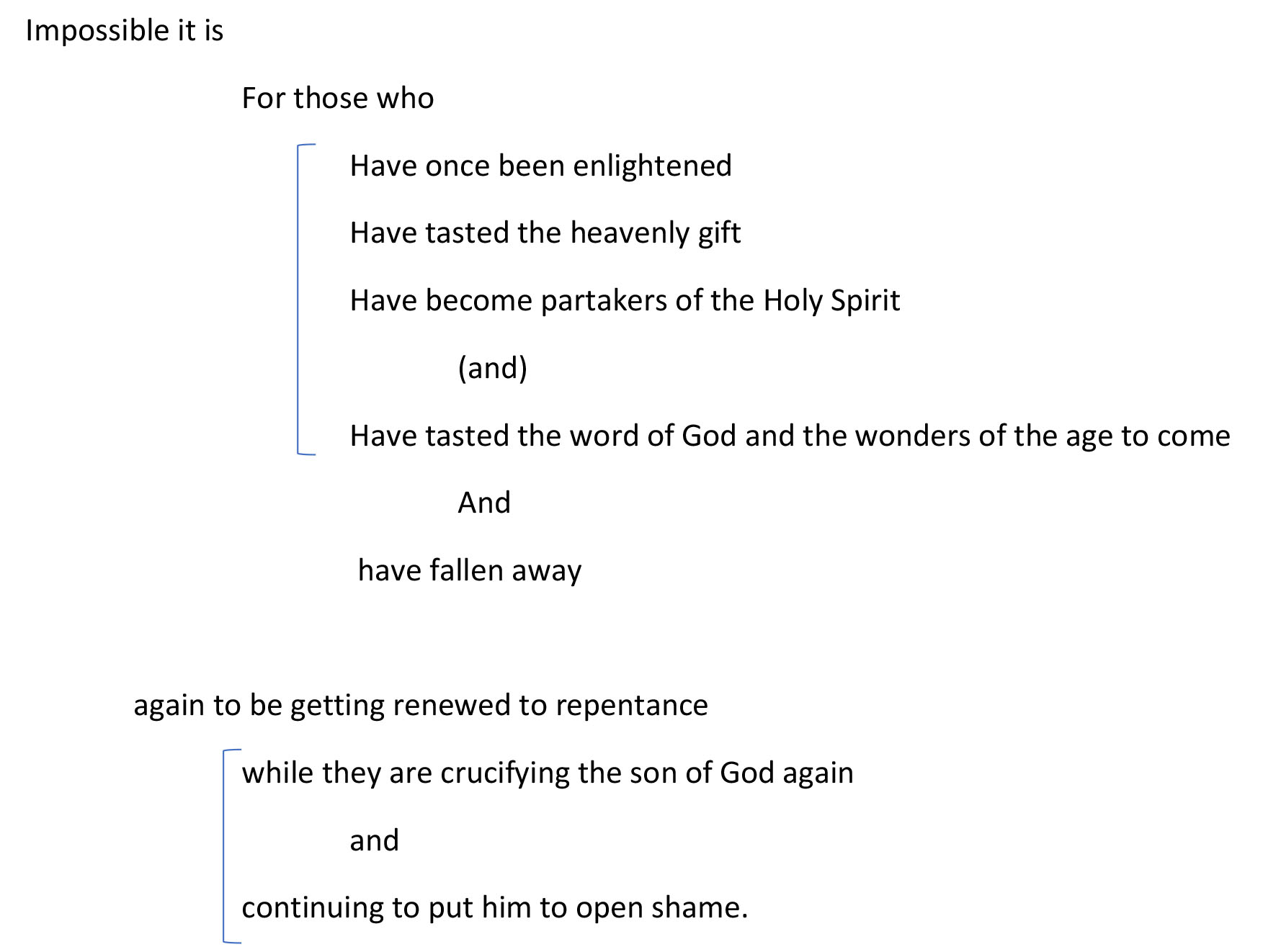
    Having jumped from signpost to signpost, this leads to 6:4-6. I have noted previously that I don’t take this as a “once out always out” passage, but rather as a warning against rejecting the voice or urging of the Holy Spirit. Paying closer attention to structure and the participle tenses helped back that view up and expand it.

    Here’s my translation with structure:

    I have summarized the theme of Hebrews as “get on the right train and stay on it until you reach the destination.” The key is that if you have the best, the greatest, or even the only hope of rescue and you don’t take it, rescue escapes you. That’s why I have the temporal sense here. If you are rejecting the final sacrifice of Christ, according to the concepts developed in the preceding five chapters, what option is there? Jesus, the Christ is sacrificed once-for-all, and cannot be sacrificed again. If we continue to fail to accept the finality, we are crucifying him afresh.

    But it’s even more simple than that. You can’t accept while you reject.

    Does that make it too simple? Actually, I think it makes it a clear statement of precisely the point of Hebrews. You have two choices: This train or no train.

    And that leads to the final passage I want to use, Hebrews 10:26-27. Here we have no sacrifice for sin after Jesus. It’s often used in sermons to threaten people with how seriously they should take New Testament commands. But that’s not the point at all. There is no more sacrifice because the sacrifice has been offered. If you don’t accept the sacrifice, there isn’t another one. You can’t redo it or substitute it.

    The whole message centers on confidence in the grace that has opened this “new and living way” (10:20), in the perfection of our High Priest, and in the necessity of placing our full confidence in Him.

    Let me add that I believe that the “cloud of witnesses” in Hebrews 12:1ff should be seen as those who are cheering us on because they have experienced the weaknesses and the failings that we have and know the grace of God and the final reward. It should not be used as a club as I have heard it preached, in the sense of: “Look at all these holy people who are watching you. Don’t screw up!”

    (Featured Image Credit: Openclipart.org.)


  • Do Liberals and Conservatives Really Need Each Other?

    Do Liberals and Conservatives Really Need Each Other?

    Early in my college days I encountered a man who would have a substantial influence on my life. It started as he explained textual variants and alternate possible translations in Genesis 1 for 2nd year Hebrew. I’d taught myself that far, and hadn’t done badly figuring out the rules, but my knowledge was less than practical. That man was Dr. Alden Thompson, now professor emeritus at Walla Walla University, and author of several books, two of which I publish.

    While showing me things that I had never seen before, and wasn’t sure I wanted to see, Alden displayed a gentleness and spiritual depth that had a profound impact on the way in which my theological understanding would develop. It is an approach he has modeled for decades and truly grown into even more as he moves forward.

    Looking at the divisions in his beloved Seventh-day Adventist Church, Alden doesn’t want victory for liberals or conservatives or any of the many other variations one might find. What he wants is conversation and an appreciation of the gifts that all bring to the table.

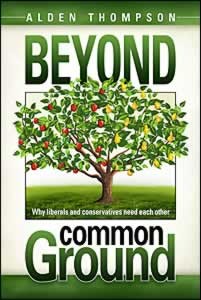
    Even though I don’t publish it, as we approach celebration of Consider Christianity Week, I wanted to call attention to Alden’s book, Beyond Common Ground: Why Liberals and Conservatives Need Each Other. Alden is talking about faith and a church organization, but the principles he discusses apply broadly, most importantly, learning to listen to and value the diversity. He matches that with a willingness I often don’t find in either liberal or conservative circles: A willingness to recognize the fear that new ideas and change may bring and to honor the need of solid ground for some people.

    While Beyond Common Ground is written very personally and is anchored therefore in its author’s community, it discusses issues I have seen trouble, divide, and sometimes destroy communities of various types. Consider reading this engaging and challenging book as you think about Christianity during Lent, and of course during Consider Christianity Week.

    Here’s a short video interview with Alden:


  • How People Mess Up Interpretation

    How People Mess Up Interpretation

    No, this is not a post about the crazy ways people interpret the Bible. It’s about the way in which people make precision difficult in communication. Am I thinking about biblical interpretation? Of course I am. If you have to guess what I’m thinking about and I don’t give you a clue, “biblical interpretation” is a good bet.

    When I teach Greek or Hebrew, and as I’ve mentioned, this is to people by ones and twos, not in seminary classes, I try to emphasize basic linguistics. How does language work in day to day usage. I can illustrate what I mean by people messing up interpretation using a one line rule I give my Greek or Hebrew students: People are lazy. This rule applies, for example, to the reason why sounds tend to drop out of common phrases. “Good day” becomes “g’day,” an expression that may be more commonly used in Australia. (I say this so that I can get in a bit of a pet peeve. Check this sort of stereotypical thing out if you can. In this case, I find “g’day” in an article titled Outrageous Aussie Stereotypes Debunked. Not promising!)

    But my “people are lazy” rule has many problems (or exceptions, if you wish), which also illustrates one of the problems of language. People are diverse. What I think is easy to pronounce someone else may find next to impossible. I remember vividly trying to learn to pronounce a few Hungarian words while driving with my translator. She would pronounce the word and I would imitate. It always went downhill from there. In Hungarian actual vowel length, i.e. the length of time a vowel sound is sustained in speech, is phonemic (i.e., it impacts the meaning). In English, this is not the case. I was taught long and short vowels, but they were not sustained for different periods of time, but were actually different sounds. (That’s a very loose way to explain it! See? I mess up interpretation too by being lazy.) For me, properly judging the length to sustain a vowel sound was next to impossible. For her, it was second nature.

    So another rule: Things you have become accustomed to doing will seem easy. To you.

    People just don’t follow one set of rules. We may have learned in English class that a paragraph consists of a thesis sentence, followed by three explanatory sentences, and ended with a conclusion. How many paragraphs in this post look anything like that? I tend to paragraph by sound, and often set off a sentence that would either be a conclusion or the introduction of a new element by itself, simulating the pauses for emphasis I might use in public speaking.

    Like this one.

    When I was an undergraduate student, one of my professors (J. Paul Grove at Walla Walla College for those who might know), required me to turn in three sermon outlines a week as part of a course in Hebrew prophets. I thought this was a horrible requirement, as I had no intention of becoming a preacher. I was going to be a biblical scholar. Bless Professor Grove! It turned out to be one of the better exercises of my educational process because it made me think of a connection between the data I was accumulating and the real world. It didn’t result in even one sermon outline that I would ever use in preaching, even though I have preached frequently. That’s because I vigorously eschew three point outlines and diligently work to violent rules of homiletics.

    Which means that I’m human. I don’t always follow the rules.

    I turn this now to structure, which I discussed a bit yesterday. Studying structure is good in interpreting scripture. Just don’t be too structured about it. I’ve been asked if I accept various outlines of Hebrews, such as Vanhoye’s. I guess it depends on what you mean by “accept.” I find a great deal to commend his work, but I don’t find that any structure is followed closely. I believe that in studying Hebrews you have to carefully track what the author has done, the ways in which he connects and interweaves his topics. He’s flexible; the interpreter must be flexible.

    Just like getting stuck on one label when trying to communicate, getting stuck on a structural label can be harmful to your mental health. People rarely follow the rules completely. Most commentaries that I’ve read do provide caveats about their structural conclusions. You should provide more.

    Flexibility is a key to sound interpretations, because people are flexible.

    (Featured image credit: Openclipart.org)

  • A Brief Note on Hebrews and Structure

    So NOT the Logic of Hebrews!

    A weakness of a great deal of Bible study is in the failure to truly see the details. In our normal conversations we have multiple contextual clues including shared history and knowledge. When reading scripture, we have to be more careful, because it is not addressed directly to us, and we often don’t share those clues. In Old Testament studies, people get used to the idea that the culture was very different. But the New Testament reflects a time and culture also different from our own, though less blatantly so. Thus we need to pay close attention.

    That in turn leads to the problem with serious, detailed Bible study. When digging out details, it’s very easy to forget the broader structure. This is particularly critical when reading Hebrews because the author signals upcoming topics, sometimes more than once, then discusses them, sometimes discusses them again in another way, and then looks back at them. You won’t understand a topic in this book unless you are paying attention to the larger structure of the book.

    On Wednesday night I’ll be discussing Hebrews 6:4-6 with my class at church. In this, I’ll draw lines from Hebrews 5:9 to 6:1 to 6:4-6 to 10:26-27, from each of those to other connections, all building toward an understanding of this difficult passage. I’ll post about it when the class is over. I don’t really have time to do it justice today.

    What I want to emphasize is that studying the structure of the literary work one is studying is critical, and is more critical when it comes from a time and place that is not yours.

  • Notes on Terms and Language Teaching

    Notes on Terms and Language Teaching

    Dave Black comments some on linguistics and teaching biblical languages in a post today. (Check out the linguistics conference coming up!)

    The difficulty is the difference between teaching someone a language in a classroom and in discussing and describing that language in some detail as a linguist would want to do. Both the framework and the deeper understanding are good and proper goals, though there is often a conflict between the two. When do you teach what?

    Dave covers a good selection of points from the debate over verbal aspect. There are problems with words like “punctiliar” or even “progressive” in terms of verbs. There are also problems in mapping the tense system (and the word “tense” itself) when teaching. But these issues are part of the problem of linguistics generally.

    Consider a label like “tree.” What do I mean by the word tree? Is the plant growing in my yard that is three feet tall a tree, a weed, a plant, or perhaps a bush? It might, under the right circumstances be called any one of those things. A simple, singular label is necessary to communication, but at the same time, a singular, simple label is also a cause of problems. For example, if I say to my wife, “We need to throw that tree out,” I may mean that a potted plant has grown very large, and I’m using tree hyperbolically to refer to it while demanding its exit forthwith. On the other hand, I could be referring to a shoe tree that’s worn out and should be discarded.

    This is why the line, “it’s just semantics” is so often lazy. When someone is playing rule book lawyer with the language, it’s quite appropriate to point out that one is expecting more of language than one is likely to get from it. We get along with ambiguity all the time. The problem comes in when we decide to be picky, or when we accidentally manage to use just the wrong word at the wrong time, meaning one that is almost right, but that can lead one off into a completely different semantic range than intended. But semantics is precisely what “it” is, and what it always is. It is about meaning. What did you expect? So it’s semantics. The word “just” is a bit oddly used. Bad semantics!

    What I try to do is very quickly introduce students to the idea that labels are shorthand. When I use the term “punctiliar,” I point out that this is a shorthand label. Why don’t I change the word then? Because my new shorthand label will also pick up unnecessary connotations, and then I’ll have to explain how it applies. Further, the student is doubtless going to see the word “punctiliar” in commentaries (as Dave points out), and he or she needs to know its intention, and even how to understand the potential fallacy. Commentaries are quite capable of containing incorrect linguistic information.

    It’s easier for me, because I teach by ones and twos, not by large classes of seminarians forced to do their required courses. I had that experience as a graduate student when I tried to tutor marginal or failing Greek students. They wanted me to get them past the test. I wanted to help them understand. Conflict! But those students I have taught since have come to me because they want to learn and understand, so I take the time.

    My conclusion is that no matter how you label it, you’re going to have to make sure students understand how these labels we call “words” work. Even if you take a living language approach, and try to get the students to understand the language as naturally as possible, you’re still going to have to help them understand linguistics if they’re going to translate those words and ideas into their own language for the benefit of those who haven’t learned a foreign language. I’d almost, almost, prefer to teach a student linguistics over teaching that student Greek or Hebrew. If I had to choose, that is. Which I don’t.

    (Featured Image Credit: Adobe Stock #126360408. Not Public Domain)

  • Linguistics Conference at Southeastern Baptist Theological Seminary

    Linguistics Conference at Southeastern Baptist Theological Seminary

    Re: Linguistics and New Testament Greek: Key Issues in the Current Debate

    It’s more than a year away, April 26-27, 2019, but this conference looks like about the most fun you can have on a seminary campus without breaking the rules! I see several names I know, some well, and one Energion author, Thomas Hudgins, who will be talking about Electronic Tools.

    I’m already planning to be there. Maybe we can meet!


  • Is 1 Thessalonians 2:13-16 Anti-Semitic?

    Is 1 Thessalonians 2:13-16 Anti-Semitic?

    Dave Black writes on this passage today on his blog, as he prepares to teach it. I have extracted the post and put it on the Jesus Paradigm site (supporting Dave’s book The Jesus Paradigm), in order to have a permanent link.

    Dave argues based on the way one should analyze the phrases and then punctuate. It’s well worth reading.

    I would add that Paul is here commending the Thessalonians for behaving as the churches in Judea did, which is also a commendation for those believers who were doubtless all or nearly all Jews themselves. The logic here indicates that Paul is condemning those who killed Jesus specifically, rather than all Jews, as he commends a large group in the same passage.

    Dave talks about vituperation. I think Paul was passionate and his language is often vigorous. It’s easy for hate to take over and reinterpret and apply words.

    Just try to talk about “moderate Muslims” in today’s atmosphere. You’ll doubtless encounter those who don’t want to make the distinction between those who engage in terrorism, those who support it, those who are apathetic toward it, and those who actively oppose it.

    Yet if we turn the situation around, we’re quite willing to make such distinctions or gradations regarding those in our own community.

    This is how stereotypes are created, and hate against a group generated. An accusation, however just, is brought against one member of a group, and then someone focuses on that group, rather than on the person involved. Soon perfectly innocent people are subjected to hatred. This happens whether it’s a matter of a racial group, a religious group, or a profession. One police officer is caught in corruption and someone concludes that “the police are corrupt.”

    On the other hand, some excuse members of a group because of prejudice (perceived or real) against the whole.

    I think Paul makes his distinction here. Those who persecuted were, quite rightly, condemned. (That goes for Christians who have persecuted others through the centuries as well.) We need to make a similar distinction at all times between those to be commended and those evildoers we must deal with.

    I’m reminded of my own reaction to the Duke Lacrosse Case. (Yes, that’s an entry on Wikipedia.)

    When I first heard of it, I assumed that the accused were guilty. Why? They seemed to me to be privileged rich kids and I thought they were exercising their privilege and entitlement. Turned out I was wrong.

    You shall not render an unjust judgment; you shall not be partial to the poor or defer to the great: with justice you shall judge your neighbor. (Leviticus 19:15, my emphasis)

    Don’t do that, Henry!