
If I get an ad in the mail from your campaign asking me to vote for you, you are a politician. I don’t mind that you are a politician. I consider that a potentially honorable profession, but I object when you lie about it.
Author: henry
-
Connecting the Unhooked to the Word
Dave has some interesting points here. Love for one another doesn’t disconnect us from the “other.” A genuine church might attract genuine people.
-
An Observation: Accuracy of Perception
An observation: Whether considering theology or politics, almost none of my liberal acquaintances resemble the image of them as portrayed by my conservative acquaintances, and almost none of my conservative acquaintances resemble the image of them portrayed by my liberal acquaintances. Whose vision requires correction?
-

Reading, Studying, Discussing, Teaching, and Proclaiming but not Practicing
I was struck by Dave Black’s note on Hebrews 4:14-16 from Wednesday on his blog. I extracted it to jesusparadigm.com, as Dave’s blog is a journal that doesn’t offer links to individual posts. (I have his permission.)
I highly recommend his post. It struck me because Hebrews is such a central part of my reading and study. There are those who claim I can’t get through an hour of study, no matter what the subject, without referring to the book of Hebrews. Within Hebrews, 4:14-16 has to be one of my most quoted passages in the book.
Dave talks about not going to our great High Priest first. That really struck me, because I think I don’t either. The other day I woke up in a cold sweat because I had dreamed about something critical going wrong. Now I’m working through quite a number of things that can justify worry, in a normal sense. I was telling Jody about my “awakening” and she just said, “Next time you wake up in a cold sweat, just remind yourself that Jesus has it all under control.” Jesus says, “Can anxious thought add a single day to your life?” (Matthew 6:27 REB).
I don’t intend to do less. But I’d also like to worry less. None of the problems I’m facing have been alleviated by my worry. Not one.
-
Biblical Studies Carnival 149 (June 2018)
Biblical Studies Carnival 149 (June 2018) has been posted at Reading Acts, and I was somewhat shocked to find a link to my own blog when looking through for nifty scholarly articles on topics of interest. Somehow my
rantpost about church buildings got a link. Yay! -

Measuring a Liberal Bias in Psychology
As a self-professed passionate moderate (the liberal charismatic title was thrust upon me by an opponent), I’m very conscious of bias on both the liberal and conservative sides. To be human is to be biased. I have my moderate biases, including a bias toward considering anything from the left or the right obviously biased. You just can’t win with me!
A number of readers likely already know that FiveThirtyEight.com is one of my favorite, of not my absolute favorite, news source. Besides their efforts to state their own biases, and the fact that I like numbers, this is a result of their efforts to cite their sources and show their work. If I question their rating of a pollster, for example, I can go look at what goes into that rating.
Before I get to the article I’m linking from them today, I want to emphasize something important. I like numbers, yes, but you have to be careful. The reason for this is that you have to understand how the numbers you’re liking were produced. Let me give an example. A friend asked me to read a book on the ancient world because I know the languages and he wanted an assessment of how much credence I should give it. In the book, someone gave measurements for the original size of the great pyramid in millimeters. There is no way the author could actually have that information. Numbers calculated in that way are designed to give the impression of precision even when such precision does not exist.
A more common way to produce a number is to assign it, such as asking people to rate something on a scale from 1 to 10. In order to know the question asked, how it’s asked, and who it’s asked of. After that you might consider asking what those people might know. For example, asking a random sample to rate the quality of cardiac care in this country on a scale from 1 to 10 produces information on how the sample views this, but might tell you as little as nothing regarding the actual state of such care, depending on who is being asked and what they could know.
So here’s the article, Psychologists Looked in the Mirror and Saw a Bunch of Liberals. (You need to read the article—the whole article. This material is useless without the reasoning behind it and the look for solutions.)
Someone noted the bias with a simple show of hands, and followed up with a study looking at the way in which results of studies were presented in journal abstracts. Here’s the generalization:
Sure enough, the abstracts more often explained their findings in terms of conservative ideas rather than liberal ones, and conservatives were described more negatively in the eyes of the raters.
The study authors tested for a bias in their raters and found that their liberal raters actually rated the abstracts as more negative regarding conservative views than did conservative raters. In a separate test, they also note that a panel of psychologists surveyed for their expectation of bias expected the results to be more biased than the study showed they were. You should, in turn, read the note on the potential problem with the panel of psychologists surveyed.
Note to self: Doing a deep enough study on an issue to have a strong opinion is a lot of work and takes a lot of time!
One of the solutions suggested is studies done by “trans-ideogical teams,” i.e., have research done by people who expect different results and who then design a study based on what would change their mind on the topic. I like this idea quite a lot.
I’ll note that this has a great deal to do with the way I publish (my company). I look to create conversation between people of widely differing viewpoints. (This is not identical to creating a church congregation, where some identity is necessary. I also support diverse congregations, but the boundaries will be set up differently.) I believe that in learning, there is great value in hearing the opposing position from someone who actually supports it.
A conservative professor requiring readings from a liberal book and explaining liberal ideas is not as challenging as hearing from an actual liberal. Similarly, if you reverse liberal and conservative. I have lived and learned in situations dominated by conservatives and at other times in ones dominated by liberals. The result I see is the same: Complacency, laziness, and arrogance. One decides one doesn’t have to have support for an idea because “everybody knows that.” But this “everybody” is a very selected subset.
I don’t see any solution here except intentionally involving people who disagree. I have found for myself that I cannot truly express the support for an idea I don’t accept myself nearly as well as a person who truly does support it, even if I try diligently.
This article is encouraging to me because it attacks bias in two ways: 1) Identifying and quantifying it, and 2) Looking at ways to correct for it.
-

On John Wesley and Total Depravity
I’ve drawn some questions and produced some amusement (from Calivinist friends) by using the term “total depravity.” Listeners were surprised to hear a Wesleyan use that particular term. “Sinners,” “sinful,” and similar terms, OK, but total depravity? I have previously heard people remark that total depravity isn’t Wesleyan, so as United Methodists we don’t believe that. (Oh, the many things we modern Methodists don’t believe that Wesley did!)
The question first came up as I used the term right after reading Romans 3:9-18, which is a somewhat depressing passage, largely made up of snippets from the Old Testament. Paul is completing his dissertation on all being sinful, Jew and Gentile alike, and in need of God’s grace. That need is total, In verse 20, he will ask: “What room then is left for human pride?” and answer, “It is excluded.”
The doctrine of total depravity does not maintain that we have all committed some list of specific sins. Rather, it claims that we are all, without God, completely and utterly lost. I find this easy to believe, because as a theist I believe that without God, I am not. Period. The specifically Wesleyan difference on this, however, is that everyone has access to God’s grace. That’s the Wesleyan doctrine of prevenient grace. It provides the universal answer (potential) to a universal problem. The differences thus arise in the doctrine of election.
I think it’s important to note also that this same passage suggests that those who don’t know the message that Israel and then the church has carried may, in fact, be doing God’s will. One might perhaps do better to let God do the judging of persons, and realize that where good is done, God is present, even if not in ways we understand.
Here’s John Wesley on this topic, from Wesley’s Sermons on Several Occasions, Sermon #74, “Of the Church.”
“21. We are called to walk, First, “with all lowliness:” to have that mind in us which was also in Christ Jesus; not to think of ourselves more highly than we ought to think; to be little, and poor, and mean, and vile in our own eyes; to know ourselves as also we are known by Him to whom all hearts are open; to be deeply sensible of our own unworthiness, of the universal depravity of our nature, (in which dwelleth no good thing,) — prone to all evil, averse to all good; insomuch that we are not only sick, but dead in trespasses and sins, till God breathes upon the dry bones, and creates life by the fruit of his lips. And suppose this is done, — suppose he has now quickened us, infusing life into our dead souls; yet how much of the carnal mind remains! How prone is our heart still to depart from the living God! What a tendency to sin remains in our heart, although we know our past sins are forgiven!
“And how much sin, in spite of all our endeavours, cleaves both to our words and actions! Who can be duly sensible how much remains in him of his natural enmity to God, or how far he is still alienated from God by the ignorance that is in him?
“22. Yea, suppose God has now thoroughly cleansed our heart, and scattered the last remains of sin; yet how can we be sensible enough of our own helplessness, our utter inability to all good, unless we are every hour, yea, every moment, endued with power from on high? Who is able to think one good thought, or to form one good desire, unless by that Almighty power which worketh in us both to will and to do of his good pleasure? We have need even in this state of grace, to be thoroughly and continually penetrated with a sense of this. Otherwise we shall be in perpetual danger of robbing God of his honour, by glorying in something we have received, as though we had not received it.”
Wesley is often calumniated by descendants (spiritually) who do not actually know what he taught.
-

A Few Notes on Civility
I’m not even sure if civility is the right word here, but it will work. I’m talking about remaining courteous even while expressing vigorous opinions.
- Civility isn’t cowardice. Rather, it is choosing the most effective way to express one’s opinion. It may lead to civil disobedience, a situation in which one offers oneself in a stand against evil.
- Civility isn’t silence. It may involve limited words. It may be a simple “I disagree.”
- Civility isn’t a lack of conviction. It’s a way of expressing yourself that you think will connect.
- Civility isn’t weakness. The loudest voice is not necessarily the one with the greatest conviction.
- Civility isn’t a debt you owe to the other side. It is something you do for yourself and for your cause.
- Civility isn’t easy. I think we all know this.
The most important action is still your vote. The reduction in turnout for mid-term elections is an unfortunate comment on how people understand the process. Please study out your candidates for this coming election and be at the polls. The primary election in Florida is August 28, and the general election is November 6. We have a senate election, a gubernatorial election, and, of course, congressional. You can get information on the various ways to vote at the Department of State-Division of Elections site.
I registered to vote when I turned 18, and I’ve been to the polls for every election since that time. I simply cannot understand low turnout for local elections or in non-presidential years.
-
Beware CNN Bearing Bible Verses
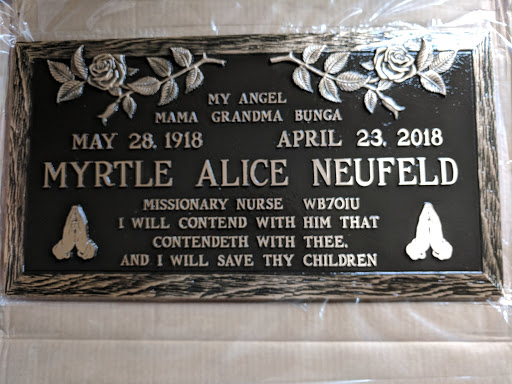
Mom’s Grave Marker When my mother passed away in April, my brother and sisters and I chose a text for her grave marker: “I will content with him that contendeth with thee, and I will save thy children” (Isaiah 49:25, KJV). It was one of mother’s favorite texts, and her concept of “children” was broad. She was a nurse and a teacher and was involved in the lives of many.
There was, however, a period in her life when she was deprived of her favorite text. Someone with scholarly credentials told her that the text didn’t mean what she thought it meant, and that she could not claim this as a promise for herself that God would save her children.
She confided this to me in the car one day. She was deeply saddened not to have this text, but she didn’t want to use it if she was misusing it.
Now if one looks at the context of the passage, both literary and historical, it is not talking about spiritual salvation of the descendants of a modern American mother, or of keeping them safe from all danger. It’s talking about the exiles of Judah who are to be brought back to their homeland. In that sense, anyone outside of the time frame of 2nd Isaiah cannot claim the passage for themselves, as it isn’t talking about them. It’s addressed narrowly and specifically.
So are quite a large number of Bible verses.
So here’s how I responded. I told her that yes, indeed, the historical context was different, but that I saw in that passage something about the character of God, portrayed in this passage. God is a God of redemption and works to redeem. God is interested in the generations to come. (It might not surprise you in this context to learn that Psalm 78:1-8 is my theme text for my teaching ministry. God cares about the generations to follow.) I could certainly find many other texts to indicate this as well, but Isaiah 49:25 encapsulates it very well, while placing it in the context of God’s negative judgment as well. This suggests in turn that God’s judgment is intended to result eventually in redemption.
So while the text was not addressed to Myrtle Neufeld in the 20th century (which was when the conversation occurred), and did not specifically speak of her children and what would happen to them, it did express God’s nature and desire for those children. My mother was never naive enough to believe that, despite any choices made, God would make everything right. What she did believe was that God was working to save her children at all times and in all circumstances.
Mom decided that she could use the text after all. Mission accomplished.
So today I read this article from CNN. What struck me in this was not the debate about Romans 13. I have definite opinions on that, but at the moment I will only note that people I respect deeply, who are both sincere and well qualified, disagree with my definite opinions on Romans 13. Well, I should acknowledge that many agree as well! I’ll get to the matter of disagreeing on the meaning of texts in a moment.
The passage that struck me was Philippians 4:13. “I can do all things through Christ who strengthens me.” Or let me quote a bit more in context:
10 It is a great joy to me in the Lord that after so long your care for me has now revived. I know you always cared; it was opportunity you lacked. 11 Not that I am speaking of want, for I have learned to be self-sufficient whatever my circumstances. 12 I know what it is to have nothing, and I know what it is to have plenty. I have been thoroughly initiated into fullness and hunger, plenty and poverty. 13 I am able to face anything through him who gives me strength. 14 All the same, it was kind of you to share the burden of my troubles.
The Revised English Bible. (1996). (Php 4:10–14). Cambridge; New York; Melbourne; Madrid; Cape Town; Singapore; São Paulo; Delhi; Dubai; Tokyo: Cambridge University Press.
You know something? Here’s the comment from the article:
When the Apostle Paul wrote that line, he was referring to a Christian’s ability to withstand suffering. It wasn’t about winning; it was about enduring loss. Paul wasn’t taking a victory lap; he was in prison contemplating his execution, says Van Voorst, a professor at Western Theological Seminary in Michigan.
Um, true. Paul didn’t play basketball. But he wasn’t just talking about a Christian’s ability to withstand suffering. He was talking about being able to handle whatever life throws at you. If you’re a basketball player, what life throws at you might be a career-ending injury or it might be an opportunity to make a couple of free throws to end the game victoriously. Yes, it is quite possible to apply this verse in ways that are not appropriate. It doesn’t mean you’re always going to win, for example.
Neither does Romans 8:28ff. The passage goes on to say that nothing can separate us from the love of Christ. It’s a powerful passage about spiritual things, about our ultimate salvation. But it’s also a powerful passage about God being with us at all times. It doesn’t mean things will happen the way I want them to. It does mean that, in the end, what God works out will be good. And yes, that good may come in the next life.
I have two major problems with what goes on in this article, though first I must note that many things noted there about abused texts are quite correct. It’s certainly possible to misuse a text. It’s also possible to disagree quite rationally about the meaning of a text or to rob that text of all applicability.
- My first problem is this: Biblical scholars can suck the lifeblood from Scripture. With enough historical study, one can assure that nothing in Scripture applies to anything in anyone’s life. Scripture is understood in community, and how it applies to the present grows out of the community and its understanding. It is important to use historical scholarship as an anchor. It’s important to acknowledge and celebrate the history. But for those who believe that God is still God, it’s quite possible to think that God might act again in ways God has acted before. If you don’t believe God is still God, your argument is on that point, not in the understanding of Scripture.I would hope that scholars would encourage, inform, and edify the members of the community, not nit-pick them into abandoning a personal reading and application of Scripture.
- My second problem is simply this: If we understand that there are multiple possibilities for ways to understand and apply Scripture, we should also expect that a news article from CNN that quotes a couple of scholars cannot settle the issue of meaning for multiple Scriptures. This is why I prefer “I disagree with that view” to “That view is wrong.” There are some really bad interpretations out there, but some of those are held by highly qualified people, and a response should include careful argumentation. “There’s another way to view this” will accomplish more, I think, than “Your view of this is stupid.”
Most obviously, I might suggest that a short article is hardly going to set the record straight on multiple Scripture passages. I found places I agreed and places I didn’t. I know of serious commentators who would agree and some who wouldn’t.
As a life-giving, spiritually invigorating support, a text can be wonderful. As a club to beat up your neighbor? Not so much.


