Threads from Henry's Web

Author: henry

  • Thoughts on James 2

    Thoughts on James 2

    Our Sunday School lesson, which I’m not teaching this week, is from James, focusing on chapter 2. I’m not teaching, but in studying, I looked at a book I publish, Holistic Spirituality: Life Transforming Wisdom from the Letter of James.

    Bruce Epperly makes a number of important comments. I’m going to do a bit of quoting from his chapter 3, pp. 15-21.

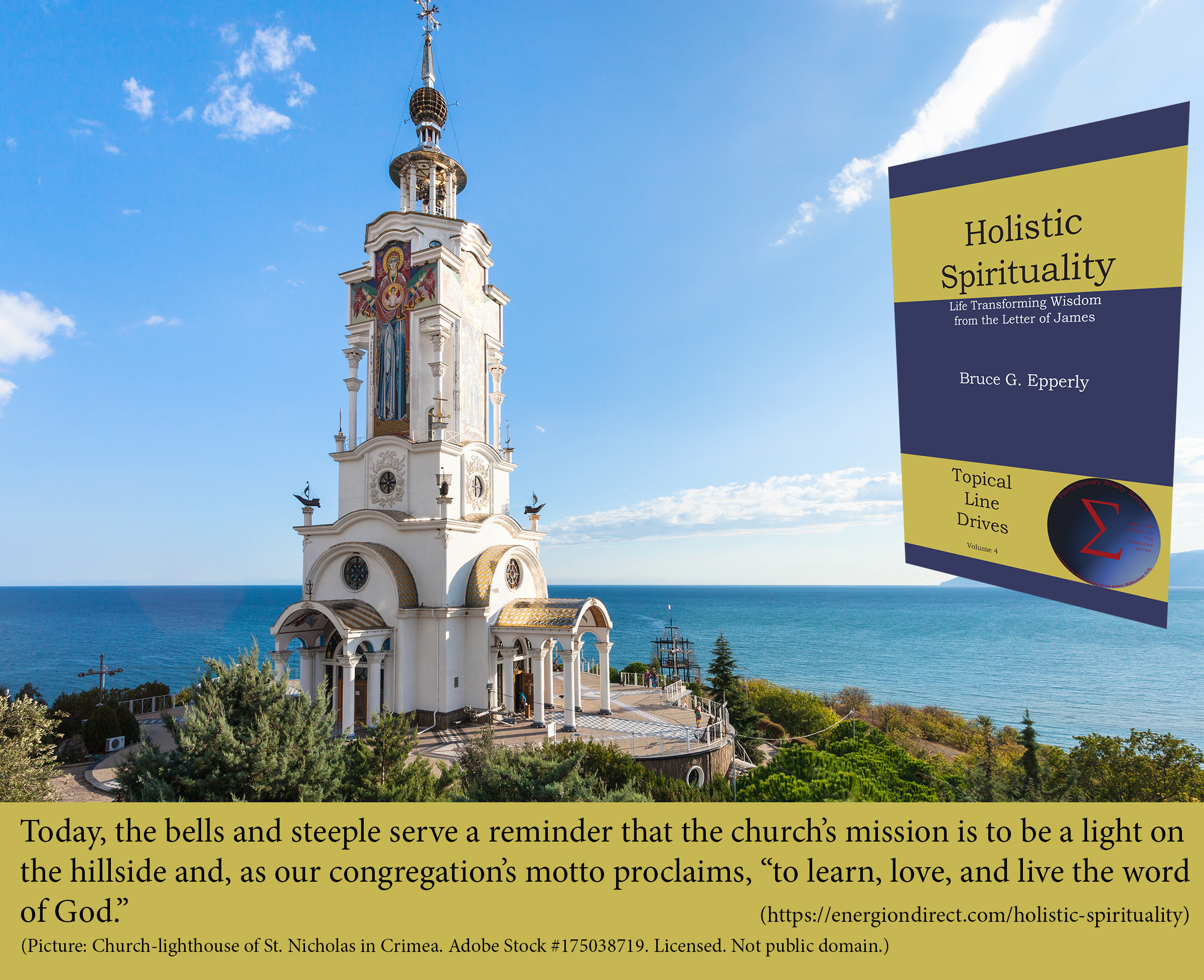
    One of my great joys is my first glimpse of the steeple of South Congregational Church, when I round the bend toward home. In earlier times, the church’s steeple guided mariners safely to shore. Today, the bells andsteeple serve a reminder that the church’s mission is to be a light on the hillside and, as our congregation’s motto proclaims, “to learn, love, and live the word of God.” (p. 15)

    I like that motto, “learn, love, and live.” I think it may go the other way as well, we learn from what we live, especially when we’re trying to live the word of God.

    Faith means nothing unless it lights the way of pilgrims and seekers, providing guidance, comfort, and nurture. (p. 16)

    Here Bruce combines faith in action and faith in witness (and our action is, I think, our best witness) in a way of which I think James would approve. We are not Christians, or Jesus people, for our own benefit alone. We receive grace to share grace. That’s why grace cannot be a passive thing. It erupts in action.

    … The Apostle asserts that because God loves us, our vocation is to love one another, even if this means crossing the barriers of race and ethnicity. Grace makes us all first-class Christians, worthy of respect regardless of ethnicity or economics. This is the essence of James’ message as well.

    James believes that a holistic faith brings together belief and action. In the spirit of the Quakers, what is important to James is to “Let your life speak.” … (p. 17)

    I think that the tendency of many interpreters to see James and Paul as opponents is misguided. They do have a different emphasis, but it is not because Paul hated or devalued action or that James thought beliefs were unimportant. Each had an emphasis, but these emphases are compatible or complementary.

    Loving Jesus means loving your neighbor. And if James is right, it means standing aloof and becoming counter-cultural in
    relation to socially-acceptable, but life-destroying, values – “being unstained by the world” – that put profits ahead of people, neglect the needy, and blame the poor for their poverty. We are all created in the image of God and we all deserve to be loved, to have a place to call home, and an opportunity to live out our gifts and talents as God’s beloved daughters and sons. (p. 19)

    That’s were it will start to get with us. Sanctified wallets are the hardest of possessions to acquire. Or, looked at the other way, the wallet is the hardest thing to give up. How much stuff must we have? What is first in our life? Putting God first will result in also putting our neighbor first.

    But what can you do? Maybe all you have to spare is coins in your pocket.

    In the realm of God, no deed is too small, for with one action at a time we can become God’s companions in healing the world. Let your life speak. (p. 20)

    This is a great little book, just 40 pages of text from Energion’s Topical Line Drives series, for accompanying a study of James. It might just be, as the subtitle suggests, life transforming!

    Read Now


  • Women Teaching in Seminary, Oh Yes! (@KaitlinCurtice)

    Women Teaching in Seminary, Oh Yes! (@KaitlinCurtice)

    On Tuesday I noticed a tweet, after comments on the Desiring God blog regarding women teaching in seminary. The answer was, not surprisingly, no. The men who do ministry should be taught by men who model men leading the church.

    Here’s the tweet:

    I thought this such a good idea that I immediately chimed in with the names of two teachers, one in my undergraduate theology program and one in graduate school who had been important, even critical influences on my learning and development. I intended to blog immediately afterward and talk about why I list these two women, both of whom have gone on to glory, in particular. Unfortunately, life happened, and a couple of days have passed. I’m still going to do it.

    Preliminary Thoughts

    But first, ever the wordy one, let me write a note on my view of women in ministry. I’ve been accused of not really being egalitarian, not by other egalitarians, but by complementarians. The reason seems to be that I don’t say men and women are the same. Come to think of it, I pretty much don’t say men and men are the same. That is, we’re all different. What I do say is that this isn’t the issue. The issue is to see each person as one who is gifted by God, to recognize the gifts God has given, and to not merely allow, but to do everything to encourage that person to use those gifts.

    How many women should be in church leadership? Precisely the number that God has gifted for that leadership. How many women should teach? Precisely the number that God has gifted to do that teaching. My main scriptural argument in favor of women in leadership is that the Holy Spirit gives gifts as the Spirit wills (Hebrews 2:4, among many others), and that when such gifts are recognized, quenching the gifts is quenching the Spirit. It is also not men who have the right to allow or not allow women in ministry. Their call is a call from God. Men have the choice of recognizing or not recognizing God’s call.

    I do understand the other view and the scriptures on which it is based. I believe that it is a case of using advice produced for a particular time and place and making it universal. I believe making it universal hinders the advance of the kingdom.

    Many

    I have been taught by many women. Doubtless, complementarians would approve of having women as teachers in elementary and high school. I have to mention home school years with my mother and my older sister Betty Rae, both strong influences on my. Ethel Wood at Wildwood Rural School in northwest Georgia, who discovered I already knew how to type, and used my help in the school office. There I learned some skills that would come back to me later when I became a publisher. But this isn’t just about having women influence one’s life. It’s about training people for church leadership.

    Theological Education

    Lucille Knapp

    Lucille Knapp taught first and second year Greek at Walla Walla College (now Walla Walla University). I was privileged to take both these courses and to become friends. She was determined not just to teach us Greek but to help us use it to understand the Bible better and to help us grow in our spiritual lives in ways beyond just language.

    I remember her particularly for gentle conversations urging me to consider unfamiliar ideas that hadn’t been part of my world before. She also connected the beauty of literature with my spiritual journey. When I graduated, I received a gift from her of a book of inspirational poetry, along with a note that urged me to remember that faith and theology were not just about the technicalities of biblical languages and biblical studies, which were my focus, but also about the experience of beauty and of God’s presence that was available through art and literature.

    There were some people who thought she should shut up and just teach Greek. It was OK that she teach technicalities, but she should quit trying to influence others and shape their spirituality in any way. I’m glad she resisted those voices and continued to model spiritual leadership to her students.

    (A bio and obituary.)

    Leona Glidden Running

    When I arrived at the Seventh-day Adventist Theological Seminary, though my degree was an MA in Religion, concentrating in biblical and cognate languages offered by the graduate school, I almost immediately meet Dr. Running. Some of us thought she truly deserved her last name, as she was an active and vigorous person who didn’t let any grass grow under he feet. Ever. She didn’t believe in letting grass grow under our feet either.

    One of my favorite memories of her was taking the final exam in Akkadian. I was the only student for that term for Akkadian, so the class had been somewhat informal. She handed me the final exam, which was a legal size sheet of paper filled on both sides with cuneiform text. She said, “Translate this. You have two hours.” Then she walked out of the room.

    Now my guess is that I might have produced a good translation of a few lines in two hours. I don’t mean getting the gist, but getting a workable translation. The idea that I could produce a decent translation of that much text in two hours at the end of my first quarter was ludicrous.

    So I struggled through, grabbing the first possible translation I could find and writing it down, knowing that I wouldn’t have time to recheck, and also knowing that I had to be making substantial errors. I managed half of the first page using that approach. At the end of two hours she was back, took the paper and made no comment. I got it back the next day with a grade — an A. So I asked her how this was possible. I was actually gratified by how few red marks there were in my translation, but I mean that with reference to my expectations. The page was still doing some bleeding! She said, “I wanted to see your first pass. I didn’t want you to have time to double check. I graded accordingly.” She had deducted only for things she thought I should have gotten without taking a second pass.

    She also invited me to tutor Greek and Hebrew for the seminary students, guided me through what to charge so I could help pay my way. (I had a fellowship, but it didn’t cover all expenses.) When my Uncle, Don F. Neufeld, passed away, she was the one who recognized that I was grieving when I was still telling myself I could handle this. She made sure I made the trip to his funeral and took care of myself. She remained a friend after graduation.

    She was, like Lucille Knapp, an example of leadership. She modeled that godly leadership for me.

    (A bio and her obituary.)

    Different Styles

    Even though I didn’t select them for that reason, I like the fact that they exhibited two very different styles. I chose these two names because their influence on me was powerful.

    I will still tell classes that while I value my knowledge of biblical languages highly, it was not learning the biblical languages that did the most for my hermeneutic. It was learning about people, learning how people react. Often elements of the tone of a Bible passage become much clearer when I think about the way people react to different things. Lucille Knapp is responsible for starting me on that way of thinking, and I’m eternally grateful.

    Dr. Running, on the other hand, taught me that thoroughness is important, but so is diligence and vigorous pursuit of a goal. It isn’t just your last read that counts, but the way you attack a text in the first place. In coming to understand a text, it’s important not to get hung up or lost in the forest while carefully examining each tree. Of course, that has to be balanced by thoroughness, but she both modeled that for her students and expected it of them.

    Conclusion

    My life and work would be significantly less productive without these two women who taught, one in a theological school, and the other in a seminary. I thank God that their gifts were not suppressed, and that they were there for my benefit.

    (Image credit: Openclipart.org. Modified by me.)

  • Daniel 9: Confession and Repentance

    Daniel 9: Confession and Repentance

    The Adult Bible Studies Sunday School curriculum was on the subject of confession and repentance with the primary passage being Daniel’s prayer in Daniel 9. This is an interesting and powerful prayer to read and deserves more attention than it gets. They secondarily referred to Psalm 51, which is also an important prayer of confession, and is much better known that Daniel 9. (I wrote a meditation on Psalm 51 here, but didn’t get to it in my Sunday School class.)

    One important difference between the two passages is that Daniel 9 is a corporate prayer of repentance, while Psalm 51 is individual. Each has individual elements and corporate elements, but the emphasis is far different. This is why Psalm 51 applies to the sin of David with Bathsheba so well. Daniel, on the other hand, is meditating on the fact that Judah has not been restored.

    Daniel is treated as righteous in the Bible. While we assume that he is human, and thus had faults and failings, none are presented. This is notable, since the Bible, unlike many other official histories, does not hesitate to present faults. Much of our historical material about Israel, while based on official chronicles (at least according to the text), are actually written by critics of the various regimes. Yet Daniel is presented positively.

    Here, however, Daniel is not afraid of the word “we.” He identifies with his people Israel (or Judah) has failed. He repents for all, and doing so identifies himself with all. There is a fine line here that we need to watch. By taking on the failings of everyone in a group, we can became paralyzed by shame and simple disgust. At the same time, recognizing that we are part of a group that has done certain things is critical. It becomes the foundation of changing the group.

    Some want to emphasize the individual aspect of confession and repentance. Others think largely in corporate terms. In a church that has done wrong, treated members badly, provided a poor witness to the community, turned its back on those in need or who are suffering, it’s important for those who pray to confess what the church has done. You may have done everything you could, but at corporate confession time, it’s a matter of the group. I think the answer to corporate vs. personal is flexible and varied. The person in the right who says “let’s” rather than “you should” can be the catalyst of real change in a group or even in a nation.

    Here’s a diagram I used in class. Well, actually, I drew with a marker on a white board, and did much worse than this, but whatever!

    The scriptures I would apply are 1 John 4:7 & 20. Of course, as always, I recommend reading the entire passage. We try to prioritize loving God over loving one another, but John ties them together, and I think Jesus does as well when he says the second commandment is like the first. You won’t fulfill one without the other.

    A good prayer of individual confession and repentance should draw you upward toward God. If it results in wallowing in guilt, you aren’t really getting it. If your prayer of confession distances you from others, you may have a problem.

    How corporate should it be? That depends on what is needed. As long as we keep the lines even, drawing closer to others also means drawing closer to God. “Everyone who loves is a child of God and knows God, but the unloving know nothing of God, for God is love” (1 John 1:7-8). You can also test that love for one another by asking whether it draws you and the one you love upward as well.

    This is only a short test, and it’s a bit like a pithy one-liner. Yes, you can get off track. But I think it helps. My hope is to keep the lines of even length and yet shorten the distance. Closer to God and closer to others. That should be my goal in life, and especially in confession and repentance. If love fulfills the law (Romans 13:10), then the chief confession is going to be my lack of love, and my repentance will be a turning toward the other points on this triangle.

    Try it! It might help!


    Here are some books on prayer and forgiveness.


  • Some Problems with Prayer

    Some Problems with Prayer

    I’ve co-authored a book about prayer, published several more, taught numerous classes, and led seminars about prayer. One thing I believe is that one should teach primary from experience, meaning that often you are teaching about your own weaknesses. In this case it it just so.

    So here are some problems. I share in each one. Each one can devastate your prayer life and your Christian experience.

    1. I don’t pray when I should. My first response to a problem is to look for what I can do to solve it. I’m a pretty smart guy and pride myself on being able to solve problems. People call me to help solve their problems, especially with computers or language. Somehow I suspect God is smarter and wiser! A friend of mine said (and I think he was quoting, but I don’t recall who), “Nothing is a substitute for prayer, and prayer isn’t a substitute for anything.” It’s not bad to work, but prayer will transform your efforts. “‘Not by might, nor by power but by my Spirit,’ says the Lord” (Zech. 4:6).
    2. I pray after rather than before. I know God can handle the “before they call” thing, but the problem here is that I make decisions and then ask God to bless them, rather than asking God to guide and then listening.
    3. I pray prayers of direction. By this I mean that I tell God how to solve problems. I don’t know the origin of the saying, but it’s unfortunately true: Many people want to serve God, but only in an advisory capacity.
    4. It’s more important to me that people know I’m praying for them than it is to actually pray. It may be a shock to some people, but you can pray without informing people. This doesn’t mean you should never tell someone you’re praying. I am deeply encouraged each time someone lets me know they’re praying for me. But the proclamation can be either a lie or a weapon or even both.
    5. I spend more time talking than listening. See also #2 and #3.
    6. Despite knowing all of this, these are still failings.

    Fortunately for all of us, God says,  “My grace is sufficient for you, for power is made perfect in weakness.” (2 Cor. 12:9). I pray for greater grace in my prayer life.

  • The Little Horn of Daniel (Again)

    Since I grew up as a Seventh-day Adventist, I almost have to be interested in Daniel 8, particularly 8:14, which is critical to the development of the Adventist movement. For those not acquainted with that history, this is the verse from which the prediction of the second coming of Jesus on October 22, 1844 was derived. In turn, that doctrine developed into the doctrine of the investigative judgment, which I list as one of my reasons for not being an SDA today.

    While at first my objections were exegetical and based on Daniel 8:14, I have come to be more concerned with the soteriology involved. I still hold to those original objections.

    Thus I link to an article from Adventist Today, Why the Little Horn of Daniel 8 Must Be Antiochus Epiphanes. I would note that the author, Winston McHarg, resigned from the SDA ministry in 1978, while I was a student at Walla Walla College, and still a few years before I left the SDA church. For a short article, this one is well-done exegetically.

  • Advent, Christmas, Epiphany

    Advent, Christmas, Epiphany

    From time to time I hear Christians, particularly pastors, lament the neglect of the Advent season. As a religious celebration Christmas comes best after the season of Advent in which we study and meditate on expectation. Then comes Christmas. Because of the commercialization of Christmas as a secular holiday (I believe one can commemorate the spiritual Christmas in the midst of a secular celebration if you want), the time of Advent is not spent in waiting and expectation, so much as in a rush. Ebenezer Scrooge had a point about Christmas being a time to buy things we can’t afford!

    But many of those who spend time on Advent don’t pay similar attention to Epiphany, which caps the twelve days of Christmas. It generally doesn’t come on a Sunday, and how can you possibly get people into church on a weekday?

    But all three of these days or seasons (Christmas is also a season), reflect important moments in spiritual life. Besides a historical reflection on the events that stand behind the Christian faith, we can have a reflection on the present of our lives, in which we wait with expectation for God to act, see God intervening, and/or come to the realization that God has acted, though God may have chosen to do so in a way that was not recognized at the time.

    I taught the Sunday School lesson this morning, and the key scripture was Matthew 2:1-12, which would be better placed on Epiphany than on Christmas Eve. Yet it helps make an important point placed here. Very few people recognized what was going on. I suggested that my class check the rest of the gospels. Nowhere does Jesus encounter someone who remembered something about his birth. “Wow, those shepherds told me about you, and here you are!” is a line that simply doesn’t come up.

    Different people recognized Jesus in different ways and under different circumstances. It’s important to remember that. Why? Because we need to understand where different people are in their experiences.

    I’ve watched a few Christmas movies this season. I enjoy the light entertainment with a definite good finish, even if I can predict it practically from the opening credits. Small towns generally win over cities. People who do “country” things generally win over those who are urban. The driven and ambitious are generally cast as villains. But there’s a sweetness to all of it.

    One interesting thing is that while the movies tell us about people who have been hurt during the holiday season, they generally tell the story of the moment in which someone overcomes or transcends that hurt and finds the joy of the wonderful holiday season.

    It would be nice if that was how the world works. It doesn’t. There will be people who will transcend emotional hurt and find healing this Christmas season. There are others who will experience new wounds. Yet others will suffer through the season, often silently, simply hoping it will be over. They won’t want to admit that they’d love to say, “Bah! Humbug!” because then they’d get labeled with the ultimate badge of dishonor: Scrooge. Before the ghosts.

    As a community, we need to be prepared to bring comfort to those who aren’t “in season.” It’s easy to imagine that someone will get into the proper spirit of expectation of advent, receive their gifts, and THE GIFT, on Christmas day, and rejoice with the Wise Men (astrologers, no doubt), on Epiphany. But many will not.

    We need to find the the time and the season of those in need of help and support. We need to recognize that Advent is not necessarily a time of confident and certain expectancy, but may be a time of wondering and struggle.

    One of the things the Israelite religion, and particularly the prophetic school, brought to Judaism and through it to Christianity is the idea that living is not an endless cycle. We’re going somewhere. There’s a point to the arrangement church fathers made of scripture, with Genesis 1 at the beginning and Revelation 21-22 at the end. We don’t live in an endless cycle. We’re going somewhere, and that somewhere is good.

    But in the meantime we celebrate cycles, with New Year’s Day coming up as we celebrate the arrival of a new year, and in many cases make resolutions that say that this next 365 (or 366) days will be better than the last. We celebrate advent every year, realizing that not everything is realized yet. We commemorate Easter, not because the event must be repeated, but because we need the reminder of new life.

    We’re always tempted to get mired one way or the other. On the one hand we can fall into hopelessness and maintain that the cycles of life are all that there are. On the other, we can get the idea that, having reached our Epiphany, we’ve made it permanently, and everyone else should join us. In the future, if we pay attention to these days it’s just a commemoration of how wonderful our lives have gotten. So we lie and we judge. We lie as we pretend that life really is that good. We judge because others haven’t attained what we pretend to have attained.

    Romans 7 is an interesting illustration. Paul seems to wallow in difficulty, finally saying, “Oh wretched man that I am! Who will rescue me?” We have the answer (or so we think) in Romans 8 as we learn that “there is now no condemnation to those who are in Christ Jesus,” and we proclaim, “Thanks be to God! Through Jesus Christ our Lord!”

    Which leads to a debate in biblical interpretation. Does Romans 7 speak of the life of one who has not accepted the grace of Christ or does it describe the life of the Christian? Do we really get to that better life here in this world, or is the Romans 8 proclamation the result of our glorification? (And, you may ask, what does this have to do with Christmas?)

    I bring up Romans 7 because it is so incredibly real. Wesleyans use the terms “prevenient grace,” meaning that grace which God offers to everyone and which is there before you even ask, and “sanctifying grace,” mean the grace that keeps moving one along toward holiness (or on toward perfection, as John Wesley might say). Romans 7, I think, speaks to us of the cycles of our lives. We do not always move forward. We also fall backward. We do what we think is not good, and sometimes (all too many times) we do what we think we ought not to do. I think the idea that we suddenly cease to experience Romans 7 is a lie we tell. It’s a lie we expect our leaders to tell. We all experience these cycles.

    That’s some bad news. The struggle continues. You’ll still be praying for God to act. You’ll still be living through times of expectation. God may still intervene, only to go unrecognized for some time afterward, when we suddenly receiver our epiphany.

    It’s also some good news. What it says is that grace is ever active. God’s sanctifying grace is persistent and active, and when we fall back into that cycle, God’s grace reaches out, grabs us, and pushes us forward so that we can still be moving onward, despite the difficulty. The bad news is that there will be more “Oh wretched man that I am” moments; the good news is that Grace will respond to each with those moments of “no condemnation” which will result in our proclamation of thanks to God through Jesus Christ our Lord.

    If we shed the lies and are real, we’ll be prepared to help others whatever their season. We do this not as people who have no problems, but as overcomers of problems who know, because we’ve experience it, that times of advent waiting are followed by God’s intervention, and that often God has already intervened, and like the folks in Herod’s court and in Jerusalem, we simply haven’t recognized the event yet. We’re waiting for epiphany.

    If you’re joyous this Christmas, I rejoice with you. What I pray is that you use your joy to help strengthen the weak, to encourage those who are less joyful, and to be real in all your times of trouble.

    The gift that Jesus brought was himself, yes, but himself as the messenger and vehicle of God’s grace. Be gracious to yourself and others in this season of joy … and grace.

  • Authorship of Hebrews Summary

    Authorship of Hebrews Summary

    Michael J. Kok summarizes the internal evidence on the authorship of Hebrews (HT: Dave Black Online).

    As Dave Black notes, his argument is really not one of internal but of external evidence. Dr. Kok cites Dave’s book The Authorship of Hebrews: The Case for Paul, which I publish. I do note the 2017 publication date, which suggests use of the new hardcover edition, which I link below. The more usual paperback is just $5.99 while the Kindle edition is just $2.99 for those who would like to check Dave’s arguments.

    My own view on this is “author unknown.” After reading Dave’s work, I no longer say “anybody but Paul,” but I still find the differences in approach and style from Paul difficult to accept, and I find the absence of Paul’s salutation at the beginning odd, at a minimum. But I put greater emphasis on internal evidence, so this may be simply a difference in approach.


  • A Note on General Revelation

    A Note on General Revelation

    No, that the horribly misused book, but the theological concept of general revelation.

    It is quite common to express concern about the quality of knowledge of God that one can get from general revelation. It lacks specificity, it’s easy to misunderstand, or it has become corrupted.

    I’m not writing this note to challenge the idea that extrapolating from the creation to the God of creation can be difficult. On the other hand, I was just reading Psalm 33 in preparation for next week’s Sunday School lesson, and I note that in vs. 6-9, we have a rather direct line drawn from creation to creator. By his word the heavens were created. He established, and that’s how it was. He commanded and it stood.

    My thought is this: I have found in written scripture that often we reject the meaning of a passage because we don’t like it. I’ve told classes that you can get a clue to how little people like what a passage says by how much ink has been used explaining it. That doesn’t mean that there aren’t obscure passages or those where the obvious is actually wrong. It can be a clue, however.

    I suspect that it may be where nature does not tell us warm and comfortable things about God that we tend to think it’s unclear. Perhaps we need to find a way to distinguish “unclear” from “very clear, but annoying.”

  • Ezekiel 36: Telling the Story

    Ezekiel 36: Telling the Story

    This was one of my texts from yesterday, though we worked from Titus 3:3-11, where I think vs. 3-8 parallels chapter 36 quite nicely.

    But my interest today is not in a specific verse, but rather in the way in which Israel’s story is told. Christians often have ambivalent, if not downright negative, feelings about the Old Testament or Hebrew scriptures. You’ll hear people say, “I’m more of a New Testament person.” In a certain sense, we should all be New Testament (Covenant) people. We are God’s people under terms of the new covenant. That’s why we call that portion of Scripture the “New Testament.”

    Nonetheless, Israel’s story is critical. One reason it is so useful is the way in which Israel told their story. Other nations record their triumphs and their successes, crediting the appropriate historical characters. Sure, one will have comments on how the gods favored this person or that, but the overall story is one of human triumph.

    Israel, on the other hand, records key failures. We focus on things like slavery in Egypt, and the human leader who brings out Israel is a reluctant leader, taking actions as God initiates. One of the key high points, the establishment of the Davidic monarchy, is told with amazing details about the failings of the human players. Then we have the exile, from which Israel emerges due to the intervention of a foreign monarch. Ezekiel 36 underlines this by not claiming that Israel had, themselves, reformed, but rather that YHWH would cleanse them, give them a new heart, restore them, and be their God. He wouldn’t even do this for their sake, but for the sake of their reputations, ending (Ezekiel 37:28) with the nations knowing that he is God because he makes Israel holy.

    Christianity joins this tradition as it is born out of the depths of despair and not the heights of triumph. We need to remember this as we strive for position and power. We serve one who did not. We honor (I hope!) a tradition that does not give its greatest honor to the powerful. We are sinners in the hands of a God who is making us holy. That is the story of salvation.