Threads from Henry's Web

Author: henry

  • Christian Violence?

    A Christian game company is producing a game based on the Left Behind series. Their own advertising quotes the New York Times saying that the game “Combines Tom Clancy-like suspense with touches of romance, high-tech flash and Biblical references.”

    The game puts players in the position of either killing or converting their opponents and includes spiritual warfare, scriptures texts and more, according to a story in the LA Times Converting Video Games Into Instruments of God.

    I’m not going to go into this in depth, but I want to ask my Christian friends this: Can a game be made Christian just because we quote some scripture and include prayer? Is there going to be a time when God will sanction this type of behavior?

    From what I can see from the advertising, I don’t think this is an improvement over the average type of violent video game. I’m particularly concerned about the “convert or die” part.

    For full disclosure I should note that I do not accept the “Left Behind” interpretation of Revelation.

    (Thanks to Dispatches from the Culture Wars for alerting me to this.)

  • Unity, Diversity, and Confusion

    Recently I wrote a couple of entries, first on diversity and liberalism, and then on the Together for the Gospel statement. The issues I discussed in those two posts raise quite a number of questions about truth, unity, and Christian fellowship. Many might decide from my comments thus far that I don’t care about truth or correct doctrines at all. But that is not the case. “Doctrine” is simply teaching, and we all have some form of teaching. Even the doctrine that correct doctrine is not primary in salvation is itself a doctrine.

    Where are the boundaries where disagreement is permissible or not permissible? How can we tell what is essential and what is not? It’s easy to quote St. Augustine, “In essentials, unity. In non-essentials, liberty. In all things, charity,” but it’s a great deal harder to define precisely what one means. Two sincere people who accept the idea of unity in essentials and liberty in non-essentials can nonetheless get into quite a fight over just what is essential.

    I think we could view the situation as a sort of continuum.

    Unity by Exclusion Unity in diversity Disunity by confusion
    Doctrinal continuum arrow Non-doctrinal

    To the far left of this spectrum (no left-wing/right-wing implications intended), we have those for whom doctrine is central and absolute. I’m seeing the folks who wrote the Together for the Gospel statement I discussed in my post Who’s Together for What?. For them the way to defend the gospel is to be both very clear and detailed on what is truth, make sure people know it, and only respect those who are fully on track as bearers of the gospel. In the center of this continuum we have those who have a small number of essential doctrines on which they require unity, but outside of that boundary diversity is permissible within the community. On the far right of my continuum, we have those who hold nothing, or almost nothing, as essential, and thus have confusion because they are not defined as a community. Even greater confusion results when a community cannot agree on just where they stand.

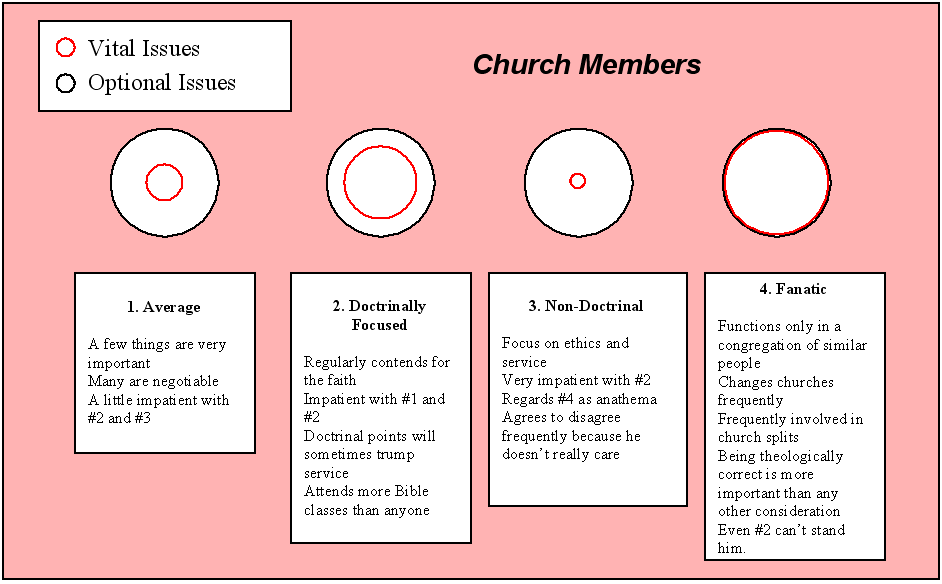
    Let me provide an illustration from another article I’m working on that looks at the type of people who might be part of such organizations:

    Church member attitudes toward doctrine and diversity
    Click the image for a larger view

    Churches that attain unity by exclusion tend to have a large number of essential doctrines. These churches tend to split, and the people in them tend to move from church to church looking for a precise match to their desires. I am not saying that such a church cannot practice unit and cannot teach the gospel; merely that it is difficult to maintain unity in that atmosphere.

    I believe the United Methodist Church, of which I’m a member, tends toward the other extreme. We tend to allow diversity in everything and require unity in nothing. We add to that a debate over where we should be allowing diversity, what is essential, and what is not.

    the-methotaku made a great comment on my previous post, Liberalism and Diversity, in which he started to do precisely what I had planned to suggest in this article–define the distinctives of Wesleyan and then United Methodist theology. Go back there and take a look.

    One reason it is often hard to define the essentials is that one can’t define “essential” without asking “essential for what?” Many people are tired of denominationalism, and I am also concerned when denominations promote themselves over Christianity as a whole. I like to call myself a “Christian, who is a member of a United Methodist congregation” rather than “Methodist.” Why? Because my primary identity is Christian. I don’t think John Wesley would have a problem with that.

    But in order to be a community in ministry to the world, I need to become part of a more tightly defined group. Rather than the very small number of doctrines I suggested as a definition for “Christian” I need some additional points that make one “United Methodist” rather than Presbyterian or Pentecostal, for example. When I define such items, I am not saying that these are additions to what makes me a Christian, rather, they define how it is that I am going to live my Christian witness in the world through a community.

    I can cooperate with anyone with whom I can agree on the essentials for that specific mission. That means that if I am dealing with an enterprise that is broadly Christian, I can cooperate with anyone who accepts basic Christianity. When I meet as a member of a congregation for worship, I expect some additional unity, though I still can allow diversity. I could easily form a small group that would share a larger number of “essential” doctrines–essential to our group, that is.

    But in each case I must try to keep these essential doctrines to the minimum required for that particular community. When I engage in charitable activity in general, for example, I don’t need to find people who agree with me doctrinally. All I need is to find people who agree that there is a human need to be filled.

    It is my prayer for the United Methodist church that we’ll reduce confusion by defining what it is that we find essential and learning to live with it. I don’t know where those lines should be drawn. I would suggest two things–they should be as inclusive as possible while allowing us to be defined as a community, and we should not use what defines us as a community to condemn those who choose a different one.

  • Who’s Together for What?

    A group of evangelical men has gotten together with the purpose of defending the gospel from, it would appear pretty much everyone. In their statement, T4G Affirmations and Denials, they say:

    We are brothers in Christ united in one great cause

  • Hebrews 11: Honor Roll of Faith

    Hebrews 11 is one of those chapters that tends to get treated apart from its context. Many people who are largely unacquainted with the basic themes of book of Hebrews are nonetheless acquainted with this one chapter. But this chapter fulfills a specific purpose in the argument of the book as a whole. Without any intention of denigrating the independent use of the faith chapter, I’d like to look at it’s place in the overall argument.

    To review the general outline, our author begins by establishing Jesus as a superior source of revelation to the Torah (1:1-4), and moving forward to discussing Jesus as our High Priest (chapters 2-4 passim). Prior to chapter 11 he focusses on the human aspects of the High Priesthood of Jesus (2:16-18), how he is one of our brethren (2:5-15) and able to sympathize with our weaknesses (4:15). He has pioneered our way into the presence of God, before the throne of grace (4:14-16).

    At the same time he has developed a foundation for the idea of something better to come, the “rest” that still waits for the people of God in the future (3:7-4:11). We have not attained it, he tells us, but it is coming. At the same time he notes that people in his audience are in danger of quitting the struggle before they attain the goal. This leads us into chapter 6, in which we have the famous passage about those who fall away, and are told that they can no longer repent (6:4-6). Nonetheless the author resumes his narrative with a statement of confidence that those to whom he is writing will not fall by the wayside (6:9).

    In chapters 7-10 he goes into more detail about the priesthood, developing the divine aspects, and the reasons why the priesthood of Jesus is better than the old priesthood. He ends chapter 10 with more admonitions to endure to the end. This endurance is based on the better promises and the faithful one who promised (10:19-25).

    But then he turns back the clock again and looks at this faith/faithfulness. There is a repetition in Hebrews 11 of the phrase “by faith,” and we need to broaden our conception of the word “faith” here to understand the full meaning. Faith is not merely a loose assent to a proposition; it is putting one’s confidence in that. Thus, “do not throw away your confidence (or boldness)” (10:35), this confidence being a result of putting one’s full trust in the way that has been provided. So we go all the way back to Abel (11:4), and we see that he worked also “by faith.” In the view of our author, Abel did not have what his readers have; he didn’t have any of the intervening revelation. He didn’t have the ultimate revelation that came through Jesus Christ. But he put his trust in God and was able to please him.

    This formula is repeated throughout the chapter. This is the cheerleader’s approach of pointing out all the prior victories and all the other people who have done what the readers are being called upon to do and saying, “Yes! You can do it! Just keep your confidence!” All these men and women of faith succeeded in pleasing God, even though they were much further from the reward and didn’t see even as much as the readers have seen themselves.

    But there is an additional element. Try looking at the stories of many of these individuals in their Old Testament context. Many of these folks do not look nearly so good in the first telling as they do on the honor roll. What’s going on? Is our author lying about them for effect?

    Let’s just take one example. If you compare the story of Moses in Exodus (Exodus 2:11-15), and then the report of the same incidents in Hebrews 11:24-27, the tone is completely different. In Exodus, Moses kind of falls into the situation, commits murder, thinks he has been caught, is in terror, and finally flees for his life. In Hebrews, he has a plan. He makes a choice: the right choice. He isn’t afraid of the king, but rather goes where he has to go and chooses who he’s going to be.

    I don’t know if that’s lying, but it’s certainly a different perspective. I would like to suggest it’s the “faith” perspective. The author of Hebrews looks back on Moses, and because Moses endured, completed his task, and died faithful to God, he is the person of decisive faith described in Hebrews 11. He may have done some stumbling along the way, but that’s not in the picture now. Moses endured. That’s really the point the author is trying to make. His point is strengthened by the fact that some of the people on the honor roll were not always perfect, were not always absolutely faithful at every moment of their life, but the testimony that can be given over their whole life when it was complete, is that they were faithful. They did it by faith.

    One can’t hope to have a better testimony than that. When I’m feeling that I’ve gone too far off the track to be regarded as a person of faith, I remember Hebrews 11. By faith all kinds of people made it to God’s honor roll. All they had to do was keep right on moving forward.

  • Misrepresenting Science in God’s Name

    The Smithsonian magazine online has an article Dinosaur Shocker, talking about the work of Mary Schweitzer who has found preserved soft tissues in fossilized dinosaur bones. The topic has been picked up by young earth creationists and used as an evidence for a young earth. This has already been discussed on the web, but if you have not read it, here are a couple of key articles:

    Though I was interested in the article, I was more interested in the way in which the material had been used and I want to comment on that briefly, because I have seen it done very often.

    The Smithsonian article made the follow comments on this use of Schweitzer’s material:

    Young-earth creationists also see Schweitzer’s work as revolutionary, but in an entirely different way. They first seized upon Schweitzer’s work after she wrote an article for the popular science magazine Earth in 1997 about possible red blood cells in her dinosaur specimens. Creation magazine claimed that Schweitzer’s research was “powerful testimony against the whole idea of dinosaurs living millions of years ago. It speaks volumes for the Bible’s account of a recent creation.

  • Good Point, Bad Exegesis

    John the Methodist on Locusts and Honey has an excellent post on sexual ethics and the exegesis behind it.

    He discusses the misuse of the story of David and Bathsheba in order to make a point that was nonetheless a good one. When he encountered this in a small group discussion, John was silent on the exegetical issue so as to not interfere with the main point, which was good.

    This reminds me of going through 40 days of purpose in our church. As we went through the book The Purpose-Driven Church, I was regularly annoyed by the use of scripture, even when the points were good, and might have been made effectively using different scripture. With my field being Biblical languages, I was particularly disturbed by the “translation shopping” approach in which he used whatever version gave words that would let him integrate it with his text. This often resulted in a phrase taken out of context.

    I kept this between my wife and myself, and didn’t tell anyone else in the church for the same reason John cites: I didn’t want to weaken the good point by pointing out the poor use of scripture. On the other hand I’m concerned that if we constantly make good points while abusing scripture, how do we deal effectively with abuse of scripture to make bad points?

  • The Danger of Ineffective Intervention

    In February of 2003, just before the invasion of Iraq, I wrote an essay entitled Revenge! in which I made some comments on the justification of violence. I think what I said then reflects well the situation in Iraq now. I’m not claiming special prophetic gifts here, but folks, I told you so!

    Sometimes that will mean war. Saddam has certainly provided justification through his own actions for someone to deal violently with him. I have no sympathy with a suggestion that somehow the Iraqi government doesn’t deserve to be removed. But I believe there is a second part to the justification of violence. How can things be better when it’s done? In this case that includes the question of who will rule Iraq following an invasion. Will there be a power vacuum left in its place?

    You see, no matter how bad a government is, there is a possibility for something worse. The possibility has been raised of Iran developing nuclear weapons. Does that make us feel more secure? Would we prefer that Iran became a power dominating the region? That is only one scenario, but it is something that must be considered.

    I’d like to expand a bit on those two justifications for violence. In my view, first there must be a reason for a person to take action, for example that they are threatened or attacked, and that the attacker is not receptive to peaceful means. The second, however, is more difficult to meet. I think you need to ask two questions: 1) Will the violent intervention be successful? and 2) Will the resulting situation be an improvement over the previous situation.

    I would add a corollary to these. If you are going to use violence, you have to use enough violence to accomplish your goal. Applying less than that to the situation only results in worse conditions, thus the resulting situation will not be better. It will generally be much worse.

    Let me illustrate. I don’t keep a gun in my house. Some of my friends think having a gun is a simple and ordinary part of being able to protect their families, and would wonder why I would not take this precaution of being prepared to defend myself. Others would congratulate me on my commitment to non-violence. Neither view correctly identify my reason for not having a gun. I’m convinced that my skill with the weapon is not sufficient to make it more likely that I will successfully defend my home than that the weapon will be used by a criminal. I am not committed to non-violence. As a veteran of the U. S. Air Force, I’m willing to see violence used in the pursuit of national goals. In my household I would feel fully justified in putting a bullet between the eyes of an intruder. I just rate the odds of my actually doing so rather low.

    In many of our recent wars (I’m a veteran of Grenada, Panama, and the first Gulf War) I have seen violence applied, but I have not seen the expected results accomplished, bar the result of Kuwait no longer being under Iraqi occupation. That’s the result of applying violence, but applying it either improperly or in insufficient amounts to accomplish one’s goal. Panama after Noriega was removed was not such a nice place for a very long time. Please note here that I’m not saying that each of these situations would have been better with more violence applied. Especially in the case of Panama, all justifications for the violence failed. Panama (and Noriega) had not provided an appropriate justification for foreign intervention, and no amount of violence applied was going to make the situation better. It was one of the clearest cases I know in which violence was a totally incorrect solution.

    All these thoughts came to mind this morning when I read the story Exporting Chaos from Newsweek. Rami G. Khouri, editor-at-large of the Daily Star in Beirut writes about the fear that he and other middle easterners have whenever us westerners get together to try to decide or influence their fate. There are some things in his article with which I disagree. For example, I don’t feel that we have some duty to provide aid to a Hamas led Palestinian government. Nonetheless, I think his remarks are almost all very well directed, and we in the west would do well to listen.

    Despite my belief that we have no duty to provide aid to Hamas, we were the ones who urged the elections. We wanted to deal with a “democratic” Palestinian government, but we wanted them to elect the “right” people. Well, folks, that is not how democracy works. You can want democracy, and you can want the “right” people in power, but if you want both, and think you can have both, you are toying with insanity. I think our foreign policy is doing precisely that.

    We want democracy in Iraq, we want human rights. We want a unified state. We want that state to be friendly to us. We don’t want it to be an Islamic state. Hold it a second! Have we considered that the people who are going to vote in that democracy might not want the same things we do? Their concerns may well have little to do with protecting the United States from terrorism. They are more concerned with how their neighborhoods are run. One aspect of the way many of them want their neighborhoods run is Islamic standards and Islamic law. We are not going to be successful in accomplishing all those goals that I listed.

    Saddam Hussein maintained a government that was more friendly to western values than anything we are likely to see by means of an election. If we wanted western values established in Iraq, we should have followed a different strategy. I suspect we would have to occupy the country with substantially larger numbers of troops and rule with a ruthlessness that would make Saddam Hussein’s rule look positively heavenly. We aren’t that ruthless (at least I hope we aren’t). It’s not a practical policy. But what we have done is exercised violence in pursuit of that sort of a goal, but done so in a way that will not be successful. That means that those who die in this war will, in the end, have died in the process of making things worse. It’s not their fault; I’m not criticizing the American troops on the ground. I’m criticizing the planning and goal setting (or lack of it) that put them in that place.

    I’m also not very happy with the democratic response to the planning. It has always seemed to be more or less that we should do something that is very much like what the current administration has done only a bit less of it. Democrats are just as infected with the bug of solving everybody else’s problems with American solutions as are Republicans. Democrats seem to be even more muddled on how we should do it.

    Violence is sometimes necessary. War is sometimes necessary. But it is a tragedy when we resort to violence, and fail to make the resulting situation better.

  • In and Around God

    I found a wonderful post on the relationship to which God invites us over at connexions (via the the Methodist Blogs Weekly Roundup), titled Living in God. The author, Richard Hall, brings to us the word “perichoresis” used by early church fathers to describe the union of the human and divine in Jesus and then the trinity (details in the post and comments to it.

    It’s not the big word that made me like this post so much, but the discussion of it. I rarely like the use of a Greek word in preaching and teaching. If you’re teaching in English, teach in English. Generally. Here, the very mystery of the word, and the mysteries it can be used to describe combine to help us think about mysterious things. And the trinity is indeed a mysterious thing, and so is the closeness of the relationship to which Jesus calls us. Often we forget that. One of the benefits of the doctrine of the trinity is simply that it makes us think constantly about relationships. It forces us to try to imagine relationships that are closer than any that we experience.

    At the same time, it illustrates how much more there is to the atonement than substitution and the paying of debts. I do not reject the notion of substitution in the atonement. I think that substitution is a metaphor that can convey to us some of the meaning. But it is a metaphor, and it conveys only part of the picture. If we allow ourselves to spend time thinking about some of these other aspects, and taking seriously Biblical materials that reach beyond that point, we will find a richness in atonement and reconciliation that will enrich our relationship with God, and flow out into our relationship with others.

    Our hope in both divine and human relationships should be this: They can be better.

  • Some Links for Saturday

    I’ve been doing some writing on many of the links I’ve found during the week, but I do want to list some of what I’ve been writing elsewhere and also a few assorted blog entries I’ve found that interested me.

    First, while perusing Wrong Words, I noticed the entry Child Abuse or Child Discipline, which in turn links to Child Abuse on the Religious Right – The Pearls. This is something that Christians especially should be aware of, because there are some dangerous things going on without sufficient protection or concern for the consequences. The type of child-raising advocated by the Pearls that these posts respond to is not something we Christians should tolerate. It’s being done in our name, and condoned as the proper “Christian” thing to do.

    Then with help from Wesley Daily, I found the following post by Neil Bishop, Putting Jesus’ Disciples Back into the World. There’s some good material there on leadership and also on keeping the church’s focus where it belongs and not getting distracted.

    Over on The Panda’s Thumb we got to see a demonstration of the rare detective abilities of certain members of the intelligent design movement, as they were fooled by a well-known internet scam. You can follow the links to the perpetrators from there. This was probably the third or fourth time I’d seen that particular scam. It has eternal life. It will keep popping up because some people really want to believe it. I wonder if the Explanatory Filter works as well detecting design as their ordinary discernment worked in detecting a well-known scam?

    Ed Brayton, over on Dispatches from the Culture Wars notes how angry congress became when the office of one of their own was raided. Suddenly the constitution became really, really important. But where were these same congressmen when it was other people getting wiretapped or raided? You can follow the story starting with his entry If You Have Nothing to Hide, Why Worry?. Where have I heard that before?

    Now for my own blogging elsewhere:

    I’ve posted several entries on the Participatory Bible Study Blog, two more on Hebrews, Hebrews 6:4-6: Can Those who Fall Return?, and Jesus as Human and Divine Priest. In addition to several minor posts, I wrote about Genesis 3 and the fall in Genesis 3: The Story of the Fall.

    On the Pacesetters Bible School Newsletter, I wrote a little bit more about continuing education in Continuing Education: Directed Learning of New Things. I also talked about applying 1 Corinthians 13 to worship in Applying 1 Corinthians 13.

    I hope you have a fine Memorial Day weekend. I’m planning to enjoy myself. Be nice to a veteran somewhere–even me. 🙂

  • Genesis 3: The Story of the Fall

    I just completed drafting a translation of Genesis 3 for my Totally Free Bible Version project, which is simply where I make my personal translation work available free on the web for anyone who wants to use it within a very limited set of rules. I want to comment some on this story and its meaning in the Christian tradition.

    If you haven’t read my materials on Genesis 1 & 2, you might want to follow the link now just to get some background. In addition you will find some useful information in my series on the historical critical method on my Threads from Henry’s Web blog. The first article is Biblical Criticism Overview – I, and the category is Biblical Criticism.

    Introduction

    A fundamental question in dealing with Genesis especially is just what type of literature each passage is. A great deal of the way we interpret a passage depends on the type of literature we perceive it to be. Both young and old earth creationists, for example perceive the first 11 chapters of Genesis to be narrative history in some fashion. The debate between their two positions has to do with precisely how one understands certain terms in the narrative. Old earth creationists, for example, will tend to see more distance betweent he symbols and the reality.

    I like the illustration used by Derek Kidner in his commentary on Genesis in the Tyndale Old Testament commentary series (see the end of this entry for links). On page 66 he discusses the differences in terms of history between the historical description of David’s sin in 2 Samuel 11, and the prophetic restatement of that in 2 Samuel 12:1-6. I think that distinction is a good one to keep in mind, but one should also be aware that Nathan’s parable that narrated David’s sin is intended in some way to convey historical facts, though concealing somewhat their real referent (even David doesn’t realize who he is condemning), and clarifying the moral issues involved.

    I would like to add a third category here–not intended as historical narrative at all. Gerhard von Rad, in his OTL commentary, tries to present these early chapters of Genesis as heavily demythologized, and indeed compared to their ancient near eastern parallels they are. But at the same time there are many mythological elements remaining, and I believe those elements, along with the function and message of the story, give us ample justification to read these passages as myth, and to accept them as performing the function of myth within early Israelite culture.

    What indicators show me that this should not be read as narrative history? Those who have read my earlier discussions of Genesis 1 & 2 will notice that some of the same reasons apply, but chapter 3 is even easier. In fact, I have some difficulty seeing how so many people can read this chapter and actually expect it to convey narrative history. Kidner’s comment that the New Testament writers take it as history (op cit, 66) misses the point, I think, simply because as a myth it is well suited to provide the foundation for precisely the type of doctrines Paul especially was presenting. We are separated from God and need to be reconciled. We are separated from eternal life, and must be redeemed by Jesus.

    Indeed, one of the most common passages used to read Satan into Genesis 3, and also involved in trying to make it history, is Revelation 12, which itself is pulled out of the narrative sequence. In my study guide to Revelation, I title that section the timeless conflict, because the rebellion of humanity, or in general creaturely rebellion and separation from God and God’s saving activity is not limited to a single historical instant.

    In this chapter, however, we open with a talking snake. As we will note there is no indication that the snake is anything but a snake, except that he talks. Then we have magic fruit. Notice that the effect comes automatically. At the end of the chapter God has to block the way to the tree of life because if human beings gets back there they will obtain eternal life magically. There is mythology removed here, but this is not entirely demythologized!

    So in my view the chapter expresses a state, an ontological reality, without providing us a narrative of the process. One could understand this as indicating an instant in which humanity was offered close communion with God and preferred instead to live independently. It could, as Tillich might express it, simply state the separation of the finite being from the infinite ground of all being. In either case the end-state is the reality with which we live, and the reality from which we look to be redeemed. At the same time, I think there is a clear sense of something gained as well. Humanity accepted cognition, choice, and moral responsibility. As a result, redeemed humanity will be, I think, greater than a humanity that never went through that experience and never experienced the choice to do right or wrong. (Pardon a little extemporaneous theologizing!)

    Sources

    This passage has a single source, the J source, and ties closely with Genesis 2:4-25. If you were reading the priestly source alone you would go from Genesis 1:1-2:3, and then go straight to chapter 5, following which you would read about the flood as the first sign that things went bad. In this case, we have the story of the fall, then Cain and Abel, then the crash represented by chapter 6.

    But this chapter is a unity. If there are any borrowing or other sources, they are at the phrase level.

    Translation and Notes

    Note: Regard this translation as draft. It’s as fresh as this morning. 🙂 Scripture text is in blue.


    1Now the snake was more crafty than any of the wild creatures that YHWH God had made, and he said to the woman, “Has God said that you may not eat from every tree in the garden?”

    Note several things about the snake. He is not a special creation. He’s one of the creatures of the field. Other than being more crafty and able to talk, we get no introduction. I would simply suggest here that when you have talking snakes, you’re probably dealing with something other than narrative history.

    2And the woman answered the snake, “We may eat the fruit of the trees in the garden. 3But regarding the fruit of the tree that is in the middle of the garden, God has said, ‘Don’t eat from it or touch it, lest you die.’”

    It’s interesting that the woman immediately moves to put an extra buffer around God’s command. If you don’t touch it, you can’t eat it. Let’s be safe. But moral choices will often require us to operate at the limits of moral decision making. For example, as one makes a decision about the morality of stem cell research, how does one operate with a hedge. You have sanctity of life issues on both sides of the equation. You have to make a decision, and you don’t get to hedge it very much. Will you eliminate research that could save lives, or will you protect embryos?

    Eve wanted a hedge. She distanced herself from the problem.

    4And the snake said to the woman, “You will certainly not die. 5Indeed, God knows that on the day that you eat from it, your eyes will be opened, and you will become like divine beings, understanding both good and evil.”

    The odd thing here is that the snake turns out to be right, as the story goes on to show. We often try to ignore this, or interpret around it in Christian understandings of this chapter. “Well, they started to die,” we say. I would suggest that there is no way out of this dilemna within Christian theology except an understanding of grace. God intended them to die, but preserved their life instead. God can repent (Genesis 6:6). I think we have the first instance of it here, and I think we’re supposed to notice.

    At the same time note that God had never denied what the snake promised. He simply said, “Don’t eat.” The possibility is left open that they would become like divine beings, and yet die as a result.

    I use the translation “divine beings” rather than “gods” because I think that fits better with the trend of the Torah as we have it now. It was not that they would become gods in the sense of being worthy of worship, but rather than they would share in an aspect of divinity, namely the ability to bring forth either good or evil.


    6When the woman saw that the tree’s fruit was good to eat, and pleasing to look at, and desireable so as to gain wisdom, she took from its fruit and ate it, and she also gave it to her husband with her, and he ate. 7And the eyes of both of them were opened, and they knew that they were naked, and they stitched together fig leaves and made themselves loin cloths.

    The woman “saw” that the fruit was good. We have an abbreviated narrative. Somehow the snake makes the woman see the fruit in the way he wants her to see it. This passage makes me wonder if we don’t have more of a narrative of internal struggle, the sort of struggle that takes place in any child who is contemplating something forbidden. It might be the cookie jar. Indeed, the cookies will taste good, and the child will experience pleasure from eating them, but there is a reason not to. An internal conversation convinces the woman that this is a pleasure worth having.

    Conversely, the text doesn’t tell us that the woman decided that God was wrong, even though that is what the snake had told her. She convinces herself that the fruit is good, and God’s statements about it recede conveniently into the background.

    8Then they heard the sound of YHWH God walking in the garden in the cool time of the day, and the man and his wife hid themselves from YHWH God among the trees of the garden.

    The immediate result of stepping out on their own is that the human couple are afraid. Notice that God is merely going for a walk, presumably looking to talk with the people he made and placed in the garden. He’s not blustering, throwing thunderbolts, threatening, stomping, or anything similar. He’s just taking a walk. Humanity has stepped out indepedently, but is afraid of the results.

    9And YHWH God called out to the man, “Where are you?”

    10And the man said, “I heard you in the garden, and I was afraid because I was naked, and I hid.”

    11And God said, “Who told you that you were naked? Have you eaten from the tree that I commanded you not to eat from?”

    The human couple had been naked since they were created, but suddenly it becomes important. With self awareness comes shame, shyness, uncertainty of how to present oneself. It’s something they will have to deal with on this new path they have embarked on.

    12Then the man said, “The woman whom you appointed to be with me, she gave me fruit from the tree, and I ate.”

    13So YHWH God said to the woman, “What is this that you have done?”

    But the woman said, “The snake led me astray, and I ate.”

    Who says the Bible isn’t relevant? This scene takes place in myriads of households, myriads of schools, and myriads of workplaces every day! We’re confronted by something that has gone wrong, and everybody looks for the person who is to blame. Everyone points at someone else. It can’t possibly be our own fault.

    Notice that God doesn’t ask the snake anything. Is it possible that the snake is simply a symbol for an internal struggle, that God doesn’t deal with the snake because it’s being used by the woman as a “devil made me do it” kind of excuse? I don’t know, but I suspect there’s a reason why the snake doesn’t get to defend himself.


    14So YHWH God said to the snake, “Because you have done this, you are more cursed than any of the wild creatures. You will crawl on your belly and eat dust as long as you live. 15And I will place hostility between you and the woman, and between your descendants and hers. Her descendants will bruise your head, but yours will bruise her descendants’ heel.”

    I have no problem in Christian theology reading back into this passage some reference to redemption, but that is not the point in its original context. The passage here simply explains why snakes are considered dangerous, looked down on, and crawl on their bellies. They did a bad thing here and they are paying for it! Women have a feud with them. This is hardly the serpent of Revelation 12, cast down from heaven, or the great Leviathan, conquered by God.


    16To the woman he said, “I will make childbearing much more difficult for you. You will bear children in pain, yet you will desire your husband, and he will rule over you.”

    Again, a description of real life in the real world of that time at least. It doesn’t mention good pain medications or women’s liberation, but the equality of male and female is something promised in Jesus, after all, and not that much a reality in the history of the world thus far.

    My wife tells me that if men had to experience the pain of childbirth there would be no humanity, and I pretty much agree with her. Somehow women keep undergoing the torture and propagating the species.


    17To the man he said, “Because you listened to your wife’s voice, and you ate fruit from the tree about which I commanded you, ‘You shall not eat from it,’ the ground will be cursed on account of you. You will eat from it only by hardship as long as you live, 18and it will bring forth thorns and thistles for you, and you will eat vegetables from the field. 19You will get bread to eat by laboring until you sweat until you return to the ground, because you were taken from it. Dust you are, and you will return to dust.”

    The man gets to work hard to produce food. But I think there is a spiritual dimension to this in that having given up total dependence on God he becomes dependent on himself. From now on he must make his own moral decisions as well as producing his own food, building his own shelter, and clothing himself and his family. Independence comes at a price.


    20So the man called his wife’s name Eve, because she was the mother of all people who were alive.

    21Then YHWH God made coats of skins for the man and his wife, and he dressed them.

    It’s interesting that Adam just now notices that Eve is the mother of all living. Perhaps it was of less importance before they were aware of their situation. In any case, to cover their nakedness, and prevent shame now that they were aware of it, they are clothed.

    22And YHWH God said, “Look! The human has become like one of us, understanding good and evil, and now, [we need to take action] lest he should take also fruit from the tree of life, and eat it, and live forever.”

    23So YHWH God sent him out of the Garden of Eden to cultivate the ground from which he had been taken. 24And he dispossessed the man and made him live to the east of the Garden of Eden, and he placed Cherubim with flaming swords turning this way and that to guard the way to the tree of life.

    This is another “magic fruit” instance. There is a tree which God must prevent the human couple from reaching, otherwise they may become immortal contrary to God’s will. Surely this is not intended as narrative history! Symbolically, this says that God does not provide eternal life to those who are operating in complete independence from him, but the fact that the couple do not die, even though God had said they would, shows that he graciously extends life.


    Let me recommend three excellent commentaries on Genesis: