
I grew up in the Seventh-day Adventist Church, which is very interested in eschatology. We didn’t learn the term all that early, but we were subjected constantly to sermons about it. SDA eschatology is one of the key reasons I’m not SDA any more, but when I first joined a United Methodist congregation, I was surprised to discover that nobody really thought that much about the end times. One pastor I know had even invited an SDA to come in and teach on Revelation. Why? “SDAs know something about eschatology.” Of course, the corollary to that was that Methodists did not.
But SDAs were not the primary source for the congregation. Most of them picked up what eschatology they knew from television and other popular media, which meant some kind of futurist interpretation including a seven-year tribulation, usually a pre-tribulation rapture, and a pre-millenial second coming. This eschatology, while built on a dispensational view of biblical interpretation and theology, was held without necessarily accepting, or even knowing, its theological foundations.
Most Methodist pastors that I encountered during this time didn’t really teach or preach about eschatology. They preferred to avoid it. They might say that Methodists weren’t really committed to a particular eschatology. Some accepted the “left behind” eschatology themselves. But in general there was, and is, a void in this area of theology.
Let me warn readers at this point that this is one of my posts reflecting on a book I have published. There won’t be much of a commercial, however. I’m just giving some of my thoughts on eschatology and why we should pay attention to it in the church.
I believe the reason many pastors and teachers don’t talk about eschatology is that it has a bad reputation amongst those theologically trained. There is so much craziness that goes on, such as setting dates for the end of the world, that people just don’t want to go there. The “left behind” theology and the futurist view of the interpretation of Daniel, Revelation, and other apocalyptic literature is popular because it is proclaimed almost in a vacuum. If people hear only one view proclaimed, they can perhaps be forgiven for thinking it is the way to think about eschatology.
And I believe that groups with even more peculiar views of the last days find an opening amongst Christians simply because pastors and teachers haven’t addressed the issues at all. I recall a comment by my uncle on a sermon which he called “fearfully and wonderfully made.” He didn’t intend it positively. Most systems or programs about the end time are, in that sense, “fearfully and wonderfully made.” They are also houses of cards, to be blown over if anyone studies the texts themselves without the guide. I find the SDA interpretation of the seals and trumpets of Revelation to be ridiculous, and rejected them while I was still a college student in an SDA school. But if you hear just that view, and look at just the texts (and the emphasized portions of texts) than an evangelist or other presenter wants you to see, it can sound very plausible.
But even more importantly, eschatology is critical. It’s where we’re going. It’s why we are the church. I don’t mean to diminish the importance of now, and there are views of eschatology that do not diminish that importance. That’s something to consider. But when you’re making a decision as to what to do and how to do it, knowing where you’re going is important. One result of bad eschatology is the idea that because Jesus is coming soon (and just what does “soon” mean?) we don’t need to take care of the planet we’re living on. Why bother, when it’s all corrupted by evil and about to be destroyed in the fires of hell?
The answer is to take this subject on directly, and as frequently as necessary to counter popular Christian culture. It is also important not to just teach some alternate scheme of the end times. Too often we teach conclusions in the church (and even in seminary), and not how to come to those conclusions, and yes, how to challenge them.
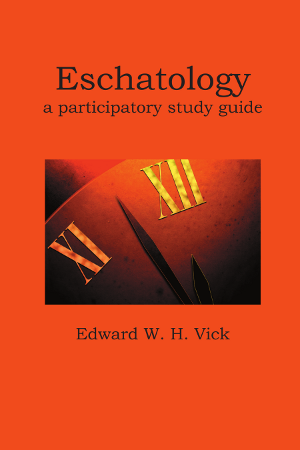
 That is what Dr. Edward W. H. Vick does in his study guide, Eschatology: A Participatory Study Guide. Interestingly enough, Dr. Vick is a Seventh-day Adventist. But he isn’t teaching the SDA evangelistic message. He’s surveying the field of eschatology and teaching readers and students the terminology and the ideas they need in order to understand the discussion of this field. It isn’t a simple book, but it is direct and straightforward. You’ll need to study it carefully, lesson by lesson. You can’t jump in somewhere in the middle. It won’t tell you what you should believe about eschatology. It will provide you with the tools to study the topic and to understand what others are saying.
I accepted this manuscript for publication because I think we need to think, study, and teach more on this topic. I am also convinced that on every topic we need to let people know not just what we conclude, but how we came to those conclusions. It builds on what Dr. Vick has already said in his books From Inspiration to Understanding: Reading the Bible Seriously and Faithfully, and The Adventists’ Dilemma. The latter volume will be of particular interest to SDAs who often wonder just what “soon” means when you’ve been proclaiming that Jesus is coming soon for a couple of hundred years. Don’t worry. The church has been doing it for 2000 years. But perhaps we don’t know what “soon” means.
There are those who may be concerned about using a book on this subject written by someone from a group that has peculiar views on eschatology. Let me assure you that Dr. Vick treats eschatology as an academic subject. I’m not going to try to characterize his view of SDA eschatology. I’ll simply say that in this book he presents an overview of this topic that is broad, intense, and extremely helpful.
(If you’re interested in pursuing a study of basic eschatology in that manner, this will be the book for you. If you’re considering this book for use in your church, remember that you can request a free evaluation copy simply by e-mailing Energion Publications with a note telling us your intended use and the size of the group you intend to use it with.)


Leave a Reply