Threads from Henry's Web

Tag: Seventh-Day Adventists

  • Psalm 119:123 – Patience

    Psalm 119:123 – Patience

    My eyes have failed looking for your salvation,
    and for your righteous word.

    Any number of people have told me that I shouldn’t pray for patience. If I do, God will doubtless send me all kinds of trials and keep me waiting so as to teach me patience by experience.

    I think it doesn’t matter if you pray for patience or not. You’re going to get an opportunity to learn patience by experience.

    The psalmist is living, well, life! I think we can all relate. From childhood trips when we doubtless drove our parents nuts by asking “are we there yet?” to expectations of other people, to our hopes even in old age for new blessings to come–and even to looking for the end of long sentences–we have opportunities to practice patience.

    Usually we don’t. If you keep wondering why your patience is being tested so much, you might consider whether you are actually gaining patience or just repeating our experience of extended impatience.

    But one of the experiences of Christian life, and yes, the lives of people of other faiths, is that things we hope for, whether they are secular in nature or the result of a perceived promise by God is delay.

    One of the big ones for Christians is the wait for the second coming of Jesus. How are we doing with that?

    Well, I grew up as a Seventh-day Adventist. Back in 1844 (well, first in 1843), Adventists calculated that Jesus would return on October 22, 1844. The history books, not to mention we’re still hanging out on this planet, suggest that prediction wasn’t right.

    I don’t bring up SDAs in order to laugh at them, but rather to point out just how normal is this is. People continuously set dates for the second coming. Many more don’t set dates, but come up with various reasons to declare that the second coming is “really near” now. We’re obviously in the last days, because [list of things we don’t like about the world here].

    In growing up I remember evangelists coming by regularly, and in order to provide the appearance of an audience when really very few visitors showed up, we’d all attend. After a time I started to notice a problem. At one point I remember wondering why Russia (the USSR back then) wasn’t part of the prophecies of the end, considering how much the older folks talked about it. A couple of years later, Russia suddenly appeared in one of these evangelistic meetings as a really-truly sign that the end was really near.

    Our eyes just get worn out reading all the explanations of why the end hasn’t come yet and why we ought to keep hoping for it.

    There’s a good side to staying on the watch for God’s promises. I think that’s what the psalmist is pointing out. No matter what has happened, no matter how long he has had to look, he has kept hoping. That is a good thing.

    Trying to make up the result you want–not so much. Perhaps we would be better to “evangelize” about the good news that Jesus loves you now and invites you into his family, rather than trying to pin down the time when he appears in the clouds. Making new predictions can just be wearing on our eyes and our hopes.

    And as someone pointed out to me today, the one thing we can’t do is give up. Ultimately that is what patience is about. We practice patience when we keep moving forward and don’t give up.

    What opportunities will you have to practice patience today? Will you take advantage of them, or will you just demonstrate your skill at impatience?

  • Are Seventh-day Adventists Christians?

    This question, which I’ve written about before, was brought to my attention again both through reading and through some conversations. As an ex-Seventh-day Adventist, I’m often asked whether I believe my former denomination is truly Christian, or whether it is some sort of cult. Ignoring what I consider the hopeless muddle in the usage of the term “cult,” I suppose I could divide this question into two, neither of which I actually like. I’m going to use Methodists throughout as the foil for this discussion, because I am a member of a United Methodist congregation. Note that I prefer to call myself a Christian who is a member of a United Methodist congregation rather than a “Methodist” or “United Methodist.”

    The first would be to ask whether the Seventh-day Adventist Church is a Christian denomination. I dislike this question, because I think “denomination” is largely an extra-Christian idea. I’m not going to throw out all concepts of denominations simply because they can provide accountability to congregations, something lacking amongst independent churches. Both independent churches and denominational churches have their share of problems, but neither reflects the kind of connections that I believe a Christian congregation or assembly should have. I would like to be held accountable by my brethren in Baptist churches as well as in the United Church of Christ. As for Seventh-day Adventists, I would say the same thing. They suffer from all the problems of being a denomination, but they also are brethren to which I would like to be connected, and in a sense, accountable.

    The second option would be to ask if members of the Seventh-day Adventist Church are Christian. I think this is worse. It identifies membership in the body of Christ with membership in a particular human organization. However, my answer would be that it is about as likely for a Seventh-day Adventist church member to be a Christian as a United Methodist church member. Probably a bunch of people in each are not.

    That leads me to a question I was asked regarding evangelism. If I was discussing Jesus with people, and this led to the idea of getting involved in a local assembly of believers, would I be willing to refer someone to a Seventh-day Adventist congregation? Hmmm! Now the rubber meets the road. Do I really mean it when I call SDAs Christian brethren? The answer here is that I’d do so on the same basis as I would refer someone to a Methodist congregation, with the additional note that I’d be specific about SDA distinctives. In other words, it would depend on the congregation. I know plenty of Methodist churches to which I would not refer a seeker. I know quite I number to which I would. The same issues would be in play. Where I think I might have more questions about an SDA congregation would be in whether the distinctives of the denomination got ahead of the gospel. But that is not a problem that is exclusive to SDAs. Any denomination, in fact, any independent church, is quite susceptible to replacing the gospel with its own distinctives, and even viewing the gospel as synonymous with its traditions.

    Now there’s a certain arrogance to this post. Who am I to decide who is a Christian and who is not? Nobody. Absolutely nobody. It’s not my job. What I do have to decide, what I think I have scriptural warrant to decide, is how I will help connect others to the body of Christ, and to do that I must discern. If I believe that I am referring someone to a place where they will be torn apart by judgment rather than led to join fellow overcomers, then I must choose some place else. But God is the only one who knows what’s on the inside, i.e. who is a “true” believer.

  • The Problem with Eschatology

    The Problem with Eschatology

    I grew up in the Seventh-day Adventist Church, which is very interested in eschatology. We didn’t learn the term all that early, but we were subjected constantly to sermons about it. SDA eschatology is one of the key reasons I’m not SDA any more, but when I first joined a United Methodist congregation, I was surprised to discover that nobody really thought that much about the end times. One pastor I know had even invited an SDA to come in and teach on Revelation. Why? “SDAs know something about eschatology.” Of course, the corollary to that was that Methodists did not.

    But SDAs were not the primary source for the congregation. Most of them picked up what eschatology they knew from television and other popular media, which meant some kind of futurist interpretation including a seven-year tribulation, usually a pre-tribulation rapture, and a pre-millenial second coming. This eschatology, while built on a dispensational view of biblical interpretation and theology, was held without necessarily accepting, or even knowing, its theological foundations.

    Most Methodist pastors that I encountered during this time didn’t really teach or preach about eschatology. They preferred to avoid it. They might say that Methodists weren’t really committed to a particular eschatology. Some accepted the “left behind” eschatology themselves. But in general there was, and is, a void in this area of theology.

    Let me warn readers at this point that this is one of my posts reflecting on a book I have published. There won’t be much of a commercial, however. I’m just giving some of my thoughts on eschatology and why we should pay attention to it in the church.

    I believe the reason many pastors and teachers don’t talk about eschatology is that it has a bad reputation amongst those theologically trained. There is so much craziness that goes on, such as setting dates for the end of the world, that people just don’t want to go there. The “left behind” theology and the futurist view of the interpretation of Daniel, Revelation, and other apocalyptic literature is popular because it is proclaimed almost in a vacuum. If people hear only one view proclaimed, they can perhaps be forgiven for thinking it is the way to think about eschatology.

    And I believe that groups with even more peculiar views of the last days find an opening amongst Christians simply because pastors and teachers haven’t addressed the issues at all. I recall a comment by my uncle on a sermon which he called “fearfully and wonderfully made.” He didn’t intend it positively. Most systems or programs about the end time are, in that sense, “fearfully and wonderfully made.” They are also houses of cards, to be blown over if anyone studies the texts themselves without the guide. I find the SDA interpretation of the seals and trumpets of Revelation to be ridiculous, and rejected them while I was still a college student in an SDA school. But if you hear just that view, and look at just the texts (and the emphasized portions of texts) than an evangelist or other presenter wants you to see, it can sound very plausible.

    But even more importantly, eschatology is critical. It’s where we’re going. It’s why we are the church. I don’t mean to diminish the importance of now, and there are views of eschatology that do not diminish that importance. That’s something to consider. But when you’re making a decision as to what to do and how to do it, knowing where you’re going is important. One result of bad eschatology is the idea that because Jesus is coming soon (and just what does “soon” mean?) we don’t need to take care of the planet we’re living on. Why bother, when it’s all corrupted by evil and about to be destroyed in the fires of hell?

    The answer is to take this subject on directly, and as frequently as necessary to counter popular Christian culture. It is also important not to just teach some alternate scheme of the end times. Too often we teach conclusions in the church (and even in seminary), and not how to come to those conclusions, and yes, how to challenge them.

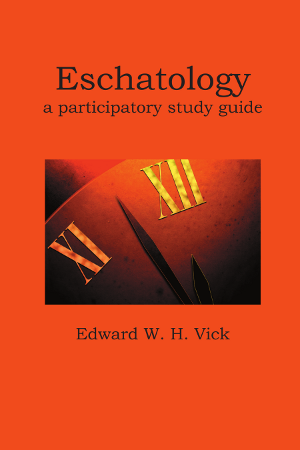
    9781938434105mThat is what Dr. Edward W. H. Vick does in his study guide, Eschatology: A Participatory Study Guide. Interestingly enough, Dr. Vick is a Seventh-day Adventist. But he isn’t teaching the SDA evangelistic message. He’s surveying the field of eschatology and teaching readers and students the terminology and the ideas they need in order to understand the discussion of this field. It isn’t a simple book, but it is direct and straightforward. You’ll need to study it carefully, lesson by lesson. You can’t jump in somewhere in the middle. It won’t tell you what you should believe about eschatology. It will provide you with the tools to study the topic and to understand what others are saying.

    I accepted this manuscript for publication because I think we need to think, study, and teach more on this topic. I am also convinced that on every topic we need to let people know not just what we conclude, but how we came to those conclusions. It builds on what Dr. Vick has already said in his books From Inspiration to Understanding: Reading the Bible Seriously and Faithfully, and The Adventists’ Dilemma. The latter volume will be of particular interest to SDAs who often wonder just what “soon” means when you’ve been proclaiming that Jesus is coming soon for a couple of hundred years. Don’t worry. The church has been doing it for 2000 years. But perhaps we don’t know what “soon” means.

    There are those who may be concerned about using a book on this subject written by someone from a group that has peculiar views on eschatology. Let me assure you that Dr. Vick treats eschatology as an academic subject. I’m not going to try to characterize his view of SDA eschatology. I’ll simply say that in this book he presents an overview of this topic that is broad, intense, and extremely helpful.


    (If you’re interested in pursuing a study of basic eschatology in that manner, this will be the book for you. If you’re considering this book for use in your church, remember that you can request a free evaluation copy simply by e-mailing Energion Publications with a note telling us your intended use and the size of the group you intend to use it with.)

  • October 22 and Eschatology

    Eschatology: A Participatory Study GuideOctober 22 probably doesn’t mean much to most of my readers, but for someone who grew up as a Seventh-day Adventist (SDA), it has great significance. It was on October 22, 1844 that early Adventists (before they were Seventh-day Adventists) expected Jesus to return. It was actually the second time they had expected that. first came what is known as the “lesser disappointment” of 1843, when they had not set a specific date, but had set a deadline of a season. Of course, the day ended, and nothing happened.

    But as often happens with failed prophecies, after thought, consideration, and some manipulation of Bible texts, the Adventists decided that something had happened, it just wasn’t something visible here on earth. Adventists made a firm decision to set no more dates for the actual Second Coming, but they continued to preach that Jesus was coming “soon.”

    In an overall doctrinal sense, this is no longer the sort of thing I consider central. But it did play a pivotal role in my decision to leave the SDA church. First was my reading of Daniel. I studied Daniel at Andrews (the SDA Theological Seminary) under a professor who strongly supported the traditional SDA understanding of the passage. People often think those who change their beliefs in college or seminary do so because liberal or unbelieving professors brainwash them. My professor made every effort to convince me that the SDA interpretation of Daniel 8:14 (the famed 2300 day prophecy) made sense. But in the context of Daniel it did not make sense to me.

    Having decided that the time prophecy element was completely unfounded I turned to Hebrews and eventually decided that the very concept of an investigative judgment was also not good theology. Having spent a considerable time outside the Christian community, it was this second element that made it relatively certain that I would not return to an SDA community. People expect the seventh day sabbath to be the problem, but while I don’t agree with much of the supporting doctrine (the idea that it is the distinctive characteristic of the remnant, for example), I wouldn’t have a problem making the seventh day a sabbath. (That isn’t at all what SDAs mean by this, of course.)

    What’s interesting right now is that I have just completed proofs for a new book, Eschatology: A Participatory Study Guide, by Edward W. H. Vick, who would see similar problems with these various elements to the ones I do, but is a former professor at Andrews University. In addition, my company distributes his book The Adventist’s Dilemma, regarding the use of the word “soon” by Adventists. I had once thought these controversies were in my past. Now I’m editing and marketing books about them.

    October 22 can cast a long shadow!

  • Finding My Way in Christianity

    Finding My Way in Christianity: Recollections of a Journey

    I’ve tried to make a habit of writing some personal reflections on the books my company, Energion Publications, publishes. That doesn’t usually involve that many posts, but I got behind earlier in the year, and I’m catching up. This one is going to be longer than usual because these are personal reflections, and this book gets rather personal for me.

    Finding My Way in Christianity leads me to some very personal reflections, so you can expect me to talk about myself a great deal here. While all the books I publish will connect in some way with my own spiritual life and experience, this one connected very directly with my personal experiences. The author, Herold Weiss, taught at the Seventh-day Adventist Theological Seminary, and while he left about 10 years before I arrived as a student, a number of names he mentions are very familiar. I knew some of his colleagues, and he also had some of those who would later be my professors in his classes.

    In particular I noticed the name Sakae Kubo, who became the dean of the School of Theology at Walla Walla College while I was a student there. I studied epistles in Greek with Dr. Kubo for two years, and he was the one who encouraged me to apply for a fellowship to study at Andrews University, where I subsequently received my MA. Amongst other people mentioned are Earle Hilgert, whose name I heard repeatedly, Siegfried Horn (though I studied under his successor, Dr. Larry Geraty), and many others.

    By the time I was at Andrews, the controversy had moved on to different names, but the same issues were involved. There was a great deal of controversy around Dr. Desmond Ford’s teachings at the time I was there, and there were still many people demanding that one accept the interpretation provided by Ellen White as definitive regarding any particular scripture.

    Let me start with a couple of stories from my time at Andrews University that seemed small at the time but have turned out to be pivotal for me in my own journey of “finding my way in Christianity.” The first was when I was invited to watch an Assyriologist at work in the Horn Museum at Andrews. I had no idea where anyone got the idea that I wanted to be an Assyriologist. I was taking Akkadian, but only as one of the languages, not my major language. (I took a concentrated quarter of study in that language.) Nonetheless I went to observe this man at work. Now it was fascinating to watch him. He was transcribing tablets and his skill and speed at drawing the signs was impressive. He asked me why I wanted to be an Assyriologist, at which point I told him I didn’t. He had apparently been told I was interested in doing my doctoral work in that area.

    What that session actually accomplished was to crystallize for me the work I really wanted to do, which was to be able to talk about the issues of history, language, and background to non-specialists–to be a popularizer. Now I suspect that I was sent to watch this man and encouraged to think about a specialized career partially because of the dangers inherent in being an SDA scholar interpreting biblical scholarship to the people in the pews.

    I had come from Walla Walla College where I found the attitudes of the professors universally helpful. At least in private, people were willing to discuss just about anything with me. In classes, they were more careful, though I thought they were generally quite honest. There was a view I learned first from my uncle, Don F. Neufeld, who was an associate editor of the Review and Herald at that time, which suggested you didn’t need to tell people everything you knew. The phrase my uncle used was “pastoral concern.”

    So out of pastoral concern you wouldn’t discuss the problems with a literal interpretation of Genesis with people whose faith might be shaken by such ideas. I had many personal conversations in which he acknowledged that the earth really couldn’t be 6,000 years old, and that the Geoscience Research Institute’s tours were really exercises in futility. He wasn’t sure that even the folks who led them really believed what they were teaching.

    I was reminded of those conversations when I read Dr. Weiss’s comment that these presentations sounded to him like “special pleading,” and that he “got the distinct impression that the presentations were efforts at treading water in order not to sink.” That is indeed the feeling one gets in such presentations. I remember seeing GRI ads offering grants to do scientific study to prove the young age of the earth, surely a case of putting one’s conclusion ahead of the evidence.

    I noticed a change when I went from Walla Walla College to Andrews University. None of my professors in either place challenged major SDA doctrines in their teaching. But questions were heard and discussed at Walla Walla, even if not all of them were answered. (One can hardly expect answers to all questions.) At Andrews, I found it easy to discuss languages and history, but questions on broader issues were much less welcome. The atmosphere was different.

    But a second experience reinforced this view. One of my professors recommended that I submit a paper I had presented in his class to Andrews University Seminary Studies for publication. I naively did so, not really thinking about the result. One of the reviewers for the paper was another professor, one with whom I was not nearly so much in tune theologically. According to the editor, who discussed the result with me, this reviewer said I was “trying to be a second Wellhausen.”

    That was, of course, both very flattering for a mere MA student, and also very dangerous in Adventist circles. The professor himself, who started avoiding me on campus, never commented on this to me until after I had graduated, at which point he stopped me to warn me of the dangers of the course I was following. I had benefited greatly from his linguistic knowledge, but had found that he would always choose the interpretation that supported traditional Adventist theology, whether or not the text supported that.

    The article was not published, and I didn’t bother submitting it elsewhere. By that time I was pretty sure I wasn’t going to manage to make a career as a Bible teacher in the Seventh-day Adventist Church even though I did try for another couple of years.

    Now let me turn to the book. No, I haven’t forgotten the book on which I’m supposed to be reflecting. Receiving manuscripts is an interesting experience. I started Energion Publications, and for some time it was a part time job for me. We’ve moved beyond that point in the last couple of years. The first several things I published were solicited. It’s not that I didn’t receive manuscripts; it’s just that I didn’t receive publishable manuscripts in the early days without going out and asking for them.

    Over the last couple of years I’ve had to put together a good process for selecting manuscripts because I’ve been receiving many that require more than five minutes to reject, and a few that I can accept. One part of that process is that I have specific people to read manuscripts so that I don’t just publish what interests me.

    Now getting a manuscript from a Seventh-day Adventist writer brings out mixed emotions. The first question is whether it is a manuscript that addresses specifically SDA issues. The second is whether it maintains an attitude of Christian charity towards the SDA church. Those are two hurdles that must be overcome in my mind. The third question is whether it is of interest to a more general audience.

    This manuscript met the first two tests. Dr. Weiss speaks directly and forcefully on occasion, but no more so than his subject demands. I think some people will be unhappy with the stories that are told, but even though I was not at Andrews at the time in question, the stories ring true and mesh with what I learned of these things when I was in school. Dr. Weiss is calling for dialog; for an attitude that allows questions to be asked and the evidence to be examined.

    I would contrast this to the idea of “pastoral concern.” As much as I learned from my uncle, this is an area where I disagree with him profoundly. I think that the unexamined question is an accident waiting to happen. I know people who have studied these questions and come to conservative conclusions. I know others who have come to more liberal conclusions. I respect both those groups and the many between. But I have a problem with those who won’t face the questions in the first place, or who don’t allow others to do so.

    I have encountered many, many young people who say that their pastors and Sunday School (or Sabbath School) teachers have deceived them. It’s not that these people gave them the wrong answers. It’s that these people didn’t admit the questions even existed.

    Such theological journeys do not occur in a vacuum, however, and I think that is the great strength of this book. Dr. Weiss recounts a cross-cultural journey that merges with the theological journey. This part of the book was another very attractive point for me. I grew up partly in Mexico and in South America myself, though I was the son of missionary parents, and I lived in the one English speaking country on the mainland of South America – Guyana. But friends and associates came from or served in many of the places mentioned in the book. The story, with each chapter titled after a geographical location, put theology in the context of a person and a community, as it should be.

    There remains my third question regarding a book about the Seventh-day Adventist church, whether it is of interest to a broader audience. For this I had to get the opinions of others. Those opinions were favorable. On the one hand, this is because the experience of a spiritual journey in the Seventh-day Adventist church is not so different from such an experience in any other denomination as one might imagine.

    On the other hand, this is because, contrary to my initial expectations, this is not a story about the SDA church. It is the story about a believer encountering his faith, and the challenges to it that we must face. Those challenges come both from the information and views that we encounter that might not fit, and also from those in our faith community who find the very idea of a spiritual journey threatening. I find this latter group most dangerous. Those who believe they have arrived will quit trying to travel.

    I was thinking about the desire of some in the SDA church to avoid literature written by people from other denominations and to halt the inquiries of young minds who might look outside of traditional channels for information, answers, and new questions. This couldn’t happen in, say, the United Methodist Church, could it? (For anyone who missed it, I’m now a member of a United Methodist congregation.)

    A church with which I’m acquainted was having trouble, as many churches do, keeping its college age young people. They started a young adult class. The teacher, not herself college age, went out of her way to discover what the two or three young people wanted to study. They ended up reading books of theology and philosophy from a variety of perspectives and discussing them in class. The class grew, even attracting a number of adults in the church to join. Young people were coming back to the church.

    Then the complaints began. Some were not happy that some of these young people didn’t attend the church services. But the big complaint was that they were not using “approved curriculum.” They started an “official” college age class to replace it, using approved young adult curriculum. That new class lasted about a month and then it was over. Those young people who had attended just Sunday School but not church continued not to attend church. They just didn’t attend Sunday School either.

    The problems described in this book can happen anywhere. It’s not just about SDAs. It’s about Christians–people–gathered into the groups we call denominations.

    When I was struggling with my own faith following completion of my degree at Andrews, I was frequently told to “just have faith.” Others would ask me how I could question the faith of the pioneers, meaning, of course, the Adventist pioneers. But I find an appeal to numbers or an appeal to history pretty weak, especially if the numbers are small and the history short. To remain a part of Adventism, one has to have a personal conviction, and such conviction is not fostered by telling the questioner to believe and shut up.

    I would address four groups of potential readers.

    First, there are those who are in the Seventh-day Adventist church, whether you are a conservative Adventist or liberal. This book will give you some insights into the joys and difficulties of those who work within Adventism, yet want to be open, examining all things, keeping what is good, and rejecting what they find to be wrong. I wish I had been able to read something like it when I was going through Andrews. I doubt it would have kept me in Adventism–I lack the patience. But it might have spared me some of my detour away from Christianity.

    Second, there are ex-SDAs. If you are angry at your former church, you will find that others have walked this road, and that there are many there who are, in fact, sincere seekers for truth. This book is encouraging to me, because I know that in my former denomination there are folks like Herold Weiss.

    Third, there are those in the broader Christian world who face similar situations. Some of the particular doctrinal issues (the investigative judgment, the role of Ellen White) will be different, but others (verbal inspiration, creationism) will be very familiar. Some of you may be walking that kind of a road right now. How do you respond to the challenges to your faith? How do you respond to new knowledge that might make you reassess some of what you have believed?

    Fourth, there are the heresy hunters. There are many divides amongst those who grew up in the SDA church but later left. One of those is between those who turn to a very conservative evangelical Christianity and those who take a more moderate or liberal route. Many who leave to join conservative evangelical communities become harshly critical. Many of these treat the entire SDA church as a cult. I think this book is a good read for these folks as well.

    I’m glad I chose to publish this book, both from the personal perspective and as a publisher. I think it will be of value to the body of Christ.

    Note: There are still advance copies available to reviewers, including those in our blogger review program. E-mail pubs@energion.com for information, or request your copy via our convenient request form.