Threads from Henry's Web

Tag: New Testament

  • Similar and Different

    Similar and Different

    Dave Black has been posting some interesting things on his blog, and yesterday he wrote a bit about Greek and Hebrew language and culture. I’ve put this on jesusparadigm.com to provide a permanent link. Here’s the bottom line:

    The bottom line: I think it’s a bit misleading to insist that grammar and thought are inherently related. There are just too many philosophical difficulties inherent in any theory of mental representations.

    He’s absolutely right. I think it’s difficult to get this sort of thing balanced because of two problems. First, there is a relationship between the forms of language an the culture that speaks it, and second, we like to find a theory that settles everything. So the New Testament must be either all Hebrew or all Greek in thought. Why? Because it’s easier to handle. If I know that the background must be Hebrew, then every time someone uses a background from Greek philosophy in interpreting a passage, I can declare them wrong and come up with one final and absolute answer.

    In fact, it’s necessary to check many things. Take Hebrews and “shadows of heavenly things,” for example. Is this an idea based on Plato’s philosophy, or do we adjust it to fit better into some idea of Hebrew thought? Perhaps we need to consider the possibility that the author of Hebrews actually has his own view of the relationship between earthly shadows and heavenly realities, and that it doesn’t derive entirely from the background.

    Which leads be to an aside. One thing that can suffer when we study the background of thought in order to categorize it, is that we can miss the original thought of an author. But we also need to balance that against the soil in which the thought germinated. There’s probably a reason that an author chooses specific words from those available to him in order to express his original thought.

    Similarly, we have the word hilasterion which either occurs or is closely related to words that occur in other Greek literature and is used in the LXX to translate some specific Hebrew terms. So when it’s used in Hebrews do we import the meaning of kapporeth, do we seek for meaning in its usage in Greek, do we spend our time on it’s etymology in Greek (surely an interesting subject!), or do we look strictly at its context in Hebrews?

    I’d suggest that we’re going to do some of all of the above, because it’s likely that the author of Hebrews was acquainted with all of that material. He was skilled in Greek, he was acquainted with the LXX, and he was capable of original thought and composition. The final arbiter needs to be the context of his specific usage, but all those other elements form the soil from which that particular meaning is nourished.

    I doubt that very many of those who argue the different positions really deny the role of other options. They just sound like they do as the press a theory. Sometimes, however, the main reason to press a theory is that it is distinctive and thus identifiable as our work. I recall hearing a sermon in which the preacher started by saying that he would show us how everyone got the story of the prodigal son wrong. He proceeded to present some good thoughts, though they were not nearly as revolutionary as his opening statement. He denied some other ideas, though his presentation had hardly made it clear that those ideas were wrong. After the sermon concluded, many people left talking about how they had been so enlightened by hearing the “real” meaning of the parable.

    I would have said, instead, that they had heard an interesting interpretation of the parable, one with some considerable value, yet neither so original, nor so revolutionary, nor so exclusive as everyone thought. I had to wonder, however, if things had been stated in my preferred way, with “one option for understanding” and “maybe we should consider” and “different understandings are possible” strewn about in the sermon.

    When we’re making a point, the temptation is to present all the evidence in favor of our viewpoint and try to downplay the things that are not in agreement. I encountered this in comparative literature. You could find those who thought that Genesis 1 & 2 were clearly copied from the Sumerian and Babylonian stories, and others who thought they were so different that they were clearly unrelated. The fact is that if you get to choose your elements you can make them appear to be very close or very distant. I’d suggest that the reality is that there is a relationship (I suggested in my work for my MA that this was one of sharing cosmological language more than one of literary borrowing/copying).

    Similarly I’ve mentioned the etymological fallacy a number of times on this blog. The idea that a word’s meaning is determined by etymology is a fallacy. But I’ve invented the anti-etymological fallacy to go with that. That’s the opposite error which assumes that any use of etymology in determining the meaning of a word is a fallacy. Determines, no. May have some relationship, yes. Thus I’m certain to look at hilasmos and hilaskomai (amongst others) when studying hilasterion. How much help do I get from etymology? That depends on the particular word, and the circumstances of its use.

    The pursuit of absolute and certain answers can tempt us to invent them when they don’t exist. It’s nice to settle back comfortably knowing that all words in the Greek New Testament should be understood as expressions of Hebrew thought. One can discard so many thick, multi-volume sets of references, and certainly one doesn’t need to read all those difficult classical Greek quotes to get ideas of the usage of the word. But comfortable and right are not the same thing.

    I can think of so many applications of this that I’d better just stop!

  • Perspectives on Paul: Paul’s Gospel or Another Gospel

    I don’t expect to finish this topic, but I’ll make a stab at getting started.

    I have added my interview with Dr. Herold Weiss to the resource page.

    Here’s the viewer embed for tonight:


    And here’s my interview with Dr. Herold Weiss:

  • Quick Thoughts after Reading Different Greek Texts

    Quick Thoughts after Reading Different Greek Texts

    Reading Greek editionsYesterday I read a few chapters (4 actually) of Hebrews with Stephen’s Textus Receptus (1550) beside my NA27, both from Logos Bible Software. It was an interesting exercise. I noticed a few things I hadn’t noticed before and was reminded of some things I know, but can easily neglect.

    I started into biblical languages to get past the gatekeepers. I wanted to read the original text for myself and discover what was there without depending on others. In that goal I failed. It’s amazing the number of little things you can notice when you look at different edited texts. And that is what our Greek New Testaments these days are. (I’ll stick with discussing the Greek, though I could make similar, but not identical, points about Hebrew.) Someone studies the manuscripts available, or existing editions, or starts with an edition and just looks at particular variants, and produces a text which I then read. I can take the Nestle-Aland 27th edition text and read it from their edition, or from the UBSIV Bible I also have which uses the same text. They list different variants. Why? Because the editors determine that for the purposes of this edition, those are the variants you need to see.

    Now it happens I’m fairly happy with most of their choices, though one reason I have various editions is so that I can check on other details. In my reading yesterday, for example, I noticed quite a number of differences in word order. It would be quite a daunting task to cover all those differences in a textual apparatus, but they might actually be meaningful. I’m very careful doing so, but I have been known to argue emphasis based on word order. Do I have the right word order?

    My point is not to make one feel helpless. Rather, I think we should be thankful to those who have gone to the work to provide us with these tools. I’m thankful that I can read my Greek New Testament in an edition that combines information from thousands of sources and then gives me notes on a selected set of the most important variants. Hebrews 12:1 has its crowd of witnesses. Whenever I study the Bible, I am standing on a substantial pyramid of other peoples’ shoulders.

    At the same time I have to remember that there is a time to get out of the rut of the ordinary and to look at things that are substantially different. I’m now interested in studying variations in word order, though I doubt I will ever have the time. Nonetheless, it looks like a field that could be fascinating to research and study.

    Lessons? 1) Always go for the source, even if you won’t really get there. 2) Be thankful to those who have gone before!

  • Is There Such a Thing as a New Testament Church?

    Is There Such a Thing as a New Testament Church?

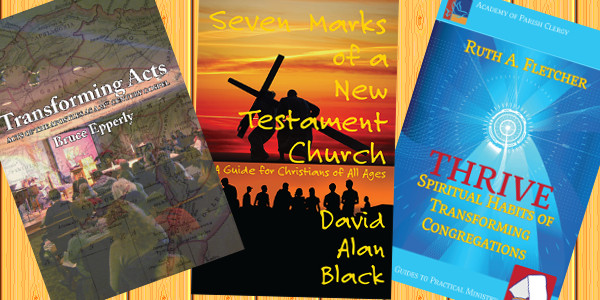
    nt church booksI’m planning to finish resume and complete my blog series on Seven Marks of a New Testament Church with added commentary from the books Thrive: Spiritual Habits of Transforming Congregations, and Transforming Acts: Acts of the Apostles as a 21st Century Gospel. This process was interrupted by SBL, by some bug I picked up in Atlanta that slowed me down for several days and by the time taken to catch up afterward.

    In the meantime, I encountered the following:

    There is no blueprint for churches in the New Testament, and to try to form New Testament churches is only to create another system which may be as legal, sectarian, and dead as others. Churches, like the Church, are organisms which spring out of life, which life itself springs out of the Cross of Christ wrought into the very being of believers. Unless believers are crucified people, there can be no true expression of the Church.”—T. Austin Sparks, Words of Wisdom and Revelation, p. 62, (quoted in Frank Viola, Finding Organic Church, p. 19).

    There’s a great deal of truth in that statement, but there is also a great deal of danger. Let me quote a couple of paragraphs from Frank Viola from just before he uses this quote to illustrate:

    Consequently, the “biblical blueprint” model is rooted in the notion that the New Testament is the new Leviticus. Advocates approach the Bible like an engineer approaches an engineering textbook. Study the structural principles and then apply them.

    But church planting is not a form of engineering. And the New Testament isn’t a rule book. It’s a record of the DNA of the church at work. … (Finding Organic Church, p. 19)

    I would love to spend some time discussing this view of Leviticus, which is, in many ways a record of the DNA of Israel as God’s people at work, but I’ll skip over my perennial annoyance with the way Christians handle the Hebrew Scriptures. And Leviticus is definitely closer to a  rule book than is anything we have in the New Testament, however inadequate the term may be in describing the book.

    Again, I would certainly agree that the New Testament doesn’t provide a “rule book” for your church, though we need to consider our understanding of the term “rule book” as well. Even rule books differ in approach! I would also agree with, and even applaud, the characterization of the New Testament as “the DNA of the church at work.” But there’s a certain negative view of engineering involved here, which is just one of the things I think is potentially dangerous.

    There’s an interesting form of binary thinking that seems to go on with the question of whether and how we apply the Bible to anything. Someone asks whether the Bible teaches a certain thing that we believe, and the pious thing to say is that it does. So we say it. Then we’re left trying to find just where it does say it. Take the doctrine of the trinity, for example. Does the Bible teach it or not? Can I discover anything about the Trinity from the Bible? Well, if you want a doctrinal statement of “trinity,” such as you’ll find in any of the Christian creeds (yes, they differ, but take any one), then you’ll have to admit the Bible doesn’t say that. Yet the pieces, or at least the questions, start from scripture. I think you can say something similar about almost any of our doctrines. They are rooted in scripture to various degrees, but we wouldn’t have so many confessional statements if the Bible clearly said what we wanted it to.

    Having grown up as a Seventh-day Adventist, I confronted this problem early. We were a church that believed in the Bible and the Bible only. Anyone could study the Bible for themselves, and the Bible was sufficient. Well, except that people kept getting the wrong things from the Bible. So we had a doctrinal statement and  baptismal covenant. When I was baptized I publicly affirmed a substantial list of doctrines, all of which the church regarded as biblical. But it was not regarded as sufficient that I affirm the Bible; I had to affirm the list.

    I think humans tend to be somewhat binary in our thinking. On discovering that the Bible doesn’t actually have a full list of the “true” doctrines or the “ideal” rules for governing your church congregation, we decide that there’s nothing at all. Let’s get away from talking about characteristics, habits, marks, or even transforming moments. The true church is the one that is produced by people transformed by the gospel.

    And yes, it is. Transformation by the power of the gospel is where it starts and it is the key. But we still read scripture. We still have to decide to meet somewhere. We still are going to do some things during our church service and not others. We’re still going to choose some activities in carrying out the church’s mission and not others.

    The danger, I believe, is that we do this sort of thing without thinking and consideration. Transformed people will be motivated to carry out the gospel commission, but will they know what to do next? Generally there is someone who leads. I have been in churches that claimed that their worship services were run by the guidance of the Spirit and were very free. No rules.

    Well, on paper. In their rule book it was true. But in practice, there was a definitely hierarchy. Who was a prophet who would speak? Who would give the message, which was as long as, if not as organized as, the sermon in any mainline or evangelical church. The “free Spirit” definitely flowed in the way human beings directed.

    In fact, despite my apparently sarcastic description, it is quite possible that the Spirit was flowing precisely as the Spirit wanted to, having chosen to work through those people. But if so, there was more structure than people were willing to admit. There were leaders in the congregation. They were just not acknowledged as formally as they were elsewhere.

    And it’s in this informality that there is a certain danger. If we do not acknowledge and plan our leadership and our actions, then some form of leadership happens. It may be good or it may not. But very frequently in places where structures are not defined, people with forceful personalities, or even people with negative agendas can take over the process. These persons are very hard to move aside to allow the Spirit to actually move, because they will often deny what they are doing.

    So how do you avoid this? More importantly, how do you avoid this without turning the church into a bureaucracy and the Bible into a procedures manual?

    Well, I think you go back to the source. Not just the New Testament, though that should be our starting place as Christians. And not just the Bible, but rather the Bible combined with our discernment and what we can hear from the Holy Spirit as we listen to the Holy Spirit and discern what we need to do as a community of believers in Jesus. I think this will be a constant process as we look at what is around us, at who we are, at our Lord, and how we can be the body of the Anointed One in the world.

    We can even learn a little bit from engineers in this process. Yes, engineers can be very picky people. I’m reminded of something Jody said as she was about to enter the doctor’s office. She was taking a particular action which she wanted the doctor to note because, she said, “Doctors are very much cause and effect kinds of people.” Engineers likewise. Every time I get into my car and every time I get on an airplane, I am very happy that engineers are cause and effect kinds of people. That’s because I really like the causes to get together and produce the effect of my car staying on the road and the airplane staying in the sky as needed. I flew nearly 7,000 hours in the Air Force relying on that sort of thing.

    One thing an engineer can do is study one thing, see how it works, and duplicate the effect by creating a similar machine. Such principles applied to scripture might include looking at the church in the New Testament and asking what caused the church to grow. Can we duplicate that? Of course times and circumstances have changed. In fact, they changed from one moment to another in New Testament times. Engineers can also take a device and adapt it to different circumstances.

    I have a smartphone, for example, that is water resistant. If I drop it in a puddle, I should be able to pull it back out, dry it off, and go on. I haven’t tried this. The prior model of the same phone didn’t have this capability. Some engineers got together and added new capabilities to the ones the previous model had. I used that previous model, and I like the new one better. There are principles that apply to both.

    And that’s important. It’s nice to say that if our church comes forth from people who have met Jesus and been to the foot of the cross (or one of those other common phrases). That must be the foundation, because church will doubtless not work with people who have not been transformed (or better, are being transformed; we are none of us there yes). But this is a principle I get from reading the New Testament. And it’s not the only principle I get.

    The good engineer knows how to look at principles and apply them to a new environment. The good Bible student knows how to look at the church in action in the New Testament and find out how to apply not every action they took, but the fundamental principles by which they tried to live, to our modern times.

    So Seven Marks of a New Testament Church doesn’t provide you with a rule book. It doesn’t replace the New Testament. It certainly doesn’t replace the gospel. But it shows you what one worker in the vineyard has discerned as principles that can be applied. The other two books, Thrive, and Transforming Acts, are doing the same thing.

    The problem isn’t really thinking like engineers. The problem is bad engineering, engineering that applies rules without understanding. Not inflexible engineering that ignores the complexity of human communities. Engineering that ignores reality is just bad engineering. I, for one, think the church could use some genuine, good engineering.

  • Seven Marks: Baptism

    Seven Marks: Baptism

    nt church books(This continues a series that started here, and continues with part 2, part 3, and part 4.)

    The second mark of a New Testament church according to Dr. David Alan Black is Christian baptism. He explains why he explicitly uses the term “Christian” with baptism. There’s a distinction there that’s important and Dave discusses it. Here’s the video. The discussion of Christian baptism begins at about 08:45.

    There are several things that Dave says about baptism that I fully agree with. He believes in baptism by immersion of believers, i.e., people who make the choice to be baptized. He also believes baptism should immediately (or very closely) follow the decision. I also, however, believe that this is an area on which there should be a great deal of tolerance for differences.

    For example, I attend a United Methodist congregation. The norm is to baptize infants and then confirm them as youth. I grew up in a church (Seventh-day Adventist) where one dedicated children as infants and then baptized them when they made their own decision. I made my decision to be baptized at age 9.

    While I strongly prefer one option, and many of my reasons are the same as Dave’s, I am quite able to be a member of a church where the practice is different. I would note that the United Methodist Discipline does allow for baptism by immersion, so a United Methodist pastor can practice believer’s baptism by immersion. He or she could not, however, refuse to perform infant baptisms, at least as I understand it. I know that some Methodist pastors are quite dogmatic on the point. My preference would be to see a quite open choice. For example, if a family prefers some kind of baby dedication, where is the problem? Again, I also know a number of Methodist pastors who would go along with that.

    I’m going to refrain from arguing the biblical material on this. I think Dave has gone over that quite well, and in this case I am substantially in agreement.

    Let me bring in short quotes from our other two authors.

    Ruth Fletcher brings in a completely different issue that may cause some concern to United Methodist readers, or those from any other church that has a fairly high view of sacraments. I’m quoting from Thrive, page 141:

    As the church finds its way into the future, the role of clergy will shift even more than it already has. Although some ministers will preach and lead worship, many will give their time to training lay people as worship leaders and small group facilitators. Although some will offer pastoral care, that care will extend beyond the members of the church into the neighborhood. Although some will teach, that teaching will focus on equipping individuals to serve in various roles both inside and outside the church. The sacramental tasks of baptizing, leading in communion, presiding at weddings and funerals increasingly will be shared with people beyond those who are ordained.

    Here I would have to say two things. First, I personally don’t see that baptism should require an ordained person. Second, as a member of a community that requires that an ordained person carry out any baptism, I will not put my first belief into practice. That is a matter of submission to the community. While I would forcefully argue for and even insist on using the community’s permission with regards to the method and time of baptism, I would also argue that where my community has a firm position, I should, as a member, live in accordance with that rule. Nevertheless I do believe that every member should be in ministry, and that ordination should not be reserved for one gift or set of gifts but should be for all. We should lay hands on and commission every member to minister using their gifts.

    Let me continue with a slightly longer quote from Bruce Epperly in Transforming Acts (p. 85):

    Such dramatic experiences – whether evangelical or mystical in nature – are not normative for all Christians. Some of us are born Christian. As cradle Christians, we are dedicated or baptized as infants, and then grow in grace not by drama but through a gentle, day to day walk with God. Nevertheless, most of us eventually face moments in which we have to say “no” to one way of life – or certain behaviors or lifestyles – to say “yes” to another.

    Providence is both gentle and dramatic. We can experience God, while we are playing with our children and looking across the table at a beloved spouse or friend; we may also discover God in the storms of life, helpless yet saved by a power beyond ourselves.

    Third, Paul’s Damascus road experience invites us to connect our spiritual experiences, whether at worship, at camp, or on the road, with discovering our vocation and mission in life. Paul is clear that his mystical experience was not an end in itself, but an invitation to a new self-understanding and vocation as God’s messenger to the Gentile world.

    Bruce is talking about the dramatic conversion experience of Paul, which relates in some ways to baptism. Numerous times I’ve encountered people who do not remember a time when they did not know Jesus. They don’t recall a particular decision moment, because they were believers from as early as they can remember. In some ways, my own view of baptism as a thing to be chosen by believers relates to my own experience. I grew up in a Christian home, but I distinctly remember the time when that belief became mine rather than someone else’s. It was no longer my parents’ faith. It was mine. That was at my baptism.

  • Why I Believe Church Pews Are Unbiblical

    Why I Believe Church Pews Are Unbiblical

    9781631990465mI’m starting a series of posts inspired by my recent interview with Dr. David Alan Black regarding his book Seven Marks of a New Testament Church. He bases this book and the seven marks on Acts 2:37-47. You can see a video of that interview below.

    I had the privilege of interviewing Dave while he was visiting Pensacola the weekend of September 6. The interview was recorded by Kyle Hall in the library at First United Methodist Church here in Pensacola. I want to thank Dave for visiting and Kyle for recording the video.

    I have several goals in this series, including discussing how we can learn from people from other tradition streams. I intend to bring in quotes and ideas derived from two other books I publish, Thrive: Spiritual Habits of Transforming Congregations by Ruth Fletcher, a Disciples of Christ regional minister and Transforming Acts: Acts of the Apostles as a 21st Century Gospel by Bruce Epperly, a United Church of Christ pastor.

    But what does all this have to do with my belief that church pews are unbiblical?

    The starting point for Dave’s book is that you can look at the book of Acts, and the activities of the early Christian church, and find things that are normative, or at least very valuable, to modern Christians. Dave isn’t alone in this conviction, but I want to start with the question of how we move from what we find in Acts to what we should do in modern churches. This topic is discussed in the first 4.5 minutes of the video.

    We don’t find sound systems or their use in the New Testament. Neither do we find hymnals, organs, pianos, praise bands, orders of service, parking lots, or many other things that are automatically part of our modern life, and often of our church activities. Is it wrong to have something in church that isn’t actually mentioned in the New Testament? There are those who would think so.

    On the other hand there are those who would say that church has changed so much that we need to come up with our own unique ways of doing things, that looking back to the early church isn’t going to be enough to deal with our complex world of the 21st century.

    I think there is some truth in both points. There are, in fact, critical principles in the New Testament that need to be part of any church that wants to label itself Christian, or more important wants to consider itself a community of disciples of Jesus. (I’d prefer the latter personally.) On the other hand we have situations in the modern world that weren’t a part of the world of the New Testament.

    The question is whether the way we choose to meet the challenges of the 21st century is worthy of the good news about Jesus. Do our solutions to modern problems, even when those problems are not directly reflected in some New Testament story or statement, fulfill the principles that Jesus taught? When we make a change does it help us love God and one another? Does it help us to make disciples wherever we go?

    So I come to church pews. They aren’t mentioned in the New Testament. They wouldn’t have been needed, though doubtless the various Christian homes that hosted meetings had chairs of some sort. I have a problem with church pews.

    Now my problem is that we can’t develop new tools and new practices to meet 21st century demands. The problem is that I don’t think church pews help us love God or one another more and I think they tend to prevent us from fulfilling the gospel commission.

    Bicycles are also not mentioned in the New Testament. They’re really good and very helpful in many places. Neither are motorcycles mentioned, but what a blessing they are. I can’t count the number of times I’d head out as a teenager, living with my parents in Guyana, South America, riding on the back of a motorcycle behind an evangelist, holding my trumpet case in one hand. It was the 20th century, true, but it was a very non-1st-century scene. Well, in one way, not 1st century. But in another, the young person heading out to help the evangelist do his work is a very 1st century scene. The tools changed, but the mission didn’t.

    But what about those pews? Yes, back to pews. What do pews do for the work of ministry. The very arrangement of our sanctuaries with pews lined up facing a platform where the more important people sit and from which they tell the less knowledgeable what to think tends toward hierarchy. If we’re going to fulfill the hope of Jeremiah 31:34, we need to get more people involved. Our problem is not that our churches don’t have enough order it’s that we don’t have the problems of 1 Corinthians 14. Too many people wanting to speak? On the contrary, just try to get them to do so.

    The pews enable this bad behavior and congregational laziness. The people in the pews are there to listen, to receive, not to share and participate.

    And then there’s the matter of stewardship. A church “sanctuary” (and what happened to worshiping in spirit and in truth?) is by nature going to be wasted space. There are so many things you can’t do there, because there are very few meetings, other than a totally platform-centered church “service” (who is getting served?), that can take place there.

    The same space, made level and filled with movable chairs would be of value for many other purposes. Children could play games. Groups could meet and discuss, putting the chairs in a circle. One might even celebrate communion as a full meal. Yes, I know, we probably have a fellowship hall for that. But why do we do that? Probably because sitting down together and eating isn’t sacred enough to happen in the holy space filled with holy pews.

    After we take the pews out, I wouldn’t mind having musical instruments, video, and plenty of parking for those who meet there, none of which are mentioned in the New Testament.

    It’s not what’s mentioned and what’s not, but the type of people we are to be and the way we are to behave as disciples of Jesus.

    Oh, we could also offer meals to those in need using that space. If it didn’t have pews, that is.

  • Eschatology: New Testament Eschatology

    Eschatology: New Testament Eschatology

    9781938434105sTonight I’ll be basing my presentation on Chapter 3 of Eschatology: A Participatory Study Guide by Dr. Edward W. H. Vick. The event description can be found on Google+.

    I’m embedded a YouTube viewer below.

    This will be on my YouTube channel and Google+ at 7 pm central time tonight.

    I’m actually going to start from what I left off last week and talk about “this generation shall not pass,” which will require me to talk a bit about biblical inspiration. Following that I plan to introduce my (not so original) simple view of eschatology and then look at Mark 13 and how it might fit in.

    Next week I’ll be looking at the variety, and some history of prophecy in Old Testament times, and then next week we’ll tackle chapter 4 of Dr. Vick’s book, Prophecy and Apocalyptic.

    As I work on these, I’m also working on a series of four talks on Revelation to be presented to some teenagers during the month of October. That may be more challenging than these presentations.

  • According to John: Excursus #2 – Interview with Dr. Herold Weiss

    john-weiss-trailerYou can get more details on the Google+ event, and you can watch either through that link, or using the viewer below.

    I apologize for posting this so late. I will post the YouTube and some comments tomorrow. Dr. Weiss is the author of the book I’m using for this study, Meditations on According to John.

  • Follow-Up on According to John: Theological Development and Determining Date and Authorship

    In my Google Hangout discussion I mentioned using the development of theological concepts in dating a particular writing. I don’t think I really covered the issue involved all that well, so I’m going to follow up briefly here. My purpose is not to argue any particular position, but to illustrate the issues.

    If I might start from a slightly broader approach, one of the ways in which one dates a particular writing is by looking at things in it that connect to events outside of it. Hopefully some of those things outside of it can be dated more precisely than the writing itself. In all cases, one should be aware that no single element provides an absolute answer. One normally gathers a set of arguments and searches for the best possible explanation of all the data. Often people reject an argument as weak when it is not intended to stand alone at all, but rather is just suggestive. It has to be combined with other data.

    To take an example from the Hebrew scriptures, the destruction of Samaria (722-721 BCE) is described both in 2 Kings and in Assyrian records. We can get quite precise dating from the Assyrian records, while we only have relative dating from Kings. We can tie the events together with a high degree of accuracy because the event is described in both.

    Narrowing it down a bit, consider both the authorship and dating of the pastoral epistles, Titus and 1 & 2 Timothy. Many scholars believe that these were written by someone in Paul’s name after Paul had died. Note here how authorship and dating interact. If Paul wrote the pastoral epistles they must date no later than the early 60s CE, since Paul dies in that period. He is unlikely to be producing new epistles after his death! Here, however, it works the other way. If it isn’t Paul that wrote them, then it is likely they were written after Paul’s death. Nobody is likely to be sending around letters claiming to be from Paul while Paul was still alive, at least not without inviting scandal.

    But why the later date? One argument relates to church history. Some would hold that the church organization displayed in the pastoral epistles is too advanced to reflect the time of Paul. In a sense, then, the later writer would be using Paul’s name to bless these developments in church organization. I’m not going to try to argue this one way or the other as that’s not my purpose. What I do want to point out is that this form of dating requires two things: 1) A correct reading of the level of church organization reflected in the epistle, and 2) An accurate assessment of the development of church organization.

    Regarding the first, let’s consider the Greek word episkopos. When you see this word in the pastoral epistles how do you understand it and translate it? How do you see it’s relation to the diakonos? Is it bishops and priests, or perhaps a more informal general overseer and local minister? What is the role and authority of those making the appointments. I’m not an expert on any of this. What I will point out is that people see these terms and the discussion of church leadership in the pastoral epistles differently. This will impact any decision on dating that relates to the development of church organization.

    Regarding the second, one has to determine just how church structure developed. This is a task for a church historian who will look both at the New Testament evidence, and the evidence of the early church fathers as they either reflect or describe the church organization that exists at that point.

    Now remember that each argument need not be decisive. Far from it. There will be many minor indicators and many indicators that could be argued either way.

    I referenced one in my discussion, the dating of Hebrews, and my difference of opinion with my friend (and Energion author), Elgin Hushbeck, Jr. One of the most important datable events of the first century of church history is the destruction of Jerusalem in 70 CE. Now, Elgin and I differ on the probable dating of the book of Hebrews. First, note that if the author of Hebrews is Paul (ably argued by David Alan Black in The Authorship of Hebrews: The Case for Paul), then it must be dated no later than the early 60s CE. Why? See above on Paul’s death.

    But the particular point that I mention here is that Elgin and I take the same piece of evidence and see a different result. I see the author of Hebrews building his entire argument on the tabernacle in the wilderness, and thus see the destruction of the temple (not in existence at the historical time our author is referencing) as much less relevant. In fact, one might argue that the author uses the tabernacle because the temple was no longer in existence. But Elgin argues that one could hardly make this argument after the destruction of the temple without mentioning that event. And as much as I may hate admitting it, he does have a point. So the evidence weighs lightly in this case.

    But now we finally get down to the issue at hand, which is dating based on theological development. This is akin to dating the pastoral epistles based on church organization but each element of the argument becomes harder. Let’s consider the case of christology. I would argue a high christology for the gospel of John. The Word was God. The Word became flesh. Case closed. Well, not quite as easily as all that, but I’d come back to those two points after arguing other interpretations.

    To date a writing in this way requires one to both read the theology of the writing in question correctly and also to have a well calibrated idea of the way in which theology developed. If you move into later times, you can look at whether a writer argues for or against gnostic positions, and just what gnostic positions are reflected. I parallel John 1:1-18 to the thought developed in Hebrews 1:1 – 4:13. In both cases we have the message presented through Jesus (a Son/the Word) placed against the message presented by Moses, with superiority attributed to the message through the Son. I would argue that the christology of Hebrews 1:1-3 is as high as the christology in John. If I then date Hebrews to the decade or so following the destruction of Jerusalem, some would say that the christology is questionable at that point. Most interpreters since the time of the reformation, for example, have interpreted the term “Word of God” in Hebrews 4:12 as referring to the scriptures and not to the person of Jesus.

    If we turn to Elgin’s dating, which is earlier, then his reading of Hebrews as high christology (as he does) means that a high christology and the associated vocabulary would be available much earlier. I refer to Elgin because he’s a friend. There are plenty of scholars who would hold either the position I do or that he does. Elgin and I hope to arrange a discussion of this between us, not so that one of us can win, but so that we can clarify the way these arguments are formulated and help readers make their own decisions. This particular type of argument is one of the weakest. I’m not arguing that it’s not worth doing, but it requires a broad knowledge and very careful work to make successfully.

    A reverse effect is also possible. One might find a way to read Hebrews as having a lower christology, simply present Jesus as the Son of God, because one assumes due to date that this is the way it should be read. In doing this sort of work, one should always be very conscious of one’s own biases.

    My point in going through all of this is to help readers get an idea of how to read introductions to Bible books, especially when those introductions differ. There are massive differences in dating given for portions of the New Testament. Matthew, for example, might be dated all the way from the 40s to the late 80s. Luke is often dated in the mid-80s, but there’s an interesting piece of internal evidence that suggests an earlier date. Acts ends before the death of Paul. One explanation for this is that the book was written before Paul died. There are other explanations; never imagine that a debate such as this is settled in one line! In addition, Luke was written before Acts (relative dating is important!), and so Luke must have been written before the mid 60s because it must have been written before Acts. But if there’s a good reason for Paul’s death to be left out of Acts, other than that it hadn’t happened yet, all this might change!

    Knowing how these arguments are formulated will help you read introductions intelligently.

  • Follow-Up on According to John: Textual Criticism

    This post relates to my follow-up on my second session of studies on the Gospel of John. First, I’d like you to read my earlier Textual Criticism – Briefly. This dates from 2006, but I don’t see anything I need to correct. I would like to expand on a few points, however.

    On the matter of older manuscripts, one of the key reasons this is less of a concern than it might be otherwise is that we have so many manuscripts available that we can afford to make a few mistakes. Really! I mean that! There are so many manuscripts, Lectionaries, quotations, and translations that the New Testament scholar can be overwhelmed with the sheer quantity of potential evidence. Having done most of my own work on the Old Testament/Hebrew Scriptures, I really notice this difference when I turn to NT passages.

    Second, we try to avoid other potential problems by looking for a reading that shows up in different geographical areas. The point of this is that we are more likely to be finding manuscripts that reflect different exemplars if they were copied in places that are far apart. This again helps to correct for any other problems that a lack of a detailed history might cause. In modern textual criticism this is accomplished by looking for manuscripts in different families.

    Most scholars would still hold that there are three major families of manuscripts, the Alexandrian, the Western, and the Byzantine. One of the current debates is over the value of the Byzantine manuscripts. Unless you get seriously into textual criticism, you will not likely need to engage with this particular debate. Just look for variety!

    When you encounter a textual note in your English translation, you likely won’t have this kind of information. The best source for a person who does not know Greek and cannot resort to a good Greek edition is a commentary that discusses the available evidence. A brief explanation such as this might help you understand such discussions.

    Finally, let me comment on what variants mean for the reliability of our text. The number of variants in the NT text is often cited as a reason to believe that the text is hopelessly uncertain, but that’s simply not the case. The more manuscripts you have, considering that they are copied by hand, the more variants you will have. But the more manuscripts you have, the better you are able to determine the original reading. In addition most variants are relatively insignificant.

    Why do I say insignificant? Let me give an analogy from my publishing work. When I edit a manuscript the majority of issues I find will be very easily identified typographical or spelling errors. There is never any doubt what the author was trying to say, and correction is easy. In a much smaller number of cases a word will be wrong and the correction a bit more difficult, yet one can be fairly certain of the desired result. In a relatively small number of cases an author will have written something I simply can’t decipher, and I have to ask what he or she meant.

    The vast majority of errors in the manuscripts belong to the first category. Sure, they are variants, but it’s obvious what the original text is. Of the remainder, a large percentage have an almost overwhelming consensus on what the correct reading is. The number on which there is a viable dispute is rather small.

    The problem in debate is the meaning of the word “significant.” I mentioned the need for definition when we use this term the other day. Two people who disagree on the number of significant variants may only differ on the meaning of the word “significant.”