Threads from Henry's Web

Tag: eschatology

  • Getting Literal, Eschatological, Apocalyptic, Even!

    Well, last night my discussion of According to John covered a lot of other ground. In particular, I was looking at the eschatological use of “hour” and “now,” and I suggested that John has a fairly simple eschatology to go with his fairly simple soteriology. I’m not going to rehash all of this. The foundation is found in Chapter 19 of Herold Weiss’s book Mediations on According to John: Exercises in Biblical Theology. For those who might wish to review the video, here it is.

    In the middle of this discussion I got into talking about the ‘L’ word. No, not liberal. Literal. I tell people that we should avoid simply saying that we’re not taking something literal, and get specific about just how we are taking whatever it is. “We don’t take that literally,” has become commonplace in discussions of the Bible in mainline and progressive circles, but often we don’t tell people just what we do with the thing we aren’t taking literally.

    Last night I was talking about something that is fairly simple to pinpoint, symbolic language in a vision report. (Note that you don’t necessarily have to believe that a person has received a divine vision in order to accept a literary category of “vision report.” I do believe people have visions, but the form remains no matter the source.) If we take a vision such as Daniel 7, for example, we have beasts (which represent something), coming up out of the sea (which represents something), onto the land (which represents something), and so forth. “Not taking Daniel 7 literally” means that I don’t believe that Daniel’s vision was about actual creatures coming from an actual sea onto the land. Rather, these beasts represent something else. Rather than taking them literally, one should take them as symbols of something else.

    One of the problems with the way visions are often interpreted is that people drop from the symbolic to the literal. The beasts, the sea, and the land are symbols, sure enough, but when the Son of Man appears in the clouds, that’s literal. But there isn’t any justification in the text for taking one part of the vision literally. One interpreter of Revelation has maintained (actually more than one, but I won’t list) that we should take everything literally that we can in the book, and only treat it as symbolic where that is essential. It’s a vision! It is filled with symbols! The default has to be that anything in the vision is symbolic unless you have good reason to believe that the writer is seeing actual events. And quite bluntly, in Revelation (or the latter chapters of Daniel), you don’t.

    I think a couple of extensions of how symbols might function would be in order, and Revelation provides examples. First, something literal can be used as a symbol. There is no doubt that the seven churches were real places. Under the rule of taking what can be taken literally, we would see the messages as tailored messages to those particular seven churches. But I would argue here that the actual churches are being used symbolically, with the number seven indicating that the messages to the seven churches constitute as a whole a message to the whole church. Various schemes, such as applying the churches to periods of history and their messages as specifically applicable to such times, while interesting, have the potential to lose us part of the message to the whole church. Second, I would use Revelation 12 as an example of where a visionary symbol points not to something physical, but to something spiritual. We might call it a symbol of a symbol.

    It’s a bit more complex to specify how this works in other passages. For example, I would call Genesis 1 liturgy. That is, by most people’s understanding, non-literal. In addition, there are symbols within the liturgical text. This is why I think it’s important to talk about how we understand a passage and why we understand it that way and avoid simply saying that we don’t take it literally. There are many non-literal ways of taking things.

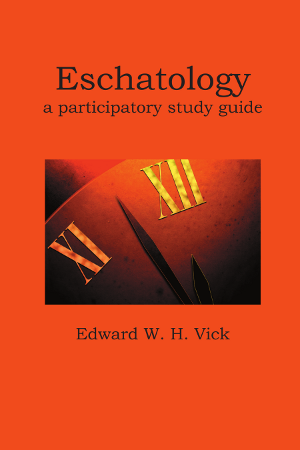
    I will go into these issues in greater detail when I begin my YouTube study on eschatology starting August 17. On August 10 I plan an interview with Dr. Herold Weiss, winding up my study of According to John. I will begin the eschatology study by looking at the landscape of eschatology using Eschatology: A Participatory Study Guide by Edward W. H. Vick, and then proceed to eschatological and apocalyptic passages. I talked about this in more detail yesterday.
  • The Problem with Eschatology

    The Problem with Eschatology

    I grew up in the Seventh-day Adventist Church, which is very interested in eschatology. We didn’t learn the term all that early, but we were subjected constantly to sermons about it. SDA eschatology is one of the key reasons I’m not SDA any more, but when I first joined a United Methodist congregation, I was surprised to discover that nobody really thought that much about the end times. One pastor I know had even invited an SDA to come in and teach on Revelation. Why? “SDAs know something about eschatology.” Of course, the corollary to that was that Methodists did not.

    But SDAs were not the primary source for the congregation. Most of them picked up what eschatology they knew from television and other popular media, which meant some kind of futurist interpretation including a seven-year tribulation, usually a pre-tribulation rapture, and a pre-millenial second coming. This eschatology, while built on a dispensational view of biblical interpretation and theology, was held without necessarily accepting, or even knowing, its theological foundations.

    Most Methodist pastors that I encountered during this time didn’t really teach or preach about eschatology. They preferred to avoid it. They might say that Methodists weren’t really committed to a particular eschatology. Some accepted the “left behind” eschatology themselves. But in general there was, and is, a void in this area of theology.

    Let me warn readers at this point that this is one of my posts reflecting on a book I have published. There won’t be much of a commercial, however. I’m just giving some of my thoughts on eschatology and why we should pay attention to it in the church.

    I believe the reason many pastors and teachers don’t talk about eschatology is that it has a bad reputation amongst those theologically trained. There is so much craziness that goes on, such as setting dates for the end of the world, that people just don’t want to go there. The “left behind” theology and the futurist view of the interpretation of Daniel, Revelation, and other apocalyptic literature is popular because it is proclaimed almost in a vacuum. If people hear only one view proclaimed, they can perhaps be forgiven for thinking it is the way to think about eschatology.

    And I believe that groups with even more peculiar views of the last days find an opening amongst Christians simply because pastors and teachers haven’t addressed the issues at all. I recall a comment by my uncle on a sermon which he called “fearfully and wonderfully made.” He didn’t intend it positively. Most systems or programs about the end time are, in that sense, “fearfully and wonderfully made.” They are also houses of cards, to be blown over if anyone studies the texts themselves without the guide. I find the SDA interpretation of the seals and trumpets of Revelation to be ridiculous, and rejected them while I was still a college student in an SDA school. But if you hear just that view, and look at just the texts (and the emphasized portions of texts) than an evangelist or other presenter wants you to see, it can sound very plausible.

    But even more importantly, eschatology is critical. It’s where we’re going. It’s why we are the church. I don’t mean to diminish the importance of now, and there are views of eschatology that do not diminish that importance. That’s something to consider. But when you’re making a decision as to what to do and how to do it, knowing where you’re going is important. One result of bad eschatology is the idea that because Jesus is coming soon (and just what does “soon” mean?) we don’t need to take care of the planet we’re living on. Why bother, when it’s all corrupted by evil and about to be destroyed in the fires of hell?

    The answer is to take this subject on directly, and as frequently as necessary to counter popular Christian culture. It is also important not to just teach some alternate scheme of the end times. Too often we teach conclusions in the church (and even in seminary), and not how to come to those conclusions, and yes, how to challenge them.

    9781938434105mThat is what Dr. Edward W. H. Vick does in his study guide, Eschatology: A Participatory Study Guide. Interestingly enough, Dr. Vick is a Seventh-day Adventist. But he isn’t teaching the SDA evangelistic message. He’s surveying the field of eschatology and teaching readers and students the terminology and the ideas they need in order to understand the discussion of this field. It isn’t a simple book, but it is direct and straightforward. You’ll need to study it carefully, lesson by lesson. You can’t jump in somewhere in the middle. It won’t tell you what you should believe about eschatology. It will provide you with the tools to study the topic and to understand what others are saying.

    I accepted this manuscript for publication because I think we need to think, study, and teach more on this topic. I am also convinced that on every topic we need to let people know not just what we conclude, but how we came to those conclusions. It builds on what Dr. Vick has already said in his books From Inspiration to Understanding: Reading the Bible Seriously and Faithfully, and The Adventists’ Dilemma. The latter volume will be of particular interest to SDAs who often wonder just what “soon” means when you’ve been proclaiming that Jesus is coming soon for a couple of hundred years. Don’t worry. The church has been doing it for 2000 years. But perhaps we don’t know what “soon” means.

    There are those who may be concerned about using a book on this subject written by someone from a group that has peculiar views on eschatology. Let me assure you that Dr. Vick treats eschatology as an academic subject. I’m not going to try to characterize his view of SDA eschatology. I’ll simply say that in this book he presents an overview of this topic that is broad, intense, and extremely helpful.


    (If you’re interested in pursuing a study of basic eschatology in that manner, this will be the book for you. If you’re considering this book for use in your church, remember that you can request a free evaluation copy simply by e-mailing Energion Publications with a note telling us your intended use and the size of the group you intend to use it with.)

  • Why We Don’t Teach Revelation Contextually

    Lawrence Garcia asks why pastors in America don’t teach Revelation contextually. It’s a good question. He gives a good answer, concluding that the contextual message of Revelation is going to run head-on into our civil religion. We have divided loyalties, and if we see our idols—imperial power, perhaps?—condemned, we get tense. If our pastors started to tell us that the message of the cross said that our dependence on the power of this world is bad, we might start finding other pastors, presumably ones with a less startling message.

    I agree that the message of Revelation runs directly into many of our favored activities and attitudes. But I think there’s another reason we don’t want to read Revelation contextually.

    It’s not as much fun.

    It’s not as comforting.

    You may be thinking “Revelation? Comforting?” but first let’s consider the matter of fun. We really like to know the future. At least we like to think we know the future. That’s why sports analysts and political pundits can make so much money. We don’t really check the accuracy of what they say, but we like to find a prophet that tells us what we want to hear. Knowing the future makes us feel special.

    Ever since we got this kind of dispensational view of Revelation that results in the Left Behind series, we’re stuck with that as the popular vision of Revelation. I recall being invited to teach a youth class shortly after I joined my first United Methodist congregation. I was there to talk about Bible translations, but when I asked for questions at the end of my presentation the first one was this: Are you pre-, mid-, or post-trib? The folks were somewhat disappointed to know that I didn’t believe in a separate rapture of the church at all. Since that time I’ve found that most discussions of Revelation are in the context of some form of futurism, with the debate being over which particular futurist view you take.

    I taught Revelation from my study guide (this web site is dedicated to that guide), which does not deal with the rapture or the seven year tribulation, neither of which can be found in Revelation, in my opinion. The group insisted on a 14th lesson to specifically discuss that question. The tribulation and who was going to be in it was the critical question. Or more precisely the critical question was who could get out of it.

    It’s just disappointing to realize that Revelation doesn’t provide a detailed road map of the future. We’d so much rather it did that! In fact, when it doesn’t, we insist on pretending that it does. It’s just more fun!

    And it is comforting. Yes, I know there are all kinds of disturbing images in the book, but if you can figure out precisely where you fit in, and if you can convince yourself that you know the future and how you’ll handle the tribulation (it won’t trouble you!), that’s comforting. We want so badly to know the future that we’ll believe almost anything.

    Eschatology: A Participatory Study GuideAnd the prevalence of a pre-tribulation rapture speaks to that desire for comfort. It tells modern Christians that unlike millions of Christians before them, and those living in other lands right now, they will indeed be able to avoid the nastiest events. They’re going to be sitting comfortably off in heaven while everyone else passes through disaster after disaster. Take that all you people who didn’t listen to us!

    But the bottom line is precisely what Laurence Garcia says: Taking the message of Revelation as it would appear in its historical context brings the message much too close to home. It’s much more relevant than the futurist understanding, but it just doesn’t make us nearly as happy.

    For those interested in digging deeper into eschatology, I’d like to recommend the latest volume in the Participatory Study Series, Eschatology: A Participatory Study Guide. This book will introduce you to the ideas and terminology that will make it possible to sort your way through the incredible amount of drivel that’s put out on this subject on a daily basis.

  • Hammering the Word SOON

    Jesus is coming soonI already mentioned that I’m in the final stages of publishing a new book Eschatology: A Participatory Study Guide by Edward W. H. Vick. One of the things that Dr. Vick emphasizes is the abuse of the word “soon” in Christian teaching and preaching. There is a problem with definitions if you repeatedly claim that something is soon and then it doesn’t happen. On the one hand, if you define “soon” so that it has meaning, you have the problem of the prediction failing. On the other, if you keep “soon” vague enough to protect yourself from the failure charge, you generally make it meaningless, “nonsense” in the technical sense, as in lacking any meaningful sense. Dr. Vick even wrote a book on precisely that topic, The Adventists’ Dilemma.

    I must confess that I suggested reducing the time spent discussing the way the word “soon” has been used in the church. It’s interesting, but just how central is it to most Christians’ thinking? Well, I don’t know about most Christians, but abuse of the word “soon” or any of its related topics, such as “knowing the times” and so forth, is rampant. We’ve just gotten over the prediction of the second coming in 2011, and now we have another one (HT: Dispatches).

    Dr. F. Kenton Beshore, of World Bible Society, doesn’t claim a specific date, but provides a range of years over which the rapture and then the second coming should be expected. (I use the title “Dr.” out of courtesy, though the bio on the World Bible Society website does not specify where any of them were earned, usually a bad sign. In addition, a couple of the degrees are normally honorary.) His claim is that the rapture should occur between now and 2021 and then the second coming seven years after that. Those who are acquainted with popular literature on Revelation will doubtless note that Beshore is pre-trib based on these numbers.

    The reasoning behind this position, such as it is, is similar to Hal Lindsey’s belief that Jesus will return before the end of the generation that saw Israel reestablished as a nation in the promised land.

    It would be hard for me to comment in detail, except to note that the entire rapture, seven-year tribulation, and second coming scheme is produced through a hodge-podge of proof-texting. It’s not even as convincing as your average proof-text usage. The relationship between the various passages involved is more than doubtful. I believe it is popular, and seems plausible to many, for the same reason that action movies are popular. They’re exciting and satisfying, with plenty of action and suspense followed by a comforting resolution. The major argument in favor of a pre-tribulation rapture is similar. It’s comforting to think that before all the bad things happen, God’s people (in which group readers confidently place themselves) are removed from the scene.

    Reality, however, even the reality of life with God, is not as satisfying to our selfish desires as an action movie. God’s people have been left to live through times of trouble many times. They are never alone, thank God, but they are often in difficulty.

    One can get great comfort from a prediction of the end. It gives one such a sense of control, and such a fine feeling of safety. Bad things will happen to others, but not to the believer. Uncertainty is for others. The believer knows.

    But over and over such “knowing” has proven to be false. There’s no more reason to believe this result than any of the preceding ones.

    The word “soon” (or various ways of saying something similar) is being abused again.

  • October 22 and Eschatology

    Eschatology: A Participatory Study GuideOctober 22 probably doesn’t mean much to most of my readers, but for someone who grew up as a Seventh-day Adventist (SDA), it has great significance. It was on October 22, 1844 that early Adventists (before they were Seventh-day Adventists) expected Jesus to return. It was actually the second time they had expected that. first came what is known as the “lesser disappointment” of 1843, when they had not set a specific date, but had set a deadline of a season. Of course, the day ended, and nothing happened.

    But as often happens with failed prophecies, after thought, consideration, and some manipulation of Bible texts, the Adventists decided that something had happened, it just wasn’t something visible here on earth. Adventists made a firm decision to set no more dates for the actual Second Coming, but they continued to preach that Jesus was coming “soon.”

    In an overall doctrinal sense, this is no longer the sort of thing I consider central. But it did play a pivotal role in my decision to leave the SDA church. First was my reading of Daniel. I studied Daniel at Andrews (the SDA Theological Seminary) under a professor who strongly supported the traditional SDA understanding of the passage. People often think those who change their beliefs in college or seminary do so because liberal or unbelieving professors brainwash them. My professor made every effort to convince me that the SDA interpretation of Daniel 8:14 (the famed 2300 day prophecy) made sense. But in the context of Daniel it did not make sense to me.

    Having decided that the time prophecy element was completely unfounded I turned to Hebrews and eventually decided that the very concept of an investigative judgment was also not good theology. Having spent a considerable time outside the Christian community, it was this second element that made it relatively certain that I would not return to an SDA community. People expect the seventh day sabbath to be the problem, but while I don’t agree with much of the supporting doctrine (the idea that it is the distinctive characteristic of the remnant, for example), I wouldn’t have a problem making the seventh day a sabbath. (That isn’t at all what SDAs mean by this, of course.)

    What’s interesting right now is that I have just completed proofs for a new book, Eschatology: A Participatory Study Guide, by Edward W. H. Vick, who would see similar problems with these various elements to the ones I do, but is a former professor at Andrews University. In addition, my company distributes his book The Adventist’s Dilemma, regarding the use of the word “soon” by Adventists. I had once thought these controversies were in my past. Now I’m editing and marketing books about them.

    October 22 can cast a long shadow!

  • Book Notes – Revelation: The Way It Happened

    When I encountered Lee Harmon in cyberspace, or more precisely he encountered me, and I learned that he’d written a book about Revelation, I was immediately hooked. Besides, Revelation – The Way it Happened is such an interesting and suggestive title. Let me warn you that, as usual, this will be less a review and more thoughts and notes on the book and on the topic.

    I grew up on Revelation. Well, Daniel and Revelation. As a young Seventh-day Adventist I would hear a new series of evangelistic sermons on the topic at least once a year. We’d all go, because we obviously didn’t want to have the venue (often a tent) be empty.

    And each year I heard an updated message. Revelation meant something just a bit different as all the charts and events were rearranged to suit the current news, and the evangelist would explain how precisely current events fit the right moment in the prophecy.

    It took me a few years, but I began to notice the problem. When I decided to leave the Seventh-day Adventist Church, eschatology was one of the key issues, along with the doctrine of the remnant which in turn derives from SDA eschatology.

    There are four major streams of interpretation of Revelation: preterism, historicism, futurism, and allegorical. Preterism holds that all or most of Revelation was fulfilled at the time (or failed of fulfillment). Historicism sees long periods of history represented by the main portions of the book (churches, seals, and trumpets especially). Futurism hold that most or all of the book remains to be fulfilled. The allegorical view comes in a variety of forms, but generally holds that the symbols in Revelation may be used to represent events at many times and places, but are not predictive of specific times and events for the most part.

    SDAs keep historicism alive. The problem is that when the scheme used was first produced, it led nicely through history up to that time (the “great disappointment of 1844), with a relatively short “time of the end” coming immediately afterward. Even after the great disappointment, when SDAs took the position that they had been wrong to set a date and time, but still assumed that the end would come very soon. (To get a more detailed rundown on this issue, in fact a very detailed one, see Edward W. H. Vick, The Adventists’ Dilemma.)

    A similar issue is present for futurists, in that the various players and the details of end time events change as time moves forward, even though they don’t have the problem of a timeline that stretches from the 1st century to the present, and must in turn be stretched further to accommodate continuing history. Futurists nonetheless have to contend that John the Revelator (whoever that was) had a vision of far future events which was attached to a short letter about current events written to contemporary churches, and that there was a gap of at least a couple of millenia between the two. Though Revelation 10:6 proclaims “no more delay” this interpretation proposes a great deal of delay indeed. Of course, once one places the declaration that there will be no further delay into the context of a much delayed prophecy chart, one can avoid the contradiction, provided one is flexible enough.

    So that leaves us with preterism, which has most of the book refer to events contemporary to its author, and the allegorical view, which often doesn’t attach the material to much of anything.

    My own bias is in favor of an allegorical view, but one that is rooted in 1st century events. Thus I see Revelation 12 as an excellent depiction of spiritual (and political) conflict no matter when it happened, but I also accept a historical grounding in the birth of Jesus and the church.

    Having rambled thus far, let’s get to the book. I usually list strengths first and then weaknesses, but so I can get on with the fun, I’m going to list weaknesses first.

    If you pick up this book thinking you’re going to get a scholarly dissertation, complete with full examination of all the views and plenty of footnotes, you’ll be disappointed. It’s a presentation of its author’s interpretation with a few references to other views, and very little in the way of footnotes. There’s a good extra reading section, though I’ll confess it doesn’t match what I’d recommend in many cases. It’s still a good listing. There are many books on Revelation, and it would be shocking if two lists coincided completely.

    On the other hand, if you pick up the book thinking you’re going to be carried gently into understanding the book via light fiction, you’ll also be disappointed. There are multiple threads, one of them a contemporary story within a story (a father telling his son a story), interspersed with commentary and some historical narration. Font and style indicators guide you through all of this, but you’ll probably feel a little bit scattered in the early stages.

    Having said all of that, let’s get to the strengths. The writing is clear and direct. It’s really easy to follow the story lines once you get them straight in your head, and despite my note about a lack of footnotes, there is no lack of references to biblical and other literature from the time.

    One of the great errors Bible students make is that they expect to be able to go read Revelation on its own and come to some sort of understanding. The book is filled with quotations and allusions, some very close, some more distant. But there are very few words in the book that don’t connect somewhere. Harmon does a good job of referencing much of this material.

    I was especially gratified to see the extensive use of the connections with Ezekiel, which often don’t get enough attention from modern futurist commentators. Of course Daniel is also important as is Zechariah but so are many other books. Getting a feel for the symbolism also requires use of other apocalyptic literature, and Harmon provides quite a number of references.

    I have been attracted to the 70s or 80s dating that Harmon uses myself, but I remain unconvinced. I think it’s a possible dating, but my main criticism of the interpretation provided may be an excessively close tie between the imagery and real world events. It’s possible, but I think it is a bit of a stretch.

    Overall, I’d say that while I find several specific theses in the book questionable, it’s a good read and it provides enough references to primary literature to help set you on your way to some rewarding study. My hope would be that readers of this book will turn to those primary sources and help change the way Christians speak about Revelation.

    The fact is that we’ve been proclaiming “soon,” in the send sense of “just around the corner” for so long, that it no longer sounds very convincing. If people did this in any field other than religion, we’d call them liars. There’s a way to understand “soon,” but this isn’t it. If the futurist interpretation of Revelation is correct, one would have to suppose that God lied to those who first heard the words. We need to rethink the way we teach prophecy, and do it less as prediction and more as admonition.

    The purpose of apocalyptic is encouragement at a time of trouble. There is encouragement there that can apply at any time and place. There is also an ultimate hope. But the reason to carry out our mission as Christians, Christ’s body in the world, is not that Jesus may come and end it all at any moment, but rather that Jesus is already near and our own end is always near. And because Jesus is near we can face our own hardships and ultimate passing from this world with hope.

    I believe in the “resurrection of the body and the life everlasting” as the creed says. But I don’t believe that the passage of time is the main issue. Whatever the length of time until the end, God is present.

    In the meantime, you could do much worse with your time than read this book and let it challenge you to further study.


  • Why I Don’t Like Left Behind

    Hat tip to Gentle Wisdom for this quiz on eschatology:


    What’s your eschatology?
    created with QuizFarm.com
    You scored as Amillenialist

    Amillenialism believes that the 1000 year reign is not literal but figurative, and that Christ began to reign at his ascension. People take some prophetic scripture far too literally in your view.

    Preterist

    100%

    Amillenialist

    100%

    Moltmannian Eschatology

    60%

    Postmillenialist

    35%

    Dispensationalist

    25%

    Premillenialist

    25%

    Left Behind

    0%


    Now I know why I don’t like the left behind books! It was also mildly funny to discover that I don’t have an “eschatology” category. I think I’ll leave it that way and just use the tag.

  • Another Interesting Lectionary Omission

    Since I’ve been attending a lectionary discussion group during Wednesday lunch, and therefore spending more time on the lectionary texts, I’ve been interested in the way the texts are selected. For this coming Sunday, Epiphany, one of the texts is Isaiah 60:1-6. “Now what could possibly be interesting about that?” you might ask.

    I’m glad you asked! In this case what’s interesting is the cut-off point. In general, this is a prophecy of restoration, given to Israel during the time of the exile, or perhaps afterward. (It would fall in trito-Isaiah, assuming one accepts that division.) More specifically it is a prophecy of Israel becoming a religious center, and other nations supporting them.

    I found it interesting that the Learning Bible (CEV), in its note on Isaiah 60:7 specifically says that the temple referenced there is the rebuilt temple, dedicated about 515 B.C. This suggests that in the view of those interpreters this passage was fulfilled with the restoration of Jerusalem and the temple following the Babylonian exile. Yet a brief reading of the chapter suggests there are a number of things which were not fulfilled at that time, such as the sun no longer being their light (verse 19) but YHWH serving that function (cf. Revelation 21:23-24), all its people being righteous (v. 21), to name just a couple. I note also that the Jewish Study Bible refers this to a future age when God will rule the nation directly.

    So again why do I find the cutoff at verse 6 interesting? Well, in that verse we have a reference to the continuation of the sacrificial services of the temple, something that most Christian interpreters do not include in any future age. Quoting from the JPS Tanakh:

    All the flocks of Kedar shall be assembled for you,
    The rams of Nebaioth shall serve your needs;
    They shall be welcome offerings on My altar,
    And I will add glory to My glorious House.

    Now Christian interpreters are not unaware of these texts, but many people in the pews are, and thus when they start studying eschatological prophecies they can become very confused.

    Let me make a couple of quick observations. First, Christian eschatology, insofar as it works from the prophecies of Hebrew scripture has divided prophecies between a first and second coming of Jesus. No such division is known here in the text. Salvation from sin and salvation from physical oppression are closely intertwined.

    Second, while both Ezekiel and Isaiah speak of a future time when the temple will be restored and sacrifices will be offered, Christian interpreters find that very hard to fit into any prophetic scheme. There are those who believe there will be a period of sacrifice in a restored temple during the time of the tribulation. I won’t go into the details of how this is supported from the text here. Suffice it to say that it can get complicated quite quickly. But in general, Christian theology has a problem with restored sacrifices seen in a positive sense, since the sacrificial system is commonly seen as unnecessary following the death of Jesus.

    One has to wonder whether the compilers of the Revised Common Lectionary didn’t want to avoid having these questions raised by a reading of verse 7 on Epiphany.

  • Time Compression in Eschatological Texts

    I want to touch on something that I encounter in conversation fairly frequently. Why is it that Christian texts applied to the coming of Jesus and to the end-times come often in the same contexts in Hebrew scripture. A good example of this is Isaiah 60-66, in which we have a mixture of texts related in Christian thought to either of these events. Isaiah 61:1-3, for example, is related to the first coming, while 66:22 is related to the second coming in Revelation 21:1. These are merely a couple of examples.

    I encountered a similar issue with Mark 13, in which a number of verses refer rather specifically to the destruction of Jerusalem, yet we slide into material that appears eschatological with very little warning. I would suggest that this ambiguity is why there is so much debate over the correct interpretation of this and closely related passages (Matthew 24, Luke 21, and the whole book of Revelation). Interpreters differ because the lines are not drawn with the sort of clarity we would like.

    Today my devotional reading included a passage that I think illustrates this telescoping, so to speak, of multiple events. It seems to me that what happens in each instance is that there is an immediate scene of God’s action, either in judgment or salvation, and that the immediate event and God’s ultimate judgment/salvation are brought together. Perhaps there is a type/antitype involved, but I will explore that at another time. In any case they are combined, and the view seems to be much like one might get looking at a distance.

    To illustrate this, let’s suppose that there are two clouds in the distance. In my imagination, I’m on the plains around Omaha, NE, where I used to watch for tornadoes. I see one in front of me, and another larger one behind that. The one that is further away may, in fact, be much larger and much more distant, but I have no perspective to give me the time. If I describe the scene, I might confuse the two looming storms–the closer, smaller one, and the larger one at an uncertain distance.

    In Isaiah 45, the primary topic is the call of Cyrus to rescue Israel (45:1ff). There is no doubt about the reference of the prophecy, because Cyrus is mentioned by name and spoken of/to in recognizable terms. Cyrus has come, accomplished his mission, and gone. In verse 23, however, we’re told that every knee will bow to YHWH, and every tongue will swear by him. That is a passage that fits much better in the eschaton than it does in the time of Cyrus, a time in which we know that no such thing happened.

    I suspect that God has very little interest in informing us about the details of the end times. We are naturally curious, and we want to protect ourselves by knowing the details and thus preparing in detail for them. But the purpose of prophecy has never been to provide that sort of information. Rather, such prophecy calls one to precisely the opposite of independence–total dependence on God.

  • Isaiah 26: Praise and Lament in Trouble

    Update: I forgot to tag the places the New Testament quotes (none in this case) or alludes to this passage.

    In my series on Biblical criticism I discussed the division of Isaiah 24-27 into various segments and discussing their form. In that article I suggested taking Isaiah 26 as a unity even though it would be the longest single segment in Isaiah 24-27.

    Other commentators suggest dividing the chapter after verse 6 into a song of praise while verses 7-21 are a community lament. I see the two parts of the chapter as inextricably tangled together. Isaiah 24-27 appears to be a confused portrayal of the end times, but it is intentionally confused–what appears confused to us is intentional.

    Our desire as Christians is to get a roadmap, to find out how to avoid trouble, and how to come out fine in the end without too much fuss and bother. But “fuss and bother” is a characteristic of final events. You have a time of conflict in which there will be moments of triumph and joy, and moments when one needs to hide.

    18Woe to those who are anxious for the day of YHWH,
    Why do you want the day of YHWH?
    It’s a day of darkness and not light!
    19It’s as though someone flees from a lion,
    but a bear meets him,
    so he goes into his house,
    leans his hand on the wall,
    and a snake bites him!
    20Is the day of YHWH not darkness rather than light?
    Is it not gloom without any gleam of light?

    –Amos 5:18-20

    This rather negative view contrasts with the joy that is expected on the day of the Lord, the day when God comes to redeem, but also to avenge. There are two reasons for this mixed description. First, the day of the Lord is joy for those who are ready and waiting, but not so joyful for those who are not. Second, the end does not come in any scriptural description without some conflict and trouble. This is not the place to go into any detail on pre-trib vs. post-trib arguments, but I think this passage hints at a situation in which the good spent some tense times along with the bad. It is certainly not a “proof passage” on this point; it simply hints on a less precisely laid out final time of conflict.

    Translation and Notes

    1In that day this song will be sung in the land of Judah.
    We have a strong city,
    Salvation set in walls and outworks!
    2Open the gates!
    So a righteous nation may enter,
    One that keeps justice.
    3The mind that depends,
    You will keep totally peaceful,
    Because he trusts in you.[Philippians 4:7]

    4Trust in YHWH forever,
    For in YH YHWH is an eternal rock.
    5For he has humbled the inhabitants of a lofty place,
    An inaccessible city.
    He will overthrow it,
    He will cast it down to the ground.
    He will make it reach the dust.
    6Feet will trample it,
    The feet of the humble,
    The steps of the poor.

    This is the song of praise, but in leads into the destruction of evil, which in turn leads into the lament of the following verses. The lament in turn ends on what, from God’s people’s point of view at least, is another high point.

    Some commentators have been concerned that the great city has already been destroyed in chapter 25, but that is part of the lack of clear chronological sense of Isaiah 24-27. The intent is to portray the time of conflict, and the feelings of God’s people, both positive and negative during that time.

    7The way of the righteous is level.
    You prepare for them a straight path.
    8Indeed in the path of your justice
    We wait for you YHWH,
    Your name and for your reputation,
    is our deepest desire.
    9My soul longs for you in the night,
    My spirit within me keeps watch for you,
    Because just as your judgments hold sway in the land,
    So do the inhabitants of the earth learn righteousness.

    Here again is the key to the day of the Lord. God asserts his rule and his justice. For some people that’s a good thing, for others, it is not so good. God’s true people wait anxiously for God’s justice, even though there may be great trouble along the way.

    10When the wicked receive grace,
    The don’t learn righteousness.
    In a land of upright people he acts unjustly,
    And has no fear of YHWH’s majesty.
    11YHWH, though your had is lifted up,
    They don’t see it.
    Let them see your zeal for your people,
    And be ashamed.
    Let the fire of your anger consume them. [Hebrews 10:27]

    There is a certain emotional conflict about the end times in that while many are being saved, God’s people know that others will be destroyed. God’s people have cried out for justice throughout history. There is the essential tension between God not wanting anyone to perish, and God’s unwillingness to allow sin to persist.

    The apparent absence of God’s judgment gives sinners permission to carry on whatever they’re doing.

    12YHWH will accomplish deliverance for us,
    Indeed all our accomplishments are things you have done!

    This is a tremendous statement of the gospel message. We really have done nothing. Even what we appear to have done is God’s activity in us.

    13YHWH our God,
    Other lords besides you have ruled us,
    Still we praise your name.

    I like this little note of repentance. “We’ve run away Lord, but we’re back. You’re the only one who matters.”

    14Being dead, they cannot live;
    Being shades, they cannot rise;
    Therefore you punished them,
         destroyed them,
         eliminated all memory of them.

    My translation is a bit different from what you will find in most versions based on Waltke-O’Connor’s grammar. It seemed strange to be talking about the dead in this verse and how they cannot rise when we have an affirmation of resurrection at the end of the chapter. What this verse actually refers to is those “other lords” who have ruled Israel. They are actually dead, unable to do anything. God has wiped them out.

    15You have added to the nation, YHWH.
    You have added to the nation.
    You have been glorified.
    You have expanded the borders of the land.

    Note the turn to a description of God’s blessing.

    16In trouble they called to you, YHWH.
    They poured out their prayer as you corrected them.
    17Like a pregnant woman who comes near to giving birth,
    She writhes, she cries out in her pains, [John 16:21]

    Thus were we from before you, YHWH.
    18We were pregnant, we writhed,
    But we gave birth to wind.
    We have not brought forth salvation on earth,
    Nor have the inhabitants of the world fallen.

    And here is another statement of God’s grace. Every human effort has failed, has accomplished nothing. They are like giving birth to wind. Yet when God steps in there is salvation.

    19Your dead will live,
    My corpses will rise.
    Wake up and sing!
    Those who dwell in the dust.
    Like drops of light is your dew,
    And the earth will bring forth the shades. [Ephesians 5:14]

    20Come my people! Enter your chambers!
    Close your doors after you.
    Hide for just a moment,
    until wrath passes over.
    21For look! YHWH is going out from his place,
    To repay the iniquity of the land’s inhabitants on it.
    The land will reveal its blood,
    And will no longer conceal its slain.

    We end with two affirmations: 1) God will bring new life, an early affirmation of the resurrection, and 2) The land is going to reveal the iniquity that has been done in it, allowing final justice.

    On the first point there has been some debate about whether this resurrection refers merely to the restoration of the nation or whether there is a resurrection of the dead involved. I believe the latter, largely because of the contrast to the dead gods/lords who will never rise again.

    On the second, note that the sacrificial system had many cases in which a sacrifice was to be offered when someone realized their guilt. The things that are concealed must be revealed so that justice can be done, whether for atonement or for punishment.