
I’ll be working from Chapter 4 of Dr. Edward Vick’s book Eschatology: A Participatory Study Guide and looking at the nature of prophecy and the literary nature of the texts. I’ll also be looking at ways in which we interpret prophetic literature. I apologize for posting this very late. I will try to comment in writing and add some links tomorrow and Saturday.
Tag: eschatology
-
A Reason to Talk Sensibly about Eschatology
… so it is not left to this sort of discussion. I did some study of and discussion of the so-called Bible codes some years back, and I’m not spending more time. The problem is that using the methodology in question (and its variants) one can come up with so many things and such vague things that it becomes self-defeating to try to respond.
In my view, by doing this sort of thing (trying to know things that are not present in the text), we go well beyond what the Bible was intended to do. The Bible is there to help you come into communication with God. That it conveys some information is not the main issue. We get stuck arguing about informational details while ignoring the broad sweep of the text.
When we turn to the Bible codes, we begin not just concentrating on informational details, we’re creating new content. It may be nice to feel that we know these things, but in fact we do not. Nobody knows. That’s the way God intended it.
-

Bill Tuck on Eschatology
Energion author William Powell Tuck, author of The Journey to the Undiscovered Country and many other books, is taking on the topic of eschatology at a personal level on the Energion Discussion Network. Since I’m currently talking about this topic on this blog and on my YouTube channel, I wanted to call attention to it. I’ll be using Bill Tuck’s material as I proceed.One of the interesting questions that the New Testament raises is the relationship between personal eschatology and universal. When the Bible talks about the end being “soon,” which has resulted in numerous disappointments for Christians, is there an element of the personal in the statement. After all, the end has been “soon” for a few billion of us over the years. I think that idea tends to raise more questions than it answers, but it raises worthwhile questsions.
-
Eschatology: What Is Prophecy
Tonight I’ll be continuing my study on Eschatology, using my Google+ page and YouTube channel. I’ll embed a YouTube viewer below.
In preparation for this study I think it would be useful to read my post from earlier this morning titled Link and Notes on Textual Criticism. That may sound irrelevant, but in it I try to say something about why I study details even though I don’t think we can attain certainty that we have the details right.
In talking about eschatology I’ve found that there’s great complexity in explaining all of the various views of the end times. For many, eschatology (if they know the word) is supposed to be about outlining how future history will go and how we will know that Jesus will appear. I’m not going to sneak anything up on you. I reject that viewpoint. Neither prophecy nor any other form of predictive statement, including the extended visions of apocalyptic, provides or is intended to provide an outline of the end of the world. What it is intended to accomplish is to let you understand how to live through the difficult times and come through to the end. The end of the particular trouble—and much of this material comes at a particular time of trouble—may not end with the end of the world. Much of apocalyptic literature reads that way, assuring suffering people that God will win in the end, but the times of trouble pass, and “the end is not yet.”
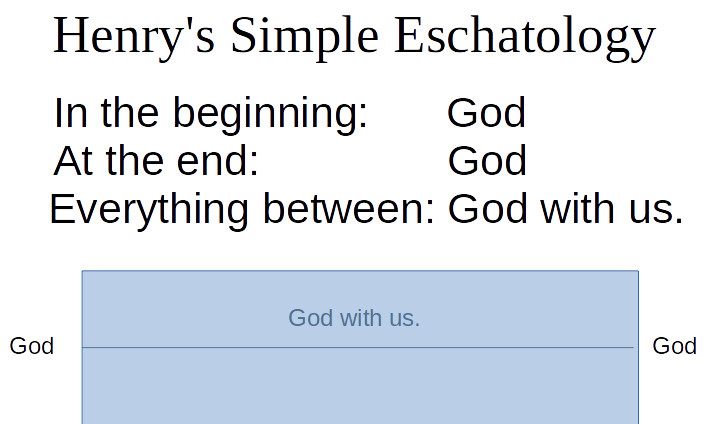
Here’s my simple eschatology (click to expand):
 You may find that particularly unsatisfactory. If so, you will perhaps want to listen to the way someone else interprets prophecy and eschatological language. But I think you are likely to be disappointed. The field of prophecy, whether we’re talking about ancient Israel or modern prophets in the church, is filled with cute explanations for why various interpretations of predictions haven’t worked out. I think there’s a reason for this.
Two options for that reason: 1) God didn’t want us to know or 2) We’re too stupid to figure out what God was saying. We’ve simply been wrong too many times.
I could say that the literature itself has failed either because we couldn’t get what God had in mind into print or because God has failed. Always assuming, of course, that I’m not willing to go with the traditional approach which is to forget about each failed prophetic interpretation and go on making more and more unsubstantiated predictions. Instead, I’ve looked back at these texts and I don’t think we’re supposed to get that sort of detail out of them. What we’re supposed to be doing is looking at how God has worked with people, the manner in which God is with us in the interim. I think we can learn a great deal.
So reading Revelation is not just a matter of looking for the literal meanings of various symbols. It is, instead a process of understanding how this text spoke to people in trouble and how it can speak to others who are similarly in trouble. I will be developing that point of view in this series.
The critical think to note from last week’s presentation is learning to make a break from the puzzle pieces approach. Much of the writing and preaching on Daniel and Revelation, or on eschatology in general is based on this approach. If I can find the right place in the text in Daniel 7, connect it with the right place in Daniel 8 and then 9, connect all of those to Isaiah 65 & 66 at just the right points, pull in a verse from 1 Thessalonians, then tie all of that to selected anchor points in Daniel 12 & 13, I ‘ll know what’s coming next. I can make a chart. I can be safe.
I would suggest that such charts are about as safe as the Tower of Babel. They come from our desire to eliminate uncertainty from our lives. We want to make our lives safe, to know what we will face, and most especially to be able to point to specific things we will avoid, while others suffer. In my view the pre-tribulation rapture partakes of wish fulfilment. We’ve read about times of trouble, and we want to find a way to say that we won’t be here for the greatest time of trouble. So we have found out when it will occur and we have found out that we can avoid it. Well, we think we can.
You know what I think? If the pre-tribulation rapture is true, as a follower of Jesus I should want to be here after the rapture to help take the gospel to those left behind. Yes, I know, there are various explanations of why this wouldn’t be the case. I just don’t believe them.
I will certainly be looking in this series at the wide variety of interpretations. How do we paste scriptures together to make doctrines such as the rapture? But I will be more interested in looking at the question of how we will live in the “God with us” period that stands between God’s creation in the beginning and God’s renewal at the end.
One might try to discard apocalyptic because of what it looks forward to. If the period of trouble will (or may) end without the end of the world, so clearly expected by the writer of apocalyptic, of what good can the material be? Well, in each case the time of trouble did end, and there was something in that message that helped through the time. We’re going to look for that.
Read Daniel 2 and 7. Now consider this: Is the key message in Daniel 3:18 or Daniel 7:13? (Leaving open the possibility that the answer is neither!) Which one do we quote or consult more?
Tonight I’ll be talking about the purpose of prophecy. I don’t believe biblical prophecy is intended for the same purpose as consulting psychics. (Note: I’m not maintaining that psychics can provide accurate information about the future. In fact, I believe they truly cannot. But people consult them in that hope.) Biblical prophecy is intended to help us live in God’s world with the knowledge that whatever happens God is with us.
Here’s the viewer for tonight:
-

Eschatology: New Testament Eschatology
Tonight I’ll be basing my presentation on Chapter 3 of Eschatology: A Participatory Study Guide by Dr. Edward W. H. Vick. The event description can be found on Google+.I’m embedded a YouTube viewer below.
This will be on my YouTube channel and Google+ at 7 pm central time tonight.
I’m actually going to start from what I left off last week and talk about “this generation shall not pass,” which will require me to talk a bit about biblical inspiration. Following that I plan to introduce my (not so original) simple view of eschatology and then look at Mark 13 and how it might fit in.
Next week I’ll be looking at the variety, and some history of prophecy in Old Testament times, and then next week we’ll tackle chapter 4 of Dr. Vick’s book, Prophecy and Apocalyptic.
As I work on these, I’m also working on a series of four talks on Revelation to be presented to some teenagers during the month of October. That may be more challenging than these presentations.
-
Eschatology: Mark 13
While I titled the event Eschatology: Mark 13, Matthew 24, and Luke 21, I will be focusing on the first. I will be mentioning the parallels and likely working directly from gospel parallels. I’m embedding the YouTube viewer first, then I’ll make a few comments.
I had hoped to post more earlier, but the work load this week prevented it. I also hope to post something more this afternoon, giving some background for what I’ll be saying. It is obviously impossible to do a detailed exegesis of Mark 13 in an hour, so I’ll be looking at some key points.
First, yes, I won’t be able to resist. I’ll mention some elements in the parallels that could play into arguments over Markan vs. Matthean priority.
Second, I want to talk about my overall view of biblical eschatology, and how I read that in Mark 13. Note that this is, to a certain extent, eisegesis. My overall view is the result of my study of many eschatological and apocalyptic passages, and not a derivative from Mark 13. Yet I will use it. I had planned to wait to present this overview, but I think it’s better for me to give my “mini-eschatology” first and then develop how I connect it with much broader and deeper eschatological views as I move forward.
Third, I want to focus on just what the disciples would have expected when they heard or encountered this material. Thus I’ll discuss the debates on whether this is original to the gospel (as a whole), whether certain elements were added later, and also just when this was written.
All of that leads to the point where I—finally—talk about “this generation shall not pass,” which has provided fodder for biblical and theological debate for the last two millenia. How was it understood in the past and how shall we read it now?
In studying eschatology from a biblical perspective, it is important to realize that one needs to resolve a broad range of questions nearly every time one wants to resolve one question. For example, the way in which one understands Daniel 9:27 impacts how one will understand “the abomination of desolation” and how one understands the vision of Daniel 7 will impact how one understands the son of man coming in the clouds. Not to mention whether one is certain those particular references are in view. Deciding how to understand those chapters involves a range of decisions regarding the text of Daniel as well as its historical and cultural context. Those decisions involve a number of issues regarding how one dates literature.
I say this because I expect to circle back to many of these passages after we’ve studied others. I think it would be useful to read Mark 13 again after we have done further study of Daniel. Jesus did not live in a cultural or theological vacuum either. Certainly his disciples did not. How might they have drawn these passages into their understanding of the words in the gospels? It is possible that what you or I decide in studying Daniel might be the correct historical understanding, i.e., we might be right about when it was written and how it would have been understood by its original audiences, but that the understanding we get there might not be the one the disciples would naturally draw in as they studied the words of Mark.
Complicated? Indeed. Fun? I think so!
-
Eschatology: They Remembered Him
I had hoped to do a bit more writing on how we interpret the Bible before tonight’s discussion. In diving into teaching a bit on eschatology, I have come to feel a bit like someone who has encountered one of the versions of the certification test for senior generalists, or the ultimate final exam. (You’ll find a few different versions and titles.) The extra credit question, “Define the universe. Give three examples,” is a bit of the right feeling.There does not seem to be any aspect of biblical studies that is not important or even critical in understanding eschatology. Some of the best examples of how not to interpret an be found in the way people handle this subject. There is always the problem of background information. How much must the student know before tackling a topic? But in eschatology, those background items become even more critical.
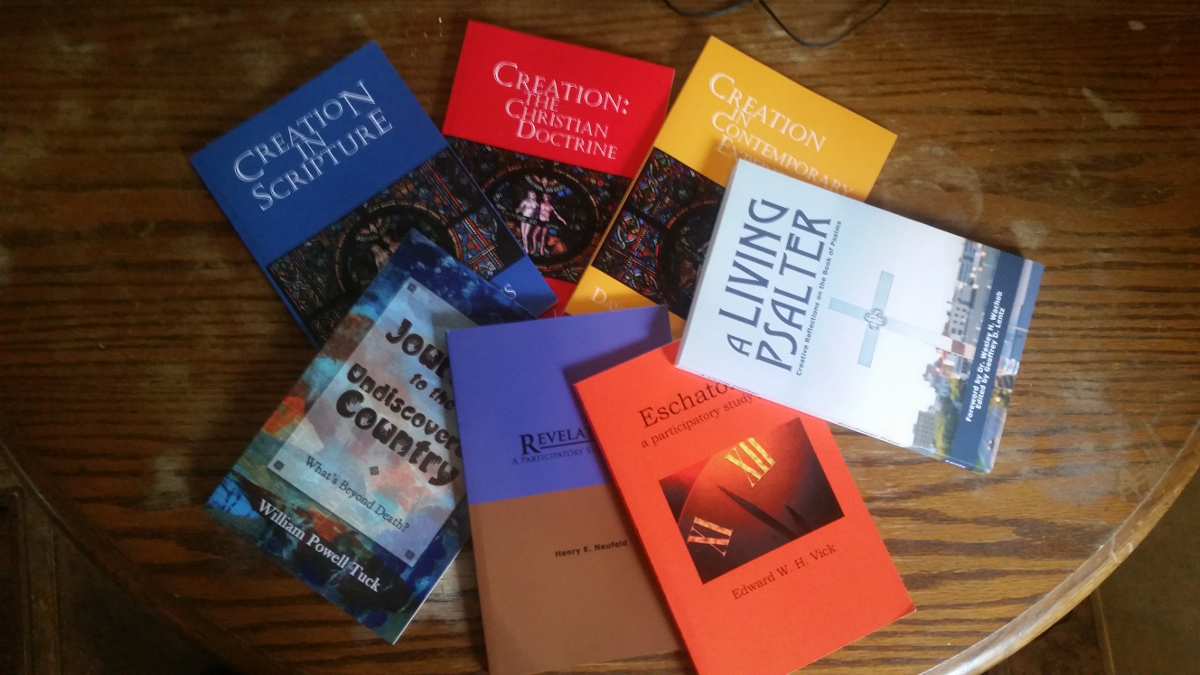
Tonight I’m going to work from Dr. Vick’s second chapter, “They Remembered Him,” and discuss what is the core of explicitly Christian eschatology. It’s quite easy for people to predict the end of the world. It may take some time, but eventually somebody is likely to be right! But does a particular outline of the end times make this doctrine Christian?
We frequently neglect eschatology in teaching and preaching. But how well does the gospel work when do this? Is it possible just to ignore this issue? Even when we talk eschatology in an individual sense, not when will the world come to an end (if it will), but when will you personally come to an end and meet God? And the latter question may not be quite as simple as it seems either. Are these events simultaneous? Do I go to heaven when I die or not?
So join me tonight as I discuss these issues and also the foundation for what Jesus said in his little apocalypse. You can find in on its Google+ Event Page or using the YouTube embedded below.
-
Eschatology: Surveying Symbols and Sources
 Tonight I’m giving myself permission to ramble in my presentation. “How will that be different?” you ask. I would imagine largely in that I won’t feel guilty while I ramble!
There are few areas that demonstrate differences in views of biblical inspiration and interpretation than eschatology, whether we mean end-time events or our own end-of-life considerations. ”
Where does everyone go at the end? and What happens to me when I die? tend to lead us to similar issues even though the chronology involved is different. In addition, the difference between a scattered proof-text approach and one that is carefully grounded in historical and literary context will come out substantially different. I don’t mean that if we could just choose one method of interpretation, we would all agree. We’re all human; we will disagree. But it would be nice to debate about the actual issues.I recall debating online with a Seventh-day Adventist. Since I am a former SDA, he expected me to “understand” certain things about prophecy, by which he meant that I would “see them as true.” Of course, “understand” and “see as true” are not synonymous. I recall that the debate came down to whether there was a connection between Daniel 8 & 9. Is there some relationship between the opening of the “2300 evenings-mornings” of Daniel 8:14 and the prophecies of Daniel 9? He simply refused to discuss the possibility of a connection. There was no connection and could not be. Why? Because his interpretation of the two prophecies required that they be separated. Now this observation doesn’t determine whether, much less how those two passages are connected. What I’m noting here is simply that for him, there was no possibility of a connection.
In terms of inspiration, we have the additional issue of just what we expect to be able to know as a result of studying eschatology from scripture. Is there a single view of the end times that one can piece together from pieces coming from 3rd Isaiah (Isaiah 56-66), Ezekiel, Daniel, the gospels (Mark 13/Matthew24/Luke 21), Paul, and Revelation, along with quite a number of other scriptures? Should we expect such a thing? If not, in what way can we view these scriptures as inspired? If so, why is the process of piecing this material together made so difficult?
My intent this evening will be to draw a very general map of the material and how it contributes to this topic. In order to understand eschatology, one must have somewhat of a handle on the whole of scripture. This is a daunting task. There are far too many people claiming to have simple solutions to everything when they show know awareness of the extent of “everything” with regard to this topic.
You can read a bit more about tonight’s discussion on the Google+ Event Page.
I’m embedded the YouTube here as well. Below this, I will post a schedule of upcoming topics, where applicable noting the chapters for Eschatology: A Participatory Study Guide by Edward W. H. Vick.
Here are the topics to follow:
Eschatology: They Remembered Him (Chapter 2 of Eschatology: A Participatory Study Guide)
Eschatology: Mark 13, Matthew 24, and Luke 21
Eschatology: New Testament Eschatology (Chapter 3 of Eschatology: A Participatory Study Guide)
(All links are to the Google+ events.)
As you can see, I interspersing material from the study guide with time spent discussing some of the source texts. In some cases, we will come back to those texts after we’ve studied further from the guide and also from other scriptures. For example, does your understanding of Mark 13 change when you think about realized eschatology in connection with it? Does your understanding of the materials in the gospels as a whole change after you study Daniel?
As you can see, I can have fun with this topic for an indefinite period of time. I may follow up a more general study with chapter by chapter studies of Daniel and Revelation, though I’d be more tempted to do this with Ezekiel. So we shall see!
-
Beginning My Eschatology Study
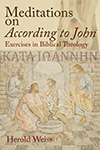
Last week was the closing session in my online study of the gospel According to John using Herold Weiss’s book Meditations on According to John: Exercises in Biblical Theology. I now turn to a new subject, eschatology, and will start with the book Eschatology: A Participatory Study Guide by Edward W. H. Vick. The reason I am starting here is that Dr. Vick provides many definitions and outlines the field and the various views quite well.I’m going to follow a different pattern for this study, however, so don’t expect a chapter per week. What I’m planning to do is go back to something I’m more familiar with and illustrate these various approaches by looking at specific passages of scripture. I’ll focus on one, but will bring in others to show the connections, both where I see intertextual relationships and where students of eschatology have tended to draw connections irrespective of any demonstrable intent of the author.
You either view using the Google+ Event Page, or with the embedded YouTube viewer below.
-
Completing My According to John Study
 At the beginning of the year I began a journey through the gospel According to John, using as my guide the book Meditations on According to John by Herold Weiss. I began this study largely for myself. I admit it. My motivation was selfish. I wanted to force myself to stick with the study week by week and to look into it more deeply than would be required just to satisfy my curiosity. I wanted to be able to present something based on each chapter of the book. (The entire study is now available as a playlist: https://www.youtube.com/playlist?list=PLdArFvZynbMDmk-CI_5EvufFIIxKfqxLN.)
The book is a bit alien to me. I stuck rigorously with the fundamentals of biblical studies, the languages, the history, the cultures, and the means of coming to some sort of idea of what that writer meant to say to his (or her) original audience. I avoided application because that is much harder to nail down, much less certain.
 I have frequently noted on this blog that I am not a theologian. That’s in the professional or academic sense. My training has not been in theology. I continue to maintain that. Teaching through one book does not make one a theologian. Nonetheless I do now have a much greater appreciation for the theological task.
What Dr. Weiss has done in this book is opened up in a practical way some approaches to connecting theology with what one reads in scripture without at the same time trying to force scripture to fit in with our creeds. We tend to see this as an either-or situation. Either the creed is scriptural or it is not. Either the trinity, for example, is scriptural, or it is not. But it is not quite so simple. One can pick up some pieces that eventually formed a part of the doctrine of the trinity without imagining that the particular text actually operated in a trinitarian framework. Indeed, one can believe the doctrine of the trinity without believing that it is actually taught in scripture. There’s a difference between being able to trace the roots to various texts and affirming that those text teach what grew out of interacting with them, with other texts, and with the experience of people living the faith.
Dr. Weiss made a valuable comment on that in his final interview for this study. (He graciously appeared twice to answer questions during the series.) He noted that very few of us really had the knowledge of philosophical language and categories of the time sufficient to really understand the results of those early councils that formulated the doctrine of the trinity. I would add that it is therefore not surprising that so many people, in talking about the trinity, fall afoul of one or another officially condemned heresy on the subject, without being aware that they have done so.
I am the publisher of Dr. Weiss’s book. One might suppose that my sole reason for using it was that I publish it and want to publicize it. I don’t deny that publicity was in my thinking. I do want to publicize the book. But for me editing this book was a profound experience. This is not because I believe that every view that Dr. Weiss expresses is set to become the new academic orthodoxy, but rather because he challenges us constantly to look at the text and what it meant and can mean.
One of the most critical issues is also probably the most controversial. Dr. Weiss challenges the common idea that the book is fundamentally sacramental. He believes that the view of operation of symbolic actions (and here I summarize a huge amount of text with some trepidation—I will provide a link to Dr. Weiss so he can correct me if I’m wrong) is more to be found in the washing of the disciples’ feet than in the traditional “sacramental passages such as the wedding at Cana, the discussion of eating Christ’s flesh and drinking his blood, or “born of water and the spirit” in John 3.
Participation was small during these studies. The most watched episodes, other than interviews, are in the 20s for views, and the least watched episodes are in single digits. I actually expected it all to be in the single digits. After all, I’m not truly an expert on this gospel.
This experience will impact my teaching in almost all areas. Some of the time I spent looking at the use of metaphors, of symbolism and how it can be layered, and the relationship between our experience, the text we read, the traditions we’ve inherited, and whatever creeds we follow will lead me to change the way I talk about almost any scripture. Of course, there are also many elements here that will remain applicable to this gospel alone. In fact, there are many ways in which I will be more wary of seeing symbolic meaning in something straightforward than I was before, because I have seen writers go a bit over the top with it.
I’m writing this both as a summary and to personally thank Dr. Herold Weiss for this book. I think it’s a great gift to the church. I think that a serious read of the gospel of John alongside these essays would be constructive for almost anyone interested in reading the Bible more seriously.
I’m now doing a preliminary read of Dr. Weiss’s next book, Meditations on the Letters of Paul, and I am also finding that they profoundly challenge me to think more and differently about that apostle. I’ll probably find occasion to use some of that material online in the future.
Next week, August 20, I will begin a study of Eschatology. The first couple of weeks I’m going to lay out a road map, looking at definitions of major terms used. In this, I’ll follow the study guide written by Dr. Edward W. H. Vick, Eschatology: A Participatory Study Guide. The study will continue indefinitely every Thursday evening at 7 pm central time.Once I’ve drawn the road map with definitions, I will go into studying some specific passages and the way in which they are applied in eschatology. This study will be much more what I’m used to doing, as I look at the historical setting. At the same time, I will be pointing out how these passages are used in the various schools of thought about eschatology in the church today.
I’d enjoy having your input here in the comments or during the Google Hangouts on Air. Watch this blog for announcements and links to each event.