
I’ve posted the event for my study on eschatology tonight. I’ll be looking at Isaiah for at least two sessions, the first focused on the servant passages as an exercise in interpretation, and the second on the language of the latter chapters and how it is incorporated into apocalyptic and in turn into our eschatology.
Tag: eschatology
-
Eschatology and Advent
 Tonight will be my last study hangout for the year as I look at eschatology and advent. You can see more at the Google+ event page. In January I will restart this series by looking at Isaiah.
Here’s the YouTube:
-
Eschatology, Ezekiel, and the Glory of God
 Tonight I’ll continue my discussion of Ezekiel, which I see as a book that stands somewhat between classical prophecy and apocalyptic, though more on the side of classical prophecy. Nonetheless you’ll see aspects of the structure and language of Ezekiel in much of apocalyptic literature, enough so that I would suggest that being acquainted with Ezekiel is a prerequisite for serious study of Daniel or Revelation.
We’ll be focusing on the glory of God and how it moves and is used symbolically in this book, right up to the temple vision. Depending on how I manage to use the time I may finish talking about this book. I’m obviously not covering this in detail, but I hope this may provide a start for those who’d like to study more.
I’ll be following this study with some selections from Jeremiah and 2nd and 3rd Isaiah, and then I’ll move to some of the visions of Zechariah before going to Daniel. We’ll be doing a full verse-by-verse study of the book of Daniel. It’s important to get a look at these prophetic books so that we can see clearly where Daniel differs and think about why it does so.
For tonight, you can view/listen through the event page on Google+ or using the YouTube viewer below.
-
Eschatology: Ezekiel 1 – II
YouTube:
My post is very late, so I expect I won’t have a live audience tonight at all (they’re always very small), but still I need to provide the link for those who watch later. There will be some interesting connections tonight with my discussion with Steve Kindle (and his book I’m Right and You’re Wrong) on the video below:
-
Eschatology: Resurrection and Life after Death
I’ll be tackling this rather intense topic tonight and likely failing to hold it down and get it under control! Following the event I will post more resources.
Informational Link: What Does It Mean to Survive Death?
-
Resource Links for Eschatology Future and Present
This is strictly a links post, giving links to the resources I’ll be referencing tonight.
First some of my own resources:
- Eschatology: Future and Present
Announcing this study and giving some questions to consider taken from Eschatology: A Participatory Study Guide - What Does It Mean to Survive Death?
I discuss some of the vocabulary problems we have with discussing life after death and an eternal reward. - Adventists, Other Christians, and the Great Disappointment
Why is this event in Seventh-day Adventist history of interest to other Christians. Or is it? - When People Speak for God
My own book on inspiration.
Essays posted today on the Energion Discussion Network related to the Great Disappointment:
- 1844 – 1: Between the Disappointments by Edward W. H. Vick
- Is It Time to Talk about Eschatology by Alden Thompson
Some other recent posts from the Energion Discussion Network:
- Process Theology: Theology for Progressive Christians by Bruce Epperly
This relates to the discussion of whether God acts in history and if so how does God relate to history. This is a substantial issue in this entire study. - Why I Don’t Argue for Inerrancy – Too Much by Elgin Hushbeck, Jr.
Another take on the inspiration of scripture. - The Battle for the Bible by Steve Kindle
No, not the battle of Harold Lindsell. Well, yes, sort of. This essay and the two that follow it discuss why we differ widely on what we believe scripture teaches.
Books referenced tonight or at other times in the series:
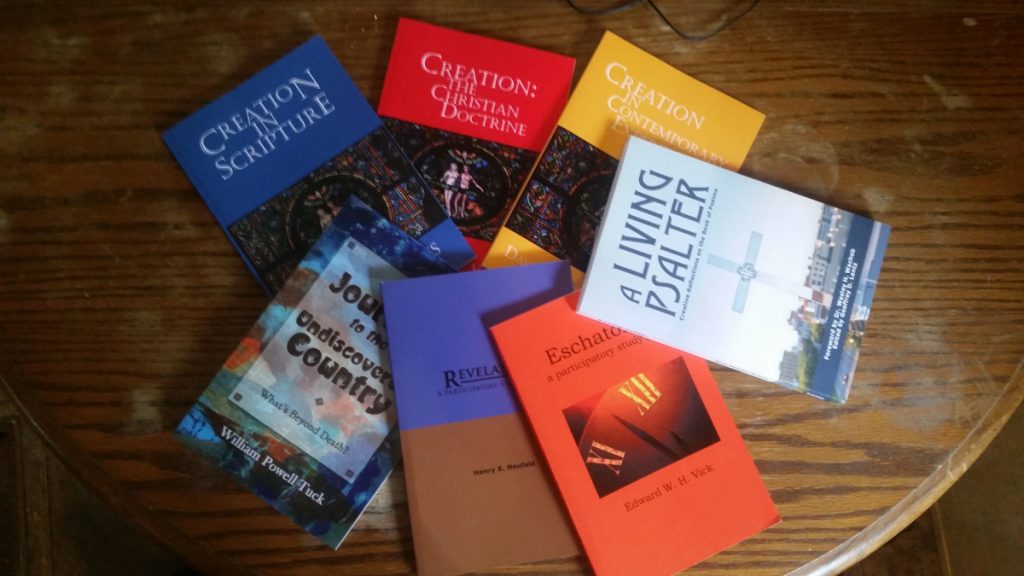
- Eschatology: A Participatory Study Guide by Edward W. H. Vick
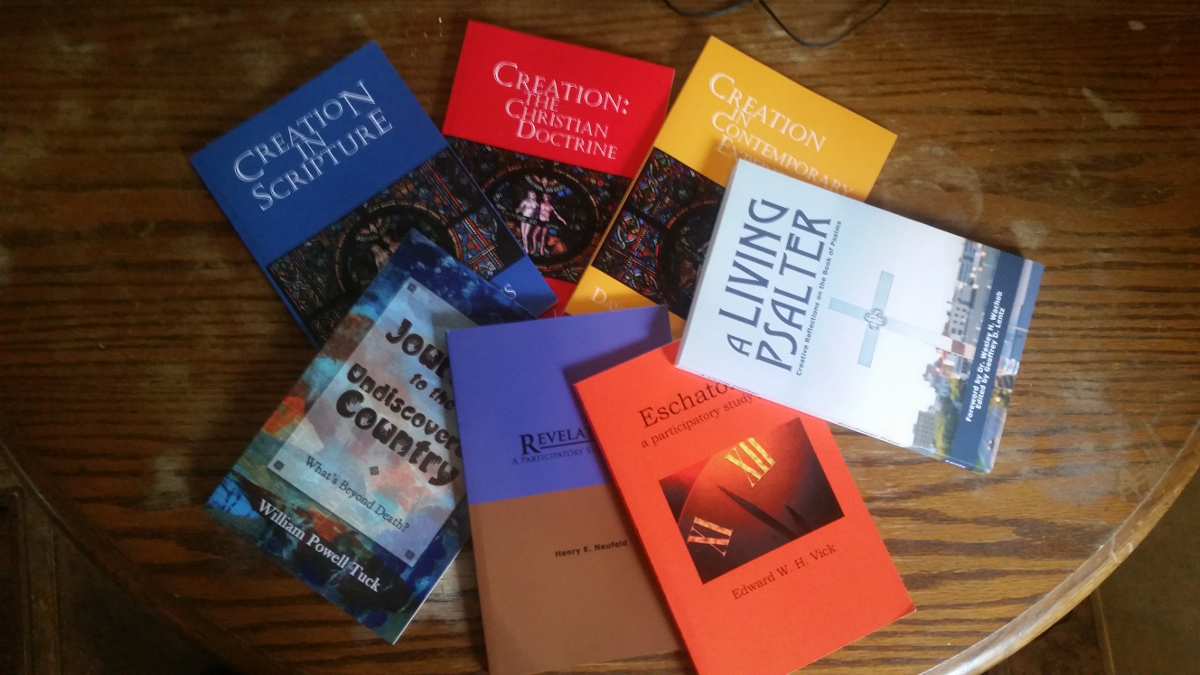
This is the primary guide for this initial portion of my study. I am using it to help us look at definitions and map out the territory before we go into verse by verse studies of various passages. - The Journey to the Undiscovered Country by William Powell Tuck
One of our primary resources on life after death. - From Inspiration to Understanding: Reading the Bible Seriously and Faithfully by Edward W. H. Vick
This is the more serious, 355 page discussion of inspiration. If you’re serious about studying what inspiration and authority are and looking at what those definitions mean for how we read the Bible, take the time to read this. I obviously also like my own book When People Speak for God, but if it had been published after From Inspiration to Understanding instead of before, it would have had dozens of footnotes to it. - History and Christian Faith by Edward W. H. Vick
“God acting in history” is a phrase that evokes many questions of definition. This little book will help you explore that idea and how it reflects in many areas. - The Adventists’ Dilemma by Edward W. H. Vick
What does it mean to say that Jesus is coming soon, if anything? This book examines the idea of a literal return of Jesus “soon” in a detailed way. - Process Theology: Embracing Adventure with God by Bruce Epperly
Process theology placed on a lower shelf. Bruce Epperly doesn’t shy away from application, but talks about how we should live with a God who is directly involved and impacted by the world.
- Eschatology: Future and Present
-
Eschatology: Future and Present
On Thursday night I’m going to do two things: 1) Present some material related to chapter 6 of Eschatology: A Participatory Study Guide (titled “Eschatology Future and Present”), and 2) Discuss October 22 as the anniversary of the Great Disappointment of October 22, 1844, as it is recalled in Adventism. On Thursday I will also kick off publication of some articles by Energion authors on that event and its implications for how we study the Bible generally and eschatology in particular. I’ll provide links to that material here.Here are the links for the event. Below the YouTube viewer, I will post a couple of questions to consider relating to Thursday night’s study.
In the study questions (page 67 of the book), Dr. Vick asks:
(3) We cannot construct a theology without making assumptions. With what assumptions would you organise your beliefs? Which of the assumptions suggested in the chapter would you be in agreement, and which would you reject? [emphasis mine]
 The latter part of this question will be hard to answer without the book, but consider the first line. Do you agree or disagree? Feel free to comment here or to bring your comments to the study on Thursday night. If you enter the comments via the Q&A app, they can become part of the study.
For some perhaps even more provocative suggestions, the following questions come from page 65, and might help in feeling out your way on assumptions.
What can I believe and what can I not believe? What are the implications of the answers I give to the question? This question then ramifies into more precise formulations.
What can I not believe about how things happen in the system of an ordered cosmos?
What can I not believe about how historical reports come to be written?
What can I not believe about the reliability of human testimony as an avenue to knowledge, whether given verbally or in writing?
What can I not believe about the capacity of a being with human limitations to foretell the future?
What can I not believe about the supernatural?
What can I not believe about claims that the supernatural causes events to take place within the cosmos? (p. 65)I’m sure that as you consider these questions, you’ll quickly see their implications for how you might read scripture. One can be open on some of these, certainly. But thinking about how you would approach the question can nonetheless be critical.
-

What Does It Mean to Survive Death?
In my Eschatology study last Thursday (Oct. 15, 2015) I tried to answer an audience question. Here it is:Is the sense of the presence of Jesus today dependent on the historical Jesus surviving death? Or, is it more like the presence of a departed parent that lingers after death?
And here’s the video, set to the point where I discussed the question.
I’m not terribly satisfied with my answer. What’s more, I am never satisfied with my answer to this and similar questions. What’s even yet more, I doubt I will ever be satisfied.
I’m sure some will find this surprising. I can certainly talk about heaven in a very present and real sense. I claim that I do not cross my fingers during the Apostles’ Creed when I come to “resurrection of the dead.” On the other hand, those who see life after death more as the presence in our memories as someone after death seem to think this is quite adequate. For me, it is not. Well, it might be.
A common modern view of life after death sees this as a simple result of our unwillingness to admit that we are truly bound by time and destined to come to an end in the sense in which we live now. Belief in the afterlife is a way to avoid this end. We don’t want to be something that exists in the memories of others or who impacts the universe through the echoes of what we were and did in our physical lives. Thus we imagine an afterlife.
There is another possibility, one that was mentioned in a recent video interview I conducted with Dr. David Moffett-Moore. I believe he was quoting someone else, but I’ll credit him for the moment. (I haven’t located the precise portion of the interview.) He said we could be seen as spiritual beings having a physical experience rather than physical beings who have spiritual experiences. I want to consider the possibility that the reason many of us see some sort of survival is not that we are carrying out wish fulfilment, but rather that we detect the echoes of this other reality. The reason we sense that the person isn’t gone is that in that spiritual sense, they are not.
And that leads automatically to what “that spiritual sense” might be. And there the problem gets complicated. Just how do you talk about something for which we have only distant echoes? Plato’s cave and the shadows seem easy by comparison. Then there is 1 Corinthians 2:9, “What no eye has seen, nor ear heard, nor the human heart conceived ….”
What we tend to do with this, however, is to take what we have already and make what no human heart has conceived be more of what we already have. We have our physical life, our comforts, our friends, and so forth, so in this other realm we will have more of those things. More people, better relationships with them, more stuff (or less need for stuff, but more satisfaction), a bigger, better place. It would be just like moving to the mansion down the road, the one we couldn’t possibly afford, only much, much more! Bigger! Better!
But what if what we can’t conceive is something we can’t conceive? I don’t mean that the mansion we can’t afford, but can have when we get to heaven, is so large we can’t imagine it that large. What if the concept “mansion” is simply the wrong one? What if no matter how we conceive of that mansion in size, splendor, comfort, or anything else, we’re no closer, because it’s simply the wrong thing to be imagining?
Here are some questions I tend to hear when talking about this: But is it real? Is heaven a place? Is it just imaginary?
And here’s the problem with our language. If I say you’re going to live in a new house, but it’s really not something you can understand, you just don’t have the concepts, you’re likely to turn to the most likely alternative: It’s imaginary; it doesn’t exist. So in order to make heaven truly inviting and special, I’m asked to affirm that it is real—just as real as my house that I can see through my office window. Just as real, but better. Well, if that’s the “real” then I can’t possibly tell you that.
We really can’t conceptualize it. On the one hand I don’t want to limit it to the chemical processes of memory inside physical bodies alone. On the other, I don’t want it to be some place else in three-dimensional space, like a fine housing development out in space somewhere. I think we get echoes from it in our minds and spirits, and we have to tie those echoes to something we can conceive, but that doesn’t mean the concepts we form are the whole story.
And I’m very dissatisfied with my answer, but it’s the only one I have. With it, I live in continuous hope.
(Let me recommend the book whose cover I show at the top of this post: The Journey to the Undiscovered Country. Bill Tuck spends some time with the various concepts he finds and looks at the echoes as they occur in scripture.)
-
Eschatology: Eschatology and the Quest
Taken from chapter 5 of Eschatology: A Participatory Study Guide by Edward W. H. Vick. You can find out more about this study on the Google+ Event page.Description:
This study is from chapter 5 of the book Eschatology: A Participatory Study Guide by Edward W. H. Vick. This will be some very basic background, discussing the quest for the historical Jesus and how it has impacted our understanding of Christian eschatology.We will also discuss (again!) the critical issue of the way in which we read and interpret scripture and how that will impact our understanding of eschatology, which draws on such a wide variety of sources.
Or watch here:
-
Eschatology: Daniel and Revelation
I’ve had a hard time keeping up with blogging this week. It’s a busy month. On Wednesday nights I’m teaching from Revelation for a youth group at a local church, and of course I have my Thursday night events, one of which I’m announcing here, which are a sort of spiritual discipline for me.
I was going to try to both talk about Daniel and Revelation (in a very general way) and then go on to talk about eschatology and the quest for the historical Jesus, but I have decided not to do that and give myself a slightly more relaxed session talking about the structure and rhetoric of Daniel and Revelation. The two books are substantially different, yet they are the two acknowledged works of apocalyptic literature in the Bible, and almost any Christian discussion of eschatology touches on them at one point or another.
Growing up as a Seventh-day Adventist meant that I repeatedly studied these books. I even took a college class titled just “Daniel and Revelation.” There was an extract of the SDA Bible Commentary combining the comments on Daniel and Revelation in one book.
While I will be looking at these two books in particular, my study since has led me to look at a much broader range of material, from Ezekiel, to several chapters in Jeremiah, to much of the latter portion of Isaiah, and much more in the Bible, and also a considerable amount of non-biblical material. Yet these two books still tend to hold pride of place.
Is their purpose to give us an end-times outline? If so, in what detail, and if not, what is their purpose? I’ll be discussing this on video this evening.