Threads from Henry's Web

Tag: Christianity

  • Episcopal Church Elects Woman as Presiding Bishop

    I’d like to congratulate the Episcopal church on electing a woman as presiding bishop. While the normal complaints about declining mainline membership are brought up, I do not believe that the membership problems that the mainline churches have are due to upholding the rights, and more importantly the divine calling of women. Further, no Christian should be determining policy based on numbers. Inclusion is right, whether it makes one popular or not.

    In a story on MSNBC.com, Episcopalians elect 1st female national leader, noted that “gasps could be heard throughout the vast convention hall when Jefferts Schori’s name was announced.”

    What is there to be shocked about? It’s long past time that we, as Christians recognize that God can call women to any level and type of ministry that he desires to. This should be a non-issue, but unfortunately it isn’t.

  • T4G: Interpretation and Egalitarianism

    In searching around the blogosphere, or more accurately taking a quick glance, I note that many bloggers are responding to the Together for the Gospel statement as though Article XVI (about male leadership in ministry) was a single aberration in an otherwise good document. In fact, for some, the tragedy of women being excluded from the conference (though not completely) was that they would be denied the otherwise wonderful Bible teaching involved.

    (Let me note a few entries that I read and that provide good links to others. These are not all examples of the tendency I noted above, but they will help you get the flavor of the discussion. Dave Warnock discusses this issue especially in his post Together or Divided?, and Michael Bird wrote an excellent post from a generally conservative viewpoint, but focussing on the complementarian/egalitarian issue in Together for the Gospel . . . Not Quite. Adrian Warnock has been blogging extensively on this from the conservative point of view. A good wrap-up can be found at Adrian Warnock’s blog.)

    I’m afraid I can’t agree with this viewpoint, however. I think that the issue of gender roles in church leadership is the single clearest example of a divisive viewpoint in this statement, not to mention one I believe is wrong. But I believe that the complementarian view comes directly from the statements on scripture and the approach to interpretation that is represented here. Now I don’t call this approach “conservative.” There are genuine conservatives who don’t accept the complementarian position, and even more important, there are complementarians who are not divisive.

    The reason I see this statement as divisive is simply that it claims that all these elements are part of the genuine gospel, and the clear implication that those who disagree are teaching a false gospel. This level of detail when defining essentials is very troubling to me. Now it may appear that I am creating an equally detailed statement by opposing this statement point by point. But let me emphasize that I do not regard my beliefs on Biblical inspiration or on egalitarianism are a part of the essential definition of the gospel. I do believe that inclusiveness is more consistent with what is fundamental than is exclusiveness. Exclusiveness is not worthy of the doctrine of the incarnation and the sacrament of communion. But that’s another post.

    The T4G statement places one’s theology, the data that one accepts as true, at the center of the issue, and even in doing this it fails to place the focus on the incarnation, in the instance of God’s reconciliation, and especially on his giving us the ministry of reconciliation (2 Corinthians 5:16-21). This emphasis is more dangerous than the complementarian attitude reflected in Article XVI, although that article does follow naturally from the doctrinal nature of the whole statement.

    There is a serious need here to define what truly is essential, and what is optional. My most fundamental problem with the T4G statement is that I believe it is almost all about non-essentials (other than statements on grace and salvation by faith, and even those are flawed), and skips many essentials.

    I’ll return to my article by article discussion in my next post on this topic.

  • CD: Leah Taylor, Faithful Friend

    In my personal testimony I speak of returning to the church in a United Methodist congregation (Pine Forest UMC), I note that I attended an evening service first where some young people gave their testimony. One of those young people was Leah Taylor (then Leah Bridges), at that time involved in soccer, music, and the Christian youth group at Pine Forest under Linda Smith. One of the things I kept my eyes on in those days was the impact that the church had on its young people, and over the years even more importantly the impact the young people had on their church. Leah is an example of the impact a young person can have on the church, if the church will only permit it.

    A few weeks ago I was priveleged to attend an evening service at Olive Baptist Church in Pensacola, FL, and the worship music and special music were provided mostly by Leah Taylor. She was also introducing her newly released CD, Faithful Friend. Leah is now a bit older than when I first heard her testimony in words, and she has a husband and three children. This time she gave her testimony in music. My wife and I would have been there just for friendship. But Leah’s passion, her worship, or the quality of her musicianship meant this was a concert I would have wanted to hear whether or not I already knew the artist.

    If you want to hear the gospel presented in music, more clearly than any sermon, you’ll want to buy this CD and listen to it. You won’t be disappointed.

    Leah’s song “Falling Up” was chosen to be in a competition for the best new song, which will be performed at the Praise in the Park concert. The first competition will be this week, Thursday the 16th at 6:15pm on Power 88 FM. The DJ will play the three songs that were selected then people can log onto www.goforth.org to
    vote for their favorite of the three. I invite my friends to listen and vote–for Leah, of course! 🙂

  • T4G Article II: Canon within Canon

    In a previous entry I discussed the inspiration of the Bible in response to the Together for the Gospel statement, Article I. Since I disagreed almost entirely with that article, and Article II also deals with the Bible, it is no surprise that I find much to disagree with in this second statement as well.

    Article II says:

    We affirm that the authority and sufficiency of Scripture extends to the entire Bible, and therefore that the Bible is our final authority for all doctrine and practice.

    We deny that any portion of the Bible is to be used in an effort to deny the truthfulness or trustworthiness of any other portion. We further deny any effort to identify a canon within the canon or, for example, to set the words of Jesus against the writings of Paul.

    I agree that the authority and sufficiency (whatever that means) of scripture extends to all of scripture, but for reasons I have previously stated, I do not agree that the Bible is our sole source of doctrine. The key to this article, however, comes in the denials, which show that it is intended to respond to the idea of a “personal canon” or a “canon within a canon.” Now I think the notion of a “personal canon” is logically questionable. A “canon” is a set of writings held by a community to be authoritative in some formal sense, such as church law. Thus a “personal canon” can be held to be oxymoronic. But there is a very practical point that is intended by the term; individuals build their spiritual life with different emphases on different portions of the scripture.

    As an example, other than the gospels, which I regard as central, I spend more time on the average reading the Pentateuch from the Old Testament and the general epistles, especially Hebrews from the New Testament. My wife tends to read more of the Psalms, some prophets, and her New testament reading other than the gospels generally comes from Paul’s less theological letters such as 1 & 2 Corinthians. But neither of us would deny that what the other is reading is inspired. This is a sort of “practical” canon within a canon.

    But I agree with the statement here to the extent that someone who defines a separate canon while denying the inspiration of other writings separates himself to some extent from the community. When the “canon within a canon” becomes more than a practical choice for my own spiritual walk and I start denigrating the authority of other scriptures for other people, then there is a cause for concern.

    But setting the words of Jesus against the words of Paul is another matter. First, there is the simple point that God chose to give the scriptures through different writers at different times and in different places. There is evidence of these differences in the writings. I believe a greater danger is the homogenizing of these differences that God put into scripture. It is not honoring scripture, or the God of scripture, to pretend that it is not constructed the way it is.

    But more importantly, this phrase is a code-word for those who build a theology out of Paul’s writings and use it as a basis to ignore the words of Jesus. Jesus talks about holiness of life and obeying the law; Paul speaks against the law. It is essential to their theology to keep people from setting the words of Jesus against their interpretation of Paul. It is common in discussion or in theological writings for them to use the words of Jesus and Paul equally because both, they say, are inspired.

    But to truly honor scripture, one must note that Paul’s words were written to a different audience than were those of Jesus. If one takes the differences seriously, then one will have to deal with what Jesus says brings salvation, and what Paul says brings salvation. One will need to deal with issues of behavior and holiness. When you homogenize scripture, on the grounds that it all comes from God, you immediately lose these nuances, and will form a theology that may be more systematic, but is less faithful to the experience of God reflected in scripture.

    In addition, those who form theology from Paul in this way tend to form their theology largely from the more theological books of Romans and Galatians, and particularly from the parts where Paul expresses his theological foundation. But salvation is also discussed in 1 Corinthians, with much less theology and much more practical application, and in both Romans and Galatians, when Paul gets down to application, he sounds much more like Jesus. One possibility that must be examined here is that modern readers have misunderstood Paul’s basic theology and its application, and may need to check their application against Paul’s.

    For example, the conclusion of some that one can be saved without the fruit of faith is clearly challenged starting with Galatians 5. Theologians have found many ways to work around this, but all of these ignore some aspect of the text. (I apologize for making broad statements with little support, but I’m trying to work through this in a reasonable amount of time. I have discussed a good deal of this material in my essay A Fruitful Faith.)

    Thus while I have some agreement on the point of a canon within a canon, I must reject what I believe is the real thrust of this statement. One cannot simply combine texts from Jesus, Paul, and other writers on the basis that all come from God. One must understand the overall view of each one and then see how they mesh. One must not limit what Jesus can say based on what he must be saying because of some theological principle gleaned from Paul.

    Let me also repeat one last time: If you are a Christian who believes the incarnation, you must logically believe that Jesus is more important than any other person, whether a writer of scripture or not. Jesus is central.

  • T4G Article I: The Bible

    The first two articles of the Together for the Gospel statement relate to the Bible. I’m going to deal primarily with the first article in this short essay. The article reads:

    I find myself so fundamentally in disagreement with this article that practically every word requires some sort of response. Since I have written fairly extensively on Biblical inspiration in articles available on the internet, I will refer to those where possible and only summarize my difficulties.

    We affirm that the sole authority for the Church is the Bible,

    It’s interesting that the major portion of the history of faith in the world in general occurred without the Bible, and even more without the Bible as we have it today. If the Bible is the sole authority, God took his time about creating that sole authority. Where in the Bible is there a statement that the Bible is the sole authority? If one is to hold to this type of exclusive view of “sola scriptura” then there should be a basis in scripture for:

    • The canon of scripture, which is nowhere specified in scripture
    • The use and interpretation of scripture, again unspecified, though we have examples of some interesting approaches
    • The precise text of scripture.

    Note that I don’t have a major problem with these issues. The Bible is the foundation of my faith, but then I don’t make any claim that the Bible is the exclusive authority. One of the key errors that stands behind the T4G view is the understanding that when the Bible refers to the “word of God” one can apply all those things that are attributed to “the word” to the Bible. For a more detailed discussion of this issue, see the pamphlet What is the Word of God.

    Throughout Biblical history the church was led by prophets, apostles, and other leaders who were said to be in some sort of communion with God. There is no indication of a time when a collection of literature would become the sole authority. This does not mean that the Bible is not fundamental, or that it is not extremely important, or that it does not convey God’s word. In fact, I would say that its authority is foundational, but it provides the foundation for a structure. The Christian church is not founded on a book, but on a person.

    verbally inspired, inerrant, infallible, and totally sufficient and trustworthy.

    You will search the Bible in vain for scriptures that actually affirm these doctrines. Skipping over the more complex theological definitions, verbally inspired is generally understood to mean that the words of scripture, and not just the thoughts or the message, is inspired. Some of those who hold that the Bible is verbally inspired also hold that it was verbally dictated, that God provided the very words of scripture to the prophet. Others hold that God protects the words so that we can safely say they are God’s words, even though the personality of writers show through. The end result is very similar, because one assumes that each word is there by God’s direct choice; not God’s choice of a writer or a message, but his choice of a specific word.

    Inerrancy is normally understood as the claim that the Biblical autographs are without error in all it affirms, no matter what the topic, thus including science and history. A minority will hold that a particular translation or manuscript contains the perfect word of God. This latter position is clearly nonsense, because no matter what translation of manuscript one chooses, one also excludes the majority of the readers of the Bible throughout history from having such an inerrant scripture. Inerrancy of the autographs suffers from a lack of any autographs by which one might check the claim. If God was concerned that the autographs be without error, he was apparently inexplicably unconcerned with seeing that the actual copies that you and I can read are without error.

    Infallibility is a vacuous claim to make about a book, simply because the book does not, in fact, do anything. Interpretations can clearly be in error. It seems more important to me to understand how people get information from the book. Infallibility that is inaccessible is of little interest, and one need only read a few commentaries or books on Biblical theology to see that infallibility is apparently inaccessible.

    Totally sufficient and trustworthy causes me to wonder what it is that the Bible is totally sufficient for. Normally theologians will say “totally sufficient for salvation,” though many will maintain that under appropriate circumstances considerably less than that is sufficient. This claim seems to me to hardly go beyond saying that the Bible is what it is. I agree! And I think it is sufficient to its purpose. I also find it trustworthy, provided we are careful to understand what its purpose is. It is no trustworthy, for example, as a science text. That’s not a criticism, just an observation. It was never intended as a science text. It does not replace one’s personal communion with God. Again, it was never intended to.

    More important than the items of definition I have pointed out is a common failing of all these claims about scripture: They all rely on a particular approach to developing a Biblical theology of the Bible. The common approach is to take a passage such as 1 Peter 2:19-21 or 2 Timothy 3:16, and then decide on the basis of these texts what the Bible ought to be. Other than the circularity of this approach, which can be ameliorated through other theological approaches, I find it interesting that in the face of a substantial history of the Bible and how it came to be, so many theologians prefer to define what they want it to be, rather than simply observing what it is.

    2 Timothy 3:16 provides us with the word “theopneustos” or “God-breathed” which has been made to carry a great deal of freight. But when God breathed into Adam he didn’t make him inerrant, he made him alive. What exactly is the content of a text that is God-breathed? But this issue applies much more to verbal inspiration. The evidence against verbal inspiration is very strong in the text and the history itself. There are certainly words that are attributed to God, but there are also words that are clearly not attributed to God. The synoptic problem presents us with clear evidence that the gospel writers copied from one another, that there are different sources in the Pentateuch, Samuel, and Kings, just as examples.

    My point here is not to recite again the details of the inspiration of scripture, which I have deal with elsewhere (Inspiration, Biblical Authority, and Inerrancy and my posts on inspiration in my studies on Hebrews), but rather to suggest that we need to use a different method. If the history of the Biblical text were completely obscure, we might have an excuse to determine its nature by creating standards based on texts, but instead we have extensive material available. We know that one author copies from another, we know that there are various sources, we know that there are differing viewpoints. (I will comment on this issue a bit more in my entry on Article II.)

    We deny that the Bible is a mere witness to the divine revelation,

    I don’t get the phrase “mere witness.” To me, the most wonderful thing about the Bible is that it is a witness to divine revelation and to divine action in history. The fact that it is written by humans who are subject to error as I am makes it much more accessible. I know that one can live by faith because Abraham, Moses, and Jesus did. This witness is not mere, it is critical. The author of Hebrews uses it as a showcase for his argument in Hebrews 11.

    or that any portion of Scripture is marked by error or the effects of human sinfulness.

    But the copies that we actually have are marked by error. I do not mean extensive error, but Biblical inerrantists will not allow the smallest error in the autographs, and yet are satisfied with a 98% or 99% accurate copy. Of course one can’t determine that for certain again, because we don’t have the autographs. I don’t think this is a serious problem for Bible study, interpretation, and application, but that is because I don’t believe that inerrancy is relevant to those issues at all.

    The effects of human sinfulness are all around us. The very fact that we need to hear the word through prophets or read it in books is the result of sin and our separation from God. Without human sinfulness there would be no need for the Bible at all.

    Inspiration is an incarnational process, God breathing life into imperfect words in imperfect human language to be preserved imperfectly by imperfect copyists, read imprefectly by imperfect readers, preached by imperfect preachers, and discussed by very imperfect bloggers such as myself.


  • Is this the Gospel? (Overview)

    In an earlier post I responded to the Together for the Gospel statement, which I do not think represents any real “togetherness,” nor do I think it represents the gospel. Now I want to be clear that I am not suggesting that my side, whatever that may be, needs to exclude the writers of such statements. At the same time I do not want to minimize my concern over the approach to Christianity that this statement represents.

    In this entry I want to simply look through the 18 articles and point out where it is that I disagree. In later posts I’ll deal with individual elements. I will only use brief quotes, but you can get the full context of each statement from the link above.

    The Opening

    We are brothers in Christ united in one great cause

  • Basis of Faith and Meaning

    A number of people over the years have suggested that because of some doctrinal position or another that I hold, I no longer have a basis for my faith. Those who express themselves a bit less forcefully see it as a weakening of faith, a distancing from God, and a lessening of belief in God’s power. Two doctrines in particular tend to bring this response: 1) My rejection of Biblical inerrancy, and 2) My acceptance of the theory of evolution. In the second case, it seems also that people feel that an acceptance of the theory of evolution robs life of all meaning. If human beings were produced by a process of descent from the smallest form of life, somehow God no longer has a purpose, or no longer has control.

    I’ve been thinking about these things recently, and asking myself just what is the basis for a meaningful Christian life, a question that seems to me to combine these two issues quite nicely. Since I rarely have difficulty finding meaning in any particular day of my life, these aren’t questions on which I spend lots of time.

    Let me list some of the places from which people say they get meaning and find a basis for their faith:

    1. A certain set of historical events, such as the incarnation, death, and resurrection of Jesus
    2. Certain spiritual experiences or encounters with God or the divine in some way.
    3. Don’t know, it just happened.
    4. A deep internal need for God.
    5. God made me specifically, and intended me for a specific purpose.
    6. Community, being part of a church or spiritual family
    7. I make my own meaning.
    8. I became convinced that the Bible was true for logical and historical reasons.

    That list is not exhaustive, but I think it illustrates this adequately. I would have to say that for myself, there are elements of the first, second, third, sixth, and seventh. The focus of my own meaning in the world, however, combines my personal encounters with God with making my own meaning. My encounters with God, however, mean that when I make my own meaning, I do so in relation to God, which doesn’t mean quite the same thing as it does by itself.

    So what would it take to shake my faith or even to make me abandon it? I really can’t think of anything. The classic question for Christians is what would happen if someone found a clearly identifiable body of Jesus, proving he was not physically resurrected. Since I do believe in the physical resurrection, that would be troubling and would require some rethinking of elements of my faith. At the same time, I believe I would simply adjust to the other possibilites in the resurrection. If I had never experienced the risen Christ, I would not find the historical evidence anything like sufficient to convince me of the resurrection. If the physical evidence got worse, I would still have the experience of the risen Christ.

    Similarly, at one time I believed something very much like a hard version of inerrancy–there could be no errors in the Bible of any type, including in historical and scientific matters. Through study I became convinced that this was not the model of inspiration displayed by the scriptures. At the same time I knew that I heard the voice of God through the scriptures. So despite a substantial shift in the method by which I believe God communicates (and it’s quite possible I’ll again change my mind with further study!), I don’t doubt that God does communicate.

    I never had the problem that some people claim with evolution, which is the loss of meaning. I went from believing that God literally formed the first human being from dirt and then literally breathed into this statue so that it became a living creature (Genesis 2:7), to believing that God formed a human being through the process of descent with modification, and when that being was the human being he intended, he saw that it was good. Notice that I don’t see God as ever getting further from the formation of man. The method changed; the result was the same.

    In a conversation with my wife I was searching for an analogy for this difference in the method by which a person was formed. I proposed the difference between a mother laboring and giving birth to a child versus a C-Section. She suggested more the difference in the connection between a parent by birth or by adoption. I still feel a little closer to the first analogy; there really is no difference in how connected the mother is to the child in either birth. I will admit that if adoption (or step-parenting) is done properly, I agree with my wife’s point. The tie should be created and should exist just as tightly as a blood tie. But I’m not sure people understand it that way. The key is that God’s parent-child relationship with human beings is not changed by the method by which he produces those children. It has always interested me that many are happier being descended from dirt than with the idea of being descended from a small life form that lived in dirt–or water.

    I think that if the meaning of your life is shaken by any change in the method of your creation, that meaning may be pretty loosely attached in the first place. You may need to look at your experience of God and your connection to God. I’m often accused of putting more weight on science than on the Bible and faith, but in a most fundamental way I think it is creationists who put a greater weight on science than I do. The methodology of science is, for me, a way of learning about the physical world, with results that are tentative and subject to change at any moment. They have to be, because we learn new things. My meaning doesn’t come to me from my understanding of the function of the physical world, and it isn’t shaken when new things are discovered about the physical world. I’m really placing much less weight on science in my spiritual life than the creationist who feels that he must find a scientific basis for everything in Genesis in order to uphold the faith.

    1Now faith is the substantial nature of things we hope for, the clear conviction of things we don’t see. 2By this means the elders were approved.

    3By faith we understand that the universe was made by the word of God, so that things which are seen didn’t come out of things already visible. — Hebrews 11:1-3 (TFBV)

    It’s my faith–my belief in, my confidence in, and my trust in God that gives substance to my spiritual hopes and gives me clear conviction. This is a different category of “knowing” than knowing that the earth orbits the sun, or accpetance of common descent. Even using the word “knowing” is deceptive, because it is entirely subjective. I can’t prove it to you, I can’t make you hear me. I have good friends who think I’m irrational because of it, and I understand their point of view. But I have the firm conviction.

    This is a conviction that worked from Abel, Enoch, Abraham, and Moses, who had no scriptures at all. They couldn’t believe that scriptures were without error, because they had no such option. They only had their belief that they had encountered and communicated with the living God. That gave them enough to work with, and gave them meaning in their lives. They didn’t have the doctrine of the incarnation or the resurrection. But they were faithful nonetheless.

    39And these all, having received approval of faith, did not receive the promise, 40since God concerning us foresaw something better, so that without us they would not come to completion. — Hebrews 11:39-40 (TFBV)

    Their belief was without seeing, without scripture, and yet they received approval and remained firm. I’m not against facts as part of your faith. But the foundation had better be deeper than the details.

  • Roy Moore (Governor) and Alabama Supreme Court Slate Lose

    There have been a number of articles on these races because of the national issues raised, including the idea that a state court should be permitted to ignore a federal court order that it regards as unlawful. Roy Moore gained fame by refusing to remove a monument to the ten commandments, but when it came down to campaigning for governor he was simply unable to pull it together.

    The article Message and money: Moore needed more, from the Birmingham News provides some analysis. It takes more than a good issue that is popular with the voters to get somebody elected. Alabama voters are probably sympathetic with Moore’s basic position on the ten commandments issue, though ignoring a court order didn’t sit well with some. But a single issue is not sufficient to get someone elected.

    I’m glad to see these particular candidates go down to defeat in Alabama.

  • Christian Violence?

    A Christian game company is producing a game based on the Left Behind series. Their own advertising quotes the New York Times saying that the game “Combines Tom Clancy-like suspense with touches of romance, high-tech flash and Biblical references.”

    The game puts players in the position of either killing or converting their opponents and includes spiritual warfare, scriptures texts and more, according to a story in the LA Times Converting Video Games Into Instruments of God.

    I’m not going to go into this in depth, but I want to ask my Christian friends this: Can a game be made Christian just because we quote some scripture and include prayer? Is there going to be a time when God will sanction this type of behavior?

    From what I can see from the advertising, I don’t think this is an improvement over the average type of violent video game. I’m particularly concerned about the “convert or die” part.

    For full disclosure I should note that I do not accept the “Left Behind” interpretation of Revelation.

    (Thanks to Dispatches from the Culture Wars for alerting me to this.)

  • Unity, Diversity, and Confusion

    Recently I wrote a couple of entries, first on diversity and liberalism, and then on the Together for the Gospel statement. The issues I discussed in those two posts raise quite a number of questions about truth, unity, and Christian fellowship. Many might decide from my comments thus far that I don’t care about truth or correct doctrines at all. But that is not the case. “Doctrine” is simply teaching, and we all have some form of teaching. Even the doctrine that correct doctrine is not primary in salvation is itself a doctrine.

    Where are the boundaries where disagreement is permissible or not permissible? How can we tell what is essential and what is not? It’s easy to quote St. Augustine, “In essentials, unity. In non-essentials, liberty. In all things, charity,” but it’s a great deal harder to define precisely what one means. Two sincere people who accept the idea of unity in essentials and liberty in non-essentials can nonetheless get into quite a fight over just what is essential.

    I think we could view the situation as a sort of continuum.

    Unity by Exclusion Unity in diversity Disunity by confusion
    Doctrinal continuum arrow Non-doctrinal

    To the far left of this spectrum (no left-wing/right-wing implications intended), we have those for whom doctrine is central and absolute. I’m seeing the folks who wrote the Together for the Gospel statement I discussed in my post Who’s Together for What?. For them the way to defend the gospel is to be both very clear and detailed on what is truth, make sure people know it, and only respect those who are fully on track as bearers of the gospel. In the center of this continuum we have those who have a small number of essential doctrines on which they require unity, but outside of that boundary diversity is permissible within the community. On the far right of my continuum, we have those who hold nothing, or almost nothing, as essential, and thus have confusion because they are not defined as a community. Even greater confusion results when a community cannot agree on just where they stand.

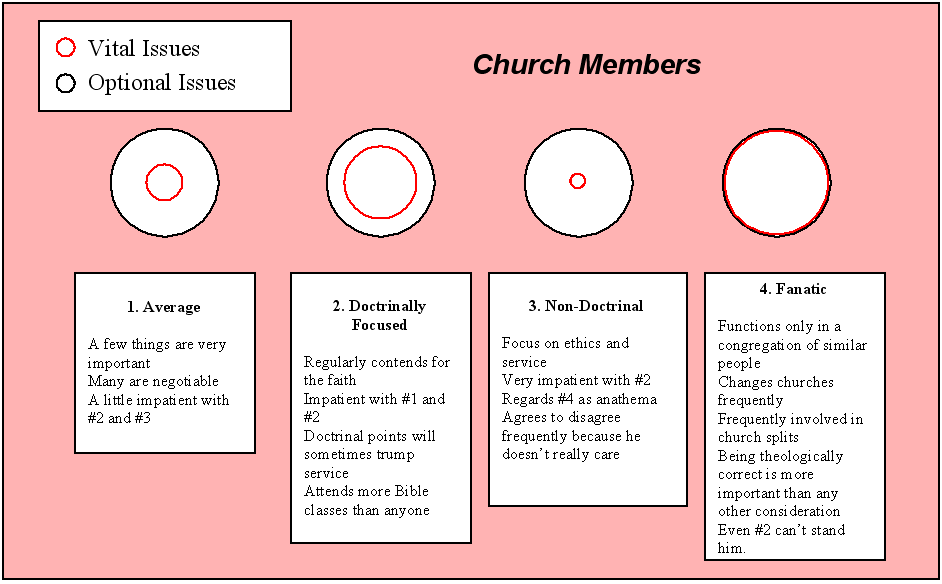
    Let me provide an illustration from another article I’m working on that looks at the type of people who might be part of such organizations:

    Church member attitudes toward doctrine and diversity
    Click the image for a larger view

    Churches that attain unity by exclusion tend to have a large number of essential doctrines. These churches tend to split, and the people in them tend to move from church to church looking for a precise match to their desires. I am not saying that such a church cannot practice unit and cannot teach the gospel; merely that it is difficult to maintain unity in that atmosphere.

    I believe the United Methodist Church, of which I’m a member, tends toward the other extreme. We tend to allow diversity in everything and require unity in nothing. We add to that a debate over where we should be allowing diversity, what is essential, and what is not.

    the-methotaku made a great comment on my previous post, Liberalism and Diversity, in which he started to do precisely what I had planned to suggest in this article–define the distinctives of Wesleyan and then United Methodist theology. Go back there and take a look.

    One reason it is often hard to define the essentials is that one can’t define “essential” without asking “essential for what?” Many people are tired of denominationalism, and I am also concerned when denominations promote themselves over Christianity as a whole. I like to call myself a “Christian, who is a member of a United Methodist congregation” rather than “Methodist.” Why? Because my primary identity is Christian. I don’t think John Wesley would have a problem with that.

    But in order to be a community in ministry to the world, I need to become part of a more tightly defined group. Rather than the very small number of doctrines I suggested as a definition for “Christian” I need some additional points that make one “United Methodist” rather than Presbyterian or Pentecostal, for example. When I define such items, I am not saying that these are additions to what makes me a Christian, rather, they define how it is that I am going to live my Christian witness in the world through a community.

    I can cooperate with anyone with whom I can agree on the essentials for that specific mission. That means that if I am dealing with an enterprise that is broadly Christian, I can cooperate with anyone who accepts basic Christianity. When I meet as a member of a congregation for worship, I expect some additional unity, though I still can allow diversity. I could easily form a small group that would share a larger number of “essential” doctrines–essential to our group, that is.

    But in each case I must try to keep these essential doctrines to the minimum required for that particular community. When I engage in charitable activity in general, for example, I don’t need to find people who agree with me doctrinally. All I need is to find people who agree that there is a human need to be filled.

    It is my prayer for the United Methodist church that we’ll reduce confusion by defining what it is that we find essential and learning to live with it. I don’t know where those lines should be drawn. I would suggest two things–they should be as inclusive as possible while allowing us to be defined as a community, and we should not use what defines us as a community to condemn those who choose a different one.