Threads from Henry's Web

Category: Politics

  • No, I Really Don’t

    No, I Really Don’t

    Vote?
    Vote?

    … have to vote for one of the major party candidates come November.

    I’m going to take a break from not posting anything political. I haven’t stayed away from political posting because I think politics is bad and Christians shouldn’t be involved. I welcome the involvement of everyone in politics. For me, it is a matter of priorities. I choose to post about the gospel and about dialogue, especially but not exclusively among Christians. I’m still not going to tell you how I will vote, but rather about how I make the decision.

    I have been registered as independent, not a member of either major party, for about 28 years. I honestly can’t remember (and have no records), whether it was 1986, 1988, or 1990 when I changed my registration from Republican to Independent, but it was one of those. The reason was that I could not accept being counted as a supporter of either of the major parties. I could say that my hope was to get the two parties removed from their privileged legal position. I do wish that, but “hope” is too strong a word. I have been told that I have given up much of my ability to influence the course of politics by this decision.

    I have been told that I have given up much of my ability to influence the course of politics by this decision. I’m told by the same people that my one “vote” in changing my party affiliation is no sufficient to be meaningful. I find that oddly contradictory.

    Each presidential election I have been told that I need to vote for one or the other of the major candidates, because one of them would become president (or holder of some other office), and indeed this is right. In all the elections in which I have voted, one of the major party candidates has won. In most cases, I voted for one or the other of them, though I have voted for other candidates on occasion.

    And you know what? One of the major candidates won, no matter what I did. That was expected. I probably had an impact on that by taking away my vote from whichever major party candidate I would have voted for had I not voted third party or independent. In each case, I fully accepted that result.

    The reason for all this is that I don’t belong to any of the political tribes into which we seem to be divided. I would never pledge to support the nominee, whoever that is, in either major party. I cannot call myself a conservative, a liberal, or even a libertarian, though I have some affinities for positions held by each.

    Let me illustrate.

    I am strongly opposed to foreign military intervention in almost all circumstances. I think that trying to occupy other countries and do “nation building” is especially unproductive—no, make that destructive—because for some reason other countries are not as enthusiastic about being made into the nation we think they should be as we are about “building” their nation. There simply aren’t enough troops out there to occupy all the countries where terrorists might hide and be overlooked by the local government.

    At the same time, I favor a strong national defense, with the emphasis on intelligence, special operations, and technology, especially developing new technology to detect and deal with 21st-century threats.

    I am fundamentally a capitalist, not pro-business, but capitalist. That means I oppose subsidies, corporate bailouts, protectionism, and governmental barriers to entry, such as most licensing laws.

    At the same time, I believe in a safety net. The problem with our existing welfare system is not that it gives too much money to people who need it, but rather that it is so complex and unwieldy that it requires a good lawyer to sort out the requirements and an army of bureaucrats to manage it. And I do mean by this that we should not have children starving, we should not have people depending on the emergency room for their medical care, and we shouldn’t have people involuntarily in the street. Of course, there will always be some that we cannot reach, but those that can, should be helped.

    I am very conservative in my lifestyle and in my personal ethics and morals.

    I am libertarian about what choices others should be allowed to make.

    I could go on and on and doubtless bore you to death. Every candidate will, if elected, do things that I consider wrong. When I vote, it’s not a matter of finding a candidate that agrees with me, but of choosing which wrong things I think should take place.

    I don’t find this very surprising. That’s politics. I often have the same problem in church. That’s how living as a community, even a fractured community, works. What I refuse to do is tie myself to any party, and I wish more people would do so as well.

    Don’t become disengaged, but at the same time don’t feel that you have to support everything because you support something, or nothing, because you can’t support everything. (I put that sentence in there to test your parsing ability!)

    I will vote. After I vote, things will happen that I don’t like. That’s also part of living in community.

    But I may vote for someone that has no chance of winning. Friends will tell me I threw away my vote. Some of them will think I hurt one major candidate, some the other. Then during the term of office to follow they’ll explain to me that one shouldn’t support any of the minor parties because they didn’t get enough votes.

    Well, they got mine.

    (Clipart source: Openclipart.org)

  • Reading for Election Year

    Reading for Election Year

    politics booksThe day after the Iowa caucuses I’m left to wonder how I could have gotten so uninterested in politics. I have been fascinated by government as long as I can remember, and when I turned 18 and could vote I not only registered immediately, I also started working as a precinct worker for a presidential campaign. Now I can read a couple of articles on an election and my appetite is more than satisfied.

    What has really happened, I think, is that I have gotten more perspective on politics. I have lived through eight years of my friends to the left despising President George W. Bush, and then another eight years of my friends on the right despising President Barack Obama. In both cases it was very difficult to conduct a civil conversation on topics of policy. I have problems with both of these presidents, I might note, and almost all of the problems I have with them are the same for both, primarily an extension of executive power and an excessive willingness to resort to force.

    I have not decided politics is not important. I will definitely vote every time I’m eligible. I will always research the candidates thoroughly once it is time to make my choice.

    What I have decided is that politics is not as critical as I once thought. I have other priorities now.

    And with that, a link. Dave Black found a list of five books one should read during an election year, and proposed one of his own.

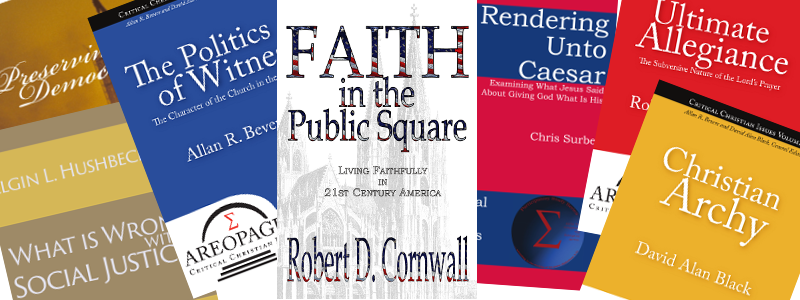
    I would add to that list The Politics of Witness by Allan R. Bevere, Ultimate Allegiance by Robert D. Cornwall, and Rendering unto Caesar by Chris Surber. Self interest is here no doubt evident. I publish them all!

  • Yes, Your Religious Group SHOULD Be Subject to Analysis and Criticism

    Yes, Your Religious Group SHOULD Be Subject to Analysis and Criticism

    no accountabilityand so should mine.

    There are quite a number of ideas that I believe are quite good when practiced voluntarily, and become dangerous and destructive when backed by force. For example, let’s take “political correctness.” Much of what is labelled political correctness is, in my opinion, simple courtesy. Notice the bold text. I think it is courtesy, and thus I follow it as a courtesy. I advocate courteous speech to others. When force is placed behind one person’s (or a group’s) idea of courtesy, so that others are forced to be courteous, all kinds of trouble breaks out. First, and more minor, is the simple problem that if courtesy is to be enforced, then we must have rules for just about every circumstance. The rules will multiply. But second, though more important, the rules of courtesy can prevent criticism. (This is an excellent argument against speech codes on university campuses, places where criticism should be the norm, not the exception.)

    I have commented on this many times with regard to individuals. A person should not become immune to criticism because he or she is too important or revered. In churches I see this with regard to pastors. Some will say “touch not the Lord’s anointed.” I say instead, “Check out the guy who claims God’s anointing very carefully.” In fact, if persons claiming God’s anointing try to exclude examination and accountability, I consider it a very good indication that there is something ungodly and unsavory going on.

    Now I would strongly advocate—advocate, not enforce—courtesy in the process of criticism, both because I think courtesy is a value in itself and because I think your critique is more likely to have an impact if it is presented in a sensible way without extra baggage. But an enforced barrier to examination, including an enforced level of courtesy, such as questions that cannot even be asked, is an opening for scoundrels.

    Freedom of speech is of great value in preventing errors and correcting problems. I advocate this not merely as a constitutional principal here in the United States, but on a personal basis. I would want any organization I support to favor free speech, and in this I include annoying and antagonistic speech, speech that I would call very discourteous. Whoever you are, whatever your position, however long you’ve held that place, I believe the world is better off if people can criticize you, even if some (or most) of those people do so unfairly, unjustly, and downright rudely.

    But what about religious groups? Isn’t it unfair to criticize other people’s cultures or their beliefs? Don’t they have a right to their own beliefs? If you criticize their culture, aren’t you engaging in cultural imperialism?

    First, of course, based on what I have already said I don’t believe it is right to ban even rude and unseemly speech. I don’t have to publish it (I am a publisher). I don’t have to read it or listen to it, but I would never ban it, even if it is totally unjustified. On the other hand, one way one discovers whether criticism was justified or not is by listening, evaluating, investigating, and then perhaps vigorously criticizing those who produced it. One way in which groups try to protect themselves from examination is by claiming that critiquing what they say somehow denies them free speech. I think this is a dangerous point of view. Critique is the proper response to ideas which I think are flawed. If you disagree, critique my ideas.

    But let me follow up with something from my own experience. You may remember the Branch Davidians. There was quite a mess back in the 90s. Now the Branch Davidians are an offshoot of an offshoot of Seventh-day Adventism. I used to be a Seventh-day Adventist, so I took note of events. People were trying to figure out whether the Davidians were actually SDAs. They were trying to figure out who SDAs were. They were looking at the doctrinal beliefs of the Branch Davidians to see why they were behaving as they did. In the storm, the few voices that said one shouldn’t criticize religious beliefs were drowned out, but they did come up.

    One of the problems I see with Christians in the United States is that very few have experience being a minority. While I would regard SDAs as simply another denomination of Christians with certain beliefs held in common with the broader community and others distinctive, SDAs are different enough from the majority that they tend to stand out as a minority. So there was some criticism that washed back from the Branch Davidians all the way back to the Seventh-day Adventist Church, a connection which had not really existed since the 1930s. When people who knew my background asked me, I would explain, but there was also a great deal of misinformation.

    But here’s the question: Was it valid to examine and critique the beliefs of the Branch Davidians? Absolutely! They carried certain beliefs to extremes that eventually resulted in death and destruction. It was not only valid, it was critical to examine these beliefs, both to see how they led to what had happened, and also to distinguish their beliefs from others. There are few ideas that cannot be taken to extremes by someone. There is the person who believes Jesus will return in glory at some point, but that we should live responsibly in the meantime, and then there is the person who believes that Jesus will soon return and that we therefore have no call to live responsibility. A bit further down that road, if it indeed is a connected road, there is the person who believes Jesus will return in two weeks, so he ought to sell all his stuff and stand out on a hill waiting for it to happen. The beliefs result in actions and it is perfectly valid to look at them.

    Look at this two ways: 1) The examination looks at the beliefs and how they connect to action; and 2) the examination illuminates the difference between various groups who might otherwise be considered the same.

    Probably most of the small number of readers who have followed me this far will connect what I’m saying with criticism of Islam and the use of terms such as “Islamic terrorism.” The use of labels needs its own discussion, and I’ve written about it in an earlier post on the Energion Discussion Network. Would you, for example, like to have the protests of Westboro Baptist Church be described as “Christian protests”? Yet that is a distinction we expect people, even non-Christians to make. Despite these people calling themselves Christians, others are supposed to figure out that they really aren’t—according to us. In fact, we expect people to distinguish them not only from Christian groups such as the Episcopal Church or United Church of Christ, which have a strongly inclusive position, we expect them to distinguish Westboro Baptist from Christians who believe homosexuality is sin, yet don’t accept their methods and the extremes. And I think it is good to make such distinctions. In fact, one element of my own definition of being a moderate is that one looks at the whole spectrum of ideas and one carefully distinguishes differences.

    But making these distinctions requires that I carefully examine, analyze, and even critique the positions of all of these groups. I’m criticizing their religious beliefs. And because those religious beliefs impact the world around them, it is a valid thing to do.

    I’ve heard religious beliefs compared to color preferences. People won’t criticize me for preferring the color blue, so they should criticize me for being a Christian. But my Christianity is not only different in intensity than my preference for the color blue (I also kind of like red, green, purple, and occasionally orange), it is also different in type. My color preference will cause me to paint walls some preferred color. Unless we’re co-owners of a building, or it’s a public building, this is unlikely to be a problem for you. My Christianity becomes the foundation for my actions, or I certainly hope it does. Thus you should be interested in my religious beliefs because they will influence my behavior, including my behavior toward you. You have a right to that concern.

    So from this perspective I look at issues regarding terrorism and Islam. I do not believe that we should treat Muslims as terrorists. I’m appalled at the suggestion that they should be registered or forbidden to build mosques in this country. But I come to this position by examining Islam, looking at information about Muslims as people, and knowing some Muslims personally. My problem with the term “Islamic terrorist” is similar to my problem with calling the Westboro Baptists Christian protestors. It is not a matter of numbers. No matter how large the group of people who are misbehaving in the name of a religion, it doesn’t make the good citizens who are members of that religion magically into bad citizens.

    It also doesn’t mean that we can’t take a look and see what is going on in that religion. But we need to do so accurately. I recently received a copy of a lawsuit in which one part alleged that Islam was a religion of violence. To make his case, the attorney cited many individual verses from the Qur’an. Interesting. He’s going to the source documents. But the fact is that Christianity and Judaism would both be very vulnerable to just that same approach. One could make a list of texts from the Bible, whether or not one includes the Christian New Testament, that would make our faiths seem to be quite horrible. Yet the vast majority of us, in either faith, do not behave in that fashion. So the critique that we make of a faith needs to be of the faith as it is understand and practiced by its adherents. That’s a little harder than prooftexting a holy book, but it is also more accurate.

    So here’s another example: Sweden’s Foreign Minister Has Criticized Saudi Arabia. I find it interesting that while she has criticized both Saudi Arabia and Israel, I found much more discussion of her criticism of Israel. What is the key to her criticism? The sentence of a Saudi blogger to 10 years in prison and 1000 lashes for something he said. In another case, a Sri Lankan woman awaits death by stoning there for adultery. The man involved was sentenced to 100 lashes. Those who condemn this sort of thing are told that they are criticizing an ancient culture and imposing their values.

    OK. I am. I believe both of those sentences are, in fact, barbaric. If your ancient cultural prejudices tell you that you can sentence someone to 1000 lashes for anything at all, or stone a woman to death for adultery, I’m quite willing to say it’s barbaric.

    There are some who will think I’m feeding into anti-Muslim prejudice. Things are bad enough with various terrorist attacks. But I think the proper response and the best response is to acknowledge and where proper condemn the actions of those who commit those actions while at the same time maintaining that those who do not commit such actions are not to share the blame. Moderate and liberal Muslims, however many there are of them, are not responsible for the actions of the Islamic State or of the Kingdom of Saudi Arabia. There are plenty of Muslims who disapprove of the actions of both. I’m right with them.

    I think the test of our sincerity—mostly of mine!—is whether I can also condemn those who look like me and claim to be like me when they also do barbaric things. And if we continue down the road of fear and anger in this country we’re going to have plenty of barbaric things to condemn.

    As current barbarism might I mention our incarceration rate (we’re #2, and China, which we consider repressive, is #130, while the “barbaric” Saudis are just #91. The Seychelles are #1 on this list)? And most of that is due to the drug war. Barbarism anyone? (This site says we’re #1.)




  • No Crime so Heinous

    No Crime so Heinous

    Fight against terrorism, Special Forces soldier, with assault rifle, police swat
    © Martin Šandera | Dreamstime Stock Photos

    There is no crime so heinous that we should punish someone who didn’t commit it.

    I’ve said this frequently about domestic crime. It seems obvious, but it is also something we forget when somebody has committed a crime and somebody has been accused of the crime. People who have no idea what the evidence is are instantly convinced that the somebody accused should be convicted and punished. Evidence doesn’t matter. But if somebody (actual criminal) and somebody (accused) are not the same person, all we’re doing is encouraging the commission of another crime (well, morally if not legally) when we ask that the accused be punished.

    I’ve noticed that the more heinous the crime, the less likely people are to give consideration to whether the person actually committed it. I hope that the officials charged with carrying out justice will be duly cautious and follow evidence, but elected officials are especially subject to following the baying of the uninformed crowd. And face it, in most of these criminal cases almost all of us are uninformed. It takes serious effort, effort that few of us are willing to expend, to develop an understanding of a case that merits attention.

    I take the same view of terrorism. There is no act so heinous that we ought to punish people other than the offender for committing it. I am fully in favor of vigorously going after those who committed the crime. I celebrate the success of the French police thus far and their recent raid. I’m even in support of going after ISIS bases, provided we can do so effectively and in a well-targeted fashion. I’m not fully convinced of the effectiveness of air raids under these circumstances, and I say that as a life-long advocate of air power and an Air Force veteran, but in principle it’s a good idea.

    But when we start to take out our anger at a heinous crime on people who did not commit it, that’s something very different. Times like this, when we feel that we are under attack, demand more, not less, patience and consideration. They demand more wisdom, not less. We should not permit our fear or our anger to make us less that we should be. And I fear we are doing so.

    This is not the plea of a pacifist. I deeply respect pacifists. True pacifism requires incredible courage. But I am not a pacifist. I would be quite willing to wield a weapon or aid in military action that was properly directed.

    But taking out the hate on Arabs generally, Muslims, or even Muslims in some defined area is not going after those who actually commit these crimes. (And yes, I prefer that we use a crime-fighting rather than a war-fighting metaphor.)

    More importantly, however, we should not take out our fear and our anger on those who are refugees from the very criminals we should be hunting. I consider it morally wrong.

    It is not our military people or our police that are disturbing me. They have a job to do. But they are directed by our politicians, and what I hear from them is dangerous.

    A friend of mine put a great comment on this on Facebook. You can read it here.

  • Nurses, The View, and Confused Values

    Nurses, The View, and Confused Values

    enrolled-scrub-nurse-200px
    From OpenClipart.org, artist bedpanner.

    I’m married to a nurse, my mother is a retired nurse, my sister is a nurse (NICU, which puts me in awe of her), and my daughter is in nursing school. It was unlikely I’d miss the discussion of Joy Behar’s comments and the resulting, entirely deserved firestorm, not to mention the failure of efforts to apologize.

    I’m going to say very little about nursing. It’s a job I would be totally incapable of doing. I wouldn’t want to. The work is too hard, the sacrifice is too great, the pay is too bad, and the treatment they receive often leaves something to be desired. We need them badly, but we don’t generally realize it.

    But the way in which one contestant for Miss America was treated is not some kind of accident. It is not just that someone misspoke or had a stupid moment. We can all have stupid moments when something comes out of our mouth that we didn’t really want to say. Many times, however, what comes out of our mouth at such moments reflects who we are and what we value more accurately than our carefully planned and nuanced statements.

    Let me get one thing out of the way. I don’t like our media. I don’t like our entertainment industry. There are remarkable few things produced by it that I will watch. So yes, I am very biased. If I didn’t say it now you’d guess from what I’m about to say. I think our media is shallow. I think our entertainment is designed for the raising of non-thinkers who don’t merely have bad values; rather, they have no real system of values at all, unless we count mental (and physical) laziness. Parents who leave your kids to be raised by your TV: That’s what you’re asking for and it’s what you’re likely to get.

    It isn’t that I’m extremely prudish. At least I don’t think so. I don’t even mind the portrayal of nudity and of sex in the media—where it is artistically appropriate. What I object to is the feeling that none of this matters. That sex, violence, indolence, irresponsibility, drunkenness, ignorance, and stupidity are so unimportant as to be routine. It’s not that sex before marriage is portrayed or implied in the shows. It is that it is assumed. You go on a date. You have sex. It doesn’t matter.

    But I don’t blame this mythical engine called “the media” for this problem. No! I blame us.

    One of the things I learned in economics that I’ve observed in real life is that prices are determined by supply and demand. There’s a corollary that supply will increase to meet demand. Even where governments have attempted to suppress the freedom of the economy, there is a limit on how much one can buck this one rule.

    Now get this: The media doesn’t want to. Why do we see what we do on television? Because that is what we watch. We may talk about higher values and a desire to see good, wholesome, edifying content (no, I don’t mean just religious), but what we actually watch is not what we claim to want. The folks in Hollywood and in the executive offices of TV and Cable networks know that. They’re going to provide what you actually watch, not what you like to pretend—in church and in blog posts that others will read—that you want to watch. Yes, I know, some of us don’t watch that sort of thing. Some of us do look for better fare. But that is not where our culture is right now, and that is the problem.

    I recall my hopes when I first got cable. I made sure the History Channel would be in my package. I planned to get all that interesting documentary material. And there are occasionally, very occasionally, things to watch. But most of it is not that helpful. My wife and I turned off cable some time ago. I admit we miss baseball, which is hard to get live, especially in the post season, but that and “A Capitol Fourth” are the only things I recall us saying we wished we had.

    But this isn’t really about TV or the media, though those tend to reflect our values as a society. There’s another reflection of our values, the amount we are willing to pay for things.

    I encounter this in working on computers. I’ll get called out to someone’s home or office to help them with their computer and they’ll complain to me about the lack of service provided by the manufacturer or retailer for their PC. But it often turns out that they have purchased the lowest cost discount PC from the largest discount organization possible. I don’t have a problem with that as such. But if you buy discount hardware from a discount retailer and then have trouble, it’s going to cost you. Just as we claim to want one sort of material in media but actually watch something different, we claim to want a certain level of service, but we give our money to businesses that don’t provide it. Guess what? Their prices are set with the intention of not providing that sort of service.

    It carries over to churches. It’s very interesting to compare a church’s claims regarding its mission and priorities and then look at the church budget. A mission oriented church will turn out to spend 1% or less of its budget on missions. Churches that claim their priority is to “reach the lost for Christ” spend more on their softball fields, cemeteries, or recreational facilities than on their claimed mission. And yes, I know that the softball field and recreational facilities can be a venue for missions. But are they? Really? Or was that just the excuse given to the church board to justify the money spent. I’ve known churches who were quite willing to spend money on the facilities and who claimed that those facilities were there so the church could better serve Jesus, but who then refused to spend the utility money to keep the building open for young people who weren’t church members.

    We may not want to talk about money, but money, in my view, is the surest way to tell what one’s values actually are. That goes for individuals as well as churches.

    And if you look at the numbers, we don’t really value nurses all that much. To some extent we value doctors, unless you bother to consider the student loans they’re busy paying off. (Some of those nurses have a stack of those too. Settle that against the amount they earn!)

    I don’t begrudge good money to sports figures and entertainers. A great baseball player is a percentage of a percentage of a percentage of an already fairly elite group. He works hard to get there, and he’s fun to watch. But the proportions of what we pay for stars? It’s not explained by all that effort or even by the numbers. Not unless you include our value system as a society. We’ll complain about Joy Behar and The View today, but tomorrow she’ll still be making more money than dozens of nurses combined, even with the way advertising is being pulled form the show.

    We’ll complain that the electrician, the construction worker, the checker at the nearest box store, or the receptionist in an office don’t do their jobs well enough, but do we treat them with respect? If they do their jobs well, do we say something? If we’re their employer, do we pay them as valued people? We need all those people along with the doctors, nurses, lab technicians, radiology techs, and so many others, but despite anything we say when we have an incident like this, many of us are going to say “Wow!” when we see the celebrity and “just another nurse” when we see the nurse. In our heads, I mean. Part of it’s the routine. We see more nurses than famous actors or actresses. We like to see people who have a gig that’s better than we expect. Sure. And that right there reflects our real values.

    So I think we should complain when someone says something stupid and demeaning about an entire profession. That’s good. Let’s have plenty of letters, stories, essays, and tributes about/to nurses. They deserve every bit of it.

    But let’s go a step further. Let’s reorder our values. Our children who are in football are not more important than those in music, or those in science programs, or those who are preparing to be excellent construction workers. We want those jobs done well. How about starting by reflecting in words and actions every day how much we value them?

  • Allan Bevere on the Left-Right Continuum

    Allan Bevere says that the left-right continuum doesn’t work. He’s citing someone else’s work first, but he’s applying the results to theology and ethics as well as politics.

    I use the term moderate to describe both my own politics and faith. This results from my view that there are many different issues with a continuum of possible views on each. As a moderate I neither assume that I must be at one end or the other of any continuum nor that I must accept a group of viewpoints. So in politics I lean toward the capitalist side on economics while on a number of social issues I lean toward what would be considered liberal. I’m not anti-war as such, but I approve of it only reluctantly under limited circumstances. I would probably be considered left of center on some social issues and right of center on others.

    I’ve written on this before: Being a Passionate Moderate and Moderate Thinking. The word “moderate” has many uses. I choose to continue to use it and then to define what I mean, which is “not bound to any extreme or group of extremes.” That means that I can take a position that is seen as extreme if I think it’s justified. It’s also why my voter registration is as an independent. I strongly object to the institutionalization of the two party system.

    In any case, read Allan’s post. It’s worth thinking about.


  • Against Torture

    I think it’s as simple as that. I’m against it.

    Energion author Bob Cornwall writes about it, and I agree.

    I saw one question that disturbed me, not in that I don’t know how to respond, but in what else it may suggest. The question is whether I’d support torture if an individual knew where a kidnapped loved one was held and wouldn’t reveal that location.

    Here’s my response. I’m a weak man who loves my family. It is quite likely that I would advocate all kinds of stupid and/or immoral things if a member of my family were kidnapped. That’s why we don’t have people under those circumstances making the rules. I might advocate this out of weakness, but in the end, I would not want to become the bad guy myself. As Christians, I would think we would understand this approach. I am happy that we have laws to direct how we behave in such situations so that the decision is not made in the emotion of the moment.

    I can make many utilitarian arguments against torture, but I think the moral argument supersedes all. This is not the type of people we want to be. It is sad that we have compromised ourselves so much for so little gain, but that is not the reason it’s wrong. That just makes a moral wrong more tragic.


  • Being Subject to the Authorities

    The Forum - from Rome.info
    The Forum – from Rome.info

    While I haven’t written anything on it myself, I’ve published quite a number of books regarding how Christians should relate to authority. These include Christian Archy and The Jesus Paradigm (David Alan Black), Ultimate Allegiance and Faith in the Public Square (Bob Cornwall), Rendering unto Caesar (Chris Surber), and Preserving Democracy (Elgin L. Hushbeck, Jr.). The last one isn’t primarily about the Christian’s relationship to authority, but it does deal with what the author believes are the legitimate functions of government, and ways in which the authorities can definitely be illegitimate.

    As I was reading from Luke 12 this morning, and realized that Jesus was speaking to people who were likely facing persecution, sometimes from those very authorities, I started to think a bit about why we tend always to start with the “rendering unto Caesar” passage, and much less from Romans 13:1-7, 1 Peter 2:13-17, or Acts 5:29. The first of those passages is quite frequently abused by those who believe that one must obey the government no matter what.

    I’m not going to write an extremely long post on this today. I just wanted to bring the subject up. The one line I appreciated most in the commentary I read on these passages came from The New Interpreter’s Study Bible, p. 2029, commenting on Romans 13:3-5.

    Governing authorities derive legitimacy and serve God by punishing bad and approving good—that is, by implementing justice. The just purposes of government evoke submission by the ascent of conscience (v. 5) rather than by fear of punishment. An unjust tyrrany, by implication, would not qualify as an authority instituted by God.…

    There are a couple of points in that passage that I believe are overstated, but I think the main point is correct. Paul here speaks of the government carrying out it’s legitimate functions, functions which the Roman government often did quite well. When, at other times, the authorities turned against the good, then one must obey God rather than human authority (Acts 5:29). A Christian would obey the legitimate authority even of an unjust government, where that is possible (often it is not), and would reject only the unjust actions. I think 1 Peter 2:13-17 implies this. Christians were to be model citizens wherever they could thus blunting accusations brought against them. When the state ordered them to do something they could not do in good conscience, then the authorities would be unable to say, “These people just ordinary lawbreakers.” Rather, they would only have the matter of conscience at hand.

    Having government ordained by God cuts both ways. First, it gives authority and order a divine imprint, and becoming simply a rebel or an anarchist is precluded short of a complete loss of legitimacy. Second, however, it places human government under the divine authority. Note that I don’t mean by this anything at all like theocracy. I do not think theocracy is desirable, nor is it called for in this passage. Rather, what this means in practice is that one’s conscience controls. It should make me subordinate to all legitimate authority and limit when I can stand against that authority to cases when I would be required to perform an act that was evil or unethical.

    The “government no matter what” spin that some have put on this passage tends to make Paul into somewhat of an idiot. Perhaps we need another rule of interpretation: If the way you interpret a passage makes the author look like an idiot, reconsider. Sometimes the God’s wisdom may look like foolishness to us, but so does actual foolishness.

    I know I’ve left a huge number of holes in this discussion, but I’ll leave those for later discussion. It’s a blog post, and sometimes I have to write one that is less than 1000 words!

  • The Potential Arrogance of Moderation

    Before you continue, look at the tag line for this blog. I self identify as a moderate, though I have a somewhat eccentric view of being moderate.

    My view of moderation doesn’t really solve the problem, however. As a moderate, I believe I should examine the whole spectrum of views on any issue before trying to select a particular view to advocate. There are two reasons for this: 1) There’s no guarantee where on the spectrum the best approach on any issue will be, and 2) If compromise is necessary, as it may well be in a variety of social or political situations, I know what the options are. I’m not a centrist, i.e. I don’t believe that I need to be toward the center on all or most issues. My actual beliefs, politically and doctrinally, may be on different sides of the spectrum on different issues. For example, I can (and do) believe both in drug legalization (for the most part), but at the same time believe in fairly vigorous law enforcement.

    But there is a potential for arrogance in this view as well. Let me just illustrate this personally. Every day I see a stream of social media posts from people in a variety of points on the political and religious spectrum. No day goes by without me sighing a bit at some people who seem over the top about one issue or another. It’s very easy for me to become arrogant and think, “Wow! I’m so much smarter than all those people who get so worked up about ______.” If I’m on one side of the spectrum or another, I get a double dose of feeling superior. I’m so unextreme! “Lord, I thank you that I am not as other people are, overwrought over so many extreme political or religious positions.” You should pardon the paraphrase.

    But a moderate position, or each position that falls within it, is an opinion on a topic as well. It is something that I prefer, something that I advocate. It may be that I am not passionate enough in my own advocacy of that position. It’s easy for moderates to sink into apathy and spend their day not advocating stuff. It’s also easy to decide that because others are so extreme, a lack of a position on an issue is a better.

    But people’s passion is not wrong, and a lack of a position is not a virtue. In many cases my decision to advocate on some issue or another is a strategic one. Where should I spend my time? What is my emphasis going to be? As a publisher, I place myself as an advocate of advocacy. I’m looking for passionate people to write books about the subjects that drive them. It should not be surprising that they are, in fact, passionate about the issues they write about. In fact, some of them are passionate about not being at the extremes, and that is also not a bad thing.

    One of the positions I’ve noticed (and participated in) is a desire to draw Christians back from being too invested in the politics of this world. I believe we should be involved, but always remember our commitment, our ultimate allegiance, is elsewhere. But even this can be a cause for arrogance. If I can take the election results more peacefully than my neighbor, that makes me so much better as a person, doesn’t it? Actually, I think not. I will suggest some moderation in tone, but you see, that is a position as well. I think reasoned advocacy and relationship building is the better approach to dealing with political and religious issues.

    Wow! Who’d a thunk it? I must be a moderate!

  • What About the Election?

    I’m both unsurprised and unconcerned. Why do I say that when I urged people to vote? I believe in participation. I believe in doing our best with the political system we have available to us. I don’t believe in getting worried about it. In addition, by following good polling data, and avoiding partisan inflation of the favorable (and deflation of unfavorable) results I was fairly certain of most results. While people complain about the accuracy of polling, there are less surprises than it seems. We just emphasize those cases where there was an upset. “Person Expected Wins Race” is a boring headline. “Upset in Election” is much more exciting and memorable.

    Does it make a difference? Yes it does. For example, the change in the composition of the senate no doubt alters the landscape for judicial appointments, potentially including ones for the supreme court over the next two years. I think there will be people who stayed home who would have liked a different reality. The question is whether they will recognize the source of the hardships encountered by their causes.

    Energion author Bob Cornwall responded in a post titled The Election is Over — God Still Reigns. Just so!

    We’re going to have a response from three more Energion authors. Click here for the event information on Google Hangouts. I expect a lively discussion considering the participants.

    In case you want to come back here to watch, I’m embedding the YouTube.