Threads from Henry's Web

Category: Politics

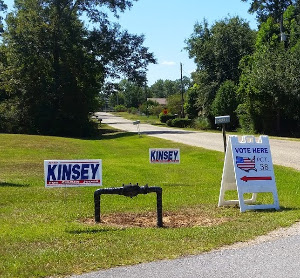
  • Please Vote in the Midterm Elections

    This is written to my American readers. Please go out and vote int he midterm elections tomorrow. I say this irrespective of your political views.

    There are a number of groups who are more likely to vote in presidential elections and then ignore the “less important” midterm and local elections. But that is not the way the system works. In casual discussions of politics we often tend to blame or applaud the current president for the things of which we disapprove or approve. Often, however, the president is not the one who is making the relevant policies. Many policies are made at the local level.

    For example, I will vote tomorrow to renew two different local sales tax options. Those impact my daily life because, combined, they raise my sales tax level from 6% (the state rate) to 7.5% (the rate in my county of residence). Voting in a presidential year won’t impact that result. Voting tomorrow will.

    There are many excuses for not voting in these less exciting elections. For example:

    1. My vote doesn’t really count. I already know who is going to win the congressional race (or any other example). Margins are important. Narrow margins make politicians listen more closely less their narrow margin disappear at the next election. If politicians know you, or the majority of some group you belong to, will stay away from the polls, they can ignore you. For example, young people are often cited as staying home from the polls, and more so in non-presidential year elections. Young people, your politicians can, will, and in fact do ignore you because they know they can get by with it.
    2. The direction is set from the top. It shouldn’t be. Change it!
    3. I’m too busy. Really? I don’t believe you. It doesn’t take that long. Remember that the lines are shorter in an off-year.
    4. There’s no difference between the candidates. This is generally quite false. I often find it hard to make a choice, though I manage it in the end. The reason is that it’s hard to balance agreements and disagreements. What happens when one candidate supports economic policies I prefer, but would vote for social policies I abhor and vice-versa. It’s not that the candidates are the same; that believe is usually the result of failing to actually study the candidates. Rather, it’s the result of the fact that none of us are likely to agree on everything. What’s more important? Don’t be lazy? Think about it and make a decision!

    I think that’s enough. If you have true convictions that you should not vote, make that decision. Be aware, however, that even that decision has an impact on the results. But don’t stay home because you just can’t get up the energy to contribute.

  • Separating Church from State

    I believe in the separation from church and state. I’m not talking about the principle derived from the First Amendment to the U. S. Constitution, though I do accept that as well, but rather about a Christian principle. I believe that the more we depend on the power of Caesar to accomplish our goals, the less likely we are to depend on the gospel and the more likely we are to become corrupted. Government power is corrupting, and I think the church should stay away from it.

    Again, I don’t think that church leaders should be excluded from politics, but they should be especially careful to separate their personal political actions from the corporate actions of the church. I, as a member, should be able to handle having a pastor who works for political goals with which I disagree, provided he does not make me a part of his goals without my consent, and provided he is not committing the church to his own views.

    As an aside, nearly every election we have some controversy over churches involved with politics. What are acceptable political activities? Is it an infringement of freedom of religion for the IRS to forbid pastors to do political advocacy from the pulpit? I’ll probably awaken more controversy with this than anything else, but this is why I am ambivalent about church tax exemption. Tax exemption has become a key element of religious liberty in this country. I grew up Seventh-day Adventist, and in every discussion of religion, a bedrock principle was that churches must be tax exempt. “The power to tax is the power to control” was the key phrase.

    But it turns out that the power to define may also be the power to control, and if the government can provide tax exemption to “churches” it must somehow define what is and is not a church. Interestingly, some Christians of my acquaintance think this is obvious. We all know what a church is. But when a more marginal religious group is looking for tax exemption, they may be defined out of it. So is religious freedom for everyone, or just for the people that we think are obviously eligible? Perhaps tax exemption isn’t such a good thing.

    Personally, I don’t want my church doing any of the things that would threaten its tax exempt status, so I have no particular problem. But the fact that certain pastors disagree, and out of their convictions, which I believe they should be free to hold, believe that their religious duty calls for their involvement in politics, what then? That’s when the definition of a church, and of the activities that go with being a church becomes important.

    What do I mean by keeping the church out of politics but keeping individual members involved? I do not mean that Christians should not be involved in politics, whatever their nation. We are citizens of God’s kingdom, but we live in one or another of the kingdoms of this world. Like Nebuchadnezzar, we need to learn that God rules these kingdoms (Daniel 4:17), but he also expects us to live morally within them. I believe that means exercising what personal power we have within them in accordance with our Christian principles.

    I was a bit disturbed at a recent event to be given a voter’s guide. It was given to me by a very nice person, but it told me very clearly how to vote, and the person who gave it to me implied that this was the “Christian” way to do it. I think that is unfortunate. Not that he should not have pursued his political goals. For that I applaud him, even though he and I will likely not be voting the same way on just about anything. No, my objection is to implying that a particular way to vote is the one and only Christian way to approach issues. I’ve encountered churches I might have joined, but have backed off when I found that a particular political posture was so thoroughly assumed that nobody would imagine a Christian could disagree.

    I think the church would be much better served by working to create disciples, and then trusting that those disciples would act in accordance with the principles that they have learned.

  • Voting in Local Elections

    Voting in Local Elections

    voting 082614I voted yesterday in the Florida primary. Despite being registered as independent (I oppose recognition of specific political parties by the government) I had one local election in which I was eligible to vote. So I did. I always do. I also like to actually go to a polling place on election day in order to cast my ballot.

    It was kind of humorous. I encountered seven poll workers and no other voters, even though it was approaching lunch time. The counter on the ballot reader said 51 people had voted in the precinct, and that they projected 94. I don’t know how accurate that projection is.

    This is an unfortunate situation in our democratic political system. (Yes, I know the difference between a “republic” and a “democracy,” a distinction that is overdrawn by many. This is a representative democracy.)  The major focus we have is on federal elections and especially on presidential elections. Then we complain about congress, or about local issues, without realizing that we are enabling incompetent government at the local level. So few people take part in the local elections and, unfortunately, even less seem to know much about them. In fact, information is hard to come by. The one election in which I was eligible to vote this time was for a circuit court judge, and it was, as usual, difficult to get reliable and useful information about the candidates.

    American who care about the things that are happening in this country need to get involved in local politics. Learn what’s going on. Vote intelligently for school board, city council, and county level offices. You have only influenced the future course of the country in a very limited way if you vote in the presidential election.


  • Is Killing Every One of Them Really Our Only Option?

    I saw a Facebook post that claims that in the light of the beheading of U. S. journalist James Foley our only option is to hunt down and kill every one of them as soon as possible.

    I think I’ve mentioned before that I’m not a pacifist. I believe acts of violence and even war can be justified. On the other hand, I think they rarely are. The question is whether we’ll really get the results we intend.

    I’m human. I’d like the people who did this to pay for it. I would have no problem condemning the perpetrators to death in a court of law.

    The question is whether another war is actually going to make anything better. Will it make less people die? Will it reduce the number of fanatics in the world? Will it mean that we won’t see another American beheaded in some other place at some other time?

    I hope we think about that.

    But more importantly, why did the killing of one American make this sort of violence our only option, but the killing of hundreds of Iraqis did not. Is there a difference in the value of these various lives?

    I pray that we, as Christians, will try to apply grace to this situation, to look on everyone, even those committing atrocities, as souls for whom Christ died. I hope as a nation that we will consider looking further forward in time and more broadly in space before we act to solve one problem by creating dozens of others.

    There may be a military option. The state bears a modern sword. Were I still in the military, I would be prepared to participate, to help wield it. But let’s look at the results of our previous military efforts before we move too quickly and ineffectively.

  • Our Emphasis in Responding to Issues in Society

    I burden my post with a somewhat long title, but it could be longer. The question is where do I put my focus when I respond to what is going on today. Now many readers are going to make assumptions as to what my beliefs are on the issues I use as examples, but I’m not talking about what our particular position on the issue is, but rather what is our first response.

    Dave Black wrote about this on his blog, and with his (blanket) permission, I’ve extracted this to The Jesus Paradigm site supporting his book by the same name, because Dave’s blog doesn’t allow linking to particular posts.

    Early on, he says (quoting an e-mail he wrote):

    I wonder why we in the church focus so much of our attention on gay marriage when it is so easy to overlook the sins that so easily beset us, such as gluttony and divorce….

    My observation is that often in the church when we decide to “call sin by its right name,” we really mean that we will call other people’s sins by their right names. I tell people there are clean sins and dirty sins. (What? Where did I get that in Scripture?) No, it’s not in Scripture, it’s in our practice. “Clean sins” are the ones I commit. “Dirty sins” are the ones you commit. Dave brings up gluttony. I’m overweight. That’s pretty good evidence that I have sinned. But it’s easier for me to go on a crusade about some other problem than to address that one, because as I address the sin of gluttony, I address myself, and that isn’t so comfortable. Now I’ve lost some weight, and I need to lose more, and contrary to all the various diet plans, what I really need to do in order to accomplish that is quit committing that particular sin.

    Now I said it’s easier for me to crusade against other sins. That’s true. Easier for me. But it’s not more effective. When people see you committing seven (or more) sins of your own regularly and then going after someone else’s problem, one with which you do not struggle, they are rarely impressed. It’s more effective to say, “Here’s what I need to overcome. Come along with me and let’s be overcomers together.”

    These days when we talk about “issues” people automatically assume the issue is same-sex marriage. I’ve had people assume I was saying things about that topic when I absolutely wasn’t thinking about it at all. So let’s use gluttony as an example. What should the church’s primary response be to the sin of gluttony? I think we can all agree that excess weight is not good for our health. It would be good if we maintained more healthy bodies.

    Should we make laws? Perhaps we should join the crusade by the former mayor of New York City to reduce the maximum size of soft drink that people can purchase. Perhaps we should change food packaging laws or make regulations about the fat and calorie content of various foods. No, I’m not talking here about the value of such laws. I’m not concerned with whether those moves would be good or bad for the country and for us. I’m asking what should our first response be as Christians.

    And that, I would suggest, must always be the gospel. “Just look at the sort of love that God has given us, letting us be called children of God. And we are” (1 John 3:1)! What is it that God will do for His children? What possible reason can we have, as Christians, for offering something else first? It’s so human to go straight for cleaning someone else up, thinking somehow that his sins are dirtier than ours, before we offer the gospel.

    But you say that there are so many people in our churches who have these problems. Well, I have a simple answer to that too. Offer them the gospel. No, not a theological lesson (though it is theology at its best), but membership in the family with the invitation to grow right there with it, to grow in a group of people who love you and realize they are also in the process of growing.

    I’m not saying not to think of political solutions. I believe in being involved. I’m at the polls for every vote for which I’m eligible. But as Christians, our solution to everything from drug addiction to an attitude of judgment toward others should be the good news about Jesus, not forced on others because we need to fix them, but offered to others so we can grow together.

    As Dave concludes:

    I believe it’s time to stop seeking God in the misguided and erroneous teachings of do-goodism, whether the source is liberalism or conservatism. Jesus Christ is the only answer to the malaise plaguing our families, our churches, and our society.

  • A Muslim Comment on the Mariam Yahya Ibrahim Ishag Case

    From time to time I hear the question regarding some act of terrorism, or by some act of a Muslim government: Where is the Muslim outrage?

    I first want to note that I find measuring online outrage to be a somewhat hopeless task. I am outraged at many things that I never manage to mention on my blog. My blogging has a great deal more to do with my current schedule than with my state of outrage.

    But I do want to call an article, Sudan Government Tells Young Christian Woman to Recant or Die, written by Harris Zafar. To quote, regarding her sentence:

    As a human of conscience, I see this as a clear violation of fundamental human rights. Moreover, as an Ahmadi Muslim, I find the actions of Sudan’s government incredibly disturbing. They claim not only to be administering Shariah Law that is allegedly a 100% Islamic constitution, but also that “it is not allowed at all for a Muslim to change his religion.”

    I found the entire article extremely interesting.

  • On Partisan Criticism and Excuses

    When President Obama was elected in 2008, I commented to Jody that I would now have to listen to over-the-top complaints from a completely different group of friends than I had over the previous eight years.

    I’m no apologist for George W. Bush. I just don’t think he was as bad as so many of his critics thought he was. Neither was he as good as his apologists tried to claim. I think you could say that about just about any politician.

    President Obama also has his critics and defenders, and I would say the same thing. He’s not nearly so bad as the critics claim, nor so good as his apologists would have us think.

    Now there will be plenty of shrill voices to tell me I’ve missed this or that scandal about either man. I make sure that my ears are not just picking up from any one direction, so I’m going to hear both sets. What will I hear? I will hear Democrats excusing behavior on the part of the current administration that would have had them apoplectic had the same behavior taken place in the previous administration. I will hear Republicans criticizing the current administration for things they would have excused under a Republican president.

    That’s why I move past these criticisms very quickly. It’s not that I think the behavior—in either case—is OK. It’s just that I always hear the other half of the argument, whether it’s explicit or not: And so you should vote for our party.

    But the problem is that “your party,” whichever party that happens to be, scares me. As much as I dislike the failure to agree to compromise legislation on things like the budget, I also am very much afraid of what would happen if either of the two parties we have now gets hold of the entire government. There just isn’t enough good sense to go around.

    So regardless of the screaming, I can tell you right now that I don’t know who I will vote for come the next election. That’s going to depend on who is nominated by each party. I’m going to go through the issues, the behavior, and yes, the associations of each candidate and make my decision. I’m also not going to be commenting publicly that much. Doing a good job of political commentary simply takes more time than I have, and apparently than most of you, or most of the paid commentators have. This piece is a good example. I should provide examples and references. I should tell you what I think would be “good sense” in government. But I’m not going to. I just don’t have the time to do this right.

    So this is more in the nature of a plea to self-examination. Try to recognize the weaknesses on your own side. You can actually vote for a candidate you consider flawed. I do it every election. If I were running, I would be that flawed candidate. There are no candidates without flaws.

    We should admit it, and make the best decisions we can.


  • Jesus Is Not on Your Side

    I’ve been watching the responses to Bill O’Reilly’s book Killing Jesus. Note that I said I was following the responses. I haven’t read the book and don’t intend to. I can’t stand listening to its author and I don’t feel any obligation to subject myself to reading his words. My attitude parallels Allan Bevere’s.

    I used to object to folks who would mention a book if they didn’t intend to read it. Now with the amount of reading material stacked on my desk, not to mention the amount I could stack there, I have to make choices. So this is a response to responses, not to the book.

    I truly enjoyed Christopher Skinner’s review. He’s very right to deplore the use of Jesus to pursue a right wing political agenda, or even a generally “American” political agenda. Our culture isn’t in line with Jesus, no matter how much we may talk about being a Christian nation.

    But now it’s time to annoy my liberal readers. Jesus doesn’t line up with liberal political views either. He lived in a world in which our political philosophies did not exist and would not have been functional. Being a businessman in Palestine of the 1st century wasn’t like being a businessman now. Nor was being a philanthropist. Or a teacher. Or an itinerant preacher.

    I don’t mean to say that we cannot look to Jesus and the principles he lived and taught to guide our political decisions. What I mean is that Jesus didn’t tell us just what to decide about how we put loving our brothers and sisters into practice outside the church. (He had a great deal to say about putting it into practice inside, though we ignore most of that.)

    Conservatives are criticized for trying to kill programs that benefit the poor. Liberals are criticized for being generous–with other people’s money (taxes). Conservatives believe that charity should be more private. Liberals believe that only the government can truly collect sufficient resources to deal with problems.

    Those are issues of political philosophy, and they are ones Jesus didn’t discuss. They just weren’t issues in his time. His audiences in Galilee weren’t going to be voting yes or no on ballots about how much to spend on education or support for poor children. Those simply weren’t options.

    There are many issues to discuss when we look at involvement by Christians in politics. I’m only focusing on one here. We tend to allege moral failure when we disagree with the means.

    For example, I might look at someone who opposes government paid health insurance, and decide that they don’t really care whether or not people get adequate health care. How can they oppose a program that will pay for adequate health care for poor people? I’m outraged! I believe they are sub-Christian, possibly sub-human! They want infants to die of preventable illnesses. They want mothers do die from inadequate pre-natal care. They want the elderly to die of cancer because they are unable to pay for the proper treatment.

    But if I take the time to talk to one of those people, I might find that they desire no such results. They may simply believe that the government will do poorly in distributing health care, that people will die because of the failures of government rather than the failures of private  providers. Whether they are right or wrong, they care just as much.

    And the accusations can be reversed. The failure, wherever it may be, is in being so certain that one’s method is correct, that one cannot imagine disagreement except through moral failure. My approach to solving the problems of health care provision and distribution are so right that the only way one can disagree is to be morally degenerate.

    And one can find morally degenerate people. I was behind a man in the Walmart shopping line who was using WIC to get food. It turned out it was for his grandchildren. He spent his time speaking ill of his son-in-law, a useless bum according to him, and his daughter, who lacked to good sense to say “no” to the proposal of marriage and then proceeded to produce children who would have to be on WIC. Aside from the stereotype that it’s bums who get WIC, His attitude (and his willingness to inform the line, stunk. And I do consider the possibility that he was so embarrassed to be using WIC that he had to find an excuse, but I still think that’s a stinky attitude.

    But there are people who might oppose the program who would be ready to pull money from their own pockets to pay for food for someone in need. It’s not their motivations that liberals should question. It’s the method.

    Jesus didn’t tell us what methods would work in our various modern societies. He left that to us to figure out. We’ll do it much better if we quit assigning either Christian or anti-Christian attitudes to the methods people believe will (or will not) work.

  • Syria: To Intervene or Not

    Religion News Service provides us with some comments by the experts on the ethics of intervening in Syria (HT: UM-Insight). Now I am neither a theologian nor an ethicist, so I wouldn’t claim to be able to parse all the issues in deciding whether an intervention is just.

    In fact, I find many of the comments by the experts substantially less than helpful. The final comments by Robert Parham of EthicsDaily.com.

    But even so my questions are simpler:

    1) Is it justified? Violence is so easy to justify based on someone else’s actions. In this case, innocent people have been killed. I don’t believe in initiating force, but I do believe one can use force to defend oneself or others. (Christians should consider deeply whether such action is justified on their own behalf or with the blessing of the church.)

    2) Will it be effective? In other words, will the situation that results be better than the situation in which one intervened? This is where I think that most attempts to justify violence fail. “He started it!” is a good playground excuse, even justification, for violence, but how often is the resulting situation actually better?

    I think it is on #2 that the Syrian mission fails. We may be able to make a point, but will Syria be a better place when we’re done? I simply don’t see how we can make Syria a better place through this action. We can justify it on the basis of saving innocent lives, presumably in the future, but what basis is there to believe that less people will be killed because we intervened?

    As an American, I will add one more question: Is it legal? President Obama is seeking the permission of congress though he has claimed, incorrectly in my view, that he doesn’t require that permission.  I think he does require such permission, but presidents have been eroding the war powers of congress, and congress has failed to defend their legal prerogatives. Are such legal issues important? I think they are. They allow us, as a nation, to take responsibility and make decisions. They limit the powers of the executive to make these unilateral decisions without adequate discussion. Now if congress will just ask, and duly consider, the ethical issues involved.

    I served in the United States Air Force. There were times when my government chose to go to war when I didn’t think there was justification. I expressed that view at the ballot box, and as an airman carried out my duties. I think the legal justification and procedure is extremely important. Our servicemen and women don’t (and in my view shouldn’t) make an ethical choice each time their government sends them into action. Those of us who are not in that position owe it to them to give thorough consideration to how justified and effective their actions will be before we risk their lives.

    In this case, I think there is good justification for action under my first question. I don’t think it’s possible for this intervention to actually be effective, i.e. to make the situation better. When I weigh my votes in the next election, I will count support for this action by my elected officials as a black mark against them.

    Note that I don’t think I’m expressing the Christian view. One can justifiably disagree, for example, if one simply thinks this can actually bring an end to the suffering. In the meantime, the church should be in the business of reconciliation, which I can support any time.

  • Robert Reich on Immigration

    Robert Reich exposes some myths about immigration. I’d have a couple of quibbles (I wish “myth” weren’t used in this way, for one thing), but they wouldn’t change the overall result. This is why I don’t worry about immigration. In fact, our paranoia about immigration costs more than immigration, in my view. I favor treating aliens as “the citizen among you …” (Leviticus 19:34). And yes, I’m aware of the hermeneutical issues with using that verse, but I choose to borrow the phrase nonetheless.