Threads from Henry's Web

Category: Christianity

  • The Danger in Appealing to the Miraculous

    The Danger in Appealing to the Miraculous

    A friend’s post on Facebook got me thinking about this verse:

    I said to them, “If anyone has items made of gold, bring them. And they gave them to me, and I threw them in the fire, and out came this calf.”

    (Exodus 32:24, my translation from the LXX)

    I can’t help but think that Aaron is hoping that a claim of miraculous activity will somehow justify his action. Moses wasn’t buying it, as his actions show.

    We laugh, but how often to we make Aaron’s appeal?

    Appeal to Blessings and Curses

    In fact, I think we do this from both directions. If someone is blessed, we often say they must be following God’s will because look at all the blessings! On the other hand, if someone is suffering hardship, we say, “They must be doing God’s work, otherwise the devil wouldn’t be after them that way!”

    Depending on how we feel about the people, we might just reverse those things. “Look at how their worldly behavior is resulting in increased worldly good! Must not be very spiritual with all that money!” Or, “If you were truly doing God’s will, you wouldn’t be having all those hardships.”

    The Bible story presents many examples that stand in opposition, no matter which of these options you take. In preparing for my Sunday School lesson tomorrow, I read Isaiah 53, which is one of background passages:

    He was despised, rejected by humanity,
    Beaten, experiencing disease.
    We turned and looked away from him,
    We despised him and accounted him nothing.

    Isaiah 53:3 (my translation)

    Whether you apply this to Israel as God’s servant, or to the remnant of exiled Israel whom God would restore, or to Jesus as the suffering servant, it still refers to someone who is suffering, even though they are in the process of carrying out God’s plan.

    In Philippians (chapter 2 was the reading, but I refer back to chapter 1 as well), we find Paul in prison. He is suffering. There are those who proclaim the gospel in a way intended to give him pain. It’s possible these were people who thought their view and presentation of the gospel was superior to Paul’s, and were using his suffering as a basis for asserting that superiority. Surely God would free Paul if his teaching was so good!

    Yet in the key reading for today’s lesson, we have the note that Jesus did not consider equality with God something to be grasped or hung onto (Philippians 2:6), yet clearly it is not Paul’s intent to suggest Jesus, in giving up everything, was not following God’s plan.

    The Case of Prophecy

    In discussing prophecy, many make frequent reference to Deuteronomy 18:21-22. If a prophet makes a prediction and that word does not come true, God has not spoken. This test of a prophet is both simple and deadly.

    Consider Jonah. He made a prediction, and that prediction did not come true. He was really annoyed, because he wanted Nineveh destroyed. I’m sure he was also annoyed, because now he was a false prophet.

    Turn that around and think of the Ninevites. Suppose they have their version of Deuteronomy 18:21-22. They say, “Well, if he’s a true prophet, the city will be destroyed in 40 days and we can be certain.”

    I call this the “dead test” for a prophet, because by the time you’ve completed your test and made a determination, you’re likely dead. Not an optimum strategy, I would say. Of course, if you’re not dead, find that prophet and a pile of rocks.

    Too bad for Jonah.

    Another Example: 1 Kings 22

    In 1 Kings 22 we have a lovely story in which Jehoshaphat of Judah, by all accounts a good king, is visiting the king of Israel. While there, they get the idea to go to war. Jehoshaphat, good king that he was, wanted to consult the LORD. The king of Israel gets 400 prophets who tell the two kings to do what they want to do.

    Jehoshaphat is not satisfied and looks for one more prophet. Micaiah is brought in, and he prophesies something quite different. The day isn’t going to go well. (You can get out your Bible and read the details.)

    So if you’re one of the two kings, how do you make a decision? If Micaiah is prophesying falsely, you can ignore him, but by the time you know that, you will also have lost the battle. Not so helpful!

    The Other Test

    Deuteronomy has another test, however, and it’s an important one.

    If prophets or those who divine by dreams appear among you and promise you omens or portents, and the omens or the portents declared by them take place, and they say, “Let us follow other gods” (whom you have not known) “and let us serve them,” you must not heed the words of those prophets or those who divine by dreams; for the LORD your God is testing you, to know whether you indeed love the LORD your God with all your heart and soul. The LORD your God you shall follow, him alone you shall fear, his commandments you shall keep, his voice you shall obey, him you shall serve, and to him you shall hold fast. But those prophets or those who divine by dreams shall be put to death for having spoken treason against the LORD your God—who brought you out of the land of Egypt and redeemed you from the house of slavery—to turn you from the way in which the LORD your God commanded you to walk. So you shall purge the evil from your midst.

    Deuteronomy 13:1-5 (NRSV)

    In this case your test is one that can be done immediately. Is this person telling us to worship other gods? I wonder if that was not the reason Jehoshaphat doubted the word of the 400 prophets. Unfortunately, even though he was wise enough to ask for one more prophet, he was apparently unwilling to go with the advice of the prophet he requested.

    The Case of Gifts

    I’ve seen this used in connection with spiritual gifts. People look for a manifestation of miraculous gifts, sometimes a specific gift, or one off of a list Paul provides. But Paul is never intending to provide exhaustive lists of the spiritual gifts. That’s why his lists don’t match. He’s just giving us examples. In each case, he’s providing a different test, not one that appeals to miraculous (or at least obviously miraculous) activity.

    In 1 Corinthians 12, we are given a view of the real test in verses 4-7, as the example list is introduced. There are varieties of gifts, but one Spirit, one Lord, one God. It is by looking at the One in whose service the gifts are used that we can discern their nature.

    No Simple Answer

    Scripture doesn’t provide us with a single, simple answer. It leaves us with the task of discernment. Are your troubles due to the devil trying to stop your carrying out of God’s work, or are they God closing doors? Is your wealth God’s blessing in response to your following God’s will, or is it the devil rewarding a servant?

    You find this out through prayer, thinking, discernment, study, and good counsel. The result may be miraculous!

    (Theme image credit: Openclipart.org.)

  • Is Your Worship a Joy

    Is Your Worship a Joy

    As I’ve been setting up a series of posts on thinking about God, I’ve discussed a little bit what our theology can do, and what it cannot. For example, in a video yesterday, I talked about how our theological knowledge cannot save us.

    Yet at the same time it can mess us up. I was told that Stanley Hauerwas started a class on liturgy by saying: “Lousy liturgy makes lousy Christians.” I’m not sure he was right on it, and of course that’s second hand, but I do think our liturgy may well say something about how we think about God.

    I was reading one of my own articles from several years ago, titled Dance Floor Worship. Here’s a line:

    Our problem, I believe, is that we want to make sacred things, while God wants us to make things sacred.

    I’d like to suggest reading my entire essay. It’s from a number of years ago, and I hope my thinking has grown, but I think I was pointing to a few things that can be important for us.

    I’m going to embed my advertising video for S. J. Hill’s book. The reason I’m doing so is that I think I have illustrated here some of the problems in what we think about God and how that will impact our actions and our worship.

    If you believe God is about to hammer you because you’re not so wonderful, then you may well either be afraid to be in God’s presence. If, on the other hand, you are aware of God’s grace and God’s gifts, you may be aware that even though you are a minute speck in this universe, the God of the universe cares about you.

    How can you join the chorus? When you believe that the God whose power is displayed throughout the universe is also one who cares about you.

  • Symbols, Actions, and Idolatry

    Symbols, Actions, and Idolatry

    I encountered a question recently that I’d like to explore a bit. The question comes in three parts, or perhaps with three perspectives.

    • When God commanded the Israelites to look to the bronze serpent to be healed, was God commanding idolatry?
    • Why would God give this command?
    • Was this a good command?

    It’s easy to dismiss the question by simply saying that it is God’s command, therefore good, and further cannot be a command to sin. But if we consider that, as Paul says, “these things are examples for us” (1 Corinthians 10:6), perhaps we might want to explore just why God would command such a thing.

    Idolatry

    Let me first note that idolatry is rather easy to fall into. We are very much idol-making people. I often use Paul Tillich’s vocabulary in this, that idolatry is making something that is not ultimate your ultimate concern. We can take a book, such as the Bible, from which we get God’s Word, and make the book, the thing, into the object of worship.

    An example of this would be using the Bible as a sort of magical talisman. I have seen people who expect the possession and use of the physical book to accomplish miracles. Not so! The power of scripture is in revealing God who is the one who takes action. It is not minimizing or dismissing the book to realize that it is what conveys to us God’s will rather than being magical or an object of worship.

    An unopened Bible sitting on the shelf in your home in a prominent place might well become your idol. You believe you are closer to God because of the object. A picture of Jesus might function in a similar way. It displays to others your faith. The question is, are you in Christ and Christ in you? That same picture on the wall might either be a reminder or it might be an idol.

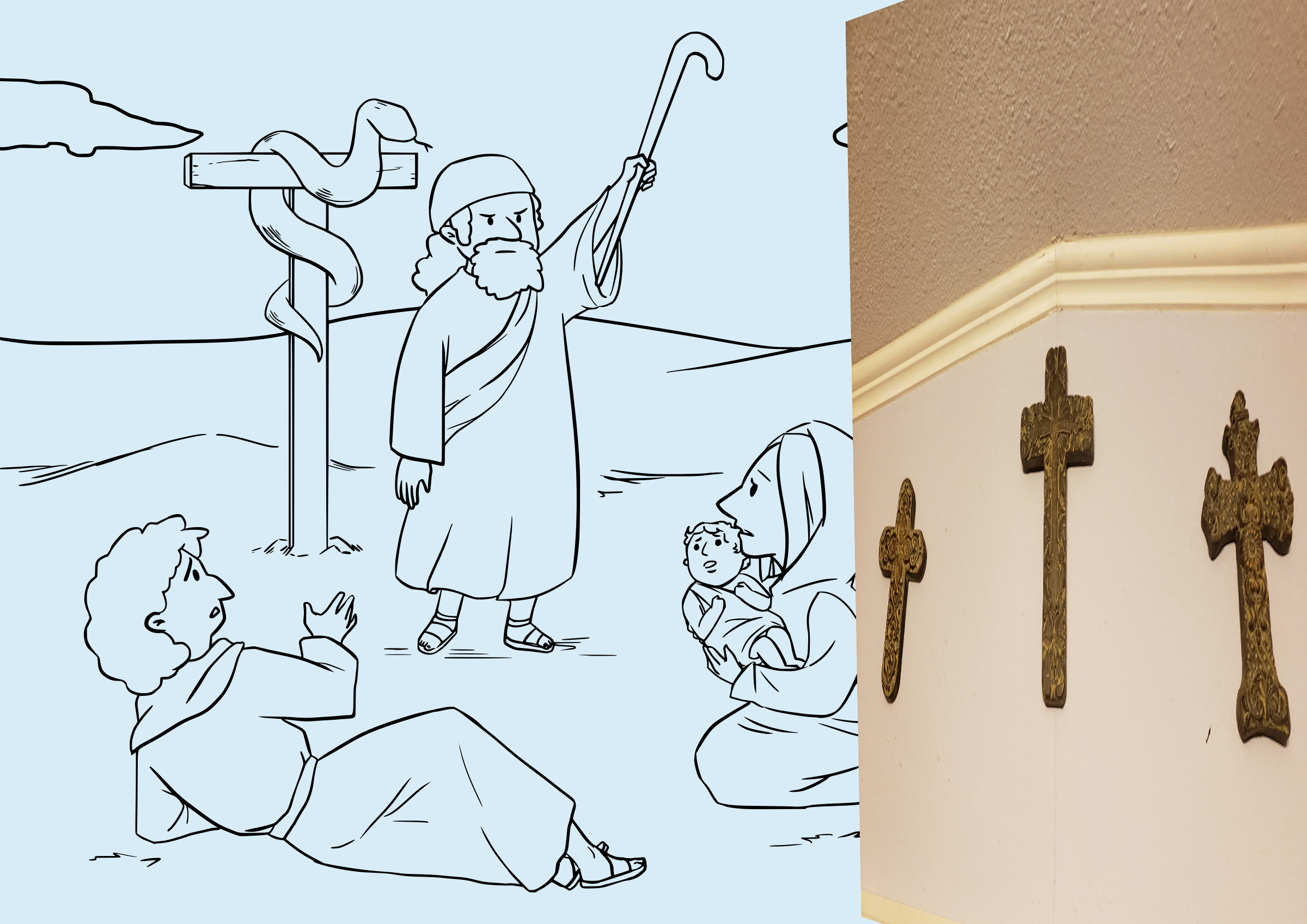
    I have three crosses over the door to my office. If I treat them as an object of worship, and forget what they symbolize, they could easily become an idol.

    Some Objects and Commands

    The ark of the covenant became a problem in this very way in scripture. It was commanded by God and built according to God’s instructions. It was supposed to be there in the temple. There was some critical symbolism involved in that under those cherubim, where there would have been an image of a god in a temple of another religion, there was empty space. Empty, at least, to human sight.

    This was part of the ritual of Israel’s worship. It played a key role. But when the sons of Eli decided to take it from the tabernacle and to war, something else happened. Idolatry broke out! In 1 Samuel 4 we have the story, as Israel gives this triumphant shout, the Philistines hear it and decide that the gods have come into the camp of Israel.

    Israel’s actions were idolatrous. They thought that God was confined to the thing. Now the thing was good. It was commanded by God, but it was being used in a way that was inappropriate. Idolatry is dangerous, because it disconnects us from God and connects us to, and limits us by, our own power.

    As a public event, this idolatry also provided a false witness to the Philistines, who believed that God was again limited to the object.

    So the question becomes, why did God want the ark built if it could be so misused?

    In this case, we have considerable evidence to suggest why this should be. The ark provided an important symbol in Israel’s worship, and even an antidote to idolatry in what it symbolized.

    At the same time we see one of the key sources of idolatry: We really like to have something to take hold of, something we can see, and a course of action that will let us take control. When Eli’s sons took the ark, they were trying to force God’s hand. If God wouldn’t save them from a distance, they’d bring God to where God could do what they wanted done.

    We combine that with liking to repeat the action. If it works once, let’s do it again.

    The Command to Worship

    We have many rituals commanded in the Hebrew scriptures, yet the prophets tend to downplay these to some extent. I think a good place to look at this is Psalm 51. Here we have a prayer of repentance, which says that God doesn’t want sacrifice (v. 16), but then says that burnt offerings will be acceptable (v. 19). What’s the difference? Repentance!

    The point of the sacrifice is a ritual that works with, reminds us of, and reinforces the actions that we need to take. It is a good ritual in that sense. But if we replace repentance with a ritual of repentance, the action itself becomes idolatry. It suggests that some action I take can box God in. “Oh well,” it says to God, “I may have sinned, but I offered a sacrifice so now you’re stuck with forgiving me.”

    We have an idolatry of action, by placing the action in place of God. Only God forgives. Leviticus and Numbers are worded carefully to not suggest that forgiveness is accomplished by the sacrifice. Rather, forgiveness comes from God. The sacrifice is God’s command, and becomes a means of bringing us to repentance and keeping us there.

    So here’s another command of God that can be abused, and in much the same way as the ark of the covenant was abused by Eli’s sons.

    A Means of Healing

    When Naaman comes to Elisha for healing he’s told to dip himself in the Jordan river seven times (2 Kings 5). Is there something particularly efficacious about the water of the Jordan river? Not at all! This is something God is commanding Naaman to do. The action doesn’t heal. God heals. God asks for that act of obedience before God heals.

    Now we could make a cult out of Jordan river water, saying that it has special healing powers. Come to think of it, we do make quite a thing out of Jordan river water, being baptized in it, bringing back bottles of it from trips to Israel.

    Now don’t get me wrong. Enjoying an experience isn’t idolatry. But if you for one moment think that being baptized in the Jordan river is better than being baptized elsewhere, that the water of that particular river has more power to cleanse from sin, you have fallen into idolatry.

    The Idolatry of Places

    When Jesus is transfigured, Peter wants to set up camp. It’s a sacred place. It’s a natural response (Matthew 17, see especially verse 4 for Peter’s response).

    That response was also natural in both Jews and Samaritans. It’s better to worship on Mt. Gerizim. It’s better to worship in Jerusalem. All of which depends on what God has commanded. It is not the place that does it, though a place can help us. I like to pray in the church sanctuary. Is this idolatry? Only if I believe that it’s the only place God can reach me.

    Jesus said that those who worship God will worship in spirit and truth, and not based on place (John 4:23).

    Again, it’s easy to see how the command works. Gathering in a place is part of the human process of building community, so God commands a place. Making the place more sacred than God is our desire to bring things under our own control. A good command becomes an idolatry of the particular place.

    About that Snake!

    In the case of the snake on a pole (Numbers 21:4-9). Here we have a simple command of God that the Israelites are to look to the serpent and they will be healed.

    Before I go to our three related questions, let’s look at two other scriptural points of reference. The first is 2 Kings 18:4. Hezekiah is reforming the land and destroying idols. He destroys the very serpent referenced in Numbers 21:4-9 at the time. Why? Because people were burning incense to the serpent and had even named it. This is idolatry. What God had once commanded and used for God has been turned to another purpose.

    This is one of the best illustrations of the process of idolatry. We find something good, something that God commands or approves, and there are good results. Instead of realizing that it is God’s power in action, we make that set of actions, circumstances, things, or the very location the means of our receiving good. We are then worshiping the creature, rather than the creator (Romans 1:25).

    In this case we have another scriptural reference point:

    Just as Moses lifted up the snake in the desert, so must the Son of Man be lifted up, so that everyone who believes in him can have eternal life.

    John 3:14-15 (my translation)

    Here we have a symbol by analogy, so again the serpent, destroyed by Hezekiah, serves God’s purpose. Never underestimate God’s power to redeem, whether that redemption is of a symbol or of a person!

    A key here, as back in Numbers, is that the person looks up to the serpent but is healed by God, and there’s a fulfillment in a person looking up to Jesus and seeing God. The lesser symbol points to the greater/greatest.

    The Questions

    Is God commanding idolatry? No. God’s command is to look at, not to worship the snake. The healing comes from God. Idolatry would be to assume that the snake healed. But the text doesn’t say that.

    Why does God command people to look at the snake? This one is harder. I don’t really know. By analogy, I assume it has something to do with teaching them other lessons. I can also look forward to the lifting up of Jesus. But how this act connected for the people I don’t know. I understand, however, that making a place of worship, providing an ark, and providing sacrifices each had an impact on the people, and I assume this did as well.

    Was it a good command? God’s word doesn’t return empty. Just because I don’t know the reasoning, which is lost in history, doesn’t mean that God doesn’t know. My guess is that Moses and the people understood this in a way I can’t, that it made sense in the situation. I have heard numerous explanations, and I can’t claim any one as definite. The fact that someone turned it into idolatry down the road doesn’t indicate that the command itself was bad. We are idol making machines. We make idols.

    Was This a Good Question?

    Perhaps I could word that differently. Should we ask this kind of question of God’s actions? Should we not just assume that God’s command is good?

    I would suggest that this is an excellent question. If you don’t ask this kind of question of a story in scripture, you can’t really learn from it. Simply appending a moral that says, “God said it, so it’s good,” doesn’t involve much learning.

    There are commands in scripture that are much more troubling, I think, and we need to be prepared to examine and see what we can learn.


  • Knowing About God or Knowing God

    Knowing About God or Knowing God

    In the dim reaches of time (no, no dinosaurs, not that long ago) I was attending college, and right during registration for my second year, I heard the call of God to study biblical languages. The call is another story, but whether it was God or not, the idea of studying the languages fit with my personality and preconceptions.

    The most important thing was to get “it” right, and “it” was whatever God had revealed. For me, this meant the Bible, and so what I needed was to go back to the original texts, a task I thought possible in those days. I also hoped to be independent, not looking to any human being to tell me what God had said, but rather to have discovered this for myself. I also thought this was an attainable goal.

    More fool me.

    Avoiding Theology

    In pursuit of this goal, I wanted to avoid the study of theology, because theology was separated from the Bible. Why study theologians when I could study the actual source? Why discuss theological ideas unless they were very directly rooted in the biblical text?

    This attitude was based on my belief that God had provided a complete and final set of facts in the Bible, and that if I got these right, I would also be right with God. I had a certain amount of perfectionism in my make-up. I’d gone to a Christian school where papers were to be completed perfectly before a student went on. I’d memorized scripture there and then had to write it perfectly, including punctuation. That exercise complete, I had to record it, again perfectly.

    I do not remember these things as chores. To me they seemed quite the proper way of going about one’s learning. Wrong wasn’t really an option. I was doubtless wrong many times, but I never believed I was wrong, so no problem!

    Theologians, because they were arguing from theological premise to new conclusion, were certainly on the wrong track, because they would certainly never attain certainty. You needed to be absolutely right about God.

    Certainty Evaporates in the Face of an Uncertain Text

    I got pretty good with biblical languages, but I also had the bad taste to study textual criticism, and in that I discovered several things. First, I would never to absolutely certain of the biblical text. My textual criticism teacher made sure I understood that by having me create my own critical text based on the manuscript images available to me. Using a limited set of resources (this was before the internet and folks like CSNTM), I was unable to produce an absolutely certain text of half a dozen verses. Not even my determination was able to convince me that my goal of independently getting to the very root of scripture was attainable.

    As I studied further into biblical criticism, I also found that even the idea of the original text was fraught with difficulties. Jeremiah comes in two versions. Daniel and Esther have additions. What would constitute the original text?

    A Question of Goals

    There are those who assume I left the church for a period of nearly 12 years because of these issues regarding the Bible. Many assume I went to a liberal seminary and was led astray. Neither of those things is true. I had plenty of teachers who tried to get me to get to know God, and most of my professors were quite conservative by any standard.

    What happened to me was a failure to connect the data points I had about God with a knowledge of and experience of God. I knew a great deal about God. I knew God not at all. My worship life withered away in graduate school.

    People told me what was going on. Lucille Knapp, who taught me Greek, would comment regularly about the literary beauty of passages. For graduation, she gave me a book of religious verse with a pointed suggestion that not everything was to be found in digging through the Greek. Alden Thompson, my advisor, regularly pointed to issues of devotion, of connecting to God and not just to stuff about God. In graduate school, my advisor Leona Running similarly pointed me to other things, while at the same time helping to satisfy my thirst for research about the data.

    With the data in hand, I left the church. All churches.

    In a post some months ago, Wanting to Be Right Theologically, I noted this pursuit of righteousness by correct theology. If we just get our beliefs right, we’ll be OK. But as important as our theology can be, this is just as much, or more of a burden than aiming work our way into favor with God. It doesn’t work.

    Theology is important, but it’s importance is in the way it can help us relate to God, most importantly in realizing that letting God into our lives isn’t the end, but a new beginning.

    Ramblings for the Coming Year

    This is going to be my topic for a number of posts in the coming year.

    I got started on making it a topic through working on the book by S. J. Hill, What’s God Really Like?: Unique Insights into His Fascinating Personality. As Stephen R. Crosby says in his endorsement of the book, “A robust theology of beauty is, and has been, conspicuously absent in much of western theology.”

    Even when we get things technically right, when we realize that God’s grace is sufficient, we can end up with a dry faith, a boring faith, a rather sad faith. We can find ourselves saved by, and living by, the data. We can have a relationship with our theological beliefs, and not with the one we believe in.

    I’m going to follow S. J. Hill’s book through, but I’m going to use many other books, primarily ones that I publish (I am a publisher, and this is what I do!), but also others. I can think off-hand of a range of books from my list, including most of our devotional category, that have helped to drive me in the direction of really enjoying God and seeing God as having a personality, and not just an entry in a theological dictionary. I’ll mention many of these books, but I’ll also be writing about my own experience and thinking and looking at the scriptures.

    Join me in thinking about these things, and hopefully in experiencing a God of beauty.

    I will be keeping books on a resource page here.

  • What Do I Do About Grace?

    What Do I Do About Grace?

    This question has come up a number of times in my Romans study group, and it’s a good one. I’m not one to call all questions good. In fact, I think if you ask the wrong question, you often end up with an answer that leads you astray.

    In this case, however, we’ve gone from Romans 1 through 11, and we’ve been learning about God’s faithfulness and God’s grace. One class member commented that the answer to any question I ever asked should be “God’s grace is sufficient.” That’s not a bad answer. Sometimes, however, we need to go a bit further.

    Paul’s going to do just that starting with Romans 12. Now some people write, teach, and preach as though Paul talks about theology and then makes a break with his theology in order to talk about action or ethics. I disagree. Paul makes clear in Romans 12 that he is building on what he has said before, and what he says is very well founded. We should read his “therefore” in 12:1 as tying this together.

    Because God is faithful, because God has given us his grace, here is the result.

    Using the Word “Law”

    One of the critical elements in understanding Romans, which leads up to this point, is Paul’s usage of the word “law.” When I was in my late teens a person I respected greatly told me that the big mistake in reading Romans and Galatians was misunderstanding “law.” This person told me to understand it as “Torah,” i.e., the practice of Judaism. The issue of the law here was one of whether gentiles needed first to be Jews.

    This is doubtless one of Paul’s points, but it is far from Paul’s whole point. That definition works better in much of Galatians, where requiring gentiles to practice Judaism, with the entry point of circumcision, is much more central. In Romans, Paul uses “law” in some different senses.

    Our tendency here is to try to find out which one sense Paul is using and then apply it throughout, but this may not be the best approach. “Law” can have quite a sizable semantic range, including God’s divine law and purpose for all time, specific bodies of law, such as the Torah as a whole, or the instructions to Noah, or even specific commands. English usage of Law doesn’t quite extend to a body of broad instruction, but that is part of the range of Paul’s usage.

    A Diagram

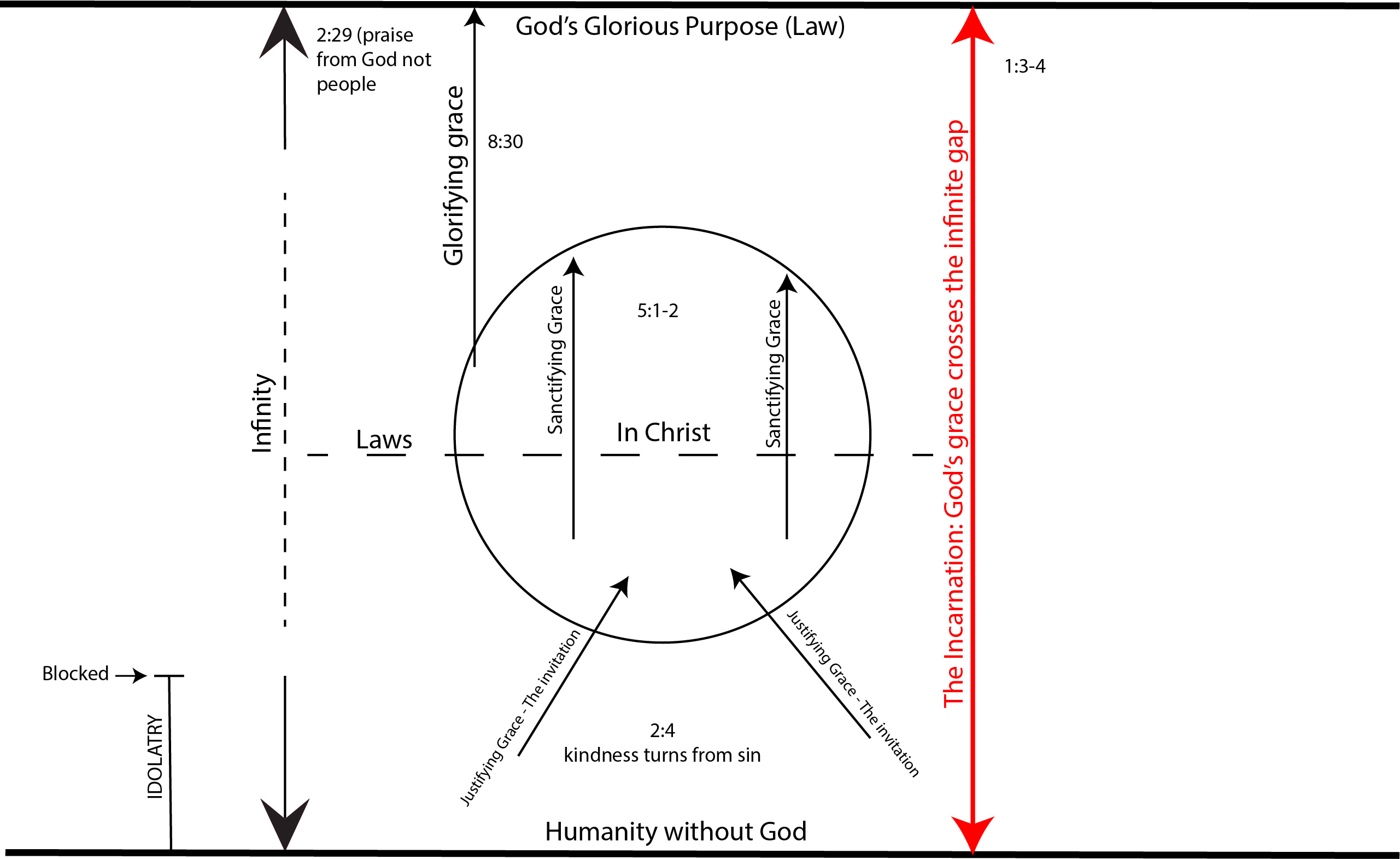
    Here’s a diagram I provided to my class. I’m going to write a few notes about it. Obviously, this is abbreviated. We have spent months getting to this point with my Romans class.

    I started to put all the notes and the text on the diagram, but that proved a bit too complex and confusing. So herewith a few notes.

    God has made no plan ever that was not intended to produce a holy people. God has a glorious purpose for us, and reaching that purpose perfectly is the ultimate goal. We have, however, all fallen well short of that, and we continue to fall short. But God’s grace is sufficient.

    There should be no balance between faith and works or grace and works, because these are different things and cannot be balanced. There is no amount of works that I can do that will force God’s hand or earn God’s favor. I like to use navigation by the pole star. Think of yourself orienting your journey by sighting Polaris. You do not believe you’re going to get to Polaris by walking in that direction, but you do believe that you’ll get to another destination. The fact that you cannot reach it doesn’t make it less of a guide for what you can reach. (You can find my calculations on the north star here, along with much other verbage!)

    The key here is the invitation of grace, the invitation to be “in Christ,” in which we allow God to work on us and change us, but we cease judging ourselves or others according to the ultimate perfection of a goal we cannot possibly attain.

    Idolatry

    The short line at the bottom left deals with idolatry. The true problem with idolatry is that it places something less than God in the place of God. That can be our own desire to attain, to be in control. We like to be in control. We feel safer if we can say that God will take us to heaven because we have completed a list of chores. But that’s placing something less than God in God’s place.

    Similarly, we can place something less than God’s perfect law in the place of God’s law. (My friend Pat Badstibner has written about this in The Law Is Not Soggy Corn Flakes.) I use Paul Tillich’s terminology to some extent, that idolatry is making something not ultimate your ultimate concern. So we have those who decide that this perfection thing being unattainable, we need to find something attainable and do that.

    Doing the attainable with God (see Philippians 2:12-13 and John 15:1-8) is just fine. God knows where he can take you, and through sanctifying grace will guide you there. (Here’s where I depart from Wesley’s plan. I don’t believe in Christian perfection. I believe that is only accomplished with glorification. It should be made clear, however, that the perfection Wesley spoke about was not the attainment of all of God’s glorious purpose for us either.)

    We start to step into idolatry when we start to trim God’s standards so that they look better to us. By this, again, I don’t mean looking at attainable goals. In fact, that is precisely what God has done with us. I show this in my diagram by the lines representing God’s commands and laws for times and circumstances.

    God’s goal is always the same, but God works this out in many different ways in various times and places.

    God’s Grace Is the Context

    On the right I put the long red line that represents God’s grace. That is the one and only thing that connects us to an infinite God. Only God can cross that gap.

    Let me apply this now to the particular question that came up in class multiple times. What do we do about sin in our midst? Do we forgive, excuse, confront, ignore?

    And here is where we need to watch out. Matthew 7:1 is, I think, one of the most misunderstood and simultaneously disobeyed passages of scripture. It’s an important command. We also have Matthew 7:15ff regarding watching out for false prophets and knowing them by their fruit. Is this latter not an act of judgment?

    I would say that we have to regularly inspect fruit and make decisions based on that. We might have to choose between one person and another to lead the children’s ministry. We might have to decide whether a pastor or teacher is acting as a false prophet. Those would be acts of judgment in one sense.

    Guidance

    The guidance I see in my chart is simply this: We also judge and inspect fruit in the light of the law and the laws.

    First, we understand ourselves to be the objects of infinite grace. We are, ourselves, sinners, in need of God’s grace and action. I realize many find this hard to accept, but I see it in the context of broader reality. I am so pitiful that without God’s creative power I would not exist at all. Thus saying I need God in order to do good is a minor derivative. From that flows the idea that all depends on God.

    Second, as recipients of God’s grace, we know that God is working in us and through us and that we are witnesses to the working of God’s grace. I often tell Christian audiences that there’s no question whether you will witness. The question is whether you will be a good witness or a bad one.

    Thus we conduct all our fruit inspection in the context of the knowledge that we are recipients of God’s infinite grace, and not as superior people looking down upon lesser mortals. That position is left to God.

    So how does that help one decide whether to confront or remain quiet?

    Simply this: It sets the context. What is right becomes the question of what is the right thing to do as a recipient of God’s grace. Proverbs 26:4-5 provides a similar issue. Read it and then ask yourself the question. If I find a fool speaking, which should I do? Listen to the Holy Spirit and decide in the context of grace.

    All to God’s Glory

    As Paul says in 1 Corinthians 10:31, “Whether you eat or drink or whatever you do, do all things to God’s glory.” So ask, “Am I doing this for God’s glory, or am I doing it to justify myself or even glorify myself?” and “Is this done as an act of grace, or an act of condemnation?”

  • Substitutionary Atonement: One of Many Perspectives

    I have often annoyed people by saying both that I believe in substitutionary atonement, though I prefer not to use “penal substitutionary atonement,” and also do not believe it is the sole reason for, view of, or metaphor to describe what God did in the atonement.

    So it’s nice to link to Roger Olson, who may be a bit less critical of substitutionary views than I am, but yet explains both the positive in this theory of the atonement and also some of the misunderstandings. If nothing else, this may help us discuss serious presentations. Well worth reading.

  • Of Christians and Ayn Rand

    Of Christians and Ayn Rand

    There have been a number of articles recently discussing Ayn Rand and her Christian supporters and (supposed) followers. One of these is by Sheila Kennedy, who doesn’t do all that bad, though I still see things differently.

    Key Questions which I Might not Answer

    The key issues I encounter are:

    • How can a Christian enjoy or appreciate Ayn Rand, who is very vigorously atheist?
    • Can Ayn Rand’s philosophy be reconciled with a Christian worldview and way of life?
    • Why do so many young Christians and other conservatives get so excited by Rand’s writing?
    • Is Rand a good writer, enjoyable apart from her philosophy?
    • Rand was not tolerant of any form of disagreement. It was all or nothing. Can one appreciate her writing while rejecting some or even most of her philosophical conclusions?

    My Experience

    First, for full disclosure, I went through almost all of the views of Rand that I’ve ever heard over the course of some years. I first rejected the very notion of reading her when an undergraduate professor suggested I read The Virtue of Selfishness. After some time, I read her novels, starting with Atlas Shrugged, and as I was searching for a place to be at the time, attempted being a follower. This didn’t work either, though I spent some time at it, so I set her aside. Then I found a different form of appreciation that was not entirely approval, that comes from me as an editor and publisher.

    Thus my question becomes why people do like her, and how to understand and discuss the related issues.

    I’m not going to structure this according to my list of questions, but I’m going to try to answer these questions in the course of my response.

    Is Ayn Rand a Good Writer?

    My first issue is with those who say that Ayn Rand is a bad writer. The label “bad writer” is always problematic. As a publisher, I can use it occasionally, such as for the individual who wanted me to publish his novel which he had hand written on lined paper in a scribble I could not read. I think I can safely refer to that as bad writing.

    Beyond that, the issue becomes a bit more difficult. I don’t like reading Dostoevsky, but he is very well-liked and read, and in fact produces quite a number of quotable items. My dislike for reading that particular style does not make it bad literature. It just makes it literature I don’t like. I use someone that literati tend to believe must be appreciated in order to emphasize my point.

    Then there are elements of popular literature that many of the literary elite, taking elite here in a positive sense, do not appreciate. I’ve encountered this attitude toward science fiction. It’s not really literature. You need to read something serious, like Dostoevsky! So here we have literature which is read by many, but is not as much appreciated in academia. I think graphic novels and superhero literature would qualify as well. The academic says it’s not good, but the public consumes it with delight.

    One of my top five favorite authors in science fiction is David Weber. He can illustrate both sides. There are actually things I don’t like about Weber’s writing, such as his tendency to rehash history, rather than allow his readers to either fill in the blanks or go back and read previous books in the series. He can hammer a theme to death, and then beat on it for some time afterward. Each element is, however, good writing in itself, and Weber is popular in science fiction. Does the critic/editor in me win out, or the relaxed reader? Definitely the latter.

    I take a non-prescriptivist approach to literature as I do in linguistics. A word’s (or expression’s) meaning is derived from its usage. A book’s value is determined by readers. Not a particular set of readers! Those readers who are influencers of the specific reader. You may argue, even correctly, that one book is of more value than another, but those arguments become part of your effort to influence.

    Note that I refer here to fiction. A non-fiction book can be judged on more objective, agreed standards, such as the accuracy and referencing of information, the clarity of the presentation, and so forth. Even here, however, the audience’s appreciation is a key. I’ve seen reviewers criticize a short book for not covering more ground. For example, books in my company’s Topical Line Drives series, in which the authors are limited to 44 pages, or a bit less than 13,000 words. Various reviewers have commented that the author should have covered some aspect of the topic. Well, blame the publisher — me!

    So I don’t see the question of whether Ayn Rand is a good writer or not as terribly relevant. The complaint amounts to “I don’t like her style.” There are a number of elements of it that I don’t like. That didn’t prevent me from reading her books, and I doubt it will dent her popularity.

    Rand and Her Christian Followers

    Let’s look at her Christian followers. Is there a way to reconcile Rand’s philosophy with Christianity? I would say there is not. What one can do is take certain aspects of her philosophy, and her political and economic views, and reconcile them with certain versions of Christianity.

    Therein lies the problem. There is no single Christianity to which one can compare Rand’s philosophy. My own view of Christianity and of what it means to follow Jesus is not compatible. But I am not the only person wearing the label “Christian.” It’s worthwhile to note that Rand is not the only person wearing the label “atheist” either. I’d hope that was obvious. I know a few atheists who despise Rand in a way few others can.

    It might be better to ask whether one can extract ideas of value from her writing without also accepting her strident atheism; indeed, her strident everything. Yes, one can. I did.

    My problem with what I did was simply that I found that the things I extracted were available from other sources. During this same period I read Ludwig von Mises, especially his book Human Action. Pretty much everything I found of value in terms of economic and political ideas in Rand was derived from von Mises, and is much better explained in his works. (Note here the value judgment, in my opinion, von Mises does the better job of presentation.)

    A Note on Economics

    I can’t leave this subject without noting an issue regarding current economic controversies. Conservatives of my acquaintance are opposed to government efforts at caring for the poor, or of income redistribution (as they see it). Liberals of my acquaintance consider this opposition heartless. As I talk to these two groups, and the wide spectrum of views around them, I rarely hear someone who truly does not care. Doubtless there are some such. The issue for most is how do you accomplish the goal of making life better for people?

    What I see is that we have people primarily concerned with production and others primarily concerned with distribution. To truly help the most people and make lives better, we need to bring these two elements together. How can we be more productive, and how can more people benefit? Wealth is not actually static. It can be produced. Distribution doesn’t always occur in an effective manner, despite capitalist claims to the contrary. (This is partially because nobody is immune from seeking control, so capitalists try to arrange the government not according to capitalist principles of supply and demand, success and failure, but rather to make the playing field better for them.)

    What’s Left?

    So what’s left for me of Rand is the story of the constructive cultural rebel who is not impressed by the standards of those around him, but who makes his or her own choices according to what seems best by his or her own standards. Note here that I like The Fountainhead better than Atlas Shrugged.

    But what makes people like these novels, works that deride the values of the faith they claim? If nothing else, one must accept that Ayn Rand’s atheism is contrary to any form of Christianity, and this atheism is pervasive, vigorous, and unyielding.

    I believe the core of this liking is the same as the reason people like Star Wars in the modern era and liked apocalyptic literature in ancient times. In the story, you get to be one of the beleaguered good guys clearly differentiated from the bad guys, with extremely clear moral standards. Gray is eliminated. It must choose one side or the other. It’s very easy to identify with the good guys.

    In the way this sort of literature progresses, one is constantly pressured to see that there is no good on the other side, and thus any tendency to compromise is suppressed. There will be a battle. Either good or evil will win. In the biblical book of Revelation, either God or Satan will win. One goes in the lake of fire; the other rules forever. There is no thought that there might be a compromise solution.

    Many of us are attracted to this. We’re tired of working in gray areas, and we’d like to always know precisely what is right and what is wrong. The more that has gone into a project, the less likely we are to accept that it might not be pristine.

    The more people who die in a war, the harder it is to get people to admit that the war might have been ambiguous at the start. People will divide into supporters of one side or the other, or at least into vigorous supporters vs. vigorous opponents of a side. “We presided over the death of thousands for an ambiguous goal,” doesn’t sit that well.

    God and Satan

    Rand, like Revelation, presents us with a god and satan scenario. She’s an atheist, yet she has “God the producer” as the ultimate good guy, the one to whom undivided loyalty is due. Idolatry is giving anything to the non-producers. On the other hand there is Satan the Moocher, who must die in the death the producer creates by withdrawing his producing power. It’s a powerful metaphor that tends to draw the reader onto the good side, produce hate for the bad side, draw a sharp distinction, and eliminate the grays.

    Is this type of literature good or bad? In this question we come full circle. I’m not going to decide whether literature is good or bad. I’m not certain things would be much different of Rand didn’t exist. I think the tendency is there in the human heart, and it’s going to find it’s justification. Certainty attracts, even when wrong. The morally clear and certain is always going to find a following, no matter how flawed the line of division is.

    For I too believe that good will win and evil will fail. But for me good encompasses a very broad spectrum, that the good involves the ability to respect and appreciate differences and ambiguity, and to use them to learn and to grow. And that happens, in my view, only with God.

    (Featured Image Credit: Openclipart.org.)

  • A Challenge to See

    A Challenge to See

    This past Sunday I was invited to preach in my home church, Chumuckla Community Church. It’s a real privilege to speak on the last Sunday of the year, hopefully rounding up where we have been and presenting a challenge for the future.

    I was offered the epiphany scriptures, and used Matthew 2:1-12. I’m not going to summarize the sermon. My message was simple: We need to learn to see Jesus in people and respond accordingly. I contrasted the “god made manifest” of an Antiochus Ephiphanes, as opposed to the baby in Bethlehem. Where is it that you see Jesus?

    Even further, how to you pursue the mission of Jesus? Is it according to the power-seeking ways of human politics, or is it in the giving ways of the Bethlehem story? Do you see God working when the powerful make power plays, or when servants serve?

    I referred to Matthew 25:31-46. There are many debates about this passage. Years ago I read it as a performance based righteousness, and as identifying the specific type of righteous performance required. (I still think it identifies righteousness for a follower of Jesus.) I later realized that nobody who thought they were going to heaven actually were doing so, and those who were, didn’t realize it. (I understand the varying views of just what is involved in this judgment. I’m not concerned with that difference at the moment. The good guys don’t realize they’re good; the bad guys think they’re good.)

    In the last couple of weeks, however, I became aware of a tragedy in the story. I’m not in any way presenting this as an interpretation of the parable. The blessing of a story, however, is that it can convey many things. The tragedy I see is that nobody at all was aware of the fact that they were seeing Jesus as they looked into the faces of people they either helped or didn’t. Not one recognized what they were seeing. This isn’t a question of salvation, but rather of the joy of living this life.

    We can argue that we should help the homeless, as an example, on the basis that we ought to do good things. We ought to help those less fortunate. Unfortunately, this can result in condescension. We look at the person as a way to punch our “good person” ticket. Or, perhaps, we perform whatever act we do out of a sense of duty. “It sure is annoying, but I suppose Jesus wants me to help this person.” This leads, for example (and I’m guilty!) to looking the other way when we don’t have cash, or don’t intend to give to a particular person.

    I’m not arguing that we need to give money to each and every person who asks. There is stewardship. There is the need to actually help. But what we do need to do is treat every person first as a human being, as one Jesus came to save, as bearing God’s image, and as a way in which we can see the face of Jesus. Hopefully, the other person will have the opportunity to see Jesus in us at the same time.

    This is not a New Year’s resolution. I expect to fail at it many times. But my challenge to myself, and to you, is to see Jesus much more frequently, and not turn away from the faces in which he is trying to show himself to me.

    And yes, you may see Jesus in the face of someone in need, someone that society might consider less than you. But you also might see Jesus in the face of one of the world’s elites. They also have a need to be treated as people.

    As I asked the congregation of Chumuckla Community Church: Did you see Him? Will you?

  • When One Issue Drowns Out Others

    When One Issue Drowns Out Others

    After interviewing Allan R. Bevere a few days ago I discovered another video. First, here’s my interview with Allan. We were talking about the United Methodist Church General Conference in 2019 looking for a way forward as a denomination with regard to same-sex marriage and related issues.

    The new video is from the Adventist News Network (HT Spectrum Magazine), which is an official project of the Seventh-day Adventist Church. Long time readers of this blog will know I grew up Seventh-day Adventist, but am now a member of a United Methodist congregation. Here it is:

    The issues in the two denominations are different. While United Methodists discuss homosexuality and same-sex marriage, Seventh-day Adventists are discussing ordination of women. In many discussions, I have heard the arguments against women’s ordination expressed in terms of the danger of a slippery slope toward accepting homosexuality. The claim is that the same arguments might be, and have been, used for both.

    In the process of discussing these issues, however, we see a number of things:

    • Money becomes a key. In the United Methodist Church it becomes a question of how much power our brethren in the global south should have over the church seeing as they are financially supported by the American church. In the SDA Church the issue of tithe has now been raised, as the North American Division wants to reduce the percentage of its tithe sent to other divisions.
    • People are accused based simply on their viewpoint. I understand how this happens. Sincerity does not mean one is right. One can be passionately and sincerely wrong, even when rightly motivated. (I should know! I’ve been there and might be now!) But one can be firm on one’s convictions and still be respectful.
    • Each side accuses the other of bringing disunity. This is a choice that comes to all. When a “Martin Luther” moment comes is it an act of disunity or an act of conscience?
    • One’s opponents may be seen as guilty of putting a stop to the gospel message, such as the implication in the Adventist News Network video that those who support women’s ordination are holding back the work of the gospel and preparation for the coming of Jesus.
    • Conformity is seen as unity.
    • Everyone starts looking at the legal ownership of church property (see the first point)!

    I have made my opinion on women in ministry clear, so I can’t stand back and play facilitator to a discussion. I believe that those God has gifted in any way should serve in that way, and I do believe women can be and are gifted for ministry. I believe God equips those he calls and the equipping is quite enough evidence. On homosexuality I’ve tried to stand back. A very good friend who passed away recently said to me once: “Henry, it’s very hard to be both a prophet and a facilitator.” He was very right. So I’ve refrained from any pulpit pounding type statements on homosexuality. It doesn’t mean I have no opinions; just that I’m going to let others do the discussion, and there’s no lack of those ready and waiting to engage.

    But let me turn to two other issues on which I’ll make something of a statement. I’m a firm believer on the one hand that we should have unity in essentials, liberty in non-essentials, and especially charity in all things. (Note the interesting and difficult history of the saying I paraphrase.) On the other hand I believe in keeping your essentials to a minimum, as reflected in the doctrinal statement I use for my publishing company, Energion Publications. I’ve discussed this before, and will link to my post Not All Doctrines Are Equal, which links to several others.)

    For my first issue I’m opposed to just about any form of prosperity theology, or even letting finance drive the train. Financial management is necessary, but it’s generally the first thing to get in the way of good moral decision making. We simply don’t take the time to find a way to do things that is financially responsible and yet morally right.

    In the case of the controversies I’m mentioning, this comes up in wanting to diminish the influence of some people over finance. Money is the presenting issue, but behind it is the fact that someone does not like the viewpoint of the other person. Whether I agree with someone or not, I believe as a Christian that I must respect that person. The believer in Africa, South America, or Asia is not diminished before God because I don’t like the way he or she will vote in a conference. Financial status should not change the nature of our relationships in the family of God. In this case, I think it would be better to lose a vote than to in any diminish another person.

    Of course, this must include not diminishing the person who is on the other side, or who is being argued about. Whether we are talking about the level of a person’s financial contributions, their sexuality, or simply their gender, it can be (usually is) paternalistic and diminishing when the person with the power discusses whether to share that power with the person who does not. In the kingdoms of the world it may be necessary. I think Jesus calls us to better behavior. (Not that I know how to always do it right.)

    Money comes up in terms of church property as well. Allan Bevere noted that the one thing that may connect us soon is our pensions (speaking as a pastor). One of the things that will likely cause controversy is those congregations who, no matter what happens, may want to withdraw from the United Methodist Church. Then we face the specter of people claiming the name of Jesus fighting it out in secular court due to church property. Quoth Paul, “Why would it not be better to be wronged? Why would it not be better to be defrauded?”

    Second, however, is the issue of hierarchy. All of these issues become issues of power. Who gets to tell who else what they should and shouldn’t do, and who gets to enforce the result. Again, after noting how the rulers of the nations behaved, Jesus told his disciples it was not to be that way with them. The greatest should be a servant. (Mark 10:41-45) I wonder how the debate would change if we saw it as a question of serving rather than having power over. (In fact, I have a problem with the whole idea of a separated class of ordained clergy, but that is a different debate.)

    I hope and pray that both my former and my present denominations will find a Christ-like way through their divisions. I don’t actually feel very hopeful. Perhaps it’s “Oh me of little faith!” Still it doesn’t look that good, no matter which direction the wind blows on the various doctrines. There is likely a right and wrong answer.  I tend to believe in moral absolutes while doubting our ability to come very close to them. But we must not violate much clearer moral values, such as the way we treat one another, in the pursuit of those truths.

    When we pursue absolutes at the expense of other absolutes, the resulting mess is absolute.