Threads from Henry's Web

Category: Christianity

  • The Sacred Scriptures of the Early Church

    The Sacred Scriptures of the Early Church

    I struggled with the title, as this is almost entirely links, and the issues raised cover so much ground. I’m posting these particularly for my Romans study on Wednesday nights.

    In both the current class and my previous series on Hebrews I maintained that the New Testament was not intended to set aside the Old, or the Hebrew scriptures. In fact, I refer to the idea that Hebrews is doing that is an author climbing out on a limb and then cutting it off behind himself.

    On the Charisma Magazine web site Dr. Michael Brown responds to a video by Andy Stanley.

    I would suggest listening to Andy Stanley and see if you can hear some of the approaches to the Old Testament I mentioned. Michael Brown provides what I consider a good response. I’m glad to note he sent Andy Stanley a copy of his critique (see Brown’s article), but I do not accept that they are not that far apart, as Stanley says. Note that the majority of the issues are in the first five minutes of the video, but I think it then pervades the rest in more subtle ways, then comes out more strongly at the end.

    Anyone who has heard me teach will know my view on this.

    Here are a couple of related books I publish.


  • Grace and the Book of Hebrews

    Grace and the Book of Hebrews

    In my experience, Hebrews has provided a wealth of texts for sermons that call for works and human effort. Pride of place, perhaps, should be held by the Wesleyan doctrine of Christian perfection, for which one of the central texts is Hebrews 6:1. No matter how many times Wesley affirmed Christian perfection as a gift of grace, he was unable to prevent this becoming a basis for performance based salvation, judgment, and self-righteousness. (While I believe in sanctification, and will mention it below, I don’t accept the idea of perfection in this life.)

    Hebrews 6:4-6 follows, which is often treated as teaching that if we commit some particular sin or other, we will lose our salvation for doing so. I’ve written about this recently, and I disagree, but I’ve heard it preached.

    Then there’s Hebrews 10:26-31, starting with the warning against continuing in sin and ending with what a terrifying thing it is to fall into the hands of the living God.

    Or Hebrews 11, so often preached as a litany of great accomplishments and presented against the lack of accomplishments in the congregation. We must, of course, become faithful like these heroes of ancient times and hold up our end of the deal. After all, God needs us and demands our service.

    Hebrews 12 starts with the clouds of witnesses, which I’ve heard preached as the “encouragement” of having all these wonderful people watching you from heaven, so you had better not mess up. Don’t want all these holy people watching you mess up, do you?

    Of course, you aim to accomplish all of this in fear of the God who is a devouring fire (12:29).

    James may be seen as an epistle of works (not an accurate portrayal, in my view, but Hebrews may well have been the source of more sermons on performance righteousness.

    But is this approach justified by the text of the letter itself? I don’t think so.

    Let me make a couple of assertions that I’m not really going to justify. Knowing that I believe these may help you understand the rest of what I’m saying. The first is that there was never a plan for salvation presented in scripture that did not have as its goal the creation of a holy people. From the invitation to the first couple to walk in the garden with God, to the call in Leviticus to be holy as God is holy, to Jesus asking disciples to follow him, to Paul inviting everyone to put their faith in Jesus, the anointed one, all the plans are part of one plan aiming at that point. The second is that grace is one of the, of not the, most difficult things to accept, because if grace is true, we are not in control. We humans like to be in control.

    Hebrews is a book about God making a holy people, and it’s a book about how none of us are in control.

    Hebrews starts with the description of God’s gracious gift, himself, in the person of Jesus. Hebrews 1:1-4 lays out this presentation. The one who is sent is sufficient to the task. As we move through the book, we see Jesus presented as one of us, tested as we are, and sharing in our experience. I have been asked whether I see Hebrews as teaching substitutionary atonement. If this is a question of whether Jesus died for us and for our sins, then the answer is surely “yes.” But if we mean “penal substitutionary atonement,” as in Jesus taking our punishment in a judical context, I think the answer is “no.”

    In Hebrews, Jesus is presented as becoming one of us. The necessary elements of the sacrifice is that it must be perfect, i.e., fully connected to God, and also fully ours. Then the form of “dying for” is incorporation. We are in Christ who is our king, our parent, and our priest, and we are incorporated in his death. He dies and we die “in him.” It is not a judicial substitution, but rather that the one dies for the nation (John 11:50) as one of the nation, indeed, as the king. The key here is that we become incorporated into that kingdom, that community, and are thus buried in his death and raised into his life (Romans 6). I think Hebrews is closely aligned with this Pauline theological presentation. Everything we are called to accomplish in the book is accomplished in Christ. That’s why Christ is presented first in the book and his superiority is established. (Refer again back to my post on Hebrews 6:4-6 for some backup for this idea.)

    So when we are called to perfection, we are called to be carried on to perfection. This is not the perfection of a person who lives a perfect life, and certainly not something we accomplish on our own. That’s clear through the arguments on why Jesus is the perfect high priest. In order to make that argument, one must establish that we are not capable of this on our own. The perfection to which we are called and to which we are carried is not ours, but the perfection of Jesus (Hebrews 5:9). He, Christ, is the source of salvation.

    Of course it is a terrible thing to fall into the hands of the living God, but we can instead be in the hands of the living God through the high priest who is sympathetic to our weaknesses. Of course, there is no more sacrifice for sin. If Jesus has opened a “new and living way” (Hebrews 10:19-20), then the only options are to go through it or not. If we are offered complete access to God and incorporation into his redemption and sanctification, what other option is needed? What other option could possible work?

    Then there’s Hebrews 11, which I think provides the key to the view of the message of Hebrews I’m presenting here. Contrary to those who preach Hebrews 11 as a triumph of the saints, it is, in fact, a triumph of grace in action. We err if we read this without adequate consideration of the stories from the Hebrew scriptures of these great heroes. Moses doesn’t fear the wrath of the king in Hebrews 11, but he flees in terror in Exodus. Sarah is rewarded for faith, but in Genesis she laughs. These people were not those who tried to obtain perfection, but those who were carried on to perfection. In 11:40 we are told that God’s plan was that they should attain perfection “with us.”

    That perfection, I believe is found in Jesus, and only in Jesus.

    These are the witnesses of Hebrews 12. We are being watched as we are carried on by those who have been carried before us. The question is truly simply whether we will truly be carried on. We can miss this both by thinking that we are going to do it ourselves, or by missing that it needs to be done at all. I’ve used the metaphor of a train for the theme of Hebrews. Get on the right train and stay on it until it reaches its destination. You can equally fail by sitting at the train station by never getting on the train, or if you set out to run alongside the train on your own power. Neither one will work. But if you get on the train you’ll move forward. (As with all metaphors, this one has its weaknesses!)

    In this view of grace, it is not put against faith. It is not faith vs. works, as though there were two approaches and one was better. It’s not a balance between faith and works. No amount of running, even combined with train-riding attempts, is adequate. But sitting in the station is also not a real option.

    What I think Hebrews makes clear is that the grace is available. Jesus opens the way to God. This is grace in action. But rather than being the enemy of true works, works of faith, grace is what opens the door and makes any works, any holiness, and any approach to God possible. Sanctification occurs only on the train, i.e., only when we are being carried on toward perfection in Jesus, our brother, our sacrifice, our high priest, and our king.

    That’s why I see grace as the critical key to the entire book of Hebrews, but I also see the book as providing a critical view of grace, a grace that is active, even more, that is God’s action taken in our lives.

    In this post I have not provided nearly enough scripture and logic to back this up fully. This is just an introduction. My recommendation is that you consider these ideas while reading the entire book to see what you find.

    (Feature image credit: Openclipart.org.)

  • When Is a Gift Spiritual?

    When Is a Gift Spiritual?

    Dave Black writes about spiritual gifts and natural abilities. (Link on jesusparadigm.com, to make a permanent link available.) I like what he said. I want to add a note. You can find more of my comments on 1 Corinthians 12-14 under the 1 Corinthians tag on this site.

    The problem that I see commonly with our reading of 1 Corinthians 12 especially is that we assume that Paul is setting out to explain spiritual gifts. I don’t think that’s what he’s up to. Rather, he is using the variety of spiritual gifts as a means to talk about Christian unity, and as a way to teach discernment of all of our activities.

    Everything is a gift of God. There are gifts that God places in the body of believers for the purpose of carrying out ministry. Whether these gifts are “spiritual” or not is not a function of whether they are received from God or not. All gifts come from God. The issue is under whose authority we place these gifts. If you take a look especially at 1 Corinthians 12:7-11, and then focus on 11, “All these are the work of one and the same Spirit,” you will start to get the picture, I think. This isn’t a list of “approved” spiritual gifts, and it isn’t a question of what gifts come from God and what gifts occur naturally. Nature itself belongs to God. The natural is divine by gift of its creator.

    Acting under one Spirit, however, is an excellent test. The gift, whether designated spiritual or not, that is used to tear down rather than to build up is distinctly unspiritual in this sense.

    Another error we often make is to extract 1 Corinthians 13 from the passage of 12-14. (Of course, the structure of the entire book is important as well.) I recently read an article, and I now can’t recall the source, that mentioned this wasn’t a wedding passage, and indeed it isn’t. Nontheless I will say it’s fine at weddings, because scripture uses the marital relationship as a metaphor to tell us about the divine relationship and also about the body of Christ. But here it is Paul’s principles for the use of God’s gifts in a spiritual way. He in turn makes those principles explicit in detailed action in 1 Corinthians 14.

    We shouldn’t be complacent in reading 1 Corinthians 14. We sometimes read it as a corrective to raucous or disorganized worship services, but the worst problem we have is that we don’t have the problems that the Corinthian church had in worship. We don’t have everyone showing up with each having “a hymn, or a word of instruction, a revelation, a tongue or an interpretation” (14:26, NIV). We each show up only with a backside to plant in a pew.

    We need first to put our gifts into God’s hands for service, and then we can start talking about how to best use them in an edifying, i.e. building, worship service.

    These three chapters are powerful, and I think incredibly relevant to the church today. We should have problems like the Corinthian church!


  • Why I Don’t Control My Wife

    Why I Don’t Control My Wife

    Shortly after Jody and I married, I was approached by a member of our church. He had a demand. “You need to control your wife,” he said. “She says [fill in theological thing here] which is wrong! You need to straighten her out.”

    I was astonished for a moment, but went with my gut. “I’d suggest you ask her about that idea,” I said. “She’s capable of answering for herself.”

    I noted that my response was from the gut, but then I started to second-guess myself. On the one hand I certainly was confident Jody could take care of herself and answer whatever questions might be asked. On the other, I didn’t want it to appear that I was unwilling to defend her. So we had a discussion and concluded that we would both use that same answer when someone asked us to explain or justify the other. “Henry/Jody is capable of answering for him/herself.” It’s worked fine for us. We’d rather have it appear that we are refusing to defend one another than that one of us considers the other incompetent.

    The first thing one might imagine was that this person was a male chauvinist who thought men should keep their wives in line. There was likely some of that involved. I doubt that he would have gone to Jody if he had agreed with her and asked her to keep me in line. But that wasn’t the only thing in play. There was, of course, the matter of theology, and also the matter of credentials. People disagree about theology all the time. I’m not concerned with the disagreement. I am concerned with the credentials.

    The particular chauvinism involved was the assumption that I would automatically know more about any particular theological issue that Jody would. Some of that, as I said, was likely simply because she’s a woman and I’m a man. This sort of thing can vary from very subtle to quite blatant, as in this case. In regard to that I’ll simply repeat what I’ve said before. I believe that everyone should act and serve according to their gifts. Who should do something or take some office is not determined by anything other than what gifts they have for that activity and how they’ve developed those gifts.

    For me this is a simple matter of recognizing each person as a person, and not as a category or a set of categories. I despise the term stupid, but I also despise the term smart as applied to a person. I think those words can be quite valid as applied to a specific idea. “Differently gifted” is often regarded as politically correct speech. I regard it as an accurate way of looking at people.

    If I regard someone as stupid, I am absolved of further concern with that person in other ways. I have now dismissed the person. They might have many things they can do, yet because I have applied this general label, I am done with that person. On the other hand, if I label someone as smart, I will then regard them as more valuable in many and various positions, and again I absolve myself of looking at specific gifts. It’s quite easy, however, to assign a smart person to a position for which they are not smart.

    I know that in reality it is rarely that extreme. People use a mix of seeing the specific gifts a person has and their overall label. Nonetheless I consider this type of thinking dangerous. It is counterproductive from a strictly business point of view. As a Christian I object to categorizing people in these ways, because I believe it violates the golden rule.

    I can illustrate how this works with me and my wife. Let’s start with a question: Who is more important to our business, Energion Publications. I’m the person with training in theology and biblical studies. I do cover design and book layout. I’m the one who figures out which of the various standards and punctuation rules we’ll follow. I’ve written more words than she has. I keep the accounts. Without me, Energion Publications would not exist.

    And then there’s the other side. Jody is the one who sets up the production schedule for a book. She’s the one who can organize our presence at a conference and create a display table. She’s the one who sees details in the appearance of a manuscript. She is best suited to recruit and work with certain authors, especially those who write devotionally. She’s the best salesman for a substantial selection of our products. She’s the one who gets me talking to the ones that I need to talk to.

    I could list many more items for each of us. Can I say the same thing about Jody—without her Energion Publications would not exist? Absolutely. Even the more academic books which she would not consider herself qualified to edit would not be completed without her efforts.

    It would be easy to consider my efforts as more important, just because I’m me, and I like to be important! I could obviously hire someone else to do all these other things. But if I’m honest, I know that there are people with the skills and gifts that I use as well. We are both essential!

    So here’s the stupid-smart scale: Which of us is smarter?

    That’s a question that just doesn’t work well. The fact is that we each have important, even critical gifts. There is no value in trying to make one better than the other. They are different. They are needed.

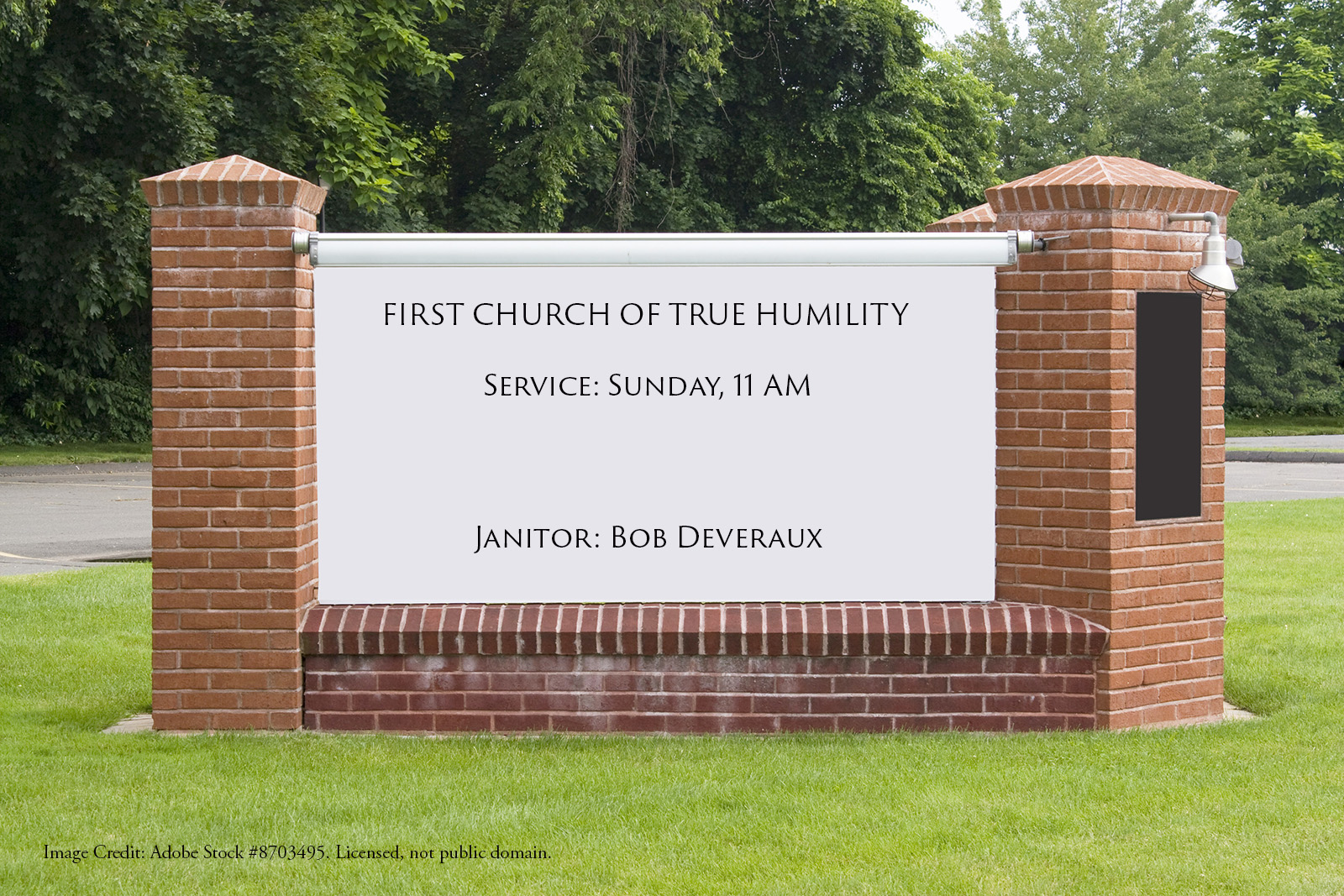
    Now let’s think about the church. Is a person with gifts of administration less critical than one with pastoral gifts? (Note that I regard almost every modern job description for a pastor as not only unscriptural, as in not even conceived of in scripture, but also unholy.) What about gifts of encouragement or helping others versus gifts of teaching? What are more important? Yet the person who helps, organizes, keeps the books, and so forth is considered less of a leader than the person who preaches or teaches. If you don’t believe me, let me ask you this: Can you find a single church sign that identifies the janitor or even the church administrator? No! It identifies the pastor.

    As an aside, I think there is a much better case for hiring a professional church administrator than there is for hiring someone to preach or teach in the local church, and certainly then there is to hire someone professionally to visit people in the hospital. Those duties can easily be divided among members of the congregation according to their gifts.

    And thus I come back to my wife and I and theological questions. Why would someone assume that I would straighten out my wife, though she wouldn’t straighten me out? Ignoring basic sexism, which I think does apply, we need to look at training, experience, and credentials.

    Many people (perhaps most) that we encounter would present theological questions to me and not to Jody. I have trained to be a teacher. I have a BA degree majoring in Biblical Languages and an MA in Religion, concentrating in Biblical and Cognate Languages. I have taught for years. I have written 13 books, which is considered an accomplishment, though none of them is particularly popular. I have been invited to preach many times and in many places. I am expected to be the theologian and to have an answer. Of course, there are many areas in which I have expertise and the ability to answer those questions.

    Jody, on the other hand, does not have a degree. What she does have is one of those old-fashioned three year nursing programs, years of experience in a variety of fields as a registered nurse, experience as a hospice nurse and then director of education for a hospice organization. Further, she has carried on a regular devotional live for decades. She has been invited to teach and to preach, and I can testify she is very good at it. She has written several books as well, at least one of which is more popular than any of mine!

    There are some questions you should ask me, but there are many other questions you should ask her. If you ask me, I’m likely going to give you an answer I got from her. If you want someone to visit you in the hospital, she’s the one. My degree, earned via seminary courses (though granted by the graduate school) didn’t teach me how to do that. I have never encountered someone who was sick or facing death who wanted my help translating a verse from Greek or Hebrew, or expounding on ancient manuscripts.

    Now how do you rate this sort of thing on a scale. Is Jody smarter than I am or am I smarter than she is? I have no idea, nor do I care. In fact, I don’t think there’s any good way to make that determination. We are each gifted in our own way. We each have a call from God to serve one another and those God places before us. We’re very different, but that makes our teamwork more valuable.

    In order to know what we can each do, you have to learn to know us as individuals. An intelligence test won’t do it. I have never been formally tested, but I know that I usually rate pretty well on the type of questions involved, yet I can forget where my local Walmart is located. Am I stupid or smart? Our degrees or lack of them will not do it. I have an MA degree, but I have trouble planning a route around town that doesn’t involve wasted miles. Am I stupid or smart? Jody can’t translate a Greek text for you, but she can help you through the inevitable questions you’ll have dealing with end of life issues. Is she stupid or smart?

    There’s the saying that there are no stupid questions. I disagree. I’ve just asked a stupid question several times. Is she/am I stupid or smart? It’s a completely useless question that produces nothing of value, and often helps people excuse themselves from actually looking at the person.

    This also goes back to the male/female thing. The assumption that because someone is a man or a woman one can safely make (derived) assumptions about their capabilities is based on a similar mental laziness. I can’t be bothered to determine what this woman or that man is capable of, so I’m just going to assign the general category to them. Whether you’re making the assumption based on a category of credentials, on race, on nationality, or on gender, It all goes back to an unwillingness to get to know someone as a person.

    Someone’s going to point out to me that men and women are different. It may shock you to know that I was already aware of that. But the difference doesn’t matter if you’re willing to learn to know the individual man or woman. If you know that person’s gifts, the abilities they share with their gender or other category will also be obvious.

    I don’t keep my wife in line. She doesn’t keep me in line. We allow each other to answer our own questions for the simple reason that we can, and that we respect one another and our gifts. Neither gender nor credentials matter.


  • Jesus and Women, Quote from Dorothy Sayers

    Check out @dianabutlerbass’s Tweet:

    https://twitter.com/dianabutlerbass/status/971759225276911616?s=09

    I have always loved Dorothy Sayers, and this makes me like her more. Guys, if you’re wondering what annoys the women around you, read the whole thread, and you’ll find a list.

    Don’t do those things!

  • Is 1 Thessalonians 2:13-16 Anti-Semitic?

    Is 1 Thessalonians 2:13-16 Anti-Semitic?

    Dave Black writes on this passage today on his blog, as he prepares to teach it. I have extracted the post and put it on the Jesus Paradigm site (supporting Dave’s book The Jesus Paradigm), in order to have a permanent link.

    Dave argues based on the way one should analyze the phrases and then punctuate. It’s well worth reading.

    I would add that Paul is here commending the Thessalonians for behaving as the churches in Judea did, which is also a commendation for those believers who were doubtless all or nearly all Jews themselves. The logic here indicates that Paul is condemning those who killed Jesus specifically, rather than all Jews, as he commends a large group in the same passage.

    Dave talks about vituperation. I think Paul was passionate and his language is often vigorous. It’s easy for hate to take over and reinterpret and apply words.

    Just try to talk about “moderate Muslims” in today’s atmosphere. You’ll doubtless encounter those who don’t want to make the distinction between those who engage in terrorism, those who support it, those who are apathetic toward it, and those who actively oppose it.

    Yet if we turn the situation around, we’re quite willing to make such distinctions or gradations regarding those in our own community.

    This is how stereotypes are created, and hate against a group generated. An accusation, however just, is brought against one member of a group, and then someone focuses on that group, rather than on the person involved. Soon perfectly innocent people are subjected to hatred. This happens whether it’s a matter of a racial group, a religious group, or a profession. One police officer is caught in corruption and someone concludes that “the police are corrupt.”

    On the other hand, some excuse members of a group because of prejudice (perceived or real) against the whole.

    I think Paul makes his distinction here. Those who persecuted were, quite rightly, condemned. (That goes for Christians who have persecuted others through the centuries as well.) We need to make a similar distinction at all times between those to be commended and those evildoers we must deal with.

    I’m reminded of my own reaction to the Duke Lacrosse Case. (Yes, that’s an entry on Wikipedia.)

    When I first heard of it, I assumed that the accused were guilty. Why? They seemed to me to be privileged rich kids and I thought they were exercising their privilege and entitlement. Turned out I was wrong.

    You shall not render an unjust judgment; you shall not be partial to the poor or defer to the great: with justice you shall judge your neighbor. (Leviticus 19:15, my emphasis)

    Don’t do that, Henry!

  • Getting Millenials in Church

    Getting Millenials in Church

    I don’t know how to get millenials (and other generations younger than mine) into church. The reason is simple: I’m past 60 years old.

    I hear frequent complaints about the failing of the current (or other intervening) generation. Is it possible, however, that they’re just as smart as or as good as my generation (or even smarter and better), but they’re not willing to put up with doing something just because it has been done before.

    I actually love Sunday mornings and going to Sunday School and church. It’s part of getting myself ready for another week. But it is very much like it has been for decades. I can’t point out too many differences between the service I attended today and one I would have attended when I was in my late teens and early twenties.

    Church people respond, “But it’s not for you! It’s for God!” But where does it say God must be honored with the order of worship I experienced, and yes enjoyed. It’s quite easy to tell someone else they ought to do out of duty something you enjoy doing. Suppose, however, you didn’t enjoy it. Would you still do it? Can you criticize someone else for not doing it.

    So what is my suggestion? If you want to know what millenials (the favored target) or any other generation or group of people want, ask them. If you’re wondering what sort of worship experience would attract them, not only ask, but ask them to lead. It might take you to the beach. You might wind up in a laboratory. You might wind up in a soup kitchen.

    You might even end up with something very old, like the worship service described in 1 Corinthians 14 with everyone participating, bringing thoughts, songs, things they’ve heard from God during the week.

    “But what if they mess it up?” you ask. “They don’t have any experience.”

    So what? Peter denied Jesus and then Jesus left him in charge, more or less. He did provide him with a bunch of other losers—by the world’s standards—to help out.

    Besides, you and I have been regularly making lots of mistakes for years. Lots of them. Instead of running the church, let’s offer them our help and support. Let’s see what they do with Jesus.

  • Thoughts on James 2

    Thoughts on James 2

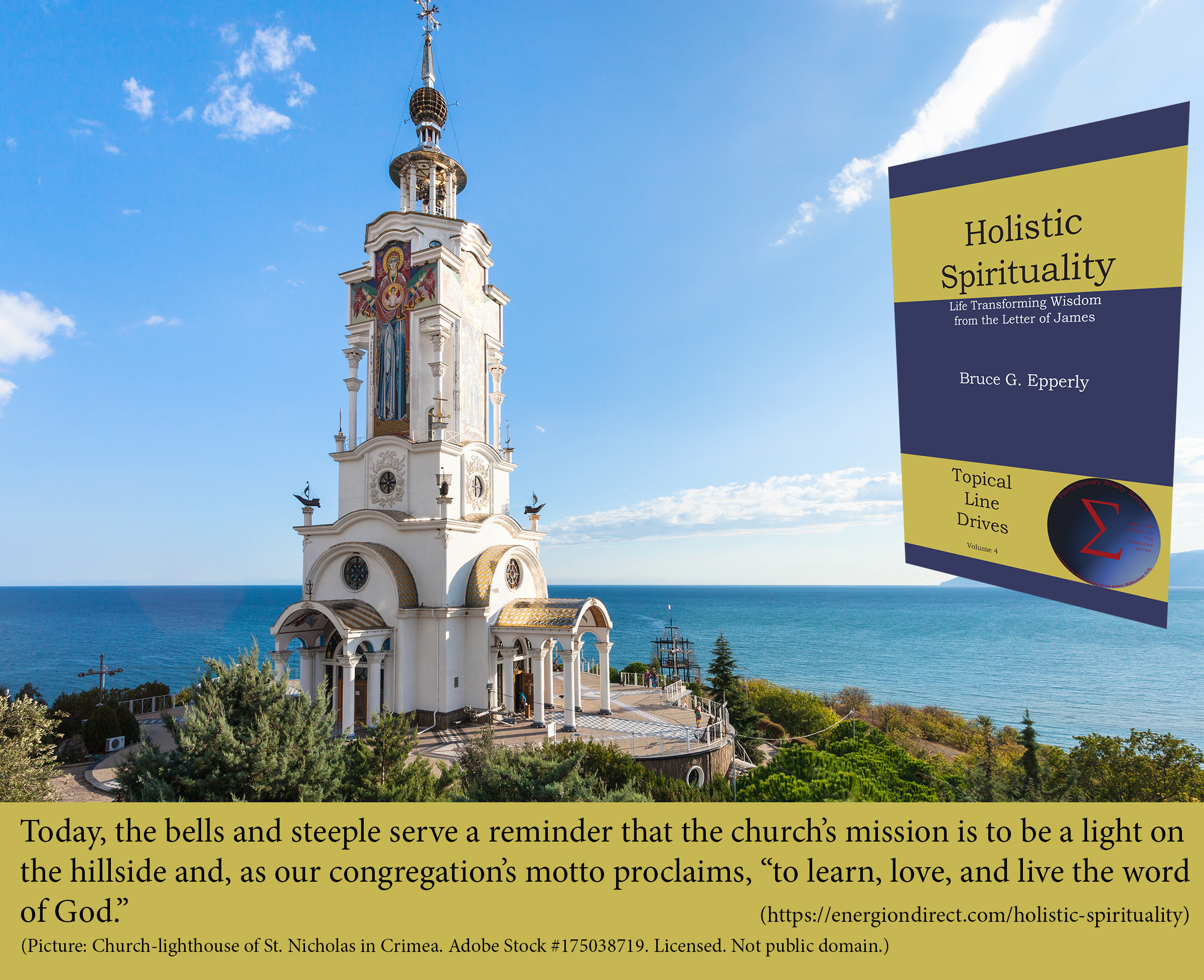
    Our Sunday School lesson, which I’m not teaching this week, is from James, focusing on chapter 2. I’m not teaching, but in studying, I looked at a book I publish, Holistic Spirituality: Life Transforming Wisdom from the Letter of James.

    Bruce Epperly makes a number of important comments. I’m going to do a bit of quoting from his chapter 3, pp. 15-21.

    One of my great joys is my first glimpse of the steeple of South Congregational Church, when I round the bend toward home. In earlier times, the church’s steeple guided mariners safely to shore. Today, the bells andsteeple serve a reminder that the church’s mission is to be a light on the hillside and, as our congregation’s motto proclaims, “to learn, love, and live the word of God.” (p. 15)

    I like that motto, “learn, love, and live.” I think it may go the other way as well, we learn from what we live, especially when we’re trying to live the word of God.

    Faith means nothing unless it lights the way of pilgrims and seekers, providing guidance, comfort, and nurture. (p. 16)

    Here Bruce combines faith in action and faith in witness (and our action is, I think, our best witness) in a way of which I think James would approve. We are not Christians, or Jesus people, for our own benefit alone. We receive grace to share grace. That’s why grace cannot be a passive thing. It erupts in action.

    … The Apostle asserts that because God loves us, our vocation is to love one another, even if this means crossing the barriers of race and ethnicity. Grace makes us all first-class Christians, worthy of respect regardless of ethnicity or economics. This is the essence of James’ message as well.

    James believes that a holistic faith brings together belief and action. In the spirit of the Quakers, what is important to James is to “Let your life speak.” … (p. 17)

    I think that the tendency of many interpreters to see James and Paul as opponents is misguided. They do have a different emphasis, but it is not because Paul hated or devalued action or that James thought beliefs were unimportant. Each had an emphasis, but these emphases are compatible or complementary.

    Loving Jesus means loving your neighbor. And if James is right, it means standing aloof and becoming counter-cultural in
    relation to socially-acceptable, but life-destroying, values – “being unstained by the world” – that put profits ahead of people, neglect the needy, and blame the poor for their poverty. We are all created in the image of God and we all deserve to be loved, to have a place to call home, and an opportunity to live out our gifts and talents as God’s beloved daughters and sons. (p. 19)

    That’s were it will start to get with us. Sanctified wallets are the hardest of possessions to acquire. Or, looked at the other way, the wallet is the hardest thing to give up. How much stuff must we have? What is first in our life? Putting God first will result in also putting our neighbor first.

    But what can you do? Maybe all you have to spare is coins in your pocket.

    In the realm of God, no deed is too small, for with one action at a time we can become God’s companions in healing the world. Let your life speak. (p. 20)

    This is a great little book, just 40 pages of text from Energion’s Topical Line Drives series, for accompanying a study of James. It might just be, as the subtitle suggests, life transforming!

    Read Now


  • Daniel 9: Confession and Repentance

    Daniel 9: Confession and Repentance

    The Adult Bible Studies Sunday School curriculum was on the subject of confession and repentance with the primary passage being Daniel’s prayer in Daniel 9. This is an interesting and powerful prayer to read and deserves more attention than it gets. They secondarily referred to Psalm 51, which is also an important prayer of confession, and is much better known that Daniel 9. (I wrote a meditation on Psalm 51 here, but didn’t get to it in my Sunday School class.)

    One important difference between the two passages is that Daniel 9 is a corporate prayer of repentance, while Psalm 51 is individual. Each has individual elements and corporate elements, but the emphasis is far different. This is why Psalm 51 applies to the sin of David with Bathsheba so well. Daniel, on the other hand, is meditating on the fact that Judah has not been restored.

    Daniel is treated as righteous in the Bible. While we assume that he is human, and thus had faults and failings, none are presented. This is notable, since the Bible, unlike many other official histories, does not hesitate to present faults. Much of our historical material about Israel, while based on official chronicles (at least according to the text), are actually written by critics of the various regimes. Yet Daniel is presented positively.

    Here, however, Daniel is not afraid of the word “we.” He identifies with his people Israel (or Judah) has failed. He repents for all, and doing so identifies himself with all. There is a fine line here that we need to watch. By taking on the failings of everyone in a group, we can became paralyzed by shame and simple disgust. At the same time, recognizing that we are part of a group that has done certain things is critical. It becomes the foundation of changing the group.

    Some want to emphasize the individual aspect of confession and repentance. Others think largely in corporate terms. In a church that has done wrong, treated members badly, provided a poor witness to the community, turned its back on those in need or who are suffering, it’s important for those who pray to confess what the church has done. You may have done everything you could, but at corporate confession time, it’s a matter of the group. I think the answer to corporate vs. personal is flexible and varied. The person in the right who says “let’s” rather than “you should” can be the catalyst of real change in a group or even in a nation.

    Here’s a diagram I used in class. Well, actually, I drew with a marker on a white board, and did much worse than this, but whatever!

    The scriptures I would apply are 1 John 4:7 & 20. Of course, as always, I recommend reading the entire passage. We try to prioritize loving God over loving one another, but John ties them together, and I think Jesus does as well when he says the second commandment is like the first. You won’t fulfill one without the other.

    A good prayer of individual confession and repentance should draw you upward toward God. If it results in wallowing in guilt, you aren’t really getting it. If your prayer of confession distances you from others, you may have a problem.

    How corporate should it be? That depends on what is needed. As long as we keep the lines even, drawing closer to others also means drawing closer to God. “Everyone who loves is a child of God and knows God, but the unloving know nothing of God, for God is love” (1 John 1:7-8). You can also test that love for one another by asking whether it draws you and the one you love upward as well.

    This is only a short test, and it’s a bit like a pithy one-liner. Yes, you can get off track. But I think it helps. My hope is to keep the lines of even length and yet shorten the distance. Closer to God and closer to others. That should be my goal in life, and especially in confession and repentance. If love fulfills the law (Romans 13:10), then the chief confession is going to be my lack of love, and my repentance will be a turning toward the other points on this triangle.

    Try it! It might help!


    Here are some books on prayer and forgiveness.


  • Some Problems with Prayer

    Some Problems with Prayer

    I’ve co-authored a book about prayer, published several more, taught numerous classes, and led seminars about prayer. One thing I believe is that one should teach primary from experience, meaning that often you are teaching about your own weaknesses. In this case it it just so.

    So here are some problems. I share in each one. Each one can devastate your prayer life and your Christian experience.

    1. I don’t pray when I should. My first response to a problem is to look for what I can do to solve it. I’m a pretty smart guy and pride myself on being able to solve problems. People call me to help solve their problems, especially with computers or language. Somehow I suspect God is smarter and wiser! A friend of mine said (and I think he was quoting, but I don’t recall who), “Nothing is a substitute for prayer, and prayer isn’t a substitute for anything.” It’s not bad to work, but prayer will transform your efforts. “‘Not by might, nor by power but by my Spirit,’ says the Lord” (Zech. 4:6).
    2. I pray after rather than before. I know God can handle the “before they call” thing, but the problem here is that I make decisions and then ask God to bless them, rather than asking God to guide and then listening.
    3. I pray prayers of direction. By this I mean that I tell God how to solve problems. I don’t know the origin of the saying, but it’s unfortunately true: Many people want to serve God, but only in an advisory capacity.
    4. It’s more important to me that people know I’m praying for them than it is to actually pray. It may be a shock to some people, but you can pray without informing people. This doesn’t mean you should never tell someone you’re praying. I am deeply encouraged each time someone lets me know they’re praying for me. But the proclamation can be either a lie or a weapon or even both.
    5. I spend more time talking than listening. See also #2 and #3.
    6. Despite knowing all of this, these are still failings.

    Fortunately for all of us, God says,  “My grace is sufficient for you, for power is made perfect in weakness.” (2 Cor. 12:9). I pray for greater grace in my prayer life.