Threads from Henry's Web

Category: Christianity

  • The Problem with Church Debates

    It hit me on Sunday as I was listening to a fine sermon for Pentecost at my home church, First United Methodist Church of Pensacola. Rev. Bob Sweet was enumerating a number of things the Holy Spirit might do for us, changes we should all make. A number of his points elicited laughter, because we all felt a bit guilty. Then he hit “stop gossiping.” This time the laughter was loud and noticeably nervous. You know why? Because everyone knew we weren’t going to stop gossiping.

    And then it hit me. The real problem with our church debates is that most of us know we’re debating the meaning of divine commands which we have no real intention of obeying anyhow. I’m not talking about things we disagree with, so we don’t do. I’m talking about things we all agree we ought to do, but never get around to doing.

    Those are the things I need to look at in my own life. What about you?

  • In the Confessions of Category

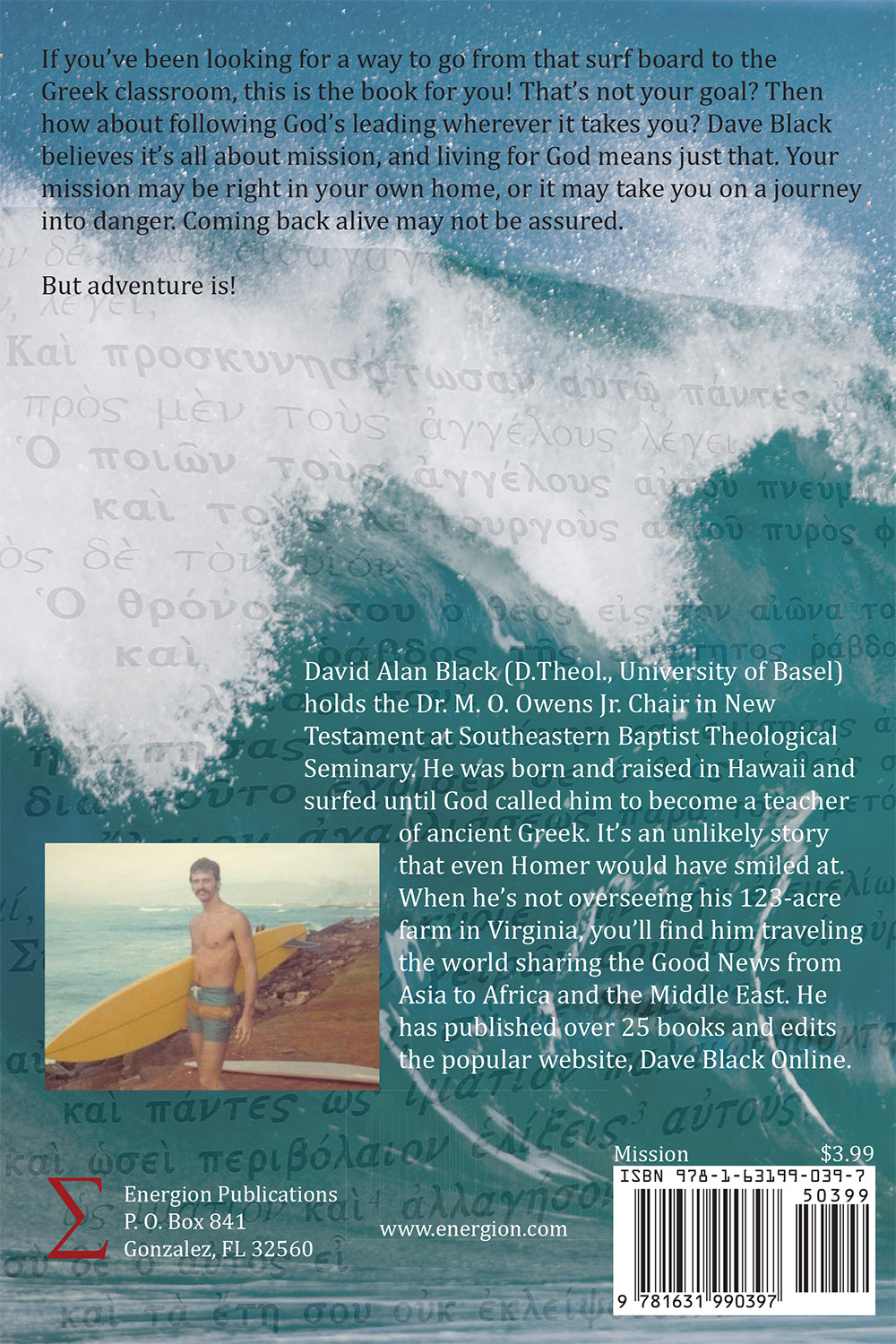
    9781631990397fWe didn’t plan it this way, but my friend and Energion author Dave Black now has a book with a subtitle that begins with “Confessions of …” So what do I mean “not planned” and why is this significant? Well, I wrote a book several years ago, and the subtitle began with “Confessions of …” Not an earth shattering coincidence, but interesting. But it wasn’t planned. In fact, we held a contest for the book title, so you can blame Mark Stevens, who won a free copy of the book for his winning title suggestion.

    Oh, I forgot. Dave’s book is titled It’s All Greek to Me: Confessions of an Unlikely Academic. Mine is titled Not Ashamed of the Gospel: Confessions of a Liberal Charismatic. Of course, “liberal charismatic” and “unlikely academic” are not all that similar.

    I’m going to have to include the back cover below for those of you who want to track down the Greek text that forms the background.

    I’ve gotten a few questions as to why I publish this sort of book. “What sort of book is that?” I’m glad you asked! I’m talking about the memoir, or personal testimony sort of book. A book that tells something about how God has led in the author’s life. I’ve even created a new category over on our Energion Direct web site for testimonies. I consider Psalm 78:1-7 a sort of theme text for my own ministry. I learned to love the Scriptures from my parents who studied it. I hope I will pass that love on to my children. I think it is often more important for people to know what sort of person an author is than what they say. I know this sounds odd coming from someone who publishes books that generally argue one or another point of view. But you see it’s more important to me that my authors are writing about things they care about and truly believe in than how well known they are.

    But there’s an additional, personal factor with this particular book. Becoming publisher for some of Dave Black’s books was a surprise to me. It started because one of my authors at the time—and I didn’t have very many—had taken Greek from Dave Black. At the time, Dave had written and had published more books than there were in the Energion catalog. But he entrusted his manuscript for The Jesus Paradigm to my little company.

    Let me say something about that manuscript. I have a mental list of books that I think should be getting more attention than they have. I regularly wonder what I can do to bring more attention to them. The Jesus Paradigm is one of those books. More people need ot read it. It will challenge the way we organize our lives and the way we do church. One pastor who read it said with some concern, “This guy is trying to run me out of a job!” Just so! Jesus didn’t die so professional Christians could have jobs. I’m not saying here that there should be no Christians paid to do the work of ministry. I don’t know how many should, but one thing I do know. I know that many, many more unpaid Christians should be doing the work of ministry.

    Since I published that manuscript Dave and I have become good friends. Many people think it is an unlikely friendship. A Southern Baptist professor and a Methodist who embraces the title “liberal charismatic”? It may seem odd, but it shouldn’t. Dave is one of those many people I know for whom the kingdom of God is central. We have Jesus!

    More importantly he’s very transparent, he means what he says, and he’s ready to listen to disagreements. You can have an excellent discussion with him at just about any moment. And for my more liberal friends who wonder, let me note that I’ve never heard Dave respond to an issue of interpretation by citing his own theology or tradition. He always argues facts and the text. You can disagree, but you’re going to have to deal with the data.

    I’m not going to try to explain friendship. I like being an unlikely friend and having unlikely friends. I’m just not sure what makes a friendship “unlikely.” I’m even told my marriage is unlikely, but it seems pretty likely to me.

    So consider reading this little book. It’s just $3.99, and I had a lot of fun creating the cover. So here’s the back cover. Enjoy!

    9781631990397b


  • In Which I Question My #UMC Membership Vows

    There’s been a great deal of talk about schism in the United Methodist Church (#UMC) over the last couple of days. It hasn’t disturbed me in the way it has disturbed many of my friends, but it has made me ask this question: Why?

    No, not why might we have schism. Why don’t I care more?

    I’ve said before that if I left the UMC, it would doubtless have something to do with apportionments. I don’t have a problem with the basic concept, and unlike many, my problem is not that some of my apportionments might support someone who takes some particular stance on homosexuality. I’m sorry, but in a complacent, self-satisfied, rich, apathetic, and unaware American church, a church that is spending much more on maintaining its institutions than on building the kingdom of God, I can’t convince myself that homosexuality is the most important issue we have. How we treat other people, yes. Institutional rules, no.

    Here’s an example. Via Allan Bevere (also an Energion author), I discovered the suggestion that the United Methodist Church officially embrace the Nicene Creed, which we apparently don’t. The problem? It would take us a minimum of eight years to accomplish this mission. Then we’d be protected from false doctrine, like all the other churches who embrace the Nicene Creed. Oops!

    Don’t get me wrong. I do, in fact, embrace that creed. I’m just thinking that having our general conference debate the issue for the next 8+ years isn’t really going to help us much.

    I think it’s my view of denominations. I think denominations are should be a good way for us to group our resources so we can be more effective in building the kingdom of God. Single congregations have some limitations in terms of resources, so they need to work together. I didn’t (and don’t) think it’s necessary or good for all our connections to be within our denomination. I don’t think it’s a good thing when we build our denomination instead of building the kingdom. I think that the amount of time, effort, and money, not to mention words, that is spent on institutional issues indicates that our priorities are not right.

    The question I’d ask about schism in the UMC is this: How can we get on with the work of the gospel with the least disruption?

    Let’s forget about who owns buildings, and who we like and who we don’t. Go about it in a Christ-like manner. Let people form the institutions they think they need. I personally doubt I’d like either half of a split UMC, but I don’t have to like it. I just have to find the place God calls me to minister. It’s as likely I could find a congregation where God called me to be after as before.

    And if you don’t mind, I’m a Christian first and a member of a United Methodist congregation second. As a Christian, I’m going to go right on embracing the Nicene Creed. Don’t go it alone? I’m not. There are hundreds of millions of Christians who do so along with me. We don’t need another eight year debate.

    That’s my primary loyalty. To the gospel. As long as I’m a part of a United Methodist congregation, I’ll support it with my prayers, presences, gifts, service, and witness. But if God calls or the institution falls, I’ll go right on following where the Lord leads as best as I can.

  • To a Generation yet to Be Born

    To a Generation yet to Be Born

    image

    This is my mother, who will be 96 at the end of May. She’s looking over a book titled Seeing the Psalter. She spent a good hour with it, commenting on methodology and various translations.

    How can she do this? Well, after years as a missionary nurse, she decided to take Hebrew and completed two years. She then taught herself Greek, with a little (remarkably little) help from me.

    She and my dad both passed on their love of Scripture to me. That’s Psalm 78:1-7 in action.

    When she was done looking over the book she took out some sheet music, went to the electronic keyboard and said, “Let’s have worship!” She led our small group of family and we shared God’s wonderful deeds (see Psalm 78 again).

    That’s how you share faith from one generation to the next.

  • At Bethel Hill Baptist Church

    image

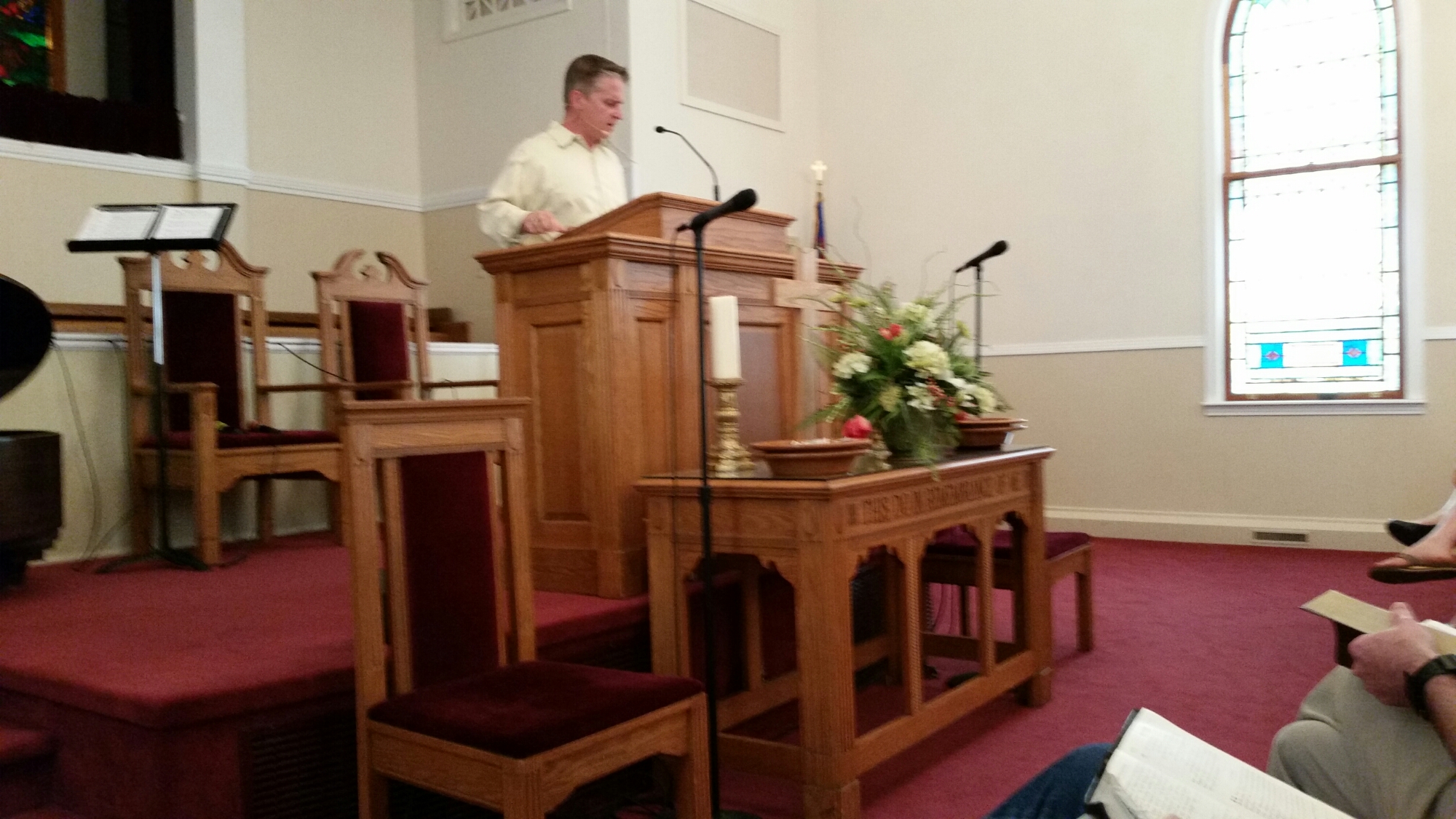
    I enjoyed sharing my testimony and Psalm 78:1-7, which is the theme text for my monistry, at Bethel Hill Baptist Church today. I want to thank Brother Jason Evans for allowing me some time in the service there.

    I was reminded of the importance of the body of Christ and the fellowship that we experience as well as the mutual support. One of my privileges in my work is the opportunity to visit many churches. For me a warm welcome is the rule and not an exception. There are many things that are so right in the church. Often we spend our time complaining about what is wrong and lose sight of how blessed we are.

    After I had shared, Jason Evans, one of the elders (they use a plurality of leadership), preached from Revelation
    11:15-19, “the kingdom of this world has become the kingdom of our Lord.” There is an end to suffering and a goal to be reached.

    image

  • The 5-Minute-a-Day Bible Reading Plan vs. My Dad’s Bible

    Some time ago I was invited to answer questions from a group of wonderful young people. They were invited to ask me any question they wanted. On about the third question, as they were discussing the background between them, I had my finger in a place in my Bible where I was going to start with my answer. One young man said, pointing at my Bible,”You know, it’s almost frightening the way you have somewhere to turn to in that thing.”

    I say that not to boast, but rather to say this. You know what’s really frightening? That this surprised him.

    When I try to answer Bible questions, I’m frequently asked just how one can get to know the Bible like I do. What it generally comes down to, however, is that they’d like me to provide them with something along the lines of a 5-minute-a-day plan. Now don’t get me wrong. There are plenty of Christians who could benefit from five minutes of Bible reading per day. It’s just that five minutes each day won’t get you to the point where you really know your Bible.

    Very few of us would spend that little time keeping up with our professional fields, and I note that Bible study is a part of my work. But while claiming that the things in the Bible are of eternal importance, we are often mysteriously uninterested in actually knowing what they are.

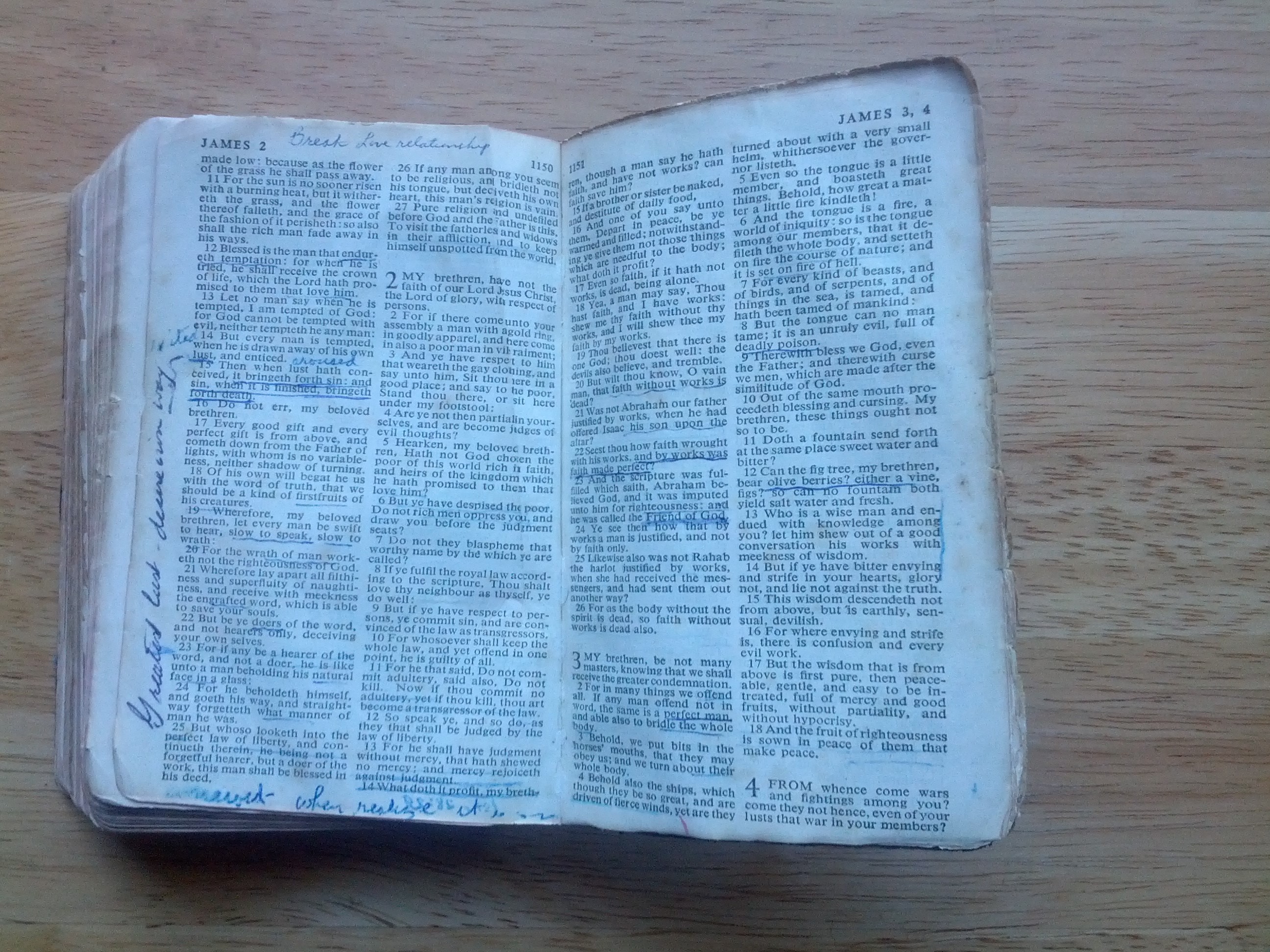
    Let me start with how I got to know my Bible as well as I do, and let me add that there are plenty of weaknesses in my knowledge of scripture. You see, it’s not my fault. I can’t claim superior spiritual reasons. I grew up with it. It all started with my Dad’s Bible.

    My Dad's Bible, one of many that he used over a lifetime. I'd often see him reading and marking them. He used this one toward the end of his life.
    My Dad’s Bible, one of many that he used over a lifetime. I’d often see him reading and marking them. He used this one toward the end of his life.

    Here are the key points:

    1. I saw my parents study their Bibles regularly, frequently, and for much more than five minutes at a time. It looked natural to me. Parents, if you want your children to read their Bibles, read yours. It will do you (and them) much more good than all the urging you can provide.
    2. I studied and memorized the Bible through church programs and in school. I memorized whole chapters. I read so much of the King James Version that I still tend to use a KJV concordance or do my #BibleGateway lookups in the KJV.
    3. I studied the Bible in college. I went out of my way to do extra reading either of or about the Bible. I took German reading and then did an independent readings course covering Old Testament textual criticism. I studied French and when it was time to write, I wrote about French translations of Hebrew poetry. I did a two quarter hour independent study of just the first chapter of Ezekiel.
    4. I asked myself what was important. If I claimed that God and my relationship with him was even moderately important in my life, I needed to spend time in touch with God through his Word.
    5. I continued reading. I even read for language maintenance while I was out of the church following seminary. When I returned, I was able to restart reading at the rate of a chapter a day in Greek.

    Boasting? God forbid that I should boast save in the grace of God that led my parents to instill these habit patterns in me and let me take an honest look at myself as I would be without him!

    My point is that if you want to know the Bible, there is no quick plan, no shortcuts, no easy osmosis method. You need to spend time with it. Prayerfully examine your priorities. If you are a parent, consider what you want to teach your children. Do you want them to think that Bible study is important? Study it. Let them see your priorities in action. Do you want them to grow up as praying people? Pray! Don’t be afraid to be spiritual and to talk about spiritual things.

  • On Ecclesiastes and Disagreeing with Authors

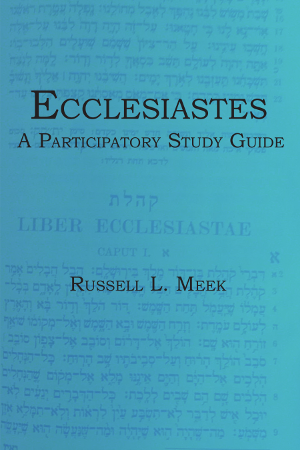
    Ecclesiastes: A Participatory Study GuideNo, not the authors of the biblical text, though that’s an interesting topic. I’m talking about disagreeing with a study guide author, in this case a study guide author I chose both to publish and then to use in my Sunday School class.

    One class member was surprised—not shocked, annoyed, or disturbed, but just surprised—that I would make those choices.

    More on that in a moment. What is it that I disagree on? Well, it is fairly simple and quite broad: authors, date, and the translation of the Hebrew word hebel. Those are the subjects we’ve covered in the first two chapters. I consider Solomonic authorship unlikely. It sounds to me more like someone later writing in a way that will suggest to his readers hearing this later literature in the light of the life and times of King Solomon. Incidentally, while I haven’t studied it that much, this could be a textual relationship, and the methods taught in chapter 2 could be used to discover whether there is, in fact, such a relationship, or if it’s just a relationship of ideas, or none at all. On hebel, I tend to read it more negatively than does the author of the study guide.

    This recalls to my mind some of the best times I had in college and graduate school. I would get together with a group of fellow students, sometimes with one of our professors, and we’d hash out issues. The goal wasn’t to find people you agreed with. That was pointless. The goal was to find brilliant people who thought differently than you did. Then you’d argue out the details and you’d all learn new things. The only time disagreement was a problem was when someone couldn’t be reasonably gracious about it. Vigorous disagreement and a spirited defense of one’s ideas was good. We tried not to get personal, and generally succeeded.

    What I told my class was that agreeing with me wasn’t even a consideration in choosing what book to publish. If it slipped in, it could just as well be a negative as a positive.

    These first two chapters of the Ecclesiastes study guide are brilliant, in my view, because they present views that will be controversial in many quarters, and they do so thoroughly, but in a way that a serious non-specialist can read and understand. You don’t just learn what the author’s opinion is and the names of some people who oppose it. You learn why he made those choices. The introduction to intertextuality is also excellent and gets Bible students to think of things that we often neglect. Just how do two texts/passages relate? Which might have influence the other? That involves sequence and availability. Which was written first? Is it likely that the earlier work was available to the later writer? What characteristics would show that two texts were related?

    People from all parts of the theological and spiritual spectrum have an unfortunate tendency to read things they find agreeable. I’m hoping that through both teaching and publishing, I can get them to look at things that are very different. This is not simply to get an idea of the spectrum of ideas. It’s also so that people learn why. In the 21st century it is unrealistic for pastors to assume people won’t get exposed to these other viewpoints. Yet there are still pastors who think they can somehow protect their congregations from discovering this fact.

    Bible students all too frequently simply accept what their study Bibles, their pastors, or some Bible teacher says as to authorship, dating, relationships between texts, and interpretation. They don’t understand why those things happen. This guide is attempting to teach people how to examine the nuts and bolts of the process, how to make such determinations for themselves.

    I was reminded of the conversation in class during the sermon. My pastor was preaching from Matthew 5, including the portions that discuss divorce, lust, and adultery. I happened to agree with what he drew from the text, but I noticed that it would be nearly impossible for people in the congregation to rebuild his logic. It’s likely a bit much to expect a pastor to get any of that “other stuff” across in a 20-25 minute homily, but I think it is unfortunate that for many congregants, that one discussion will be all that they learn about that passage. They will go home with an interpretation (assuming they remember it), but will be unable to defend it, and would be unable to reproduce it or apply the same principles to another text.

    I truly don’t look for authors who agree with me. I look for authors who will educate, because education in turn empowers people to take action.


  • Trajectories, Hermeneutics, Sexual Ethics, and Ecclesiology

    Reading Chris Seitz on the Biblical Crisis in the Homosexuality Debates (by Alastair Roberts) reminded me of three things I already believed:

    1. It is very dangerous to try to develop hermeneutics while wrapped up in a debate on a particular topic.
    2. The best test of one’s hermeneutics is to change the subject. Does it still work?
    3. Debate often tends to obscure the middle ground.

    Despite the pretentious title, I mean this to be a short post. I also would like to note that I have not read Chris Seitz; I have only read Alastair Roberts’ comments. But his comments are not particularly wild or annoying, compared to other things I have read.

    You need to read Alastair’s entire post, but here’s a key line:

    The flirting of many evangelicals with forms of trajectory hermeneutics is just one example of the way in which the creedal understanding of the relationship between the testaments has become compromised.

    I’ve written before about trajectories, and clearly I believe that there are trajectories in scripture and that we need to pay attention to them. This is part of my belief that we often develop doctrines of inspiration (and a resulting hermeneutic) that ignore the human portion of the communication. I don’t refer here to the prophet, but rather to those who receive God’s communication. The accuracy of communication cannot be stated without noting how accurately a message is received. But that is another topic which I discuss further in my book on the subject.

    What I’m interested in here is the suggestion that the debates about sexual ethics in general, and about homosexuality in particular, have done violence to hermeneutics that had not already been done.

    So I change the subject. What hermeneutic produces the liturgy and organizational structure of the Episcopal Church USA or the Anglican communion as a whole? How do we get from the New Testament to the cathedral, from the home meeting where everyone participated to church architecture with a raised platform and a privileged few leaders? Might I even go so far as to ask what trajectory permitted these changes?

    I note that one departure from scripture, in sexual ethics, is regarded as sufficient to prevent certain levels of fellowship between the United Methodist Church, of which I am a member, and the Episcopal Church or the United Church of Christ. The other, in ecclesiology seems less important to those in positions of authority.

    But of course that question is grossly unfair, because I could ask the same thing about the organizational structures and liturgy of the United Methodist Church. Well, as long as everyone is sinning in the same way …

    This reminds me of a conversation I had with a theology professor about a colleague who was teaching religion somewhere in the Bible belt. This colleague noted that there was a great deal of tension about his moderately liberal academic views regarding scripture as he taught. He was teaching a general course in basic Christianity, however, and eventually they came to sexual ethics. Suddenly the students reversed positions. The professor took the idea of sexual purity seriously, with sexual relations only permissible within marriage. Suddenly the conservative students thought their “liberal” professor was way too conservative.

    Which reminds me of another thing I’ve observed about the human side of doctrine. There are clean sins and dirty sins. Clean sins are the ones I commit. Dirty sins are the ones you commit.

    I wouldn’t want to speak for God, but I’m suspecting God’s view might be different.