Threads from Henry's Web

Category: Christianity

  • The Relevance of Atonement Theories

    The Relevance of Atonement Theories

    Discussion Ahead traffic sign in woman's hand on a white background
    Discussion Ahead traffic sign in woman’s hand on a white background

    On the Energion Discussion Network we have two essays posted in answer to the question “Do atonement theories continue to speak to the human condition?” The “yes” answer, written by Dr. Allan Bevere appeared yesterday. The “no” answer appeared today, written by Rev. Steve Kindle. I find both of these articles well worth reading.

    In the past I have been accused of rejecting penal substitutionary atonement because of the fact that I don’t see it as central, or as the explanation of the atonement. In fact, I don’t see any theory of the atonement as a single explanation of the atonement. Our theories of the atonement are metaphors, used to carry across some of the meaning to us.

    As does Allan Bevere, I do find pretty much all theories of the atonement relevant in one way or another. Where I tend to be concerned is where a metaphor begins, in some people’s minds, to become the reality, i.e. that rather than believing in the cross of Christ we believe in our particular metaphor, the one that may best speak to us. I recall a professor from whom I took a class in exegesis of Romans from the Greek text. What was remarkable about the class was that his favorite theory, or metaphor, for the atonement as the moral influence theory. Now I have a bit of a liking for that metaphor myself, but it is not the metaphor Paul uses in Romans. There is some overlap. But this professor, because that was his very most favorite metaphor, taught nothing but, twisting Paul considerably in the process.

    I’d add one more caveat. Relevance is a word that points both ways. A metaphor, to be relevant must communicate to one who hears. If it doesn’t, it isn’t working as a metaphor. I think quite often we need to correct the presentation of some metaphors to make them function better. If they don’t carry something over, they aren’t relevant in that case, however great they might be otherwise.

  • Reading for Election Year

    Reading for Election Year

    politics booksThe day after the Iowa caucuses I’m left to wonder how I could have gotten so uninterested in politics. I have been fascinated by government as long as I can remember, and when I turned 18 and could vote I not only registered immediately, I also started working as a precinct worker for a presidential campaign. Now I can read a couple of articles on an election and my appetite is more than satisfied.

    What has really happened, I think, is that I have gotten more perspective on politics. I have lived through eight years of my friends to the left despising President George W. Bush, and then another eight years of my friends on the right despising President Barack Obama. In both cases it was very difficult to conduct a civil conversation on topics of policy. I have problems with both of these presidents, I might note, and almost all of the problems I have with them are the same for both, primarily an extension of executive power and an excessive willingness to resort to force.

    I have not decided politics is not important. I will definitely vote every time I’m eligible. I will always research the candidates thoroughly once it is time to make my choice.

    What I have decided is that politics is not as critical as I once thought. I have other priorities now.

    And with that, a link. Dave Black found a list of five books one should read during an election year, and proposed one of his own.

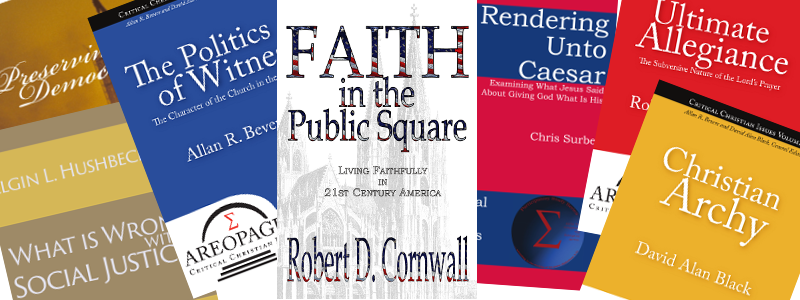
    I would add to that list The Politics of Witness by Allan R. Bevere, Ultimate Allegiance by Robert D. Cornwall, and Rendering unto Caesar by Chris Surber. Self interest is here no doubt evident. I publish them all!

  • Thursday Night Eschatology Study – Isaiah Part 2

    I’m starting in about 15 minutes. Tonight I’m going to be looking at Revelation 21 & 22 and their use of 3rd Isaiah (chapters 56-66). I want to look at how imagery is used and reused and how this impacts the way we interpret.

    Google+ Event Page


  • Identifying Extremes – Examining Everything (An Example)

    Identifying Extremes – Examining Everything (An Example)

    book cross-hatchThis morning Dave Black posted some things about reading Hebrews from the Good News Bible (TEV) and also on authorship and canonicity. I’m not posting to enter into a debate on this point, but rather to note an attitude.

    Dave says:

    The undeniable reality is that questions of canon and authorship matter. Of course, both sides demonize the other. Proponents of Pauline authorship are dismissed as obscurantists, while proponents of Hebrews’ non-Paulinity are accused of succumbing to the spirit of the age. But why should we tolerate this kind of judgmental divisiveness? Maybe we need another conference on campus to discuss the issue!

    Good points! I am deeply concerned when people who are treated with intolerance by one group, move to another, and then treat their former group with intolerance. Is there justification for some reaction? I know many people personally who have been treated badly and many of them have been deeply hurt. There’s some justification here for anger. I publish books by authors who have lost their jobs over theological positions.

    But is the justification enough? I don’t think so. Our response to intolerance needs to be greater tolerance. That doesn’t mean we have to accept and approve behavior. What it means is that we need to look for a freer exchange of ideas and better treatment of people.

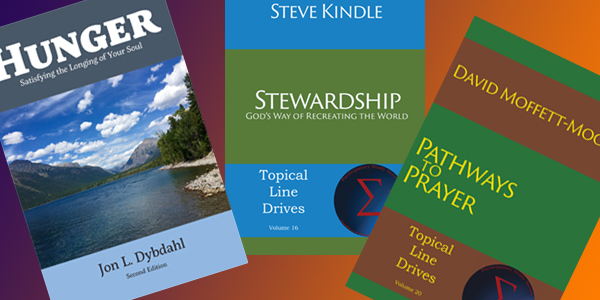
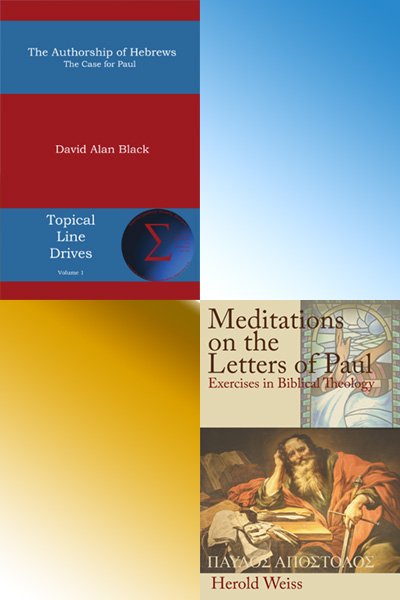
    There are those who wonder why I publish a book like Dave’s The Authorship of Hebrews. Not only do I publish that book, but I requested it. Dave didn’t push it on me. I don’t accept Pauline authorship of Hebrews. I don’t believe we can know the author’s name with any confidence. Yet Dave’s work on this topic shifted my position from one that excluded Paul from the list of possible authors to accepting that his authorship is a possibility. More importantly, Dave demonstrates how to challenge an academic consensus—with detailed, careful scholarship.

    Now let me provide a contrast and a comparison. In the lower right of my little graphic today we have the cover for the forthcoming book from Dr. Herold Weiss, Meditations on the Letters of Paul, which I’m currently editing. First, the contrast. Contrary to Dave Black’s acceptance of Pauline authorship of Hebrews, not to mention the pastorals, Dr. Weiss accepts a minimal Pauline corpus. He even rejects Colossians. So his meditations are on a substantially smaller set of writings that Dr. Black’s would be. Now for the similarity: Besides the fact that I enjoy and have learned much from both writers and both books, neither of these men has ever asked me to accept something because it’s in their tradition, or just because they said so. They are both willing to debate and discuss.

    I can give you numerous reasons why I publish books from a variety of perspectives, and I’ve done so before. But there’s a personal reason. I like them and I benefit from them. I have published some books that I really wish had been better. I do not claim any sort of editorial infallibility. In fact, I would claim feet of clay. But I have learned from and benefitted by reading each and every book I have published.

    Let me suggest a response to Dave’s little book. How about looking at some of the vocabulary comparisons excluding the pastorals, or even working from a minimal Pauline corpus? I’d like to play with that. I don’t know if it would be meaningful, but somebody could look at it.

    Just a thought …

  • Exclusivism, Inclusivism, and Pluralism in Soteriology

    Exclusivism, Inclusivism, and Pluralism in Soteriology

    Discussion Ahead traffic sign in woman's hand on a white backgroundThis past week on the Energion Discussion Network two answers were posted to the question “Can the great religions be vehicles of salvation for their followers?” Answering “Yes” was Dr. Herold Weiss, and answering “No” was Dr. H. Van Dyke Parunak. Both are authors published by my company, Energion Publications.

    I enjoyed reading the responses for a number of reasons other than the actual answer given to the question. Quite frequently we respond to an article based on whether we agree with the answer or not. The well-argued, well-presented article is one that supports our own point of view. The scattered, poorly presented one is the one we oppose. In my experience only a few people can say, “This was a well-written article even though I disagree vigorously with its conclusion.”

    I’m going to do precisely that in this case. Both of these responses to the question are well-written, and they are even well reasoned. It may seem odd to say that when they come to opposite conclusions. It’s important, however, when you read something this short regarding a topic this complex, that you ask yourself just where the author is coming from. Having edited books by both men, I have a leg-up in doing that, but if you read carefully you can clearly see the approach each takes to revelation (particularly scripture), theology, and finally doctrine. These approaches can be experienced at length in Dr. Weiss’s book Meditations on According to John: Exercises in Biblical Theology, and Dr. Parunak’s book Except for Fornication: The Teaching of the Lord Jesus on Divorce and Remarriage.

    You can get some idea of the difference simply by counting the number of scriptural quotations in each post. My quick count gives me eight quotations by Dr. Parunak and one by Dr. Weiss. There are some who will think that gives the answer. Dr. Parunak is being more scriptural than Dr. Weiss. I would suggest that this is something like determining how scholarly a book is by counting the footnotes. I have a book on my shelves which has an overwhelmingly large number of footnotes. But if one eliminates footnotes to the author’s own works, footnotes to unreliable sources, and simply incorrect footnotes, the count drops dramatically. The notes give the impression of scholarship, but unless they are also carefully and correctly done, they are not themselves good scholarship.

    So the question here is how scripture is used in each case. If you think of it this way, Dr. Weiss is actually inviting you to read more scripture, as he refers to broad theological concepts. You’d need to read at least the books of John, Romans, and Galatians, to actually pick up on some of the ideas he’s presenting.

    So now, in turn, am I intending to put down Dr. Parunak’s work based on changing the way I count from a quotation count to a necessary reading count. Absolutely not! This is, in fact, one of the best exercises I’ve seen in years of the way in which the approach an author takes to scripture impacts his or her results.

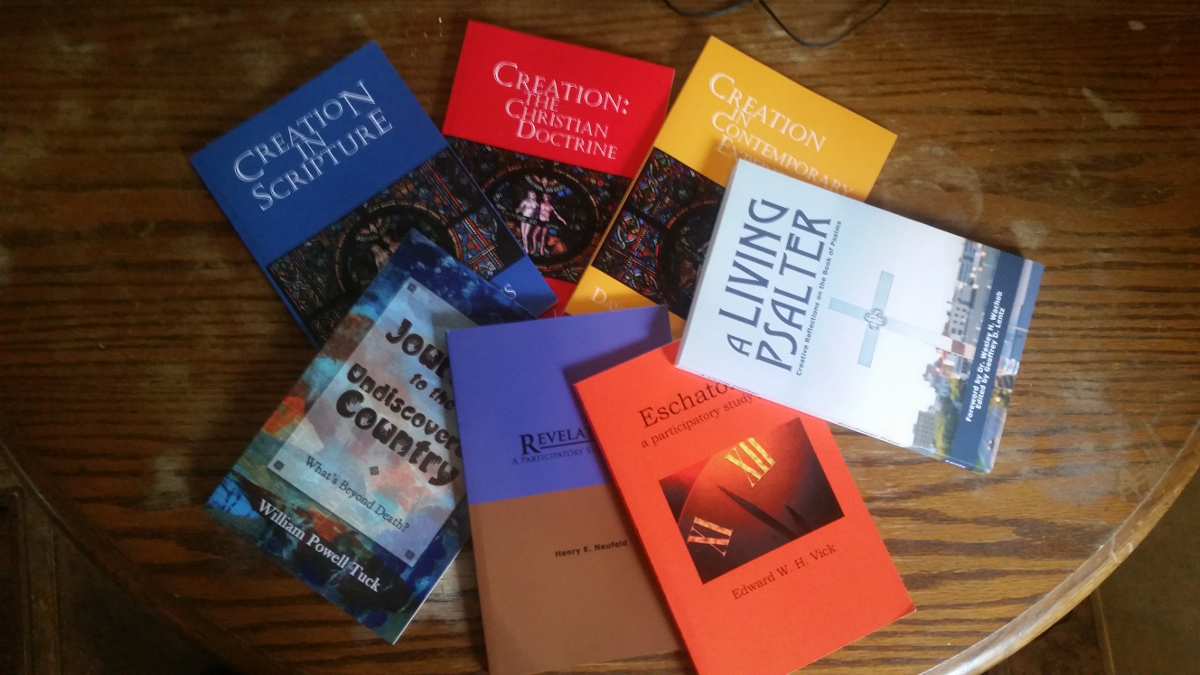
    For Dr. Weiss, scripture is a varied landscape, reflecting a variety of viewpoints, backgrounds, cultures, and even theologies. This landscape invites us to study and to form theology. He would never (and in my experience has never) simply quote a text and say that the text settles the issue. He would always apply that text to a study of the theology of the book of the Bible it came from and as part of the work of its author, particularly its human author. He demonstrates this in a range of books, but particularly in his book Creation in Scripture in which he looks at the variety of views on creation that are contained in the Bible. Some people wonder how he can do this. Surely the creation story is not told repeatedly, even if one accepts that there are two stories in Genesis, which many do not. But Weiss is talking about views of creation, how God is understood to be the creator: Theology, not science or history.

    In the YouTube video below you can watch me interview him about the gospel of John, though Colossians comes up at well!

    Dr. Parunak, on the other hand, sees scripture as more directly from the hand of God, in the sense that all scripture presents a unified picture of doctrine that can be deciphered by the interpreter, and can and should be tested and result in a high degree of certainty. So he will draw a more direct connection between a particular scripture passage. He does not have room for a variety in scripture such that we could say that one theology differs from another.

    You can see me interview Dr. Parunak below, and you’ll hear him express this for himself:

    Though I find the question of pluralism interesting, I find the way in which we answer it even more interesting.

    If you want to explore these ideas further, let me recommend a little book by Rev. Steve Kindle, I’m Right and You’re Wrong: Why We Disagree about the Bible and What to Do About It. If you’re more interested in the issue of biblical inspiration, try my own book When People Speak for God, The Authority of Scripture in a Postmodern Age (Bob Cornwall), or the more intense From Inspiration to Understanding: Reading the Bible Seriously and Faithfully.

    My point here is not to critique either approach. I am not forced to publish anything. I wouldn’t have published books by these two authors unless I found their contribution valuable. But you and I as readers have to answer for ourselves the question of what we believe, and to do that we need to get behind the question of what an author believes to why he or she believes that. “Because the Bible says it,” is not really an answer unless you also know how that author or speaker reads and interprets the Bible.

    So what about my answer to the question posed? Can the great world religions be vehicles of salvation for their adherents? I must note first that I regard my discussion of methology as much more important than any answer I might give here. Let me use Dr. Weiss’s terminology, which he discusses in his book Finding My Way in Christianity, pages 192 & 193. Exclusivism, he says, is the belief that all are saved through the sacrifice of Jesus and must confess in order to do so. Inclusivism says that there may be those in other faiths who are saved, but they are saved by the sacrifice of Jesus. Pluralism says that any religion may provide salvation and that Christianity does not have an exclusive hold on the true salvation story (I am using my own wording though working from Weiss’s material).

    As I look at the question, I find it very difficult to answer without implying something I don’t mean. I am saved by the grace of God, not by a faith tradition, or a particular set of doctrinal beliefs. So just because someone says “Lord, Lord” doesn’t mean they are on the right road. My church membership is not what saves me. So in the sense that I believe God’s grace comes to me without consideration for my merit, in which I include meritorious beliefs as well as meritorious acts, I cannot exclude anyone. How wrong would I have to be in order to be excluded from God’s grace?

    On the other hand, since I do believe that God was in Christ reconciling the world to himself, i.e., I believe that the incarnation is conceptually an exclusive event, and I also believe that there is just one God, however differently we may understand God, then I also see no salvation outside of Jesus, not because one has to understand this in a particular way, but because that was God’s ultimate act, one I see not merely as historical, but also as timeless and unbound by geography. God said that God was not too far away, that God was able to understand and to feel, and that God was able to deal with our guilt, our brokenness, and yes, our healing.

    I find that both a message worth proclaiming, and at the same time a call for humility. How wrong can I be and yet be the subject of God’s grace? And in that case how wrong should I allow someone else to be and still consider them to be under God’s grace?

    Actually I have an easy answer to that one. Nowhere has God made me the one to decide. I am simply convinced that if infinite God was willing to become finite and limited and live life as I must live it, that God isn’t going to miss any useful option in seeing God’s grace become effective on God’s children. I must sincerely doubt that God’s grace is less effective than mine.

    As such, I’m going to trust God to get it right.


    As a follow-up I’m going to discuss these issues with two other Energion authors, Dr. Allan Bevere and Dr. Bruce Epperly. This will be live via Google Hangouts on Air on January 26, 2016 at 7:00 pm central time:  Exclusivism, Inclusivism, and Pluralism Hangout (January 26).

  • From My Editing Work: Faith, Hope, and Love Together

    From My Editing Work: Faith, Hope, and Love Together

    9781631992223mFrom the forthcoming book Meditations on the Letters of Paul by Herold Weiss:

    The mind does not operate in a vacuum. As it operates it expresses itself in a concrete environment through the body. Faith and hope may be thought as purely intellectual activities – but Paul says “Not quite!” Christian faith and hope cannot be apart from love because in such case they would lack accountability. Indeed, faith and hope are possible on account of God’s love, and are effective when they manifest themselves as Christian love, which can only be a concrete expression of faith and hope. According to Paul, Christian faith, hope and love abide together. Thus, Christians don’t live in the past affirming their faith in what God did in Christ, neither do they live daydreaming about the future final triumph of God’s righteousness. They live in the present, loving the world by being engaged with it.

    I don’t have the page number yet as I’m just working on the manuscript, but watch for this book soon!

  • Church as a Social Occasion

    Church as a Social Occasion

    Or perhaps as the social occasion.

    Thom Rainer has a post titled Seven Things Church Members Should Say to Guests in a Worship Service. It comes complete with a header picture of people who, to me, look like they’re forcing excessive smiles. I probably see it that way because I’m an introvert. I suppose that there is nothing wrong with these seven things, though I must note that I prefer that the restrooms be well-marked with signs so that I don’t have to ask someone where they are, and I’m very likely to be the guy who forgets who you are even though you’ve been down the pew from me for months. In fact, I’d just as soon you let me sit there, think, and pray as come try to make a social occasion out of it.

    There’s nothing wrong with being the social person. There’s very much right with being a friendly person. Yet I’m left with several questions. The most important question is just what it is we’re trying to accomplish.

    It seems to me that all of this is aimed at getting more people to attend your church service. The goal is to make people “church-going” and to make sure that an adequate number attend your church. In order to accomplish this we try to make church a great social occasion with a friendly atmosphere (provided one likes that sort of thing).

    I confess that I may be hypercritical here. But all of these lists, and in fact a huge percentage of the talk about church growth seems to center around how many people we have in church. So if you have a church that is a very strong social club, you’re a successful church.

    But in reading the gospel commission I can’t seem to find the part about making sure large numbers of people attend church once per week. That isn’t even mentioned, much less presented as a goal.

    Someone’s going to say that this is the goal. We get them into church and from there we make disciples of them. But I don’t seem to see as many lists of ways to make disciples out of the people you manage to get to attend your worship service. I don’t see nearly as much about getting the people who are good, church-going people to go out and make those disciples. I don’t see nearly as much about getting those people to observe the things Jesus commands.

    I recall a pastor recently who said to the church: The only excuse for a church to exist is to be a witness to Jesus Christ. I’d refocus that to this: The only excuse for us to have a church service is to help us be and become better disciples of Jesus.

    This means that there is a good reason to get people to attend church, provided that church is about becoming better disciples. As I’m been reading about fellowship, I think there’s much more to the idea of communion as a shared meal celebrated regularly. Our church gatherings are not so much services as training and motivation to become active servants. In order to do that we need to be reminded of who we are and of how we are part of a body.

    Perhaps if we built these times around a common meal where interaction involved more than greeting and attempting to remember names, singing a few songs, and listening to someone lecture, we might be able to build the body of Christ as a community that serves, and in fact embodies Jesus Christ for the world. That might mean we need to break up some of our huge congregations and spread out into the community in smaller groups.

    I’m no expert on church organization or church growth. I’m pretty sure that, despite my own tendency, Sunday morning isn’t designed as a time of individual prayer and meditation for me. I can do that many other times. Yet I can’t help but get the impression that our church activities are centered around that Sunday morning worship service. If singing hymns and listening to a lecture of variable quality doesn’t light up your life, you’re just the wrong type of person.

    But do these worship services really help us to be Christians? Do they carry out the gospel commission? Are the spaces in which we do these activities well utilized in pursuit of the gospel? Despite being a person whose habit it is to be in church every week almost without exception, I’m seeing it as less and less productive.

    Perhaps our problem is that the goal is the wrong one. Filling our church sanctuaries on Sunday morning was never the aim of the gospel commission. Making disciples was.

    Is it?

  • Eschatology and Advent

    Eschatology and Advent

    Some Eschatology SourcesTonight will be my last study hangout for the year as I look at eschatology and advent. You can see more at the Google+ event page. In January I will restart this series by looking at Isaiah.

    Here’s the YouTube:

  • Is There Such a Thing as a New Testament Church?

    Is There Such a Thing as a New Testament Church?

    nt church booksI’m planning to finish resume and complete my blog series on Seven Marks of a New Testament Church with added commentary from the books Thrive: Spiritual Habits of Transforming Congregations, and Transforming Acts: Acts of the Apostles as a 21st Century Gospel. This process was interrupted by SBL, by some bug I picked up in Atlanta that slowed me down for several days and by the time taken to catch up afterward.

    In the meantime, I encountered the following:

    There is no blueprint for churches in the New Testament, and to try to form New Testament churches is only to create another system which may be as legal, sectarian, and dead as others. Churches, like the Church, are organisms which spring out of life, which life itself springs out of the Cross of Christ wrought into the very being of believers. Unless believers are crucified people, there can be no true expression of the Church.”—T. Austin Sparks, Words of Wisdom and Revelation, p. 62, (quoted in Frank Viola, Finding Organic Church, p. 19).

    There’s a great deal of truth in that statement, but there is also a great deal of danger. Let me quote a couple of paragraphs from Frank Viola from just before he uses this quote to illustrate:

    Consequently, the “biblical blueprint” model is rooted in the notion that the New Testament is the new Leviticus. Advocates approach the Bible like an engineer approaches an engineering textbook. Study the structural principles and then apply them.

    But church planting is not a form of engineering. And the New Testament isn’t a rule book. It’s a record of the DNA of the church at work. … (Finding Organic Church, p. 19)

    I would love to spend some time discussing this view of Leviticus, which is, in many ways a record of the DNA of Israel as God’s people at work, but I’ll skip over my perennial annoyance with the way Christians handle the Hebrew Scriptures. And Leviticus is definitely closer to a  rule book than is anything we have in the New Testament, however inadequate the term may be in describing the book.

    Again, I would certainly agree that the New Testament doesn’t provide a “rule book” for your church, though we need to consider our understanding of the term “rule book” as well. Even rule books differ in approach! I would also agree with, and even applaud, the characterization of the New Testament as “the DNA of the church at work.” But there’s a certain negative view of engineering involved here, which is just one of the things I think is potentially dangerous.

    There’s an interesting form of binary thinking that seems to go on with the question of whether and how we apply the Bible to anything. Someone asks whether the Bible teaches a certain thing that we believe, and the pious thing to say is that it does. So we say it. Then we’re left trying to find just where it does say it. Take the doctrine of the trinity, for example. Does the Bible teach it or not? Can I discover anything about the Trinity from the Bible? Well, if you want a doctrinal statement of “trinity,” such as you’ll find in any of the Christian creeds (yes, they differ, but take any one), then you’ll have to admit the Bible doesn’t say that. Yet the pieces, or at least the questions, start from scripture. I think you can say something similar about almost any of our doctrines. They are rooted in scripture to various degrees, but we wouldn’t have so many confessional statements if the Bible clearly said what we wanted it to.

    Having grown up as a Seventh-day Adventist, I confronted this problem early. We were a church that believed in the Bible and the Bible only. Anyone could study the Bible for themselves, and the Bible was sufficient. Well, except that people kept getting the wrong things from the Bible. So we had a doctrinal statement and  baptismal covenant. When I was baptized I publicly affirmed a substantial list of doctrines, all of which the church regarded as biblical. But it was not regarded as sufficient that I affirm the Bible; I had to affirm the list.

    I think humans tend to be somewhat binary in our thinking. On discovering that the Bible doesn’t actually have a full list of the “true” doctrines or the “ideal” rules for governing your church congregation, we decide that there’s nothing at all. Let’s get away from talking about characteristics, habits, marks, or even transforming moments. The true church is the one that is produced by people transformed by the gospel.

    And yes, it is. Transformation by the power of the gospel is where it starts and it is the key. But we still read scripture. We still have to decide to meet somewhere. We still are going to do some things during our church service and not others. We’re still going to choose some activities in carrying out the church’s mission and not others.

    The danger, I believe, is that we do this sort of thing without thinking and consideration. Transformed people will be motivated to carry out the gospel commission, but will they know what to do next? Generally there is someone who leads. I have been in churches that claimed that their worship services were run by the guidance of the Spirit and were very free. No rules.

    Well, on paper. In their rule book it was true. But in practice, there was a definitely hierarchy. Who was a prophet who would speak? Who would give the message, which was as long as, if not as organized as, the sermon in any mainline or evangelical church. The “free Spirit” definitely flowed in the way human beings directed.

    In fact, despite my apparently sarcastic description, it is quite possible that the Spirit was flowing precisely as the Spirit wanted to, having chosen to work through those people. But if so, there was more structure than people were willing to admit. There were leaders in the congregation. They were just not acknowledged as formally as they were elsewhere.

    And it’s in this informality that there is a certain danger. If we do not acknowledge and plan our leadership and our actions, then some form of leadership happens. It may be good or it may not. But very frequently in places where structures are not defined, people with forceful personalities, or even people with negative agendas can take over the process. These persons are very hard to move aside to allow the Spirit to actually move, because they will often deny what they are doing.

    So how do you avoid this? More importantly, how do you avoid this without turning the church into a bureaucracy and the Bible into a procedures manual?

    Well, I think you go back to the source. Not just the New Testament, though that should be our starting place as Christians. And not just the Bible, but rather the Bible combined with our discernment and what we can hear from the Holy Spirit as we listen to the Holy Spirit and discern what we need to do as a community of believers in Jesus. I think this will be a constant process as we look at what is around us, at who we are, at our Lord, and how we can be the body of the Anointed One in the world.

    We can even learn a little bit from engineers in this process. Yes, engineers can be very picky people. I’m reminded of something Jody said as she was about to enter the doctor’s office. She was taking a particular action which she wanted the doctor to note because, she said, “Doctors are very much cause and effect kinds of people.” Engineers likewise. Every time I get into my car and every time I get on an airplane, I am very happy that engineers are cause and effect kinds of people. That’s because I really like the causes to get together and produce the effect of my car staying on the road and the airplane staying in the sky as needed. I flew nearly 7,000 hours in the Air Force relying on that sort of thing.

    One thing an engineer can do is study one thing, see how it works, and duplicate the effect by creating a similar machine. Such principles applied to scripture might include looking at the church in the New Testament and asking what caused the church to grow. Can we duplicate that? Of course times and circumstances have changed. In fact, they changed from one moment to another in New Testament times. Engineers can also take a device and adapt it to different circumstances.

    I have a smartphone, for example, that is water resistant. If I drop it in a puddle, I should be able to pull it back out, dry it off, and go on. I haven’t tried this. The prior model of the same phone didn’t have this capability. Some engineers got together and added new capabilities to the ones the previous model had. I used that previous model, and I like the new one better. There are principles that apply to both.

    And that’s important. It’s nice to say that if our church comes forth from people who have met Jesus and been to the foot of the cross (or one of those other common phrases). That must be the foundation, because church will doubtless not work with people who have not been transformed (or better, are being transformed; we are none of us there yes). But this is a principle I get from reading the New Testament. And it’s not the only principle I get.

    The good engineer knows how to look at principles and apply them to a new environment. The good Bible student knows how to look at the church in action in the New Testament and find out how to apply not every action they took, but the fundamental principles by which they tried to live, to our modern times.

    So Seven Marks of a New Testament Church doesn’t provide you with a rule book. It doesn’t replace the New Testament. It certainly doesn’t replace the gospel. But it shows you what one worker in the vineyard has discerned as principles that can be applied. The other two books, Thrive, and Transforming Acts, are doing the same thing.

    The problem isn’t really thinking like engineers. The problem is bad engineering, engineering that applies rules without understanding. Not inflexible engineering that ignores the complexity of human communities. Engineering that ignores reality is just bad engineering. I, for one, think the church could use some genuine, good engineering.

  • That Law Doesn’t Apply to You

    That Law Doesn’t Apply to You

    From openclipart.org
    From openclipart.org

    Jody and I are teaching Sunday School tomorrow, and the starting point is the Adult Bible Studies Uniform Series, Winter 2015-2016. Thus we start the Advent season by studying the 4th commandment (the Sabbath command; some count these differently) and related texts. If you know me, you’ll probably know that I’m not a fan of the Adult Bible Studies series. In fact, I’m not really that much of a fan of Sunday School curriculum. The problem I have with it is not bad content, but rather homogenized content, as the series is edited to be used in many contexts. It’s a hazard of producing material that can be used generally.

    If I could have my own way, I’d strongly suggest that such material only be used at the starting level, and that more challenging material follow, eventually leading to Sunday School classes going straight to sources and bringing in a variety of views. But they should bring this variety in through studying serious examples of material from various streams, not by watering down the material.

    That said, I also want to emphasize that I’m not trying to critique the author of these lessons. In fact, I’ve added his book The Bible’s Foundation: An Introduction to the Pentateuch to my planned reading list. I’m not trying to critique the editors either. It’s simply that when something is written for this broad of an audience, the edges get knocked off before it’s finished, and I think the people in our pews can benefit from experiencing those edges. It was the misfortune of this lesson to sand down (in my view) one of the edges that I think very important.

    Note to those who like short posts: This won’t be short. I’m planning to refer my Sunday School class to it if they want more. For the same reason I won’t be quoting much from the lesson, because I expect the primary readers to be people who are holding this lesson in their hands.

    First, I’m going to look at the topic and where I see difficulties. Then I’m going to follow up with some of my own take on that material. I will also talk about the issue of space. Priorities are always hard to work out when you have limited space in which to express your view. I’m also writing against that constraint.

    Two passages take pride of place in the discussion, both from Exodus. The first is Exodus 20:8-11, the Sabbath command itself, and how that might work out in modern times. In this discussion we go from the Sabbath command itself, which specifies that no work is to be performed on the seventh day of the week, and roots this in the creation account (“in six days YHWH God made heaven and earth”). This passage brings discomfort in a couple of different ways, as generally mainline Christians worship on Sunday (if they show up at all), and do not believe in a literal six day creation week.

    In addressing the second point, the lesson gives us one of the best parts of the lesson, noting that the story in Genesis 1, and rooting the Sabbath in creation in the commandment as well, is the faith assertion of the writing that the Sabbath was “embedded within the very structure of the universe” (p. 7). Then he also shows us how a single event can take more than one meaning by referring to the reiteration of this command in Deuteronomy. So this command can have multiple meanings, one more universal (creation) and one more specific to Israel (the Exodus), though considering the way the Exodus motif is drawn into Christianity in the gospels, the second is somewhat universal as well.

    The one thing I would add is that if one looks at the two stories of creation in Genesis, 1:1-2:4a and 2:4bff, one can see that at least the final redactor was not all that concerned with the physical structure or chronological history of creation, but rather had theological issues in mind. Genesis 1:1-2:4a is a liturgical passage. Worship in ancient near eastern temples reflected in some ways the people’s view of cosmology, and so liturgy was (and in my view, is) to reflect reality. Genesis 1 then places the Sabbath command into the heart of the liturgy as a weekly reminder of who is in charge. It’s difficult to be certain precisely how much of that liturgy was thought by author, redactor, or early reader to reflect reality. I suspect that if our concern is science, we should be more interested in the difference in cosmology (waters below, earth, firmament, waters above) than in the chronology, as the latter is liturgical. We do not maintain that Jesus was raised precisely on the date of Easter because we celebrate at that time, and we do not hold that Jesus is somehow raised once a year every year. Similarly, we don’t maintain that the ministry of Jesus was a week-long affair because we commemorate the resurrection through gathering for worship each Sunday. These are liturgical remembrances. The Israelites were capable of designing good liturgy, and embedding God as creator in a central way laid that foundation.

    Thus I don’t think that creationism, whether old or young age, really needs to come into this. I accept the theory of evolution and would have no problem with commemorating creation on a weekly basis on the seventh day of the week. I can even imagine that this liturgical role might have been in the mind of the writer of Genesis 1 at the time, though it’s entirely possible that he thought this literally happened in a literal seven day week. That bothers me no more than his cosmology does, which is not at all. God must speak to people as they are. Imagine Genesis 1 starting with an explanation of the physics of a singularity.

    But having moved past that we ask how do Christians keep the Sabbath today. There are two lines drawn between a text and modern practice in this lesson. I’m pretty sure the way the lines function is pretty much by accident. But I do think this is what classes are likely to get out of the material. On page 8 we are told that for us the Sabbath has become Sunday because we celebrate the resurrection, and we carry out Sabbath-keeping by attending Sunday School and church and participating in the life of the church. This paragraph looks like a kind of direct connection. We do obey this law and we do it in this particular way.

    My problem here is that while I can draw a connection between commemorating the resurrection and commemorating creation, and I think a rather good one, that connection is not made explicit. On the other hand I cannot draw a very good connection between the command to rest and give rest to your entire household and those (even animals) that depend on you and going to Sunday School and church. I can find plenty of Old Testament warrant for participating in community education and worship life, but it’s not what the Sabbath command talks about. So here we travel fairly directly down the road from Old Testament law to modern application, yet I see a chasm in the road that isn’t bridged.

    Before I did deeper into how I might handle the Sabbath command, however, I want to look at the other passage, Exodus 31:12-16. which calls for the death penalty for breaking the Sabbath. The lesson draws a very different line here. Citing 1 John 4:18, we are told that “… we cannot reconcile a loving God who demands death for working on the sabbath. We cannot affirm the death penalty for sabbath violation” (p. 7). And yet, we have Leviticus 19:18 “love your neighbor” on the one hand, and the deaths of Ananias and Sapphira (Acts 5) as death penalty counter-examples. We have a canon-within-the-canon disjunction, but only by assertion.

    One of the tests of a hermeneutic is to ask whether it can be applied consistently. Now I will note that I know of consistent approaches that would deal with all these texts, but they are simply not expressed. That is my key issue here, and it has been my key issue with many United Methodist materials since I first joined a UM congregation. Way too much is presented by assertion. A scholar asserts, so we assume that is what we should believe. Then another scholar asserts something different, and the more thoughtful members wonder what’s wrong. A good illustration is the long-time church member who came to me wondering how she could ever learn to study her Bible. She kept reading the study notes and couldn’t see how the text said what she was seeing. She was shocked when I said, “How do you know the people who wrote the study notes are right?”

    It’s hard to show people how we got to the conclusion as well as the conclusion itself, but if I were to make a choice, it would be for us to present less conclusions and show our work. Teach the members to study by our examples, and they can go form more conclusions for themselves.

    So let’s go back to these two texts. How would I approach them? Here’s the first point:

    Unless you are a Jew, the letter of these two laws does not apply to you.

    How do I know this? Simple. They are addressed to the children of Israel. Read the beginning of Exodus 20. Ask yourself, “Who is the audience?” You’ll get it. I’m appalled at movements to put Ten Commandments monuments on courthouse lawns. The tables are very much an expression of the letter, especially when extracted from the story in which they are presented. We have no intention of keeping most of them. We can start with the one in question in this week’s lesson. We do not keep the Sabbath according to the letter of the Sabbath command and we don’t intend to. We don’t keep the one about graven images either, and we don’t intend to, not according to the letter of the law. We would at least claim that we ought to keep the one about coveting, but doubtless we won’t. So why put the text of those laws up on courthouse lawns? That isn’t (and shouldn’t be) the law that the court is enforcing. When we see people bow down in front of those tables of the law it gets even worse. No, the text isn’t a graven image (according to the letter), but bowing down in front of it and making it a central issue starts pushing the boundaries.

    The boundaries of what, you ask? Well, the boundaries of the principles that are expressed in these commands. Those principles are expressed in a variety of ways, and they are modified in a variety of ways. They come from the story as well as from the command itself. One of the things to note about Bible stories is that many things are told in a very sparse way without commentary. People often cite the she-bears in 2 Kings 2:23-25 as an example of divine violence in the Old Testament, but there are two things one should note: 1) The story doesn’t comment one way or the other as to whether it was a good idea for Elisha to curse the boys and 2) it doesn’t even say that God sent the she-bears, just that they showed up. I think it’s likely that the writer thinks God sent the she-bears and at least didn’t disapprove of Elisha’s behavior. But the story doesn’t actually say that. (See a homily I wrote about Elisha and the She-Bears here.)

    So we start from the point of view that we are not commanded to do any of these things. I can say this at least for my Sunday School class as we are all gentiles! But nonetheless this is scripture for us, and we see God in action. So using this approach let me tell you some of the principles I find in the Sabbath command.

    1. I agree fully with our lesson that God is in charge of time.
    2. God as the creator is made central to our lives, our ethics, and our worship.
    3. Care for one another and care even for creation is embedded at this same place, as the Sabbath command is to apply to all within our gates. We aren’t even to make slaves work. All get to rest.
    4. There is a need to specifically set aside time for rest. I’d suggest that if we don’t do it specifically, the rest time will never happen. I can certainly testify to that in my own life. This fourth point is the place where I violate the principles of the Sabbath command most regularly and directly!

    Considering these principles, does going to church on Sunday fulfil the Sabbath command, not in letter (which would mean truly resting every Saturday all day)? In terms of the first element, I think it does. The shift to the resurrection is not nearly as radical as it seems, as the resurrection is itself a reaffirmation of God as creator. This shift also goes along with another Christian shift, expressed especially well in the book of Hebrews, and that is the shift from the Torah (in its narrower sense as the Pentateuch) as the center of our faith and understanding of God to the person of Jesus. That principle is carried out.

    By keeping this celebration weekly, we also meet in some sense the second principle. Unfortunately, I think we fail to affirm adequately why we are in church each Sunday. It just sort of happens, as it did in our lesson. There we are for no better reason than that it’s what we do. It’s our habit. I don’t want to knock having church attendance a habit. That helps you through the difficult times. But it needs to be much more than that as often as possible.

    But as for time for rest, and giving rest to others, I would suggest our Sunday worship pretty much fails. I’d note the number of work related e-mails I receive on Sunday afternoon from pastors. My point here, however, is not that these pastors shouldn’t send me e-mails on Sunday afternoon. Rather it is that there needs to be explicit times for the rest that we need, and that this rest needs to be extended to others as well. For pastors, Sunday is pretty much a day of work. They need to find themselves a day off. Their Sabbath is likely to come in two parts at least: Their worship with their congregation, which may actually be debilitating, and their time for their own rest that will need to come later in the week. Congregations should be aware that Sunday doesn’t work as a Sabbath for their pastor or generally for their church staff. They should positively participate in finding the appropriate rest time for those who serve them.

    Finally, I go back to point #3, and note that often our worship on a Sunday morning is about us. That is also a failure to apply the principles of the Sabbath command. The rest we need is to be extended to others. It is an inclusive rest, and it applies to all of creation.

    You’ll note here that while I say that the written command does not apply, from its principles I find a great deal that we should consider imperative in our lives. I could easily get all of this wrong. Realizing that the letter does not apply should lead us to a process of discernment and asking just what it is that God would have us to learn from a particular passage. I’m laying out what I see here. What do you see? If you disagree, can we discuss it? Perhaps we’ll all learn together. In applying principles we will get to practice the sort of community that results from us all being part of God’s creation, and in turn all being part of God’s redemption. The law grows! In us, it is alive!

    And then we turn to Exodus 31:12-16, which seems to be the more difficult passage. As I have already said, this law does not apply to me and it does not apply to you. I am not commanded to carry out the death penalty on Sabbath breakers. But can I reconcile the death penalty for Sabbath breaking with a loving God? That’s a more difficult question. I think it needs to be met with a counter-question: Do I have to reconcile it?

    Just as I believe God could not start his discussion with Israel about God’s role as creator by explaining a singularity and the big bang (and is that really the answer or will we look back and laugh at it in another few decades or centuries?), so God could not simply change everything about people in one act. In this case, I’ll only go so far as to say that applying the death penalty to the Sabbath command simply puts it into that most serious category of crimes. Should I support the death penalty for it now? I don’t think this passage answers that question or even points to an answer. I would agree that I could not now affirm the death penalty for this command as the act of a loving God, but I think it’s much harder to discern its role for the Israelites in their very earliest history.

    So the question that I ask instead is what would make Sabbath breaking an offense of the most dire nature. Here I think we must go back first to the fact that these commands are addressed to Israel at Mt. Sinai following the Exodus. There is no death penalty, for example, in Genesis 2:1-4a. There’s just a blessing. Why is there one here? And I see as a good answer that the Sabbath was a marker of identity. It identified Israelites to others as Israelites. It identified them as YHWH’s people. Violation was seen in these passages as tantamount to treason, to a rejection of that identity. That the death penalty applied I would suggest is an example of a thing not changed, rather than an indication of God’s eternal will.

    We often imagine how God might have changed everyone in a moment, but I suspect those of us who have tried to change the ethos of a group of people are much less certain that this result can be obtained quickly. People don’t change all that easily. When God interacts with people we will see not only God but the people he interacts with. If you’re thinking that I’m wrong, just consider how quick we are to want others killed today, whether it is as part of our judicial system or in war. We resort to “kill them” awfully quickly. Perhaps we haven’t moved as much from the world of Exodus 31:12-16 as we’d like to think.

    Fortunately, we have other passages that tend to work on us in those areas as well. We as Christians struggle with identity. We are in the world but we are supposed to be different. Where is our identity to be found now? John 13:35 might suggest something: “If you love one another.” We don’t have the death penalty for this one, but perhaps we ought to consider that this definition of identity should have the highest respect that we can give anything in our church and community.

    Now, having laid out how I see these texts, I want to ask how you do. I’ll be listening to my Sunday School class, and I’ll be happy to listen to (or read!) comments here. My main hope here is that by laying out our thinking we can learn to help one another grow, always looking back to scripture and to those around us to see what principles we should be applying in our lives.