Threads from Henry's Web

Category: Christianity

  • Advent, Christmas, Epiphany

    Advent, Christmas, Epiphany

    From time to time I hear Christians, particularly pastors, lament the neglect of the Advent season. As a religious celebration Christmas comes best after the season of Advent in which we study and meditate on expectation. Then comes Christmas. Because of the commercialization of Christmas as a secular holiday (I believe one can commemorate the spiritual Christmas in the midst of a secular celebration if you want), the time of Advent is not spent in waiting and expectation, so much as in a rush. Ebenezer Scrooge had a point about Christmas being a time to buy things we can’t afford!


    But many of those who spend time on Advent don’t pay similar attention to Epiphany, which caps the twelve days of Christmas. It generally doesn’t come on a Sunday, and how can you possibly get people into church on a weekday?

    But all three of these days or seasons (Christmas is also a season), reflect important moments in spiritual life. Besides a historical reflection on the events that stand behind the Christian faith, we can have a reflection on the present of our lives, in which we wait with expectation for God to act, see God intervening, and/or come to the realization that God has acted, though God may have chosen to do so in a way that was not recognized at the time.

    I taught the Sunday School lesson this morning, and the key scripture was Matthew 2:1-12, which would be better placed on Epiphany than on Christmas Eve. Yet it helps make an important point placed here. Very few people recognized what was going on. I suggested that my class check the rest of the gospels. Nowhere does Jesus encounter someone who remembered something about his birth. “Wow, those shepherds told me about you, and here you are!” is a line that simply doesn’t come up.

    Different people recognized Jesus in different ways and under different circumstances. It’s important to remember that. Why? Because we need to understand where different people are in their experiences.

    I’ve watched a few Christmas movies this season. I enjoy the light entertainment with a definite good finish, even if I can predict it practically from the opening credits. Small towns generally win over cities. People who do “country” things generally win over those who are urban. The driven and ambitious are generally cast as villains. But there’s a sweetness to all of it.

    One interesting thing is that while the movies tell us about people who have been hurt during the holiday season, they generally tell the story of the moment in which someone overcomes or transcends that hurt and finds the joy of the wonderful holiday season.

    It would be nice if that was how the world works. It doesn’t. There will be people who will transcend emotional hurt and find healing this Christmas season. There are others who will experience new wounds. Yet others will suffer through the season, often silently, simply hoping it will be over. They won’t want to admit that they’d love to say, “Bah! Humbug!” because then they’d get labeled with the ultimate badge of dishonor: Scrooge. Before the ghosts.

    As a community, we need to be prepared to bring comfort to those who aren’t “in season.” It’s easy to imagine that someone will get into the proper spirit of expectation of advent, receive their gifts, and THE GIFT, on Christmas day, and rejoice with the Wise Men (astrologers, no doubt), on Epiphany. But many will not.

    We need to find the the time and the season of those in need of help and support. We need to recognize that Advent is not necessarily a time of confident and certain expectancy, but may be a time of wondering and struggle.

    One of the things the Israelite religion, and particularly the prophetic school, brought to Judaism and through it to Christianity is the idea that living is not an endless cycle. We’re going somewhere. There’s a point to the arrangement church fathers made of scripture, with Genesis 1 at the beginning and Revelation 21-22 at the end. We don’t live in an endless cycle. We’re going somewhere, and that somewhere is good.

    But in the meantime we celebrate cycles, with New Year’s Day coming up as we celebrate the arrival of a new year, and in many cases make resolutions that say that this next 365 (or 366) days will be better than the last. We celebrate advent every year, realizing that not everything is realized yet. We commemorate Easter, not because the event must be repeated, but because we need the reminder of new life.

    We’re always tempted to get mired one way or the other. On the one hand we can fall into hopelessness and maintain that the cycles of life are all that there are. On the other, we can get the idea that, having reached our Epiphany, we’ve made it permanently, and everyone else should join us. In the future, if we pay attention to these days it’s just a commemoration of how wonderful our lives have gotten. So we lie and we judge. We lie as we pretend that life really is that good. We judge because others haven’t attained what we pretend to have attained.

    Romans 7 is an interesting illustration. Paul seems to wallow in difficulty, finally saying, “Oh wretched man that I am! Who will rescue me?” We have the answer (or so we think) in Romans 8 as we learn that “there is now no condemnation to those who are in Christ Jesus,” and we proclaim, “Thanks be to God! Through Jesus Christ our Lord!”

    Which leads to a debate in biblical interpretation. Does Romans 7 speak of the life of one who has not accepted the grace of Christ or does it describe the life of the Christian? Do we really get to that better life here in this world, or is the Romans 8 proclamation the result of our glorification? (And, you may ask, what does this have to do with Christmas?)

    I bring up Romans 7 because it is so incredibly real. Wesleyans use the terms “prevenient grace,” meaning that grace which God offers to everyone and which is there before you even ask, and “sanctifying grace,” mean the grace that keeps moving one along toward holiness (or on toward perfection, as John Wesley might say). Romans 7, I think, speaks to us of the cycles of our lives. We do not always move forward. We also fall backward. We do what we think is not good, and sometimes (all too many times) we do what we think we ought not to do. I think the idea that we suddenly cease to experience Romans 7 is a lie we tell. It’s a lie we expect our leaders to tell. We all experience these cycles.

    That’s some bad news. The struggle continues. You’ll still be praying for God to act. You’ll still be living through times of expectation. God may still intervene, only to go unrecognized for some time afterward, when we suddenly receiver our epiphany.

    It’s also some good news. What it says is that grace is ever active. God’s sanctifying grace is persistent and active, and when we fall back into that cycle, God’s grace reaches out, grabs us, and pushes us forward so that we can still be moving onward, despite the difficulty. The bad news is that there will be more “Oh wretched man that I am” moments; the good news is that Grace will respond to each with those moments of “no condemnation” which will result in our proclamation of thanks to God through Jesus Christ our Lord.

    If we shed the lies and are real, we’ll be prepared to help others whatever their season. We do this not as people who have no problems, but as overcomers of problems who know, because we’ve experience it, that times of advent waiting are followed by God’s intervention, and that often God has already intervened, and like the folks in Herod’s court and in Jerusalem, we simply haven’t recognized the event yet. We’re waiting for epiphany.

    If you’re joyous this Christmas, I rejoice with you. What I pray is that you use your joy to help strengthen the weak, to encourage those who are less joyful, and to be real in all your times of trouble.

    The gift that Jesus brought was himself, yes, but himself as the messenger and vehicle of God’s grace. Be gracious to yourself and others in this season of joy … and grace.

  • Following the Path of Jesus

    Following the Path of Jesus

    On January 1 God called two texts to my attention as themes for the year. They are Philippians 1:27-30 and Ephesians 5:1-2. I haven’t said a great deal about this, though the theme of those texts has shown up in a number of posts. Then yesterday I saw Dave Black’s latest translation of Philippians 1:27-30, which I like a great deal, and I wanted to mention it. Reading a text in a modern, clear, might I say dynamic, rendering brings it home. Here’s the translation:

    Now the only thing that really matters is that you make it your habit to live as good citizens of heaven in a manner required by the Good News about Christ, so that, whether or not I’m able to go and see you in person or remain absent, I will be hearing that all of you, like soldiers on a battlefield, are standing shoulder to shoulder and working as one team to help people put their trust in the Good News. Don’t allow your enemies to terrify you in any way. Your boldness in the midst of opposition will be a clear sign to them that they will be destroyed and that you will be saved, because it’s God who gives you salvation. For God has granted you the privilege on behalf of Christ of not only believing in Him but also suffering for Him. Now it’s your turn to take part with me in the life-or-death battle I’m fighting — the same battle you saw me fighting in Philippi and, as you hear, the one I’m fighting now. (emphasis mine)

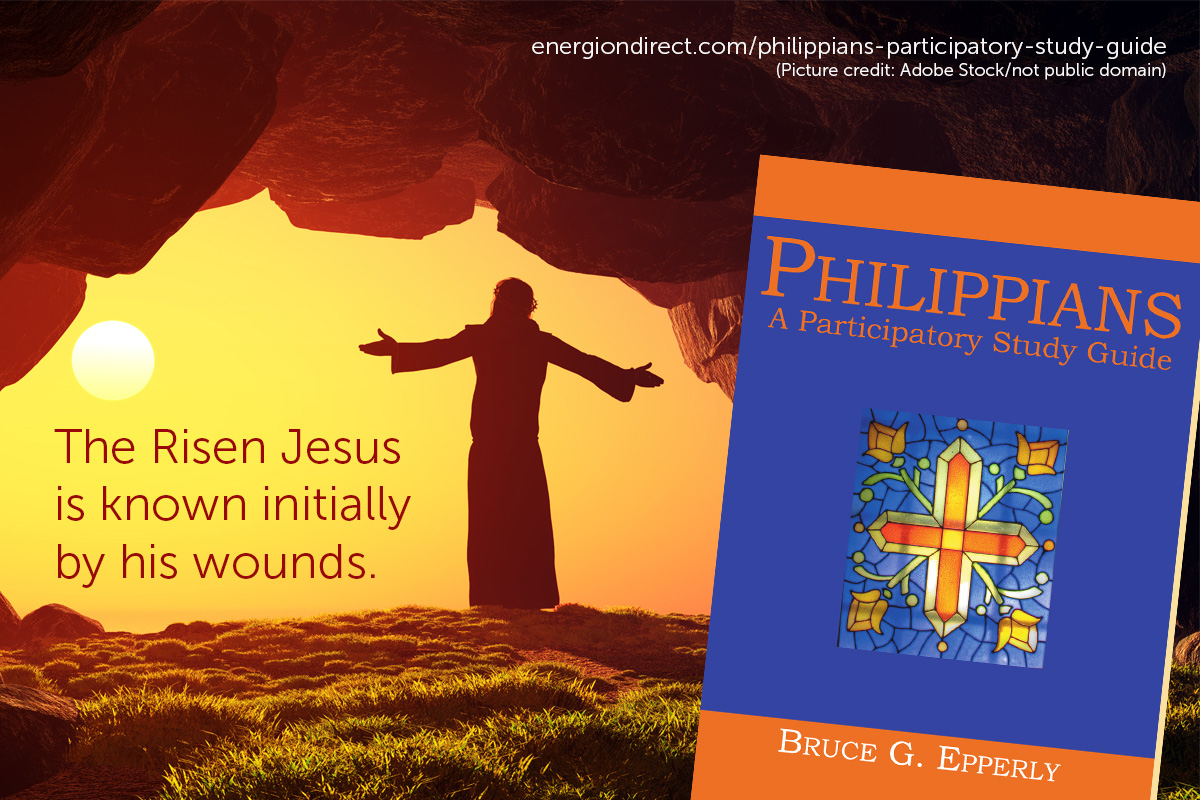
    This emphasized line led me to a quote from Bruce Epperly’s book Philippians: A Participatory Study Guide:

    Even now in our time, we can take confidence in Paul’s assertion that God is with us and that, in life and death, and celebration and persecution, Christ sustains us. We are resurrection people. But, our lives are also cruciform or cross-shaped. The Risen Jesus is known initially by his wounds, and we too may experience suffering and loss as a result of our relationship with Christ. Still, at the end of the day, integrity, fidelity, and the promise of resurrection life far outweigh any trials of this lifetime. – p. 19

    Bruce also quotes the song “I have decided to follow Jesus.” It’s a good song, but it’s one that should be very hard to sing. No, not musically, but due to meaning.

    (I must note here in passing that I love to use materials that come from very different theological streams. It is especially important, I think, when people from opposite sides of the spectrum agree fully on the meaning of a text, even more so when that text says something people would often rather not hear.)

    On the night when Jesus was betrayed, there were twelve people (at least) who had decided to follow Jesus. One betrayed him. One denied him publicly. The rest “advanced in the opposite direction.” We can take hope from the fact that so many found their way back!

    Ephesians 5:2 similarly gives us a hard call “walk in love.” Now we like that, because we often call very unloving things “love.” But the verse goes on “just as Christ loved us and gave himself for us. We have a very clear pattern for what love actually means. I’m a love proclaimer. I believe in the power of love. The reason love so often seems wishy-washy, that it so often fails, is that what we call love is often partial. It is not commitment, but rather a sort of generic liking. That’s why the key to following Jesus is not the experience of miraculous physical acts, or wealth, or healing for everyone in sight, or healing of all our emotional ills. The key to following Jesus is the willingness to take up the “privilege” of suffering for him.

    This, I must confess, is not the true story of my life. Nonetheless, just as I can travel northward by using the pole star as a guide even though I’ll never reach it, so I will keep facing this way, and trust in the grace of the One who gave himself first.

    (Allow me to call attention to two previous posts: God Perfected through Suffering and Thankful for the Gift of Suffering for Jesus?)

  • Why I Believe the Laws of Physics Will Continue Unabated

    Why I Believe the Laws of Physics Will Continue Unabated

    It’s hurricane time, as Irma approaches Florida. Note here that I make again the error of many Americans, which is that the hurricane tends to become of interest when it’s arriving at our shores. It has already been quite destructive in a number of places and right now in Cuba.

    Yet the discussion intensifies, and we are, inevitably, confronted with loads of hurricane theology. I think it’s because we get to watch hurricanes approach for such a long period of time. Earthquakes and tornadoes happen quickly more quickly. But we track the hurricane, we pray, and we do theology, generally bad theology.

    I do not here claim to have a corner on good theology. I am quite unabashedly regarding as bad theology any theology that seems particularly bad to me. So there.

    I am not, however, alone. Behold this tweet from author Carol Howard Merritt:

    Now before everyone gets the wrong idea, I do pray, and I do believe in prayer. It’s just that what people believe prayer will accomplish starts to get particularly silly when there’s a hurricane trundling along nearby.

    I’ve even prayed that God would mitigate the storm, or perhaps send it out to the open Atlantic, with due warning to all sailors who might get caught in its path. I have not, however, claimed that this prayer was likely to do a great deal to change the path of the storm.

    So why on earth did I pray it?

    This reminds me of talking with my Dad. My father was an MD, and a missionary. When he was not overseas, he was trying to serve those in need in the U. S. and Canada. He never made any money, and came as close as anyone I know to accomplishing John Wesley’s goal: Dying with only the change in his pocket.

    I occasionally had conversations with my dad about the possibility of going into practice in an area where he would make money. The nice thing about that, from my viewpoint, would be that I could afford more stuff. In my case that would have been books, parts for my radios, chemicals for a photo-lab, etc. (In relation to nothing in particular, I would note that I often feel sympathy for parents of children such as myself.)

    With my dad I would express my interest in such possibilities and how nice it would be to have more money. What I didn’t expect was that he would actually abandon his lifelong calling of service to others and go find a way to make money. I was honest about my desires, but I did not hold the discussion with some kind of expectation of results.

    Why? Because I knew my father. I knew who he was. I knew what he believed. There was as much likelihood that my father would abandon his calling as there is that God will discard the laws by which he has chosen to run the universe.

    Theologians may look upon general revelation, the revelation of God in God’s creation, with a bit of a jaundiced eye. Observation of nature does not easily result in the sort of ethical rules that a “Thou shalt not kill” does. Yet some of the most stable and definite indications of the way God works are displayed in the form of natural laws.

    Air over heated water. The rotation of the earth, the way in which a heated gas (like the stuff in air) will rise. High pressure ridges. Troughs. These are some of the many things that result in the formation of hurricanes and in directing their courses. “He makes his sun to rise on the just and the unjust” and “summer and winter will not cease” are reflections of this nature of God’s action. Of course, we already knew that from observation. Unless, of course, we have not been observing.

    So when I told God it would be nice for the hurricane to head out over the Atlantic, that was fine. But knowing just a bit about God, I wasn’t expecting that God would drop all the laws of physics just to suit me. God has been running the universe according to those laws by an estimated nearly 14 billion years.

    But I tell God in prayer anyhow, because that’s what I do. Then I more seriously pray for the people who are in the way of the storm and that those who can will provide the needed help, that we’ll all give as we are able. There’s the common saying that prayer changes things. Personally I think that’s fairly rare. What it does is actually much harder: It changes me. It changes you.

    And if it does that, it has done well.

    (I wrote a series of articles on this back in 2003, which are also included in my book Not Ashamed of the Gospel: Confessions of a Liberal Charismatic. They are The Hand of God, The Hand of God: Miracles, and The Hand of God: Prayer. I recently published a book by Dr. Bruce Epperly, Angels, Mysteries, and Miracles, which also deals with this subject.)


  • In Controversy, Build Community

    In Controversy, Build Community

    So the disciples decided to send help to the brothers and sisters living in Judea, as each one was able. They carried out their plan, and had Barnabas and Paul deliver their gift. (Acts 11:29-30)

    This is a short verse, but I think it’s very sweet. As the story of Acts progresses, we’re entering the phase of controversy between those who are welcoming gentiles to the church (without their first becoming Jews) and those who don’t wish to do so. It will get quite heated as Paul’s ministry gets going.

    But here there’s a simple pause. The believers in Antioch send what they can to the believers in Jerusalem. Nobody is asking which side of the controversy they’re on.

    Here’s the principle: In controversy, build community.

  • Responding to Church Criticism

    Responding to Church Criticism

    Steven Cuss took to The Jesus Creed (Scot McKnight’s blog) to respond to Francis Chan about the church. This is all about a very valid and, I think, much needed conversation about the church.

    When we criticize the church in America there can be many responses.

    1. Defensive – we are really, truly doing good things
    2. Could be worse – we have our problems, but we’re doing some good stuff
    3. Look at you – you’re making more mistakes than we are (or you have in the past)
    4. You’re too critical – you shouldn’t point out our problems because that’s negative

    There are a few more, I suppose, but those will do.

    The problem is that as long as we use these various responses, reform or correction will definitely not happen. Once we have responded, we have generally also minimized our need to act. We function a bit like a vehicle stuck in mud or sand. You can stomp the accelerator because you need to get moving, but all you do is rock a bit forward and then a bit back.

    I think that often describes our churches. We don’t take the serious steps that are needed to really have an impact on our culture. We want to be a little bit different, mostly in the sense that we attend church, but not be real salt, scattered through and changing everything.

    Now not all criticism is useful. Not all criticism is valid. But a great deal is. The person who aims to change cannot pre-moderate his or her comments. If you are making a call for reform, and nobody is getting upset, you probably aren’t doing it right.

    My blog header proclaims me a “passionate moderate” amongst other things. I think moderation is a good thing if you’ve found the right range of options and the right position. But sometimes the right thing is what everyone else regards as an extreme. I’d really like to find that “moderate” position at the center of God’s will.

    How about you?

  • Measuring Success

    Measuring Success

    It seems to me that one of the most serious difficulties we have in the church today is the way we measure success. We are driven by numbers and money. It’s easy, of course, to justify this. After all, if you don’t have money, you generally can’t help people. I am reminded of Chapter 3 of Acts, in which Peter (with John) says, “Silver and gold I have none,” yet look what they did.

    Still, the temptation is great to judge the success of a meeting by the attendance, and the success of a church by its budget. I’d add that I don’t suggest we think the other way either. Just because a church is prosperous does not mean its ministry and mission is in trouble. It’s just that I don’t see the numbers and the money as God’s measure.

    With that in mind I was struck by two verses in Chapter 8. Stephen has just been killed, and Luke tells us that Saul continues to persecute the church. Everyone except the apostles is scattered across the countryside of Judea and Samaria (v. 1).

    By our standards, this is a bad thing. All this talent is leaving the big church, the one with the resources to carry out the mission! Stephen is dead, and Philip is about to head out. “Everyone” doubtless includes many more. The church is being drained.

    If this was an American church, the next question would be how we would pay the bills for the facility. I recall one church that had a serious scattering of membership, and that became a serious problem. You have to sell some buildings or some land, and that can be difficult. Members don’t like the feel of selling off the property and there’s always a question of whether you’ll get enough for it. Besides, selling stuff and downsizing is a sign of defeat!

    We’d doubtless feel the same way about persecution. Now don’t get me wrong. I’m not a fan of persecution. I really don’t want to be persecuted. But if I can put it bluntly, I doubt God really cares what I want.

    In this case, something great happens. “As they were scattered, they went about proclaiming the Word …” (8:4). In the movement of the story of the early church as told in Acts we’re in that transition as we move from Judea to Samaria and from there to the whole world. The failure of the church as the members scatter is the success of God’s plan.

    I’m thinking we need to spend our time finding God’s plan and measuring our success by how much we’re on that. As I read scripture, I’m suspecting that plan may be different from ours. Let God speak and move in our generation.


  • There Are Plenty of Opportunities to Pray

    There Are Plenty of Opportunities to Pray

    School is starting, and so we have the regular drumbeat of comments about prayer in school. One of the most common, used at my church today, is the comment that as long as there are exams, there will always be prayer in public schools. Which is, of course, quite true. Also, largely irrelevant.

    Opponents of public school prayer aren’t trying to prevent students from saying, “Jesus help me!” as they start a test. (Well, I should make the “nut” proviso — I’ve discovered that there is really no idea so stupid that there isn’t a nut somewhere who will support it.) No serious opponent of school prayer is concerned with prayer before tests. What they’re concerned with is publicly sponsored prayer. The child is required to be there. The teacher operates with the power of the government. The prayer is sponsored by political authority.

    It’s not my intention, however, to discuss the politics, or to examine from the state’s side whether it’s a good idea for prayer to be prescribed or permitted when led by someone with official authority.

    My concern is with prayer by Christians, or even more with talking about prayer and promotion of prayer by Christians. What we say about prayer and what we do about prayer is important. My observation is that there are a lot more people talking about prayer and advocating prayer than are actually praying. This makes me wonder about the issues we choose to make central.

    During the course of a day I find that I can pray in my bedroom, my living room, my office, my car, walking on the sidewalk, sitting in a restaurant, meeting with a client … Hmmm! Come to think of it, there really are no places or times when I can’t pray in one way or another. The way in which I pray may be constrained. It might not be best to suggest a time of prayer with every client, though honestly most of them would say “yes” if I asked. Each circumstance may require a different approach to prayer, silent, aloud, head bowed, or not, brief, or longer, kneeling (rare for me), or lying down in my bed.

    If I complain that I can’t pray in a public place, I’m really complaining that I cannot make it clear and public that I am praying in that public place. If I’m willing for my prayer to be between me and God, the only ones who can block it are God and me.

    I’m leaving out of this discussion the question of whether it is good as public policy to allow some sort of officially sponsored prayer at public events. Personally, I prefer prayer to be individual or part of a voluntary community. But regardless of this issue, the opportunity exists.

    If your child or grandchild is going to public school, let me ask a few questions:

    1. Will you be praying with that child (if they are in your house) before they leave for school?
    2. Will you be praying for that child irrespective of what anyone at school is doing?
    3. Will you and your church be praying for your children and those of the community?
    4. Will you be modeling a life of prayer for your child or grandchild that makes spirituality inviting?

    I’m sure you can find many other opportunities and ways to proceed with prayer. Too often our underlying concern, as evidenced by our actions, is more with the public display of our spirituality than with the spirituality itself. This doesn’t mean that I believe that if you advocate for teacher led prayer in public schools you are somehow less spiritual. But if you do so without taking the opportunities that are available, it may be time for some self-examination.

    Come to think of it, even if you, like me, advocated for only voluntary prayer, your (our!) primary concern should be what we’re doing with the opportunities we have to pray every moment of every day.

    (Energion books on prayer.)

  • Acts of the Apostles and 21st Century Action

    Acts of the Apostles and 21st Century Action

    I publish a couple of books that use Acts of the Apostles as a source for principles to guide the 21st century church. I publish such books with a certain amount of trepidation, as it’s very easy to apply material piecemeal, which results in discovering that the biblical book in question tells us to do what we wanted to do in any case.

    Two books that deal with this issue in the Energion catalog are Transforming Acts: Acts of the Apostles as a 21st Century Gospel by Bruce Epperly and Seven Marks of a New Testament Church by David Alan Black. Now considering that the authors of these two books are some distance apart on the theological spectrum—Bruce is United Church of Christ and Dave is Southern Baptist—one might suspect that there is a wide gulf between what they see as most important or applicable in the New Testament church. In actuality, I found myself more surprised by the level of agreement involved. There are certainly differences, and yet there are themes that are clear to both authors.

    I suspect the level of agreement results from greater care in studying the text. No, I don’t believe careful study will make us agree on everything. Careful study tends to do two things: 1) It discovers clear themes, and 2) it clarifies and outlines differences and the reasons for them. I will repeat what I have said before: Most of the heat in arguments between Christians results from not understanding the way in which we’re using our sources. If we did understand the source of an opponent’s beliefs, that wouldn’t mean we’d agree, but it would reduce frustration. There’s nothing like having two people look at a text and clearly see different things. There is a strong temptation to assume the other person is stupid, obtuse, ignorant, or perhaps demonically deceived.

    Yet Christianity is a faith that is built on studying sources. We may differ on what those sources are, whether it’s the biblical canon, writers in the theological tradition, or authoritative institutions. The point is not to eliminate the inputs because they might be misunderstood or misapplied. Rather, I would suggest it is to study these sources with an awareness of the differences.

    One of the ways to do this is to actually study pieces of biblical literature as they were written. If I get to make a selection of texts, I can definitely bias the results. That doesn’t mean that I will find that everything there applies to my everyday life now, but I do need to be aware of the things I’m not applying and why I’m not applying them.

    I started re-reading Acts of the Apostles the other day, and was immediately struck by some of these kinds of issues. Let me note just a few.

    1. Acts 1:2-3 – Jesus teaches the disciples for some time following the resurrection. We don’t have a formal record of this teaching. Is this a plug for apostolic tradition? If it is, note that Paul wasn’t in on this, yet has provided us with much of New Testament theology.
    2. Acts 1:4-5 – Awaiting the promise of the Spirit. Acts was most likely written before John, but here we have that continuing teaching of the Holy Spirit, and when the Spirit does come upon the disciples, it seems to come upon the whole group. Is this a foundation for the belief that revelation continues and can come to each one of us?
    3. Acts 1:21-26 – Choosing a successor to Judas by lot. This one presents some interesting issues. I enjoyed teaching this to a class in a church that had just completed a search for a new pastor. I asked them if their procedure, much different from the one here, was biblical, which resulted in an energetic discussion. It’s interesting to me that we have no evidence here of prayerful discussion. Peter presents his interpretation of scripture, then two people are chosen that fill the requirements (we don’t hear the source of those requirements), and then one of the two is chosen by lot. God is invoked, but God is invited to choose between the two candidates selected by the apostles. At which point the chosen person disappears into history. Most of the book is about Paul, a person who does not fulfill the requirements and is chosen by a completely different method. So is God’s way casting lots or should we wait for the lightning bolt?
    4. Skipping Acts 2 and going to 3:1-10 – Is this the sort of thing that should characterize a modern church? If so, we’re largely too tame. And we should, of course, consider chapter 5 with Ananias and Sapphira. Church discipline, anyone?

    My purpose in making this truncated list is to show that there are things here we do (baptism, preaching, even healing [in some sense]), and others that we don’t (casting lots), and it’s worthwhile to realize that something more than just grabbing sentences or paragraphs and applying what they “clearly teach” is going on. I’m not complaining about that extra stuff going on. That’s part of life and yes, part of faith. The problem comes in when we try to pretend that we’ve dumped everything extra. (Note that there are churches who use a form of lots in selecting leadership, so that is a valid item to list.)

    The next question to ask yourself is just why you do certain things and not others. Why would you preach, baptize, accept into membership, but not heal? Why do you find it appropriate to await the baptism of the Holy Spirit, but not to choose all church leadership by casting lots? (Notice how I slipped “all” in there when it’s not in the text?) Understanding how we get wherever we are can help us understand one another. It might even help us with course corrections.

  • Praying for Our Leaders

    Praying for Our Leaders

    There has been some fuss recently about praying for political leaders, in particularly, regarding an image of folks praying for President Trump. I think that many prayers for and against leaders mistake the value that prayer has. Further, complaining about what other people pray is largely a waste of time, and again reflects a misunderstanding of the value of prayer.

    I recall the quote that “most people want to serve God, but only in an advisory capacity.” (I looked it up and found this attribution to former SBC president Adrian Rogers.) When the majority of our prayers involve telling God what to do, what does that say about our believe in the omniscience, omnipotence, and indeed, the wisdom of God? Many of those who pray positively for President Trump, advising God to destroy his enemies and to prosper the president, also prayed quite negatively regarding President Obama. Just as happens in the broader American society, in Christianity we tend to exchange scripts when the party in power changes. About the same number of prayers get said, and the same number of complaints made. They are just made by different people.

    My prayers for our leaders have not changed with the change of presidents. No, I do not deny having opinions, even strong ones, regarding various political issues. I have just chosen to spend my time on other things. But I prayed regularly that God would bless President Obama, and I continue to pray that God bless President Trump, according to his will.

    How can I do this since I must disagree with substantial policy choices of one or the other? Very simply. I believe that God’s blessing is always a positive thing. Some people worry about prayers that they don’t like. I do not. I believe God can and does work, but I both believe that he doesn’t need advisors, and that he’s not going to let self-appointed advisors get in the way of his divine plan. Some are concerned about “prayers amiss,” but I think that idea is the result of a misapplication of James 4:3, which actually supports the idea that God is not going to respond to a prayer for evil.

    So I welcome prayer, even ones I don’t like. I suspect that if I seek God, I may somehow get closer to him than I was before. The same thing applies even to those who advise God to do things I would disapprove. Opening yourself to God is both dangerous and wonderful.