Threads from Henry's Web

Category: Biblical Inspiration

  • Trajectories, Hermeneutics, Sexual Ethics, and Ecclesiology

    Reading Chris Seitz on the Biblical Crisis in the Homosexuality Debates (by Alastair Roberts) reminded me of three things I already believed:

    1. It is very dangerous to try to develop hermeneutics while wrapped up in a debate on a particular topic.
    2. The best test of one’s hermeneutics is to change the subject. Does it still work?
    3. Debate often tends to obscure the middle ground.

    Despite the pretentious title, I mean this to be a short post. I also would like to note that I have not read Chris Seitz; I have only read Alastair Roberts’ comments. But his comments are not particularly wild or annoying, compared to other things I have read.

    You need to read Alastair’s entire post, but here’s a key line:

    The flirting of many evangelicals with forms of trajectory hermeneutics is just one example of the way in which the creedal understanding of the relationship between the testaments has become compromised.

    I’ve written before about trajectories, and clearly I believe that there are trajectories in scripture and that we need to pay attention to them. This is part of my belief that we often develop doctrines of inspiration (and a resulting hermeneutic) that ignore the human portion of the communication. I don’t refer here to the prophet, but rather to those who receive God’s communication. The accuracy of communication cannot be stated without noting how accurately a message is received. But that is another topic which I discuss further in my book on the subject.

    What I’m interested in here is the suggestion that the debates about sexual ethics in general, and about homosexuality in particular, have done violence to hermeneutics that had not already been done.

    So I change the subject. What hermeneutic produces the liturgy and organizational structure of the Episcopal Church USA or the Anglican communion as a whole? How do we get from the New Testament to the cathedral, from the home meeting where everyone participated to church architecture with a raised platform and a privileged few leaders? Might I even go so far as to ask what trajectory permitted these changes?

    I note that one departure from scripture, in sexual ethics, is regarded as sufficient to prevent certain levels of fellowship between the United Methodist Church, of which I am a member, and the Episcopal Church or the United Church of Christ. The other, in ecclesiology seems less important to those in positions of authority.

    But of course that question is grossly unfair, because I could ask the same thing about the organizational structures and liturgy of the United Methodist Church. Well, as long as everyone is sinning in the same way …

    This reminds me of a conversation I had with a theology professor about a colleague who was teaching religion somewhere in the Bible belt. This colleague noted that there was a great deal of tension about his moderately liberal academic views regarding scripture as he taught. He was teaching a general course in basic Christianity, however, and eventually they came to sexual ethics. Suddenly the students reversed positions. The professor took the idea of sexual purity seriously, with sexual relations only permissible within marriage. Suddenly the conservative students thought their “liberal” professor was way too conservative.

    Which reminds me of another thing I’ve observed about the human side of doctrine. There are clean sins and dirty sins. Clean sins are the ones I commit. Dirty sins are the ones you commit.

    I wouldn’t want to speak for God, but I’m suspecting God’s view might be different.

  • Starting Ecclesiastes in Sunday School

    Starting Ecclesiastes in Sunday School

    9781938434662mWhile I was off teaching Revelation elsewhere, my Sunday School class at First United Methodist Church of Pensacola studied from Harvey Brown’s new book Forgiveness: Finding Freedom from Your Past. Harvey’s book is just 40 pages (it’s in our Topical Line Drives series, and that’s the limit), and we discovered just how many questions can be raised in 40 pages!

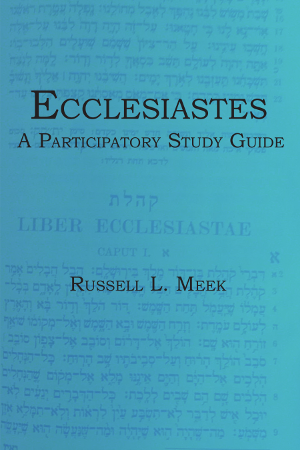
    Today we’re starting a study of Ecclesiastes, using the participatory study guide just published in November. This guide is written by Russell Meek of Midwestern Baptist Theological Seminary, and though I may be biased as editor and publisher, I think it’s one of the best studies you could do on the book of Ecclesiastes. Still, I’m going to have to tell the class that I disagree with a number of the conclusions in the book.

    But that, you see, is the great thing. Russ presents those conclusions so well, that I’ll have a run for my money making a case against things that he says, even with him absent. And in that discussion, I hope, the members of our small Sunday School class we’ll learn how these things are done.

    We’ll be talking about date and authorship today. This is an area of biblical studies that I think lay people in the church need to understand better. They take dates given in their study Bibles and assume they are either absolute, or at least they are a scholarly consensus. But how is it that serious biblical scholars make determinations about these things. Russ’s lengthy and very readable discussion of authorship is an excellent place to start.

    As I’ve been reading Ecclesiastes in preparation for this class, I’ve been struck by the interesting question of what the inclusion of such a book in scripture means about inspiration. No, I don’t mean about inerrancy, but rather about the way in which God chooses to communicate with us. I think we are often misguided in our discussions of inspiration because we are asking the wrong questions. Then we adjust our views of inspiration according to how effective scripture is at answering our questions. But what if God never intended to answer those questions through scripture in the first place? We might be doing something like querying our physics text to learn how to deal with our emotions.

    So I will also ask the class to think about just what questions might be answered by the inclusion of Ecclesiastes in the canon as well as by the text of the book.

  • Of Virgin Births and Whale’s Bellies

    Allan Bevere asks an interesting question today on his blog: Just how important is the doctrine of the virgin birth to you? He titles the post Must One Believe in the Virgin Birth to Be a Christian?

    I tend to annoy people on both sides of the spectrum (belief in miracles spectrum, of course) because despite the word “liberal” in the subtitle of this blog I do, in fact, believe in the virgin birth as an event that happened in history, but at the same time, I’m not concerned with whether others believe it or not. Allan cites Albert Mohler, who believes it is necessary to accept the virgin birth in order to be a Christian.

    Allan also stomps on one annoying tendency, the way in which some liberals tend to pounce on conservatives as less intellectual because of their beliefs. If one accepts miracles, one is less sophisticated. But I think it is only fair to point out the opposite fault in Mohler’s article, the tendency to regard liberals as less devout because of the things they don’t believe in.

    Nicholas Kristof pointed to his grandfather as a “devout” Presbyterian elder who believed that the Virgin Birth is a “pious legend.” Follow his example, Kristof encourages, and join the modern age. But we must face the hard fact that Kristof’s grandfather denied the faith. This is a very strange and perverse definition of “devout.”

    This is a conservative’s way of belittling an opponent, just as “intellectually unsophisticated” is the liberal’s approach. I must, however, point out that neither side is above using the other’s ammunition, and that both sides have those who avoid either fault.

    In support of my belief in the virgin birth, I will be very brief. I’ve already accepted the bodily resurrection, so the virgin birth hardly seems like an issue to me. At the same time, and more importantly, I accept the incarnation as both true and as the most central doctrine of Christianity, and if I can accept that infinite God can become a human being, the idea that this might be accomplished through a virgin birth again seems pretty trivial.

    In support of my belief that the virgin birth is not essential, I will again cite the doctrine of the incarnation. I believe the incarnation is absolutely critical. It’s quite possible, however, to see the virgin birth as a metaphorical statement of that doctrine, or perhaps more precisely an expression of part of the meaning of that doctrine. I don’t even claim to have any details in mind on how the virgin birth might occur. Did God create a new baby in the womb? Did God adjust the DNA? So despite believing in a virgin birth as a historical event, I don’t have a clue as to how it happened. Thus in teaching it, I probably say almost the same things as would someone who believed it was purely metaphor.

    And that brings me to whale’s bellies. On The Jesus Creed we have Scot McKnight getting involved in the question of the historicity of the book of Jonah. (I’ll leave you to follow the further links there.) A miracle of preserving someone’s life for three days inside a sea creature of some sort, whether a whale or something else, is again trivial alongside the incarnation and the resurrection. But I don’t believe the book of Jonah is historical. Why? I think there’s very good evidence in the text that we’re reading fiction designed to make some very specific points to an audience in a different time and place than the one in which the story is set. I don’t have a problem with the miracle. Were I convinced that Jonah was history, nothing else in my belief system would have to change. God could manage the whale’s belly thing. I just happen to believe God did not do so. But if you want to accuse me of being intellectually unsophisticated, go ahead. Because I am intellectually unsophisticated enough to believe the miracle is possible.

    Then there’s the question of Jesus’ use of the three days motif from Jonah. I will simply comment that I know one can refer to a fictional story in this fashion because I have done it myself. I’ve used a fictional story to illustrate a real event and it has generally worked just fine. Occasionally fine, fact-oriented, 21st century folks get upset with me about it, but I tell them to chill.

    I want to respond also to the first comment on McKnight’s article, which is from Joe Carter. Here he wonders how we might distinguish when Jesus is using supernatural power and when he’s using the knowledge of his culture. I’d make two points. 1) If Jesus didn’t use the knowledge of his culture, could he really have been said to have lived as a human? Would not constant supernatural knowledge make him not quite truly human? 2) Is this not the common problem in reading scripture? We distinguish the cultural background from the message all the time in case after case. Surely it is not that difficult in most cases, and in many cases where it is difficult, it is not all that important.


    Enhanced by Zemanta
  • Common Ground on Genesis

    On the Spectrum blog there’s quite a lot of discussion of the age of the earth and a search for common ground. The problem with the phrase “common ground” is that it can mean many different things. Two recent articles on the age of the earth had quotes that caught my attention. As far as I can tell (my specialty is Biblical languages, not any of the various sciences involved), the discussion of the various dating methods is quite good.

    This material comes from members of the Seventh-day Adventist church, my former denomination, and one that is pretty firm on the young age of the universe and a literal seven day creation week. Watching this discussion unfold amongst SDAs is something I find fascinating.

    The first article, Genesis Literalism and the Temple of Doom – I, after summarizing some of the methods, concludes:

    Even if the message is not one we want to hear, recognizing the validity of these tools of science should be the basis for common ground.

    Sounds good thus far. Then we continue with the second article, creatively titled Genesis Literalism and the Temple of Doom – II, and after some more dating methods are summarized we have another conclusion:

    The obvious question, then, is, “how should the Church respond to this evidence?” As suggested previously, perhaps the best way to deal with this evidence, given a predisposition in favor of YEC, is simply to say nothing about age. Taking this approach would act as a hedge against further compelling scientific confirmation of a very old age. To proceed in this way would preserve the Church’s credibility, and would seem to be the only approach to common ground.

    This one doesn’t strike me right at all. Essentially keeping silent about age when you’ve just admitted that the scientific evidence is entirely against young age seems very odd, and doesn’t seem any basis for common ground at all. Common ground between what groups or positions? In essence, by its silence, the church would say “We were wrong, but we don’t want to admit it, so now we’re going quiet.” Or so it seems to me …

    I see two options for someone convinced that the earth is old, yet who espouses some form of biblically based Christianity: 1) Take a new look at the biblical evidence or role in the discussion or 2) Admit science is against you, but uphold what you believe the Bible teaches. The first approach is mine, looking both at how we understand certain passages of scripture and also looking at the role God intended scripture to play in scientific discussions. I’ve written on that before. Dr. Kurt Wise and Dr. Todd Wood are examples of folks who take the second approach.

    I don’t think silence is going to work long term. I hope I will see in future installments that I have misunderstood the intent of the writer. I will certainly continue to read the series.

  • On Inerrancy Again

    My previous post refers to Preserving Democracy, written by my friend Elgin Hushbeck, Jr., but doesn’t actually mention that we have been friends for some time. I say this because I’m about to take his name in vain (sort of). We’ve been friends since the mid-90s when we met on the Religion Forum on Compuserve.

    One of the books I publish is Elgin’s book Evidence for the Bible. Now he doesn’t explicitly argue for inerrancy in that book, but he does affirm the doctrine of inerrancy, while I do not. I recall when I had occasion to drive him from Pensacola to the airport in New Orleans, after he’d spoken at a conference I had organized, and we spent the nearly three hours involved in discussing inerrrancy and applying it to specific scriptures.

    What we found was that we stated our view of scripture differently, but when it came down to specific cases, we handled passages in a very similar way. Our practice was much closer than our theory. Now I would maintain, and I suspect Elgin would as well, that a good theory works in practice, and thus there is probably some weakness in the expression of one or the other view of inspiration, if not both.

    I was reminded of that conversation when I read the iMonk Classic: We thought he was such a nice boy…and then we found out he didn’t believe in….Inerrancy!!, and a response on JOLLYBLOGGER. Many of the arguments are very similar, even though I’m not a Calvinist. In the places one refers to belief in Calvinism one could, with equal force, refer to similar positions from Arminianism.

    I commend these two posts for re-reading and discussion. I haven’t yet changed my mind, but there are serious points here that deserve consideration.

  • Adrian Warnock on the Doctrine of Scripture

    And as you might expect, I’m disagreeing with him. In introducing a post urging people to read Wayne Grudem’s Systematic Theology (not a bad idea), he says:

    There is no more foundational subject than the doctrine of Scripture. All the current theological arguments that are causing such disruption in the Church today stem from a lack of confidence in the authority of Scripture. …

    Now the first part of that statement is pretty obvious and quite foundational. I don’t think we can be Christian and talk about being Christian without dealing with the doctrine of scripture. However far you may end up away from regarding scripture as foundational, you’re going to have to deal with this doctrine.

    As it happens, I believe that scripture is foundational, and whatever we believe must be rooted in it. Not only our doctrine of scripture, but also our hermeneutic that is derived from that basic doctrine is critical in how we will understand and live our faith. I would like to see us discuss this more.

    But the second sentence is quite problematic, and I think represents one of the greatest barriers to sound dialog within orthodox Christianity today. Let me quote it again:

    All the current theological arguments that are causing such disruption in the Church today stem from a lack of confidence in the authority of Scripture.

    Um, not so much. Now there are people who lack confidence in scripture, and this can lead them to many odd views, views which fall outside of reasonable definitions of the bounds of Christianity. There are also people who express (at least) great confidence in scripture but who show no great ability to actually discover what it’s saying.

    Yes, there are certain disputes which results from differences in various people’s confidence in scripture, but I don’t think they are the major ones, and I especially don’t think they are the bulk of those that are debated within orthodox Christianity.

    Let’s illustrate with a point I’ve debated (indirectly via blog post) with Adrian before, penal substitutionary atonement. For Adrian, nothing less than viewing penal substitution as the meaning of atonement is adequate.

    I believe that penal substitution does occur in scripture, but that it is one of a number of metaphors, all of which are required for an understanding of the atonement. I believe this, not because I lack confidence in scripture, but because I am confident that a full scriptural understanding of the atonement requires much more than penal substitution. Like every other finite description, using penal substitution exclusively or even to diminish other views, especially in my view christus victor, diminishes our understanding of the atonement.

    From the evidence of reading Adrian’s blogging over several years, I’m certain that penal substitution is a “current theological argument” and is “causing disruption” and thus I must exclude it from any list of those based on a lack of confidence in scripture.

    I think I made my best statement on this in my post from last Easter, Atonement: The Error Adrian Warnock and Giles Fraser Share.

    I see a similar type of issue in the debates over creation and evolution and certain major figures in reformed Old Testament studies, such as Peter Enns, Bruce Waltke, and Tremper Longman. I think it would be ridiculous to assert that these three men lack confidence in scripture, yet they are in the middle of a theological controversy. The difference is not confidence but the way in which they understand scripture.

    In connection with this I appreciated Jeremy Pierce’s recent post, Arguments Against Old Earth, in which he reclaims the term “creationism” for any set of beliefs that God created the universe. I am a creationist, because I believe in God the creator. I do want to debate a bit about Jeremy’s categories, though they are really quite good. That’s for another post.

    In summary I would say that the problem in most theological debates within Christianity is not confidence but understanding. There is an element here where one’s hermeneutics make the decision, but in a number of cases, such as understanding 2 Corinthians 5 an imputed righteousness, I think often the hermeneutics are similar, but the application is different. Confidence, however, is not part of the problem.

    (Note: I have not yet read, but I do intend to read Adrian’s book Raised with Christ: How the Resurrection Changes Everything.)

  • BioLogos and Reasons to Believe in Dialogue

    While I am much more in support of the approach of BioLogos than Reasons to Believe, I’m glad to see that they are discussing. Perhaps laying out the details of each group’s approach may help Christians understand the issues more clearly.

    I see very little future, however, for the day-age theory, despite its strong acceptance amongst Christians. I think it’s rather an uphill battle to suggest that the actual intent of the writer of Genesis 1-2 was to portray the days as ages, and fitting geological history into a day-age theory seems to require some selective use of the evidence.

    I think the evidence is pretty good that the early Israelites would have heard this primarily as seven literal days. It is the progress of geology and biology, particularly evolutionary biology that makes us think otherwise. My position continues to be that God speaks to a time and culture in words and concepts that are understood by that culture. If we then listen in on their dialogue with God, as we do in reading scripture, we must translate the message into a new cultural context.

    Thus I see much more role for theology than for strict exegesis in the reconciliation of Genesis and science, though I believe that the process of reconciliation largely teaches us that such reconciliation is beside the point.

  • Scot McKnight on Walton on Genesis 1

    Scot McKnight has started an 18 part discussion of John Walton’s book The Lost World of Genesis One: Ancient Cosmology and the Origins Debate. Even though I have not yet read Dr. Walton’s book, I can tell you that this is a very important discussion for Christians and that I expect much value just from reading online discussions.

    This first installment, referring to chapter one of the book, examines the claim that Genesis 1 is ancient cosmology and that God spoke to the Israelites using their knowledge of cosmology. Incidentally I have been arguing this since I was in college, and it is hardly original with me. It takes a long time for this sort of thing to penetrate from theological schools to popular level books.

    To summarize:

    “God communicated his revelation to his immediate audience terms they understood” (17). … [page # refers to book page #-HN]

    Just so. That sentence could be considered the critical and central point of my own view of inspiration. That is why I can see something in scripture that is clearly wrong–according to our understanding of the data–and yet not say it’s wrong. It was right at the time and it is right for us now, because God intends us to read as a community that continues in time, and thus we are asked to understand both the human audience (both prophet and people) and the Divine Speaker.

    I would note one thing here, which is that simply seeing Genesis 1 as ancient cosmology doesn’t settle all issues in the origins debate. I’ll be interested to see what transpires in further chapters. What I have found most tricky is dealing with the fall and redemption.

    I’m very eager to see the rest of this discussion and to get my hands on Walton’s book.

  • Interpreting the Bible VIII: Biblical Literalism, Attitude, and Avoidance

    This is a continuation of my series on interpreting the Bible. The first post in the series is Interpreting the Bible I: Obvious Exegesis, while the most recent one was Interpreting the Bible VII: Christians Contribute to Confusion.

    As a reminder, my starting point was a number of comments that suggested that those who take the Bible less literally are thereby less serious Christians. These suggestions were not coming from conservative Christians, but from non-Christians. In some cases, I question the motivation of such suggestions. I believe that Richard Dawkins, for example, prefers to debate hard-line fundamentalists, and so would like to dismiss the rest of us from the Christian faith.

    What I believe I have done so far is to show that interpreting the Bible, broadly called hermeneutics, is a bit more complex than these folks would like, and that just taking the Bible literally, as best as I can understand what they mean by “literally,” is not the way Christians have read the Bible historically. I have further noted that even basic exegesis, which I define as looking for the text as it was intended to be understood by the original audience, is more complex than these folks let on.

    Those who are eagerly waiting for me to solve issues such as the violent passages in the Bible or gay and lesbian marriage will still have to wait. While I will discuss those issues, my primary purpose here is to look at the method. I believe that our discussions of the Bible would be much more profitable if we would simply think and talk more about how we come to our understanding, rather than simply trying to defend that understanding. Two people may mean very different things by saying that a concept is “Biblical.”

    Let me reiterate here, as I believe has been demonstrated previously with the help of commenters, that the issues I’m discussing do not hinge on belief in inerrancy. Belief that the Bible is inerrant does not limit one with reference to determining what type of literature a particular passage is.

    I want to clarify this further by using a couple of examples. Two controversial books amongst conservatives are Jonah and Job. There are quite a number of people, even conservatives, who will claim that these books are fiction. To make that claim doesn’t mean that the books contain error. Rather, it means that they intentionally present whatever it is they present in fictional form. Now there are those who regard fiction itself as evil, but that is a different argument.

    Let’s say you have a historical novel, written with the intent of accurately portraying a certain place and time in history, but doing so using fictional characters in a fictional narrative. What would constitute an error? Well, if one introduced an historical event connecting to the story, and placed this event at the wrong time, it might be an error. Suppose one had an historical building, and it didn’t exist at the time in question. That might be an error as well.

    The key in all of these points would be the author’s intent. Such an author might well introduce a house or a small street that was not historical, but wouldn’t presumably introduce a new city hall. There are things that the historical novel wishes to convey that are facts, and there is a story to be enjoyed along the way. Similarly, C. S. Lewis is not in error in the Screwtape Letters if there is no demon named Screwtape, nor is he in error in the Chronicles of Narnia if there is no Narnia.

    I find this comparison to be of interest in the books of Jonah and Job, because I think we often get to argument about little houses and back streets in the story, while missing the big things.

    In Jonah, I frequently hear discussions of two major issues: First, was Jonah really swallowed by a “great fish” or a “whale”? Second, was Nineveh really so big it would take three days to walk across it. (Those who know some Hebrew may laugh a bit at the particular rendering there–I’m using the form in which I normally hear the question.) But are those really the questions?

    I would suggest several themes in the book of Jonah:

    1. God can call you to uncomfortable places and missions on which you would rather not go.
    2. Even when you’re going the other direction, God is likely to take note.
    3. Intervention may be uncomfortable–note how Jonah ends up on shore.
    4. God offers repentance even to people I may hate.
    5. God is gracious and merciful, even to the worst of sinners.

    … and a few more, none of which are really impacted by whether the story is fictional. All of these points have annoyed someone at some time, and indeed according to the story, they annoyed Jonah, and presumably were controversial amongst the readers of the book. I am not here trying to argue these points. I’m simply saying that finding fiction in the Bible is not the same thing as finding error.

    I consider Job even more interesting. If the book is historical, then we have an individual who suffered because God allowed him to be attacked and tormented. This may, of course, be extended by analogy or in principle to others. On the other hand, if the story is fictional, then one would have to assume that Job is presented as a type of sufferer, and that it is quite possible that God might call on me–or you–to suffer to make a demonstration for him. Are you concerned that bad things seem to happen to good and bad people alike? Here are some bad things that happen specifically to good people.

    Now you can get that second idea while reading Job as historical, though I have heard some folks argue that this is something that happened only once (they forget about Jesus, apparently), but I think that if you read it as a fictional account, you are forced to the conclusion that it applies broadly in principle–God’s servants may be called to suffer in the fight against evil, and they may never know just why. Note that Job never receives an explanation of his suffering.

    So you note here that the issue is not whether the text is in error or not, or whether one takes it literally or not, but rather just what are the literary characteristics, what is meant by them, and just how that might apply. If I could delete one statement from the vocabulary of Christian conservatives it would be: “I take the Bible literally.” If I could delete one statement from the vocabulary of liberal Christians: “I don’t take the Bible that literally.” Both are misleading. (As I note in my review of his book How to Study the Bible for Yourself, Tim LaHaye makes this his first rule of hermeneutics. Needless to say, I disagree; in fact, I regard it as one of the worst rules.)

    If I might pound this point into the ground a bit, some interpreters, including LaHaye, have applied this to the book of Revelation. But just what should one take “literally” in the book of Revelation? Personally, I tend to take the introduction quite literally when it uses a variety of literary indicators to show that John saw a vision. Once we’re in a vision, I take things as a vision, which may have varying degrees of attachment to physical things, and I believe that is the correct way to take them. Even where there are likely literal connections, such as with the churches, or with a number of symbols, the vision context warns us to look for more than meets the eye. Revelation 12 & 13, for example, while containing symbols that may be attached to specifics, also provide a very good general appreciation of the battle between good and evil, and numerous principles for living in the midst of such a battle. The literal/non-literal dichotomy is terribly inadequate to the task of understanding such a passage.

    Some may be wondering how one would take the vision framework non-literally. There are many commentators who would treat the “vision” as a literary device used to present a set of symbols. It is quite possible to understand it in that way, though I disagree. In fact, I think assuming an ecstatic state, in vision, for some of the writing of Revelation will explain some literary and linguistic peculiarities, but that is a completely different topic.

    Now I would maintain that conservatives, liberals, and those between are all susceptible to coming up with ad hoc interpretations that allow one to avoid the impact of a text, or to make a text have an inappropriate impact. Let me start with a controversial one.

    Leviticus 18:22 is commonly presented as a text demonstrating that homosexuality is sin and unacceptable. (Note that “I don’t take it that literally” doesn’t seem to work here. It’s pretty literal.) I like to present people with Leviticus 19:33-34, which says to treat an alien living among you as one of your own citizen. Now I’m not arguing what applies here and what doesn’t. Both are literal commands given in the same general body of law. A valid approach would be to ask just how commands given to Israel in Leviticus apply to others.

    But avoiding all of those issues, it’s very interesting to watch people’s responses to this connection. First, it is almost universally assumed that simply because I present Leviticus 19:33-34 I believe that Leviticus 18:22 is not applicable. Liberal audiences often assume that because they want to; conservative audiences assume that because they can’t imagine why I would present them with such an alternative text if it isn’t to undermine the impact of the first text.

    But the real question here is why and how either text should apply. I would suggest that there are similar tasks of interpretation and application that need to be used in both cases. In actuality, however, with most lay audiences I find that these two texts apply according to cultural inclinations. Those who favor gay and lesbian inclusion exclude 18:22 and very often the same people are delighted to include 19:33-34. Those who oppose homosexuality accept 18:22 as applicable, but will explain that 19:33-34 was for a different time and place.

    I would suggest that the processes of interpretation and application for both are complex, and that in neither case is the best approach simply trying to interpret the individual text. If your question is how should our nation treat aliens residing in the country, I doubt you will find clear direction as to what the law should be. If the question is how you, as an individual Christian, should treat aliens, I think you will find many scriptures that you can group together in finding the proper principles to guide your behavior. Similarly with homosexuality, I think the approach that says, essentially, “How many texts are there that forbid homosexual acts, and how can I (or can I not) explain them,” is precisely the wrong approach. A better approach to any question is to try to discover God’s ideal, and then look at how we might approach that.

    To continue with my examples, however, let me look at another passage:

    32Now the whole group of those who believed were of one heart and soul, and no one claimed private ownership of any possessions, but everything they owned was held in common. 33With great power the apostles gave their testimony to the resurrection of the Lord Jesus, and great grace was upon them all. 34There was not a needy person among them, for as many as owned lands or houses sold them and brought the proceeds of what was sold. 35They laid it at the apostles’ feet, and it was distributed to each as any had need. — Acts 4:32-35

    Here again you have a verse that can split interpreters right in the middle! Out of the characteristics of the early church just what are we supposed to apply today. Many of my more liberal brethren are pretty happy with the common ownership thing, and there being nobody in need in the church. They will take various attitudes toward the rest, such as whether this should be done entirely by the church, testimony to the resurrection, and so forth. There are many who would make Christianity a matter of the distribution of wealth, without any regard for the testimony to the resurrection.

    On the other hand, I can cite my own uncle, Don F. Neufeld, an interpreter in the Seventh-day Adventist Church, associate editor of the SDA Bible Commentary and editor of the SDA Bible Dictionary. In a personal conversation he was quick to point out to me that this practice was quickly abandoned by the church and didn’t appear to be the norm in Paul’s congregations, for example. This strikes me as an example of finding trajectories in scripture, something I think is quite appropriate, yet is often criticized as too subjective.

    I have heard many other explanations for common ownership, most aimed at keeping the early church from being too socialist. So here we have otherwise conservative interpreters finding the exit ramp in the middle of this verse. But liberals need not crow, because Christian unity, power, and mutual support is inextricably linked to the testimony of Jesus risen from the dead, and I think it would be difficult to build a case that the author of Luke-Acts would think it possible for it to be any other way.

    (I am aware that liberals do not necessarily deny the resurrection, though many do deny a physical resurrection. I am called liberal, and I personally accept a physcial–or bodily–resurrection. Nonetheless I believe that it is a liberal weakness to attempt to separate good works from the incarnation, and that is a weakness I see as ultimately fatal to Christianity.)

    The issue, I think, is our attitude in approaching scripture. There can be quite a variety of approaches to understanding scripture, and none of them are necessarily related to whether we take scripture seriously. What I would say characterizes a distinctly Christian approach to (Christian) scripture is the attitude of openness to correction. Each approach to interpretation can be used as a means of avoiding things I don’t like, i.e. of making scripture simply the excuse for what I wanted to do anyway.

    Liberal and conservative Christians don’t differ so much on the basic desire to avoid certain passages as on which passages they avoid and how they go about avoiding them.

    (I will continue next time by trying to look faithfully at some of the violent passages in the Old Testament. Don’t get impatient–this series will go on for a long time. Apologies to those who want a quick answer; I don’t believe in quick answers.)

  • Borrowing and Inspiration

    I want to discuss inspiration just a bit, partly because it is relevant to my next post on Biblical interpretation (I hope to post it later today), and partly because there is someone on Twitter who is spouting a great deal of nonsense with regard to parallels and borrowing.

    (For those interested, he is @BibleAlsoSays, he claims to be “Religion’s Nightmare,” and he has a rather routine web site by the same name. If you are a believer, don’t worry about going to the non-believers side. You’ve likely heard all these accusations before.)

    But my purpose here is to take a quick look at the way in which we debate inspiration, particularly, but not exclusively, when we’re using the term “inerrancy.” I would note that the problem I’m discussing remains the same in any discussion in which some form of inspiration beyond an ordinary text is claimed of scripture.

    I recall an e-mail discussion I had with a Muslim lady some years back. She seemed to believe I was a sincere Christian who might be willing to look at something better. We exchanged several e-mails, but her final attempt to persuade me can be summarized as: The Qur’an provides you with a clear and absolute answer for every question and aspect of life.

    Now I don’t know enough about Islam or the Qur’an to say just how many Muslims would agree with that, though I have heard it from more than one Muslim, so I know it is not a unique argument. What ended our discussion was my response. I told her that I didn’t find that to be an attractive quality in a holy book. She was quite stunned.

    You see, to her it was obvious that a book that answered all of her questions and gave her absolute ground on which to stand must be divine.

    I hear the inverse of that argument quite frequently. There is some aspect or another of the Bible that someone thinks is inconsistent with divine revelation. They bring this to me, sometimes repeatedly, because it is so obvious to them that it is the nail in the coffin of my faith, and they are quite stunned when my faith doesn’t merely rise from the supposed coffin–it never got in it in the first place.

    The problem, stated simply, is this: What are the proper characteristics of divine revelation, and how do you make that determination? In each of these cases, someone has determined what divine revelation must or must not be, and thus their argument is conclusive. Well, it’s conclusive if you accept their assumption.

    Now some of you might be questioning me on another point, which is just how parallel the parallels are, and just how “copied” the copied scriptures are. This is a good question. While one may find strong parallels to the stories of creation and the flood, one also finds significant differences.

    It is my contention, for example, that the Genesis account was not copied from the Babylonian or Sumerian accounts, but that the author was aware of other creation accounts and intentionally contradicted them. One need only compare the function of the wind in Enuma Elish to Genesis 1:2 to get my basic point.

    But in addition, while one may demonstrate a parallel in certain places, it is much harder in others. Where in the ancient world do we find poetry comparable in style and theme to that of Isaiah 40-66? Where do we find struggles with God that are truly like those of Jeremiah?

    But valid as those points are, I don’t think they get to the basic point, which is that we impose a set of assumptions of what a sacred text should be on various sacred texts, which would result in nothing more than selecting the sacred text that we find most helpful to the needs we feel. But is that a valid argument for truth?

    I would suggest that a major part of the problem here is the attempt to select a religious text as standard prior to a “selection” of faith or a faith community. In my own experience, an acceptance of scripture was not logically prior to an acceptance of Christ, even though I knew scripture.

    I might put it this way: The good news (gospel) is not that the Bible is true and you ought to obey it, but rather that Jesus Christ died for your sins and rose from the dead. I become part of the body of Christ first, and then accept the scriptures because they testify of Jesus.

    Now I don’t want to make this a purely fideistic approach. I do believe there is a place to discuss reliability, but that place is within the context of the body of Christ and not as a sterile issue that simply attempts to demonstrate a body of facts. But at the bottom of my belief system, unsurprisingly, is an act of faith. Without that act of faith, the rest does not seem nearly so logical.

    Apart from the conviction in my heart–you ask me how I know He lives / He lives within my heart–I would not be able to get past the impossibility of the resurrection. Let me add here that those who try to make the resurrection more “possible” do nothing for me. If the resurrection is “possible” in a natural sense, then it is also meaningless.

    Thus, for me, learning about inspiration has been much more of a journey in which I look at how God works. I learn more about how God speaks by looking at how scripture works–borrowing and all–than I do by reading specific texts that discuss inspiration. By looking at scripture I understand how God works.

    There is one other point regarding borrowing. People who make an issue of borrowing in the ancient world seem to me to be generally unaware of literature. What we call mythological themes are repeated in literature all over the place.

    To call this copying plagiarism, besides being anachronistic, is to ignore the passage of time and the contemporary standards of referencing. But saying that the Genesis story of the flood was copied from Gilgamesh, or that the first chapter of Genesis was copied from Enuma Elish ignores even modern standards. The standard movie disclaimer “inspired by a true story” might be closer to the truth.

    To be effective, communication must communicate, and that involves using relevant themes. Mythological themes come from the problems of real life, and it should not be surprising at all that they are repeated multiple times.

    I would add one final note, though this blog post is getting too long. In establishing parallels, one must look at both similarities and dissimilarities. One can make almost any two stories seem parallel if one is permitted to list only similarities. On the other hand, one can prove that two stories are not at all parallel if one is permitted to list only dissimilarities. You can only establish some form of true relationship when you consider both, and in addition account for universal themes.

    For me, the study of parallels is a completely relaxed process of looking at how scripture communicates–a wonderful blend of human and divine. Without the human, it could not be said to communicate; without the divine it would have nothing to communicate.