Threads from Henry's Web

Category: Biblical Inspiration

  • Numbers 30-31, Biblical Cultural Shock, and the Process of Hermeneutics

    Since I wrote recently about biblical culture shock, and have also commented from time to time on our impatience with the process in politics, it was interesting for me to come to Numbers 30 and 31 in my evening reading.

    [ncs_ad pid=’9780842334280′ adtype=’aer.io’ float=’left’]Numbers 30 is a sort of kinder, gentler sort of culture shock. It’s about vows in general, and more particularly about women and vows. When can “a woman’s man” abrogate her vow. If you read this passage negatively, there’s a certain sense that a woman needs to be protected from rash vows by a sensible man, whether by her father or her husband.

    Underlying that is a much more robust view of the sacredness of the vow in the first place. Promises are somewhat weaker in our modern society, so we really have two levels of culture (at least) in this passage to get past. The first is the idea that a rash vow to do something stupid would actually be binding. I think our modern view would be that if it’s rash and stupid, don’t do it, and God will forgive you. If it’s a verbal agreement with someone else, we still might wiggle out. Even if it’s in writing, we’ll probably try. But those “outs” are not permitted by the text.

    It’s important to note a category of cultural issue here. We have to adjust to the question in order to understand the answer. No, this isn’t presented in question and answer format, but much of Torah is answering various questions about how a group of people will come to be a society and live together. How do we work things out? There are other passages in scripture where this problem occurs. Take 1 Corinthians 14:40 as an example. I’ve heard this quoted so many times, often to state that we must rigorously follow the order of service contained in the bulletin. But the question Paul is answering here is not “can there be deviations from the church bulletin?” Rather, he’s talking about a large group coming together in which most people feel they have something to express in the gathering. (What about church bulletins? Use your common sense. I’d suggest saving trees by not printing them.)

    So once we’ve gotten past that, we have the next issue which is the subjection of the women to men in what is clearly a serious spiritual issue. There is an assumption underlying this passage that the responsible spiritual decision maker in the home is a man, whether the father or the husband. It is on his action that the result is based.

    I’m an egalitarian, and so, I suspect, are many of my readers. I don’t want to debate that right now. Whether you are egalitarian or complementarian, consider your reaction to the passage in connection with your existing beliefs about the roles of men and women. I’m reading this passage through with the Cornerstone Biblical Commentary on Leviticus, Numbers, and Deuteronomy, with the Numbers portion written by Dale A. Brueggeman. Here’s a quote regarding vows in the New Testament:

    As in this text, wives were expected to be subject to their husbands (Eph 5:22-24; Titus 2:5; 1 Pet 3:1-7), although mutual consent had become a strong consideration (1 Cor 7:4). … (397)

    So we’re going to find some variety among Christians today in how they might relate to the relationship between men and women reflected in this passage, as well as to the general idea of a vow.

    [ncs_ad pid=’1893729907′ adtype=’aer.io’ float=’right’]The attitude toward vows becomes a critical element of Alden Thompson’s exposition of what he calls “the worst story in the Old Testament” in chapter 6 (pp. 99-123) of his book Who’s Afraid of the Old Testament God?. The passage covered is Judges 19-21. There the nation of Israel has sworn a rash vow that they will not give any of their daughters to the Benjaminites as wives. When they find that they have reduced the tribe of Benjamin to a small number of men (no women at all!) they want to find a way out. Now the modern idea would be to get together and repeal the previous vote, but the sacredness of the vow/oath is such that this isn’t an option for them. Instead, they find alternative ways to provide wives. (You’ll have to read the passage.)

    I would suggest that, contrary to Alden’s chapter title (as much as I like it), the next chapter in Numbers may be the worst story in the Old Testament. Numbers 31 is pretty dismal. Those who might call Christianity or Judaism violent religions might well cite a passage like this one.

    And herein lies the question of interpretation. We find it easy to bypass or ignore a passage like Numbers 31. You’ll find very few Christians who believe that the behavior of the Israelites, even though it is presented as divine command, is something we would apply today. We’ll have various reasons for doing so, and in looking at how we apply this passage, we can discover a great deal about how we interpret scripture.

    Think about how you do it. Then compare how you respond to Number 31 with how you responded to Numbers 30. Are the two approaches the same? Or do you have a sort of ad hoc explanation which comes out with a result you “know” is right, but which cannot be applied universally?

    I’d suggest that we need to consider our method of biblical interpretation carefully and ask whether the same method works everywhere.

    I wrote something about Numbers 31 for the spring issue of Sharing the Practice. You can find that article online, Preaching an Unpreachable Passage.

  • Inerrancy according to the Chicago Statement

    Tim Bulkeley is asking a question about the Chicago Statement on Biblical Inerrancy. When I say that I reject biblical inerrancy, a frequent (and valid) follow-up is to ask what kind of inerrancy I reject. The answer, for me, is the inerrancy of the Chicago Statement.

    If you’re wondering what about that statement I reject, I could point to plenty of items, but the short answer would be Article XII, which Tim Bulkeley quotes, especially this: “We further deny that scientific hypotheses about earth history may properly be used to overturn the teaching of Scripture on creation and the flood.”

    I’ve written on all this before. For now I just want to provide the link and open the discussion.

    Note the recent series of articles on the Energion Discussion Network:  Creationism: A Denial of the Authority of the Whole Bible, A Literal Reading of Genesis 1-3Which Creation is the Greater Witness?

  • Links and Notes on Textual Criticism

    Links and Notes on Textual Criticism

    Grid-Pattern-200px
    Grid Search Pattern by Scout, OpenClipart.org

    Jeremy Myers at Redeeming God has an interesting post on textual criticism (HT: Thomas Hudgins). Myers is comparing the textual commentaries written by Bruce Metzger (with input of the UBS committee) and Philip W. Comfort. It’s fun to watch the critical scholars disagree!

    If anyone believes I consider that a negative comment on critical scholars, let me disabuse you of that notion. It is, instead, a comment on the texts and sources we have to work with. The reason we have disagreements is not that scholars are somehow stupid or unnecessary, but rather that the evidence is, in fact, complex and requires serious study. Often there isn’t enough evidence to come up with any real conclusion. Where I would criticize critics, and in fact any biblical scholar, is in making conclusions that imply evidence that is better than they have or are likely to acquire.

    When attempting to make the evidence solidly in favor of one conclusion, Christian apologists like to spend their time talking about the New Testament. Why? Because the New Testament evidence is much clearer. Not necessarily clear, but clearly than that for the Hebrew scriptures (or Old Testament). You have an abundance of New Testament manuscripts that tends to put most issues into pretty strong consensus territory. Such is not the case for the Old. We have, in many cases, just enough evidence to suggest that there is a great deal we’d like to know but lack the evidence to study. Looking at the differences between the Septuagint and the Massoretic Text, for example, suggests many possibilities, but leaves us without a detailed trail of evidence to study.

    There are a number of responses to this complexity. We can give up on knowing what scripture teaches. We can decide that the inspiration of scripture operates in very different ways. Or perhaps we can think that the Holy Spirit guides people in the church (and out of the church, for that matter) as they study, and that God doesn’t mind that we come to different conclusions.

    I choose the latter, and apply this to various higher critical methodologies as well as textual criticism. The details are fun to study, but we don’t have to settle all the details in order to be followers of Jesus. We don’t have to settle all the doctrinal issues in order to be followers of Jesus. Yes, it’s fun, and I think even useful to study all those things, but settling them is not necessary. God can guide you when you study your English (or other native language) Bible as well as he can study me when I read Hebrew, Aramaic, or Greek. Maybe even better, for all I know.

    Because I believe that inspiration resides in God’s actions in history and that one of those actions was the production of scripture (yes, scripture in its various debated forms), I think it’s still useful to study everything about the text, from its prehistory to it’s canonical state, to it’s dissemination and variety of translation. I don’t believe God resides at just one point. I may hear from God as I apply source criticism to Genesis, for example, seeing two different creation stories and looking at them independently. I can also hear from God when I see those as combined into the larger volume of the book of Genesis and the Pentateuch as a whole. I can still see God when I look back at that creation story from the perspective of the New Creation which is in Christ Jesus.

    When I read scripture in this fashion, debates about inerrancy and historicity tend to fade into the background as I hope to listen to every echo of God’s voice in the texts I have using whatever means I have to dig out that echo.

    I’m an Amateur Radio operator (KT4B for those who care). I remember when I was in my teens how I would try to contact different parts of the world. It was nice to do so using a reasonably high powered (200 watt at the time) transceiver and a directional antenna on a tower 50 ft high. I could hold conversations with people on the other side of the world if I did the work right. Sometimes, however, things didn’t work so well. Careful listening and careful sorting through the interference could still get a message through.

    I remember once operating from Georgetown, Guyana (WB4BUQ/8R1 at the time) and trying to contact a station in Iceland that was using just 200 mW of power. To qualify for the award he was seeking we had to be able to exchange a certain amount of information and then verify the contact via mail. In normal conversation it would take less than 30 seconds. Using Morse Code and his low power station it took close to a half an hour.

    The information was of no value to me or to him, other than to confirm the effort and its success. But there was great growth in my skills (I don’t know about his) to be gained simply from the effort.

    That is my view of digging into the shadowy, difficult details of scripture. It’s a learning process. It doesn’t really matter whether I come to the same conclusion as you do. I’ve spent time searching for and looking at the echoes of God’s work, and that is enough to justify the effort.


  • What Creationists Could Learn from Herold Weiss

    What Creationists Could Learn from Herold Weiss

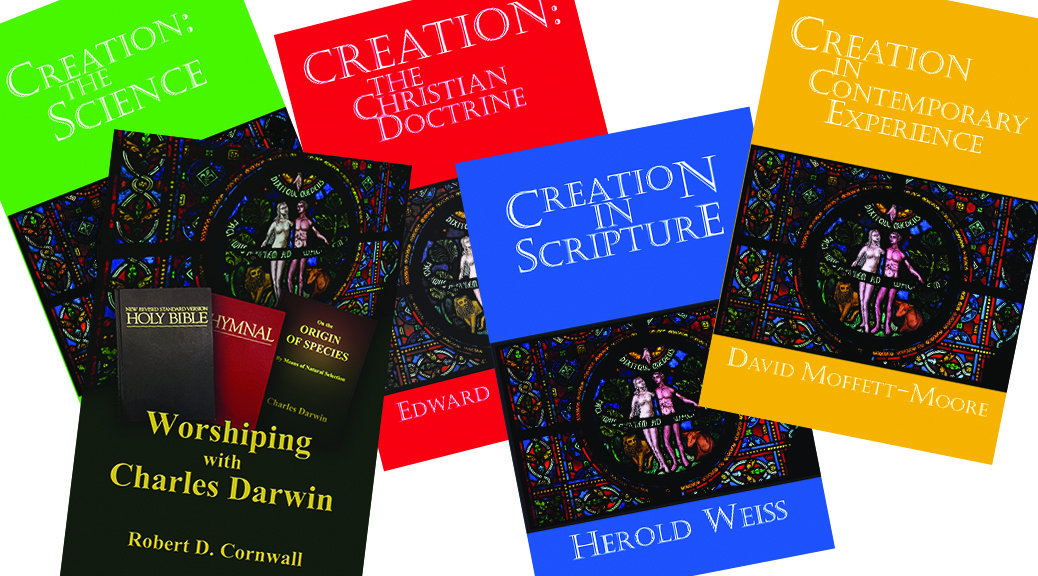
    creation-5We’re starting a new series of posts on the Energion Discussion Network and the current author is my friend and Energion author Dr. Herold Weiss. He’s the author of the book Creation in Scripture, the first in a series discussing creation from the point of view of those who accept the theory of evolution. That note should tell you that Dr. Weiss’s work can be controversial, as are all discussions of this topic.

    I don’t happen to like the terms generally used, but it is generally somewhere between frustrating and futile to try to change language. “Creationist” has become the label of those who believe in a recent (read 6 to 10 thousand years) creation in a literal week, while “theistic evolutionist” labels those who believe God is creator but that the process of evolution is how he has chosen to diversify life here on this planet.

    Dr. Weiss does something in his first post in this series that tends to annoy creationists (using the definition above). He calls their view unscriptural. The typical view of a creationist is that their view is scriptural while the theistic evolutionist has chosen to ignore the Bible in favor of evolutionary theory. No matter how strong the evidence for evolution (and they will, with few exceptions, maintain that it is weak), they would not see how it could override the Word of God. So the argument, at least as they generally present it to me, should be couched in terms of their strong convictions about scripture and the weak convictions of the theistic evolutionists, which are to be defended.

    But neither I nor Dr. Weiss thinks our position is biblically weak. In fact, I did not change my view from a young earth creationist, which I was until some time during my third year in college, because I had studied evolutionary science. My science requirement was fulfilled in a chemistry class, taught, by the way, by a young earth creationist. It was in doing research for a paper that I found that I could not reconcile the biblical texts on the basis required for young earth creationism. The starting point was chronology, and it wasn’t even comparisons with archeology. It was simply looking at what must have happened between two points in the biblical story, and determining that it was beyond extremely improbable; it was impossible. And further, there was no report of some sort of miracle to connect the dots.

    From there the question changed for me. Why is God presenting the story in this manner? (I’m ignoring here all the things I have come to believe about biblical inspiration over the years and discussing my thinking at age 20.) From there I started to ask just what it means to me that God is the creator and how that doctrine reverberates through scripture.

    And this is what I think creationists can learn from Dr. Weiss. No, I’m not suggesting they will all read his book and decide to become theistic evolutionists. He isn’t even trying to make that case in the book, and I know my own views would be unlikely to change in reading one book. What he does that is important is look at how creation, and its implications, is presented in various parts of the Bible. Creationists seem to me to be hung up in Genesis 1-3, important chapters to be sure, but not the only thing in scripture on the topic. And yes, I do think these chapters are important, even foundational, even though I read them differently. And no, I’m not claiming that creationists are ignorant of all other passages. What I’m suggesting is that they are not brought into the discussion enough.

    Too much of the debate about creation and evolution is concentrated on when and how and too little is focused on so what now?.

    I think it would be great if we spent more time on the third question. Yes, we’d still disagree on when and how, and we’d still argue that both of those questions impact the answer to the third, but we might have a chance to shed a bit more light. I think Dr. Weiss has facilitated that.

  • What the Bible Really Says? Really?

    What the Bible Really Says? Really?

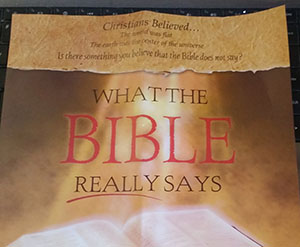
    bible_really_saysI opened my mailbox today to be greeted by a slick flyer inviting me to discover what the Bible really says about a variety of things. Among the the questions I’m told I can get answered: What is the future of our country during this economic downturn? What does the Bible really say about the second coming? What does the Bible really say about law and grace? What does the Bible really say about a vacation every week?

    I’m rather well acquainted with this type of brochure, because I grew up as a Seventh-day Adventist. We had plenty of opportunities to see this sort of advertising. We were supposed to be the people who were right, and thus who would eventually straighten out the rest of the world. Well, at least those who were not destined for the lake of fire.

    One of the things that my SDA teachers wanted me to learn was to go to the Bible about everything and to study it for myself. I did, and as a result I decided that the SDA church wasn’t the church for me. Especially on the topic of eschatology, I came to very different conclusions.

    That’s the critical thing. The internet and the airwaves are filled with people who claim that they know precisely what the Bible teaches about almost any subject you can imagine, even when the Bible may not say much of anything about it.

    To discover God’s message for you in scripture, you need to study for yourself. Now one of the things I was taught to do as a child was to look up the texts the evangelist used to see whether he was citing them correctly. There’s nothing wrong with doing so, but in a way this is a trap.

    Studying the texts that someone else provides in the order and in the structure in which they provide them will very often lead you precisely to their conclusions. What you need to do is study the scriptures for yourself, in an order that you may discover, prayerfully, under the guidance of the Holy Spirit that God promises to you, not just to experts or ordained leaders.

    While you’re doing that you need to examine just how it is that you come to understand the text, and especially to understand the way in which the text applies to you and to your life.

    You can illustrate the problem with the way that the brochure I received talks about a “weekly vacation.” What the writers of the brochure mean is the seventh-day Sabbath. For various reasons that seem good to them, they believe that the command to keep the seventh day holy still applies, while other commands, such as various sacrifices do not. I don’t mean here to argue that they’re wrong about that, but rather that their view comes from a particular way of understanding scripture.

    9781631990991s
    Some of our presuppositions and their impact.

    I remember a certain book about the King James Version, one that advocated it as the only Bible Christians should use. “It’s a very scholarly book,” I was told. “It’s filled with footnotes.” The problem is that the footnotes varied between those that were to unreliable sources, those that were plain wrong, and those that were to other examples of the author’s own work.

    Similarly, just because a presentation of scripture has a large number of texts doesn’t mean it’s scriptural. Neither does it mean it’s not. What it means is that you should examine it and decide for yourself.

    When I cite SDA documents many people approve. Of course we should examine (and dismiss) the claims of schismatics like Seventh-day Adventists. They are, after all, wrong! But there is no type of mistake in understanding scripture that is truly exclusive to SDAs. You’ll find these mistakes in many denominations and tradition streams.

    You need to examine everything. Think about these things for yourself. Get multiple scholarly opinions and test your own work against those. If you do this, you may be surprised at how many opinions about the Bible are predetermined by the presuppositions of the person holding that opinion.

    Including mine.

  • Preaching from the Old Testament

    Preaching from the Old Testament

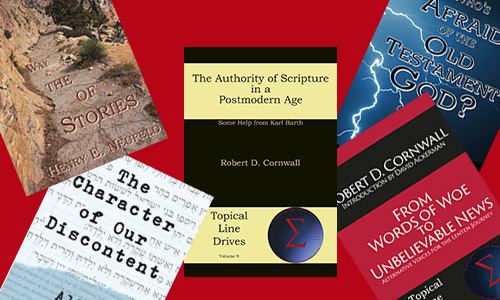
    violence and scripture booksNo, I’m not going to do it, but I’m going to ask Dr. Bob Cornwall some questions about it. He’s currently preaching a series in his church from 1st & 2nd Samuel. Bob is one of my Energion authors (see his book list here), and is editor of the two book series we publish in cooperation with the Academy of Parish Clergy, Conversations in Ministry and Guides to Practical Ministry. You can find more information about this event on its Google+ event page.

    I’m going to ask Bob how he handles the authority of the text he is preaching from, and especially whether he will deal with some of the more violent passages and how he will preach from them. There are quite a number of passages in the books of Samuel that could be very troubling to a 21st century conversation.

    This morning, I was reading one of those: 1 Samuel 15. You can read the whole thing if you want to get a general picture, but let me just summarize here. God tells Samuel to pass the order to Saul, King of Israel, that he should go and wipe out the Amalekites. He is supposed to designate them as herem, meaning that they are devoted to destruction, every person, every creature, every thing is to be destroyed. And lest we be tempted to soften the story, we are told that this included men, women, and even nursing babies.

    Saul disobeys God and doesn’t kill everyone. The best of the animals are preserved, and the king is taken captive. Saul blames this on the people. God blames Saul and says he has cut Saul off (or at least Samuel says God says this) from being king over Israel. This story opens the cycle of stories about the conflict between David and Saul, which ends with Saul’s death in battle and David’s accession to the kingdom.

    I have heard this story handled in a number of ways:

    1. Get a modern lesson from it, ignore the gory details, and hope nobody notices. I remember hearing it in my early years taught as a story about obedience. When God tells you to do something, you better do it. When I did ask about the killing, I was told that it was God, so it was OK.
    2. Emphasize the gory details. We’ve all become too cowardly to truly uphold God’s will in the world. (Yes, I’ve actually heard this.) We can just hope folks like this aren’t too serious.
    3. Some things in the Bible are less inspired than others, and this is one of the less inspired. Bloodthirsty people did bloodthirsty things and blamed God.
    4. When people lived in a violent world God worked within their context. So things that might be commanded then could be forbidden now, not because God has changed but because he is staying the same, and working with us where we are.
    5. The Old Testament God was violent. That’s why we stick with the New Testament. (If you take this approach, you should likely avoid texts like most of Revelation and Acts 5:1-11.)
    6. Let’s never read this in church and hope nobody notices.

    I could probably come up with some more given time. I’ll be interested to see how Bob Cornwall handles the text. He’s both a good preacher and accomplished scholar, so I expect his comments to be helpful.

    In the meantime, two things. Following a challenge on a similar text, I wrote two blog posts. The first was a story/dialogue discussing the text, titled The God-Talk Club and the She Bears, on my Jevlir Caravansary fiction blog. (In the God-Talk Club series I write dialogue without any intention of expressing my own point of view. It’s sort of an exercise for me in trying to express several views on a topic.) The second was a homily on the same passage, titled Real Guy Interpretation.

    Finally, I recently interviewed two authors, Allan Bevere, author of a book based on a series of Old Testament sermons he preached titled The Character of Our Discontent, and Alden Thompson, author of Who’s Afraid of the Old Testament God?. I’m embedding that video below.

  • The Importance of Experience

    I was thinking of titling this “In Which I Annoy My Evangelical United Methodist Friends,” since so many of them are talking about the Wesleyan Quadrilateral and trying to privilege scripture within it in some way. I am not entirely in sympathy with many of these approaches.

    You see, the moment I decided to take a closer look at the United Methodist Church was when I read in the United Methodist Discipline (1992, I think), about the sources of our faith. It’s not that I thought this statement was unique. Neither was it because I thought that Methodists had discovered the way to understand scripture correctly. Rather, I thought it honestly described what we actually do. And by “we” I do not mean just Methodists, but all Christians who use the Bible. We do not understand the Bible without our experience and our tradition, which is just experience collected across space/people and time. Reason ties these things together. Without our reason, we don’t come up with any interpretation of scripture at all.

    What privileges scripture, to the extent that it is privileged, is that it is the most universal, most tested, and most accepted source. My personal experience may be very important to me. In fact, it is. My personal encounters with God have an enormous impact on how I understand my faith. But the fact that I believe that God has told me a certain thing doesn’t make that determinative for someone else.

    Each congregation has a tradition, built on the collected experiences of that group. There will be similarities within a denomination, but there are local traditions. There are family traditions as well, collections of the experiences of members of that family over time. Denominations have traditions of their own and stand within broader tradition streams. For Methodists we have the Church of England as a source of tradition. Yes, we do carry things from that background. Then we have many who have broken off based on various elements of our own tradition.

    All of these experiences have an impact, conscious or otherwise, on how we understand and apply scripture. It cannot be any other way.

    This is one reason why I dislike the inerrancy debates, even though I’ve participated. I do not affirm the doctrine of inerrancy. The usual response to that is for someone who does affirm it to ask me for my list of errors with the intention of providing his or her list of resolutions for those errors. I don’t have a list of errors in scripture. I believe the Bible is what God wanted it to be. But that’s a belief that derives from my doctrine of God and not from any observations about the Bible and history or the Bible and science.

    Each item on such a list of biblical errors can be translated as “My errant understanding of subject X says that my errant understanding of scripture passage Y is in error.” Where’s the inerrant standard, inerrantly understood, that lets me determine whether the Bible is actually inerrant?

    So I make a different affirmation: When you’ve heard the message God has for you in scripture, that message is true. I follow it with an additional note: To the extent you need to, you can discover God’s message for you in scripture. Or anywhere else, for that matter.

    I have absolute confidence that God is speaking. I have similar confidence that my hearing is defective. That goes whether I’m feeling God’s presence as I listen to Mahalia Jackson singing “Just a Closer Walk with Thee,” hearing God’s voice in my head as I pray and spend silent time listening for it, or interpreting a passage of scripture.

    So what advantage does scripture have over my general impressions? To paraphrase Paul, much in every way. I’m tremendously thankful to folks like Abraham who had to listen to God’s voice without having that huge body, the “great cloud of witnesses” (Heb. 12:1) whose testimony has been tested over and over again. It’s the church’s testimony and it’s of paramount importance as I work my way through my own experiences.

    Here’s a discussion of this very issue. Thomas Hudgins and I don’t agree on all the details, but we do agree that these things work together to give us confidence in God.

    But it’s also a training ground. Read about maturity in Hebrews 5:11-14. The Bible fails if we treat it as systematic theology, as a science text, or even as a history text. That failure is not because of some list of theological, scientific, or historical errors. Rather, it’s because God has chose to speak through the testimony (witness to experience?) of many different people at different times and places. He requires us to use discernment and to see what is right and wrong as the decisions are placed before us.

    quad1

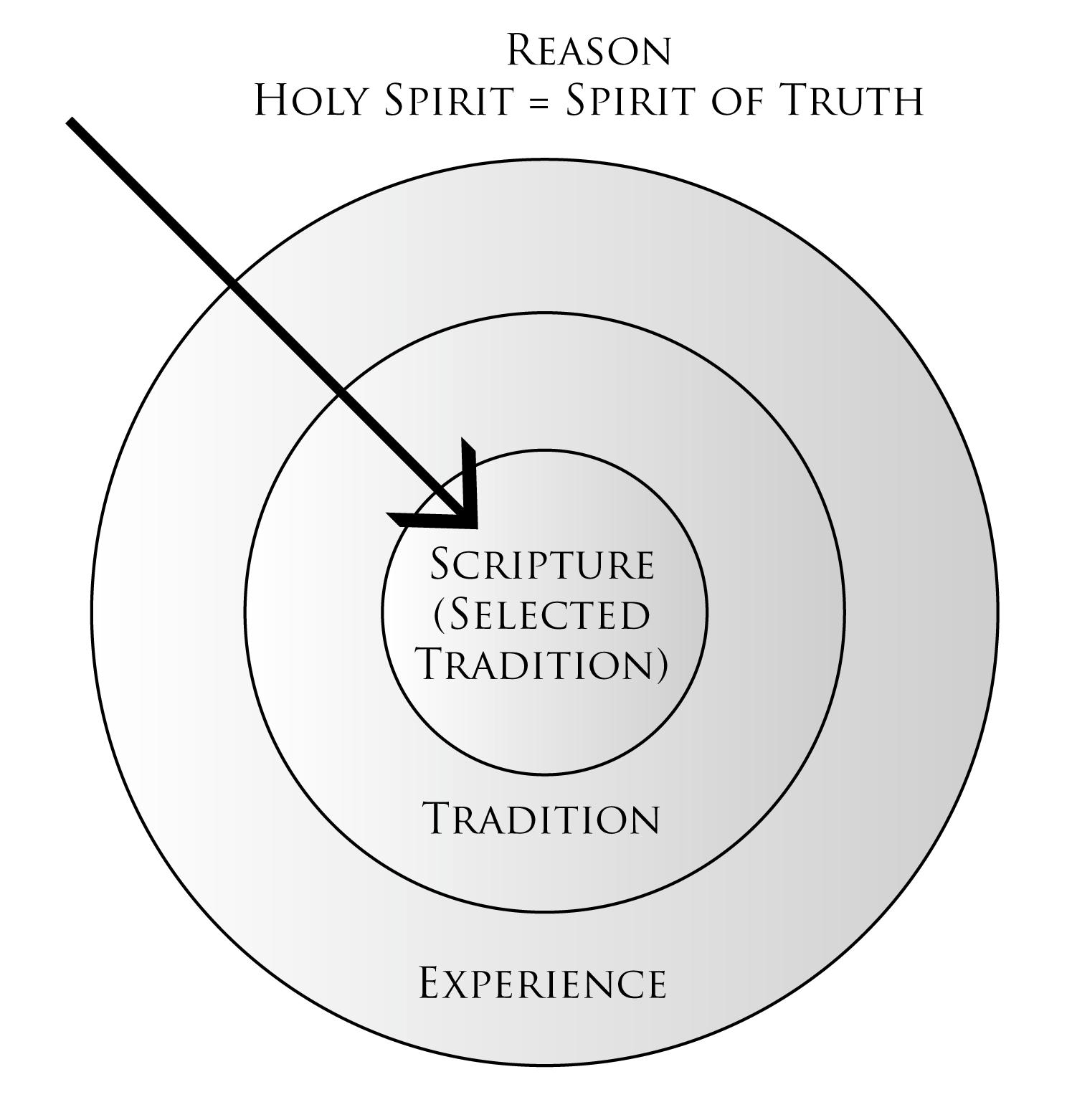
    So back to the quadrilateral. I treat it both as quadrilateral and as equilateral. We can enter by any door. Any one of these elements may provide the right question and might contain the right answer. It will not always end at scripture.

    But … and it’s an important but … there is a problem with the way United Methodists use the quadrilateral all too often. We tend to use it as a four lane highway. Which of the lanes can I get my idea through? If I get my idea through one, that’s enough. Instead, we need to use this as a four layer filter. Every answer we get to a question needs to interact with all elements. How does it relate to scripture? How does it fit with experience? What can we learn about this sort of thing through tradition? All of those questions will, of course, be processed by our reason. But that’s what the Spirit of Truth is for, after all, to guide us into all truth (John 16:13)! I illustrated this process with the diagram to the left in my book When People Speak for God.

    I believe that the nature of scripture is absolutely intentional on God’s part. Rather than giving us easy answers to easy questions he has given us a combination of testimony to God’s action in the world and principles (embedded in the testimony) by which we can make such decisions. When Jesus says, “On these two hang all the law and the prophets” (Matthew 22:40), he provides us with such a principle of interpretation. This is not a principle that helps you discover what the historical intent of a writer was. We have quite useful techniques of exegesis for that. But it provides us a principle for how we, as Christians living in the 21st century should apply it. Sometimes it says that the people who were doing their best to follow God didn’t live up to it. We should take those stories and try to hang the lessons we think we learn from them from the two commands as Jesus said.

    It’s interesting to compare the stories of Patriarchs in Hebrews 11 to their sources in Hebrew scripture. Moses left Egypt, not fearing the wrath of the king (Hebrews 11:27), but he was afraid (Exodus 2:14). A biblical error? A contradiction? No! A testimony to what is seen by the eyes of faith.

    We need to struggle with these stories if we’re to see where we are and where we need to be brought to greater maturity. How many of us need to learn not to fear the wrath of the king? But if we look earlier in that same passage, how many of us need to learn not to take God’s work into our own hands through violence?

    Testimony, the telling of our own stories and experience, doesn’t give us the sort of systematic set of answers we might prefer. But it does train us to think, to discern, and to decide.

    My guess is that’s what God was after in allowing scripture to come into being as it did.

    Oh, and one more thing …

    Tonight I’ll be talking with author Doris Horton Murdoch about testimonies in a Google Hangout on Air titled Lent: Season of Testimonies.

  • Words from the Mouth of God?

    In comments to an earlier post one reader notes that there are those who call the Bible “words from the mouth of God.” I respond that I do not think the Bible is words from the mouth of God, but rather the testimony of people’s experience of God. There are those who think I diminish the authority and power of the Bible in this way. I disagree. I think that the testimony that results from the experience of God is much more valuable, and I believe it also more accurately reflects the nature of the biblical text itself.

    I believe that it’s valuable to be able to distinguish the nature and function of various portions of scripture. While all scripture is inspired, not all scripture is produce in the same way and it does not necessarily function in the same way. There are some obvious examples, such as the speeches of Job’s friends in the book of Job. That is surely quite a substantial amount of writing that is not words from the mouth of God. One may say that it is inspired and that it is profitable, yes, but in words that the book of Job actually attributes to God, we are told that it is not God’s message in those passages. They contribute to a message provided by the book, but the words are not God’s words.

    Now most people who talk about verbal inspiration are not surprised by this sort of statement. There are also those who point out to me that it’s God’s Word, but not necessarily God’s words in all cases. It seems to me, however, that we might as well just come out and say it. Often our affirmations about scripture get in the way of what scripture actually is and how it functions.

    I prefer to say that scripture is the testimony of those who have experienced God, brought forth in various ways using various forms. It is providentially preserved by God as the message that we need. It begins with an act of God (which may be an act of communication, but it might even be a permissive act, or lack of action, such as permitting the Assyrians to come against Israel (2 Kings 17). It might be reported as the words of God, as much material in the prophets is reported. It might be reported in the form of a story, or history researched and reported, as in Samuel-Kings. It might be a letter written to a church as in many of the epistles of the New Testament. In the end, it must be recognized by the community and then interpreted, in all cases providentially guarded by God. (Of course, we realize that in the interpretation, at least, God’s providence does not prevent our error or even our stupidity!)

    Much of our discussion of inspiration centers around how the original text came into being. This is, indeed an interesting topic, but the majority of our differences come not from potential differences in the source texts but rather from our ways of interpreting them (see my post yesterday, Book: I’m Right and You’re Wrong). Further, I think our affirmations about inspiration often fly in the face of what we actually observe in scripture. This can result in us trying to make scripture fit our conception of what it ought to be.

    If nothing else, the incarnation, in which God acts very much contrary to what everyone expects, should suggest to us the dangers of trying to force God’s actions into our molds. But it seems to me that we do this with scripture.

    Consider Isaiah 7:1-17. This contains the famous “virgin” passage, but that’s not what I want to discuss. Read the passage carefully and look who’s talking at various points. I identify a narrator who gives the historical situation and then reports that Isaiah got a word from the Lord with instructions for action and a message to give to Ahaz. We also have a report on Isaiah’s action, and then some words that Isaiah said, some of which appear to be the words of the Lord, but some appear to be Isaiah simply expounding on what God is going to do. This entire passage is part of an overall Bible book which includes more than one type of literature, and even includes an historical interlude, but only a fraction of the whole claims to actually be God’s words.

    There are those who think I make these comments because I don’t believe the Bible is very historical. I would note that I am not very disturbed by those who are skeptical of the historicity of many Bible passages. But I really find relatively little in the parts of scripture that actually claim to be history that I cannot accept as at least generally historical. What I mean here by “generally” is that I treat an account that says it’s taken from the “chronicles of the kings of Judah” (1 Kings 14:29 and many other references) as precisely that: it’s taken from the chronicles and it has precisely the historical veracity of those chronicles, always adjusted for second hand reporting. I don’t see it as necessary or valuable for God to “fact check” the sources. The message (word) of God is conveyed by the testimony (words) of a human writer depending on the words of other human writers.

    Considering that those words will in turn be interpreted by very limited human beings such as me, I’m pretty happy with that situation.

  • Sunday School Today: Authority and Truth

    1893729389I think I titled the next chapter in my book When People Speak for God rather pretentiously: Authority and Truth. That’s what we’ll be discussing today in my Sunday School class.

    As I was reading the chapter, I came across the following, which ties into several things I’m thinking about these days:

    There is, however, a deeper claim that’s involved in both the virgin birth and the resurrection. These doctrines state that God is fundamentally interested in communion with human beings. In the virgin birth we have the statement that God is prepared to share our form and our condition and to become a part of that history. In the crucifixion, God says that he is prepared to carry that sharing all the way, to experience death. In the resurrection, he states that despite his willingness to share it, he’s above it, and thus able not just to communicate with us, but to redeem us.… (pp. 135-136)

    I call my view of inspiration incarnational, because I see God’s Word, however it is expressed when it is communicated with human beings, as a form of incarnation. The problem with this is that I think the orthodox doctrine of the incarnation is not well understood. (There is, of course, the sense it which it will never be well understood and will always be a mystery!) But the way people often hear the term “incarnational” in connection with inspiration is as a claim that the Bible is a mixture of divine and human. When I call scripture incarnational, I do not mean a mixture. I mean that it is all divine and all human. We can sense aspects of divine and aspects of human, just as we can with Jesus the man, but we cannot divide.

    Inspiration is all-the-way incarnation as well. God’s power is contained in the finite form. What we need is ears to hear and eyes to see.

    I’ll have more to say about this over the next few days.

  • Craig Blomberg, Reviewed by Louis Markos, Commented by Mike Licona

    … or On the Meaning of Words, Particularly Inerrancy

    There’s a post on First Things titled Ehrman Errant. Now criticizing Ehrman is apparently great sport, and Blomberg has replied to some of the types of criticisms Ehrman presents in a book, which Louis Markos reviews. The reason I mention Mike Licona, a colleague of Markos, is that he makes a comment on precisely the section that led me back around in a circle to the beginning of the piece. As a quick note, I previously reviewed Ehrman’s book Misquoting Jesus, but  have not read either The Orthodox Corruption of Scripture or Blomberg’s book that is reviewed here. I’m basing my comments strictly on the review and the comments to it.

    The problem, as I see it, is one of language and communication. How do you communicate a message to a particular person in particular circumstances? When we are communicating in a way that might later be read by others, how do we accomplish this. As a simple example, if I want a two-year-old not to fall off the porch, I might try explaining gravity, acceleration rates, and probabilities of various injuries based on the height of the porch and the nature of the ground below. Or, more intelligently, I might just close the door, or say no (and enforce it). In fact, preparing to write this led me to write a humorous (I hope) short story for my fiction blog titled Genesis Wasn’t Written This Way.

    When we start talking about biblical inerrancy, however, we are by nature talking about language. What does the word “inerrancy” mean? How are people going to perceive me if I say I believe in inerrancy? What if I say I don’t? And that, in turn, depends on who you are. If you’re a professor in an evangelical seminary, it seems to me that you understand this term differently than the people in the pews of the United Methodist church I attend. So the question is this: Who am I talking to?

    Let me start from the end. Louis Markos complains about Blomberg’s chapter on gender-neutral language. He says:

    Blomberg, along with the translators of the NRSV, NLT, CEV, and NIV 2011, take it for granted that the convention of using “man” or “mankind” to designate the human race is merely cultural. It is not. It is God himself who originally made the designation: “When God created man, he made him in the likeness of God. Male and female he created them, and he blessed them and named them Man when they were created” (Genesis 5:1-2; ESV).

    To which his colleague, Mike Licona objects in the comments:

    … There are some passages that call for a gender neutral translation….

    And the reason, I think, that there are passages that call for a gender neutral translation is that language changes. It is not that we have new discoveries in Hebrew and Greek that mean that we should translate gender references differently. Rather, our usage in English has changed. Markos can quote the ESV, “God created man,” but the word used was not the English “man,” but, of course, the Hebrew adam. That word refers to humanity (in this case), not just the male persons within that broader designation. So the question in translation would be how we refer to humanity today.

    Similarly, consider the Greek adlephoi. It’s a plural and at one time would have been translated “brethren.” For some time, it was translated in that way and it was often understood to refer to the whole congregation, male and female together. But does it mean that to audiences now?

    Some years ago I tested this with a couple of classes I was teaching on translation. The classes broke somewhere between 30 and 40 years of age. Those older than that thought “brethren” referred to the guys. Those younger thought it referred to everyone. I suspect the break point would be younger now as the culture moves.

    Now you can complain about the culture, but nonetheless in those mythical “good old days” people were understanding verses that used the Greek adelphoi, translated as “brethren” to refer to both genders. If you translate that way now, you introduce an inaccuracy, because your audience doesn’t understand it the same way as their ancestors did. You can complain all day that they should. You can wish they would spend more time reading older literature and thus understand this important (to you) point. But they aren’t going to. Now if you want a scriptural admonition to refer to the whole congregation, you need to use something like “brothers and sisters.” Not all instances of adelphoi should be so translated. That depends on the intent of the writer. Who was he referring to?

    I recall a pastor, a good friend, who complained to me about the NRSV because it used “brothers and sisters.” He preferred the RSV, because it kept the traditional language. The next Sunday he was preaching and read a verse from the RSV that included “brothers.” He immediately looked up and said to the congregation, “And that means you sisters too!” His pastoral instinct was better than his translation theory.

    But how does this relate to inerrancy? Inerrancy is, of course, a word, and it has meaning—to people. Meaning apart from meaning to some person or group is meaningless. Somebody understands a meaning. Blomberg is arguing that there are errors in transmission, but they are not critical, they don’t damage the message or the value of the whole. But that is not the same as the absence of errors. It is an absence of important errors. Blomberg’s position isn’t some new thing. It’s pretty standard evangelical theology. If preachers, teachers, and other church leaders made this point from the pulpit or the lectern somewhat more often, we’d probably have less problems with a critic such as Ehrman. But people out there in the pews pretty generally think that “without error” means there are no errors, not that there are no errors that theologians deem important.

    The same thing applies when we criticize others for using “verification system that has only existed for some 250 years” (1st paragraph). This is the verification system and the level of factual and numerical accuracy that people expect these days. If I say, “_____ is without error” they generally assume it is without error as they perceive errors. Yes, there are variations in this, but we actually tend to put words on them. It might not be precisely inaccurate for me to say it’s 80 degrees outside if it’s 78 or 79 degrees. But I’d normally be expected to say “about” if I were to mess with numbers in this way.

    Well, the Bible doesn’t use numbers in the way we moderns expect them to be used, and it’s inappropriate to expect it to. Biblical literature has genre and literary standards and they are those of the time and place when those texts were written. But if you’re going to then label the Bible inerrant, a term that is itself new, you have to specify the standard by which that is measured. (I’m not claiming that the concept, depending on which concept of inerrancy is involved, is new.) So if we’re going to expect people to apply a different standard when determining whether something in the Bible is an error, then we need to make sure they understand the standard.

    There is a tendency amongst scholars now to use words that mean definite things to most hearers, but then to back off and ask to be judged by a different standard. The gospels are not histories in the modern sense. Just so! They aren’t. But if they aren’t histories in the modern sense, then don’t expect to use them as such without having them judged as such. If I claim that Jesus performed miracles (and I do), I can’t say that the reason is simply that they were recorded in inerrant gospels. Why? Because I’ve also just said that those gospels don’t meet modern historical standards. Personally, I think it’s a good thing that they don’t. I think they are much more important than any document that met modern historical standards would be. Not that a modern style history wouldn’t have it’s uses, it just wouldn’t have the same uses as a gospel.

    But I think that we play sleight of hand with the terminology. “The gospels aren’t modern history so you can pretty much accept their view of Jesus without judging them by modern historical standards,” is a philosophical and historical way of having your cake and eating it too. I believe in Jesus, but I do not do so because the gospels demonstrate this in a sense a modern historian could accept.

    One more thing. Someone is bound to suggest to me that I should always apply the definitions used by qualified theologians. Those are the definitions that matter. I think that’s wrong. I don’t communicate with very many trained theologians. I don’t write for them, I’m never invited to speak to them (probably for good reason), so I’m not going to use words that communicate with them but not with the audience I’m actually addressing. For me, because I teach Sunday School classes in a United Methodist church and occasionally speak as a guest at various churches, the appropriate meaning of inerrancy is the one they’re going to hear when I use the term.