
Threads from Henry's Web

Category: Bible Translation

  • The Bible: Translation of Translations and Copy of Copies

    A couple of weeks ago I was asked to teach a Sunday School class on the history of the Bible. Teaching a class on how we got the Bible in about 50 minutes requires some serious decisions; you can’t cover everything, but you want to cover the most important thing.

    At one time I would have thought this idea of translation of translations and copy of copies would largely be a waste of time. Surely everyone understands at least this much of how copying and translation work, both in ancient times and today. But then there is the truly dismal article recently in Newsweek, which demonstrates yet again that you can’t count on major news sources to do even minimal research and fact checking. It’s not my intention to refute that article; it’s both self-refuting, and has been refuted quite ably multiple times. But I am interested in the number of Christians who don’t seem to know how to respond to a claim such as I have in the title.

    So has the Bible been translated so many times that you can no longer rely on the content? Has it been copied so many times that the cumulative weight of errors has made it essentially unrecoverable?

    Quite apart from bad journalism, these questions were awaiting me in Sunday School. I’m going to first go through the logic copying and translation generations, then talk about definitions and how we use terms such as “reliable,” “original,” “significant,” and “accurate,” then finally look at what we should do about this sort of thing. I really don’t blame Newsweek, surprisingly enough. They are much more a symptom than a cause.

    This first part is simple. If you already have some knowledge of the history of the Bible or of ancient manuscripts, you shouldn’t need to read it at all.

    The following chart will help illustrate the discussion:
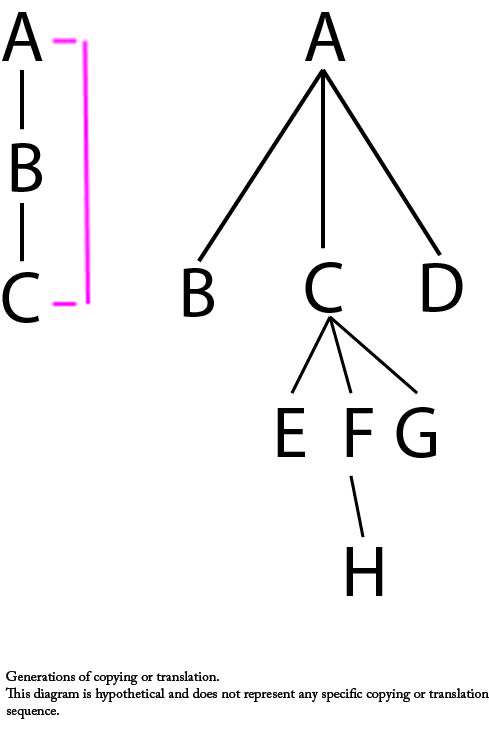
    Translation/Copying generations illustrated.
    Translation/Copying generations illustrated.

    Translating a document is non-destructive. If you look at the left hand side of the chart you’ll see a simple illustration of generations, A, B, and C. If this is the generations of a translation, then some meaning will be lost between A and B, and then additional meaning will be lost if C is translated from B. An illustration might be the translation of the Old Testament from Hebrew to Greek in the LXX (Septuagint), and then into Old Latin. Jerome preferred to go back to the Hebrew when he produced the Vulgate.

    The loss of meaning is ameliorated if one consults the original while translating from a translation, as shown by the red lines. This latter situation illustrates the story of the Douai-Rheims Bible, which was translated from Latin, but with the Greek and Hebrew texts available. Until Vatican II, Roman Catholic translators were expected to translate the Bible from the Latin. Since that time, a number of excellent Catholic translations have been produced from the original languages, including the NAB and NJB.

    Note, however, that the A-B-C chart on the left illustrates the worst situation, a translation of a translation. Not only that, but you will find it hard to locate a translation of this nature in the Bible section of any bookstore, because almost all modern translations are made from the original languages. One exception is The Living Bible. That version stands alone in being properly called a paraphrase, as it was paraphrased from an English version, the American Standard Version, so it was a paraphrase of a translation.

    So the idea that the Bible has been translated so many times that we have lost all idea of its meaning is simply false. Most translations are from the original languages, and besides that, I can pick up my Greek New Testament, or one of my copies of the Hebrew scriptures, and read directly from the original languages.

    If we look now at the chart on the right, just the part showing A through D, we see this illustration. Yes, the Bible has been translated many times, but the vast majority of these translations went back to the original languages, and not to any translation.

    In class I was asked about the KJV. Where does it fall in all this? It’s a translation from the original languages. There are those who accuse the translators of using the LXX as the source for the Old Testament, but what they actually did was consult the LXX as they translated the Hebrew, which was (and is) a good idea.

    So what about copies of copies? Notice that when I said the translators go back to the original, it was always “original languages,” not necessarily “original text.”  That’s because it’s quite true that we do not have the autographs. Further, we don’t know precisely how many generations of copying have gone on.

    But there are two counterpoints to this. First, it is vanishingly unlikely that the number of generations is in the thousands. We have thousands of copies, but those that date back to the first few centuries are doubtless only a few generations removed. Second, and more importantly, the number of copies made actually works against the issue of copyist generations, because it is unlikely that each generational sequence will produce the same errors. So as you look at the right hand side of my chart above, you will see how you can have many, many copies in only a few generations. In the case of the Bible we can look back through history using multiple paths. This allows us to attain a fairly high level of confidence in the text that we use.

    And what we use is a critical edition, either one already available, or one made by the translators of a particular version. We don’t go back and just grab a manuscript and start translating. First we must study the text, comparing these many, many witnesses to the source text, and coming to the best conclusion we can. For the vast majority of the New Testament text, there is next to no controversy.

    But here is where the issue of definitions comes in. What is significant? What can be considered reliable? What do I mean by confidence in the text? It’s extremely important for us to be clear on these things, otherwise it’s quite easy to seem to be lying.

    There are significant variants in manuscripts. What do I mean by “significant” in this case? Simply that these variants would alter the way I would translate. There may be spelling differences, but these I would not regard as significant.

    On the other hand, one might consider only those variants that might impinge about a doctrine, or perhaps a major doctrine, of one’s denomination as significant. Such a variant would be the supposed Trinitarian statement in 1 John 5:7-8.

    But that, in turn, raises another type of significance: How viable is a reading. A goof by a scribe in one manuscript out of hundreds that might witness to a particular passage hardly qualifies as significant to the textual critic. Interesting in terms of scribal practices and lack thereof, but hardly significant to determining the actual reading. In the case of 1 John 5:7-8, we would have to say that the reading is not significant, at least to the vast majority of textual critics, as it is not regarded as viable. (Disagreement is possible on virtually anything, of course. The question is how valid or well-founded such disagreement is.)

    My point here is that we need to be careful with these terms. I find a text that is 95% non-controversial quite reliable as historical materials go. Historians often work with less. But to certain KJV-Only advocates, the only thing that would be reliable would be 100% equivalence. They tend to waffle, however, when presented with printing errors in the history of the KJV.

    I read my Bible with confidence, not because I don’t think there’s any question anywhere in it, but because I think the reconstruction is extremely good and the differences that remain don’t make problems for me. In fact, they make the whole thing more interesting. I see God working in the imperfect people who experience His presence and activity and recorded that for us. I again see God working in the amazing distribution and preservation of copies of what those people wrote. I am not disturbed by the problems; I’m astounded by how few there are.

    All this leads me to what I see as the problem. People with the training to understand this process rarely talk about these things in Sunday School or from the pulpit. I have heard two reasons for this: 1) It’s too complicated and people don’t want to know, and 2) It might shake their faith to hear about this stuff.

    I think both are bogus. I haven’t encountered anyone who can’t understand the process of copying and translation once it’s explained, and people are going to hear about this from someone, perhaps someone who claims the Bible has been translated hundreds of times, with the implication that it has gone through that many generations. Not talking about it isn’t helping anything.

    When we do talk about it, we need to do much ore than simply say that we know how it works and you can rely on your Bible. In modern terms people will expect at least 99.9% accuracy when you say that, if not 100%. The first person to come along and point out that there are thousands of variations in the text will then be able to shake their faith.

    You may say that claiming this level of reliability is not deceptive. After all, considering historical processes and understanding how copying and translation work, the Bible is remarkably well preserved. But the people in the pew don’t hear it that way because they often don’t have the background in historical methodology to figure it out. They’re going to feel deceived, because they interpreted what you said within their context, and they got the wrong idea.

    You may not regard the absence of John 7:53-8:11 from some of our oldest manuscripts as significant, but your congregation almost certainly will. I’ve been told that it isn’t significant, because we can still teach about forgiveness even without the story, but that is a rather loose idea of reliability, accuracy, or confidence.

    My suggestion is to take the time, provide the background, and let people understand just what is in question and what is not. Define terms carefully, so people understand just what portion of the text is in question and what is not.

    We need to do more than just respond to miserable articles like the one I referenced above. We need to teach this material up front.

    After all, in one way or another our congregations are relying on the Bible as at least one witness to the Word of God. We need to tell them why we think they can.

  • When Should You Talk about Textual Criticism?

    I’ve posted a question that originates with Thomas Hudgins over on the Energion Discussion blog. Here are my comments to go with that post.

    The question has quite a number of implications. For example, if your listeners do not normally look at the textual notes in their Bible translation, they might not be aware of the issues. Not mentioning a difficulty might be an issue of honesty. (“Pastor, you never gave me any idea how many variants there are in the New Testament text. You lied to me!”) On the other hand, constantly mentioning textual variants, most of which are fairly minor (though translations normally mention only a very small minority, NET excepted, and thus only ones that impact meaning more significantly), and discussing the text all the time can be very distracting.

    I resonate with much of what Thomas says in his post. It’s very easy, as a pastor or teacher, to leave the wrong impression. You can leave your listeners thinking they can’t study the Bible at all unless they’ve spent time with textual criticism as you have. You can make them think no translation is at all trustworthy.

    There are always at least two types of tension here.

    First, there’s the issue of what skill is needed in order to study the Bible. I took a Biblical Languages major as an undergraduate, rather than religion or theology, because I wanted to understand the Bible better. I don’t think I wasted my time. I can get more out of a passage using what I learned, including a quarter each in New Testament and Old Testament textual criticism, than I could if I was limited to English translations. On the other hand, it is not impossible to understand the vast majority of scripture using an English translation, especially considering the number we have available and the wonderful resources we have in addition.

    Second, there’s the issue of the trustworthiness of the Bible. Many pastors avoid issues in the text because they’re afraid people will get the idea that they cannot trust the text of scripture. (“If major translations don’t even agree, how can I be sure?”) I think this is a questionable approach, because the vast majority of the text of the New Testament is not in dispute. It’s much more convincing to mention that before, rather than after, someone discovers textual variants. If you haven’t mentioned it, you’ll sound like you’re on defense, and you’ll sound like you’re making it up as you go along.

    Some may ask why I’m concerned this much about the reliability of the text when I don’t accept the doctrine of biblical inerrancy. There are three answers to this:

    1) It is a matter of historical fact that we have very strong evidence for the text of the New Testament, and that variations are, on the average, minor. Are there significant variants? Yes, but the disputed texts are not that numerous. In fact, a great deal of debate in this area centers around the vocabulary used to describe the situation. Numbers always need to be kept in perpsective.

    2) I do believe in the providential preservation of God’s message. (Vocabulary alert: What is meant by “providential preservation” differs from person to person.)

    3) I believe we need to be honest at all times.

  • Quick Follow-up on Hebrews 2:6-8

    I commented earlier on the difficult choices involved in translating an Old Testament reference that does not match the Old Testament passage in your own translation.

    Here’s an example from the NIV1984. First, Psalm 8:4-6 –

    what is man that you are mindful of him,
    the son of man that you care for him?

    You made him a little lower than the heavenly beings
    and crowned him with glory and honor.

    You made him ruler over the works of your hands,
    you put everything under his feet.

    Now look at this as translated in Hebrews 2:6-8 –

    “What is man that you are mindful of him,
    the son of man that you care for him?

    You made him a little lower than the angels;
    you crowned him with glory and honor
    and put everything under his feet.”

    The key phrase here is “a little lower than the angels.” The usage of this line in Hebrews will reflect an alternate translation of the Greek (LXX), “for a little while lower.” The translation is, I believe, accommodated to the phraseology in the Old Testament. The NASB is pretty open about simply translated the text in front of the committee, and leaving it to commentators to deal with the difference in the text and translation.

    I find this interesting, though not a major issue. It is valuable, however, to understand the approach taken by your translation. I am much more concerned with the attempt by the NIV to “fix” problems through questionable translations, such as the sudden introduction of an unjustified pluperfect at Genesis 2:19, a rendering that survived from the 1984 to the 2011 NIV.

  • A Gender Neutral Example – Hebrews 2:6-8

    A couple of days ago I discussed gender-neutral language in a post dealing with both inerrancy and Bible translation issues. Today, as I was doing some reading about Hebrews, I encountered a vigorous comment against such language in a passage in Hebrews. The passage in question is Hebrews 2:6-8, and it quotes from Psalm 8:4-6. The NIV translates the first anthrwpos as “mankind” and then huios anthrwpou as “a son of man.” They then continue with a series of plural pronouns in the explanation.

    In his The New American Commentary: Hebrews, David L. Allen responds to this translation with some vigor. (Note that he is responding to the TNIV, and relying on the text of the 1984 NIV, but the text of the 2011 NIV has in it every difficulty he references in his discussion. I really can’t get the flavor of his arguments without quoting more than I’m going to quote in a blog, but he starts with two major issues. The first is that by obscuring the anthrwpos/’adam reference with a plural (TNIV uses “mortals” while NIV2011 uses “mankind”) one loses the sense of the unity of the human race through descent from Adam. Secondly, by using plural references in succeeding texts, one makes it more difficult, if not impossible, to connect this to “son of man” as a Messianic title for Jesus. Whether this was the intent of Psalm 8 in its original context, it appears to be an intent of the author of Hebrews.

    Of these he says:

    Third, to change the word or phrase to a more “gender neutral” expression, especially in light of the other two problems above, is simply an exercise in linguistic political correctness. (p. 240, Nook edition)

    The issues here are somewhat more complex than any case I was referencing in my earlier post. When you have someone address a congregation that includes both men and women using adelphoi, the issue is more one of referent. In this case, we need to ask a couple of questions:

    1) In what way was the author reading the passage? In other words, how would he have understood it in then making his argument? It seems courteous, in a sense, to render a quotation in the same way as the person quoting it intended. This is by no means uncontroversial. If an author quotes the LXX, as is done here, but the Bible translation in question translates its Old Testament from the Hebrew, what should be done? There are cases in which a translation will accommodate their own rendering of the OT verse to the translation as they have it in their OT, whether or not that fits the author. On the other hand, to have the author of Hebrews quote Psalm 8:4-6, and then have the rendering there differ from what a reader will find when he or she turns to the Old Testament in that very same Bible edition can (and will) raise questions. So it is a case of decisions, decisions, and no matter what you do, there will be disagreement.

    2) What will your readers miss when they read your rendering? In this case we have two choices. We might leave out some understanding of the unity of humanity and the connection between a singular son of man and Jesus. On the other hand, for some readers, we might be leaving out the sense that this is humanity and not just some particular man. I know of nothing that would cover all options except for an explanatory note, and most of us are likely aware of how many people read explanatory notes.

    I don’t consider this a clear case of a change of language requiring a change of translation. The word anthrwpos, as used here, is covering a different semantic range, and the translator needs to take that into account. The danger into which the NIV2011 and the TNIV have both slipped here is that they undercut the author’s presentation by using a different translation of the passage he’s building on. He chose the LXX of his time. Perhaps we should honor the idea of his choosing a translation by translating that translation in a way that matches his use.

    What do you think?

  • Discussion on Verbal Aspect

    I exchanged a few e-mails today with Dave Black about Greek verbal aspect. He has quoted me on his blog, and I’ve extracted the material for the jesusparadigm.com site, so there’s a permanent link. What I said wouldn’t make a full discussion, so it’s best to read it there in the full context.

    My own background involves an MA in Religion, concentrating in Biblical and Cognate Languages, which was built on a BA in Biblical Languages. I’ve tutored a few people and taught Greek and Hebrew in churches from time to time, but this is not my profession. I have taken about 12 graduate hours of linguistics.

  • The Potential Arrogance of Critiquing Bible Translations

    When I wrote yesterday about the HCSB introduction and its use of the label “optimal equivalence” I fully intended to write another post complaining about that introduction. And I will mention the other issue briefly in this post. But something else was drawn to my attention in the meantime.

    Let me lay a foundation. Some years ago I was chatting about a particular Bible passage with a young person who was also a new Christian. We were discussing the best rendering of a particular verse in the Old Testament and when I defended the version we were looking at he said, “Wouldn’t ____ (naming a well-known figure) know best, since he reads Hebrew?” Now I didn’t point out that I read Hebrew as well, which was, perhaps, relevant! But I did point out that the translation we were examining had been made by a committee of several people, each of whom read Hebrew, and then it was reviewed by editorial committees, many of whom read Hebrew. They should get some credit!

    This is one thing that concerns me when I hear pastors or teachers say, “This is how this text should be translated …” or “What the Greek text really means is ….” I’ve commented before that you’re generally about to be misinformed when someone says that. But even when an expert makes a comment about just what a translation should be, I have concerns. (Note that I’ve never heard someone say “what the Greek text really means” who was well-qualified in the language. They just don’t talk that way.)

    My concern even when the linguistic information to follow is accurate is that this suggests to people that our Bible translations are carelessly put together by people with less language skills than the average pastor. Anyone with a few minutes and a reasonable pastor’s library can correct the work of the Bible translation committee! That’s simply not accurate. It also feeds a concern amongst many Christians that they cannot truly get to the meaning of scripture because so much is lost in translation, and they don’t have the time or talent to acquire facility with the source languages.

    People like these come up to me in church hallways all the time. They’ve heard me introduced as knowing Greek and Hebrew, usually in exaggerated terms. “Reads Greek as well as you read English,” is one line that’s been used. I don’t know where they get that. No, most English readers exceed my speed at reading Greek. My main claim to fame is that I have kept my Greek and Hebrew up. I read my devotions in the original languages, so my comprehension is better than average, but I have not kept abreast of all the best linguistic scholarship. Nonetheless, people ask me what’s the best Bible translation. Can they trust the translation they’re using? What wonderful insights can I give them quickly that are missing from their Bible version?

    These kinds of questions result, I think, from a profound ignorance about how Bible translations are made, who makes them, and the general quality of the work. I don’t want to diminish the value of knowing biblical languages. I wouldn’t trade that training for anything. But the best use to make of such knowledge is to deepen your own understanding of the scriptures, and then express that deeper understanding in words that people in the pews can understand. You don’t have to tell them with every insight how wonderfully smart you are because you know the languages.

    The fact is that we have a very good set of translation options. Most—nearly all, I think—significant errors in interpretation can be avoided simply by carefully studying your text in context from your translation, and then comparing a few other translations to check your work. Properly using the linguistic comments of a few commentaries will help you even more. (May I recommend a book that I publish, “In the Original Text It Says …”?)

    My point here is that Bible translators, in general, are a skilled and dedicated group of people who have provided a number of excellent translations for the English-speaking world.

    Barring a couple of really troubling efforts, such as Jack Blanco’s Clear Word, any critique I offer relates to details and general approach. I don’t intend to call a translation bad unless I say it outright, for example, The Clear Word is a bad translation, if it can even properly be called a translation. So when I publish a couple of posts criticizing something in the HCSB introduction, I’m not trying to tell you it’s a bad translation. It’s not. It’s quite good. As with most translations, I disagree with some renderings.

    Here’s some key points I try to remember in order to avoid the potential pitfalls. How successful am I?

    • Most “errors” reported in a Bible translation are not errors. Yes, I mean that. I have found very few translations for which I cannot find the justification. I may not agree with that justification, but it exists. For example, the following are not errors: Choosing a different textual variant than I prefer, translating a Greek genitive as a different type than I think appropriate, finding the English translation in a different part of the semantic range of a word, choosing a different option for what a clause modifies, using English words that I think are less than well-known by people in the pews. Each of those things can be annoying. I’ll criticize it in the translation. But that simply means that I would make another choice than the translation committee did. In general, there were more of them with higher level degrees. Read my arguments and make your choice. Reserve the word “error” for an error of fact, such as citing that reading incorrectly, proposing a meaning for a word that has no foundation at all, or using an English word that doesn’t fall in the semantic range of the word in the source language. You’ll find that translation committees make very few errors under this latter definition.
    • Say “I disagree” or I would prefer” rather than “this is wrong” or “the right way to translate this is.” It’s not a matter of uncertainty, or not caring about the truth. It’s a matter of giving credit to qualified people who disagree.
    • Don’t preach about translation differences. Preach about the text and the message of the text. You can almost always do this well in English without trotting out your Greek and Hebrew knowledge.
    • Say some good things about Bible translators. I have some concerns about the priority placed on providing more and more English translations as opposed to providing for those who have no translation, or even don’t have the quality we have in English. But these people are doing good work for the Lord and your congregation should know about them and be thankful for them.
    • When the foundation of your difference is theological, make sure people know it. Sometimes our theology influences our translation. It could hardly be otherwise. That overlaps closely with thoroughly studying the context. If I understand Paul’s theology in one way, I am going to be influenced away from a linguistically sustainable translation that has him teaching something else. The theology matters.

    But this last point leads me to my other complaint from the HCSB introduction. It’s under the heading “The gender language policy in Bible translation.”

    Some people today ignore the Bible’s teachings on distinctive roles of men and women in family and church and have an agenda to eliminate those distinctions in everhy arena of life. These people have begun a program to engineer the removal of a perceived male bias in the English language. The targets of this program have been such traditional linguistic practices as the generic use of “man” or “men,” as well as “he,” “him,” and “his.”

    I resemble that remark. Well, not very much. You see, I prefer “people” to “men,” “humankind” to “mankind,” and “brothers and sisters” rather than “brothers” or “brethren.” I’ve found, in surveying folks I teach, that there is a bit of a generation gap on these terms. Younger people tend to hear “men” as referring just to male persons. Older folks understand it generically. So my approach in translation is to translate as I think my audience understands the term.

    I was quite amused by a former pastor of mine who complained bitterly about the use of “brothers and sisters” to translate the Greek adelphoi. In the NRSV this is done when the translators thought the referrent was a group including both genders. He preferred the older RSV because of this issue. Yet when he read from the RSV in church and came to “brothers” he’d look up and say, “That means you sisters as well!” He complained about the translation, but he knew about the problem with understanding, and his pastor’s gift kicked in to make sure nobody felt left out.

    But having said that, I don’t think I’m ignoring the Bible’s teaching on “distinctive roles of men and women.” I disagree on where lines should be drawn. You may think I’m wrong, but I assure you my motivation is not to avoid the teaching of scripture. I simply read it differently.

    Could we not simply say something like, “We believe that gender distinctions should be maintained in the language and have translated according to the Colorado Springs guidelines? (The introduction references these in the next paragraph.)

    The issue of gender roles and gender languages is a legitimate topic of debate. What I’m suggesting here is that we don’t make this kind of issue, on either side, a matter of questioning one’s commitment to scripture or the quality of one’s work on Bible translation.

    In my little charting program (MyBibleVersion.com) I rate translations on such issues. The point is that you can use this information to pick a translation that you are comfortable with. Find the NRSV annoying because of gender language? The ESV handles the issue differently while otherwise following a similar translation philosophy. And so on …

  • Optimal Equivalence and the HCSB

    It has been some time since I complained about something in a Bible translation, so here goes! In this case it’s not the translation itself, but rather the description of the translation in the introduction.

    I used the HCSB in church today, and I noticed something interesting about the way the name of God is used. In most cases, they use LORD for YHWH, but in one case they used Yahweh. According to the introduction, they use Yahweh if there is an emphasis on the name and what the name is. I haven’t looked at how they make this determination, but it would make an interesting study. I’m using the Nook edition, which loses the small caps on LORD, so it comes out as Lord in the edition. The print edition uses the long standing conventions for indicating the name of God.

    This was not, however what got on my nerves. Translations handle the name of God in a variety of ways. I just wanted to know how they justified their approach. On the way to finding this explanation I found their description of their translation philosophy. They reject both “dynamic (or functional) equivalence” and “formal equivalence” in favor of “optimal equivalence.”

    So what is optimal equivalence? Amongst the various things that seem to characterize it are an acknowledgement that neither formal nor functional equivalence can be followed absolutely, that form cannot completely be separated from meaning, and that the text should be exhaustively analyzed at all levels. Then using “the latest and best language tools and experts, the nearest corresponding semantic and linguistic equivalents are used to convey as much of the information and intention of the original text with as much clarity and readability as possible.”

    That, of course, is completely contrary to the intention of other translators who ….

    Well, actually, that’s pretty much how translators describe their work. Naming it “optimal equivalence” is just marketing speak. In fact, I think the HCSB has failed in these goals in a number of cases, as do most translations (see my notes on the HCSB). Doubtless were I to put my best effort into accomplishing those goals in a translation, I would fail numerous times. So claiming these ideas as a distinguishing feature of a particular translation is, to put it mildly, a bit misleading. The point is not that the HCSB, contrary to other translations, wants “to convey as much of the information and intention of the original text … as possible.” Rather, they tend to approach that goal in their own particular way, and you can find a statement on that in their introduction as well: “… form cannot be neatly separated from meaning and should not be changed (for example, nouns to verbs or third person ‘they’ to second person ‘you’) unless comprehension demands it.” That suggests that they lean toward formal equivalence, and indeed, my own analysis, done a couple of years ago, supports my initial impression.

    I don’t want to be too negative about this particular translation. I actually find it overall quite readable. It’s a credible and usable translation, though not my favorite. The issue is that it is not some sort of break through in translation theory or practice. Everybody tries to accurately convey what’s in their source text via the target language. The question is just what information is regarded as most important (you’re going to lose something) and how that information can best be conveyed.

    And that is where the very legitimate differences in translation philosophies occur.

  • A Bible and Book Burning

    Pastor Marc Grizzard of (oh the irony!) Amazing Grace Baptist Church (I’d link, but the web page at the only link I have is suspended) is planning a book burning. He believes the KJV is the only true Word of God for English speaking people, so he’s going to burn copies of all those “perversions.” But he’s also going to burn books by heretics such as Billy Graham, Rick Warren, and Mother Theresa.

    I think I’m a much worse heretic than any of those guys, and in proof I present my YouTube video, Why I Hate the KJV:

    1893729206mIn addition, I write about and commend all those “perversions” of the Bible in my own book, What’s in a Version? complete with the friendly slogan on the front: The best Bible version is the one you read. Alternatively, one might read my book Not Ashamed of the Gospel: Confessions of a Liberal Charismatic. Surely there is enough heresy (as defined by Marc Grizzard) in there to merit burning.

    I’ll tell you what. I’ll even supply copies of the books. It’s probably too late to get them there for this Halloween, but it’s not too early to plan for next year.

    And send me a video of my books going in the flames, of course.

    Just noticed how old the story was. Oh well … it was fun anyhow!

  • Tabulated Lists in Translation

    Elements of formatting and layout can have a significant impact on the use of a Bible translation and even the way in which it will be read and understood. Examples of formatting choices that may be very significant include paragraph divisions (not to mention the more historical, though unoriginal, chapter and verse divisions), section headings, and the often overlooked capitalization choices for divine names and titles.

    In reading Numbers 13 the other day I noticed another case, which I doubt will impact interpretation very much, though I do think it impacts readability–tabulated data. In the NLT, Numbers 13:4 introduces the list of those chosen to spy the land of Canaan. Here NLT breaks out, puts headers of “Tribe” and “Leader” and presents the content in tabular form. This doubtless makes it easier for a modern reader to scan through the list.

    I thought I’d check a few other translations that I had close at hand, just for fun. (This selection is neither carefully selected nor exhaustive. These are Bibles that are on my ready-reading shelves.) Providing a tabulated list are the NLT, JPS, NIV, and REB. Breaking these verses out into separate lines, while maintaining paragraph format otherwise are the NJB, CEV, HCSB, and NAB. I’m skipping any versions that do not include paragraphing, as each leader would automatically start on a new line due to verse breaks. Finally, both the NRSV and the ESV include the names in a paragraph, not broken onto separate lines. (I’m not certain if this might change by edition or if this part of formatting is protected.

    This is doubtless a trivial point, but when all aspects of formatting and page layout are combined, the overall impact can be considerable. It is a good idea for the serious Bible student to be aware of the choices that are being made by translators.


  • Duped on Ekklesia?

    On God Directed Deviations Miguel posts You’ve Been Duped! Ekklesia Does Not Mean “Called Out Ones.” He quite justifiably identifies the etymological fallacy.

    But in the comments, some folks are not so sure and don’t really see the issue. I can see why they don’t see it. As I’ve pointed out before, there’s a reason the etymological fallacy is so common. It often works. That is, words that relate in form often do relate in meaning. Compound words often do reflect their individual components in the meaning of the compound form.

    So it’s not a fallacy to define a word in a way that reflects its etymology. It’s a fallacy to define a word in that way because of that etymology alone. Having worked with reading Ugaritic, as well as several other Semitic languages from the ancient near east, I often used etymology. But that was just a starting point on a word that was obscure. The context rules in terms of the definition of the word.

    So how might the issue of translating ekklesia as “called out ones” be important?

    First let me note that there is a sense of “called out” in the definition of ekklesia. An assembly generally consists of people called out from amongst others who were not so called. I can feel that possibility in the various definitions. I suspect that might be how the word came to mean “assembly,” though I haven’t done enough research to be certain.

    So if the word developed historically from a sense of being called out (classified as a guess right now), why not use “called out ones” as the definition today? Simply because that gives an incorrect emphasis. That is not the main sense of ekklesia as it is used in our literature. In general, I believe the sense of “called out” is only present in a limited sense. The key is in the gathering together, not in being called.

    So even if we can see a sense of the assembly being called out (and I can), we need to focus on the gathering, and build the actual definition from the usage of the word.

    The etymological fallacy is very attractive precisely because it is sometimes right and often partially right. The partially right cases cause the most problems.