
Tonight at 7:00 pm central time I’ll be interviewing Dr. Bruce Epperly for the Energion Tuesday Night Hangout.
Author: henry
-

Perfection and Maturity in Hebrews 6:1
Perfectionism is an interesting trait, and can be quite destructive. United Methodist pastors are still asked whether they are going on toward perfection, though I have found few who expressed great comfort with the required “yes” answer, and not a few who had their fingers crossed.
The line comes from Hebrews 6:1, and the more I study Hebrews, the less I see this in terms of attaining a moral standard. John Wesley himself made it clear that “Christian perfection” would be a gift of God, given by grace, and not an attainment (repeatedly stated in his compilation A Plain Account of Christian Perfection).
But what is the perfection to which a Christian should go on toward?
Before I look at that, let’s ask about the verb that is being rendered by “going on” here. This is almost universally translated actively, taking it as a middle voice. (Let me skip all the arguments about the middle voice here and just say that in this context, a middle does justify an active translation.) But it can also be taken as passive, and I think it should.
Let me quote David Allen:
…The verb may be construed in the middle voice in the sense of “to bring oneself forward,” but most likely it should be taken as passive, suggesting God as the one who moves the readers along to the desired goal. Christians are dependent upon God and his grace to enable them to press forward to maturity. (Hebrews, The New American Commentary, p. 400 [Nook Edition])
(I was helped to a decision on this in a discussion with Dr. David Alan Black, who should not be blamed for the rest of this post!)
This fits well with what I see as the message of Hebrews in general, which I summarize as “get on the right train and stay on it until it reaches its destination.” Human action is called for in the book of Hebrews, yet it is always action that is empowered by God, and not by us.
But the other side of this is what sort of perfection is involved. In learning we’re often told to go find the definition of a word in the dictionary and then we think we understand a passage we’re reading. For building language skill, that’s not a bad plan. But for coming to understand a relatively complex piece of theology, it leaves something to be desired.
Biblical languages students start by learning glosses for (a word or phrase seen as an equivalent), then learning that there are numerous possible glosses and that the lexicon provides such lists. After they have become skilled at this process, one hopes they will learn to work with definitions and semantic ranges for the words. But even at that stage, the tendency is to discover what a word means in scripture and then to force that meaning into the text.
I think that’s what is happening here. We see this verse as demanding that we continue the quest to attain a state of moral perfection. But in the book of Hebrews our task is to continue in Jesus, our High Priest. If we stay the course with Him, we will attain the promises. (I’m not going to reference everything here. Many of these are themes stated repeatedly and in different ways through the book.)
We might also consider the perfection of Jesus, who is “perfected” through suffering (Hebrews 2:10). Clearly, Jesus is not brought to a state of moral or ethical perfection. Rather, he is being perfected as a High Priest, acquainted with all our weaknesses (Hebrew 4:14-16) but also above us all in all ways (Hebrews 7:26-27), the perfect person to be the communicator or mediator between God and humanity. In this case we’re looking at a definition on the order of “totally suited to accomplish a particular mission.”
I might use this sense in recommending someone for a job. The “perfect” candidate is not one who is never going to make any mistakes, nor is he necessarily a person who is known never to engage in sexual misconduct off the job. Rather, that candidate is the person who is fully qualified to carry out the assigned tasks. It doesn’t mean he’s not wonderful in all those other ways; it’s just not the element in view.
Thus Jesus can be perfect and need perfecting all at the same time, and we see this developed from Hebrews 2-4. Hebrews 5:9, which immediately precedes our passage (I consider 5:11-14 as the first step in an argument that continues in 6:1. The chapter break separates this in a less than helpful manner.
So now we look at the state of the audience. They are stuck at basics and not ready to understand the discussion of Melchizedek which he wants to start. So having noted both the weakness and what strength would look like, he suggests that we lay aside the basics (the milk) and go on to the meat, whereupon he does precisely that.
“Let us be moved along toward perfection …” calls us away from basics and on to the meaning of this high priesthood. There is, I believe, a call to action and yes, to holiness, in moving on doctrinally, but the call here is to get past basic thinking and move on toward more mature thinking. Let your minds be perfected.
As I’ve commented before, students of Hebrews often divide the book into doctrinal presentations and exhortations. It’s not entirely wrong to differentiate, but I don’t believe these two elements are all that separated for him. The understanding of the Melchizedek priesthood of Christ is, in itself, a call to new action.
“Being carried on” or “being moved on” toward perfection is passive in form, but being carried by Christ is a rather active passivity, as we might deduce from Hebrews 11. Note how the preparation for solid food is through exercising one’s faculties.
Active passivity. Gracious working. It might just describe life “in Christ”!
(This post’s featured image is licensed from Adobe Stock, #115932220. It is not in the public domain.)
-

A Note on Modern Prophecy and Prophets
I was given the title “liberal charismatic” (not as a compliment) because I believe that all the gifts of the Holy Spirit are potentially in operation today and that God speaks to people now as much as he has at any time in history. On occasion, this makes for trouble, as people expect me to accept a variety of professed prophets as somehow authoritative due to the office they claim or that is claimed for them. In other word I believe in prophets and prophecy, but I do not consider any particular prophet authoritative as such.
Going further, I very much doubt that I would have considered any ancient prophet authoritative solely on the basis that the individual made such a claim or that the claim was made about them. I doubt that the prophets themselves would expect such obedience to them apart from discernment. Moses is regarded as the greatest of the prophets in Hebrew scripture, and the record shows him making errors and being aware that he had done so. As a Christian believer in the incarnation, I would have to make a partial exception for Jesus, bearing the divine imprint (Hebrews 1:1-4), yet even here, I would suggest that one with discernment would note the message and the life and then be convinced.
It is important here to distinguish inspiration from authority. Isaiah, for example, was an inspired person. This is my belief and the conclusion of the Jewish and Christian traditions. Further, both of those traditions have declared the book that bears his name authoritative. If we had lived in Isaiah’s time, however, while many of us would consider him inspired, we would find that his authority was much less accepted. I’m guessing, in fact, that Isaiah may have said many uninspired things in the course of his life, and many things that should not have been considered authoritative. He may well have said many things that were of divine origins that never made it into his book. If we found a fragment of a scroll the purported to contain sayings of Isaiah, and if these seemed, by the best scholarship available, to date back to Isaiah and to share literary characteristics with things we consider to come from Isaiah, would this fragment automatically have authority in the church? Absolutely not. We have canonized a book, not the theoretical potential output of a person, however inspired it may be. The homilies of St. John Chrysostom are quite inspiring, and perhaps inspired, yet they do not have the authority of scripture.
Many are uncomfortable with the canonization process because however one interprets the process, it is a process in the church that results in the canon. In other words, church authorities are responsible for the collection of materials we regard as authoritative. I think it is necessary that we consider this a Holy Spirit guided process (or even more that the church is a movement guided by the Spirit, to the extent we’ll follow!) or we do not have a good basis for faith. There are those who believe the books have certain identifiable characteristics, and there are certainly some similarities, yet debates about canonicity have resulted from the fact that it’s not quite that smooth and well-defined. (I recommend chapters II [Canon] and III [Authority: Influence and Acceptance] in Edward Vick, From Inspiration to Understanding: Reading the Bible Seriously and Faithfully [Energion Publications, 2011], pp. 17-72, for a detailed exposition of these ideas.)
In my own book When People Speak for God, I make the statement: “The last person, and the decisive person, to hear from God is you” (p. 4). I mean that very seriously, whether we’re dealing with the interpretation of scripture or hearing a word from one who claims to be a prophet, you need to hear, discern, distinguish, and act. I believe that anyone can hear from God. I consider this very scriptural, perhaps as scriptural as anything can be. It is demonstrated repeatedly in the text. We make the people who heard, such as Abraham, Samson’s mother, or Mary, very holy and so separate them. But when they heard from God, they were ordinary people carrying on rather ordinary lives. Anyone may be inspired. Authority results from discernment.
Let me refer you to a couple of tests for prophets in Deuteronomy. The one we hear most is from Deuteronomy 18:22, which is that if their word is not fulfilled, they are false. (Jonah would have fallen on this test, but that is for further discussion. See Jonah: When God Changes.) But there is another passage, Deuteronomy 13:1-3, which provides another test. There it says that if someone makes this claim, and even provides a sign which comes through, if they then tell you to worship other gods, they must not be obeyed.
As a final point on theory, there are those who consider that if a modern word contradicts the Bible it must be rejected, while if it is in accord with the Bible it is redundant. I would suggest that this presents a false (and possibly dangerous) dichotomy. Throughout the stories in scripture, God worked with and guided people, without ever giving an indication that this would change. In fact, I think the best reading suggests that God speaks a great deal and the limitation is more in the fact that we decide not to listen. When a spiritual movement is young and lively, people listen and generate ideas. Then comes structure. Structure is designed to limit and control this spirit. So the authorities tend to want to shut it down at the source. God is done speaking and he ended with the last book we want to see as authoritative. There is room for freedom, and there is some need for structure, but death follows allowing either of those needs to become absolute. Let there be authority, but let authority by challenged.
I wrote all of that to form the basis for the following. I listen to and apply discernment to any claim, whether the person claims to be a prophet or not. I have generally found in my experience that those who make no claim to speak for God, but just speak what they have learned in their own communion with God speak with much more authority and wisdom than those who make the claim. I think there is a great deal of indiscipline, lack of wisdom, and general confusion in much of the current prophetic movement in Christianity. I will only make specific charges if a person is part of a community of which I am a member, but for myself I work to discern what God is saying. Part of that process is listening myself.
The one way not to be manipulated is to be a student, a learner, a thinker, and to let the Spirit of Truth work. When that is said, don’t be arrogant. I could be wrong. You could be wrong. Being wrong isn’t the end of the world as long as you keep your mind, your hearing, and your discernment active.
-

Identifying Hatefulness
There are many people concerned about hatefulness right now, and one might think that this concern came largely from opponents of the president-elect. I’ve found, however, that the concern comes from all sides. (“Both sides” is a very dangerous concept in a complex world.)
Let me suggest a simple test. When you find a blog post, Facebook status, Tweet or something else in the form “Did you know that (derogatory term here) (name of person) did (disgusting thing) and is unfit to feed pigs,” just substitute your own favorite politician/candidate/commentator in the (name of person) block and ask yourself how you’d feel. If it would make you very angry, then it’s just possible that it’s a hateful statement.
I know the standard retort: “But (name of person) actually did it whereas (MY name of person) is actually innocent. Truth counts!”
That’s really not the point. It’s not even an issue of whether the person deserves to get called out on it. The problem is that we need discourse that is both civil and truthful if we’re going to get anywhere but deeper into fruitless conflict. You do not increase the value of a truthful comment by adding insult to it. “The other side started it” and “we have to respond” are not adequate either. How effective has your response been with regard to whatever it is you’re responding to?
There are many proposed policies right now that make my blood boil. I occasionally start writing posts that I have to delete, not because I think they’re false, but because I think they won’t advance the discussion.
To identify a couple of such issues, let me say that I consider a border wall on our border with Mexico or a registry of Muslims to be misguided, based on faulty data, and, in fact, morally wrong. It’s much easier to discuss and support those positions than some of the more personal (and even moral) claims made against specific persons. On the other hand, if I were in the Senate (not going to happen!) I would certainly have to consider such personal issues and, based on the best evidence available to me, vote for or against particular confirmations. Suggesting a free pass is silly. The losing side does it after each election.
Let me reemphasize. I oppose hateful, insulting speech not because I think the “other” side hasn’t triggered some of it, but because I think it’s both wrong and ineffective. It does nothing to convince new people that your position is right. I’m not arguing for fairness, but for effectiveness.
-
My Life and Educational Experiences for Bible Study
When I am introduced to speak or teach, mention will doubtless be made of my MA in Religion, concentrating in Biblical and Cognate Languages, though the correct degree name will be shortened, and the language skill usually exaggerated. In my mind, however, there are many things that have contributed to my study of the Bible. I’ve never encountered a biblical scholar who found this surprising, but sometimes non-academics are surprised.
I thought I’d list some of the key experiences, many of them not of my choice, which have nonetheless been critical in forming my thinking and informing my study.
- Bible memorization. As a preteen and early teenager I attended a small private school where we memorized substantial Bible passages. By substantial I mean that we memorized Psalm 119, all 176 verses, Genesis 1 & 2, many Psalms, Luke 2, and so forth. We also memorized scatterings of texts on various topics. This memorization, which I certainly would not have accomplished if it had not been required, has nonetheless stuck with me and helps me see the broader picture. I don’t have to go read Isaiah 53 or 58, because I memorized them, and though I could not repeat them in the KJV (which we used), I still have a fair idea what’s there.
- Bible survey. At the same school we were required to memorize titles for most of the chapters (we covered the Psalms by knowing what chapters were in the five books). Along with memorizing, this again helped me with an overview, and made it much easier to find content that I need. I still surprise people by pointing them to a book and range of chapters even when I’m not sure of the specific verse they’re looking for. Further, we had workbooks which asked questions about the text of the entire Bible. These were not thought questions, but content questions. I think it’s unfortunate that people who teach critical and independent thinking often forget that having the facts at hand is useful in thinking, and those who teach the facts often forget that facts strewn about the landscape are not so helpful unless they are critically examined and ordered. Sometimes “Bible study” turns into a simple recitation of opinions, in part because students are so unaccustomed to reading the text and making their own judgment regarding the meaning.
- History and historiography. There is an obvious benefit to knowing biblical history and related ancient history. I think some study of other history–any other history–is of great value as well. One of the problems we have with studying the Bible both “seriously and faithfully” is that we make up special methods for studying it as opposed to other texts. We also make up rules for studying biblical history which might not be accepted elsewhere. There’s no substitute for actually reading and studying some good texts on history unrelated to the Bible.
- Sociology. I hated my undergraduate sociology, but I’ve come to value that area of study, though I still consider the one undergraduate course I took to have been seriously deficient. People are people, and studying how people behave and respond helps me read Bible stories more faithfully.
- And yes, language. Learning to read the biblical languages is valuable in many ways, including being able to spot nuances in the way things are expressed more easily. One of the most important things I learned, however, was how complex the process of translation can be. When you are first learning to read another language (and often for much longer), you are really mentally translating the text into your native language. It can be a struggle and should give you a great appreciation for those who translate on a professional basis. It’s so much easier to criticize scattered renderings where you have a strong opinion than it is to produce a quality translation of a substantial portion of the source text.
- English, my native language. The process of understanding an ancient text and then expressing it in modern terms will tax your knowledge of and fluency in your native tongue. Many times I have been trying to express something from the Greek or Hebrew text and have stumbled for lack of a good English expression. Many really bad ideas in biblical studies have resulted from this, such as claims that “English can’t really express this idea.” The real issue is can you use your native language creatively.
- Church life. I don’t think you’ll understand the Bible unless you’ve experienced church. I don’t mean that church is such a good representation of what’s in the Bible. Usually not so much. But a great deal of the Bible story is about people trying to form and maintain communities, and if you haven’t actually tried, you may not understand them. I hate church politics, but at the same time church politics is a necessary thing. Politics is what happens when people try to act together. You can do it well or poorly, morally or immorally, but you will have to do it.
- Experiencing family. I have nothing against folks who are single, and I remained single until I was 42, and then married and acquired a family all at once. When I was single I was always of the opinion that raising children was likely more difficult than I could imagine. I was right! But again, understanding people who thought of themselves as God’s family is easier after experiencing the parent side of being a family as well as the child side.
There are other things that have helped, but I hope I have made the point that there are many things other than languages, and indeed many things other than academic study that help one understand. These other elements are even more important if one wants to teach. Being able to clearly express a set of ideas involves not only knowing those ideas well, but also knowing the medium of expression (language, art, etc.) and the audience well. The hermit professor, sitting like Simeon Stylites atop an ivory tower, has little impact on the world around.
But further, I suspect not one reader of this post does not have one or more of the experiences I listed, or perhaps others I have not. That means that the person without the degree in biblical languages also has a contribution to make. We ought all be prepared to listen and learn.
-

Perspectives on Paul: Introducing Salvation
We’re going to start our look at Paul’s soteriology by reading Galatians 2:15-3:18 and looking at Bruce Epperly’s fourth lesson in Galatians: A Participatory Study Guide, “The Dynamics of Grace.” Here’s a quote:
Three key words are present in Galatians – grace, justification, and faith. Put simply, grace is God’s love embodied in the life, death, and resurrection of Jesus Christ. The cross of Christ is victorious over sin and liberates us to live freely through God’s Spirit. Grace can’t be earned, but is God’s loving gift for all who have gone astray. Earning God’s love by following the law ends up separating us from the grace of God. God gives us everything, but we want to justify ourselves as if the cross and resurrection never occurred. We can’t nullify God’s grace by our dependence on Jewish law; but we can diminish our experience of grace. (p. 34)
Tonight I’m going to talk about some views of what salvation is, what we are saved from, what we are saved to, and how this is accomplished.
-

In Memory of John Sailhamer
I never met Dr. John Sailhamer, but I appreciate scholars who propose and support theories that are substantially out of the ordinary. I don’t mean crazy, just creative and risky. I found out recently that he has passed away.
In celebration of his life I’d like to link to my review of his book, Genesis Unbound. At the time I reviewed it, it was unfortunately out of print and I’m glad to see that a new edition was published in 2011. I’m showing a link to it at the left of this post.
This is among the books that I strongly recommend that anyone involved in debated issues of creation or with an interest in it should read.
-
Book Notes – Hebrews: A Commentary (NTL)
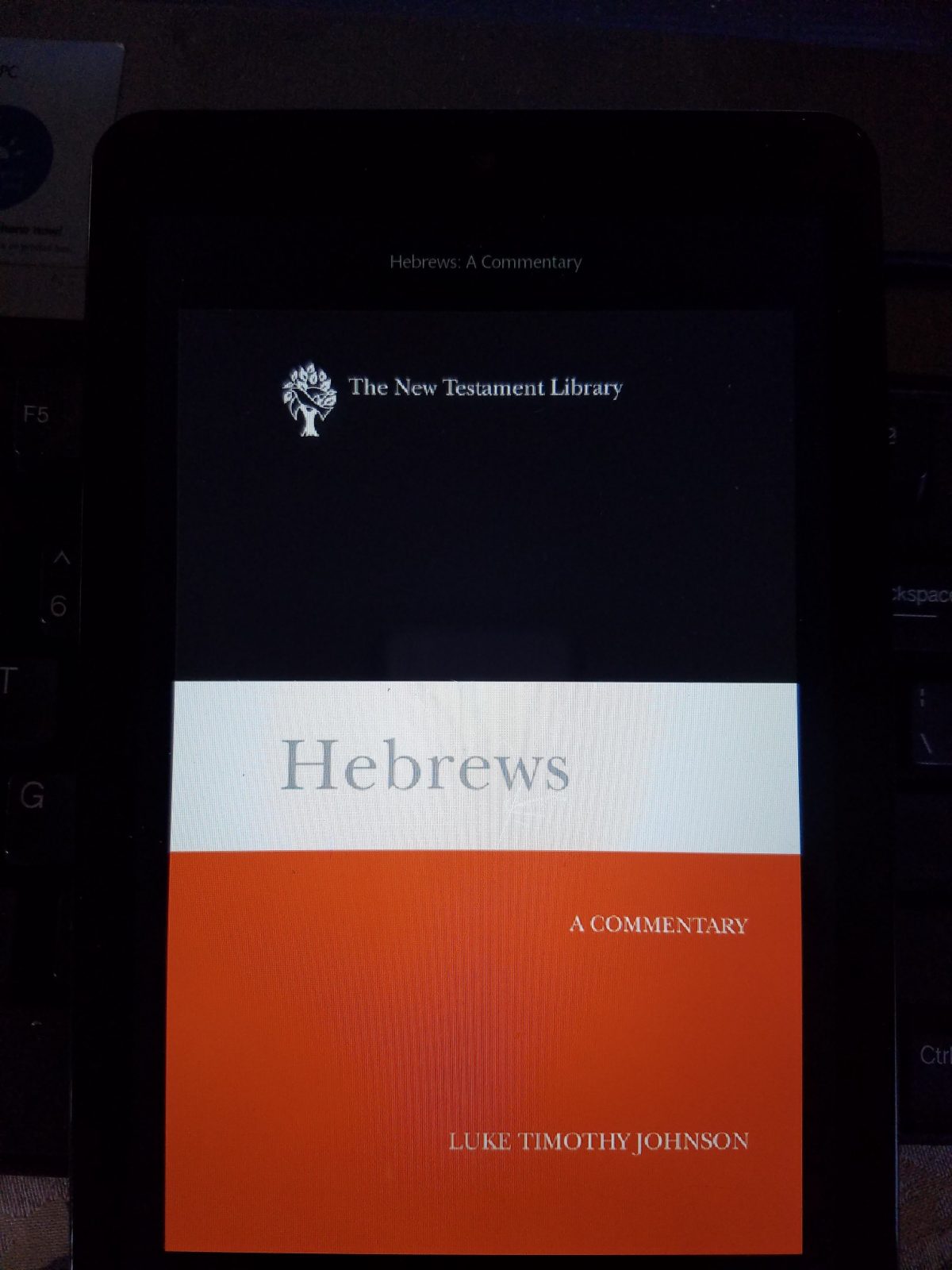
I recently worked my way through Luke Timothy Johnson’s Hebrews: A Commentary (New Testament Library) along with the Greek text, and I’m going to write a few notes on the book, which may, or may not, constitute a real review. Time will tell!
The problem with many blogger book reviews is that they often amount to no more than various length notifications as to whether the author liked the book or not. There are some really wonderful exceptions to this, and you really can find a great deal of information about a title in the blogosphere, but you can also read many words (such as these) which don’t tell you a thing! As an alternative, you get an argument against everything the author wrote in the book, usually without sufficient quotations or references to let you get a feel for what the reviewer is arguing against.
In my view the ideal review identifies the goal(s) of the book, comments on how successful the book was in accomplishing these goals, has some interaction with the ideas, and finally has a summary evaluation which is based on the stated goals. I recall reading a book about Christian apologetics. I thought it was well written, carefully argued, and thorough. There was one problem, however. The author claimed in the introduction that he would close all the holes in arguments from Christianity and the Bible. He compared the work of others to putting one leaky bucket in another: You slow the leak but you don’t stop it. He was going to stop it. In the end, if I was asked whether I liked the book, I would have to say “yes,” despite (or even because of) the fact that I disagreed in many places. Yet in a review I would have to say that the stated objective was not achieved, and making a claim that one would accomplish such an objective was, shall we say, suboptimal.
In the case of a commentary, the difficulty is greater than with an ordinary book. There are two key problems: 1) Many people have very fixed ideas of what a commentary ought to do, and little forgiveness for a commentary that doesn’t accomplish their list of goals, and 2) People (particularly scholars) have quite a variety of very fixed ideas. No matter how you choose to write a commentary, no matter how large or small you make it, and no matter how carefully you draw compromises between never completing the task and short-changing the reader, someone will complain.
I would like you to note here my own inconsistency. I’m writing in prescriptive language about what ought to be in a review, while arguing against prescriptive ideas about writing a book. I will live with this inconsistency.
Besides, this isn’t a review. Here are my general thoughts.
I found Hebrews: A Commentary by Luke Timothy Johnson to be the most helpful commentary I have read thus far in terms of stimulating theological reflection. By that I mean that the author doesn’t merely provide a view, but he argues it in such a way that it stimulates new thinking. My personal response to some of his views is that they are perhaps a little too tied to orthodox theology and a little less daring than the book of Hebrews deserves, but that is at the nit-picking level. Johnson knows how to present quite orthodox theology in a way that is challenging and helpful.
As I studied using this commentary, reading the Greek text and taking second looks at the textual notes, I often found myself reflecting for some time after I’d read my chosen portion for the day. I rarely find that level of stimulation for thought in a commentary.
This is not David Allen’s volume in the NAC series. Dr. Allen covers everything and references everything. The only negative thing I would say about his commentary is that I have to have some energy built up before I go to consult it. If you want a detailed and complete survey of the topic along with arguments in favor of a particular solution, but all means use David Allen’s work. On the other hand, if you want to get more quickly to the topic for teaching and preaching, use Luke Timothy Johnson.
I know we don’t like to think that we might shirk some portion of the possible study of a passage we’re going to teach or preach. We’d like to think that we covered everything before we tried to present an exposition to others. But we all face the clock. Brevity is not a sin.
So when I want to get right to meditating on the text, but with some solid meat to set it up, I turn to Johnson’s commentary.
Now I haven’t called this a review, yet I’d like to present some interaction. I’d suggest, however, that I’ve already done this in blog posts on Hebrews written after reading material from Johnson’s commentary. You can start with Hebrews and the Problem of Writing Introductions. I could provide a number of links, but the simplest thing to do is to type “Hebrews” in the search box after you get to that article. Nearly everything I wrote on Hebrews after that point references Johnson.
Note: I read
-

Is It Greek Pedagogy, Learning Skills, or Something Else
These discussions seem to come up all the time about learning Greek, but the discussion also applies to Hebrew. How one can imagine it’s critically important to learn Greek if one is to preach or teach, but not so much to learn Hebrew, I don’t know. But the degree requirements of various colleges and seminaries reflect just such an attitude.
That said, I want to make some comments about learning and teaching, but more importantly about goals. Thomas Hudgins has written a good deal about this in a recent post, and he posted some material from Dave Black, which provides me a good link for that as well. Both make some excellent comments on pedagogy and what those of us who teach need from the students.
On the use of the word “we,” I want to note that my role as teacher is vastly different from Dave’s or Thomas’s. I tutored Greek as a student in graduate school, helping Master of Divinity students get ready for tests. And that was indeed what it was: Getting them ready for the test. None had patience for letting me help them comprehend the subject better. They wanted to make sure they had memorized enough answers to get by on the test. Since then I have occasionally offered classes in the local church or tutored individuals who were trying to learn. The key element here is that people came to these classes because they had a goal, and they pursued the goal.
And this is why I think we need to look at two other things. I used “learning skills” in the title, but what I really mean is the art and practice of being a student. There’s probably a perfectly good word for it, but short of suggesting you be a good talmid, I can’t bring it to mind. But beyond learning skills there’s motivation, and behind motivation there’s purpose, or perhaps mission.
That leads me back to graduate school and my graduate advisor, Dr. Leona Glidden Running. I was truly blessed to have Dr. Running as a teacher and advisor. I learned enormous amounts from her in classes in Syriac (which I audited), Akkadian, and Middle Egyptian. From the list of languages you can see that I had the motivation for learning languages. Thus I learned from good teachers and some whose pedagogy may have lacked a bit.
It was also Dr. Running who got me into tutoring and sent her students to me for help in both Greek and Hebrew. The problem with tutoring points me to what I think is a problem in ministerial education: Students going through language courses in order to check a box. We’re often fairly good at ditching traditions in Protestantism. Just look at the reformation! But folks, that was 500 years ago. What traditions have you ditched lately?
What I encountered were students who were studying Greek because it was required for the degree, some of whom had been told by ministerial advisers, mentors, and church leaders that the only reason they should learn Greek was to get their degree, and most of whom would serve churches that didn’t care what biblical languages they might have learned. Is it any wonder that they just wanted me to help them through the test? I can’t count the number of times I was called within hours of the test, or late on a Friday afternoon or even working into Saturday with desperate pleas for that help. At this time I was a Seventh-day Adventist and I took my Sabbath seriously. (I’ve recently commented that it’s one thing from my SDA background that I really miss.) But these ministerial students who were supposed to be preparing to shepherd people in that tradition, were quite ready to ditch their Sabbath rest to get past the test.
I know from reading what others have said that while the details may differ, the attitude is quite similar. Some seminaries have given up on the languages as a requirement. Often those seminaries are ones that have reduced the entire biblical studies requirement to a minimum. So study of biblical languages goes the way of Bible study, and it all happens without that much planning.
So speaking as someone who thinks biblical knowledge is critical, let me suggest that we need to reexamine this entire process. What is a Master of Divinity degree for? What are our goals? Within that, what are the goals for knowledge of the Bible? Of biblical languages? Once we know what we need—and want—then we need to ask how we get it. Forcing students to take one or two (or whatever number) of semesters of Greek and/or Hebrew doesn’t accomplish anyone’s ultimate goal, at least anyone I know of. Nobody actually hopes that the student will pay tuition, check off a box, and leave with no knowledge that he or she will use (except possibly the university finance department).
I don’t know about other biblical languages classes, but my teachers taught with the goal of having us learn to read the language. They knew they were only going to accomplish that in a few cases, but they still worked toward that goal. If the assumption of everyone else is that the student will not, in fact, learn the language, then we need to do something about that. That isn’t something that a Greek teacher can fix. He or she can try to motivate more students, to provide as much useful information as possible, but that all constitutes making the best of a bad situation.
Amongst the possibilities that should be considered are requirements for additional classes in history, cultures, people (sociology/psychology), linguistics, or other topics that helps a person understand a written text. Perhaps, in addition, one might include classes specifically in taking complex ideas and expressing them clearly and simply (to whatever extent possible). Then we can aim the biblical languages classes at people who do actually want to learn to use the material.
I have to put in my ritual dig at the whole educational system. I think that in the 21st century world the degree system is getting more and more out of date. Something more like the badges system that the Mozilla Foundation is sponsoring may be at least an early pointer toward a replacement. But that moves beyond this post …
In summary, in languages as in anything else, we need to keep our focus on the mission. That starts with knowing what the mission is.
And we don’t.
-

Thankful for the Gift of Suffering for Jesus?
Because you have been graciously given this on behalf of Christ:
not only in Him to believe,
but also for Him to suffer. (Philippians 1:29, excessively literally)I’ve been meditating on two texts as the new year begins, Philippians 1:27-30, and Ephesians 5:1-2. I’ve been kind of ignoring this suffering thing so far. But last night listening to music in worship at Freedom Church Pensacola, it suddenly struck me to think: Do we have any songs in which we actually praise or thank God for suffering? There may well be, but I don’t recall one off-hand.
This is certainly not a criticism of the church I was in at the time I thought it. I don’t recall this sort of thing anywhere. We don’t talk about it in the way Paul does here. In fact, we don’t really want to acknowledge the reality of suffering. Often our singing, praying, preaching, and indeed our living presents the pretense that nothing ever can or will go wrong. Have you ever heard anyone say in church, when a testimony is called for, that they have had a horrible week and just don’t know how they can go on? No! That’s a sign that they’re crazy. The intelligent and sane ones pretend.
I don’t think Paul is saying here that suffering is wonderful and good in itself. I think the privilege is that the suffering that will come—and despite our desires, it will—is not vain and of no worth, but rather it is suffering on behalf of the kingdom. It’s not cheering that there is pain, but rather cheering from the pain that whatever happens is not in vain.
This reminds me of the Battle Hymn of the Republic and the frequent change of the line “as He died to make men holy, let us die to make men free” to “as He died to make men holy, let us live to make men free.” (You can find more on this here.) Those who have served in the military know that dying may be necessary. It’s not what you live for, but many people have faced death for their nation. Many Christians have faced or are now facing death for their faith. It’s a reality, but just as we change the line in the song, we’d rather not talk about it. Certainly, we don’t want to sing about it.
Conducting ourselves in a way that is worthy of the gospel (Philippians 1:27) may involve annoyance, discomfort, suffering, and even death. God’s gift is that we do it in, with, and through Jesus Christ.


