Threads from Henry's Web

Author: henry

  • You Don’t Have to Have an Opinion about Everything

    I posted a note from an article regarding the data released by DHS about Russian hacking, if it was Russian, and then I started wondering whether people would assume it is my opinion that the Russians were not involved.

    In fact, I do not have an opinion on that because I do not have enough information to support a reasonably informed one. The article simply notes that the evidence released by DHS doesn’t appear to point to Russian activity specifically. That doesn’t mean that this is the only software used, or the only IPs, nor does it mean that the understanding of the article writers is complete. Their conclusions are stated in admiral fashion. They note the nature of the evidence and what they can identify about who it points to.

    What amazes me, however, is the massive number of people who already have come to a conclusion on this. Either the Russians did it or they didn’t, and we make the determination based not on actual data but simply on which group of people we associate ourselves with. My guess is that not one in ten of those people with a firm opinion on this topic have even the tiny amount of information that I’ve collected, nor do they have my knowledge of computer security. Many of them couldn’t really tell you what “hacking” means, and what would be necessary to get the kinds of data involved. Yet they have firm opinions, loudly expressed.

    I note here that I’m not a security expert in the sense that the people who develop anti-virus software are. I simply know enough about how computers are attacked that I can select good software and suggest/apply good security practices. The people who have the expertise to actually make determinations are not all that numerous.

    It doesn’t hurt not to have an opinion. It doesn’t hurt to say, “I don’t know.” Which I say right now: I don’t know. I am not convinced it was a Russian government action, nor am I convinced it was not. Let’s look at the evidence.

    What really bothers me about all this, and what I do have an opinion about, is the threat that potential hacking presents to national security. A serious effort could disrupt an election and in ways that are much worse than some manipulation of information. Get used to it. Information is going to be manipulated. I don’t trust the government to be able to deal with the human factors that hamper good data security. In my experience, the most common problem is the password on a sticky note, often also easily guessed, and not the highly technical hacker.

    And of course I must note that I suspect rampant stupidity has a greater influence on U. S. elections than does foreign interference, assuming there was any.

    We might want to consider electing some more technically qualified leaders for a technical age … it’s just a thought.

    (FWIW, it’s bad writing style to conclude with something quite unrelated to your title and opening paragraph. But this is my blog and I’ll write badly if I want to.)

  • Similar and Different

    Similar and Different

    Dave Black has been posting some interesting things on his blog, and yesterday he wrote a bit about Greek and Hebrew language and culture. I’ve put this on jesusparadigm.com to provide a permanent link. Here’s the bottom line:

    The bottom line: I think it’s a bit misleading to insist that grammar and thought are inherently related. There are just too many philosophical difficulties inherent in any theory of mental representations.

    He’s absolutely right. I think it’s difficult to get this sort of thing balanced because of two problems. First, there is a relationship between the forms of language an the culture that speaks it, and second, we like to find a theory that settles everything. So the New Testament must be either all Hebrew or all Greek in thought. Why? Because it’s easier to handle. If I know that the background must be Hebrew, then every time someone uses a background from Greek philosophy in interpreting a passage, I can declare them wrong and come up with one final and absolute answer.

    In fact, it’s necessary to check many things. Take Hebrews and “shadows of heavenly things,” for example. Is this an idea based on Plato’s philosophy, or do we adjust it to fit better into some idea of Hebrew thought? Perhaps we need to consider the possibility that the author of Hebrews actually has his own view of the relationship between earthly shadows and heavenly realities, and that it doesn’t derive entirely from the background.

    Which leads be to an aside. One thing that can suffer when we study the background of thought in order to categorize it, is that we can miss the original thought of an author. But we also need to balance that against the soil in which the thought germinated. There’s probably a reason that an author chooses specific words from those available to him in order to express his original thought.

    Similarly, we have the word hilasterion which either occurs or is closely related to words that occur in other Greek literature and is used in the LXX to translate some specific Hebrew terms. So when it’s used in Hebrews do we import the meaning of kapporeth, do we seek for meaning in its usage in Greek, do we spend our time on it’s etymology in Greek (surely an interesting subject!), or do we look strictly at its context in Hebrews?

    I’d suggest that we’re going to do some of all of the above, because it’s likely that the author of Hebrews was acquainted with all of that material. He was skilled in Greek, he was acquainted with the LXX, and he was capable of original thought and composition. The final arbiter needs to be the context of his specific usage, but all those other elements form the soil from which that particular meaning is nourished.

    I doubt that very many of those who argue the different positions really deny the role of other options. They just sound like they do as the press a theory. Sometimes, however, the main reason to press a theory is that it is distinctive and thus identifiable as our work. I recall hearing a sermon in which the preacher started by saying that he would show us how everyone got the story of the prodigal son wrong. He proceeded to present some good thoughts, though they were not nearly as revolutionary as his opening statement. He denied some other ideas, though his presentation had hardly made it clear that those ideas were wrong. After the sermon concluded, many people left talking about how they had been so enlightened by hearing the “real” meaning of the parable.

    I would have said, instead, that they had heard an interesting interpretation of the parable, one with some considerable value, yet neither so original, nor so revolutionary, nor so exclusive as everyone thought. I had to wonder, however, if things had been stated in my preferred way, with “one option for understanding” and “maybe we should consider” and “different understandings are possible” strewn about in the sermon.

    When we’re making a point, the temptation is to present all the evidence in favor of our viewpoint and try to downplay the things that are not in agreement. I encountered this in comparative literature. You could find those who thought that Genesis 1 & 2 were clearly copied from the Sumerian and Babylonian stories, and others who thought they were so different that they were clearly unrelated. The fact is that if you get to choose your elements you can make them appear to be very close or very distant. I’d suggest that the reality is that there is a relationship (I suggested in my work for my MA that this was one of sharing cosmological language more than one of literary borrowing/copying).

    Similarly I’ve mentioned the etymological fallacy a number of times on this blog. The idea that a word’s meaning is determined by etymology is a fallacy. But I’ve invented the anti-etymological fallacy to go with that. That’s the opposite error which assumes that any use of etymology in determining the meaning of a word is a fallacy. Determines, no. May have some relationship, yes. Thus I’m certain to look at hilasmos and hilaskomai (amongst others) when studying hilasterion. How much help do I get from etymology? That depends on the particular word, and the circumstances of its use.

    The pursuit of absolute and certain answers can tempt us to invent them when they don’t exist. It’s nice to settle back comfortably knowing that all words in the Greek New Testament should be understood as expressions of Hebrew thought. One can discard so many thick, multi-volume sets of references, and certainly one doesn’t need to read all those difficult classical Greek quotes to get ideas of the usage of the word. But comfortable and right are not the same thing.

    I can think of so many applications of this that I’d better just stop!

  • The Importance of Breaking Rules of Style

    When I was in the Air Force, I submitted a performance report on someone I supervised. The lieutenant who was the next person to endorse the report returned it to me, informing me that I shouldn’t use the passive voice so much. Problem was, I hadn’t used a single passive clause in the report. What the lieutenant didn’t like was my use of the perfect tense. He wanted to get rid of “has” and “have” because he’d heard they shouldn’t be there. And the fact is that my report did overdo the use of the perfect tense so I fixed it.

    What I’ve found as an editor, besides my inability to properly edit my own work, is that the writing style people use is often the result of a number of rules of thumb they learned in High School English class. They don’t understand the rules, but they cling to them, because that’s what they know. They’re afraid of being wrong and looking uneducated. I often suggest to authors to make their written style closer to their spoken style. It’s natural to get a bit more formal when writing, but don’t overdo it.

    My intention in writing this, however, is not to give advice about writing, but rather about reading and understanding.The value of a passive verb is in emphasizing something in a more subtle way than with bold print, an exclamation mark, or other more blatant approaches. It’s important to understand the way things are usually done so you can feel it when they’re done differently. In your native tongue this is automatic for most of us, though some people are more aware than others of the subtleties possible with language.

    This is very important for those who study the Bible in the original languages. We still have a tendency to make exegesis a series of word studies, but the way the words are put together is extremely important. That’s why I emphasize reading quantities of a foreign language. There are many theories about the way to learn a language. I’m not going to jump on any one bandwagon except to say that one needs to have exposure to a large body of text in the language written by those who are proficient.

    Modern tools provide many excellent opportunities to do this. Take as many of those opportunities as you can!

    (For an example, see Dave Black’s notes on 3 John from 12/27/2016.)

  • A Good Book Review – Running My Race

    A Good Book Review – Running My Race

    A good book review is not one that says nice things about the book, although nice is nice, so to speak. I occasionally read a positive review that makes me wonder whether the reviewer read the book. There are likewise negative reviews that make one wonder. As a publisher, I must take all these in stride.

    A really good review, however, is one that shows the reader read the book and also got from it something the author and publisher had hoped to get across.

    Thus a review of Running My Race (David Alan Black) on The Tired Blog. I was feeling fairly tired today, and then I read this review. It really cheered me up. If I can publish a few books each year that make readers uncomfortable, then I’m doing my job.

    Of course, as publisher I’d also like to note that Running My Race is a good book! 🙂


  • Checking Facts and the Authorship of Hebrews

    Checking Facts and the Authorship of Hebrews

    Dave Black just posted a note on the authorship of Hebrews which brings up an important point: Fact checking. This comes up all over the place these days. It’s so easy to just quote something you’ve heard or to reference a secondary source when a primary source is available. As an editor I’m reminded of this constantly when I look up quotes in books or check references. Sometimes one must cite a secondary source, but most commonly one can find a way to access the information directly.

    So assuming you read Dave’s post (which I copied to our Topical Line Drives site so we’d have a permanent link), did you follow his advice: “Look up these verses for yourself if you like”?

    I remain unconvinced that Paul wrote Hebrews, and I actually find the issue less critical than others do. I think one can look at the book itself and figure back to the issues that were important to the author. It’s nice to know authorship, but when it’s uncertain, I dislike making conclusions that depend on a specific answer to a complicated question. I’ve switched from the “anyone but Paul” school to the “uncertain authorship, but Paul is possible” option after reading (and publishing) Dave’s book.

    But that conclusion is less important than the broader one: Do you get as close to the source as you can in checking facts?

  • Hearing the Christmas Voices

    Hearing the Christmas Voices

    Classic nativity scene
    Credit: Openclipart.org

    In today’s Christmas sermon our pastor told a story he’s told before, but with a slightly different slant, and that reminded me of a number of things I’ve been thinking about over the last couple of weeks.

    Let me be clear that I’m not criticizing the pastor for telling the story with a different slant. In fact, I think that’s honoring the genre. Stories, like gems, are most beautiful when we look at different facets and under different light.

    Let me draw in another thread here, or better, another story. Some years ago I was leading a Bible study group. The topic was somewhere in the book of Revelation, and as we went over some of the details and the options for interpretation, one of the participants exclaimed, “Why couldn’t God have just written it all clearly across the sky?!”

    Precisely! Why not? It’s valuable to consider how it is that God communicates with us. We make assumptions, often based on what we want to know, but we have to ask if the communication is designed to provide us with the kind of data we want. That study group participant, for example, wanted a clear understanding of the future, which the symbols of Revelation were not providing. It might be valuable to ask whether those symbols are intended to provide that information.

    Here’s another thread, another story, to draw into this discussion. I was reading Ezekiel 37 recently and came to verse 9. God speaks to Ezekiel and tells him to prophesy to the wind (breath, as it turns out) to come into the bodies which have been assembled and covered with flesh and skin. When Ezekiel speaks to the wind, the wind obeys and the bodies come to life.

    It struck me that God is in the valley (omnipresence, yes, but we don’t always mention it), and is in command of the wind. Why tell Ezekiel to tell the wind? Of course, if you’re a Bible student at all, you’ve seen that principle in action many times. In fact, it occurs a couple of times before verse nine in this very chapter, but somehow it struck me at that point in this story.

    God tends to accomplish things through people. Most importantly, God communicates with people through other people. Quite freqently, he does this in stories, and even in stories that come at the same thing from different angles. (Angels too!)

    This isn’t what most of us would prefer. Given the choice, we’d like a single, definitive account of the nativity, a single, definitive, systematic theology, and a single, definitive code of conduct that would allow us to know what God wants at all times and in all places.

    Speaking of which, the people in Jesus’ time wanted certain things and generally had certain ways they hoped those things would be accomplished. A new king, genuinely and provably from the line of David, equipped with a large (obviously victorious) army, resulting in independence from the Roman Empire. We present that list as though we feel that there was something wrong with them for wanting all those things. In reality, if you read the prophets and don’t assume the answer is “Jesus,” you’d likely get tbe same idea. And considering how we in America react to a bit of inconvenience in the political sphere, we’ be yelling even louder to get rid of the oppressors and looking even harder for a savior figure.

    So we have the son of God showing up in a way that was quite contrary to expectations, and we have multiple stories. Think about it! Very few people got the word directly, and most of those who did were from unexpected places and professions. Astrologers figure it out in the stars, and Herod hears from them. Shepherds hear from the angels, and others hear from the shepherds.

    We, in turn, hear from multiple witnesses that don’t really agree. I’m not calling the historical difficulties insuperable, but the amount of energy that goes into reconciling them is a testimony in itself to how different they are. The differences are challenging, and I think enlightnening.

    We like to combine the stories so we hear about shepherds, wise men, a trip to Egypt, and other events all in one sequence. But the writers don’t combine all those elements. Mark and John can tell the story without birth narratives. That gets drawn into debates about historicity, but I would suggest it’s more important to hear the individual voices.

    These are stories, and they are being told from a particular slant. They are threads in the broader story of the Christian faith — both the combined narratives and the individual ones.

    And right here there is another warrant for telling stories with different slants, seen through different filters. Consider that our Christian narrative is drawing another narrative into itself. We draw in those prophecies of Isaiah and Zechariah, and we give them new meanings. (Matthew does a lot of this.)

    In one sense, we’re borrowers of another story. In another, we’re writing a new conclusion to an existing story. In another, we’re immigrants, drawn into someone else’s story.

    It’s easy to sit around and call other angles on the story “wrong,” and try to create the definitive story. But to each of us God says, “Prophesy to the wind” (Ezekiel 37:9), and “the wind blows where it wills” (John 3:8), both of which I cheerfully take out of context, and the story (stories) refuses to be contained or constrained.

    Where will you find yourself in the story you’re creating with God in the coming year?

  • Ignoring the Biblical Teaching about Greed

    Ignoring the Biblical Teaching about Greed

    Credit: Openclipart.org

    On a variety of subjects I regularly hear about how people ignore the plain teaching of scripture. I’d like to take away the phrases “the Bible clearly teaches” and “the plain teaching of scripture” from conservatives, while taking “we don’t take that literally” away from liberals. Then maybe we could get around to discussing the nuances and appropriate social contexts for some biblical materials.

    But one thing that I hear about much more rarely is the sin of greed, surely one of the things Jesus talked about very frequently in a number of different ways. I’d like to nominate “committing all that I possess to God” as a pretty clear teaching of Jesus.

    Nobody is really saying “greed is good” using the word. Instead, we justify greedy actions by ourselves and others. I’d be very shocked to learn that more than a couple of percent of the possessions of the Christians in the United States was committed to God (or the church), and of what’s committed to the church, a significant amount is used in a self-centered manner.

    Perhaps this would be an important topic on which to make a new commitment as we observe commercialism and greed used as a way to celebrate the birth of Jesus, who had no place to lay his head.

    That was all launched as I was looking back through Christmas stories from my fiction blop (The Jevlir Caravansary), and found How Scrooge Got It All Wrong.

    You see, what Scrooge really needed was some good, modern business advice!

  • Why I Publish Books by and for Seventh-day Adventists

    Why I Publish Books by and for Seventh-day Adventists

    This may seem like a simple question. A better one might be, “Why not?”

    Some Prefatory Remarks

    sda booksSeventh-day Adventists (SDAs) are often misunderstood, which complicates the issue. If I had transferred my membership from a Presbyterian church, for example, to a United Methodist congregation, it’s unlikely anyone would ask me why I maintain relationships with Presbyterians. As an ex-SDA, however, I’m often asked questions like the one I’m trying to answer right now. SDAs ask me how I could possibly leave the church. At an SDA church where one of my authors was speaking, a young man exclaimed to me, “How could you possibly have difficulties with SDA doctrine?” If you want to understand why I left the SDA church or how I feel about it, you might try reading The Joys and Sorrows of Being ex-SDA.

    Here’s my key point: While I disagree with the Seventh-day Adventist Church on a number of doctrinal points, especially on issues of prophecy and some applications of the (otherwise valuable) term “remnant people,” I still regard them as brothers and sisters in Christ, in the same way and on the same basis that I regard fellow Methodists, or members of Presbyterian, Baptist, Assemblies, United Church of Christ, independent, or any other Christian congregation. I have disagreements on doctrine with pretty much everyone I know (often including yesterday’s version of myself), and that doesn’t make me deny Christian fellowship.

    But there are always those other questions about SDAs. They’re different, yes, but they’re more different in weirder ways than others. Which reminds me of the church Staff-Parish Relations committee that decided that an SDA speaker, who had also spoken at continuing education events for pastors at the conference level, could not be allowed to speak at their church. Having read something about Latter Day Saints, they were certain they didn’t want an SDA to speak. Surely we should stick to Methodist speakers.

    There are two forms of ignorance here. 1) There’s ignorance of precisely who SDAs are and what they believe, and 2) There’s the ignorance of just how much weirdness we have in mainline denominations. If I need to find a crazy speaker, but am limited to those who are United Methodists, I will have no difficulty at all!

    What I Publish

    So what does this have to do with publishing?

    Very little, actually. It’s just that people expect it to.

    I frequently have to remind people that I am a Christian publisher, publishing books selected for a Christian audience. That doesn’t mean that all our readers are Christians. What’s more, it doesn’t mean that all our authors are Christians. In a blog post titled Why Did You Publish THAT Manuscript? (on the Energion blog), I noted that “We judge manuscripts and not authors here at Energion Publications.”

    To me that is a rather obvious point, but it has raised questions. In order to guarantee the publishing of Christian authors only I would have to first define the boundaries of Christianity, and then make myself the judge of whether someone had met those criteria or managed to fall within those boundaries. I can do that for myself with regard to organizations and systems. It’s a simple matter of definitions and categorization. To do it with persons would be problematic. In fact, I personally simply accept anyone’s self-confession of what their religious view is.

    Further, as publishers have discovered before, it’s much more difficult to determine whether a person is a good person than it is to determine whether a manuscript is a good manuscript. I choose to deal with manuscripts.

    Seventh-day Adventists

    I think my earlier remarks largely answer the question. When a manuscript by an SDA author seems to me to be of interest to my audience, an audience which definitely does include SDAs, I’ll publish it, always provided it meets other necessary criteria. I avoid publishing books that are of interest to only one denomination, for example.

    Here are some specific points:

    • Am I on a mission to convert SDAs and get them out of the SDA church? No. I have no intention of persuading anyone to leave their denomination. In fact, I will state that if you’re leaving any church, including the SDA church, because of anger at the organization, you’re going to find plenty of imperfections wherever you go. If you leave a church congregation or a denomination, do so for positive reasons. I may disagree with some doctrines of the SDA church, and so I moved to an organization that is more doctrinally compatible with my views, but I applaud and highly value the SDA educational and health systems. I also value much of the theological work done by SDAs over the years. I can both disagree with, and value, ideas.
    • What about the seventh day Sabbath? I consider the Sabbath a part of one’s approach to worship and a spiritual practice. Where I have seen it carried out as a spiritual practice, I find the seventh day Sabbath valuable. As with any other activity, it can be converted into a legalistic “work,” but the key here is “any other activity.” Because keeping the seventh day as the Sabbath stands out as unusual, people take it as extraordinary evidence of legalism. But it’s simply one more practice that can be positive or negative. I have said before that I miss the Sabbath as practiced in SDA circles. I have other means of seeing sacred time, but there’s nothing that quite matches taking sacred time together with a community.
    • Don’t SDAs think they’re the only true Christians? Some of them do. So do one or two Methodists. I think this is a problem for the SDA church partly because of teaching about God’s remnant people. But I have no problem with SDAs as a group over it. Most SDAs that I encounter treat me as a fellow-Christian even though I have left the church. There are occasional folks who treat me as an apostate. I believe that could be solved if there were no people in the SDA church. As things are, we’re stuck with it.
    • But SDAs don’t believe we go to heaven when we die! Indeed they don’t. Neither do I. I think the Bible is actually quite unclear about what happens after death, but the balance, I believe, favors soul sleep and a resurrection. I just don’t happen to think it matters. Arguing about this is very time-bound thinking. If I die and go to heaven immediately, there will be one breath here and next (breath? who knows?) on the other side. If I die and sleep with God until the resurrection, there will be one breath here, and the next (whatever!) on the other side. I won’t know the difference. (I publish several books related to this: Eschatology: A Participatory Study Guide, From Here to Eternity, Journey to the Undiscovered Country, and the forthcoming Death, Immortality, and Resurrection. The first and last are by Edward W. H. Vick, an SDA author.)
    • SDAs believe in Ellen G. White, a false prophetess. Got you now! Ellen White did indeed have a great deal to do with the founding of the SDA church, though I find her own view of herself and her mission refreshingly humble. I also find a number of her writings to be excellent devotional works (Steps to Christ, Desire of Ages, etc.). We have a voluminous collection of her writings, including letters that she wrote over a long life. The SDA church has had some struggles over how to view her and her relationship to the Bible. Bluntly, however, I’ve found traditions in local congregations of the United Methodist Church that have more sacred standing, in practice, than her writings do in the SDA church. I would say, rather, that the church as a whole, and the modern Charismatic and Pentecostal movements in particular, would do well to learn from the SDA experience. Speaking of which, I’m in the process of releasing Inspiration: Hard Questions, Honest Answers by Alden Thompson. He deals with issues of Ellen White in connection with discussing biblical inspiration in a work that I think the wider church would do well to study.
    • How do I deal with SDA authors in my catalog and marketing? Like any other author. I’ll advertise their books for their own denomination, but also present them to others for their wider value. And just like any other author, SDAs may write something that’s addressed more to their own church than to others. In that case, they will be more likely to publish within the denomination, again just like any other author might. I neither emphasize nor do I conceal the denominational connections of my authors.
    • Do my SDA authors quote Ellen White in their works? Yes, and no. I tell them to quote Ellen White as they normally would and if it’s necessary, we will add an explanatory note to the book so that others can understand and still benefit. This is a function of the level of controversy surrounding her work, rather than any judgment of it that I might make. Because there is controversy, explanation is helpful. On the other hand, when addressing the larger Christian community, SDA authors often feel it’s best to make their points without reference to an SDA specific source.
    • Are you trying to provoke dissent in the SDA church? No more so than in any other church. I do have some books in my catalog that have gone out of print from SDA publishing houses. The level of controversy in the SDA church has nothing to do with my decision. I still judge the book, not the author, and certainly not any former publisher. But beware! I’m not the arbiter of truth, and certainly not the arbiter of SDA doctrine. If you don’t want your beliefs challenged, then it’s my hope that my books are not for you!

    Conclusion

    I publish SDAs in the same way and on the same basis as I publish anyone else. It’s that simple (he says 1600 words later)!

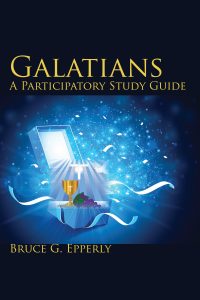
  • Tonight on the Energion Tuesday Night Hangout: Bruce Epperly

    We’re going to talk about process spirituality, Advent, and Christmas. Fun!

  • Syntax and Exegesis of the Greek New Testament

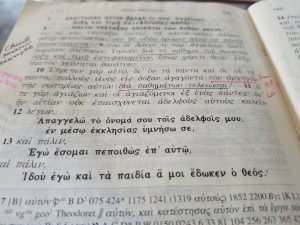
    Dave Black has some interesting thoughts on syntax in the Greek New Testament and its importance for exegesis. I’ve extracted them to JesusParadigm.com so as to have a permanent link (by permission).

    I became a convert to the importance of linguistics in understanding biblical languages when I read James Barr’s The Semantics of Biblical Language in graduate school, and I took up the topic with all the fervor of a convert. I recall hearing more than one person comment that New Testament Greek doesn’t really have syntax, by which they meant that the relationship between words, phrases, clauses, etc. is indicated in Greek by word forms rather than by word order as it is in English.

    In reality, however, word order has a more subtle impact on the meaning than it does in English. As is usual with such binary distinctions, one can get in trouble with this one.

    When I have taught Greek, which is only on rare occasions, I start immediately talking about Greek word order, and such linguistic concepts as semantic range. With classes of lay people, I usually have the equivalent of a single term or perhaps a year with each student. In that time, I think it is more important that they come to understand some concepts of how language works and improve their ability to read material on the language in commentaries.

    My suggestion to those who want to go further is to make sure that they read lots of Greek text. This is why I like reader’s lexicons (listing words by chapter/verse), and the even more accessible tools available in good Bible software. It is quite possible for someone to use these tools to avoid actually studying and understanding, but a person who will do that will likely do the same thing with whatever resources are available.

    If your interest in biblical languages is aimed at going a grabbing a Greek word that you can emphasize, then that’s as far as you’ll get. And you will often be wrong. Your “wrongness” may sound important, but it will still be wrong.

    The excellent tools available now give you the opportunity to both cover large amounts of text by letting you look up the meaning of forgotten (or never learned) words quickly, and also to dig deeper. As the material Dave links to indicates, however, you need to think about more than word studies if you want to dig deeper into the meaning of the text.