
I will resume the studies next Thursday night. Some unforeseen scheduling problems intervened.
Author: henry
-

Not Just Money
On New Year’s Day this year I was struck by two texts and decided to make them a kind of theme texts for living during the year. I didn’t really make a plan or a resolution. I was just impressed to keep these two texts available and look at them. I’ve found that I actually end up looking at them at random times. They are Philippians 1:27-30 and Ephesians 5:1-2. At some point I’ll talk about the phrase “be imitators of God” in Ephesians 5:1, which I find challenging, or perhaps intimidating would be more the word.
Today, however, I read on after the end of chapter one into the first four verses of chapter 2. Here Paul challenges the Philippians to do nothing from selfish ambition or contentiousness (two closely related ideas!) or from vanity (we could spend a day meditating on that word), but to count others as greater than oneself with humility. Again, we could talk about the latter. Have you ever experienced someone counting something else greater than himself with no humility at all? “Look how great I am! I count even this lowlife failure as more important than I am!”
But then there’s verse 4: “Don’t look out for your own interests, but for the interests of others.”
Now there’s the one. If the church should have a key verse, this would be it, I think. It contrasts to the world’s value, expressed to me once by someone advising me on my business: Ain’t nobody cares about your business like you do!
Now you see how my thinking turns toward business and the making of money. I have nothing against those things, but it’s actually quite easy to be generous with your money and to be contentious and vain with everything else. Thousands of brass plates on church pews, stained-glass windows, and other objects designated for “spiritual” use testify to the fact that there are people quite generous with their money while satisfying their vanity. If you don’t believe me, try removing one of those labeled pews or swap out the stained glass window. Even worse, leave the pew or the window there but remove the name plate. Vanity will jump up and slap you in the face!
Looking after our own interests crops up everywhere. Why is the color of the church carpet a very contentious thing? We all have colors that we’d like to look at, and colors that we don’t find pleasing. How many times have you heard people argue carpet color on the basis that it would serve someone else better?
What about a misspelled name in the bulletin when someone serves on Sunday morning? Have you ever heard the complaints about that? The church secretary ought to be fired!
I don’t mean to list all the ways we can be contentious, as they are so numerous, and so many of them do not have to do with money.
“Look out for the interests of others,” says Paul.
One of the great problems with our witness in the American church is that we are so much like all the people we’d like to witness to. We want to explain all the theology to them and get them all straightened out. But what we really need to do is look out for the interests of others.
And to be a good witness, we need to extend that action outside the church community as well.
On page 25 of his little book Stewardship: God’s Way of Recreating the World (Topical Line Drives), Steve Kindle quotes 2 Corinthians 8:3-5. I’m just going to highlight one clause: “they gave themselves first to the Lord.” That’s the foundation of stewardship. It’s also the foundation of living in Christian community, and it’s the foundation of being an actual witness (not just a nuisance) to those outside the community. Looking out for God’s interests, perhaps. God is very interested in God’s children, in God’s creation.
Who is welcome in your church? How will they live with you? How will you live with them? Do you give yourself to God first and then look out for the interests of others instead of your own?
If you’ve followed me this far, let me suggest a question to think about. If a man and a woman entered your church this Sunday and the woman was wearing a hijab, while both clearly looked middle eastern, what would your reaction be?
(Featured image credit: Openclipart.org.)
-

Wanting to Be Right Theologically
I work on a heavy schedule, and as someone who is self-employed, with two distinct lines of business, I very rarely see a blank to-do list. In fact, now that I think about it, it has been several years since I finished a day and could say I was done.
I identify a couple of goals here. First, I’d like to be done at some point. “Now I can go on vacation,” I would say, “because everything is done.” Second, I want to get as much done as possible, not to mention a few impossible things. In reality, I’m not going to be satisfied on either of those points.
Quoth Paul, “Oh wretched man that I am! Who will deliver me?”
You may think I’m being irreverent to use that quote, in which Paul is referring to his own inability to do what he knows is right and wants to do, but I think it’s closer to the mark than most suspect. So let me first illustrate what I’m talking about with my work, and then get back to the spiritual lesson.
No, that’s not quite right. Getting done with my work is physical, mental, and spiritual process. One of our problems is that we spiritualize spirituality until it has nothing to do with daily life. Ideally (another interesting word), we’ll see the physical and the spiritual working together. Everything from doing the dishes to writing a book to running a marathon (as my friend Dave Black is about to do) is both physical and spiritual; above all, real.
Thus I start with the illustration of how I can attack my day. There are two extremes I can take. The first is my natural inclination. That is, I get up in the morning, come to this computer (most of my work resides in its chips), and start attacking my list. I’m not really a list person, but reality has forced lists on me. If I find myself failing to accomplish the list, I add hours at the end of the work day, all the while wishing I could add hours to the physical day. This process is direct, measurable in effort and results, and easy to understand. More work = more accomplishment.
Before I go to the next option, let me tell you about the problem I have with leaving the first. Mary Heaton Vorse (I believe she originated the saying) said that writing was the art of applying the seat of the pants to the seat of the chair. She was absolutely right. The arts of editing, designing, and marketing are much the same. So if chair meets backside for more hours, more will get written. Authors (and editors, designers, marketers, and perhaps all humans) have many excuses for not having seat meet seat, one of the most common being that you can’t force creativity. Editors, who like to disembowel the excuses of authors, like to point out that you’re not being all that creative outside of the chair either. Writing great novels in your imagination is perhaps not all that likely to bring either fame or fortune!
So having written one or two books myself, and having published around 170 by other authors, I have a strong tendency to stick with Mary Heaton Vorse.
Not so fast!
I also know that creativity will demand its pound of my flesh. One of my techniques for planning out a cover or the chapter headers for the interior of a book is to put them on a computer screen I’m not using and walk by them every so often. This is a way of forcing me to become so disillusioned with the current state of the object that I will come up with a new look just to preserve my sanity. Put less bluntly, I look at it, think about it, and suddenly come up with an idea. Then I apply back side to chair and implement, generally followed by more looking.
Now we turn to the second approach to my day. In this approach I ask what makes me productive. I could list a number of things, such as getting enough sleep. Staying up late to finish a project can get it out the door on schedule, while actually making me further behind overall. I am less efficient on insufficient sleep. Failing to spend time in daily devotions makes me less efficient. It’s easy—almost irresistibly easy—to decide that I’m too busy for that devotional time and simply jump into work. In fact, as I write, I must confess that this morning other than prayer time before I got out of bed, I am writing without devotional time. But this blog post struck me as I prayed (no, I’m not telling you this is God’s word; it’s just my musings), and here I am, drawn to the keyboard and the chair.
Walking is also important for my efficiency. If I don’t get active, I’ll find myself accomplishing little. Walking can be done at any time of the day, and therein lies another problem. Can I stop working and take a walk? Can I stop working inside and go out and clean up branches in the yard? The second is easier than the first. Why? Because it feels like I’m working toward a goal. What is walking but time when the seat of my pants does not connect with the seat of my chair and thus is wasted? At least cleaning the yard produces stacks of broken branches and piles of leaves!
But, and this is a serious “but,” thus gaining the initial point in this paragraph. But, I say, this impression is an illusion. Yes, I need to work. I need to accomplish things, but I also need to do things that keep me functional. There is a balance here that is not helped by my tendency to think in extremes. If I could just work 16 hours straight, the book would be done, I think. But that doesn’t work. There is a balance, a place where things work best.
But, another serious “but,” I want to be able to say how hard I work. If I rest, in order to be more efficient, I can’t say I worked 16 hours, thus impressing other people with my diligence and dedication. Saying that I ordered my day to preserve mental, physical, and spiritual health, and thus actually accomplished more work than I would have if I had gone with Plan A just doesn’t have the same ring. Deep inside me is this little voice telling me that approach sounds lazy. Somewhere in there is another voice that tells me it is lazy. The voice that tells me it’s lazy lies like a rug. The one that tells me others will think it’s lazy is just irrelevant.
I’m so programmed for work that I tend to listen to those voices anyhow. “Oh wretched man that I am! Who will deliver me?”
Can you perhaps see some of our problems with spiritual things? In our minds there is a God out there demanding this ultimate perfection, incredibly wonderful holiness, and the attainment of unreasonable standards. We’ve even made a theology of it. We’re so desperately wicked and God is so holy that we are without hope. Jesus comes in and makes up the difference. That’s fine, except that we don’t really buy it. So we come up with new ways to try to attain “rightness” with God.
Way, way back in the ancient days, it was by offering enough of the right sacrifices. Then we weren’t sure, so we offered more, all the while letting actual righteousness get lost in the scramble to offer the right sacrifices. Then we got hold of Jesus, so to speak, but since we couldn’t really believe that things were taken care of, we had lists of works. We’d try to make sure we got the lists done, and we were afraid that if we didn’t quite manage that, we’d be lost. (This isn’t a critique of Catholic theology, but of human existence. I don’t think the change of theology does nearly as much as people hope.)
Come the reformation, we renewed the idea that God had taken care of it. We ended all the sacrifices with Jesus and now the reformation wanted to end all that checklist work being righteous enough to get to heaven. But we really didn’t want to believe that either, so we came up with righteousness by correct theology.
I personally think the demands of theological correctness are much greater and much more sinister than the demands of correct living. The farmer in the field or the construction worker laying bricks could hope to live with integrity and carry out acts of charity. But now we have details of theology that must be learned but that many people don’t really get. There are those who demand, however, that they be understood. I was told once that if I didn’t realize that Christ had died for my sins and that I was thus “once saved, always saved” irrespective of any future event, I was not in fact saved at all. In this man’s view, my understanding of the theology was critical to my salvation. I might be incapable of doing one righteous thing (he made sure to quote scripture on that), but I must be capable of righteously (and rightly) understanding his view of the atonement, else Christ died in vain.
We replaced the vanity of gaining righteousness by performing the right ritual with the vanity of performing the right set of deeds. Then we replaced the vanity of the deeds with the vanity of our understanding. All the while our lives continued to do very little to reflect righteousness by any standard.
“Oh wretched people that we are! Who will deliver us?”
Jesus, I think, if we’ll listen. Matthew 5:48 says to be perfect, but Matthew 7:1 says not to judge. Interesting that we try to apply that to others (while missing “by their fruit” a few verses forward), but not necessarily to ourselves. Earning the favor of God by doing things that are, really, the best things for ourselves and doing them perfectly is, of course, impossible. We can’t attain this. We might as well hope to reach the pole star by walking north!
But here comes grace, ready to take that burden from you. To quote Paul again, “Thanks be to God through Jesus Christ our Lord!” It’s the realization that you don’t have to reach the pole star, but you can walk north. You can go ahead and have times of rest in your spiritual life. Why? Because you live in grace. You can work on your own sanctification. Why? Because God has given you the space.
If you spent your time trying to attain the pole star, you would have serious problems getting over the next hill. In an article titled North Star Closer to Earth than Thought, I found the estimate that it’s only 323 light years to Polaris, the current pole star. I also found an estimate that it would take 225 million years to walk one light year at 20 miles per hour. (I think the writer has a problem with the concept “walk.”) But even at that clip, Google tells me that 225 million times 323 light years is seventy-two billion six hundred seventy-five million. Of course that is shortened from ninety-seven billion six hundred fifty million by the new measurements (323 light years to Polaris rather than 434)!
That shortening is sort of like saying, “No, you don’t have to accomplish all these deeds, just make sure you get the right set of beliefs. Then it will take only a bit under 73 billion years longer than you’ll live instead of 97 billion. Rejoice! Sing Hallelujah!”
We need to let grace free us from the need for judgment, and then we can seek God without the constant worry that our experience and understanding are inadequate. Of course they’re inadequate! But God …
You were dead through the trespasses and sins 2 in which you once lived, following the course of this world, following the ruler of the power of the air, the spirit that is now at work among those who are disobedient. 3 All of us once lived among them in the passions of our flesh, following the desires of flesh and senses, and we were by nature children of wrath, like everyone else. 4 But God, who is rich in mercy, out of the great love with which he loved us 5 even when we were dead through our trespasses, made us alive together with Christ[a]—by grace you have been saved— 6 and raised us up with him and seated us with him in the heavenly places in Christ Jesus, 7 so that in the ages to come he might show the immeasurable riches of his grace in kindness toward us in Christ Jesus. 8 For by grace you have been saved through faith, and this is not your own doing; it is the gift of God— 9 not the result of works, so that no one may boast. 10 For we are what he has made us, created in Christ Jesus for good works, which God prepared beforehand to be our way of life. (Ephesians 2:1-10, emphasis mine)
Perhaps we should give up the works and the judgment, especially self-judgment, and live.
-

When Definitions Tangle: Law vs Law and Will vs Will
I might have said collide, as sometimes seems to be the case, but let’s start with tangle. Here’s Paul in Romans 2:
12 All who have sinned apart from the law will also perish apart from the law, and all who have sinned under the law will be judged by the law. 13 For it is not the hearers of the law who are righteous in God’s sight, but the doers of the law who will be justified. 14 When Gentiles, who do not possess the law, do instinctively what the law requires, these, though not having the law, are a law to themselves. 15 They show that what the law requires is written on their hearts, to which their own conscience also bears witness; and their conflicting thoughts will accuse or perhaps excuse them 16 on the day when, according to my gospel, God, through Jesus Christ, will judge the secret thoughts of all. (Romans 2:12-16, NRSV, courtesy of BibleGateway.com).
What definition of “law” can you use that will actually make sense of everything Paul is saying. Those who have sinned “apart from the law” also perish “apart from the law.” First inclination is to think those without Torah perish without Torah. Of course we might compare Romans 7:7 and ask just where is sin without a law. To get out of Pauline literature, we might note that 1 John 3:4 identifies sin as the transgression of the law (or lawlessness), while (back to Paul again) “whatever does not proceed from faith is sin” (Romans 14:23). Pardon me for jumping about, but I’m illustrating the problem of definitions here.
Then we have verse 13, where the “doers of the law” will be justified, except that we can refer to Galatians 2:16 (another book, but still Paul), where we are informed that nobody will be justified by the works of the law. So is Paul referring to the same law in Galatians 2:16? I’m not going to resolve all this here. I’m just suggesting the serious need to look at definitions. I’ve heard these various passages put together, and I myself have quoted 1 John 3:4 as though it came from Paul, just because I have it squirreled away in my brain along with Paul-talk.
But just with Paul’s discussion we may be looking at some tangles, as verse 14 suggests that Gentiles, not possessing the law, might instinctively do what the law requires. Now doubtless this doesn’t refer to the Gentiles instinctively knowing to practice Leviticus 6, which provides detailed instructions for a trespass offering. Not to mention any number of chapters around it. So there’s something other than the details of Torah that Paul has in mind here. From verse 15, “what the law requires is written on their hearts” suggests the same thing, and apparently God will judge them according to the law that they have.
My own though here and throughout the writings of Paul is that he sees an overall law of God which is then instantiated for those God is working with. The law (as you have it) reflects the law (as God desires it), and expectations are laid on you accordingly. The closest reflection of living by God’s law would be when our acts proceed from faith (Romans 14:23). I’m not really trying to fill out this thesis here. Rather, I’m suggesting that a great deal of confusion in reading Paul would be eased if one were as flexible in understanding the word “law” and connected phrases as Paul is in using the term.
Which leads me to the term “will.” What is God’s will? What is God’s plan? Some people are wonderfully comforted with the idea that God has a plan for their lives. Others are not that happy that they don’t really have a choice. Sometimes these ideas clash even when they are used by people who would both (or all) say that they want to live “in God’s will.”
But what do we mean by that?
I would suggest that we, in the modern church, are even more flexible in our use of “will” than Paul is in his use of “law.” I would suggest that God’s will is actually a very flexible thing. God’s plan for your life is that you make the best use of your gifts and talents according to the principles of God’s law. Just what has God decided and what is left to you? Listen, think, act, and enjoy.
God is flexible enough to deal with it!
(Featured Image credit: Openclipart.org.)
-
Energion Tuesday Night Hangout
Tonight my guest will be Dr. Bob LaRochelle, author of books such as Crossing the Street and A Home United, and we’ll be talking about adolescents and faith. Bob is preparing a manuscript for release late spring or early summer on this topic. Join us and bring your questions.
-

Teaching How to Experience God
At my home church, Chumuckla Community Church, we’re going through the Experiencing God workbook. There will be 10 sermons, and then discussion groups. My wife Jody leads one right after church each Sunday, and I’m part of that. Doubtless someone will suggest that the book is somewhat more conservative than the theology I express on this blog. I’m delighted that this is the case. Later I’ll read something that’s more liberal and I’ll be delighted with that as well. I believe God is just as happy to talk to conservatives as to moderates and liberals.
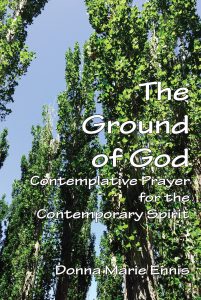 The thing that bothers me about all teaching materials that deal with the experience of God’s presence, whether through listening to the Holy Spirit, expectation and exercising of spiritual gifts, or following God in any other way, is that it is often uncertain ground. In fact, I would suggest that if there isn’t an element of risk, you’re not really talking about experiencing God.
There are two basic approaches to trying to teach someone else to experience God. First, one can be prescriptive and define parameters. Second, one can be descriptive and open doors. In reality, of course, an individual’s approach will fall somewhere between, but there is usually a tendency one way or the other.
What I have found is that the most important thing any teacher can do regarding prayer, hearing from God, experiencing God, finding God’s will, or simply sensing God’s presence is ground clearing. Most people who want to hear from God or experience God aren’t simply looking for a formulaic approach they can follow. Rather, they’re usually facing barriers to the experience. Often these barriers are really good approaches they learned from someone else, but which do not work for them.
 For example, my wife and I pray differently. Yes, we have times of prayer together, but when we’re each in our private time with God, we take a different approach. She likes music. I like music, but not when I’m praying. She’ll turn on the music and enjoy her time talking with (with, including listening) God. I start with scripture. I will select a passage and read without forcing the pace. I read very fast when that’s what I intend. In prayer time I read slowly and allow the words to direct me into communion. I will sometimes be directed to a different passage.
Jody’s prayer time would be really unfruitful if she used my method. She’s likely to end up looking at scripture, but that will come as she hears from God in her prayer time. I, on the other hand, find music uplifting and energizing, and often use it to get myself charged for work on a day when I’m feeling slow. Right now I’m typing largely in silence. If I had gotten up unmotivated, I would likely have gone up to my office, turned on some music, and would have found myself getting ready to go.
It’s great to share your experiences. Just avoid telling someone, or leaving them with the impression, that your way is the one and only way to experience God. If you read the Bible stories, you’re going to find quite a variety: Abram just hears, as Abraham he later argues, Moses hears but might rather not at first, Gideon required a sign for each move, Balaam heard through a donkey (hard head there, I think), Jesus was in constant communion. There’s a valuable variety in scripture.
Experiencing God is great. Don’t be afraid of present experience. Beware of either letting someone place you in a straight-jacket, or of placing someone else in one. God’s way is past finding out. You and I haven’t gone that far!
(I’ve put some books I publish related to experiencing God into a collection on Aer.io. Check these out!)
-
On Refugees
And now for a short post. Here’s one of many links to the stories: Trump vows ‘new vetting’ to weed out Islamic radicals.
I try to avoid partisan politics on this blog, but on this issue I must be clear. I believe that we should be open to refugees even at very substantial risk to ourselves. I do not believe the current risk even approaches significant. I am totally opposed to the actions taken by the current administration on this issue. I would regard it as my duty to aid any refugee at any level of which I am capable.
-
Galatians 2:16 – A Problem in Translation and Theology
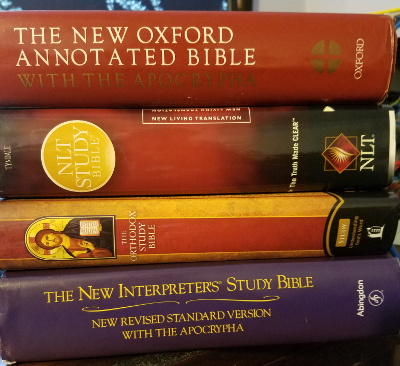
I wanted to write a quick note here as this relates to my study tonight, as well as illustrating quite a number of translation problems. Here is our text, with CEV (NOT CEB) to the left, NRSV in the center as a “literal” comparison, and NLT to the right. I’m copying the NRSV notes as they highlight the issue.
But we know that God accepts only those who have faith in Jesus Christ. No one can please God by simply obeying the Law. So we put our faith in Christ Jesus and God accepted us because of our faith.
yet we know that a person is justifiedd not by the works of the law but through faith in Jesus Christ.e And we have come to believe in Christ Jesus, so that we might be justified by faith in Christ,f and not by doing the works of the law, because no one will be justified by the works of the law.
Notes: d. Or reckoned as righteous and so elsewhere. e. Or the faith of Jesus Christ. f. Or the faith of Jesus Christ.
(The Holy Bible: New Revised Standard Version. (1989). (Ga 2:16). Nashville: Thomas Nelson Publishers.“Yet we know that a person is made right with God by faith in Jesus Christ, not by obeying the law. And we have believed in Christ Jesus, so that we might be made right with God because of our faith in Christ, not because we have obeyed the law. For no one will ever be made right with God by obeying the law.”
Tyndale House Publishers. (2013). Holy Bible: New Living Translation (Ga 2:16). Carol Stream, IL: Tyndale House Publishers.
If you look at notes e & f which are identical, you’ll see the problem. The Greek text can justifiably be translated either as “faith in Christ,” that is, our faith directed to Christ, or as “the faith of Christ,” Christ’s faithfulness to us. That’s not an insignificant difference. The NRSV does well here by translating one way and footnoting another. The problem is that people rarely read footnotes. In a Dynamic Equivalence (or functional) version the translator is obliged to make a choice. You cannot clearly express the meaning of the original in a new language if you have not understood it. Having understood it (you think), there is always the possibility that you have misunderstood it.
This is another important reason why I urge people who study the Bible in translation to both use more than one and also to read translator’s footnotes. They can be critical.
(See MyBibleVersion.com for some comparisons.)
-
Bloody Sacrifices and Salvation
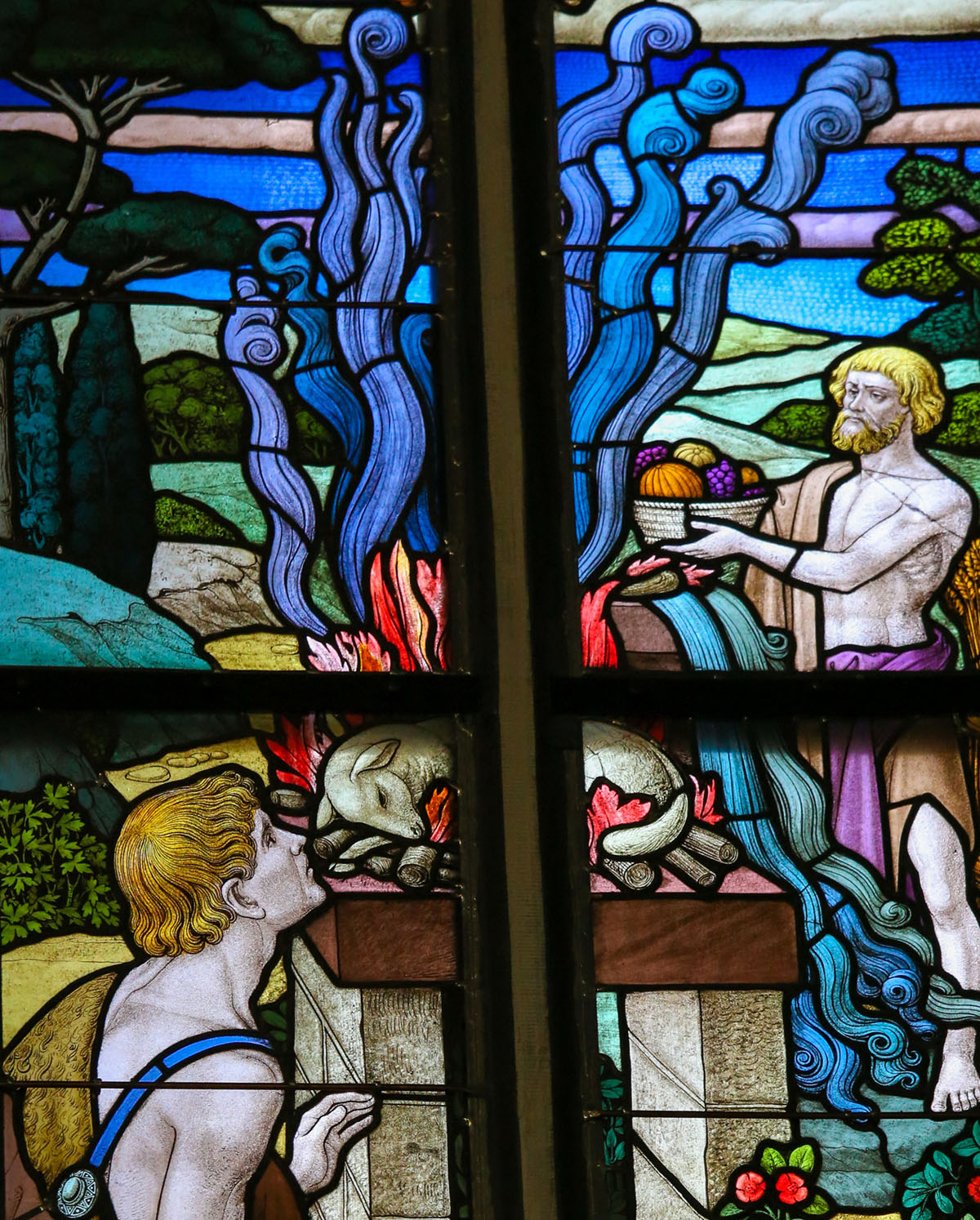
One of the problems with understanding biblical talk about salvation is that we do not live with a sacrificial system. For many Christians, the whole idea of sacrifices is that someone sinned and a bloody sacrifice was required for atonement. Christians believe that because of one bloody sacrifice, that of Jesus on the cross, no other bloody sacrifices need be offered, and we’re very relieved. In Judaism, the sacrifices have been replaced by Torah observance, without sacrifices due to the absence of the temple. Despite the desire of some Jews to rebuild the temple, I suspect the majority are quite happy with its absence.
This was emphasized to me recently as I prepare for (never ending) episodes of my study on Paul, especially as I read Galatians, and even more as I read Hebrews. The problem is that every word needs to be defined, and we are, to a large extent, convinced that we already know what the words mean. In fact, we are so convinced that we can define ourselves right past the message of the scripture we’re reading. As Mark Twain said, “It ain’t what you don’t know that gets you into trouble. It’s what you know for sure that just ain’t so.” (Read more at BrainyQuote).
My purpose here is not to provide a new and perfect (I have been reading Hebrews, after all!) answer to the question of what sacrifice really means. The word means different things in different places. I has a range or ranges of meaning. In cultic terms, as opposed to the more personal,, it seems to grow out of the idea that one needs to communicate with the divine. That can be as simple as the need to present your petitions effectively or as complex as wanting to hear from God, or from the gods, what is the ultimate plan for the physical universe, always assuming there is one.
That’s why you have a complex array of sacrifices and rituals in any religious system. The actual sacrifices and rituals evolve as worship takes place, and as people believe they receive communications, or more specifically directions, from the divine. The actual rituals are a mix of what people expect such things to be (tradition), from what people perceive to have worked (accurately or not), what people have heard, and available options and resources. These rituals will also combine the perceived needs of people, secular authorities, and religious authorities in various measures.
It may seem somewhat irreverent to some to apply this kind of process to biblical rituals, but as I argue in my book When People Speak for God, communication involves at least two termini, and one of those, in this case, is human. The lesser (slower, narrower, less precise) terminus determines the quality of the received message. In addition, a culture does not turn on a dime. Even revolutions are actually evolutionary to some extent.
The result is that the cultic system serves a range of needs. In modern Christianity we’ve come to think of salvation in rather simple terms: Avoid hell, and go to heaven. The intervening problem is that we’re sinners (though that term can get complex too), and the solution is the sacrifice of Jesus. All of which can be quite helpful except that it leaves us living in this world with all the many and varied issues in our lives.
The biblical concept of sacrifice was not quite so narrow. Or, rather, I should say that the biblical concepts of sacrifice were not quite so narrow. There is no particular reason to assume that every author in scripture is going to use the word “sacrifice” (or rather, various words sometimes so translated) in precisely the same way. If you read the texts carefully, you’ll find they are quite varied and nuanced.
In Leviticus, the world is made up of sacrifices. That’s because, for the most part, Leviticus is a book giving instructions about the cult to priests who were to carry it out. In that book sacrifices speak to the continuous presence of God, to atonement for specific sins, to atonement for guilt perceived for unknown reasons, to thanksgiving for blessing, to rituals for healing and purification, and ever so much more. The sacrifices were an integral part of the way the community of Israel was to live in community with its God.
The sacrificial system was not universally loved. For the prophets, it was often a dead routine carried out in Jerusalem by a nation in rebellion. Even earlier we have Samuel’s comment to Saul:
22 And Samuel said,
“Has the LORD as great delight in burnt offerings and sacrifices,
as in obedience to the voice of the LORD?
Surely, to obey is better than sacrifice,
and to heed than the fat of rams.(The Holy Bible: New Revised Standard Version. (1989). (1 Samuel 15:22). Nashville: Thomas Nelson Publishers.)
Or as Hebrews Hebrews 10:5-7 quotes Psalm 40:6-8:
Consequently, when Christ came into the world, he said,
“Sacrifices and offerings you have not desired,
but a body you have prepared for me;
6 in burnt offerings and sin offerings
you have taken no pleasure.
7 Then I said, ‘See, God, I have come to do your will, O God’
(in the scroll of the book it is written of me).”The Holy Bible: New Revised Standard Version. (1989). (Hebrews 10:5–7). Nashville: Thomas Nelson Publishers.
Now the author of Hebrews puts Psalm 40:6-8 into the mouth of Jesus, and here emphasizes something that is often missed in Christian discussions of atonement. One of the claims made by various New Testament writers was that Jesus accomplished God’s will in a way that humans had failed to do. It’s not that we don’t have in mind the idea that Jesus accomplished God’s will. Rather, it is because that is not part of our view of atonement.
I think this is why we so often have trouble understanding something like John 3, in which yet another different view of atonement is presented, one in which we immediately “have” eternal life. The typical response to this is that I’m going to die. How is it that I can have eternal life? But that’s because we get off the track of a desire to create community here and to be in communion with God (and both of these concepts invite further discussion and definition), and have limited our idea to one thing. Where do I spend eternity?
That is a question that doesn’t work well in isolation. It makes faith, salvation, and atonement a narrow and selfish thing. It’s not that we shouldn’t want to care for our eternal reward. Rather, it’s because we shouldn’t try to plan our eternity independently and as a solely future event.
I’m mostly raising questions here, and providing way too little in pointing the way. The key thing I’d like to suggest is that we need to quit reading scripture in the elementary or high school sense of “look the word you don’t know up in the dictionary.” That’s a good starting point. But then you need to allow the context of one author’s work build a nuanced definition for you.
I recall reading Ludwig von Mises’s book Human Action back when I was in college. It’s more than 800 pages of rather intense prose. In that book von Mises creates his own vocabulary. He’ll say that a particular word (psychology, for example, which he replaces with thymology [but not precisely]) has problems of definition. Then he defines the word himself and proceeds to use it in further discussion. If you don’t pay attention, you’ll wind up completely baffled a few pages further. You can’t use the dictionary, because the word is not there. What you can do is develop your own understanding of the term as von Mises uses it.
Try that with your Bible. It can be rewarding!
(Featured image is from Adobe Stock [#126750439] and is licensed. It is not public domain.)


