
… and he was teaching continuing education. Doesn’t it point to a problem if a roomful of doctors can’t tell that the person teaching them never completed medical school?
Author: henry
-
I got goosebumps
… during the closing song at church today, Joyful, Joyful, We Adore Thee. Perhaps this explains it! Or perhaps not.
-
Biblical Studies Carnival and Biblioblogs Top 50
The Biblical Studies Carnival has been posted at Bulletin for the Study of Religion, and the Biblioblogs Top 50 is out. I’ve moved up in the world to #35, probably as the result of actually blogging (what a concept!).
-
Creationism vs Anti-evolutionism
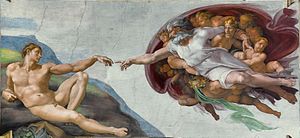
- Image via Wikipedia
According to Todd Wood there’s a real difference, and I agree, although I think real creationists are a bit thin on the ground. He writes about this on the Center for Faith and Science International web site. One of the requirements, in my view, is the admission that the foundation of young age creationist thinking is accepting Genesis 1-11 as history and building from there. To claim that one accepts young age creationism based solely on current scientific evidence is simply no believable.
That is precisely where Todd Wood and Kurt Wise (author of Faith, Form, and Time–the one creationist book you should read if you want to understand it) are refreshingly honest. They admit they start with their conviction about what the Bible says and that there is much science to be done to back up such a view.
What caught my attention in this article is the reference to George McCready Price, a Seventh-day Adventist who pioneered modern day creationism and flood geology. I got to Price’s writings by starting with Frank Lewis Marsh and his small book Evolution or Special Creation. Marsh was somewhat more accessible than Price.
Despite the fact that I believe that to read Genesis 1-11 as history is generally to misread it, I appreciate the faith stance of Todd Wood and Kurt Wise and their honesty in admitting their starting point in faith.
(I’m experimenting with Zemanta. I may have overdone the linking!)

-
Wesleyan-Arminian vs Calvinist Self-Identification
I found this interesting article at Baptist Press via the Methoblog’s Twitter feed. The article discusses an apparent divide between the Southern Baptist Convention and other denominations on how many pastors, particularly young pastors, are identifying themselves as Calvinists. One interesting note is that while identification as Calvinist outside the SBC is not increasing, identification as Wesleyan or Arminian is decreasing over this same time period.
Now I have to confess that my first question regarding such a report is just what the methodology was. Usually when you dig down to the actual questions, you find out that a survey doesn’t produce quite as much information, or at least the type of information that reports indicate.
In this case the human tendency is to say that this indicates there are more Calvinists and less Wesleyans or Arminians around today. And that may indeed be true, especially including all denominations. But it’s important to realize that this report didn’t define any of its terms; it simply asked about self-identification.
That’s important. I’m wondering how many of those questioned are knowledgeable enough to properly classify themselves. I’ve encountered a few United Methodist pastors who couldn’t identify all of the five points of Calvinism, and thus would have a hard time determining whether they were Calvinist or not. And considering that there are five points of Arminianism, which actually predate the five points of Calvinism (as a form of expression, not as theological beliefs), I have to wonder how many pastors (not to mention lay members) could actually tell an interviewer just what it means to be Arminian.
I have found even more in the charismatic and pentecostal streams who don’t acknowledge any connection to their Wesleyan roots, if they are actually aware of them. This results in some interesting theological mixes in charismatic and pentecostal thinking. One that I find most interesting is that eschatology derived from dispensationalism is quite popular, while other views associated with dispensational theology, such as cessationism, are excluded.
I’m not saying one cannot produce a similar eschatology without resort to dispensationalism, but I certainly have not seen it done very well in most Wesleyan, charismatic, or pentecostal writing or teaching. (Caveat: I have not done a thorough survey of the literature. That’s something I’d like to do at some point. This is anecdotal.) It is nonetheless interesting to watch people grab random pieces of Daniel, Isaiah, Joel, and other books, mix them with 1 Thessalonians, Matthew 24/Mark 13/Luke 21, and mix them with Revelation, without any real framework for just how the text should be interpreted in its original context, and what is the proper framework to use in connecting them. While I do not accept classical dispensationalism (more modern progressive dispensationalism seems hard to reject outright–it says so little!) I must admit that it does provide a fairly stable framework on which to hang these various texts.
I recall one class I was teaching on Revelation, in which the students insisted I dedicate a class to teaching about the tribulation. While I do believe there will be troubled times before the end, I do not believe in a “Tribulation” in the sense of a seven year period. In any case, I made my best effort at bringing in the texts while not actually lying about what I thought of the relationship between them, and the class got pretty glassy eyed as we looked at each one. I would note that most of them still accepted the tribulation at the end. They were well steeped in the “Left Behind” series.
But I must reign myself in and return to topic, or at least somewhere in the vicinity of the topic. I’m wondering what others have experienced. Is self-identification accurate in terms of Calvinism and Arminianism? How many people who identify themselves as “neither” might simply not know enough about the roots of their current theology? How many are identifying with more modern movements derived from one or the other? (I think this latter idea would be more likely for Wesleyan-Arminians than for Calvinists.)
Finally, how many think they have transcended this debate in some way? I’d be interested in comments or links to blog posts on the subject.
-
Gordon Fee and Pentecostal Scholarship
Charisma magazine has a great article on Gordon Fee (HT: sunestauromai).
I particularly was struck by these two paragraphs:
For the most part, though, Pentecostals remain resistant to—or indifferent toward—theology and scholarship. After all, modern Pentecostalism was birthed in spiritual experience, not intellectualism. As the movement spread, Pentecostals simply didn’t see a need for theological pursuits. “We don’t need scholars; we just need the Holy Spirit!” has been the mainstream Pentecostal cry for the last 100 years.
Among evangelicals, few have looked to Pentecostals for in-depth biblical teaching. A commonly held view has been: “Pentecostal theology? What’s that?”
I encountered the first attitude in an introductory class I taught on studying the Bible. One young lady quit the class, saying that though I was teaching good things she didn’t need any of it, because she had the Holy Spirit. I can testify that she displayed very great need of learning to study the Bible more diligently!
I have exemplified the second attitude. When a friend of my daughter came home from ministry school with a book on Pentecostal theology. I remember remarking that I didn’t know there was such a thing! Of course today that’s exaggerating things somewhat. In my own publishing efforts I hope to bring together the work of conservative, liberal, and charismatic scholars to the benefit of all.
Gordon Fee has made a wonderful contribution over the years. I regard his commentary on 1 Corinthians in the NICOT series
to be one of the best commentaries on any Bible book I have ever read, and for its size and audience probably the best. (Of course, one must consider that I haven’t had time to read that large a number of commentaries!) I’m looking forward to reading his new commentary on Revelation.
In any case, check out the article, and especially the comments on prosperity theology. It is no wonder that a serious student of Paul would be very critical of modern prosperity or “health and wealth” theology.
-
Better Bibles: Which Translation to Choose?
Iver Larsen has a good post on choosing a Bible translation over at Better Bibles blog. The discussion is also excellent. Go join the fray!
You might also check out my site, Bible Translation Selection Tool.
-
Dave Black: Ten Best Books for Studying New Testament Greek
David Alan Black has posted a new essay, Ten Best Books for Studying New Testament Greek. The majority are books I have read and/or are on my shelves, but there are a couple that are just on my “need to read this list” and a couple more I’m going to add.
I note that when I teach Greek classes locally, usually to a couple of people at a time, I use the #1 and #2 books on his list. I know that as one of his publishers I should perhaps use one of his books as my text, but I will plead historical reasons–I picked the textbooks before I was his publisher!
If I might underline a couple of books on his list: #5. Peter Cotterell and Max Turner, Linguistics and Biblical Interpretation, and Dave’s related book, Linguistics for Students of New Testament Greek: A Survey of Basic Concepts and Applications
. I take a small risk in recommending books I haven’t personally read. My introduction to linguistics started with my graduate advisor, Dr. Leona Running at Andrews University, and continued with some graduate work in linguistics at the University of Illinois Chicago Circle. Those linguistics classes did more for my understanding of translation and exegesis than did many of my exegesis classes.
I always spend time talking about linguistics with my Greek or Hebrew students. It makes a great deal of difference to how valuable one’s technical language knowledge will be. When I studied Greek, I found that even syntax was neglected to some extent.
Finally, #10. Rodney Decker, Koine Greek Reader: Selections from the New Testament, Septuagint, and Early Christian Writers. In particular note the “Septuagint” and “Early Christian Writers.” In my opinion, if your reading is limited to the New Testament, you cannot claim to really understand New Testament Greek. I include the LXX in my regular reading, and I’m including more and more literature from the early church. It will be well worth your while to do so.
-
2 Corinthians and Leadership
Brian Fulthorp has written a few notes on 2 Corinthians, a book that has been growing on me over the last few years. I think it’s unfortunately neglected in Christian preaching. Except for a few proof texts we rarely hear much of the message of this book.
This comment from Brian might indicate why the book is not popular:
Gombis notes Paul as the Apostle of weakness and that it is only through our weakness and dependency on God that we can experience his power or that God’s power them becomes fully manifest – listen to that carefully: it is only when we are completely and utterly and fully dependent on God and function in our own weakness that God’s power is made complete in us or that his power is fully manifest – this is true biblical and Pauline leadership.
“[F]ully dependent on God and function in our own weakness….” Doesn’t sound like much fun! Might not be seeker friendly either. Time to go read a different book.
-
On Saul and David – for World Prayr Blog
I wrote a post on Saul and David for the World Prayr devotional blog. It ties into my series in some ways.
