Threads from Henry's Web

Author: henry

  • Psalm 119:126 – Time to Act

    Psalm 119:126 – Time to Act

    It’s time to act, LORD.
    They’ve set your law aside.

    I’ve talked about waiting and patience a few times, so let’s look at the second part of this verse.

    How can one set God’s law, or any law, aside?

    We usually think of simply breaking the law, a sort of binary choice. I’m either doing it or not. And of course, that is one sort of lawlessness. I know what the law is. I have the power to do the right thing, and I choose to do the wrong thing instead. That certainly happens!

    But there are a few other ways to set the law aside, or make it void.

    We can trim around the edges of the law. A common way of doing this is to discuss what limit the state troopers are actually enforcing. Can you get by with 5 miles over the speed limit? 10 miles? You’ll see occasional arguments online about this. Inevitably, there will be an officer in the discussion who says he doesn’t actually have any margin for grace. If you’re speeding, you’re speeding!

    I observed this driving through Ohio way back when the dinosaurs roamed and I was in graduate school. Someone had told me that the Ohio cops didn’t have any margin on enforcement, so I stuck straight to the speed limit. A few miles into the state another car crawled past me. He couldn’t have been doing more than a couple miles over, but in a couple minutes there came the flashing lights as the trooper sped past me and soon I saw the slight speeder at the side of the road.

    I congratulated myself on my great intelligence and waited until the next state to speed up.

    But there are other ways we can make the law void. Another way is to load people down with laws and regulations until it’s pretty certain that no matter how hard they try, they’ll be violating the law at some point. Once you get there, people realize they can’t be completely in the clear no matter what, and they become careless about keeping even more important laws.

    You can also have the attitude of self-righteousness in which you’re convinced that you must keep the law, and that you’re a good person, so you’re doing it. How does this work? You reduce the actual laws to a level that you can. You grade yourself on an imaginary curve.

    All of these tend to result in a certain amount of lawlessness, and when carried far enough can be destructive of a family, a community, or a nation. Laws are important, but they are very much subject to misuse and abuse, often by the people who ought to be upholding them.

    With the psalmist, we can call on God. It’s time to act! People are setting your instructions aside and substituting their own.

    How can you live constructively in relation to the laws that you know?

  • Psalm 119:125 – Teach Me

    Psalm 119:125 – Teach Me

    I am your servant. Teach me
    and I will understand your testimonies.

    As I read this verse late last night, I had the feeling that I’d talked about just about every element of it. I’ve been pointing out repeatedly that every claim to have done something in some way reflects another when the psalmist acknowledges dependence on God. There are verses expressing thanks for the law and hope in God’s promises, and also those expressing the pain of waiting.

    This verse puts a great deal of the whole message of the psalm in a very few words. “Teach me and I’ll understand.” God is the source of law, testimony, and yes, history itself. And God is the best teacher.

    This led me to thinking seriously about the entire psalm. One of the things that can make scripture hard to read and understand is the variety of literature we find, not to mention history and background. We rarely have the patience for reading a passage as a whole. I recall once making a suggestion to someone planning worship that it would be nice to either use all four lectionary passages as part of the order of worship, or to imitate them by having the same variety.

    One of the most powerful worship services I have ever attended involved an extensive set of readings. I believe it was Year a, 3rd Sunday in Lent, with John 4:5-42, Romans 5:1-11, Exodus 17:1-7 and Psalm 95. The one I recall was the full scripture reading of John 4:5-42. I was already both impressed and blessed by the inclusion of all the readings in the service, but then the pastor began to preach, and he tied every one of those passages into his message, weaving a tapestry about God’s work of redemption from all of them together. He ended with the service of Holy Communion and as he spoke the words, he again wove material from all those readings. He combined the reading of scripture, the exposition of scripture, and the application of scripture in the form of worship into one single picture and message and then called the congregation to go forth and live it.

    This commitment to bringing these various elements together as a whole is very important in itself. Understanding some relationships, historical and liturgical, is very helpful in building a community that serves God and humanity. Tied into a message of hope and redemption, the service of Holy Communion can be an experience of spiritual renewal. Seeing an example of careful, thoughtful construction of a worship experience is a message in itself.

    That is what I feel when I read this Psalm. Yes, there are so many pieces. It’s easy to feel that it’s scattered. But if you have the patience to observe, to absorb it, and look for how everything fits into an expression of prayer, praise, worship, and instruction, you’ll find a very powerful piece of literature.

    If you have an opportunity to study this in Hebrew, you can add the craftsmanship of presenting it as an acrostic. This craftsmanship is also a form of praise and teaching. God can be worshiped in and with beauty, structure, imagination, imagery, and sound.

    One of the ways God teaches us today is by the preservation of this kind of literature by which we can learn. Poetry in the heart reflects God’s poetry of all creation.

    How will you join your heart and voice with this poetry today?

    (Featured image credit: zamrznutitonovi licensed via iStockPhoto.com

  • Psalm 119:124 – Grace

    Psalm 119:124 – Grace

    Deal graciously with your servant
    and teach me your statutes.

    I’m going to use the words of this verse, written long before there was such a thing as a Christian, to discuss a peculiarly Christian issue: Sanctification.

    Sanctification is a long word for becoming or being made holy, and “holy” is a word that we’re often not that sure about, though we act like we are. We can have a high concept of our own holiness, which usually manifests itself as self-righteousness. “Look how holy I am! I’m closer to God than you are!”

    We quote or paraphrase Ephesians 2:8, “For it is by grace that you are saved and not of works, lest anyone should boast.” But at the same time we have a picture of what a good Christian should be, and we’re quick to judge other people who don’t fit into our vision of Christian behavior.

    The result is that we’re often judging our salvation and that of others based on our perception of their holiness, or on what they have done. This is the unfortunate result of us being afraid to talk about works lest people think we’re basing our salvation on our works.

    But look at this verse. The word I’ve translated “graciously” is more literally (and commonly) translated “lovingkindness,” which is God’s love given to us. I think “graciously” gets the point. So when God deals graciously with us, what does God do?

    God teaches us statutes, rules to live by.

    You see, salvation is not just a gift of getting out of whatever nasty results we can expect in the next lives based on our behavior. It’s not a “get out of hell free card.” Well, actually it is, but it’s so very much more. And you can see the same divine approach with Israel. Israel is called to be God’s people. They become God’s people not because of something they’ve done. Passages from Genesis 12 when Abraham is called through Deuteronomy emphasize this.

    The rules come afterward. What is their purpose? Their purpose is to produce a holy people. That’s the plan. So I guess we ought to get busy and get this sanctification thing done, right?

    Not even close. Becoming a holy people is also God’s gift, which starts with the gracious gift of God’s law, carefully packaged to fit the circumstances of those who receive it. “Be holy for I am holy,” is repeated over and over in Leviticus. It’s a call, but the call is to receive the gift. When King David is called to be a man after God’s own heart (1 Samuel 13:14), it is not because he as done everything perfectly, or because he will lead a perfect life, but rather because he will be open to God and allow God to work in and through him.

    “Teach me your statutes” is a call to the one who empowers everything in the universe to empower one’s own life.

    What can God do in you today?

    (Featured image generated by Jetpack AI.)

  • Psalm 119:123 – Patience

    Psalm 119:123 – Patience

    My eyes have failed looking for your salvation,
    and for your righteous word.

    Any number of people have told me that I shouldn’t pray for patience. If I do, God will doubtless send me all kinds of trials and keep me waiting so as to teach me patience by experience.

    I think it doesn’t matter if you pray for patience or not. You’re going to get an opportunity to learn patience by experience.

    The psalmist is living, well, life! I think we can all relate. From childhood trips when we doubtless drove our parents nuts by asking “are we there yet?” to expectations of other people, to our hopes even in old age for new blessings to come–and even to looking for the end of long sentences–we have opportunities to practice patience.

    Usually we don’t. If you keep wondering why your patience is being tested so much, you might consider whether you are actually gaining patience or just repeating our experience of extended impatience.

    But one of the experiences of Christian life, and yes, the lives of people of other faiths, is that things we hope for, whether they are secular in nature or the result of a perceived promise by God is delay.

    One of the big ones for Christians is the wait for the second coming of Jesus. How are we doing with that?

    Well, I grew up as a Seventh-day Adventist. Back in 1844 (well, first in 1843), Adventists calculated that Jesus would return on October 22, 1844. The history books, not to mention we’re still hanging out on this planet, suggest that prediction wasn’t right.

    I don’t bring up SDAs in order to laugh at them, but rather to point out just how normal is this is. People continuously set dates for the second coming. Many more don’t set dates, but come up with various reasons to declare that the second coming is “really near” now. We’re obviously in the last days, because [list of things we don’t like about the world here].

    In growing up I remember evangelists coming by regularly, and in order to provide the appearance of an audience when really very few visitors showed up, we’d all attend. After a time I started to notice a problem. At one point I remember wondering why Russia (the USSR back then) wasn’t part of the prophecies of the end, considering how much the older folks talked about it. A couple of years later, Russia suddenly appeared in one of these evangelistic meetings as a really-truly sign that the end was really near.

    Our eyes just get worn out reading all the explanations of why the end hasn’t come yet and why we ought to keep hoping for it.

    There’s a good side to staying on the watch for God’s promises. I think that’s what the psalmist is pointing out. No matter what has happened, no matter how long he has had to look, he has kept hoping. That is a good thing.

    Trying to make up the result you want–not so much. Perhaps we would be better to “evangelize” about the good news that Jesus loves you now and invites you into his family, rather than trying to pin down the time when he appears in the clouds. Making new predictions can just be wearing on our eyes and our hopes.

    And as someone pointed out to me today, the one thing we can’t do is give up. Ultimately that is what patience is about. We practice patience when we keep moving forward and don’t give up.

    What opportunities will you have to practice patience today? Will you take advantage of them, or will you just demonstrate your skill at impatience?

  • Psalm 119:122 – Are You Beastly?

    Psalm 119:122 – Are You Beastly?

    Be the assurance for your servant’s well-being;
    Don’t let the arrogant oppress me.

    Do God’s rules for living actually work?

    This is one of those questions that usually gets a pious answer. “Of course they do!” But do we really mean it?

    When we see a crisis, do we turn to God or do we turn to human answers: human politics, human authority, self-reliance, and self-serving?

    I think these things we should each consider seriously. There are so many individual choices concerning which we can disagree. My father spent World War II in a camp in Canada, planting trees. He did not believe it was right for a Christian to bear arms, even in defense of his country. His government did not give him the option of serving in the medical corps. So he planted trees.

    I, on the other hand, served 10 years in the United States Air Force voluntarily. I was not in the medical corps. I believed then as I believe now that a democratic nation requires a military establishment that carries out the lawful orders of the civilian authorities.

    It would probably take some time to debate this, and I doubt that I would come to agreement with a pacifist. But I respect my dad’s position and I respect the position of even more committed pacifists. When they ask what Jesus would do, they can’t imagine participating in warfare as an option.

    The question I’m asking today is simply whether you have considered whether you are carrying out the vision of Jesus, or when things get difficult to you resort to the methods of the enemy?

    In a post I wrote on Revelation 12 & 13 some time ago, I made a list of “beastly attributes.” Here they are:

    1. Tears down others – 12:4, drawing 1/3 of the stars. Beasts and dragons rarely fall alone.
    2. Consumes and destroys – 12:4
    3. Is not the greatest power – 12:8. Note that verses 8 & 9 compile a great deal of what is now Christian belief about the Devil. The imagery hear draws on a number of passages in Hebrew scripture.
    4. Persecuter – 12:13
    5. Sweeps people/things away – 12:15. It’s humorous to note here that there is a single Greek word for “carried away by a river.” There’s got to be some history for that word!
    6. Angry with those not on his side – 12:17.
    7. Speaks blasphemy – 13:1,5.
    8. Though not the geatest power (see #3), operates with great authority – 13:2.
    9. Puts anger into action in war with the “other side” – 13:7.
    10. Wants all the attention and worship – 13:13.
    11. Deceives – 13:14.
    12. Applies force to get worship – 13:16-17

    I then (May 22, 2024) asked whether we, in the church, are making an image to the beast. Beasts want images.

    In that post I asked the question:

    So what image do we display through our churches? When someone looks at the reality, is the beast behind the image, or the lamb?

    I’d extend that question to this: When someone looks at your life, do they see an image being built to the beast, or to the lamb?

    Let God make the right image in you today. (Philippians 2:12-13).

  • Psalm 119:121 – Don’t Let Them Get Me!

    Psalm 119:121 – Don’t Let Them Get Me!

    I have done what is just and right,
    Don’t let my oppressors get me!

    My translation is a little more informal today. I get to do that since I’m not writing a translation of Psalm 119, but rather meditating on each verse.

    Do you sometimes feel like people are after you? I do!

    But for me it’s not people who are enemies or oppressors. It’s friends, clients, and customers, and even potential candidates for one of those relationships.

    I recall coming in a few days ago and telling Jody, “I could deal with people not needing me any more.” I had been answering computer questions, Bible questions, and questions about publishing for a couple of hours and hadn’t been able to get away from my phone and computer screen even for a moment of thought.

    When that happens, I start to wonder if I’m giving people useful answers or even understanding their questions. I begin to wonder if I’m giving the right person the answer. I come to a point where it’s imperative that I ignore the phone, the emails, and texts for a period of time and reorient myself.

    Not one of those people were actually enemies. They were, in fact, all people whose relationship I value.

    I wonder how often we drive ourselves, or more precisely I drive myself, to these lengths, not by what others expect of us but by our own unrealistic expectations of our own performance. I know at the moment that there are many things that it would be good for me to get done that I can’t. I am a caregiver as well as carrying on my business and doing some ministry work apart from that. That means some things don’t get done.

    I think our verse refers more to an appeal to God for protection based on one’s efforts to do right, protection from those who are hostile.

    But what about protection from friends? No, that’s not really it. How about protections from myself? Lord, don’t let me fall into my own oppressive hands!

    Yep, I’ve strayed from the verse, but I can’t resist another note advocating meditation. For me, the time when God speaks to me is when I’m meditating on a passage of scripture, and sometimes that meditation leads me well away from the direct meaning of the verse.

    Over the last few weeks I have more and more frequently been telling people that I can’t answer right now and then setting a time when I can. And you know what? Nobody has gotten upset about it at all. They’re all willing to work with me in order to fit their particular questions/needs into my schedule.

    Who is the oppressor? I am.

    Lord, deliver me from me!

    (Featured image generated by Jetpack AI, and very slightly edited by me.)

  • Psalm 119:120

    Psalm 119:120

    I get goosebumps from dread of you,
    I’m afraid of your judgments.

    C. S. Lewis has a wonderful quote on this, which is fairly well known. I suspect, however, that many people don’t know the context.

    Sometimes this question has been pressed upon our minds with the purpose of exciting fear. I do not think that is its right use. I am, indeed, far from agreeing with those who think all religious fear barbarous and degrading and demand that it should be banished from the spiritual life. Perfect love, we know, casteth out fear. But so do several other things—ignorance, alcohol, passion, presumption, and stupidity. It is very desirable that we should all advance to that perfection of love in which we shall fear no longer; but it is very undesirable, until we have reached that stage, that we should allow any inferior agent to cast out our fear.

    C. S. Lewis, “The World’s Last Night” in The World’s Last Night

    This question is asked in the context of concern about the second coming or the end of the world, however you see it. Lewis argues that an emotion of fear would not be helpful in that case, because the valuable results of a rational fear cannot be sustained for a long time. I would argue that repeated claims that the end of the world is around the corner make fear ineffective.

    There is valuable fear. That’s the kind of fear that keeps us from doing stupid things. Well, sometimes it fails to keep us from doing stupid things. That’s what Lewis is talking about when he says that ignorance, alcohol, passion, presumption, and stupidity can cast out our fear. I recall quite a number of times I did stupid things. In fact, even though I have never been drunk, there were a number of times when I did stupid things with people who were drunk, because I was part of they group, and hey!, the stupid things were fun!

    I figure the Lord had to have angels working over time to allow me to attain maturity. Not necessarily intelligence and good judgment, but survival, at least!

    There’s another way in which fear can be destructive, and that’s when it’s random fear. A child who is abused by a parent and can’t find a way out is threatened with destruction by the fear. The fear is constant, whether the abuse is currently taking place or not.

    Evil is the source of that kind of fear. Effective fear is consistent with reality and helps direct our paths.

    Often, people try to remove “fear” from the “fear of the Lord.” There’s a good point to this. There are those who live in fear of God as they would fear an angry, abusive father. That is not the fear of the Lord. But there is a healthy fear. The God who made gravity made it such that gravity will get you at the bottom of a cliff. You should fear jumping off.

    In our verse today what strikes me is the personal closeness of this fear. There are several ways to translate the Hebrew words, especially of the first line. But what is clear is that the fear is producing a reaction in his body. He is reacting to the presence of God and the realization of who he is and who God is.

    But then, in the presence of God, there is the perfect love. Continuing in the presence of God will cast out that fear, replacing it with a realization of love.

  • Psalm 119:119 – Scorn

    Psalm 119:119 – Scorn

    You hold in scorn all the wicked of the land,
    therefore I love your testimonies.

    I will confess that the lasts several verses seem to have given me less elevated thoughts. Holding people in scorn often sounds like a pretty good idea. How can those idiots do such stupid things. Not just wicked, but stupid! God is right to be scornful of them!

    At this point, I recall something I say all the time about teaching an preaching: Be sure to target the text at yourself before you target it at others.

    There’s a second issue as well. Why is it that I read this text as one of the good guys? Now you might quickly say that the author is speaking as one of the good guys. I’m not so sure of that. He frequently invokes God’s aid, and as I’ve done a few times thus far, I can point to verse 176 – “I have gone astray like a lost sheep …”

    Now I imagine there’s a sense in which the psalmist does regard himself as one of the good guys. He is, after all, one of God’s chosen people. He has God’s Torah with statutes, testimonies, commands, and yes, the stories of God working with the people. So he’s in the family. That’s one thing. At the same time, he has shown considerable awareness of shortcomings, and of his need for God to work with and on him in dealing with those.

    So we could view this verse in a completely different way. Not a condemnation of “them” and a congratulation of self, but rather as an accurate observation. God doesn’t look well on the wicked. The very laws of nature tend to punish those who will not cooperate. But the way the psalmist is advocating for avoiding this is love for God’s testimonies.

    I suspect this latter has a great deal to do with what the Psalmist is saying. And one of the elements I see in the use of “testimonies” here is that look at how God has acted.

    To reference another Psalm I love, Psalm 78:

    He established a decree in Jacob,
    and appointed a law in Israel,
    which he commanded our ancestors
    to teach to their children;
    that the next generation might know them,
    the children yet unborn,
    and rise up and tell them to their children,
    so that they should set their hope in God,
    and not forget the works of God,
    but keep his commandments;
    and that they should not be like their ancestors,
    a stubborn and rebellious generation,
    a generation whose heart was not steadfast,
    whose spirit was not faithful to God.

    Psalm 78:5-8 (NRSV)

    I think Psalm 119 as a whole is doing precisely this.

    What will you pass on to the next generation, whether biological or spiritual?

    (Featured image generated by Jetpack AI and edited slightly by me.)

  • Psalm 119:118 – Deceit

    Psalm 119:118 – Deceit

    You disdain all those who stray from your statutes,
    for in falsehood is their deceit.

    I spent most of my time thinking about translation issues today, because this verse is rather difficult. You’ll notice the second line, which could be literally translated, “for lying is their lie.” Let’s look at some other solutions.

    You reject all who stray from your statutes,
    for their whole talk is malice and lies.

    REB

    You spurn all who go astray from your statutes;
    for their cunning is in vain.

    NRSV

    You treat with contempt all those who revolt against your statutes,
    because their thoughts are crooked.

    LXX (my translation)

    Suspended have you all who stray from your statutes
    for falsehood is their deceit

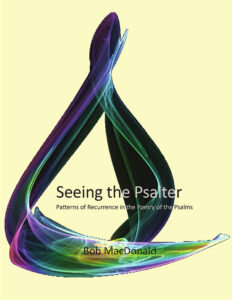
    Bob MacDonald, Seeing the Psalter, p. 386

    Bob provides the following note: “118 suspended, סלה (slh) the same letters as in the untranslatable pause or suspense in a psalm, and used of wisdom suspending in the balance, weighing (Job 28:16).” This is quite a good explanation and a real possibility for the first line. “Falsehood is their deceit,” remains a bit difficult still.

    Mitchell Dahood, well known for creative reconstructions of the text, translates:

    Make a mound of all who stray from your precepts,
    because their idolatry is false.

    Psalms III, p. 168 and note

    Both of these changes, “make a mound” and “idolatry are possible, though I would not regard them as probable.

    The difficulty with a verse like this is that it uses a number of words that have similarly spelled roots to others, and that are not found in the Hebrew scriptures very many times. The most important element in understanding the precise meaning of a word is the context, and in poetry, it’s hard to determine precisely what the intention is, as the context itself is flexible.

    This illustrates why you should be interested, but not worried, if you find footnotes in your Bible that indicate alternate texts or possible translation. This is part of the process of working with translation, and especially with translation of ancient documents where we have some difficulty discerning the intent.

    It also suggests that we should be grateful to those who do this work. The sources I’ve mentioned here each involved significant research and discussion by many people. I benefited by simply having a reference that gave me the results of their efforts.

    And finally, one thing is clear in the text: Rebellion against God’s statutes and deceit and falsehood are not good things.

  • Psalm 119:117 – Sustain

    Psalm 119:117 – Sustain

    Sustain me and I shall be saved,
    And I will continually meditate on your statutes.

    The Message gives a nice feel for this verse:

    Stick with me and I’ll be all right;
    I’ll give total allegiance to your definitions of life.

    Psalm 119:117, The Message

    Now this translation has the problem that many do, which is that it’s clearer than the text it translates. One of the features of poetry is expression which evokes meaning and feeling, but does not lay it out blow by blow. Nonetheless, a translation like The Message can sometimes force us to look for the boundaries of a text.

    One thing I prefer over The Message on this verse is the idea of meditation. The verb used in Hebrew can cover a lot of ground, such as “gaze at,” “pay attention to,” and yes, “meditate” or “keep/observe.” The precise point in that range of meanings that the author intended is difficult to say for certain. My view is that in poetry, the intent is often to evoke broader meaning. When we narrow such a verse to just one set of precise meanings, we can lose the intention of the verse.

    And that’s the thing about meditation. An attorney needs to know more than simply the textual content of the law. In our legal tradition, they need to know the history of interpretation in the form of previous court rulings. Once they know that, they also need to be able to understand the story into which they have been drawn in order to know how they can apply all that material to their particular situation.

    It is similar with God’s law. God could have inspired a compendium, carefully cataloged and containing just the specific ordinances. But that’s not what we have. If you’d like to see what that would look like, consider passages such as Exodus 22 & 23 or the Hammurabi Code. These are codes of law, but in the case of those chapters of Exodus, the code is contained in history, and the foundation of that code of law is in the actions of the lawgiver.

    Is it any wonder that the psalmist can spend 176 verses expressing his joy in the law? He can see his God in that law, and in the way in which that law was presented. He knows that the reality behind the law is the creator-redeemer God. The word used here for “saved” as I uncreatively translated it, can also be translated with words like “be rescued” or “be victorious.”

    The God revealed in the law is the God who saves. When one meditates on the law, one learns about the lawgiver who also rescues, supports, and sustains to the end.

    I again find this verse to be an encapsulation in two short lines of the message of the Psalm.

    Live today as a child of the Creator who sustains you. Always!

    (Featured image credit: Viktor Aheiev. Licensed via iStockPhoto.com.)