Threads from Henry's Web

Author: henry

  • I Think I’d Go Somewhere Else

    A discount for praying? Actually, yes, I say a blessing over my food. So I have some problems with the “disobeying Jesus” thing. There are occasions when you don’t have to hide in order to pray. That’s not what Jesus was getting at in Matthew 6:1, though making a public show of it, which this restaurant seems to encourage, is definitely what he was talking about.

    But the idea of profiting by praying is just so wrong in so many ways …

    (HT: Exploring Our Matrix)

  • A Liberal Adventist Pastor and Young Atheists

    Pastor John T. McLarty, a Seventh-day Adventist who blogs at Liberal Adventist Pastor has posted his sermon for today, titled Church and Young Atheists as well as another related piece Questions My Kids Ask, written for the Green Lake Church Gazette.

    I mostly want you to go, read these posts, and hopefully comment and enter the discussion. What I want to add here is that we need more pastors to try to hear what young people are saying, learn what they’re thinking and see how the church can respond. I have friends who are very leery of the idea of the church, or God, trying to be relevant. They suggest we should become relevant to God. And I agree that the end result is supposed to be that we become more Christ-like, more God-like. But I see the whole story of the Bible as God becoming relevant to us first, so that we have the opportunity to move on from there.

    Too much of the discussion of young people that I hear has to do with our stereotypes of who they are and what they are doing. For example, there’s the stereotype of the atheist who was hurt at church and therefore really hates the church and not God. And, like most stereotypes, there’s a basis for this. There are many people who have distanced themselves from faith because of the people in the church.

    But there are also those like the young lady Pastor McLarty describes, who have simply found too many things they were asked to believe by the church that they couldn’t manage. They aren’t really atheists. They disbelieve a number of things they were taught, are unsure about many others, and they have more important things to do with their lives than to try to create their own theological system.

    Further, there are those I would call real atheists. These are people who have come to the conclusion for various reasons that there is no God. And yes, my Christian friends, these people exist. You can tell yourself that they aren’t real, that deep down they do believe and are just rebels. I’m sure it’s comforting at some level to pretend that this form of rejection of everything you hold dear doesn’t actually exist. But it does. Not only that, they’re generally good people, great neighbors, and credits to their communities.

    Why am I saying all of this? Simply to say that in any conversation on any topic we need to listen to what the other person has to say and then respond to them, not to a label. And Pastor McLarty is quite correct that for those he was referring to, rolling out proofs of God’s existence isn’t really relevant. In fact, I rarely find that rolling out proofs of God’s existence, all of which are quite inadequate in so many ways, is the best approach. These “proofs” answer certain objections in certain ways, but they don’t really prove that the Christian God is real.

    But that is another subject …

  • In (Partial) Defense of Confessional Schools

    Brandon Withrow tells the story of How Westminster Theological Seminary Came to Define Fundamentalism for [Him]. It is a story that is repeated over and over again, and in this case a professor was removed from Westminster for saying much the same thing as I would about the study of the Old Testament:

    Green says that the Bible — and books in it like Genesis, for example — should be read in two ways: Firstly, read “Genesis on its own terms,” as an “unfolding story,” meaning, “as an Israelite book, and not (yet) a Christian book!” The second way means letting “the Jesus-ending of Israel’s story reshape the way you interpret” Genesis, which “is the way you read Genesis as a Christian book.”

    I’ll usually tell classes to listen for my terminology. If I say “Hebrew scriptures” I’m referring to that literature in its purely historical sense. What did it mean to those who first read it? If I say “Old Testament” I’m referring to the same literature as the first part of the Christian Bible. I refer to this as reading through Jesus-colored glasses. I consider both readings perfectly valid and related, but they are not the same thing.

    I must confess, of course, that I am neither Reformed nor a fundamentalist. I did, however, attend a confessional school. I got my MA degree (Religion, concentrating in Biblical and Cognate Languages) at Andrews University, and the degree was offered in cooperation with the Seventh-day Adventist Theological Seminary. For those who think I was brainwashed into accepting evolutionary theory while being educated by liberals, I should note that as an SDA school, the official position was that the world was created in six literal days, followed by a seventh day of rest (Seventh-day, you see), and that this happened around 6,000 years ago.

    My problem with all these stories is simply this: Why should someone remain a professor at a seminary if he or she does not support the confession that seminary is established to support? When I discovered that my beliefs were no longer in accord with those of the Seventh-day Adventist denomination, I left. I didn’t have any position, much less a tenured one. I understand the investment. I understand the hardship. I also believe I understand the attachment to an organization that one thought would be supportive but happens not to be. But I’m not sure that in the nature of what a seminary is, it’s possible not to have boundaries on what a professor may believe. I’m certain, for example, that I would not belong in a Reformed seminary. I don’t want to minimize the pain of such a separation, but I think it might be necessary nonetheless.

    It’s a bit touchier for schools that are not seminaries, for example, liberal arts colleges. Those schools, however, are established by religious organizations to educate members of their faith, and often others whom they hope to attract to their faith. It seems to me that the supporters of a school should have some say in what is taught there. The alternative would be for there to be no religiously connected schools at all.

    I happen to deplore the narrow testing of doctrinal beliefs amongst professors. There needs to be an exchange of ideas on a faculty. There is, in addition, a matter of integrity. Recent stories about Bryan College claim a change in the doctrinal statement along the way. That adds another layer to the issue. But not every school can or should represent everything.

    Does someone get a good education at a confessional school? I think that’s an excellent question. I suspect that the answer will be generally ‘yes.’ There may be elements lacking. Debates have occurred around Seventh-day Adventist schools regarding whether the theory of evolution is adequately taught on the one hand, and whether it should be taught at all on the other. Accreditation organizations think it should be. Denominational leaders would prefer not.

    Accreditation organizations are generally a good thing. I certainly want to thank the team that visited Andrews University a short time before I arrived there as a student and told them that they couldn’t offer a concentration in Church History at the graduate level without offering patristic Latin. That resulted in the addition of a readings course in the Latin church fathers, which I was able to take. I don’t believe, however, that accreditation should be based on a school giving up on its confession. The assumption is that academic freedom is impaired by the confession. Doubtless it is. But how much?

    Academic freedom is impaired by many things. Sometimes it is impaired when it should be, such as when a school denies tenure to a crackpot. Sometimes it is impaired when it should not be, as when tenure is denied to someone unorthodox but visionary. The problem is to tell the difference between the crackpot and the visionary.

    It is in discerning that difference that I think it is more important to have a variety of educational institutions, not all run according to the same vision and standards. You will, of course, have students who are not informed about certain views, or who do not hear them from a real advocate. But no matter what you do, students are going to miss some things. Students at Westminster will not hear from Peter Enns, someone I consider well worth hearing. But students at Eastern University will. I think Westminster is the poorer for not having Peter Enns on their faculty. But I’m not Reformed.

    My question is this: How many secular universities or mainline seminaries are looking for very conservative or fundamentalist scholars to balance their departments?

    I was educated in rather conservative schools. I grew up hating the way in which new and more liberal ideas were suppressed. (I would note that quite a number of my professors were not narrow at all and made sure I was introduced to other ideas, even ones they disapproved. But the denominational atmosphere was not friendly.) Thus I am very aware of the way conservatives can suppress liberal ideas. I’m writing this article contrary to my personal feelings but in accordance, I think, with logic.

    I don’t think true academic freedom is possible in a single system. Variety is necessary, and variety must include ideas of which I disapprove. I think some people are living in the old days (for them) when they were being blocked from new ideas that were more liberal, and so they keep watching just for the suppression of more liberal or progressive ideas. But it’s possible for conservative ideas, or just unorthodox ideas, to be suppressed as well. That’s why I like a variety of schools organized in a variety of ways. Thanks to places like Westminster, conservative Reformed scholars have a place to work, research, and write. Others can reject their ideas, but those ideas are available.

    I’d still go to one of the more liberal schools if I was going back to school. But I’m glad the others exist.

  • Reflecting on Today’s Sunday School Discussion

    9781631990021Today my Sunday School class, The Way at First UMC Pensacola, will spend a second week discussing Process Theology after reading Bruce Epperly’s little introduction (Process Theology: Embracing Adventure with God).

    Last week we spent most of our time on definitions. Asked to relate Calvinism, Arminianism, Openness Theology, and Process Theology, here’s what I came up with. Perhaps my more theologically inclined readers will tell me how I did.

    • Calvinism – God created the universe and foreordained all that would happen. He knows the future both because he does it, and because he is above space and time, transcendent.
    • Arminianism – God created the universe, and the people in it have real free choice, an impact on what happens, and God elected those who he foreknew would choose salvation. As with the Calvinists, God is seen as separate from the universe, not bound by time and space.
    • Openness – God created the universe as described by the Arminians, but has chosen to work within the universe and not to know. It is as though all time and space is available for God to see, but he chooses not to see all time, and thus works with us as though he lacks this form of foreknowledge. (Note: I have also heard openness express as “God knows everything there is to know, but the future is not there to know. I got the definition I used through an interview with Dr. Richard Rice of Loma Linda University and am using it from memory, so I wish to credit him without blaming him for the way I shortened it!)
    • Process Theology – God is entangled with space and time, expressed by panentheism, i.e. the universe is entirely in God. Process theologians talk about God’s action much as openness theologians do but without the same transcendence. (Note that this is not the same as pantheism, in with the universe and God are the same.)

    One of the questions I will ask today is this: How much difference does your belief on these various systems make in the way you relate to God and to others? Is this important or trivial?

    My own comment is that while I personally don’t find Calvinism scripturally acceptable (though I certainly understand where it comes from scripturally), I have never had difficulty working with Calvinists in ministry and mission. (A few of them have difficulty working with me, I suppose, but really not that many.) So while I’m Arminian with a certain sympathy for the openness position, I don’t consider this some sort of test of fellowship or faith. The reason is simple: I don’t think I know the answer. I see in scripture God interacting with people as though the outcome was in doubt. I see statements that sound much more static. I see humanity’s free will and responsibility asserted. I see God’s absolute sovereignty asserted. I don’t think we really know how they relate in actuality.

    So on something that is so contentious, and I think so subject to error, a bit of humility is in order.

    Next week we’ll begin studying my own book When People Speak for God. Other than my study guides to Revelation and Hebrews, I’ve rarely used one of my own books as the basis for a class discussion. Fun!

  • Allan Bevere and a Third Way

    Recently on Facebook Allan Bevere commented that he had taken the road less traveled and now he didn’t know where he was. Sometimes I think I resemble that remark.

    But wherever Allan is, we may be neighbors, as he talks about a third way, avoiding liberal/progressive and conservative, in this interview on the WesleyCast. I’ve been thinking about writing something about the danger of moderate pride as well. It’s easy to sneer at all the people who post their overdone political notes on Facebook, with the reason of the moment that the world is coming to an end. But then there is the complacency of having the wisdom to avoid all such overblown statements.

    But there are a number of key elements that I think are important. Perhaps I’ll have to make some overblown statements of my own. At times one may need to be a bit over the top in order to get people’s attention. Allan’s comments are largely on current issues in the United Methodist Church, but they have wide applicability.

    So here are some key points, in my own words. (Listen to the interview for Allan’s take on them):

    • It’s not about always choosing the middle way. It’s about seeing all the ways and then choosing what works. That’s why I’m sometimes told I’m not moderate, but rather liberal or conservative. I take the fact that I’ve been accused of both fundamentalism and liberalism as a good thing.
    • It can be just as important to understand why I make particular choices as it is to make the right ones. I think being accidentally right is not particularly helpful. It’s hard to repeat!
    • As Christians we should be about connection first, I think. Allan’s suggestion of having communion together more often would be very, very helpful. The problem is, we don’t always regard those who disagree with us as Christians. Perhaps the idea of “open communion” should be pushed more vigorously. Breaking bread with someone is not an endorsement of all their views. It is simply a statement that one desires fellowship.
    • Let’s examine the roots of our beliefs more closely.
    • Let’s examine the priorities of our beliefs more closely. For example, I find it interesting that many Christians believe that movies with explicit sexual scenes are unacceptable, yet will accept extreme violence. Is this the result of our cultural prejudices or of considering what is good for our spiritual lives?

    Well, those are some random thoughts. Mostly I want you to listen to Allan’s interview and hear what he has to say.


  • Bible Study for Monday, July 28

    Well, we didn’t do so well this past Monday, but a new week is coming! On Monday, July 28, we will meet again via Google Hangouts, with the announcement via e-mail (if you’ve requested one), or on my Google+ page.

    Jody has already posted the question for this coming Monday and the scriptures:

    The Scriptures for this week are:
    Isaiah 55:1-5
    Psalm 145:8-21
    Romans 9:1-5
    Matthew 14:13-21

    Opening question is: What legacy will you leave your family and friends? Or What legacy did your parents leave you?

    I’d simply focus in on the word “legacy.” Start with Romans 9:1-5 and work outward. I suggest reading all of Psalm 145 and Isaiah 55. If you haven’t read all of Romans 9-11 recently, try that as well. It puts the question of Romans 9:1-5 into some context. I’ve found that those on the Arminian side of the divide people tend not to like Romans 9-11 very much. When I took Exegesis of Romans as an undergraduate, we didn’t make it out of chapter 8. The semester ended and there we were!

    I recall one discussion group I was leading as we studied the book of Hebrews and its connections with other scriptures. Suddenly in the middle of one session one of the members stopped us all by exclaiming, “Wow! You’d almost think there was a plan!”

    Yeah, you just might at that. Look for the plan. Look for the legacy.

  • Breaking Homeless (and other) Stereotypes

    The title of this blog, Threads from Henry’s Web, suggests that I’m the one producing the threads and hopefully drawing you in. But often the threads are leading me somewhere. Some things happened in just the last couple of weeks:

    • A conversation with an author about a new book talking about those living on the fringe of society. (Yes, we’re going to publish it. Watch for announcements on Energion Publications news.)
    • A book of poetry that evoked some startlingly strong and stark images for me (also to be published)
    • Work on a web site for a local community ministry (Pensacola United Methodist Community Ministries), that involved a good conversation about what they hope to accomplish in the community here. Watch for some big and exciting changes in their web site!
    • The video I’ll link below.

    Think about it.

    Others may not be what you imagine them to be.

  • Patently False Church Sign

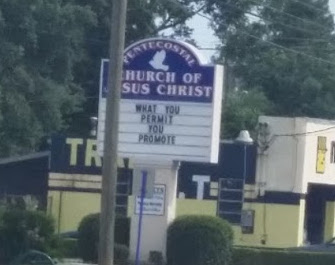
    I was stopped at a light and saw this church sign. Yep! I did! I grabbed my cell phone and took a picture. (It was a long red!)

    what you permit you promoteIt’s nonsense.

    It’s a particularly bad use of the slippery slope argument.

    A free society depends on us permitting things that we do not promote. I permit people to utter nonsense, even in my presence. I do not promote their speech.

    I’m guessing that this was intended to refer to same-sex marriage, as a warning that if we allow it, we must promote it. But permitting and promoting are not the same thing.

    It is, of course, quite possible that we should neither permit nor promote some activities. Murder, for example. But permitting even murder would not be the same thing as promoting it.

    I suppose it’s too much to expect the purveyors of church sign quotes to use the language with any skill. In fact, church signs are a very rich source of really bad quotes.

    But this one just got on my nerves.

    OK. I’m done.

  • Work Glitch and Bible Study

    Something happened on the way to Bible study, and we were unavailable. We apologize profoundly to anyone who showed up. We will resume next Monday night. We’ll announce the topic tomorrow.