
14 ‘My sins were bound like a yoke
Lamentations 1:14 (REB)
tied fast by his own hand;
set upon my neck,
it caused my strength to fail.
The LORD abandoned me to my sins,
and in their grip I could not stand.
I’ve actually been meditating on this verse over the last few weeks while I haven’t been posting. I think it’s rather important. I first thought about sin/sins in the way I’m going to speak of them here when I read Ezekiel 23:49 and several other passages that suggest that what the people suffer is simply their own sins brought back on them.
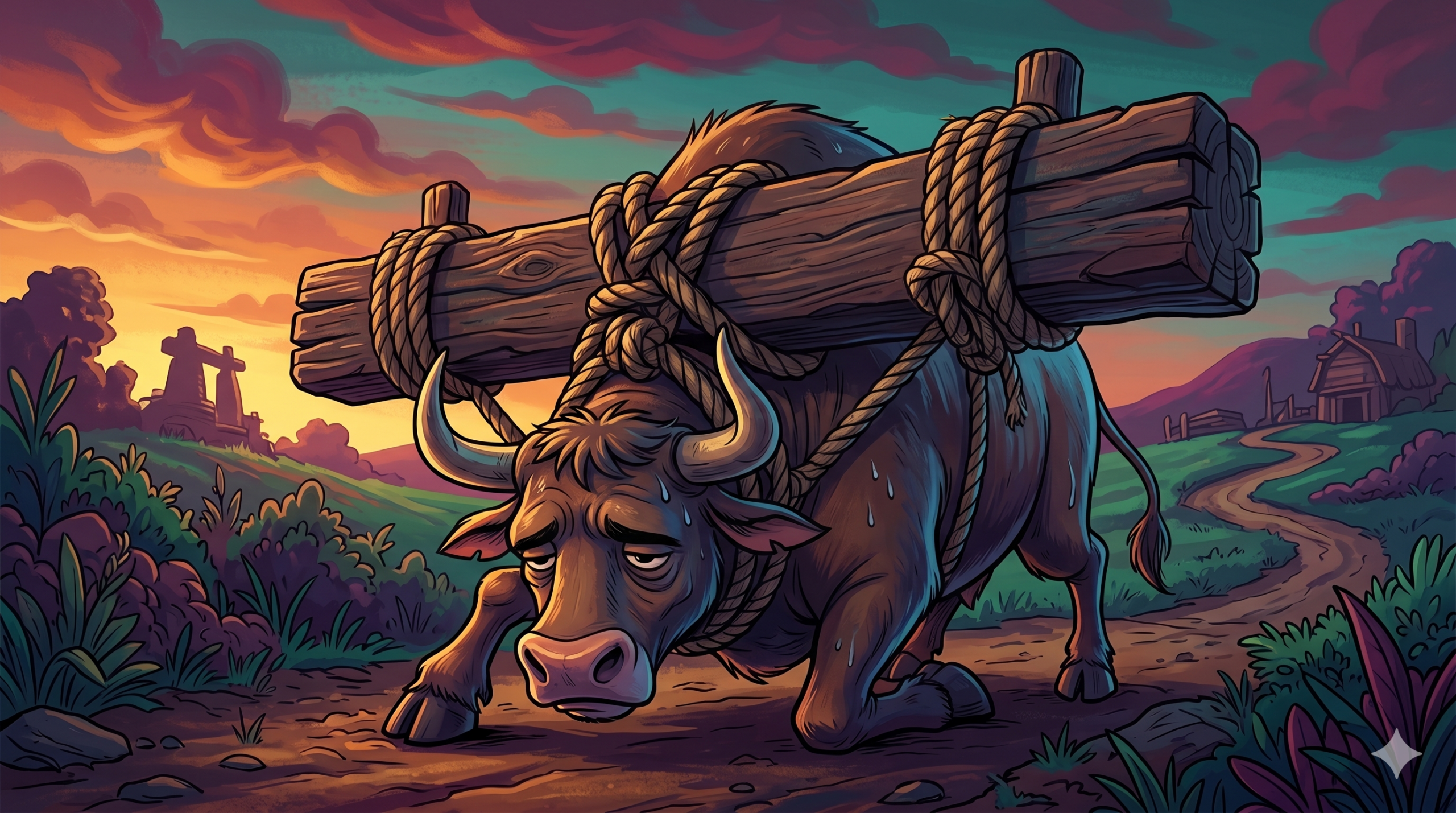
Now this is a more graphic passage, in that we have the imagery of a animal, such as an ox, pulling a load that is secured by a yoke. This is a lamentation, so it’s important to “hear” the poet telling us about living under the yoke.
Frequently we think of sins in the plural, and see them as a sort of list of infractions against ritual or formal rules. We could imagine a workplace where a series of annoying or even stupid rules occur. Since we’re thinking about God, we imagine that we have to check off the boxes because that’s how you get to heaven.
This is not just a mistaken, but an inadequate view in so many ways. When there are suboptimal rules in a workplace, freedom is to be found in finding a better job, thus working in a better environment. You can compare workplaces according to how rewarding they are as a work environment. So you can compare “better” and “worse” workers on a checklist, and “better” and “worse” workplaces in a similar way. Freedom comes by escape to a better place.
But when we talk about “sin” in the biblical place, this is the wrong view. Note here that the sins are bound to the person. The penalty is, in one sense, a complete lack of freedom. The ox cannot escape the yoke, and the lament is that the Israelites were unable to escape the yoke made by their own transgressions. Finally, we have the observation that the punishment here is God abandoning the people to their sins. This is what is causing their strength to fail. It is not some invented judgment or punishment. It is rather the result of their actions.
But this takes us back further to the specific nature of sin, again as displayed in the Bible story. We think generally of making a list of our faults and failings and trying to overcome them. I once had a terrible temper. In fact, I still do. If I overcome that temper, I’ll be that much closer to God, right?
Not so. It’s a good thing to tame one’s temper, but the problem is that that’s just an item checked off the list. It all goes back to the basic rebellion, the desire to be independent of God and of God’s commands. And the gap made by that is great.
We’re not in the workplace, deciding whether we like it, or perhaps that we should move on to a better employer. We’re in God’s universe. The rules are the rules of life. As it says in Deuteronomy 30:15, we’re offered a choice of a way of life and good or death and evil. We don’t have the option of choosing a whole other plan.
This is a great lamentation. We’re abandoned, not to some externally planned torment, but to the results of our own rebellion against the way of life, the way that is life.
The starting point to recovery is simple. It’s coming to the point of sincerely making this lamentation.
Leave a Reply