Threads from Henry's Web

Tag: United Methodist Church

  • Don’t Judge Discipleship by Numbers

    This post is to call your attention to a post by Beth Quick, Mark Driscoll, Mainline Churches, and The Numbers Game (Hat tip: MBWR #82, with strong second to the Best of the Methodist blogosphere! note). I’m also closing the comments here so that any additional discussion will be centered around her blog.

    I want my church to grow. But I also think people can be simply attracted to what is new, flashy, easy, convenient, socially fulfilling. I think some churches, both mainline and other, can grow for wrong reasons too.

    How do we assess growth in discipleship, really? I’m not sure we can do it by the numbers, the stats.

    Go! Read! Think!

  • Free Speech, Gay Rights, and the Bible

    I want to call attention to this post and to the story behind it. An evangelical Christian was arrested in south Wales and charged with using “threatening, abusive or insulting words or behaviour.”

    Ed Brayton said:

    I am obviously a staunch advocate of gay rights, but some of the people who claim to be on the same side need to get something through their skulls: you do not have a right to never encounter the opposition of disapproval of others.

    Very frequently I have to point to problems like this on the other side, i.e. as a Christian I’m busily telling my fellow-Christians that we need to support free speech for everyone, and freedom of religion for everyone. Christians should, for example, be at the forefront of the battle for freedom of religion for Wiccans in the military. We know from both sides the danger of persecution. We’ve been and still are persecuted in parts of the world. We have been, and still are persecutors. We have every reason to know it’s bad.

    I was glad to see several non-Christian posters who support the freedom of speech of this evangelical Christian. My question is will this story simply make evangelical Christians angry about a “homosexual agenda” or will it alert all of us, whatever our persuasion, to the problems of restricting freedom of speech and of expression? I hope it is the latter. We need to keep speech free, or we may be the next target.

  • Squaring the Wesleyan Quadrilateral

    One of the things that originally attracted me to the United Methodist Church was the quadrilateral, in the form in which it is presented in the discipline. Since becoming a member I have found out that most members of United Methodist congregations have no idea what this is, that some members use the quadrilateral to justify just about anything, and that others seem to want to eviscerate it or simply replace it with a more standard “sola scriptura” stance.

    First let me clarify a couple of points. I’m not here trying to figure out what Wesley meant by his comments on the elements of the quadrilateral; I’m simply looking at how I see them functioning today. Second, I’m using “sola scriptura” in the more popular sense that tends to cut the scriptures off from tradition and experience, and to downplay the role of reason in interpretation. I realize that more sophisticated theologians do not make these errors, but in the pews, “Bible alone” tends in this direction. I do believe that both the label and the attached rhetoric have tended toward this imbalance in the pews, so I don’t hold the theological sophisticates guiltless on this point.

    For those who don’t know, the quadrilateral supposes the use of scripture, tradition, experience, and reason in the formation of doctrine. Because many people have driven truckloads of manure through the supposed filter of this method and called it doctrine, others have tried to modify the quadrilateral. One particular explanation is that the quadrilateral is not an equilateral, but that scripture is the longer line. This is a well-intentioned effort to test more United Methodist doctrine by the standards of scripture, but I think it is neither precisely correct, nor is it adequate to the task. In effect, it pushes people toward a “sola scriptura” stance, but doesn’t clarify the position of the other three elements, other than to give them a smaller and subordinate role.

    (more…)

  • Working in your Call

    And YHWH spoke to the fish, and it spit Jonah up on dry land.
    Then YHWH’s word came to Jonah a second time, saying, “Get up! Go to Nineveh! . . . ” — Jonah 2:11-3:2a

    I knew a man who almost got a law degree, but dropped out during the last year of law school. He was incredibly intelligent and creative. He could have done many things. His parents thought a law degree was a good idea so that he could make money and have a respectable profession. Once he dropped out of law school he lived a life of frustration, always “almost getting there” with the things he really wanted to do.

    In secular life and in the church, you can create a life of frustration for yourself by not doing what it is that you’re actually called and gifted to do, something that usually corresponds to what you want to do deep down in your heart. I’m not talking about that desire to go fishing, or to spend your life on the beach and get someone to pay for it, but your genuine desire the accomplish something with your life.

    Too often, the people who are already out there, living their own frustrating lives, take out their frustration on the next generation by telling them that their goals and their dreams are somehow not respectable enough or important enough. We tell the talented musicians, artists, and actors that the church really needs pastors, secretaries, and administrators, and if they want to earn enough money and make it in the world, they need to be doctors, lawyers, or nurses. Sometimes instead we point them to easier paths than they would choose, because we think they can’t make it.

    I don’t mean we don’t need to encourage our young people to count the cost and decide on a realistic basis what they really want to do. I do mean is that we need to let people look inside themselves, listen to God, and choose where it is that they can really be fulfilled and can really make a contribution that counts eternally.

    As a Christian and member of the United Methodist Church, I believe I see this in our church structure. We are overwhelmingly focussed on the offices of the church and church staff positions that are aimed at maintaining what we already have. If we want to see revival in the United Methodist Church, and in the broader Church we need to start recognizing roles other than pastors and our standard staff. We need to have career paths for evangelists, teachers, apostles, and prophets, the other four from the traditional five-fold ministry. But that’s not enough. We also need paths for artists, dramatists, multimedia experts, and internet specialists.

    And when we have all those paths open, we must encourage people to find their call and follow it, and gear up the church membership to support it financially and with their time.

    Business as usual isn’t working now, and it’s not going to start working. For the church to answer God’s call we need members who answer God’s call. We need to let God out of the box, get out of our box, and be ready to affirm and empower others as they apply and share the gospel in the 21st century.

    Avoid the frustration! Get with God’s program!

  • Unity, Diversity, and Confusion

    Recently I wrote a couple of entries, first on diversity and liberalism, and then on the Together for the Gospel statement. The issues I discussed in those two posts raise quite a number of questions about truth, unity, and Christian fellowship. Many might decide from my comments thus far that I don’t care about truth or correct doctrines at all. But that is not the case. “Doctrine” is simply teaching, and we all have some form of teaching. Even the doctrine that correct doctrine is not primary in salvation is itself a doctrine.

    Where are the boundaries where disagreement is permissible or not permissible? How can we tell what is essential and what is not? It’s easy to quote St. Augustine, “In essentials, unity. In non-essentials, liberty. In all things, charity,” but it’s a great deal harder to define precisely what one means. Two sincere people who accept the idea of unity in essentials and liberty in non-essentials can nonetheless get into quite a fight over just what is essential.

    I think we could view the situation as a sort of continuum.

    Unity by Exclusion Unity in diversity Disunity by confusion
    Doctrinal continuum arrow Non-doctrinal

    To the far left of this spectrum (no left-wing/right-wing implications intended), we have those for whom doctrine is central and absolute. I’m seeing the folks who wrote the Together for the Gospel statement I discussed in my post Who’s Together for What?. For them the way to defend the gospel is to be both very clear and detailed on what is truth, make sure people know it, and only respect those who are fully on track as bearers of the gospel. In the center of this continuum we have those who have a small number of essential doctrines on which they require unity, but outside of that boundary diversity is permissible within the community. On the far right of my continuum, we have those who hold nothing, or almost nothing, as essential, and thus have confusion because they are not defined as a community. Even greater confusion results when a community cannot agree on just where they stand.

    Let me provide an illustration from another article I’m working on that looks at the type of people who might be part of such organizations:
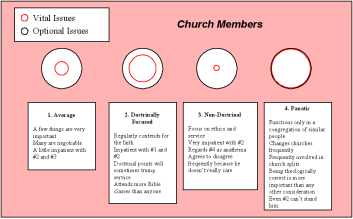
    Church member attitudes toward doctrine and diversity
    Click the image for a larger view

    Churches that attain unity by exclusion tend to have a large number of essential doctrines. These churches tend to split, and the people in them tend to move from church to church looking for a precise match to their desires. I am not saying that such a church cannot practice unit and cannot teach the gospel; merely that it is difficult to maintain unity in that atmosphere.

    I believe the United Methodist Church, of which I’m a member, tends toward the other extreme. We tend to allow diversity in everything and require unity in nothing. We add to that a debate over where we should be allowing diversity, what is essential, and what is not.

    the-methotaku made a great comment on my previous post, Liberalism and Diversity, in which he started to do precisely what I had planned to suggest in this article–define the distinctives of Wesleyan and then United Methodist theology. Go back there and take a look.

    One reason it is often hard to define the essentials is that one can’t define “essential” without asking “essential for what?” Many people are tired of denominationalism, and I am also concerned when denominations promote themselves over Christianity as a whole. I like to call myself a “Christian, who is a member of a United Methodist congregation” rather than “Methodist.” Why? Because my primary identity is Christian. I don’t think John Wesley would have a problem with that.

    But in order to be a community in ministry to the world, I need to become part of a more tightly defined group. Rather than the very small number of doctrines I suggested as a definition for “Christian” I need some additional points that make one “United Methodist” rather than Presbyterian or Pentecostal, for example. When I define such items, I am not saying that these are additions to what makes me a Christian, rather, they define how it is that I am going to live my Christian witness in the world through a community.

    I can cooperate with anyone with whom I can agree on the essentials for that specific mission. That means that if I am dealing with an enterprise that is broadly Christian, I can cooperate with anyone who accepts basic Christianity. When I meet as a member of a congregation for worship, I expect some additional unity, though I still can allow diversity. I could easily form a small group that would share a larger number of “essential” doctrines–essential to our group, that is.

    But in each case I must try to keep these essential doctrines to the minimum required for that particular community. When I engage in charitable activity in general, for example, I don’t need to find people who agree with me doctrinally. All I need is to find people who agree that there is a human need to be filled.

    It is my prayer for the United Methodist church that we’ll reduce confusion by defining what it is that we find essential and learning to live with it. I don’t know where those lines should be drawn. I would suggest two things–they should be as inclusive as possible while allowing us to be defined as a community, and we should not use what defines us as a community to condemn those who choose a different one.